





 President’s Message
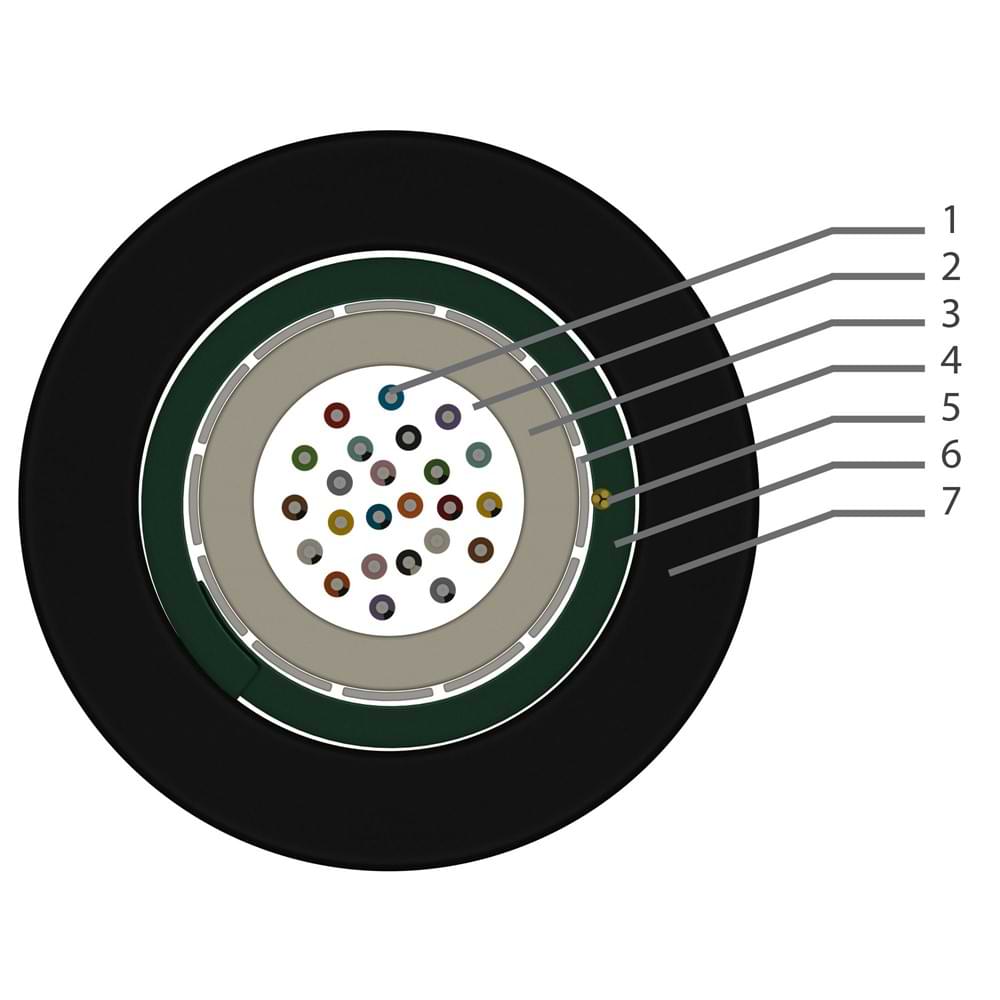
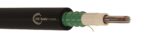

| 1 – Optical fiber core ¹ |
| 2 – Waterproof thixotropic jelly |
| 3 – PBT Tube |
| 4 – Non-metallic strength member (Glass yarn) |
| 5 – Ripcord |
| 6 – Corrugated steel tape |
| 7 – UV resistant polyethylene (HDPE) black outer jacket |
| Part Number | Core Type | Core Count | Tube Count | Tube Diameter (mm) | Cable Diameter (mm) | Cable Weight (kg/km) |
|---|---|---|---|---|---|---|
| 3.205.0.6.1.0900.0.0002 | SM G.652.D | 2 | 1 | 2,8 | 7,5 | 71 |
| 3.205.0.6.1.0900.0.0004 | SM G.652.D | 4 | 1 | 2,8 | 7,5 | 71 |
| 3.205.0.6.1.0900.0.0006 | SM G.652.D | 6 | 1 | 2,8 | 7,5 | 71 |
| 3.205.0.6.1.0900.0.0008 | SM G.652.D | 8 | 1 | 2,8 | 7,5 | 71 |
| 3.205.0.6.1.0900.0.0010 | SM G.652.D | 10 | 1 | 2,8 | 7,5 | 71 |
| 3.205.0.6.1.0900.0.0012 | SM G.652.D | 12 | 1 | 2,8 | 7,5 | 71 |
| 3.205.0.6.1.0900.0.0016 | SM G.652.D | 16 | 1 | 3,8 | 8,7 | 91 |
| 3.205.0.6.1.0900.0.0018 | SM G.652.D | 18 | 1 | 3,8 | 8,7 | 91 |
| 3.205.0.6.1.0900.0.0020 | SM G.652.D | 20 | 1 | 3,8 | 8,7 | 91 |
| 3.205.0.6.1.0900.0.0024 | SM G.652.D | 24 | 1 | 3,8 | 8,7 | 91 |
| Part Number | Core Type | Core Count | Tube Count | Tube Diameter (mm) | Cable Diameter (mm) | Cable Weight (kg/km) |
|---|---|---|---|---|---|---|
| 3.205.0.6.1.0625.0.0002 | OM1 | 2 | 1 | 2,8 | 7,5 | 71 |
| 3.205.0.6.1.0625.0.0004 | OM1 | 4 | 1 | 2,8 | 7,5 | 71 |
| 3.205.0.6.1.0625.0.0006 | OM1 | 6 | 1 | 2,8 | 7,5 | 71 |
| 3.205.0.6.1.0625.0.0008 | OM1 | 8 | 1 | 2,8 | 7,5 | 71 |
| 3.205.0.6.1.0625.0.0012 | OM1 | 12 | 1 | 2,8 | 7,5 | 71 |
| 3.205.0.6.1.0625.0.0016 | OM1 | 16 | 1 | 3,8 | 8,7 | 91 |
| 3.205.0.6.1.0625.0.0020 | OM1 | 20 | 1 | 3,8 | 8,7 | 91 |
| 3.205.0.6.1.0625.0.0024 | OM1 | 24 | 1 | 3,8 | 8,7 | 91 |
| Part Number | Core Type | Core Count | Tube Count | Tube Diameter (mm) | Cable Diameter (mm) | Cable Weight (kg/km) |
|---|---|---|---|---|---|---|
| 3.205.0.6.1.0502.0.0002 | OM2 | 2 | 1 | 2,8 | 7,5 | 71 |
| 3.205.0.6.1.0502.0.0004 | OM2 | 4 | 1 | 2,8 | 7,5 | 71 |
| 3.205.0.6.1.0502.0.0006 | OM2 | 6 | 1 | 2,8 | 7,5 | 71 |
| 3.205.0.6.1.0502.0.0008 | OM2 | 8 | 1 | 2,8 | 7,5 | 71 |
| 3.205.0.6.1.0502.0.0012 | OM2 | 12 | 1 | 2,8 | 7,5 | 71 |
| 3.205.0.6.1.0502.0.0016 | OM2 | 16 | 1 | 3,8 | 8,7 | 91 |
| 3.205.0.6.1.0502.0.0020 | OM2 | 20 | 1 | 3,8 | 8,7 | 91 |
| 3.205.0.6.1.0502.0.0024 | OM2 | 24 | 1 | 3,8 | 8,7 | 91 |
| Part Number | Core Type | Core Count | Tube Count | Tube Diameter (mm) | Cable Diameter (mm) | Cable Weight (kg/km) |
|---|---|---|---|---|---|---|
| 3.205.0.6.1.0503.0.0002 | OM3 | 2 | 1 | 2,8 | 7,5 | 71 |
| 3.205.0.6.1.0503.0.0004 | OM3 | 4 | 1 | 2,8 | 7,5 | 71 |
| 3.205.0.6.1.0503.0.0006 | OM3 | 6 | 1 | 2,8 | 7,5 | 71 |
| 3.205.0.6.1.0503.0.0008 | OM3 | 8 | 1 | 2,8 | 7,5 | 71 |
| 3.205.0.6.1.0503.0.0012 | OM3 | 12 | 1 | 2,8 | 7,5 | 71 |
| 3.205.0.6.1.0503.0.0016 | OM3 | 16 | 1 | 3,8 | 8,7 | 91 |
| 3.205.0.6.1.0503.0.0020 | OM3 | 20 | 1 | 3,8 | 8,7 | 91 |
| 3.205.0.6.1.0503.0.0024 | OM3 | 24 | 1 | 3,8 | 8,7 | 91 |
| Test Standard | Specified Value | Acceptance Criteria | |
|---|---|---|---|
| Maximum Installation Tension ² | IEC 60794-1-2-E1 | 1.0 x W(N), min. 1200 N | Fiber strain ≤ 0.33% |
| Maximum Operation Tension | IEC 60794-1-2-E1 | 0.5 x W(N), min. 600 N | Δα ≤ 0.05 dB, No fiber strain |
| Crush Strength | IEC 60794-1-2-E3 | 1500 N / 100 mm, max. 15 min. | Δα ≤ 0.05 dB, No damage |
| Impact | IEC 60794-1-2-E4 | 10 Nm, 3 impacts, R= 300 mm | Δα ≤ 0.05 dB after the test |
| Torsion | IEC 60794-1-2-E7 | 1 m. 100N, +/- 180°, 10 cycles | Δα ≤ 0.05 dB, No damage |
| Repeated Bending | IEC 60794-1-2-E6 | R=20x D, 100 N, 35 cycles | No damage |
| Bending Radius | IEC 60794-1-2-E11 | R=20x D, 4 turns, 3 cycles | Δα ≤ 0.05 dB, No damage |
| Temperature Cycling | IEC 60794-1-2-F1 | -20°C to +70°C | Δα ≤ 0.05 dB/km |
| Waterproofness | IEC 60794-1-2-F5B | Sample= 3 m, water column= 1 m | No water leakage in 24 hours. |
| Minimum Bending Radius | |
|---|---|
| Operation | 20 x cable Ø |
| Fixed | 15 x cable Ø |
| Temperature Range | |||
|---|---|---|---|
| Storage | 0°C to + 70°C | Installation | -30°C to +60°C |
| Transport | 0°C to + 70°C | Operating | -20°C to +70°C |
| Marking | ETK Kablo – Date of Manufacture – Fiber Count and Type – Length Marking |
|---|---|
| Packing | Wooden drum with protection |
| Delivery Lengths | 2 km, 4 km ± %5 tolerance |
A-D(ZN)(SR)2Y Armored Fiber Optic Cable for Outdoor Networks
ETK Kablo’s A-D(ZN)(SR)2Y Fiber Optic Cable is a metallic armored outdoor fiber cable engineered for high-performance data transmission in harsh environmental conditions. Designed with a central loose tube structure and corrugated steel tape armor, it provides exceptional mechanical protection, rodent resistance, and long-term reliability for direct burial or duct installations.
Construction and Mechanical Protection
The cable features a UV-resistant black polyethylene (PE) outer sheath combined with a corrugated steel tape (SR) layer that protects optical fibers from crushing forces, soil movement, and external impact. Inside, a gel-filled central loose tube seals out moisture and extends fiber lifespan — ensuring consistent performance in underground or high-humidity environments.
Fiber Types and Configurations
The A-D(ZN)(SR)2Y armored fiber cable is available with both singlemode fibers (G.652D, G.657A1/A2) and multimode fibers (OM1, OM2, OM3, OM4, OM5), in configurations from 2 to 48 cores. It offers stable optical performance and low attenuation for long-distance backbone links, campus networks, and telecommunication infrastructure.
Applications and Performance
This armored outdoor fiber optic cable is ideal for regional data backbones, network extensions to remote buildings, industrial sites, and outdoor distribution systems where mechanical protection and rodent resistance are critical. It supports high-speed optical transmission while maintaining signal integrity under heavy loads or soil pressure.
Standards and Quality Assurance
ETK Kablo’s A-D(ZN)(SR)2Y complies with IEC 60794 and EN outdoor cabling standards, ensuring full compatibility with modern fiber-optic network infrastructures. Its armored PE construction provides long service life, mechanical stability, and protection against environmental stress in mission-critical applications.
Why Choose ETK Kablo’s A-D(ZN)(SR)2Y Cable?
Choose ETK Kablo’s A-D(ZN)(SR)2Y Armored Fiber Optic Cable — built for security, durability, and consistent optical performance across demanding outdoor fiber networks.
Frequently Asked Questions about A-D(ZN)(SR)2Y Armored Fiber Optic Cable
What is armoured fiber cable?
Armoured fiber optic cable is a type of optical communication cable reinforced with a metallic protective layer such as corrugated steel tape (SR) or steel wire armor. This layer protects optical fibers against mechanical stress, rodent damage, and crushing forces in outdoor or underground installations, ensuring long-term reliability.
What is OM1, OM2, OM3, and OM4?
OM1, OM2, OM3, and OM4 are classifications of multimode fiber defined by their core size and bandwidth capacity. OM1 (62.5 µm) supports up to 1 Gbps, OM2 (50 µm) up to 10 Gbps, OM3 (laser-optimized) up to 40 Gbps, and OM4 up to 100 Gbps over shorter distances. These fibers are used for data centers and short-range high-speed links.
Where is armored cable not permitted?
Armored fiber cables are not recommended for indoor riser shafts or plenum spaces where non-metallic, halogen-free constructions are required by building codes. In these environments, LSZH or dielectric loose-tube cables should be used instead to meet fire safety standards.
When to use armored fiber cable?
Use armored fiber optic cables like A-D(ZN)(SR)2Y when additional mechanical protection and rodent resistance are needed. They are ideal for direct burial, outdoor conduits, industrial environments, and telecom backbone networks exposed to physical stress or environmental hazards.
What is a loose tube?
A loose tube is a small plastic tube within a fiber optic cable that contains and protects the optical fibers. It is often gel-filled or dry-blocked to prevent water ingress, allowing fibers to move freely inside the tube and remain isolated from external mechanical forces.
What is the difference between loose tube and buffer tube?
Loose-tube cables contain fibers within gel-filled tubes for outdoor use, offering moisture protection and flexibility over long distances. Tight-buffered cables (sometimes called buffer-tube designs) have individually coated fibers, providing easier termination and are used mainly in indoor applications.
What is acceptable loss for single-mode fiber?
Typical optical attenuation for single-mode fiber (G.652D or G.657A1/A2) is about 0.35 dB/km at 1310 nm and 0.22 dB/km at 1550 nm. In practical installations, total system loss should remain below 10 dB including connectors and splices to maintain high-quality transmission.


