





 President’s Message
Cat 6A Data Cable

Cat 6A Cable for 10 Gigabit Ethernet Networks
Cat 6A Cable provides high-performance copper connectivity for 10 Gigabit Ethernet, enterprise networks, data centers, smart buildings and demanding structured cabling systems. ETK Kablo manufactures Category 6A cables in U/UTP, U/FTP, F/FTP and S/FTP constructions together with mechanically protected SWA and SWB designs.
The ETK Kablo Cat 6A portfolio operates with Category 6A transmission requirements through 500 MHz and includes solid-copper constructions with PVC, LSOH and PE jacket options. Buyers can therefore select the screening architecture and material system according to network density, electromagnetic environment, fire requirements and installation conditions.
Cat 6A is designed for 10GBASE-T over full structured-cabling channel distances. However, category alone does not define the complete cable. Conductor size, shielding, alien-crosstalk performance, jacket material, PoE loading and mechanical protection should all form part of the specification.
What Is Cat 6A Cable?
Cat 6A stands for Category 6 Augmented. It extends balanced copper cabling performance to 500 MHz and provides standardized support for 10 Gigabit Ethernet over conventional structured-cabling channel distances.
Compared with Cat 6, Category 6A places greater emphasis on controlling alien crosstalk between neighboring cables. This becomes especially important in high-density installations where many Ethernet cables operate together in bundles and pathways.
Cat 6A is widely used in data centers, enterprise offices, server rooms, smart buildings, high-capacity wireless infrastructure, industrial networks and other applications where 10 GbE capability is required.
ETK Kablo Cat 6A Cable Types
ETK Kablo manufactures four principal Cat 6A screening architectures together with armored constructions.
| Cat 6A Type | Individual Pair Screen | Overall Screen | Typical Selection Logic |
|---|---|---|---|
| U/UTP | None | None | 10 GbE networks in controlled electromagnetic environments |
| U/FTP | Foil around each pair | None | Strong pair isolation without an additional overall metallic screen |
| F/FTP | Foil around each pair | Overall foil | Individual pair protection plus an additional overall foil barrier |
| S/FTP | Foil around each pair | Overall braid | Comprehensive screening for demanding EMI environments |
| Armored | Depends on construction | Depends on construction | 10 GbE routes requiring additional mechanical protection |
Cat 6A U/UTP Cable
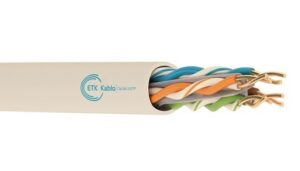
Cat 6A U/UTP Cable contains four unshielded twisted pairs without an overall metallic screen.
ETK Kablo's U/UTP constructions use solid copper conductors, polyethylene insulation and controlled pair geometry designed for Category 6A transmission through 500 MHz.
U/UTP can provide an efficient Cat 6A solution for offices, enterprise buildings and other installations where electromagnetic interference remains controlled.
The ETK Kablo U/UTP range includes PVC, LSOH and PE jacket variants.
Cat 6A U/FTP Cable
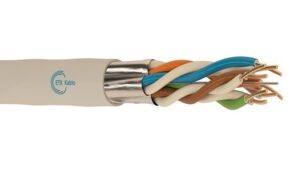
Cat 6A U/FTP Cable places an individual foil screen around each twisted pair while leaving the complete cable core without an additional overall metallic screen.
This architecture provides direct electrical separation around the four data pairs and helps control pair-to-pair crosstalk and external electromagnetic coupling.
U/FTP can provide an effective balance between high screening performance, cable diameter and installation efficiency in dense structured-cabling systems.
ETK Kablo manufactures U/FTP Cat 6A cables with PVC, LSOH and PE outer-jacket options.
Cat 6A F/FTP Cable
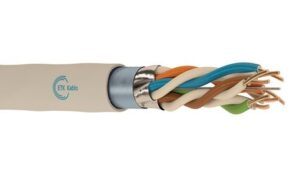
Cat 6A F/FTP Cable combines individually foil-screened twisted pairs with an additional overall foil screen around the complete cable core.
The individual pair screens provide direct separation between data circuits, while the overall foil adds another electromagnetic barrier.
F/FTP can therefore suit high-density structured cabling and electrically demanding environments where the project requires both pair-level screening and an overall foil screen.
The ETK Kablo F/FTP family includes PVC, LSOH and PE jacket versions.
Cat 6A S/FTP Cable
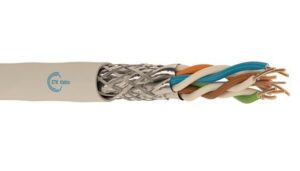
Cat 6A S/FTP Cable combines individually foil-screened pairs with an overall metallic braid.
In ETK Kablo S/FTP constructions, each twisted pair receives an Al/PET foil screen while a tinned copper braid surrounds the complete cable core.
This architecture provides strong protection against electromagnetic interference and alien crosstalk and can be particularly relevant in data centers, industrial networks and other electrically demanding environments.
U/UTP vs U/FTP vs F/FTP vs S/FTP
| Construction | Pair Shielding | Overall Shielding | Main Advantage |
|---|---|---|---|
| U/UTP | None | None | Simple construction and efficient installation |
| U/FTP | Foil | None | Strong pair isolation without an overall metallic screen |
| F/FTP | Foil | Foil | Pair isolation plus an overall foil barrier |
| S/FTP | Foil | Braid | Comprehensive EMI protection with overall braid screening |
The most heavily screened construction is not automatically the best solution for every network. Screening affects cable diameter, flexibility, termination, bonding requirements and cost. The installation environment should determine the appropriate architecture.
F/UTP vs F/FTP Cat 6A Terminology
Cat 6A F/UTP and F/FTP describe different shielding architectures.
F/UTP means one overall foil screen around otherwise unshielded twisted pairs.
F/FTP means each pair is individually foil-screened and an additional overall foil surrounds the cable core.
The ETK Kablo Cat 6A range uses F/FTP for this fully foil-screened construction. Procurement documents should therefore use the exact shielding designation required by the project.
What Does SSTP Mean in Cat 6A Terminology?
SSTP is an informal commercial term sometimes used for highly shielded Ethernet cable.
Modern structured-cabling specifications should preferably use the ISO/IEC screening notation that clearly identifies the overall and individual-pair screens.
For ETK Kablo Cat 6A products, S/FTP describes a construction with an overall braid and individually foil-screened twisted pairs.
23 AWG Solid Copper Cat 6A Cable
Conductor construction is especially important for 10 Gigabit Ethernet and Power over Ethernet applications.
ETK Kablo Cat 6A families use 23 AWG solid copper conductors in their standard four-pair constructions.
Solid copper provides predictable DC resistance and stable transmission characteristics for fixed structured-cabling installations.
Professional buyers should distinguish solid copper from copper-clad conductor products when evaluating 10 GbE, PoE and project-compliance requirements.
500 MHz Cat 6A Performance
Category 6A transmission requirements extend through 500 MHz, twice the nominal category bandwidth of Cat 6.
Important electrical parameters include:
- Insertion loss
- Near-end crosstalk (NEXT)
- Power-sum NEXT
- Return loss
- ACR-F / far-end crosstalk performance
- Propagation characteristics
- Characteristic impedance
- Alien crosstalk performance
The complete installed channel must meet the applicable Category 6A requirements. Cable performance alone cannot compensate for incompatible connectors, poor termination or unsuitable installation practices.
Cat 6A Cable for 10GBASE-T
One of the main reasons to specify Cat 6A is support for 10GBASE-T 10 Gigabit Ethernet over a full conventional structured-cabling channel.
This differentiates Cat 6A from Cat 6, which can support 10GBASE-T over shorter distances under suitable conditions but is not the normal full-distance 10 GbE category.
Cat 6A is therefore particularly relevant for networks where horizontal copper infrastructure must support 10 GbE without shortening the standard channel architecture.
Cat 6A Cable and Alien Crosstalk
Alien crosstalk describes unwanted signal coupling between neighboring cables rather than between pairs inside one cable.
It becomes increasingly important at Cat 6A frequencies because high-density network cables often run closely together in bundles and pathways.
Several factors influence alien-crosstalk performance:
- Cable geometry
- Pair design
- Shielding architecture
- Bundle density
- Installation pathway
- Connector and patch-panel performance
- Field installation quality
Shielded constructions can provide additional isolation, but good installation practice remains important for the complete Cat 6A system.
Cat 6A Cable for Data Centers
Cat 6A is a major copper-cabling option for data centers and technical facilities that use RJ45-based 10GBASE-T connectivity.
Potential applications include:
- 10 GbE server connections
- Network management infrastructure
- Equipment and appliance connections
- High-density rack environments
- Server and network rooms
- Storage and technical networks where copper is specified
U/FTP, F/FTP and S/FTP provide different shielding strategies for these environments. The correct choice depends on cable density, EMI exposure, pathway capacity, grounding philosophy and the overall data-center architecture.
Cat 6A Cable for Wi-Fi Infrastructure
Modern wireless access points can require increasingly high wired uplink capacity and Power over Ethernet.
Cat 6A can provide a strong horizontal cabling platform for high-performance access points where multigigabit Ethernet, high PoE loading or future network expansion form part of the project design.
The cable specification should consider both network bandwidth and remote-powering requirements.
Cat 6A Cable for Power over Ethernet
Power over Ethernet sends electrical power and Ethernet data through the same balanced copper cabling.
As remote-powering requirements increase, cable resistance and heat accumulation become more important, particularly in large bundles.
PoE-oriented Cat 6A selection should consider:
- 23 AWG solid copper conductors
- DC conductor resistance
- Resistance unbalance
- Bundle size
- Ambient temperature
- Pathway ventilation
- Number of energized pairs
- Required PoE level
Shielding type primarily addresses electromagnetic performance and should not replace a proper PoE thermal assessment.
PVC Cat 6A Cable
PVC Cat 6A Cable provides a conventional outer-jacket solution for structured-cabling installations where PVC materials meet the project requirements.
ETK Kablo offers PVC versions across several Cat 6A shielding architectures.
The exact flame-performance and CPR classification should be confirmed from the individual product documentation rather than inferred from the Category 6A designation.
LSOH / LSZH Cat 6A Cable
LSOH Cat 6A Cable uses halogen-free material systems for installations with project-specific smoke and corrosive-gas requirements.
These constructions can be particularly relevant in data centers, airports, hospitals, public buildings and other enclosed environments.
LSOH or LSZH does not mean fire resistant. It describes cable-material behavior during combustion and should not be confused with FE180, PH120 or other circuit-integrity requirements.
Outdoor Cat 6A Cable with PE Jacket
ETK Kablo manufactures outdoor Cat 6A cable variants with UV-resistant polyethylene outer jackets.
PE constructions are available within several Cat 6A shielding families, allowing the network design to combine outdoor environmental protection with U/UTP, U/FTP, F/FTP or S/FTP electrical architecture as applicable.
Outdoor Cat 6A can support:
- Campus networks
- Building-to-building Ethernet links
- Outdoor industrial LAN routes
- External IP surveillance infrastructure
- Outdoor Wi-Fi connectivity
- Technical infrastructure networks
A PE outer jacket should not automatically be interpreted as mechanical armor or aerial support. The exact installation route must match the selected cable construction.
Cat 6A Armored Cable
ETK Kablo also manufactures Cat 6A Armored Data Cable for physically demanding 10 Gigabit Ethernet routes.
The armored range includes:
- Steel Wire Armored (SWA) Data Cable
- Steel Wire Braided (SWB) Data Cable
These reinforcement systems provide additional mechanical protection while the underlying Ethernet construction remains responsible for Category 6A transmission performance.
Mechanical armor and electromagnetic shielding should therefore be specified separately.
SWA vs SWB Cat 6A Cable
| Protection Type | Main Function | General Selection Consideration |
|---|---|---|
| SWA | Steel Wire Armor | Strong mechanical protection for demanding fixed installations |
| SWB | Steel Wire Braid | Braided mechanical reinforcement with a different flexibility profile |
The required mechanical construction should follow installation conditions such as impact risk, cable pathway, bending requirements and physical exposure.
Shielding and Armor Are Different
| Construction Element | Main Purpose |
|---|---|
| Individual Al/PET Pair Foil | Pair isolation and electromagnetic screening |
| Overall Foil | Additional overall electromagnetic barrier |
| Tinned Copper Braid | Overall electromagnetic screening |
| Steel Wire Armor | Mechanical protection |
| Steel Wire Braid | Mechanical reinforcement |
A screened Cat 6A cable is not automatically armored, and an armored Ethernet cable still requires the correct signal-screening architecture where electromagnetic protection is specified.
Cat 6 vs Cat 6A Cable
| Characteristic | Cat 6 | Cat 6A |
|---|---|---|
| Nominal Category Bandwidth | 250 MHz | 500 MHz |
| Gigabit Ethernet | Yes | Yes |
| 10GBASE-T over Full Standard Channel | Not the normal design target | Yes |
| Alien Crosstalk | Less central to category design | Major Cat 6A performance consideration |
| Typical Project Direction | General professional Gigabit networks | Enterprise and high-performance 10 GbE networks |
Cat 6A provides higher transmission performance, but that does not mean every network requires it. Cat 6 can remain appropriate where Gigabit Ethernet satisfies the project requirements.
Cat 6A vs Cat 7 Cable
Cat 6A and Cat 7 can both support 10 Gigabit Ethernet over standard channel distances, but they belong to different structured-cabling performance architectures.
Cat 6A operates through 500 MHz and is available in several screened and unshielded constructions. Cat 7 corresponds to higher-frequency Class F cabling and normally uses highly screened architectures such as S/FTP.
The correct choice therefore depends on project standards, shielding requirements, electromagnetic environment and the complete cabling system rather than simply choosing the higher category number.
Cat 6A Packing Lengths
Cat 6A 500m cable is one of the packing configurations that can be required for structured-cabling projects.
Selected ETK Kablo Cat 6A products include packing options such as 305 m, 500 m and 1000 m depending on the exact construction.
Required packing length should be confirmed during quotation because packaging can differ between shield types, outer jackets and armored versions.
Cat 6A Standards and CPR Requirements
ETK Kablo Cat 6A product documentation references international structured-cabling standards including ISO/IEC and ANSI/TIA requirements according to the individual construction.
The exact applicable standard edition should be confirmed from the selected datasheet and project specification.
CPR reaction-to-fire classification must also be treated separately from Ethernet category. ETK Kablo holds different CPR classifications for specific Cat 6A constructions, so one Euroclass should not automatically be applied to the entire Cat 6A portfolio.
Project buyers should verify the Declaration of Performance for the exact cable being supplied.
How to Specify a Cat 6A Cable
A complete Cat 6A RFQ should define both network performance and the physical cable construction.
| Specification Item | Information to Provide |
|---|---|
| Category | Cat 6A |
| Network Requirement | 10GBASE-T or project-specific Ethernet application |
| Screening | U/UTP, U/FTP, F/FTP or S/FTP |
| Conductor | Solid copper and required AWG / conductor diameter |
| Outer Jacket | PVC, LSOH or PE according to installation |
| Installation Environment | Indoor, outdoor, data center, industrial or other route |
| Mechanical Protection | Standard, SWA or SWB where required |
| PoE Requirement | Required remote-powering application |
| CPR Requirement | Required Euroclass and additional classifications |
| Packing Length | 305 m, 500 m, 1000 m or project-specific requirement where available |
| Documentation | Datasheet, test results, DoP and project documentation |
ETK Kablo Cat 6A Cable Portfolio
| Category | Main Construction Direction |
|---|---|
| Cat 6A U/UTP | Unscreened 10 Gigabit Ethernet cable |
| Cat 6A U/FTP | Individually foil-screened pairs without an overall screen |
| Cat 6A F/FTP | Individually foil-screened pairs with an overall foil screen |
| Cat 6A S/FTP | Individually foil-screened pairs with an overall braid screen |
| Cat 6A Armored | SWA and SWB mechanically protected Cat 6A cable |
PVC, LSOH and PE options are available across applicable ETK Kablo Cat 6A families. Exact conductor, screen, jacket, CPR classification, mechanical protection and packing configuration should be confirmed from the selected product datasheet.
Why Choose ETK Kablo for Cat 6A Cable?
ETK Kablo manufactures Cat 6A cable across several electromagnetic, environmental and mechanical constructions rather than offering one generic 10 Gigabit Ethernet cable.
The portfolio includes U/UTP, U/FTP, F/FTP and S/FTP architectures together with PVC, LSOH and outdoor PE options and mechanically protected SWA and SWB products.
This range allows network contractors, data-center projects, industrial facilities, distributors and infrastructure buyers to select Category 6A performance together with the screening and mechanical design required by the installation.
ETK Kablo can evaluate shielding, conductor construction, jacket material, PoE requirements, CPR classification, mechanical protection, packing length and project documentation together during the quotation process.
Frequently Asked Questions About Cat 6A Cable
What is Cat 6A cable?
Cat 6A is an augmented Category 6 balanced copper cabling system designed for transmission performance through 500 MHz and 10 Gigabit Ethernet over full standard structured-cabling channel distances.
Does Cat 6A support 10 Gbps?
Yes. Cat 6A is designed to support 10GBASE-T 10 Gigabit Ethernet over standard structured-cabling channel distances when the complete installed system meets the applicable requirements.
What frequency is Cat 6A?
Category 6A transmission requirements extend through 500 MHz.
Is Cat 6A usually 23 AWG?
ETK Kablo standard Cat 6A constructions use 23 AWG solid copper conductors.
What is Cat 6A U/UTP?
U/UTP contains unshielded twisted pairs with no overall metallic screen.
What is Cat 6A U/FTP?
U/FTP uses individual foil screens around each twisted pair but no additional overall metallic screen.
What is Cat 6A F/FTP?
F/FTP uses individual foil screens around every twisted pair together with an additional overall foil screen around the complete cable core.
What is Cat 6A S/FTP?
S/FTP uses individually foil-screened pairs together with an overall metallic braid.
Is F/UTP the same as F/FTP?
No. F/UTP has one overall foil around unshielded pairs. F/FTP has individually foil-screened pairs plus an additional overall foil screen.
What does SSTP mean?
SSTP is an informal commercial term sometimes used for highly screened Ethernet cable. The more precise structured-cabling notation should identify the actual construction, such as S/FTP.
Can Cat 6A cable be installed outdoors?
Yes, when the exact construction is designed for outdoor installation. ETK Kablo offers PE-jacketed Cat 6A products across several shielding families.
Does ETK Kablo manufacture armored Cat 6A cable?
Yes. ETK Kablo's Cat 6A range includes Steel Wire Armored and Steel Wire Braided mechanically protected constructions.
Is Cat 6A better than Cat 6?
Cat 6A provides higher category performance, 500 MHz bandwidth and standardized full-distance 10GBASE-T capability. Cat 6 can still be the appropriate choice where Gigabit Ethernet satisfies the project requirements.
What information should I provide when requesting a quotation?
Provide the required shielding type, 10 GbE requirement, conductor specification, PVC/LSOH/PE jacket, indoor or outdoor environment, armor requirement, PoE requirement, CPR classification, packing length, quantity and required project documentation.


