





 President’s Message
Fire Alarm Cables
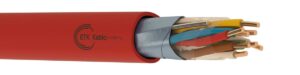
J-Y(St)Y Lg Fire Alarm Cable
SKU:
J-Y(St)Y Lg
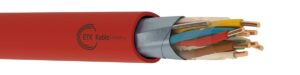
J-H(St)H Lg Fire Alarm Cable
SKU:
J-H(St)H Lg
Fire Alarm Cables | Halogen-Free, Flame-Retardant Safety Wiring Solutions
ETK Kablo’s Fire Alarm Cables are high-performance low-voltage signal transmission cables engineered for fire detection and alarm systems. Designed for environments requiring flame retardancy, low smoke emission, and electromagnetic compatibility (EMC), they ensure uninterrupted signal flow during critical emergency operations.
Our product range includes industry-standard J-H(St)H and J-Y(St)Y constructions, fully compliant with VDE, EN, and IEC standards—ideal for alarm loops, evacuation systems, sensors, and emergency communication lines.
Technical Construction and Design
ETK Kablo fire alarm cables are built with solid bare copper conductors for long-term conductivity and low resistance. Common conductor diameters range between 0.6 mm and 0.8 mm, arranged in twisted pairs to reduce crosstalk and maintain signal integrity across complex networks.
Each conductor is insulated with either halogen-free or PVC compounds based on project requirements. The J-H(St)H series features halogen-free flame-retardant insulation that produces minimal smoke and no corrosive gases, while J-Y(St)Y cables use PVC for cost-effective solutions where halogen-free materials are not mandated.
A collective Al/PET (aluminum-polyester) foil shield with a tinned copper drain wire provides full 100% coverage against EMI/RFI interference. This shielding ensures stable data transmission in power distribution zones, control panels, and mixed electrical environments. Outer sheaths are available in red (J-H(St)H) or grey (J-Y(St)Y), using flame-retardant PVC or halogen-free compounds for enhanced durability.
Signal Integrity and Electromagnetic Protection
In modern fire alarm and evacuation systems, reliable communication between detectors and control panels is critical. ETK Kablo’s shielded cables ensure low attenuation and noise immunity even in high-interference zones. The twisted pair structure maintains balanced impedance, ensuring precise signal transmission in addressable fire alarm systems and intelligent safety networks.
Fire Safety and Material Performance
The J-H(St)H series complies with IEC 60332-1 for flame retardancy, IEC 60754-1/2 for halogen-free content, and IEC 61034 for low smoke emission. These materials limit toxic gas release and ensure visibility during evacuation, while the flexible thermoplastic outer sheath provides easy installation without compromising fire performance.
For standard indoor applications where halogen-free materials are not required, the J-Y(St)Y series provides a robust and economical solution, maintaining essential flame propagation standards under EN 50200 and equivalent norms.
Application Areas and Industries
ETK Kablo’s fire alarm and signal cables are designed for fixed indoor installations in fire-safe environments. Typical applications include:
- Commercial buildings – fire detection, public address (PA), and emergency signaling.
- Hospitals and healthcare facilities – nurse call systems, evacuation triggers, and monitoring networks.
- Tunnels, rail systems, and airports – halogen-free, low-smoke cabling ensuring safe evacuation.
- Factories and data centers – shielded cables maintaining EMC stability during operations.
- Public institutions and educational facilities – integrated with BMS, HVAC, and emergency lighting systems.
Product Range and Options
Available in 2x2x0.8 mm² to 10x2x0.8 mm² constructions, ETK Kablo’s J-H(St)H and J-Y(St)Y cables can be supplied with customized shielding, sheath materials, and CPR ratings.
J-H(St)H models feature halogen-free insulation with collective aluminum shielding and red sheath color.
J-Y(St)Y variants use PVC insulation and grey sheaths, offering cost-effective solutions for general-purpose communication lines.
Quality Assurance and Certification
Manufactured under ISO 9001 certified systems, ETK Kablo’s fire alarm cables undergo rigorous testing for:
- Conductor resistance and insulation integrity
- High-voltage withstand capacity
- Flame retardancy and shielding coverage
- Dimensional and mechanical consistency
Depending on project requirements, cables are supplied with CPR classifications such as Dca s2 d2 a1 or Cca s1b d1 a1, DoP certificates, and CE marking. Comprehensive test reports and technical datasheets are available upon request.
Project Integration and Support
ETK Kablo provides full documentation packages including DoPs, test certificates, and technical drawings to ensure smooth approval in fire audits and inspections.
Our engineering team supports customized fire alarm cabling solutions for integration with BMS systems, PA/VA setups, HVAC control, and emergency cutoff mechanisms.
ETK Kablo’s Fire Alarm Cables combine fire safety, EMC shielding, and electrical reliability—providing secure communication channels when protection of life and property is most critical.
Whether halogen-free J-H(St)H or PVC-based J-Y(St)Y, our cables are trusted in hospitals, high-rises, transport tunnels, and government facilities worldwide.
Fire Alarm Cables — Frequently Asked Questions
What cable is used for fire alarm?
Fire alarm systems typically use fire-resistant, low-smoke zero halogen (LSZH) signal cables such as
J-H(St)H (halogen-free, collectively screened) or J-Y(St)Y (PVC, screened) depending on local code.
These constructions maintain circuit integrity, limit flame spread, and reduce smoke/toxic gases.
What are fire alarm cables made of?
Conductors are usually solid bare copper formed in twisted pairs. Insulation and sheaths are
LSZH halogen-free compounds (for low smoke and zero corrosive gases) or PVC where permitted.
Many designs add an Al/PET foil screen with a tinned-copper drain wire for EMC protection; some use
mica/fire-barrier tapes to improve survival at high temperatures.
What is FP200 cable?
FP200 is a common UK designation for a fire-resistant LSZH signal/power cable used in life-safety systems
(e.g., fire alarms, emergency lighting). It typically combines heat-resistant insulation (often XLPE with fire-barrier tape)
and an LSZH sheath to maintain operation during fire. Exact construction varies by manufacturer and standard.
Can I use regular cable for a fire alarm?
Generally no. Most building codes require certified fire-resistant, low-smoke cables for fire alarm circuits
(e.g., J-H(St)H/CPR-rated in the EU, or listed fire alarm cable types like FPL/FPLR/FPLP in the US). Using non-rated
“regular” cable risks code violations and loss of system integrity during fire.
What is FP400 cable?
FP400 is a UK term for a fire-resistant armoured power cable (often LSZH sheathed, with a fire-barrier and
steel wire armour) used to feed life-safety circuits where mechanical protection is required. It provides circuit
integrity under fire plus robust impact and crush resistance. Exact specs depend on the manufacturer/standard.
What cable for smoke alarm?
For mains-interlinked smoke/heat alarms, use a fire-resistant LSZH cable sized to local code (often 2-core or 3-core,
300/500 V) and certified to the applicable standard (e.g., CPR class in the EU, listed fire alarm cable in the US).
For panel-based systems, use the same J-H(St)H or equivalent fire-alarm cable used elsewhere on the loop.


