





 President’s Message
Blog
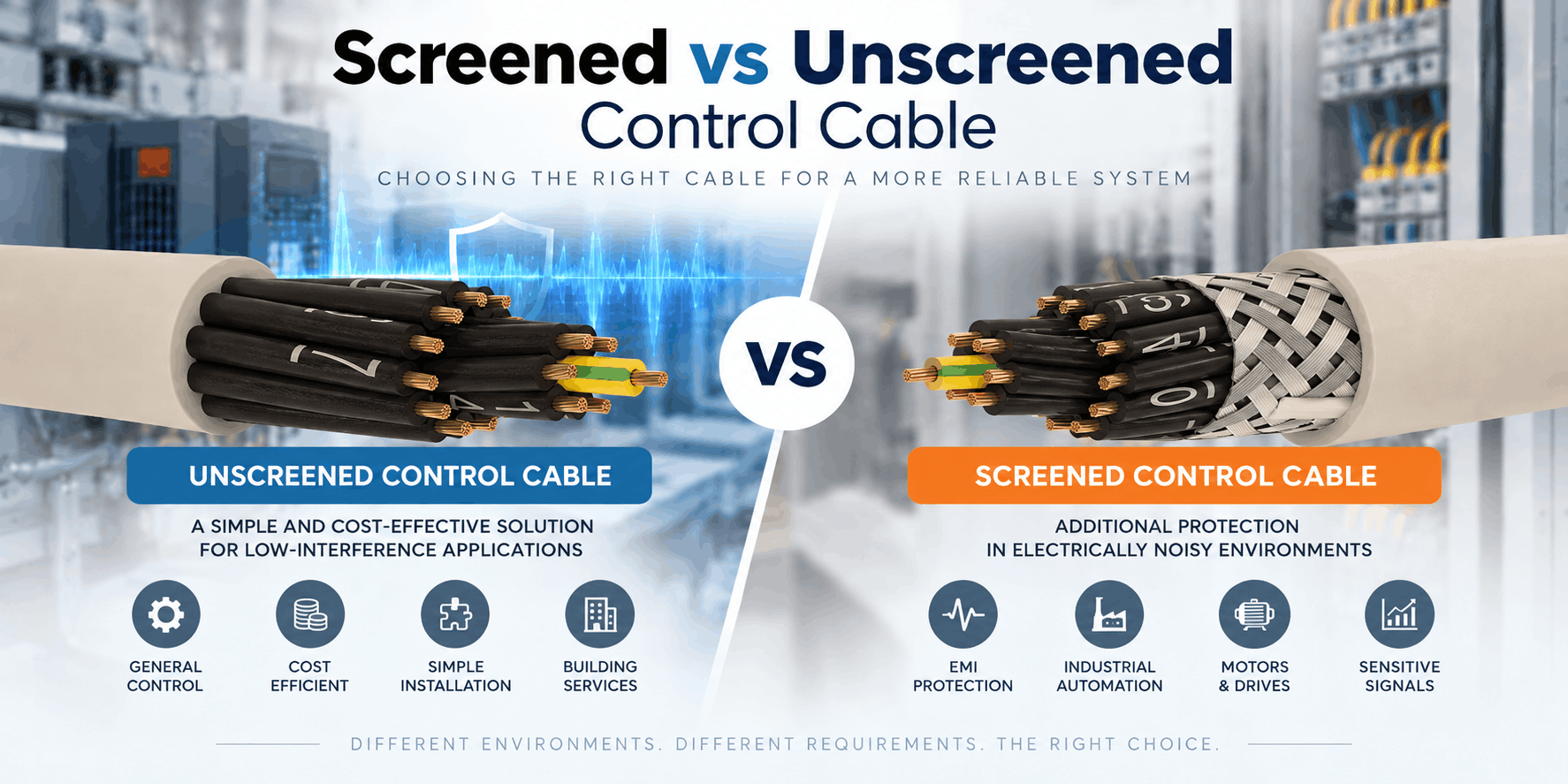
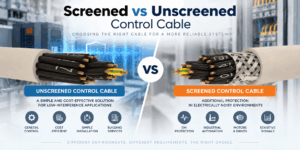
Screened vs Unscreened Control Cable: What Is the Difference?
Reading Time: 16 minutes
Control cable shielding is one of the most important design decisions when selecting cable for industrial automation, machinery, building services and process-control circuits. A screened control cable can reduce the effect of electromagnetic interference on sensitive signals, while an unscreened control cable can provide a simpler, smaller and more economical solution where electrical noise is limited.
However, screening should not be selected automatically. Adding a metallic screen changes cable diameter, weight, flexibility, termination requirements and cost. Meanwhile, an unscreened cable is not technically inferior when the electromagnetic environment and connected circuit do not require additional protection.
For example, a straightforward relay or contactor circuit installed away from significant interference sources can often use an unscreened multicore control cable. By contrast, analogue feedback, encoder-related circuits or control wiring routed near motors and variable-frequency drives can benefit from a screened construction.
Therefore, the correct question is not simply whether screened cable is “better.” The correct question is whether the circuit, signal level, electromagnetic environment and project specification justify the additional screen.
Quick answer: screened control cable contains a conductive layer such as aluminium/polyester foil, copper braid or a combination of screening elements to reduce electromagnetic interference. Unscreened control cable does not contain this additional metallic screen. Screened cable is generally preferred for electrically noisy environments and sensitive control signals, while unscreened cable can be suitable for conventional control circuits where EMI risk is low.
Control Cable Shielding at a Glance
| Characteristic | Screened Control Cable | Unscreened Control Cable |
|---|---|---|
| EMI protection | Higher | Lower |
| Metallic screen | Yes | No |
| Typical screen | Foil, copper braid or combined screen | Not applicable |
| Cable diameter | Usually larger | Usually smaller |
| Weight | Usually higher | Usually lower |
| Flexibility | Can be reduced depending on screen design | Often higher for equivalent core construction |
| Termination | Screen must be considered | Simpler |
| Typical environment | Electrically noisy | Low-interference environment |
| Typical applications | Sensitive control, feedback, automation | General command and switching circuits |
| Relative cost | Generally higher | Generally lower |
Consequently, neither construction is universally superior. The correct option depends on what the circuit carries and where the cable operates.
What Is an Unscreened Control Cable?
An unscreened control cable contains insulated conductors assembled beneath the outer sheath without an additional conductive screen surrounding the cable core.
Typical construction can include:
- Flexible copper conductors
- PVC or halogen-free insulation
- Layered multicore assembly
- Fillers where required
- Outer sheath
Because the construction contains fewer layers, an unscreened cable can offer a compact and economical solution for many ordinary automation circuits.
For instance, ETK control cable families such as YSLY and HSLH provide unscreened options for appropriate general control applications.
However, the absence of screening means the cable relies primarily on circuit design, physical separation and the surrounding electromagnetic environment rather than a dedicated metallic barrier against interference.
What Is a Screened Control Cable?
A screened control cable includes one or more conductive layers around the cable core or around selected conductors.
The screen can use:
- Aluminium/polyester foil
- Tinned copper braid
- Bare copper braid
- Foil combined with braid
- Other project-specific conductive constructions
Depending on cable design, a drain wire can also be included to provide electrical continuity with a foil screen.
Therefore, screened control cable adds an engineered electromagnetic protection layer rather than merely another mechanical component.
What Does Control Cable Shielding Actually Do?
Control cable shielding helps reduce the coupling of unwanted electromagnetic energy into or out of the cable.
Potential interference can originate from:
- Electric motors
- Variable-frequency drives
- Power cables
- Transformers
- Contactors
- Switchgear
- High-current conductors
- Switch-mode power supplies
- Industrial machinery
When unwanted electrical energy couples into a control circuit, it can create induced voltages or distort sensitive signals.
As a result, equipment can experience unstable measurements, incorrect feedback or communication disturbances depending on the circuit.
Screening therefore provides an additional path and electromagnetic barrier that helps reduce these unwanted effects when incorporated correctly into the overall system design.
What Is Electromagnetic Interference?
Electromagnetic interference, commonly abbreviated as EMI, describes unwanted electromagnetic energy that affects the operation of an electrical or electronic circuit.
Industrial facilities contain many potential EMI sources because power and control equipment frequently operate close together.
For example, rapid switching inside a variable-frequency drive can generate high-frequency electromagnetic disturbances. Likewise, motors and contactors can create transient electrical events.
Consequently, control circuits carrying relatively small signals can be more vulnerable than robust switching circuits.
Screened vs Unscreened Cable in Low-Noise Environments
An unscreened cable can be entirely appropriate when electromagnetic interference is limited.
Typical examples can include:
- Relay commands
- Contactor control
- Simple on/off circuits
- Auxiliary contacts
- Basic machine controls
- Control-panel wiring
In addition, cables routed away from high-current power systems can face significantly lower electromagnetic stress.
Therefore, adding screening in every low-noise application can increase material, cable size and cost without providing meaningful system benefit.
Control Cable Shielding in High-Noise Environments
Control cable shielding becomes more valuable when control circuits operate close to significant EMI sources.
For example, screened cable can be considered when routes pass near:
- VFD-controlled motors
- Servo drives
- Large motors
- Power distribution cables
- Transformers
- Welding equipment
- Heavy industrial machinery
Meanwhile, signal sensitivity also matters. A circuit carrying a low-level analogue measurement can require greater interference protection than a simple relay coil command.
Consequently, both the surrounding environment and the nature of the signal should influence the screening decision.
Signal Level Matters
Not every control circuit responds to electromagnetic interference in the same way.
A high-level discrete signal can tolerate more induced noise than a low-level analogue measurement.
For example, sensitive circuits can include:
- Analogue feedback
- Low-voltage sensors
- Encoder signals
- Measurement circuits
- Precision feedback systems
By contrast, straightforward digital switching or relay functions may be much less sensitive.
Therefore, cable selection should consider signal amplitude and required measurement accuracy rather than only the physical location of the cable.
Screened Control Cable vs Instrumentation Cable
A screened control cable should not automatically be treated as instrumentation cable.
Although both can use metallic screening, the internal construction and intended signal requirements can differ substantially.
Instrumentation cable commonly uses twisted pairs or triads for analogue measurement and process signals.
Control cable, meanwhile, often uses multiple cores intended for command, switching and automation functions.
Consequently, adding a screen to a multicore control cable does not transform it into an individually paired instrumentation construction.
Overall Screen vs Individual Screens
A cable can be screened in several ways.
An overall screen surrounds the complete cable core.
By comparison, an individual screen surrounds a particular pair, triad or group of conductors.
Overall screening is common in multicore control cables because it provides collective protection from external interference.
Individual screening can be useful when separate low-level circuits must also be protected from interaction with each other.
Therefore, project engineers should not treat the word “screened” as a complete description of screen architecture.
Foil-Screened Control Cable
Aluminium/polyester foil provides high screen coverage around the cable core while adding relatively little thickness.
A foil screen is commonly used together with a drain wire.
Advantages can include:
- High coverage
- Compact construction
- Low additional weight
- Effective electrostatic screening
However, foil is mechanically different from a woven copper braid.
Accordingly, the appropriate screen type depends on the intended cable flexibility, frequency range and electromagnetic environment.
Copper Braid Screen
A copper braid consists of many conductive wires woven around the cable core.
Tinned copper is frequently used because the tin coating can support corrosion resistance and processing.
Copper braid can provide:
- Good electrical conductivity
- Mechanical flexibility
- Effective electromagnetic screening
- Robust screen continuity
Meanwhile, braid coverage is inherently different from the near-continuous physical coverage achievable with foil.
Therefore, screen performance cannot be evaluated solely by asking whether a cable contains copper braid.
Foil and Braid Combined
Some control cable constructions combine foil and copper braid.
In this arrangement, the two screening layers can complement each other.
For example, foil can provide extensive surface coverage, while copper braid can provide a low-resistance conductive screen with good mechanical properties.
Consequently, combined screening can be useful in more demanding EMC environments.
However, additional layers also increase cable diameter, weight and manufacturing cost.
Control Cable Shielding vs Armour
Control cable shielding and mechanical armour serve different purposes.
A metallic screen is primarily intended to manage electromagnetic interference.
Armour is primarily intended to provide mechanical protection.
Possible armour systems can include:
- Steel wire armour
- Steel wire braid
- Metallic tape armour
Therefore, SWA or SWB should not automatically be described as an EMC screen even though they contain metal.
Likewise, a copper screen should not be assumed to provide the mechanical protection of purpose-designed armour.
Screening Does Not Replace Mechanical Protection
A screened cable can still be mechanically vulnerable.
For example, thin foil screening can protect against electromagnetic disturbance while providing little resistance to crushing or impact.
Meanwhile, a heavily armored cable can provide substantial mechanical protection without being optimized as a sensitive-signal screen.
Consequently, mechanical and electromagnetic requirements should be specified independently.
YSLY as an Unscreened Control Cable
YSLY is widely used as a flexible unscreened PVC control cable for general automation and machinery circuits.
Typical characteristics can include:
- Flexible copper conductors
- Multicore construction
- PVC insulation
- PVC outer sheath
- No overall electromagnetic screen
Therefore, YSLY can be suitable where the control function does not require additional EMI protection.
However, exact voltage rating, conductor construction and materials should always be confirmed from the specific product datasheet.
YSLYCY as a Screened Control Cable
YSLYCY belongs to screened control-cable constructions intended for applications requiring additional protection against electromagnetic interference.
Depending on the exact cable design, the screen system can incorporate conductive braid and other screening elements.
As a result, YSLYCY can be selected for automation and control circuits operating in electrically noisier environments.
Nevertheless, the presence of a screen does not mean that every sensitive communication protocol can use YSLYCY. Protocol-specific cables can require controlled pair geometry, impedance or capacitance beyond conventional control-cable requirements.
YSLY vs YSLYCY
The essential difference between YSLY and YSLYCY is the additional electromagnetic screening system in the screened construction.
In simplified terms:
- YSLY → unscreened flexible control cable
- YSLYCY → screened flexible control cable
However, product selection should also consider conductor count, cross-section, voltage rating, sheath material and installation conditions.
Therefore, the decision should not be made only by comparing the product designation.
Where YSLCY Fits
YSLCY is another screened control-cable designation found in industrial automation applications.
Its exact screen and internal construction should be checked against the relevant manufacturer’s datasheet.
For that reason, buyers should avoid assuming that every cable containing “C” or “CY” in its designation uses an identical screen architecture.
Instead, construction tables should identify whether the cable uses braid, foil, combined screening or another arrangement.
Halogen-Free Unscreened Control Cable
Control cable shielding and sheath material are independent design decisions.
For example, HSLH provides a halogen-free unscreened control-cable option for appropriate applications.
This can be useful where:
- Low smoke is required
- Halogen-free materials are specified
- EMI risk is limited
- Additional screening is unnecessary
Therefore, choosing LSZH construction does not automatically mean that the cable must also be screened.
Halogen-Free Screened Control Cable
Halogen-free screened control cables combine electromagnetic protection with LSZH material characteristics.
Depending on ETK cable family and construction, examples can include HSLCH or HSLHCH variants.
These cables can be relevant in:
- Airports
- Hospitals
- Public buildings
- Transport infrastructure
- Data centers
- Industrial facilities
However, LSZH characteristics and electromagnetic screening remain separate performance properties.
Consequently, each requirement should be specified individually.
Control Cable Shielding Near Variable-Frequency Drives
Control cable shielding deserves particular attention around variable-frequency drives.
VFDs switch power electronically at high speed and can create substantial electromagnetic disturbance.
As a result, nearby sensitive control and measurement circuits can experience induced noise if cable construction and routing are unsuitable.
Screened control cable can therefore provide additional protection for appropriate circuits operating in these environments.
Nevertheless, cable screening works as part of a broader EMC system that also includes equipment design, routing, bonding and installation practices.
Control Cable Shielding Near Motors
Electric motors can also create challenging electromagnetic conditions, especially when controlled electronically.
For example, feedback and control wiring can run through the same machinery zone as motor feeders and switching equipment.
Therefore, screened cable can be beneficial where sensitive control signals operate in close proximity to motor circuits.
By contrast, control wiring located remotely from the motor-power path can require less electromagnetic protection.
Control Panels and Screening
Control panels often contain power and signal circuits in a compact space.
Potential noise sources can include:
- Contactors
- Power supplies
- Drives
- Relays
- Transformers
- High-current conductors
Accordingly, screened control cable can be useful when sensitive external signals enter or leave a panel containing significant electrical noise.
However, ordinary relay and auxiliary wiring may still use unscreened cable where the system design permits it.
Screened Control Cable for Analogue Signals
Analogue signals can be sensitive because interference directly affects the measured electrical value.
Examples can include:
- 0–10 V
- 4–20 mA
- Low-voltage feedback
- Sensor outputs
In addition, long cable runs can increase exposure to surrounding electromagnetic fields.
Therefore, screening is frequently considered for analogue control circuits.
However, instrumentation cable can be more appropriate than conventional multicore control cable when the application requires dedicated twisted pairs or individually screened elements.
Screened Control Cable for Encoder and Feedback Circuits
Position and speed feedback can require strong signal integrity.
For example, encoders can generate rapidly changing signals that are vulnerable to noise in industrial machinery environments.
Consequently, screened cable is commonly considered for these circuits.
Nevertheless, the encoder manufacturer can specify a dedicated cable geometry, conductor arrangement or characteristic impedance.
Therefore, a generic screened control cable should not automatically replace a purpose-designed encoder cable.
Unscreened Cable for Relay and Contactor Circuits
Relay and contactor control circuits often use relatively robust switching signals.
As a result, unscreened multicore control cable can be an efficient solution where the electromagnetic environment is not unusually severe.
Moreover, avoiding unnecessary screen layers can reduce cable diameter and simplify the overall construction.
Therefore, screening should not be added merely because a cable is installed in an industrial facility.
Does Screened Cable Always Perform Better?
No.
Screened cable offers additional electromagnetic protection, but that does not make it the correct choice for every circuit.
For example, unnecessary shielding can result in:
- Larger cable diameter
- Higher weight
- Higher material cost
- Additional termination considerations
- Reduced flexibility in some constructions
Consequently, the objective is appropriate protection rather than maximum construction complexity.
Does Unscreened Cable Mean Low Quality?
No.
An unscreened control cable can be manufactured to the same conductor, insulation, mechanical and fire-performance quality expectations as a screened version.
The difference is functional.
One construction includes an electromagnetic screen, while the other does not.
Therefore, an unscreened cable selected correctly for a low-EMI application is not a lower-quality solution.
How Screen Type Affects Flexibility
Screen construction can influence how a cable bends and handles.
For example, a dense copper braid introduces additional metallic material around the core.
Meanwhile, foil can add less bulk but has different mechanical behaviour.
Combined screens can create an even more substantial cable structure.
Consequently, engineers should compare bending radius and overall diameter rather than assuming all screened cables behave identically.
How Screening Affects Cable Diameter
Adding a screen usually adds material around the cable core.
The increase can result from:
- Screen tape
- Copper braid
- Drain wire
- Separator layers
- Inner sheath
Therefore, the screened version of a cable family can have a greater overall diameter than a comparable unscreened version.
This difference can affect glands, conduits, cable trays and machinery routing.
How Screening Affects Cable Weight
Copper screening can add meaningful mass, especially in larger multicore cables.
As conductor count and diameter increase, the quantity of braid or other screen material can also increase.
Consequently, screened cables can weigh more per kilometre than comparable unscreened constructions.
For large projects, the difference can influence drum size, transportation and handling considerations.
Screening and Fire Performance Are Separate
A metallic screen does not establish fire performance.
Likewise, an unscreened cable is not automatically less flame retardant.
Fire characteristics depend on elements such as:
- Insulation compound
- Outer sheath compound
- Fillers
- Cable construction
- Applicable test performance
Therefore, control cable shielding, LSZH construction, flame retardancy and CPR classification should be evaluated separately.
PVC Screened vs Unscreened Control Cable
PVC constructions can exist in both screened and unscreened cable families.
For example:
- YSLY → unscreened PVC control cable
- YSLYCY → screened PVC control cable family
Consequently, PVC does not indicate whether a cable is screened.
The product construction must identify the actual electromagnetic screen.
LSZH Screened vs Unscreened Control Cable
The same principle applies to halogen-free control cables.
An LSZH control cable can be either screened or unscreened.
For example, HSLH can provide an unscreened halogen-free construction, while screened HSL-family variants can provide additional electromagnetic protection.
Therefore, material fire characteristics and EMC characteristics remain separate selection criteria.
Control Cable Shielding and CPR Classification
Control cable shielding does not determine the cable’s CPR Euroclass.
Depending on the product and certification, screened and unscreened cables can be designed for classes such as:
- B2ca
- Cca
- Dca
- Eca
Meanwhile, supplementary classifications can address smoke, flaming droplets and acidity.
Consequently, a project requiring both electromagnetic screening and a specific CPR class must state both requirements.
Current IEC Standards for Screened and Unscreened Control Cable
IEC standards also recognize both screened and unscreened flexible control-cable constructions.
The current IEC 60227-7:2024 specifically covers flexible PVC-insulated screened and unscreened cables with two or more conductors and rated voltages up to and including 300/500 V within its scope.
In addition, conductor requirements can reference IEC 60228:2023 where applicable to the cable design.
Therefore, screening is a cable-construction option within established control-cable frameworks rather than an informal aftermarket feature.
IEC 60228 and Flexible Conductors
IEC 60228:2023 defines standardized conductor requirements for many insulated electric cables, including flexible copper conductors.
Control cables frequently use Class 5 flexible copper construction because it provides convenient handling and routing in automation systems.
However, conductor class and screening are separate characteristics.
Consequently, both screened and unscreened control cables can use flexible Class 5 copper conductors where the applicable product design permits it.
Flame Propagation and Control Cables
Where flame-retardant performance is required, the finished cable can be tested according to the applicable fire standard.
IEC 60332-1-2:2025 is the current IEC method for vertical flame propagation on a single insulated wire or cable using a 1 kW premixed flame.
However, passing this flame test does not indicate whether the cable contains an electromagnetic screen.
Therefore, flame propagation and control cable shielding should remain separate entries in the technical specification.
Screened vs Unscreened Control Cable for BMS
Building Management Systems can contain conventional control circuits alongside KNX, BACnet, Modbus and Ethernet networks.
For ordinary control outputs, screened or unscreened multicore cable can be selected according to the circuit and electromagnetic environment.
However, protocol-specific networks should use cable constructions appropriate to their physical layer.
For example, a screened multicore control cable should not automatically replace a purpose-designed RS-485 or KNX cable.
Consequently, BMS cable selection should begin with the protocol before considering screening.
Screened vs Unscreened Cable for Industrial Automation
Industrial automation contains both high-noise equipment and relatively robust control circuits.
As a result, the same production line can legitimately contain both screened and unscreened control cables.
Screened constructions can serve noise-sensitive feedback and control functions.
Meanwhile, unscreened constructions can serve conventional commands and auxiliary circuits.
Therefore, specifying only one control-cable type across an entire plant can be unnecessarily restrictive.
Screened vs Unscreened Cable for Machinery
Machine builders often need to balance electromagnetic compatibility, flexibility, dimensions and cost.
For example, compact equipment can contain motors, drives, sensors and relays in a relatively small physical area.
Accordingly, selected sensitive circuits can benefit from screening.
However, many auxiliary control circuits can still use unscreened cable.
Consequently, machine cable schedules should distinguish circuits by function rather than applying screening universally.
Common Control Cable Shielding Mistakes
1. Assuming Screened Cable Is Always Better
Additional screening is useful only when the application benefits from EMI protection.
2. Using Unscreened Cable Beside Major Noise Sources Without Review
Sensitive circuits can require greater electromagnetic protection around motors, drives and power equipment.
3. Treating Screening and Armour as the Same Thing
EMC screening and mechanical protection have different functions.
4. Assuming Any Metallic Layer Is an Effective Screen
Material, coverage, conductivity and system design all matter.
5. Ignoring Screen Construction
Foil, braid and combined screens have different characteristics.
6. Selecting by Product Code Alone
Always confirm the actual construction from the technical datasheet.
7. Assuming Screened Control Cable Is Instrumentation Cable
Instrumentation cable can require dedicated twisted pairs or triads.
8. Using Control Cable for a Protocol-Specific Bus
KNX, RS-485 and other systems can require controlled transmission characteristics.
9. Assuming LSZH Means Screened
Halogen-free material construction does not establish electromagnetic screening.
10. Assuming Screening Determines CPR Class
Reaction-to-fire classification is a separate cable characteristic.
11. Ignoring Cable Diameter
Screening can increase the outside diameter of a cable.
12. Ignoring Cable Weight
Copper screens can add significant mass on large multicore cables.
13. Ignoring Bending Radius
Additional screen layers can affect cable flexibility and handling.
14. Using Maximum Screening for Every Circuit
Over-specification can increase cost without improving the intended control function.
15. Comparing Screened and Unscreened Cables with Different Core Designs
A fair comparison should use technically equivalent conductor counts, sizes and materials.
How to Choose Screened vs Unscreened Control Cable
Step 1: Identify the Circuit Function
Determine whether the cable carries switching commands, analogue measurements, feedback or another control function.
Step 2: Assess Signal Sensitivity
Low-level and precision signals generally deserve greater attention to electromagnetic interference.
Step 3: Identify Nearby Noise Sources
Check for motors, VFDs, transformers, power cables and other high-noise equipment.
Step 4: Review the Equipment Requirements
Confirm whether the connected device manufacturer specifies screened cable or another particular construction.
Step 5: Choose the Screen Type
Where screening is required, evaluate foil, braid or combined constructions according to project requirements.
Step 6: Confirm Conductor Size
Select the appropriate cross-section based on electrical and circuit requirements.
Step 7: Check Core Count
Provide sufficient cores for all required commands and auxiliary functions.
Step 8: Select PVC or LSZH
Choose the insulation and sheath system according to environmental and fire requirements.
Step 9: Check CPR Requirements
Specify the necessary reaction-to-fire classification where applicable.
Step 10: Review Mechanical Requirements
Consider flexibility, bending radius, abrasion and mechanical protection independently of screening.
Step 11: Check the Installation Environment
Review temperature, moisture, UV exposure, oils and industrial chemicals where relevant.
Step 12: Compare Equivalent Cable Constructions
Finally, compare screened and unscreened products only after confirming that the remaining technical parameters are equivalent.
What Should Buyers Include in a Control Cable RFQ?
A professional RFQ should describe why control cable shielding is required rather than simply requesting “screened cable.”
Useful information includes:
- Application
- Circuit function
- Number of cores
- Conductor cross-section
- Conductor class
- Rated voltage
- Screened or unscreened requirement
- Foil screen where required
- Copper braid where required
- Combined screen where required
- Drain wire where required
- PVC or LSZH materials
- CPR class
- Flame-propagation requirement
- Operating temperature
- Minimum bending radius
- UV resistance
- Oil resistance where applicable
- Mechanical protection
- Required standards
- Project-specific documentation
Consequently, manufacturers can propose technically equivalent products rather than interpreting “screened control cable” differently.
ETK Kablo Screened and Unscreened Control Cables
ETK Kablo manufactures both screened and unscreened control cable constructions for industrial automation, machinery, building services and infrastructure applications.
Unscreened product families include solutions such as:
- YSLY
- HSLH
- Other project-specific multicore control cables
Meanwhile, screened control cable families include constructions such as:
- YSLCY
- YSLYCY
- YSL(St)CY
- HSLCH
- HSLHCH
- Other project-specific screened variants
Depending on product family, screening can use foil, tinned copper braid or combined systems.
In addition, ETK can provide PVC and halogen-free control-cable constructions according to project requirements.
Therefore, ETK approaches control cable shielding as an application-specific engineering decision rather than assuming that every automation circuit requires the same screen construction.
Frequently Asked Questions About Control Cable Shielding
What is the difference between screened and unscreened control cable?
Screened cable contains a conductive layer intended to reduce electromagnetic interference. Unscreened cable does not contain this additional electromagnetic screen.
When should screened control cable be used?
Screened cable can be useful for sensitive control and feedback circuits operating in electrically noisy environments.
When is unscreened control cable suitable?
Unscreened cable can be suitable for conventional control circuits where electromagnetic interference is limited and the connected equipment does not require screening.
Is screened cable always better?
No. Screening adds electromagnetic protection but can also increase cable size, weight, complexity and cost.
Does screened cable eliminate all EMI?
No. Cable screening forms one part of the complete EMC design, which also includes equipment, routing, bonding and installation conditions.
What is a foil screen?
A foil screen commonly uses aluminium laminated to polymer film around the cable core and can be combined with a drain wire.
What is a copper braid screen?
A copper braid uses woven conductive copper wires around the cable core to provide electromagnetic screening.
Is foil better than copper braid?
Not universally. Each construction offers different electromagnetic and mechanical characteristics.
Can foil and braid be used together?
Yes. Some cable constructions combine both screen types for more demanding electromagnetic environments.
Is control cable shielding the same as armour?
No. Screening primarily addresses electromagnetic interference, while armour primarily provides mechanical protection.
Is YSLY screened?
YSLY is generally an unscreened flexible control cable construction.
Is YSLYCY screened?
Yes. YSLYCY belongs to screened flexible control-cable constructions.
Is HSLH screened?
HSLH is generally an unscreened halogen-free control cable construction.
Can LSZH control cable be screened?
Yes. Halogen-free and electromagnetic-screening requirements can be combined in suitable cable constructions.
Does screened cable have a larger diameter?
Usually, the additional screen and supporting layers increase diameter compared with an otherwise similar unscreened construction.
Is screened control cable heavier?
It can be, particularly where substantial copper braid is used.
Should analogue control signals use screened cable?
Screening is frequently beneficial for low-level analogue signals, although the exact cable should follow the connected equipment and project requirements.
Should relay circuits use screened cable?
Not necessarily. Conventional relay circuits can often use unscreened control cable where EMI conditions are acceptable.
Should control cable near a VFD be screened?
Sensitive circuits operating near VFDs often benefit from additional electromagnetic protection, but the complete system and equipment requirements should be evaluated.
Can screened control cable replace instrumentation cable?
Not automatically. Instrumentation cable can require specific pair, triad, capacitance and individual-screen constructions.
Can screened control cable be used for KNX or RS-485?
Not automatically. Protocol-specific networks can require controlled impedance, pair geometry, resistance or capacitance that ordinary control cable does not provide.
Does screening determine flame retardancy?
No. Flame performance depends on the complete cable construction and applicable fire testing.
Does screening determine CPR class?
No. CPR reaction-to-fire classification and electromagnetic screening are separate characteristics.
How should screened vs unscreened control cable be selected?
Evaluate circuit function, signal sensitivity, EMI environment, equipment requirements, screen type, conductor size, fire performance and mechanical conditions.
Conclusion
Control cable shielding should be selected according to the electromagnetic environment and the sensitivity of the circuit rather than as a universal upgrade.
Screened control cables use conductive layers such as foil, copper braid or combined screening systems to reduce electromagnetic interference. As a result, they can provide valuable protection for sensitive control, analogue and feedback circuits operating near drives, motors, power cables and other noise sources.
Unscreened control cables provide a simpler alternative for conventional command, switching and auxiliary circuits where EMI exposure is limited.
Therefore, neither construction should automatically be considered superior.
Select Screening According to the Circuit
The correct selection process begins with the circuit function. Engineers should then assess signal sensitivity, nearby interference sources and the requirements of the connected equipment.
In addition, screen type matters. Foil, copper braid and combined screens have different electrical and mechanical characteristics.
Meanwhile, fire performance, sheath material and mechanical protection remain separate specification decisions. An LSZH cable can be screened or unscreened, while armour should not be confused with an electromagnetic screen.
Finally, product designations such as YSLY, YSLYCY, YSLCY, HSLH, HSLCH and HSLHCH can help identify cable families, but the actual datasheet should confirm the precise screen construction.
Ultimately, the correct cable is the one that provides enough electromagnetic protection for the circuit without adding unnecessary complexity, diameter or cost.
Benzer yazılar
Ethernet Cable Testing: NEXT, Return Loss, Insertion Loss and ACR Explained
Ethernet cable testing verifies whether a twisted-pair copper cabling system can transmit data within the electrical performance limits...

Fiber Optic Cable Attenuation: 850, 1310, 1550 and 1625 nm Explained
Fiber optic cable attenuation describes the reduction in optical power as light travels through an optical fiber. It is normally expres...
A-02YSF(L)2Y vs A-2Y(L)2Y Outdoor Telephone Cable
A-02YSF(L)2Y vs A-2Y(L)2Y is an important comparison when selecting copper outdoor telephone cable for telecommunications networks, und...
RS-485 Cable vs Instrumentation Cable: Can Instrumentation Cable Be Used for Modbus RTU?
A Modbus RTU cable must do more than carry a low-voltage digital signal from one device to another. Modbus RTU commonly uses an RS-485 ...

Ethernet Cable for PoE: Conductor Size, Heat and Bundle Performance
A PoE Ethernet cable carries data and electrical power over the same balanced twisted-pair cabling system. This capability simplifies t...
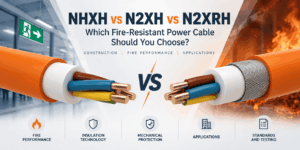
NHXH vs N2XH vs N2XRH: Which Fire-Resistant Power Cable Should You Choose?
NHXH vs N2XH vs N2XRH is an important comparison when specifying 0.6/1 kV power cables for emergency and life-safety systems. Although ...

How to Specify Low Current Cables for Infrastructure Projects
A professional low current cable specification should define much more than a cable name, conductor count or sheath colour. Infrastruct...

Fire Resistant Cables for Hospitals and High-Rise Buildings
Fire resistant cable for hospitals and high-rise buildings supports electrical, communication and control systems that may need to rema...

Industrial Control Cable Selection for Automation and Machinery
Industrial control cable selection should begin with the function of the circuit and the mechanical conditions of the machine rather th...
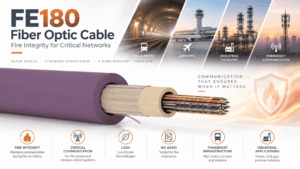
FE180 Fiber Optic Cable: Fire Integrity, Applications and Selection
An FE180 fiber optic cable is designed for optical communication routes where continued transmission during fire can form part of the p...
Screened vs Unscreened Control Cable: What Is the Difference?
Control cable shielding is one of the most important design decisions when selecting cable for industrial automation, machinery, buildi...

BMS Cable Selection: Building Automation Cables for HVAC and Smart Buildings
BMS cable selection should begin with the communication protocol and physical layer rather than with a generic request for “building au...


