





 President’s Message
Blog
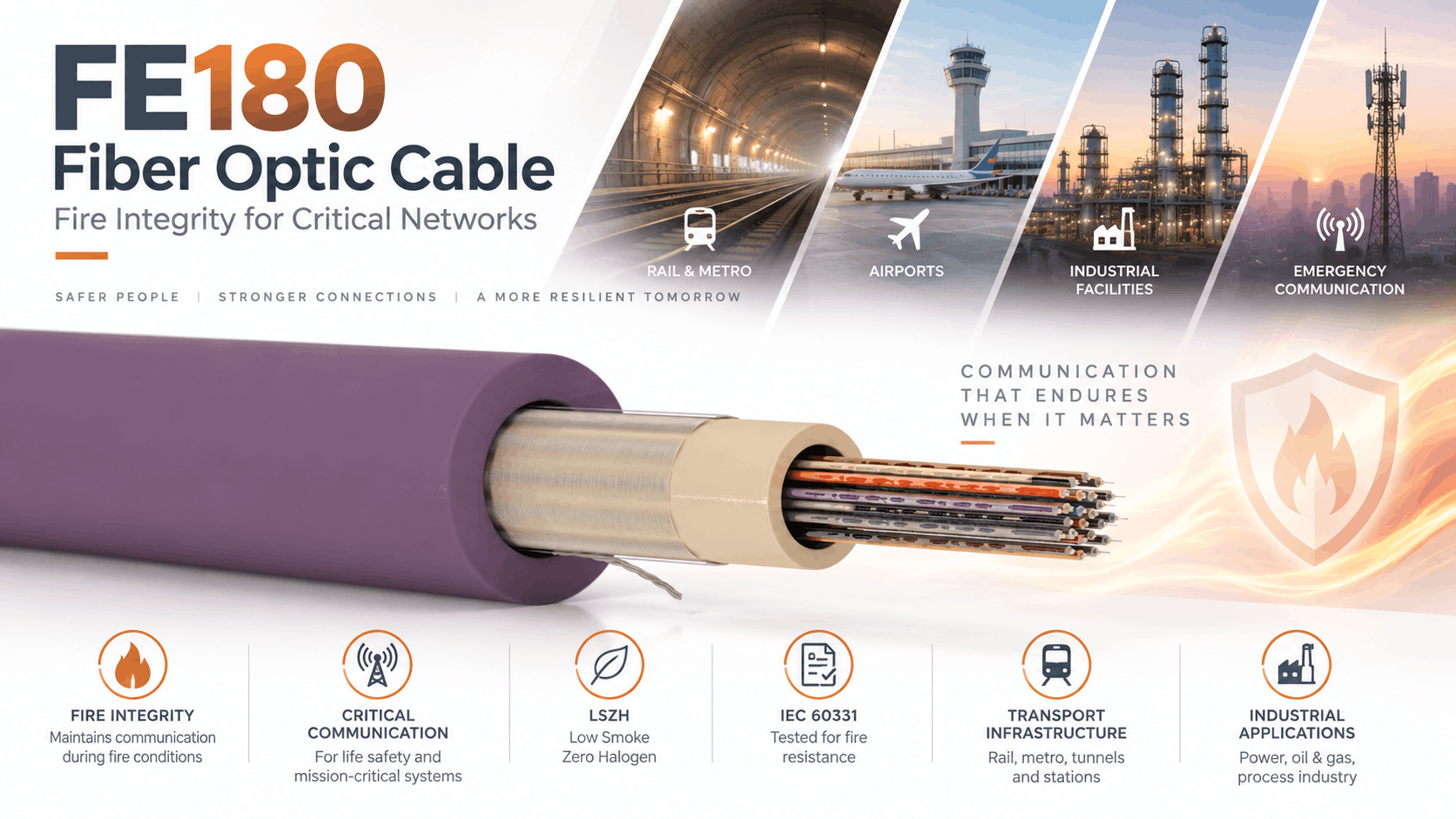
FE180 Fiber Optic Cable: Fire Integrity, Applications and Selection
Reading Time: 14 minutes
An FE180 fiber optic cable is designed for optical communication routes where continued transmission during fire can form part of the project safety strategy. Unlike ordinary flame-retardant fiber cables, a fire-survival construction focuses not only on limiting flame spread but also on protecting the optical transmission path for a defined period under specified test conditions.
However, FE180 is frequently misunderstood. It is not a CPR Euroclass, it does not mean B2ca, and it should not automatically be treated as equivalent to PH120, E30, E60 or E90. Each term describes a different aspect of cable or cable-system fire performance.
For fiber optic networks, the distinction becomes particularly important because the cable does not need to maintain electrical conductor continuity. Instead, the optical fibers must continue carrying the required signal within the performance limits defined by the applicable fire test and project specification.
Therefore, engineers should evaluate the actual test report, cable construction, optical performance, fire exposure conditions and installation system rather than approving a product simply because “FE180” appears in its description.
Quick answer: FE180 fiber optic cable is used where an optical communication link needs enhanced fire-survival performance. Typical applications can include tunnels, metro systems, railway infrastructure, airports, emergency communication networks, industrial facilities and other critical backbone routes. FE180 should be specified separately from CPR reaction-to-fire requirements such as B2ca and from system-level functional-integrity classifications.
FE180 Fiber Optic Cable at a Glance
| Characteristic | What It Means |
|---|---|
| Primary purpose | Maintain optical communication during defined fire exposure |
| FE180 | Fire-integrity designation encountered in European cable specifications |
| Typical construction | Fire-resistant optical core with protective tapes and LSZH layers |
| Optical fibers | Single-mode or multimode depending on network design |
| LSZH | Can reduce smoke and halogen-related combustion products |
| CPR class | Separate reaction-to-fire requirement |
| B2ca / Cca | Not equivalent to FE180 |
| Mechanical protection | Can include metallic or non-metallic reinforcement where required |
| Typical environments | Tunnels, transport infrastructure, airports and critical facilities |
Consequently, FE180 should be considered one part of a complete fiber optic cable specification rather than a complete product definition by itself.
What Does FE180 Mean?
FE180 is a fire-integrity designation encountered particularly in European and German-influenced cable specifications.
In practical project language, FE180 indicates that the relevant cable construction has demonstrated fire-survival performance for a defined period under its applicable test method.
Nevertheless, the designation should never be separated from the underlying standard and test certificate.
For example, a technical submittal should identify the exact test procedure used, the tested cable construction, the duration achieved and the performance criteria applied during the test.
Therefore, writing only “FE180 required” in a tender can leave important technical details unresolved.
FE180 Fiber Optic Cable Is Not the Same as Ordinary Fiber Cable
Conventional fiber optic cable focuses primarily on optical transmission, mechanical protection and environmental durability.
Depending on application, normal fiber cable specifications can address:
- Fiber type
- Fiber count
- Attenuation
- Loose-tube or tight-buffered construction
- Tensile strength
- Crush resistance
- Water blocking
- UV resistance
- Armour
- CPR classification
By contrast, an FE180 fiber optic cable also incorporates design features intended to protect the optical transmission path during fire exposure.
As a result, its material system and internal protective layers can be substantially different from those of an ordinary LSZH fiber optic cable.
Why Optical Continuity Matters During Fire
Modern infrastructure increasingly relies on fiber optic backbones for critical communication.
For example, optical networks can carry:
- Emergency communications
- CCTV transmission
- Transport control information
- Network supervision
- Public-address backbone data
- Security-system traffic
- Building-management communication
- Operational control data
If a critical fiber link fails immediately when exposed to fire, equipment at the other end of the network can lose communication even when local power remains available.
Therefore, selected backbone routes can require enhanced fire-survival performance as part of the overall system resilience strategy.
How FE180 Fiber Optic Cable Maintains Communication
An FE180 fiber optic cable can use several protective layers to delay damage to the optical fibers.
Depending on the product design, these can include:
- Fire-resistant tapes
- Mica-based barriers
- Glass-fiber elements
- Special LSZH compounds
- Heat-resistant bedding
- Protective inner sheaths
- Mechanical reinforcement
Meanwhile, the optical cable core must still preserve acceptable transmission performance.
Consequently, successful fire-survival design involves more than surrounding a conventional fiber cable with a thicker outer sheath.
FE180 Fiber Optic Cable and IEC 60331
The IEC 60331 series provides test methods for cables required to maintain circuit integrity under specified fire conditions.
Importantly, the current IEC 60331-1 and IEC 60331-2 scopes include optical fiber cables.
The applicable part depends partly on the overall cable diameter within the scope of those standards.
Therefore, buyers evaluating a fire-resistant fiber optic cable should confirm exactly which IEC 60331 test method appears on the product documentation.
Moreover, project specifications should avoid relying on obsolete standard references when a current test method is available.
Why Older Fiber Optic Fire Specifications Need Review
Some existing specifications still reference older fire-testing documents because transport and infrastructure tenders can remain in use for many years.
For example, legacy datasheets can refer to historical optical-fiber-specific IEC fire tests.
However, standards evolve.
Therefore, consultants and purchasing teams should verify whether the referenced test remains current and whether the proposed cable has been evaluated under the presently applicable method.
This review becomes especially important when comparing products from different manufacturers because datasheets can use terminology from different generations of standards.
FE180 vs B2ca Fiber Optic Cable
This is one of the most important distinctions in fiber optic fire specifications.
FE180 and B2ca do not describe the same fire characteristic.
FE180 concerns continued function or fire integrity under the applicable test framework.
B2ca, meanwhile, is a CPR reaction-to-fire Euroclass used to describe how a cable contributes to fire development.
Therefore, B2ca evaluates characteristics associated with the cable’s behaviour in a fire, while FE180 addresses the ability of the cable to continue performing its intended function under specified fire exposure.
Consequently, a project can theoretically require both characteristics if both reaction-to-fire performance and fire survival are necessary.
Reaction to Fire vs Fire Integrity
Reaction to fire asks:
How does the cable behave as part of the fire?
Fire integrity asks:
Can the cable continue performing its intended function during the fire?
These questions are fundamentally different.
For example, a cable can achieve strong reaction-to-fire performance yet have no requirement to continue transmitting data while directly exposed to fire.
Conversely, a fire-survival cable still needs separate evaluation when the project also specifies smoke, flame spread or CPR performance.
FE180 Fiber Optic Cable vs LSZH Fiber Cable
LSZH stands for Low Smoke Zero Halogen.
It primarily describes material behaviour relating to smoke generation and halogen-containing combustion products.
Therefore:
LSZH does not mean FE180.
An ordinary LSZH fiber optic cable can provide valuable fire-related material characteristics without being designed to preserve optical transmission during prolonged fire exposure.
Likewise, an FE180 fiber optic cable can also use LSZH materials, allowing the design to address both smoke behaviour and fire survival.
Why Low Smoke Matters in Critical Infrastructure
Smoke can create a major hazard in enclosed and high-occupancy infrastructure.
For instance, dense smoke can reduce visibility along evacuation routes and complicate emergency response.
This issue becomes especially relevant in:
- Tunnels
- Underground stations
- Airports
- Metro systems
- Hospitals
- Public buildings
Therefore, fire-survival fiber cables used in these environments frequently combine enhanced fire integrity with low-smoke material systems.
Nevertheless, each performance characteristic should remain separately documented.
FE180 Fiber Optic Cable vs PH120
FE180 and PH120 should not be presented as two levels on one universal scale.
PH classifications are commonly encountered in emergency-circuit cable specifications involving defined fire and mechanical conditions.
However, designers should not assume automatically that an electrical-cable PH designation transfers directly to every optical-fiber construction.
Therefore, a fiber optic tender requesting PH120 should identify the actual required test method and confirm that the proposed optical cable carries relevant evidence for that test.
The test report remains more important than the marketing terminology.
FE180 vs E30, E60 and E90
E30, E60 and E90 introduce another distinct fire-performance concept.
These classifications can relate to the functional integrity of an installed cable system, including elements beyond the cable itself.
For example, the tested arrangement can involve:
- Cable
- Tray
- Ladder
- Clamps
- Supports
- Fixings
- Installation spacing
Therefore, an “E90 fiber optic cable” description should be treated carefully.
Where system functional integrity is required, the approved installation configuration should be reviewed together with the cable.
Why Cable Supports Matter
A fire-resistant optical cable cannot maintain network continuity if its installation system fails prematurely.
For example, failure of a tray or fixing can cause the cable to collapse into a more severe fire zone or suffer mechanical damage.
Consequently, critical installations may need fire-tested cable-support systems in addition to the fire-resistant cable itself.
This becomes particularly relevant on long tunnel and station routes.
Typical FE180 Fiber Optic Cable Construction
A fire-survival optical cable can use a central loose-tube, multi-loose-tube or another optical design depending on the required fiber count and application.
A typical construction can combine:
- Single-mode or multimode optical fibers
- Loose tube
- Water-blocking elements
- Strength members
- Fire-resistant barrier
- LSZH bedding
- Mechanical protection where required
- Fire-performance outer sheath
However, there is no universal construction that defines every FE180 cable.
Therefore, buyers should evaluate the complete datasheet rather than assuming that all fire-resistant fiber products use identical layers.
Mica Tape in Fire-Resistant Fiber Optic Cable
Mica-based tapes are frequently associated with fire-survival cable constructions because mica provides strong heat resistance.
In fiber optic cable, a fire-resistant wrapping can help delay thermal damage to the cable core.
However, mica tape alone does not prove that the finished cable meets FE180 or another fire-integrity requirement.
The complete cable must demonstrate the required performance under the applicable test.
Consequently, construction photographs should never substitute for certification.
Metallic Armour in FE180 Fiber Optic Cable
Some FE180 fiber optic cable applications also require mechanical protection.
Depending on the route, metallic protection can help resist:
- Impact
- Crushing
- Rodents
- Installation damage
- External mechanical stress
Possible constructions can include corrugated metallic tape or other armour systems.
Nevertheless, armour and fire resistance address different hazards.
Therefore, an armored fiber optic cable should not automatically be described as fire resistant unless the finished construction has appropriate fire-test evidence.
Non-Metallic Fire-Resistant Fiber Cable
Not every fire-resistant optical network requires metallic protection.
Non-metallic constructions can be preferred where electrical isolation, lower weight or avoidance of conductive armour is important.
For example, aramid yarns and glass-based reinforcement can provide tensile or mechanical support without introducing conventional metallic armour.
Consequently, the choice between metallic and non-metallic construction should follow the mechanical and installation requirements separately from FE180 performance.
Single-Mode FE180 Fiber Optic Cable
OS2 single-mode fiber is particularly relevant to long-distance infrastructure backbones.
Typical applications can include:
- Railway communication
- Metro networks
- Airport backbones
- Tunnel communications
- Utility infrastructure
- Industrial networks
Therefore, OS2 is frequently a logical fiber choice when an FE180 requirement appears on long critical routes.
However, the fiber type should still match the optical equipment and network architecture.
Multimode FE180 Fiber Optic Cable
Multimode fibers can also be used in appropriate fire-survival communication networks.
Depending on equipment and distance, this can include:
- OM3
- OM4
- OM5
For example, multimode fiber can suit shorter high-speed links within buildings or technical facilities.
Therefore, FE180 performance does not determine whether the network should use single-mode or multimode fiber.
Optical design and fire performance remain separate specification decisions.
Fiber Count in FE180 Cable
Fiber count should reflect the communication architecture, redundancy strategy and future-capacity requirements.
Potential configurations can include:
- 4 fibers
- 8 fibers
- 12 fibers
- 24 fibers
- 48 fibers
- Higher counts where construction permits
However, increasing fiber count can change cable diameter and internal geometry.
Consequently, buyers should verify that the required fire certification covers the actual cable family and construction being supplied.
FE180 Fiber Optic Cable for Tunnels
FE180 fiber optic cable can be particularly relevant in tunnels because communication infrastructure often supports operational and emergency systems across long enclosed routes.
Potential applications include:
- CCTV backbones
- Emergency communication
- Traffic monitoring
- Control-system networks
- Public-address infrastructure
- Network redundancy
Moreover, tunnels can place strong emphasis on smoke behaviour because evacuation and emergency access occur within enclosed spaces.
Therefore, the full cable specification can combine optical, fire-survival, smoke and mechanical requirements.
FE180 Fiber Optic Cable for Metro Networks
Metro systems contain both stations and long underground communication routes.
Fiber optic backbones can connect:
- Stations
- Control rooms
- Technical rooms
- Security systems
- Operational networks
- Communication equipment
As a result, network resilience can become particularly important during emergencies.
An appropriate fire-resistant optical cable can therefore support project strategies requiring continued communication through selected fire scenarios.
FE180 Fiber Optic Cable for Railway Infrastructure
Fixed railway infrastructure can use fiber for signalling-related communication, CCTV, station systems and telecommunications.
However, fixed infrastructure cable should not be confused with rolling-stock cable installed inside trains.
Therefore, engineers should identify whether the fiber optic cable belongs to:
- Station infrastructure
- Trackside infrastructure
- Tunnels
- Technical buildings
- Rolling stock
Each environment can require different mechanical, fire and regulatory characteristics.
FE180 Fiber Optic Cable for Airports
Airports contain extensive communication networks distributed across terminals, plant areas and operational facilities.
Critical optical links can serve:
- Security systems
- CCTV
- Facility-management networks
- Emergency communications
- Network backbones
- Operational control systems
In addition, large airports can contain long cable routes between technical rooms and separate buildings.
Consequently, fire performance, optical distance, mechanical protection and environmental conditions should all be considered together.
FE180 Fiber Optic Cable for Hospitals
Hospitals rely heavily on communication infrastructure for building systems, security, monitoring and information networks.
However, not every hospital fiber link requires fire-survival performance.
Therefore, FE180 should be specified only where the fire strategy identifies a need for continued communication during fire.
Meanwhile, LSZH and CPR requirements can apply more broadly according to the building specification.
Industrial Applications for FE180 Fiber Optic Cable
Industrial plants can contain communication routes serving process control, safety systems and remote infrastructure.
Potential environments include:
- Petrochemical facilities
- Energy plants
- Utility infrastructure
- Large manufacturing sites
- Process facilities
Moreover, fiber optic cable offers inherent immunity to electromagnetic interference, which can be advantageous around high-power industrial equipment.
Therefore, fire-resistant optical construction can combine communication resilience with the normal EMI advantages of fiber.
Fire-Resistant Fiber and Network Redundancy
Fire-resistant cable should not replace good network architecture.
For example, a critical network can use physically separated redundant routes so that one fire event does not affect both paths simultaneously.
Consequently, engineers can combine fire-resistant cable with:
- Redundant network switches
- Diverse cable routes
- Ring topology
- Backup power
- Separate fire compartments
Therefore, cable fire integrity represents one layer of resilience rather than the complete resilience strategy.
FE180 Does Not Guarantee the Entire Network
An optical link depends on more than the cable itself.
For instance, successful communication also requires:
- Active network equipment
- Power supplies
- Connectors
- Splice closures
- Patch panels
- Network topology
If these components fail during the same incident, a surviving cable alone cannot maintain communication.
Consequently, system designers should coordinate cable survival with equipment and network resilience.
Splices and Fire-Resistant Fiber Networks
Fiber optic routes frequently contain fusion splices.
However, the cable’s fire-survival rating does not automatically establish the performance of every splice enclosure installed along the route.
Therefore, designers should consider whether critical routes can minimize intermediate connection points or provide suitable protection for them.
This issue becomes increasingly important when long infrastructure routes contain multiple transition or distribution points.
Indoor vs Outdoor FE180 Fiber Optic Cable
Fire resistance alone does not define environmental suitability.
An indoor FE180 fiber optic cable can lack the UV or moisture resistance required outdoors.
Conversely, an outdoor fire-resistant cable can require:
- UV-resistant sheath
- Water blocking
- Temperature resistance
- Mechanical reinforcement
- Rodent protection
Therefore, project specifications should define fire and environmental performance separately.
FE180 Fiber Optic Cable for Duct Installation
Duct routes can expose cable to moisture, pulling stress and installation friction.
Accordingly, a fire-resistant cable intended for duct use should also provide appropriate:
- Tensile performance
- Crush resistance
- Water protection
- Outer-sheath durability
Consequently, an indoor fire-survival fiber cable should not automatically be approved for an underground duct simply because its optical and fire ratings appear suitable.
FE180 and CPR Requirements
European projects can contain both fire-integrity and reaction-to-fire requirements.
However, these requirements should appear as separate entries in the specification.
For example, a consultant might define:
Fire integrity: applicable FE180 requirement
and separately define:
Reaction to fire: specified CPR Euroclass
Therefore, buyers should request documentation proving each requirement independently.
Can FE180 Fiber Optic Cable Also Be B2ca?
Potentially, but the two performances require separate evidence.
A cable does not become B2ca simply because it has fire-survival capability.
Likewise, B2ca classification does not demonstrate FE180 fire integrity.
Consequently, where both requirements appear in a tender, suppliers should provide the appropriate documentation for both characteristics.
Common FE180 Fiber Optic Cable Specification Mistakes
1. Targeting Only “Fire Resistant Fiber Optic Cable”
The exact fire-integrity standard and required duration should also be defined.
2. Treating FE180 as a CPR Class
FE180 and CPR Euroclasses describe different fire characteristics.
3. Assuming B2ca Means Fire Survival
B2ca does not by itself demonstrate continued optical transmission during fire.
4. Assuming LSZH Means FE180
Low-smoke halogen-free construction does not automatically establish fire integrity.
5. Treating PH120 as Automatically Equivalent to FE180
Verify the exact standard and test evidence instead of equating different designations.
6. Treating E90 as a Cable-Only Rating
Functional integrity can depend on the complete installed system.
7. Ignoring Optical Performance During Fire
Fiber networks depend on maintaining acceptable optical transmission rather than electrical conductor continuity.
8. Specifying Armour Without Defining the Mechanical Hazard
Mechanical protection should match the actual installation environment.
9. Ignoring Fiber Type
OS2, OM3, OM4 and OM5 remain network-design decisions.
10. Ignoring Fiber Count
The required fiber count should reflect network capacity and redundancy.
11. Assuming Fire Resistance Makes a Cable Outdoor Rated
UV, water and environmental characteristics remain separate requirements.
12. Ignoring Cable Supports
A critical route can fail if the installation system collapses during fire.
13. Ignoring Splice Enclosures
The complete optical path includes more than continuous cable.
14. Using an Obsolete Test Reference Without Verification
Standards and test methods should be checked against their current status.
15. Approving a Cable from Marketing Wording Alone
Test reports and certificates should support the claimed fire performance.
How to Specify FE180 Fiber Optic Cable
Step 1: Define the Critical Network Function
Identify why optical communication must continue during a fire.
Step 2: Define the Fire-Survival Requirement
State the applicable standard, test condition and required duration.
Step 3: Select Fiber Type
Choose OS2 or the appropriate multimode fiber according to the network equipment and distance.
Step 4: Define Fiber Count
Include operational fibers, redundancy and reasonable future capacity.
Step 5: Select Cable Architecture
Choose central loose tube, multi loose tube or another appropriate optical construction.
Step 6: Define LSZH Requirements
Specify smoke and halogen-related material characteristics where required.
Step 7: Define CPR Separately
State the required reaction-to-fire class independently from FE180.
Step 8: Define Mechanical Protection
Add armour or reinforcement where the route faces impact, crushing or rodent risks.
Step 9: Define Environmental Performance
Specify indoor, outdoor, duct, UV, moisture and temperature requirements.
Step 10: Review the Installation System
Where functional integrity is required, verify cable supports, clamps and fixing arrangements.
Step 11: Review the Optical Path
Consider splices, enclosures, patching and active network equipment.
Step 12: Verify Documentation
Finally, confirm that the proposed test reports correspond to the actual cable construction being supplied.
What Should Buyers Include in an FE180 Fiber Optic Cable RFQ?
A professional FE180 fiber optic cable RFQ should define both optical-network requirements and fire-survival requirements.
Useful parameters include:
- Application
- Required fire-integrity standard
- Required duration
- Applicable IEC 60331 test where required
- Fiber type
- OS2, OM3, OM4 or OM5
- Fiber count
- Central or multi-loose-tube construction
- LSZH requirement
- CPR Euroclass where applicable
- Armour requirement
- Metallic or non-metallic construction
- Water blocking
- UV resistance
- Indoor or outdoor use
- Duct suitability
- Operating temperature
- Tensile load
- Crush resistance
- Minimum bending radius
- Maximum cable diameter where relevant
- Test reports
- Third-party certification where required
Consequently, manufacturers can quote technically comparable products rather than interpreting the phrase “fire-resistant fiber” differently.
ETK Kablo FE180 Fiber Optic Cable Solutions
ETK Kablo manufactures fiber optic cable constructions for telecommunications, transport, infrastructure and other critical communication networks.
For projects requiring enhanced fire survival, relevant constructions can combine optical fibers with fire-resistant barriers, LSZH compounds and additional mechanical protection according to the project design.
ETK’s fiber optic manufacturing capabilities also allow project specifications to address:
- Single-mode fiber
- Multimode fiber
- Different fiber counts
- Loose-tube constructions
- Armored constructions
- Non-metallic constructions
- Indoor and outdoor requirements
- LSZH material systems
However, the exact FE180, IEC, CPR or other fire-performance requirement should always be matched against the documentation of the proposed cable construction.
Therefore, ETK approaches FE180 fiber optic cable selection according to the required optical function, fire-survival performance, mechanical environment and installation conditions rather than relying on one universal fire-resistant fiber design.
Frequently Asked Questions About FE180 Fiber Optic Cable
What is FE180 fiber optic cable?
It is an optical cable designed and tested for enhanced fire-survival performance under the applicable FE180-related specification while continuing the required optical function.
Does FE180 mean the cable works for exactly 180 minutes in every fire?
No. The designation relates to performance under a defined laboratory test. Real fires and installed systems can create different conditions.
Is FE180 the same as B2ca?
No. FE180 concerns fire integrity, while B2ca is a CPR reaction-to-fire classification.
Is FE180 fiber cable automatically LSZH?
No. LSZH and fire integrity describe separate characteristics, although they are frequently combined in critical-infrastructure cable designs.
Is FE180 the same as PH120?
No. The terminology relates to different fire-test concepts, so the underlying standards and certificates should be reviewed separately.
Is FE180 the same as E90?
No. E90 can refer to functional integrity of an installed cable system, while FE180 describes another fire-integrity characteristic.
Can FE180 fiber optic cable be B2ca?
A product can potentially meet both requirements when separately designed, tested and documented for each performance characteristic.
Can FE180 fiber optic cable use OS2?
Yes. OS2 can be used where the optical network requires single-mode transmission.
Can FE180 cable use OM3 or OM4?
Yes, where the network and cable construction support the required multimode fiber type.
Can FE180 fiber cable be armored?
Yes. Suitable designs can include mechanical protection where the installation requires it.
Can FE180 fiber cable be non-metallic?
Potentially. Non-metallic designs can use suitable fire-resistant and strength elements where the required test performance is achieved.
Is FE180 fiber cable suitable for tunnels?
It can be relevant to critical tunnel communication routes when the project requires continued optical transmission during fire.
Is FE180 fiber cable used in metro networks?
Yes, fire-survival fiber can be specified for selected communication and backbone routes in metro infrastructure.
Can airports use FE180 fiber optic cable?
Yes. Selected critical communication backbones can require enhanced fire-survival performance according to the airport’s project specification.
Does fire-resistant fiber eliminate the need for redundant routes?
No. Redundant topology, physical route separation and resilient network equipment remain important parts of critical-network design.
Does an FE180 cable guarantee that the entire network survives?
No. Switches, power supplies, splices, connectors and other network elements must also remain available for communication to continue.
What should buyers verify on the certificate?
Check the exact cable construction, applicable test standard, performance duration, optical criteria, testing laboratory and scope of the certification.
How should FE180 fiber optic cable be selected?
Start with the required fire-survival function, then specify fiber type, count, cable architecture, mechanical protection, environment, LSZH performance and any separate CPR requirements.
Conclusion
An FE180 fiber optic cable serves a very different purpose from an ordinary flame-retardant or CPR-rated optical cable.
Its role is to support continued optical communication during defined fire exposure where the network forms part of a critical infrastructure strategy.
However, FE180 should not be confused with B2ca, LSZH, PH120 or E90. Each designation addresses a different part of cable or cable-system fire performance.
For that reason, engineers should begin with the function that must survive. They can then define the applicable fire test, optical fiber type, fiber count, cable architecture, mechanical protection and environmental construction.
Specify Fire Integrity and Reaction to Fire Separately
Where a project also requires a CPR class such as B2ca or Cca, that requirement should appear separately from FE180.
Likewise, LSZH should be treated as a material characteristic rather than evidence of circuit integrity.
Meanwhile, system resilience should include cable supports, splices, active equipment, power supplies and network topology rather than concentrating exclusively on the cable.
Ultimately, the correct fire-resistant optical solution is not the cable with the greatest number of fire-related labels. It is the cable whose documented optical, fire, mechanical and environmental performance matches the actual critical communication route.
Benzer yazılar
Ethernet Cable Testing: NEXT, Return Loss, Insertion Loss and ACR Explained
Ethernet cable testing verifies whether a twisted-pair copper cabling system can transmit data within the electrical performance limits...

Fiber Optic Cable Attenuation: 850, 1310, 1550 and 1625 nm Explained
Fiber optic cable attenuation describes the reduction in optical power as light travels through an optical fiber. It is normally expres...
A-02YSF(L)2Y vs A-2Y(L)2Y Outdoor Telephone Cable
A-02YSF(L)2Y vs A-2Y(L)2Y is an important comparison when selecting copper outdoor telephone cable for telecommunications networks, und...
RS-485 Cable vs Instrumentation Cable: Can Instrumentation Cable Be Used for Modbus RTU?
A Modbus RTU cable must do more than carry a low-voltage digital signal from one device to another. Modbus RTU commonly uses an RS-485 ...
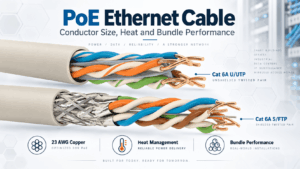
Ethernet Cable for PoE: Conductor Size, Heat and Bundle Performance
A PoE Ethernet cable carries data and electrical power over the same balanced twisted-pair cabling system. This capability simplifies t...
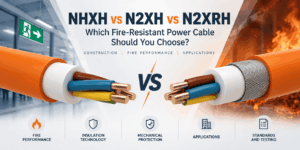
NHXH vs N2XH vs N2XRH: Which Fire-Resistant Power Cable Should You Choose?
NHXH vs N2XH vs N2XRH is an important comparison when specifying 0.6/1 kV power cables for emergency and life-safety systems. Although ...
How to Specify Low Current Cables for Infrastructure Projects
A professional low current cable specification should define much more than a cable name, conductor count or sheath colour. Infrastruct...
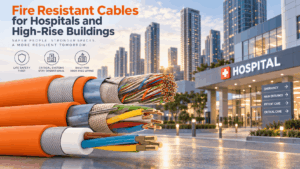
Fire Resistant Cables for Hospitals and High-Rise Buildings
Fire resistant cable for hospitals and high-rise buildings supports electrical, communication and control systems that may need to rema...
Industrial Control Cable Selection for Automation and Machinery
Industrial control cable selection should begin with the function of the circuit and the mechanical conditions of the machine rather th...
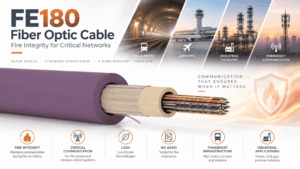
FE180 Fiber Optic Cable: Fire Integrity, Applications and Selection
An FE180 fiber optic cable is designed for optical communication routes where continued transmission during fire can form part of the p...
Screened vs Unscreened Control Cable: What Is the Difference?
Control cable shielding is one of the most important design decisions when selecting cable for industrial automation, machinery, buildi...

BMS Cable Selection: Building Automation Cables for HVAC and Smart Buildings
BMS cable selection should begin with the communication protocol and physical layer rather than with a generic request for “building au...


