





 President’s Message
Blog
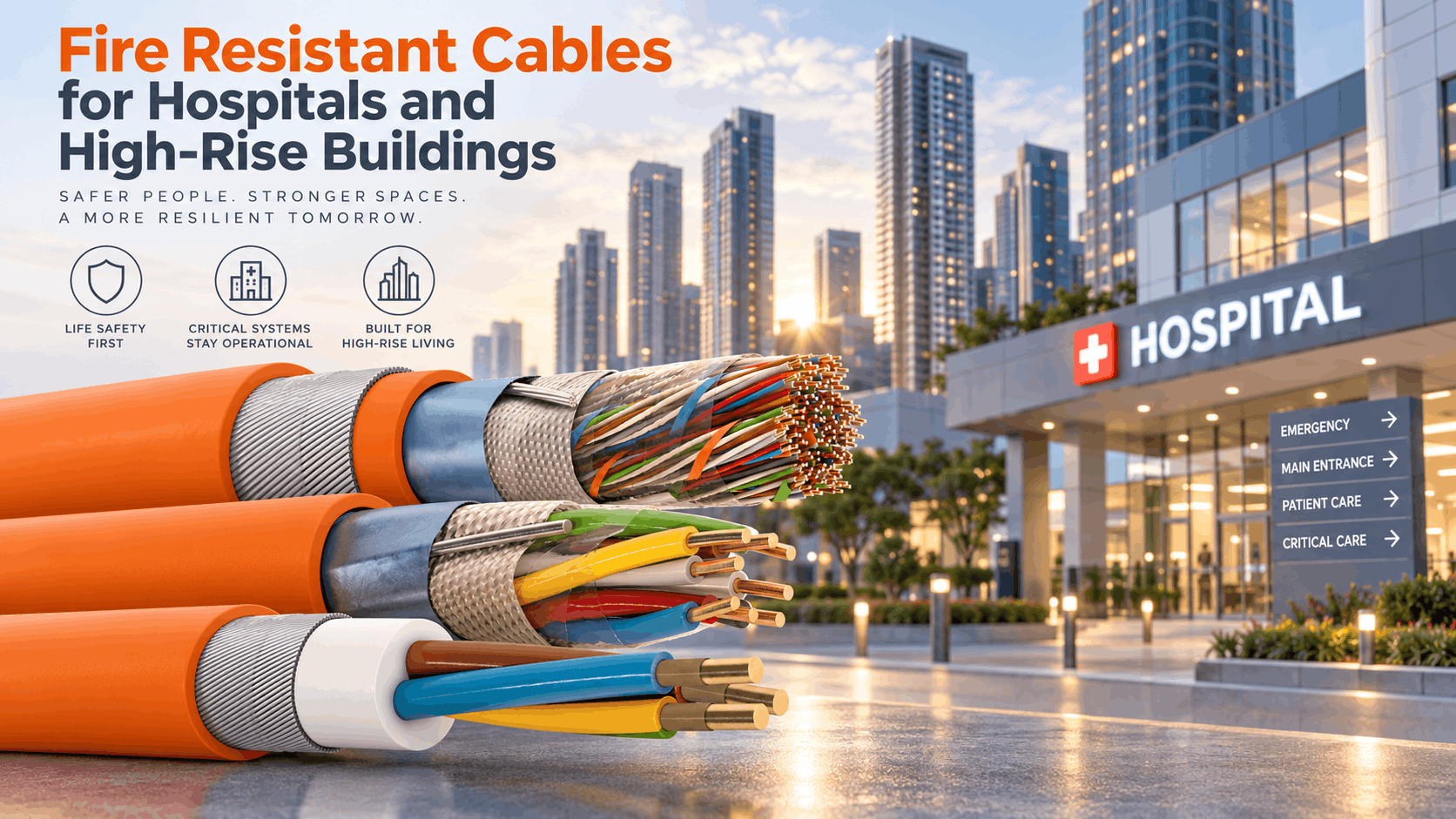
Fire Resistant Cables for Hospitals and High-Rise Buildings
Reading Time: 16 minutes
Fire resistant cable for hospitals and high-rise buildings supports electrical, communication and control systems that may need to remain operational during a fire. These buildings present demanding life-safety conditions because evacuation can take time, occupants may depend on assisted movement, and critical systems such as emergency lighting, fire detection, smoke control and emergency communications can remain necessary throughout the incident.
However, not every cable inside a hospital or high-rise building needs fire-survival performance. Some cables primarily require appropriate reaction-to-fire characteristics, while selected life-safety circuits require continued operation under defined fire conditions.
For example, a cable serving normal office lighting has a different safety function from a cable feeding an emergency smoke-control system. Likewise, a conventional BMS communication circuit does not automatically need the same fire-integrity performance as a fire alarm, voice evacuation or pressurization circuit.
Therefore, engineers should begin with the system function rather than simply specifying the highest available fire rating across the entire building.
Quick answer: fire-resistant cables in hospitals and high-rise buildings can serve emergency lighting, fire alarms, voice evacuation, smoke extraction, stair pressurization, fire-fighting lifts, critical controls and other life-safety systems. Cable selection can involve IEC 60331 or EN 50200 circuit-integrity requirements, PH classifications, LSZH materials and, where required, system-level functional integrity. The exact duration and test requirements must follow the project fire strategy and applicable regulations.
Fire Resistant Cable for Hospitals at a Glance
| System | Why Continued Operation May Matter | Typical Cable Consideration |
|---|---|---|
| Fire detection | Maintains alarm and monitoring functions | Fire-resistant signal cable where required |
| Voice evacuation | Provides instructions during emergency response | Fire-resistant communication / speaker cable |
| Emergency lighting | Supports safe evacuation routes | Fire-resistant power cable |
| Smoke extraction | Supports smoke-management strategy | Fire-resistant power and control cable |
| Stair pressurization | Helps protect escape stairs from smoke | Fire-resistant power and control circuits |
| Fire dampers | Supports compartmentation and smoke control | Control cable according to system design |
| Fire-fighting lifts | Supports emergency-response access | Fire-resistant supply and control systems |
| Emergency communications | Maintains communication between critical areas | Fire-resistant communication cable |
| Critical network backbone | Can maintain selected data links | Fire-resistant fiber optic cable where required |
Consequently, a hospital or high-rise project can require several different fire-resistant cable families rather than one universal cable construction.
Why Hospitals Require Special Fire Cable Planning
Hospitals create unusual evacuation conditions because many occupants cannot leave a building quickly without assistance.
For example, healthcare facilities can contain:
- Patients with reduced mobility
- Intensive-care patients
- Operating theatres
- Recovery areas
- Diagnostic departments
- Staff-intensive treatment zones
- Medical equipment
- Visitors unfamiliar with the building
As a result, evacuation strategies can differ significantly from those used in ordinary commercial buildings.
Meanwhile, hospitals often rely on compartmentation and controlled movement between protected areas rather than expecting every occupant to leave the building immediately.
Therefore, selected fire-safety and emergency systems may need to remain available for an extended period according to the building’s fire strategy.
Why High-Rise Buildings Create Different Risks
High-rise buildings introduce another set of challenges because occupants can be located many floors above ground level.
For instance, evacuation can involve long vertical travel distances, protected stairways, fire-fighting lifts and sophisticated smoke-control systems.
In addition, electrical and communication services often travel vertically through risers that connect many floors.
Consequently, failure of one critical cable route can potentially affect systems across a significant part of the building.
Therefore, high-rise fire-cable design must consider not only the cable itself but also route separation, fire compartments, support systems and the equipment supplied by the circuit.
What Is a Fire-Resistant Cable?
A fire-resistant cable is designed to maintain its required electrical, control or communication function during a defined fire test.
Depending on cable type, the construction can include:
- Mica tapes
- Fire-resistant insulation
- Glass-fiber layers
- Special fillers
- Ceramic-forming compounds
- LSZH bedding
- Fire-performance outer sheaths
However, simply using heat-resistant materials does not prove fire-integrity performance.
Instead, the complete cable construction must demonstrate the required performance under the applicable test method.
Fire Resistance vs Flame Retardancy
This distinction is particularly important in hospital and high-rise specifications.
Flame-retardant cable is designed to limit flame propagation.
Fire-resistant cable is designed to continue performing its required function while exposed to fire under specified conditions.
Therefore:
Flame retardant does not mean fire resistant.
Nevertheless, one cable construction can be designed to satisfy both requirements where the applicable tests are met.
Circuit Integrity in Hospitals and High-Rise Buildings
Circuit integrity concerns whether a cable continues carrying electrical power, control signals or communication during the specified fire exposure.
For life-safety systems, this can be critical because emergency equipment may remain necessary after a fire begins.
For example, loss of a smoke-extraction fan control circuit could affect the building’s smoke-management strategy even if the fan itself remains undamaged.
Likewise, failure of an emergency-lighting feeder can reduce visibility along escape routes.
Consequently, cable integrity should be coordinated with the required operating period of the complete safety system.
Fire Resistant Cable for Hospitals: Fire Alarm Systems
Fire resistant cable for hospitals can be specified for selected fire alarm and detection circuits according to the system design and local requirements.
Fire alarm systems can connect:
- Detectors
- Manual call points
- Control panels
- Alarm sounders
- Interface modules
- Monitoring devices
However, the phrase “fire alarm cable” describes an application rather than one universal cable construction.
Therefore, the project specification should identify the applicable circuit-integrity and fire-performance requirements rather than relying only on the product name.
Voice Alarm and Evacuation Systems
Voice alarm systems can provide critical instructions to occupants and staff during an emergency.
In hospitals, clear communication can become especially important because staff may need to coordinate patient movement rather than initiating uncontrolled evacuation.
Similarly, high-rise buildings can use voice messages to support phased evacuation strategies.
Consequently, selected speaker circuits, control circuits and associated cabling can require maintained performance according to the system design.
Fire Resistant Cable for Hospitals: Emergency Lighting
Fire resistant cable for hospitals can also serve emergency-lighting circuits where the project requires continued operation during fire.
Emergency lighting can support:
- Escape corridors
- Stairways
- Exit routes
- Critical treatment areas
- Plant rooms
- Emergency-response routes
Moreover, high-rise escape paths can extend across many floors.
Therefore, the cable serving emergency lighting should be selected according to the required circuit duration, electrical load and fire strategy.
Smoke Extraction Cable
Smoke-control systems can require power and control cables that remain operational during the relevant emergency period.
Potential equipment includes:
- Smoke-extraction fans
- Jet fans
- Motorized dampers
- Smoke-control panels
- Monitoring equipment
For example, a smoke-extraction fan can require a substantial power feeder while the associated damper and monitoring equipment use separate control cables.
Consequently, the system can require several fire-resistant cable constructions with different conductor sizes and functions.
Fire Resistant Cable for Stair Pressurization
Stair pressurization systems aim to reduce smoke infiltration into protected escape stairs.
These systems can include:
- Pressurization fans
- Motor starters
- Control panels
- Pressure sensors
- Motorized dampers
Therefore, both power and control wiring can form part of the safety function.
In high-rise buildings, maintaining pressurization can be particularly important because occupants may depend on stairs over many storeys.
Fire Dampers and Smoke Dampers
Fire and smoke dampers help maintain compartmentation or control air movement through HVAC systems.
Depending on design, the system can require:
- Actuator power
- Open/close commands
- Position feedback
- Fire-system interfaces
However, not every damper circuit requires the same fire-survival duration.
Accordingly, engineers should coordinate cable performance with the damper’s required operating sequence during fire.
Fire Resistant Cable for Hospitals: Critical HVAC Controls
Fire resistant cable for hospitals can also appear within selected HVAC safety functions.
Normal comfort HVAC should not automatically be confused with life-safety ventilation.
For example, ordinary room-temperature control may shut down during a fire, while smoke extraction or pressurization remains necessary.
Therefore, the fire strategy should identify which HVAC functions are critical and which circuits require maintained operation.
Fire-Fighting Lifts in High-Rise Buildings
Fire-fighting lifts can support emergency personnel in tall buildings.
The associated electrical system can include:
- Power supply
- Control circuits
- Communication
- Associated equipment
Moreover, the complete supply route may need protection beyond the cable itself.
Therefore, cable selection should be coordinated with the required system integrity, routing and installation method.
Evacuation Lifts
Some building designs also incorporate lifts into evacuation strategies where permitted by the applicable building and fire-safety requirements.
In such applications, the reliability of the electrical and control infrastructure becomes especially important.
However, lift evacuation design is a system-level fire-engineering decision rather than simply a cable-selection issue.
Consequently, the required cable fire performance should follow the approved evacuation strategy.
Emergency Power Distribution
Life-safety systems can depend on electrical distribution equipment such as generators, UPS systems or emergency switchboards.
The cable route between the emergency power source and critical equipment can therefore form part of the overall safety chain.
For example, a fire-resistant cable supplying a smoke-control fan provides little benefit if upstream switchgear or distribution equipment fails first.
Therefore, designers should evaluate the complete electrical system rather than viewing fire-resistant cable in isolation.
Fire Resistant Cable for Hospitals and Medical Equipment
Not every medical-equipment circuit requires fire-resistant cable.
Medical equipment can have specific requirements for electrical safety, power quality, redundancy and emergency supply, but these do not automatically mean the cable itself needs circuit integrity during fire.
Therefore, fire resistant cable for hospitals should be reserved for circuits whose required emergency function justifies it.
This approach avoids confusing clinical continuity requirements with fire-survival cable requirements.
Progressive Evacuation in Hospitals
Hospitals can use evacuation strategies that move patients progressively between protected compartments rather than immediately evacuating everyone outside.
As a result, life-safety systems may need to remain functional in parts of the building while occupants remain elsewhere inside.
For example, emergency communication, fire detection and selected ventilation controls can remain relevant throughout the incident.
Consequently, cable-survival duration should align with the fire-engineered evacuation strategy rather than a generic assumption.
High-Rise Evacuation and Cable Integrity
High-rise evacuation can also occur in phases.
For instance, floors closest to the fire can evacuate first while other occupants remain temporarily in place according to the building strategy.
Meanwhile, stair pressurization, voice communication and smoke control can continue operating.
Therefore, high-rise life-safety systems can require longer and more coordinated operational continuity than systems in a small low-rise building.
IEC 60331 for Fire-Resistant Cable
The IEC 60331 series provides internationally recognized methods for testing cables that need to maintain circuit integrity during fire under specified conditions.
Current IEC 60331-1 and IEC 60331-2 methods combine fire exposure with mechanical shock at a temperature of at least 830°C.
IEC 60331-1 applies within its scope to cables exceeding 20 mm overall diameter, while IEC 60331-2 addresses applicable cables not exceeding 20 mm.
Therefore, specifying simply “IEC 60331” can be incomplete.
Instead, engineers should identify the appropriate part and confirm that the supplied cable construction falls within the documented test scope.
Why Mechanical Shock Matters During Fire
A real fire can expose cable systems to more than heat.
For example, cables can experience:
- Falling materials
- Support movement
- Structural deformation
- Mechanical impact
- Vibration
Consequently, fire testing that includes mechanical shock provides different information from a simple flame-propagation test.
This distinction matters in large and complex buildings where cable routes can extend through many structural zones.
EN 50200 and Emergency Circuits
EN 50200 provides a European fire-resistance test method for unprotected small cables intended for emergency circuits.
Its scope is relevant to cable types used in applications such as:
- Alarm systems
- Emergency lighting
- Communication circuits
- Other emergency systems
Moreover, the test includes mechanical shock during fire exposure.
Therefore, EN 50200 can appear frequently in hospital and high-rise emergency-circuit specifications.
PH Ratings for Hospital and High-Rise Cables
PH classifications describe fire-survival duration under the applicable test framework.
Depending on the project, specifications can refer to classifications such as:
- PH30
- PH60
- PH90
- PH120
However, the longest rating should not automatically be selected for every circuit.
Instead, the required duration should correspond to the safety function and approved fire strategy.
FE180 in Hospital Cable Specifications
FE180 also appears in many European fire-resistant cable specifications.
However, FE180 should not be treated automatically as another name for PH120 or IEC 60331.
Therefore, buyers should verify:
- Applicable test standard
- Test duration
- Exact cable construction
- Certificate scope
- Testing laboratory
Consequently, the certificate provides more useful technical information than the designation alone.
E30, E60 and E90 Functional Integrity
E30, E60 and E90 are commonly associated with functional-integrity requirements for complete cable installation systems.
Unlike a cable-only test, system-level integrity can depend on:
- Cable
- Cable tray
- Ladder
- Clamps
- Supports
- Anchors
- Installation spacing
Therefore, specifying “E90 cable” without checking the tested installation arrangement can oversimplify the requirement.
Why Cable Supports Matter in Hospitals
A fire-resistant cable cannot maintain a life-safety circuit if its support system fails prematurely.
For example, plastic cable ties or unsuitable supports can fail long before the cable itself reaches its fire-survival limit.
Consequently, the installation method matters alongside the cable specification.
This becomes particularly important above escape routes, inside risers and on circuits serving critical hospital areas.
Why Cable Supports Matter in High-Rise Buildings
High-rise cable systems often travel long vertical distances.
As a result, support failure can create substantial mechanical loads and affect multiple floors.
Therefore, critical riser circuits need appropriate supporting and fixing arrangements that match the required fire strategy.
Moreover, cable supports, joints and terminations should form part of the complete integrity assessment.
BS 8519 and High-Rise Life-Safety Systems
For projects using British standards, BS 8519 provides guidance on the selection and installation of fire-resistant power and control cable systems for life-safety, fire-fighting and other critical applications.
Its approach is particularly relevant to large and complex buildings where system integrity depends on more than the cable.
For example, the complete installation can include:
- Power sources
- Distribution systems
- Cables
- Supports
- Joints
- Glands
- Terminations
Therefore, high-rise specifications should consider the complete electrical path when a critical system must continue operating during fire.
Fire Resistant Cable for Hospitals vs LSZH Cable
Fire resistant cable for hospitals and LSZH cable describe different properties.
LSZH materials aim to reduce smoke and halogen-containing combustion products.
Fire-resistant construction, meanwhile, aims to maintain the circuit function during specified fire exposure.
Therefore:
LSZH does not mean fire resistant.
However, fire-resistant hospital cables frequently use LSZH material systems because both characteristics can be valuable in occupied public buildings.
Why Low Smoke Matters in Hospitals
Hospitals can contain occupants who cannot evacuate independently.
Therefore, smoke conditions can have significant consequences during emergency movement and fire-fighting operations.
In addition, dense smoke can reduce visibility along corridors, stairs and treatment areas.
Consequently, low-smoke materials can form an important part of the project’s cable fire-performance strategy.
Why Halogen-Free Cable Can Be Important
Combustion of some halogen-containing materials can release corrosive gases.
These gases can affect:
- People
- Electrical equipment
- Electronic systems
- Metal components
- Emergency-response environments
Therefore, halogen-free materials are frequently specified in hospitals, high-rise buildings and other high-occupancy facilities.
Nevertheless, the project must specify circuit integrity separately where continued operation is required.
Reaction to Fire vs Resistance to Fire
Reaction to fire describes how a cable contributes to fire development.
Resistance to fire concerns whether a cable or cable system continues performing its required function during fire.
Therefore, these characteristics should not be treated as alternative names for the same rating.
For example, CPR Euroclasses address reaction-to-fire performance, while IEC 60331 and similar frameworks address circuit integrity.
CPR Cable Classes in Hospitals and High-Rise Buildings
European building specifications can require CPR reaction-to-fire classifications for applicable cables.
Possible Euroclasses include:
- B2ca
- Cca
- Dca
- Eca
Moreover, supplementary ratings can describe smoke, flaming droplets and acidity.
However, a high CPR class does not automatically demonstrate that the cable will keep a life-safety system operating during fire.
Consequently, CPR and circuit-integrity requirements should appear separately in project specifications.
B2ca vs Fire-Resistant Cable
B2ca does not mean fire resistant.
Instead, B2ca is a reaction-to-fire classification.
For example, a B2ca cable can demonstrate strong reaction-to-fire characteristics without being designed to maintain electrical continuity during prolonged direct fire exposure.
Therefore, a hospital project requiring both properties should request separate evidence for each.
Fire-Resistant Power Cable in Hospitals
Fire-resistant power cable can supply critical equipment that must remain available during fire.
Depending on the project, applications can include:
- Emergency lighting
- Smoke extraction
- Pressurization fans
- Fire-fighting systems
- Critical pumps
- Emergency equipment
However, fire performance does not replace normal electrical design.
Therefore, conductor size, voltage drop, protection, short-circuit capability and installation conditions still need proper calculation.
Fire-Resistant Control Cable
Control cable can remain necessary for commands, status signals and safety-system interfaces.
Potential applications include:
- Fire dampers
- Smoke dampers
- Ventilation controls
- Fan commands
- Fire doors
- Emergency panels
Moreover, selected circuits can require electromagnetic screening in electrically noisy environments.
Consequently, fire resistance and screening should be specified as separate characteristics.
Fire-Resistant Signal and Communication Cable
Life-safety systems also rely on low-voltage signal and communication circuits.
For example, these can include:
- Alarm signals
- Emergency communications
- Voice alarm
- Monitoring circuits
- System interfaces
Therefore, a generic fire-resistant power cable should not replace a dedicated signal cable simply because both can survive fire.
Electrical properties such as capacitance, screening and conductor arrangement can remain important.
Fire-Resistant Fiber Optic Cable
Hospitals and high-rise buildings increasingly depend on fiber optic backbones.
Selected critical communication routes can therefore require enhanced fire-survival performance.
For example, fiber networks can support:
- Security systems
- Critical communications
- Building networks
- Monitoring systems
- Emergency infrastructure
However, not every building-network fiber route requires fire-resistant construction.
Consequently, the fire strategy should identify which optical links need continued operation.
Screened Fire-Resistant Cable
A fire-resistant control or signal cable can also require electromagnetic protection.
Potential interference sources include:
- Motors
- Large electrical equipment
- Power cables
- Transformers
- Variable-frequency drives
Therefore, screened fire-resistant cable can be appropriate for sensitive circuits where both circuit integrity and EMC protection are necessary.
Nevertheless, screening does not establish fire resistance by itself.
Armored Fire-Resistant Cable
Some hospital and high-rise cable routes can require mechanical protection.
For example, cables can pass through:
- Plant rooms
- Service areas
- Technical shafts
- External routes
- Areas exposed to impact
Possible protection systems can include metallic armour or other reinforcement.
However, armour primarily addresses mechanical hazards.
Therefore, the finished armored cable still needs appropriate fire-performance evidence where circuit integrity is required.
Fire Resistant Cable for Hospitals: Cable Risers
Fire resistant cable for hospitals can run through vertical or horizontal service routes connecting multiple areas of a healthcare facility.
Risers can contain high concentrations of electrical and communication cables.
Therefore, project engineers should consider:
- Fire compartmentation
- Cable support
- Fire stopping
- Route separation
- Mechanical loading
- Reaction-to-fire requirements
Consequently, the integrity of the route depends on more than the cable product alone.
Fire-Resistant Cable in High-Rise Risers
High-rise risers can extend across dozens of floors.
As a result, a single riser can carry supplies for emergency lighting, smoke control, communications and other critical systems.
Therefore, route planning should reduce the risk that one local fire disables several redundant systems simultaneously.
Moreover, physical separation and fire compartmentation can complement fire-resistant cable construction.
Redundancy and Diverse Cable Routes
Fire-resistant cable should not replace good system architecture.
For example, critical systems can use:
- Redundant power supplies
- Diverse cable routes
- Separate fire compartments
- Backup generators
- UPS systems
- Redundant network paths
Consequently, cable fire integrity represents one layer of resilience rather than the complete safety solution.
Fire Resistant Cable for Hospitals: Common Specification Mistakes
1. Specifying Only “Fire Rated Cable”
The phrase does not define the test method or required duration.
2. Assuming LSZH Means Fire Resistant
LSZH material characteristics do not establish circuit integrity.
3. Assuming Flame Retardant Means Fire Resistant
Flame propagation and continued circuit operation are different characteristics.
4. Treating B2ca as a Fire-Survival Rating
CPR reaction-to-fire performance does not automatically demonstrate circuit integrity.
5. Using the Same Fire Rating for Every Circuit
Different safety functions can require different survival periods.
6. Selecting the Longest Rating Automatically
The required duration should follow the approved fire strategy.
7. Treating FE180 and PH120 as Identical
The applicable standards and test evidence should be checked separately.
8. Treating E90 as a Cable-Only Rating
System-level integrity can depend on supports, fixings and installation arrangements.
9. Ignoring Cable Supports
A cable cannot maintain a circuit if the installation system collapses prematurely.
10. Ignoring Joints and Terminations
The complete electrical path includes more than the cable between two points.
11. Making Every Hospital Cable Fire Resistant
Only circuits that require fire survival should receive that specification.
12. Confusing Medical Critical Power with Fire Integrity
Emergency medical power and fire-survival requirements address different risks.
13. Ignoring Smoke Requirements
Low-smoke materials can be important in occupied evacuation environments.
14. Ignoring Mechanical Protection
Fire performance does not automatically provide impact or crush resistance.
15. Ignoring Route Diversity
Redundant systems can still fail together when both cable routes occupy the same fire zone.
16. Approving Cable from Marketing Labels Alone
Certificates and test reports should support the required performance.
How to Specify Fire Resistant Cable for Hospitals
Step 1: Identify the Life-Safety Function
Determine what the circuit must continue doing during the fire.
Step 2: Define the Required Operating Duration
Use the building fire strategy rather than selecting a duration by habit.
Step 3: Select the Applicable Fire Test
Identify IEC 60331, EN 50200 or another project-specific requirement as applicable.
Step 4: Define PH or Other Classifications
Where required, state the exact performance classification and supporting documentation.
Step 5: Define System Functional Integrity
If the project requires an E-class or similar system rating, verify the complete cable-support configuration.
Step 6: Specify Electrical Requirements
Define voltage, conductor size, current, core count and circuit characteristics.
Step 7: Define LSZH Requirements
Specify smoke and halogen-related material performance where required.
Step 8: Define Reaction-to-Fire Performance
Specify the applicable CPR Euroclass independently from circuit integrity.
Step 9: Review Screening
Add electromagnetic screening where the circuit and environment require it.
Step 10: Review Mechanical Protection
Specify armour or reinforcement only where the installation route justifies it.
Step 11: Review the Cable Route
Consider fire compartments, risers, route separation and exposure to fire.
Step 12: Verify Supports and Fixings
Make sure the installation system supports the required operational duration.
Step 13: Review Joints and Terminations
Confirm that accessories do not create weak points in the circuit.
Step 14: Verify Certificates
Finally, confirm that the test report applies to the exact cable construction being supplied.
Hospital Fire Cable RFQ Checklist
A professional fire resistant cable for hospitals RFQ should define the circuit function rather than simply request “fire cable.”
Useful information includes:
- Hospital or high-rise application
- Life-safety system
- Circuit function
- Power, control, signal or communication cable
- Rated voltage
- Conductor size
- Number of cores or pairs
- Required fire-integrity standard
- Required duration
- IEC 60331 part where applicable
- EN 50200 requirement where applicable
- PH classification where applicable
- FE180 requirement where applicable
- E30 / E60 / E90 requirement where applicable
- LSZH requirement
- Smoke requirement
- Acidity requirement
- CPR class where applicable
- Screening requirement
- Mechanical protection
- Indoor or outdoor installation
- Operating temperature
- Support-system requirement
- Required certificates
- Project-specific standards
Consequently, manufacturers can quote technically comparable products instead of interpreting a broad “fire-resistant cable” requirement differently.
ETK Kablo Solutions for Hospitals and High-Rise Buildings
ETK Kablo manufactures low-current, control, communication, signal and fiber optic cable solutions for building and infrastructure projects.
Depending on the project specification, relevant fire-performance constructions can include:
- Fire-resistant signal cables
- Fire-resistant control cables
- Fire alarm cables
- Fire-resistant fiber optic cables
- LSZH communication cables
- Screened fire-resistant constructions
- Project-specific low-current cables
In addition, cable construction can combine fire-performance requirements with screening, halogen-free materials or mechanical protection according to the application.
However, the exact FE, PH, IEC, E-class or CPR requirement should always be matched against the certification of the proposed product.
Therefore, ETK approaches fire resistant cable for hospitals and high-rise buildings according to system function, required survival time, electrical characteristics and installation environment rather than using one universal fire-rated cable for every circuit.
Frequently Asked Questions About Fire Resistant Cable for Hospitals
Why do hospitals need fire-resistant cables?
Selected life-safety systems can need to remain operational while patients, staff and emergency personnel respond to the fire.
Do all hospital cables need to be fire resistant?
No. The requirement depends on the circuit function and approved fire strategy.
What systems can require fire-resistant cable?
Examples can include emergency lighting, fire detection, voice evacuation, smoke control, pressurization and other selected life-safety systems.
Does LSZH mean fire resistant?
No. LSZH describes smoke and halogen-related material characteristics rather than circuit integrity.
Does B2ca mean fire resistant?
No. B2ca is a reaction-to-fire Euroclass and does not by itself demonstrate continued circuit operation.
What does IEC 60331 test?
IEC 60331 provides methods for evaluating circuit integrity of applicable cables under specified fire and mechanical-shock conditions.
What does PH120 mean?
PH120 describes defined fire-survival performance under its applicable test and classification framework.
Is FE180 the same as PH120?
No. The designations should be checked against their respective standards and test certificates rather than treated as interchangeable.
What does E90 mean?
E90 is commonly associated with functional integrity of a complete tested cable installation system for the applicable duration.
Why are cable supports important?
A fire-resistant cable cannot maintain a circuit if its trays, clamps or fixing system fail prematurely.
Can hospitals use fire-resistant fiber optic cable?
Yes, where selected critical optical communication routes require continued transmission during fire.
Does emergency lighting require fire-resistant cable?
It can, depending on the system design, applicable regulations and required operating duration.
Do smoke-extraction fans need fire-resistant cables?
Selected power and control circuits serving smoke-control equipment can require maintained functionality according to the fire strategy.
Are fire-resistant cables required in high-rise buildings?
Selected life-safety and fire-fighting circuits can require fire-resistant cable systems depending on applicable regulations and building design.
Why are high-rise cable risers important?
Risers can carry critical services across many floors, so support, compartmentation and route protection can affect system resilience.
Should every life-safety circuit use the longest available fire rating?
No. The required duration should match the function, evacuation strategy and applicable code.
Can fire-resistant cable also be LSZH?
Yes. Suitable constructions can combine fire integrity with low-smoke halogen-free materials.
Can fire-resistant cable also be screened?
Screening can also be incorporated into fire-resistant signal and control cable constructions where electromagnetic protection is required.
Can fire-resistant cable be armored?
Armored constructions are also possible where mechanical protection is required and the complete cable has the necessary fire-performance evidence.
How should fire resistant cable for hospitals be selected?
Start with the life-safety function, then define operating duration, applicable fire test, electrical parameters, fire-material requirements, installation system and certification.
Conclusion
Fire resistant cable for hospitals and high-rise buildings should be specified according to the life-safety function that must continue operating during an emergency.
Hospitals can require prolonged or progressive evacuation because some patients cannot move independently. Meanwhile, high-rise buildings can rely on protected stairways, smoke control, pressurization and fire-fighting systems across many floors.
Consequently, emergency lighting, fire detection, voice alarm, smoke extraction, pressurization and other critical systems can require different combinations of circuit integrity, electrical performance and installation-system protection.
However, circuit integrity should not be confused with LSZH materials, flame retardancy or CPR reaction-to-fire classification. Each characteristic addresses a different part of cable fire performance.
Specify the System Before the Fire Rating
The most reliable approach starts by identifying what the circuit must continue doing during fire.
Next, engineers can define the required operating time and select the appropriate test method or classification.
Meanwhile, conductor size, screening, mechanical protection, LSZH performance and reaction-to-fire requirements should be specified separately.
Finally, designers should evaluate cable supports, joints, terminations, power sources and route diversity because the complete system—not merely the cable—determines whether the safety function survives.
Ultimately, the best fire-resistant cable specification is not the one containing the greatest number of fire-related labels. It is the cable and installation system whose documented performance matches the actual life-safety function of the hospital or high-rise building.
Benzer yazılar
Ethernet Cable Testing: NEXT, Return Loss, Insertion Loss and ACR Explained
Ethernet cable testing verifies whether a twisted-pair copper cabling system can transmit data within the electrical performance limits...

Fiber Optic Cable Attenuation: 850, 1310, 1550 and 1625 nm Explained
Fiber optic cable attenuation describes the reduction in optical power as light travels through an optical fiber. It is normally expres...
A-02YSF(L)2Y vs A-2Y(L)2Y Outdoor Telephone Cable
A-02YSF(L)2Y vs A-2Y(L)2Y is an important comparison when selecting copper outdoor telephone cable for telecommunications networks, und...
RS-485 Cable vs Instrumentation Cable: Can Instrumentation Cable Be Used for Modbus RTU?
A Modbus RTU cable must do more than carry a low-voltage digital signal from one device to another. Modbus RTU commonly uses an RS-485 ...
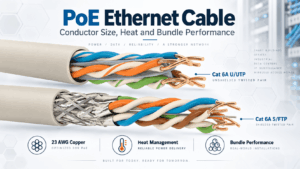
Ethernet Cable for PoE: Conductor Size, Heat and Bundle Performance
A PoE Ethernet cable carries data and electrical power over the same balanced twisted-pair cabling system. This capability simplifies t...
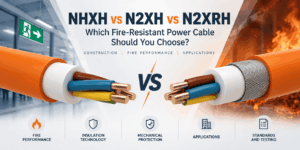
NHXH vs N2XH vs N2XRH: Which Fire-Resistant Power Cable Should You Choose?
NHXH vs N2XH vs N2XRH is an important comparison when specifying 0.6/1 kV power cables for emergency and life-safety systems. Although ...
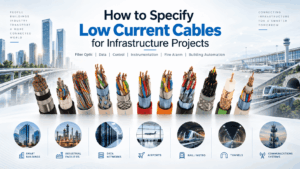
How to Specify Low Current Cables for Infrastructure Projects
A professional low current cable specification should define much more than a cable name, conductor count or sheath colour. Infrastruct...
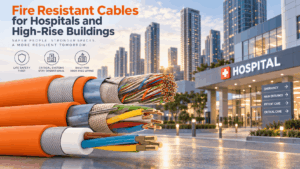
Fire Resistant Cables for Hospitals and High-Rise Buildings
Fire resistant cable for hospitals and high-rise buildings supports electrical, communication and control systems that may need to rema...
Industrial Control Cable Selection for Automation and Machinery
Industrial control cable selection should begin with the function of the circuit and the mechanical conditions of the machine rather th...
FE180 Fiber Optic Cable: Fire Integrity, Applications and Selection
An FE180 fiber optic cable is designed for optical communication routes where continued transmission during fire can form part of the p...
Screened vs Unscreened Control Cable: What Is the Difference?
Control cable shielding is one of the most important design decisions when selecting cable for industrial automation, machinery, buildi...
BMS Cable Selection: Building Automation Cables for HVAC and Smart Buildings
BMS cable selection should begin with the communication protocol and physical layer rather than with a generic request for “building au...


