





 President’s Message
Blog
A-02YSF(L)2Y vs A-2Y(L)2Y Outdoor Telephone Cable
Reading Time: 14 minutes
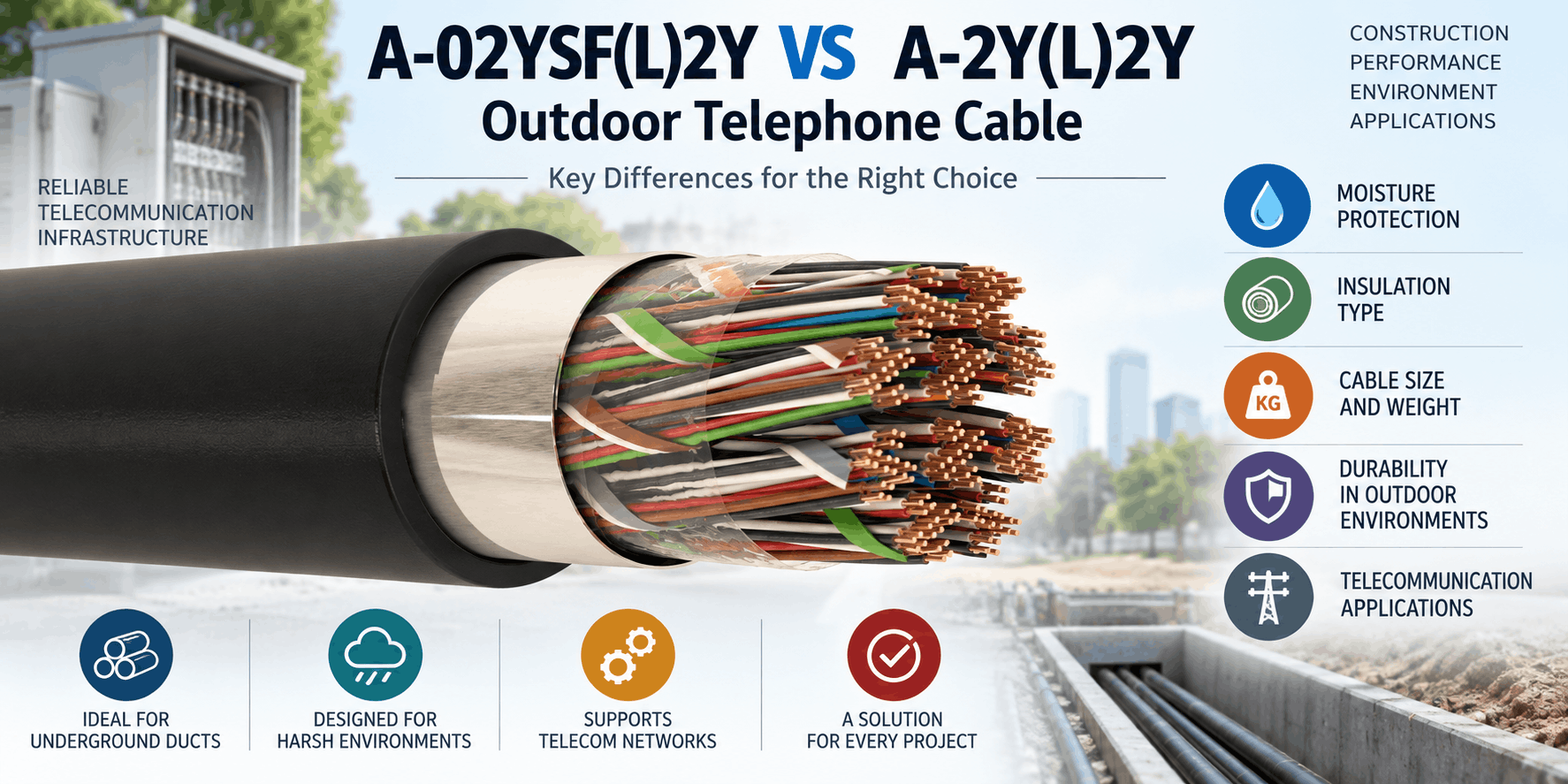
A-02YSF(L)2Y vs A-2Y(L)2Y is an important comparison when selecting copper outdoor telephone cable for telecommunications networks, underground ducts, inter-building connections and other fixed outside-plant communication systems. At first glance, the two cable designations appear very similar. Both can use solid copper conductors, multi-pair or star-quad construction, an aluminium-based screen and a black polyethylene outer sheath.
However, two construction differences significantly affect how the cables should be specified. A-02YSF(L)2Y uses foam-skin polyethylene conductor insulation and a jelly-filled cable core. By contrast, A-2Y(L)2Y uses solid polyethylene conductor insulation and a dry, unfilled core.
Therefore, the choice is not simply between two names for the same outdoor telephone cable. The insulation architecture, moisture protection, cable diameter, weight and installation environment can differ even when conductor diameter, pair count and basic electrical requirements are similar.
For example, a telecommunications route exposed to persistent moisture or a duct system where water penetration is a realistic long-term risk can benefit from the longitudinal water protection of the jelly-filled A-02YSF(L)2Y construction. Meanwhile, A-2Y(L)2Y can provide a simpler and lighter dry-core solution where the installation environment and project specification do not require jelly filling.
Quick answer: choose A-02YSF(L)2Y when the project requires foam-skin PE insulation together with jelly filling for enhanced longitudinal moisture protection. Choose A-2Y(L)2Y when solid PE insulation and a dry-core outdoor telephone cable are suitable. Both constructions can provide solid-copper conductors, aluminium laminate screening and a UV-resistant PE outer sheath, so moisture protection and insulation design are the main differences.
A-02YSF(L)2Y vs A-2Y(L)2Y at a Glance
| Characteristic | A-02YSF(L)2Y | A-2Y(L)2Y |
|---|---|---|
| ETK product code | KPDF-AP | PD-AP |
| Primary application | Outdoor telecommunications | Outdoor telecommunications |
| Conductor | Solid annealed copper | Solid annealed copper |
| Insulation | Foam-skin polyethylene | Solid polyethylene |
| Core filling | Jelly filled | Dry / unfilled |
| Secondary filling | Yes, in ETK construction | No |
| Core formation | Pairs or star quads | Pairs or star quads |
| Screen | Copolymer-coated aluminium tape | Copolymer-coated aluminium tape |
| Outer sheath | UV-resistant PE | UV-resistant PE |
| Longitudinal moisture protection | Enhanced by jelly filling | Relies on dry-core construction and outer protection |
| Relative cable weight | Generally higher for comparable configurations | Generally lower |
| Typical selection driver | Higher moisture-risk routes | Dry-core outdoor installations |
Consequently, engineers should determine the required moisture-protection concept before selecting between the two constructions.
Understanding the A-02YSF(L)2Y Designation
The cable designation describes important parts of the construction.
In the traditional German-style telecommunications cable nomenclature:
- A identifies an outdoor cable.
- 02YS refers to foam-skin polyethylene insulation.
- F indicates a filled cable core.
- (L) identifies the aluminium laminate layer.
- 2Y identifies the polyethylene outer sheath.
Therefore, the designation itself already reveals two of the most important characteristics of the cable: foam-skin insulation and a filled core.
Understanding the A-2Y(L)2Y Designation
A-2Y(L)2Y follows a similar naming system but omits both the foam-skin and filling designations.
Here:
- A identifies outdoor construction.
- 2Y identifies polyethylene conductor insulation.
- (L) identifies the aluminium laminate layer.
- 2Y identifies the polyethylene outer sheath.
As a result, A-2Y(L)2Y uses solid PE insulation and a dry-core construction.
This distinction is fundamental because the outer appearance of the completed cables can otherwise be very similar.
A-02YSF(L)2Y vs A-2Y(L)2Y: The Main Difference
The simplest way to understand A-02YSF(L)2Y vs A-2Y(L)2Y is to separate the comparison into two questions.
First, does the project require foam-skin or solid polyethylene conductor insulation?
Second, does the cable core require jelly filling for longitudinal moisture protection?
A-02YSF(L)2Y answers both questions with the more elaborate construction: foam-skin insulation plus jelly filling.
A-2Y(L)2Y uses the simpler alternative: solid PE insulation plus an unfilled core.
Meanwhile, many other construction elements remain broadly similar.
Therefore, the comparison should focus primarily on insulation architecture and water protection rather than treating every layer as different.
A-02YSF(L)2Y vs A-2Y(L)2Y: Foam-Skin vs Solid PE
Foam-skin polyethylene combines a foamed polyethylene region with a solid outer skin around the conductor.
The foamed portion reduces the amount of solid dielectric material surrounding the copper conductor. Meanwhile, the solid skin provides a continuous outer surface that supports handling, identification and manufacturing stability.
By contrast, A-2Y(L)2Y uses solid polyethylene insulation around the conductor.
Solid PE provides a simple, robust dielectric system with strong moisture resistance and established performance in outside-plant telecommunications cable.
Consequently, the two cables achieve their electrical and mechanical objectives through different insulation architectures.
Does Foam-Skin Insulation Automatically Mean Better Performance?
Not necessarily.
Foam-skin insulation can provide useful dielectric and dimensional advantages within a properly engineered telecommunications cable.
However, cable performance depends on the complete construction rather than insulation type alone.
Important parameters include:
- Conductor diameter
- Pair or quad geometry
- Mutual capacitance
- Capacitance unbalance
- Conductor resistance
- Insulation resistance
- Screen construction
Therefore, engineers should use published electrical data rather than assume that the foam-skin version automatically outperforms every solid-PE construction.
Electrical Performance in the A-02YSF(L)2Y vs A-2Y(L)2Y Comparison
Interestingly, ETK’s published technical values for the two cable families are closely aligned across corresponding conductor diameters.
For example, the current ETK data for a 0.60 mm conductor gives a maximum average conductor resistance of 62.1 Ω/km at 20°C for both product families.
The published maximum average mutual capacitance is also 45 nF/km for the 0.60 mm versions.
Therefore, the main reason to choose between the products is not necessarily a dramatic difference in the headline resistance or capacitance figures.
Instead, insulation architecture, moisture protection, physical size, weight and project requirements often become the deciding factors.
A-02YSF(L)2Y vs A-2Y(L)2Y: Why Jelly Filling Matters
Jelly filling occupies the air spaces inside the cable core.
ETK’s A-02YSF(L)2Y construction uses a special filling compound within the core to reduce water migration through those spaces.
Moreover, ETK applies a secondary jelly filling between the cable-core wrapping and the aluminium screen.
This creates an additional barrier against moisture movement.
Consequently, the cable is particularly relevant where long-term exposure to water inside ducts or underground routes represents a significant project risk.
A-02YSF(L)2Y vs A-2Y(L)2Y: Jelly-Filled vs Dry Core
A-2Y(L)2Y does not include the filling stages found in A-02YSF(L)2Y.
Instead, the conductors form pairs or star quads, the core receives its wrapping and aluminium laminate layer, and the cable is completed with the polyethylene outer jacket.
Therefore, the cable avoids the added weight and handling characteristics of jelly filling.
A dry-core construction can be suitable when the route and project design provide adequate environmental protection.
However, engineers should consider what happens if external water reaches the cable core through accidental sheath damage or an improperly sealed joint.
A-02YSF(L)2Y vs A-2Y(L)2Y for Water Protection
Water protection is one of the clearest selection factors in A-02YSF(L)2Y vs A-2Y(L)2Y.
The PE outer sheath and laminated metallic layer provide environmental protection in both constructions.
However, A-02YSF(L)2Y also fills internal spaces with water-blocking compound.
As a result, the jelly-filled construction provides additional protection against longitudinal water migration if moisture reaches the cable interior.
By contrast, a dry-core cable lacks that internal filling mechanism.
Therefore, the jelly-filled version provides a stronger moisture-management architecture for routes with persistent water exposure.
Radial vs Longitudinal Water Protection
Radial moisture protection aims to prevent water from penetrating inward through the cable layers.
Longitudinal protection aims to prevent water that has already entered the cable from travelling along its length.
The distinction matters because a damaged sheath can create a local entry point.
A laminated sheath can provide strong radial protection while intact.
However, once water enters an unfilled cable core, the internal air spaces can allow moisture to migrate along the cable.
Therefore, jelly filling provides an additional longitudinal defence that becomes particularly useful in wet outside-plant environments.
A-02YSF(L)2Y vs A-2Y(L)2Y for Duct Networks
Underground ducts represent a major application for outdoor telecommunications cables.
Although ducts provide mechanical routing and protection, they should not automatically be considered dry environments.
Water can enter through:
- Manholes
- Joint chambers
- Condensation
- Groundwater
- Damaged ducts
- Drainage problems
Therefore, persistent moisture inside a telecom duct can justify the use of A-02YSF(L)2Y.
Meanwhile, dry-core A-2Y(L)2Y can remain suitable where the network design, route condition and project specification permit it.
A-02YSF(L)2Y vs A-2Y(L)2Y for Direct Burial
Direct-burial routes place cable directly into the ground or an engineered buried installation without continuous duct protection.
As a result, environmental protection becomes particularly important.
Both cable families use polyethylene outer sheaths suitable for outdoor service according to their specific product designs.
However, the jelly-filled A-02YSF(L)2Y architecture adds internal moisture protection.
Consequently, it can be particularly attractive where the project specification allows the construction and the buried route presents a realistic water-ingress risk.
Nevertheless, direct burial also introduces mechanical considerations. Where additional armour is required, engineers should select the appropriate armoured telephone-cable construction rather than assume that either unarmoured product automatically provides sufficient mechanical protection.
Are A-02YSF(L)2Y and A-2Y(L)2Y Armoured?
The standard ETK constructions discussed in this comparison are not steel-wire-armoured cables.
The aluminium layer provides screening and contributes to the laminated cable construction, but it should not be confused with heavy mechanical armour.
Therefore, routes exposed to significant impact, crushing, digging or other mechanical hazards may require another outdoor telephone cable variant.
ETK’s broader outdoor telephone cable range includes additional constructions for different protection requirements.
Screening in A-02YSF(L)2Y vs A-2Y(L)2Y
Both ETK constructions use a flat aluminium tape coated on both sides with copolymer material.
The metallic layer provides an overall screening function around the cable core.
This helps reduce the influence of external electromagnetic fields on the low-frequency communication circuits.
Moreover, the bonded laminate concept contributes to the environmental integrity of the completed outer construction.
Therefore, screening does not represent the primary difference between A-02YSF(L)2Y and A-2Y(L)2Y.
Both products already incorporate a metallic screen layer.
Why Outdoor Telephone Cable Uses a PE Outer Sheath
Polyethylene is widely used for outdoor telecommunications cable because it provides strong resistance to moisture and environmental exposure.
ETK uses UV-resistant black polyethylene for both of these constructions.
The outer jacket protects the cable against:
- Sunlight
- Moisture
- Surface abrasion
- Normal outdoor weather exposure
Therefore, the final 2Y in both designations identifies an important shared characteristic.
However, PE sheath material alone does not determine whether the cable core is dry or jelly filled.
A-02YSF(L)2Y vs A-2Y(L)2Y: Cable Diameter
The additional filling compound and different insulation construction can affect completed cable dimensions.
For example, ETK’s published 100-pair versions with 0.60 mm conductors illustrate this difference.
The A-02YSF(L)2Y version has an approximate diameter of 26 mm.
Meanwhile, the comparable A-2Y(L)2Y version is approximately 24.2 mm.
Therefore, the jelly-filled construction can require slightly more pathway space for an otherwise comparable conductor and pair configuration.
The exact dimensional difference varies with pair count and conductor diameter, so project engineers should always use the specific product table.
A-02YSF(L)2Y vs A-2Y(L)2Y: Cable Weight
Jelly filling also contributes to cable weight.
Using the same ETK 100-pair, 0.60 mm example, A-02YSF(L)2Y is approximately 961 kg/km.
The comparable A-2Y(L)2Y construction is approximately 821 kg/km.
Consequently, the filled cable adds approximately 140 kg/km in this specific configuration.
That difference can influence:
- Drum handling
- Cable pulling
- Transport
- Support calculations
- Installation labour
Therefore, water protection should be specified where it provides a real project benefit rather than added without considering installation logistics.
Does the Lighter A-2Y(L)2Y Cable Mean Easier Installation?
Lower cable weight and smaller diameter can simplify certain installation activities.
For example, a lighter cable can reduce drum weight and pulling force over long duct routes.
A smaller outer diameter can also preserve more space inside congested ducts.
However, installation convenience should not override environmental requirements.
If the route has a significant water-ingress risk, the added protection of the jelly-filled construction can provide greater long-term value than the initial handling advantage of a dry-core cable.
Jointing and Termination Differences
Dry-core cable is generally cleaner to prepare because installers do not need to remove filling compound from the conductors and core.
Jelly-filled cable requires additional cleaning during joint preparation and termination.
Therefore, A-2Y(L)2Y can offer simpler handling during some jointing operations.
Meanwhile, the jelly inside A-02YSF(L)2Y provides the moisture-protection benefit for which the additional installation step exists.
Consequently, installation convenience and environmental protection should be balanced rather than evaluated separately.
Conductor Diameter in Outdoor Telephone Cable Selection
Both ETK cable families can be manufactured with several copper conductor diameters.
The current published ranges include sizes such as:
- 0.40 mm
- 0.50 mm
- 0.60 mm
- 0.63 mm
- 0.65 mm
- 0.80 mm
- 0.90 mm
Increasing conductor diameter reduces DC resistance.
Therefore, larger conductors can support lower loop resistance over long telecommunications routes.
However, larger copper conductors also increase cable diameter, copper weight and cost.
Consequently, conductor diameter should follow route length, transmission requirement and network design.
0.4 mm vs 0.6 mm Outdoor Telephone Cable
A 0.4 mm conductor provides a compact and economical solution for suitable network distances.
Meanwhile, 0.6 mm copper substantially reduces conductor resistance.
For both ETK product families, the current published maximum average resistance is approximately:
| Conductor Diameter | Maximum Average Resistance at 20°C |
|---|---|
| 0.40 mm | 139.4 Ω/km |
| 0.50 mm | 89.4 Ω/km |
| 0.60 mm | 62.1 Ω/km |
| 0.80 mm | 35 Ω/km |
| 0.90 mm | 27.6 Ω/km |
Therefore, conductor size can have a much larger effect on DC loop performance than the choice between foam-skin and solid-PE insulation.
Pair Count in A-02YSF(L)2Y vs A-2Y(L)2Y
Outdoor telephone cables can contain large numbers of copper pairs.
ETK’s published product tables extend from small pair-count cables to very large multi-pair constructions.
For example, project requirements can include:
- 2 pairs
- 10 pairs
- 20 pairs
- 50 pairs
- 100 pairs
- 200 pairs
- 500 pairs
- 1000 pairs or more
As pair count increases, cable diameter and weight become increasingly important installation variables.
Consequently, the difference between filled and dry constructions becomes more significant on very high-pair-count cables.
Why Star Quads Are Used in Outdoor Telephone Cable
Outdoor telephone cable can use star-quad construction to organize conductors for balanced communication circuits.
Four insulated conductors form a quad, which can provide two communication pairs.
Groups of quads are then assembled into larger cable units.
This controlled geometry supports stable low-frequency transmission and helps manage crosstalk between circuits.
Therefore, conductor arrangement forms an important part of telecom cable performance even though it is less visible than the outer sheath or filling compound.
A-02YSF(L)2Y vs A-2Y(L)2Y for Local Telephone Networks
Both cable families can serve fixed outside-plant telephone infrastructure.
Potential applications include:
- Subscriber distribution networks
- Telephone exchanges
- PBX interconnections
- Campus telecommunications
- Industrial communication systems
- Cabinet-to-building links
For a wet outside-plant route, A-02YSF(L)2Y provides the stronger internal moisture-protection concept.
For a controlled dry-core application, A-2Y(L)2Y can provide a simpler construction.
Therefore, network environment should determine the final choice.
Can These Outdoor Telephone Cables Carry Data?
Outdoor copper telephone cables can support appropriate analogue and low-frequency digital communication applications.
However, they should not be confused with modern Ethernet-category cable.
Cat 6 or Cat 6A cable uses tightly controlled pair geometry and transmission requirements for high-frequency Ethernet networks.
A-02YSF(L)2Y and A-2Y(L)2Y are outside-plant telecommunications cables intended for their specified telecom applications.
Therefore, engineers should not replace an Ethernet cable with a multi-pair telephone cable simply because both products contain twisted copper conductors.
Can A-02YSF(L)2Y or A-2Y(L)2Y Be Used for Power?
These cables are telecommunications products rather than power-distribution cables.
Their conductor sizes, insulation systems and electrical characteristics are engineered for communication circuits.
Therefore, they should not be treated as substitutes for low-voltage power cables.
If a project requires both power and communication, engineers should specify separate suitable cable systems or a purpose-designed composite construction.
A-02YSF(L)2Y vs A-2Y(L)2Y for Industrial Sites
Industrial facilities can use outdoor telephone cable for inter-building communication, legacy telephone networks, alarms and selected low-frequency signalling systems.
However, industrial sites can also present:
- High moisture
- Underground ducts
- Electromagnetic interference
- Mechanical hazards
- Long cable routes
Therefore, engineers should evaluate environmental conditions beyond the basic pair count.
A wet underground route can favour A-02YSF(L)2Y, while a protected dry-core route can support A-2Y(L)2Y.
Outdoor Telephone Cable Comparison for Railway Infrastructure
Railway stations and trackside infrastructure can contain conventional telecommunications and signalling-support networks that require rugged outdoor copper communication cables.
Cable routes can pass through outdoor ducts, technical rooms and underground chambers.
Consequently, moisture protection can become an important selection criterion.
However, railway-specific circuits can also impose project standards beyond ordinary outdoor telephone cable requirements.
Therefore, engineers should verify the complete railway specification rather than select cable from designation alone.
A-02YSF(L)2Y vs A-2Y(L)2Y and DIN VDE 0816
These cable designations belong to the established German-style nomenclature used for outdoor telecommunications cables associated with the DIN VDE 0816 family.
The standard framework covers external cables for telecommunications and information-processing systems.
However, a cable designation alone does not replace a technical datasheet.
Manufacturers can offer different conductor sizes, pair counts, physical dimensions and project-specific variants.
Therefore, procurement teams should combine the requested designation with measurable electrical and construction requirements.
Why the Complete Cable Designation Matters
Small differences in telecommunications cable codes can represent significant changes in construction.
For example:
- 02YS indicates foam-skin insulation
- 2Y indicates solid polyethylene
- F identifies filling compound
- (L) identifies the laminated aluminium layer
- T can indicate another mechanical protection element in related cable families
Consequently, deleting one letter from an RFQ can unintentionally change the requested cable architecture.
This is particularly important when international procurement teams translate local cable terminology into manufacturer quotations.
Common A-02YSF(L)2Y vs A-2Y(L)2Y Specification Mistakes
Treating the Two Cables as Identical
The insulation and core-filling systems differ, so they should not be substituted automatically.
Ignoring the F in A-02YSF(L)2Y
The filling compound is a fundamental part of the jelly-filled moisture-protection design.
Assuming Both Cables Are Jelly Filled
A-2Y(L)2Y is a dry-core construction in the ETK product design discussed here.
Ignoring Foam-Skin vs Solid PE
A-02YSF(L)2Y and A-2Y(L)2Y use different conductor-insulation architectures.
Choosing by Pair Count Alone
Conductor diameter, water protection and environmental exposure also affect cable selection.
Assuming Aluminium Screening Is Heavy Armour
The aluminium layer provides screening and laminated protection but should not be confused with steel-wire armour.
Ignoring Duct Water
Underground ducts can contain water even when the cable itself is not directly buried.
Over-Specifying Jelly Filling
Filling adds protection but can increase diameter, weight and joint-preparation effort.
Under-Specifying Moisture Protection
A dry-core cable can be a poor choice where longitudinal water migration represents a significant project risk.
Using Telephone Cable for Ethernet
Outdoor telephone cable and Ethernet cable serve different transmission applications.
Using Telephone Cable for Power Distribution
These products are communication cables rather than power cables.
Ignoring Conductor Diameter
Conductor size strongly influences resistance and long-distance loop performance.
Ignoring Cable Weight on Large Pair Counts
High-pair-count jelly-filled cables can become significantly heavier than comparable dry-core designs.
Approving Cable from the Designation Alone
The final datasheet should confirm electrical, dimensional and construction requirements.
How to Choose A-02YSF(L)2Y vs A-2Y(L)2Y
Evaluate Water Exposure First
Determine whether the cable route can experience persistent moisture, flooded ducts or groundwater exposure.
Decide Whether Longitudinal Water Blocking Is Required
Where water migration inside the core represents a significant risk, jelly-filled A-02YSF(L)2Y provides additional protection.
Select Foam-Skin or Solid PE Construction
Confirm which insulation architecture the project specification requires.
Define Conductor Diameter
Choose 0.4 mm, 0.5 mm, 0.6 mm or another available size according to loop resistance and route length.
Define the Required Pair Count
Calculate active circuits, redundancy and realistic future expansion.
Review Cable Diameter
Make sure the proposed construction fits available ducts and pathways.
Check Cable Weight
Consider drum handling, pulling equipment and installation logistics, particularly for large multi-pair cables.
Verify Mechanical Protection
If the route requires armour, select the appropriate armoured cable variant rather than relying on the aluminium screen.
Review the Installation Environment
Confirm whether the cable will run in ducts, underground, outdoors, between buildings or through industrial areas.
Verify Electrical Data
Compare conductor resistance, mutual capacitance, capacitance unbalance and dielectric strength.
Review Jointing Requirements
Consider the additional cleaning and preparation associated with jelly-filled cable.
Confirm the Complete Datasheet
Finally, approve the exact conductor size, pair count, construction and packing configuration before ordering.
A-02YSF(L)2Y vs A-2Y(L)2Y RFQ Checklist
A detailed RFQ for A-02YSF(L)2Y vs A-2Y(L)2Y should define the actual network and environmental requirements rather than asking only for “outdoor telephone cable.”
Useful parameters include:
- Required cable designation
- ETK KPDF-AP or PD-AP where applicable
- Number of pairs or star quads
- Conductor diameter
- Maximum conductor resistance
- Mutual capacitance
- Capacitance unbalance
- Insulation resistance
- Foam-skin or solid PE insulation
- Jelly-filled or dry core
- Aluminium screening requirement
- PE outer sheath
- UV resistance
- Installation environment
- Duct or buried application
- Expected water exposure
- Mechanical protection requirement
- Approximate outside-diameter limit
- Drum length
- Required cable marking
- Applicable project standard
- Required test documentation
Consequently, manufacturers can compare technically equivalent constructions and avoid substituting a dry-core cable where a filled cable was required—or vice versa.
ETK Kablo A-02YSF(L)2Y and A-2Y(L)2Y Solutions
ETK Kablo manufactures both cable families within its extensive outdoor telephone cable portfolio.
A-02YSF(L)2Y, product code KPDF-AP, uses solid copper conductors, foam-skin polyethylene insulation, jelly filling, secondary filling, an aluminium laminate screen and a UV-resistant black polyethylene outer sheath.
A-2Y(L)2Y, product code PD-AP, uses solid copper conductors, solid polyethylene insulation, an aluminium laminate screen and a UV-resistant black polyethylene outer sheath without the jelly-filling stages of KPDF-AP.
Both product families are available across multiple conductor diameters and large pair-count ranges to support telecommunications infrastructure projects.
Therefore, ETK approaches A-02YSF(L)2Y vs A-2Y(L)2Y according to route conditions, moisture exposure, pair count, conductor diameter and project specifications rather than treating the two constructions as direct equivalents.
Frequently Asked Questions About A-02YSF(L)2Y vs A-2Y(L)2Y
What is the main difference between A-02YSF(L)2Y and A-2Y(L)2Y?
A-02YSF(L)2Y uses foam-skin PE insulation and a jelly-filled core, while A-2Y(L)2Y uses solid PE insulation and a dry core.
What does F mean in A-02YSF(L)2Y?
F identifies the filled cable-core construction. Filling compound occupies internal spaces and helps restrict longitudinal water migration.
What does 02YS mean?
02YS identifies foam-skin polyethylene conductor insulation.
What does 2Y mean?
2Y denotes polyethylene. In these cable designations it appears in relation to PE insulation or the PE outer sheath depending on its position.
Is A-2Y(L)2Y jelly filled?
The ETK PD-AP construction discussed here is dry and does not include the filling-compound stages found in A-02YSF(L)2Y.
Which cable provides better protection against longitudinal water migration?
A-02YSF(L)2Y provides the stronger internal water-blocking architecture because its cable core contains jelly filling compound.
Can A-2Y(L)2Y be installed outdoors?
Yes. It is an outdoor telecommunications cable with a UV-resistant polyethylene outer sheath. The route conditions must still match the approved product specification.
Can A-02YSF(L)2Y be installed in ducts?
Yes. Its jelly-filled construction is particularly relevant for telecommunications ducts where water exposure can occur.
Which cable is lighter?
For comparable ETK configurations, dry-core A-2Y(L)2Y is generally lighter because it does not contain the additional jelly filling.
Which cable is smaller in diameter?
A-2Y(L)2Y can be slightly smaller in comparable configurations, although the exact difference depends on conductor diameter and pair count.
Do both cables have aluminium screening?
Yes. The ETK constructions discussed here use copolymer-coated aluminium tape around the cable core.
Are these cables armoured?
Not in their standard KPDF-AP and PD-AP constructions. Separate cable variants should be selected where additional mechanical armour is required.
Can these cables be used for Ethernet?
They should not be treated as substitutes for Cat 5e, Cat 6, Cat 6A or other purpose-designed Ethernet cables.
Can they carry telephone signals?
Yes. Both are designed for outdoor copper telecommunications applications including appropriate telephone and low-frequency communication circuits.
Does larger conductor diameter reduce resistance?
Yes. Increasing copper conductor diameter significantly reduces DC resistance and can improve long-distance loop performance.
Which cable should be selected for a wet underground route?
A-02YSF(L)2Y is generally the stronger starting point where the project specifically requires additional longitudinal moisture protection.
Which cable is easier to clean during jointing?
A-2Y(L)2Y is cleaner to prepare because its core does not contain the jelly filling found in A-02YSF(L)2Y.
Is foam-skin insulation always better than solid PE?
No. The correct construction depends on the required electrical, physical and environmental performance. The complete datasheet should control the decision.
Are A-02YSF(L)2Y and A-2Y(L)2Y interchangeable?
Not automatically. Moisture protection and insulation design differ, so a substitution should receive technical approval.
How should A-02YSF(L)2Y vs A-2Y(L)2Y be selected?
Start with water exposure and moisture-protection requirements, then compare insulation type, conductor diameter, pair count, electrical performance, cable dimensions and installation conditions.
Conclusion
The A-02YSF(L)2Y vs A-2Y(L)2Y comparison demonstrates why seemingly small differences in telecommunications cable designations can represent meaningful construction changes.
A-02YSF(L)2Y combines foam-skin polyethylene conductor insulation with a jelly-filled cable core. ETK also applies secondary filling between the core wrapping and aluminium screen, providing an additional moisture-protection layer.
By contrast, A-2Y(L)2Y uses solid polyethylene insulation and a dry-core construction. This can reduce cable diameter and weight while simplifying cable preparation during jointing.
Meanwhile, both product families use solid copper conductors, organized pairs or star quads, aluminium laminate screening and UV-resistant polyethylene outer sheaths.
Therefore, the decision should focus primarily on moisture exposure, insulation architecture and installation conditions rather than assuming that one product is universally superior.
Choose the Moisture-Protection Strategy First
For routes with substantial water-ingress risk, the jelly-filled A-02YSF(L)2Y architecture provides additional protection against longitudinal moisture migration.
For suitable dry-core outdoor applications, A-2Y(L)2Y can offer a simpler and lighter construction.
Next, conductor diameter should be matched to the required loop resistance and network distance.
Afterward, pair count, cable diameter, weight and mechanical protection should be checked against the installation route.
Finally, procurement teams should verify the complete manufacturer datasheet because the cable designation identifies the architecture but does not replace detailed electrical and dimensional requirements.
Benzer yazılar
Ethernet Cable Testing: NEXT, Return Loss, Insertion Loss and ACR Explained
Ethernet cable testing verifies whether a twisted-pair copper cabling system can transmit data within the electrical performance limits...
Fiber Optic Cable Attenuation: 850, 1310, 1550 and 1625 nm Explained
Fiber optic cable attenuation describes the reduction in optical power as light travels through an optical fiber. It is normally expres...
A-02YSF(L)2Y vs A-2Y(L)2Y Outdoor Telephone Cable
A-02YSF(L)2Y vs A-2Y(L)2Y is an important comparison when selecting copper outdoor telephone cable for telecommunications networks, und...
RS-485 Cable vs Instrumentation Cable: Can Instrumentation Cable Be Used for Modbus RTU?
A Modbus RTU cable must do more than carry a low-voltage digital signal from one device to another. Modbus RTU commonly uses an RS-485 ...
Ethernet Cable for PoE: Conductor Size, Heat and Bundle Performance
A PoE Ethernet cable carries data and electrical power over the same balanced twisted-pair cabling system. This capability simplifies t...
NHXH vs N2XH vs N2XRH: Which Fire-Resistant Power Cable Should You Choose?
NHXH vs N2XH vs N2XRH is an important comparison when specifying 0.6/1 kV power cables for emergency and life-safety systems. Although ...
How to Specify Low Current Cables for Infrastructure Projects
A professional low current cable specification should define much more than a cable name, conductor count or sheath colour. Infrastruct...
Fire Resistant Cables for Hospitals and High-Rise Buildings
Fire resistant cable for hospitals and high-rise buildings supports electrical, communication and control systems that may need to rema...
Industrial Control Cable Selection for Automation and Machinery
Industrial control cable selection should begin with the function of the circuit and the mechanical conditions of the machine rather th...
FE180 Fiber Optic Cable: Fire Integrity, Applications and Selection
An FE180 fiber optic cable is designed for optical communication routes where continued transmission during fire can form part of the p...
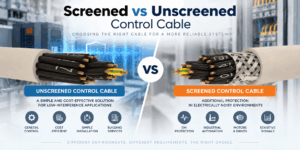
Screened vs Unscreened Control Cable: What Is the Difference?
Control cable shielding is one of the most important design decisions when selecting cable for industrial automation, machinery, buildi...
BMS Cable Selection: Building Automation Cables for HVAC and Smart Buildings
BMS cable selection should begin with the communication protocol and physical layer rather than with a generic request for “building au...


