





 President’s Message
Blog
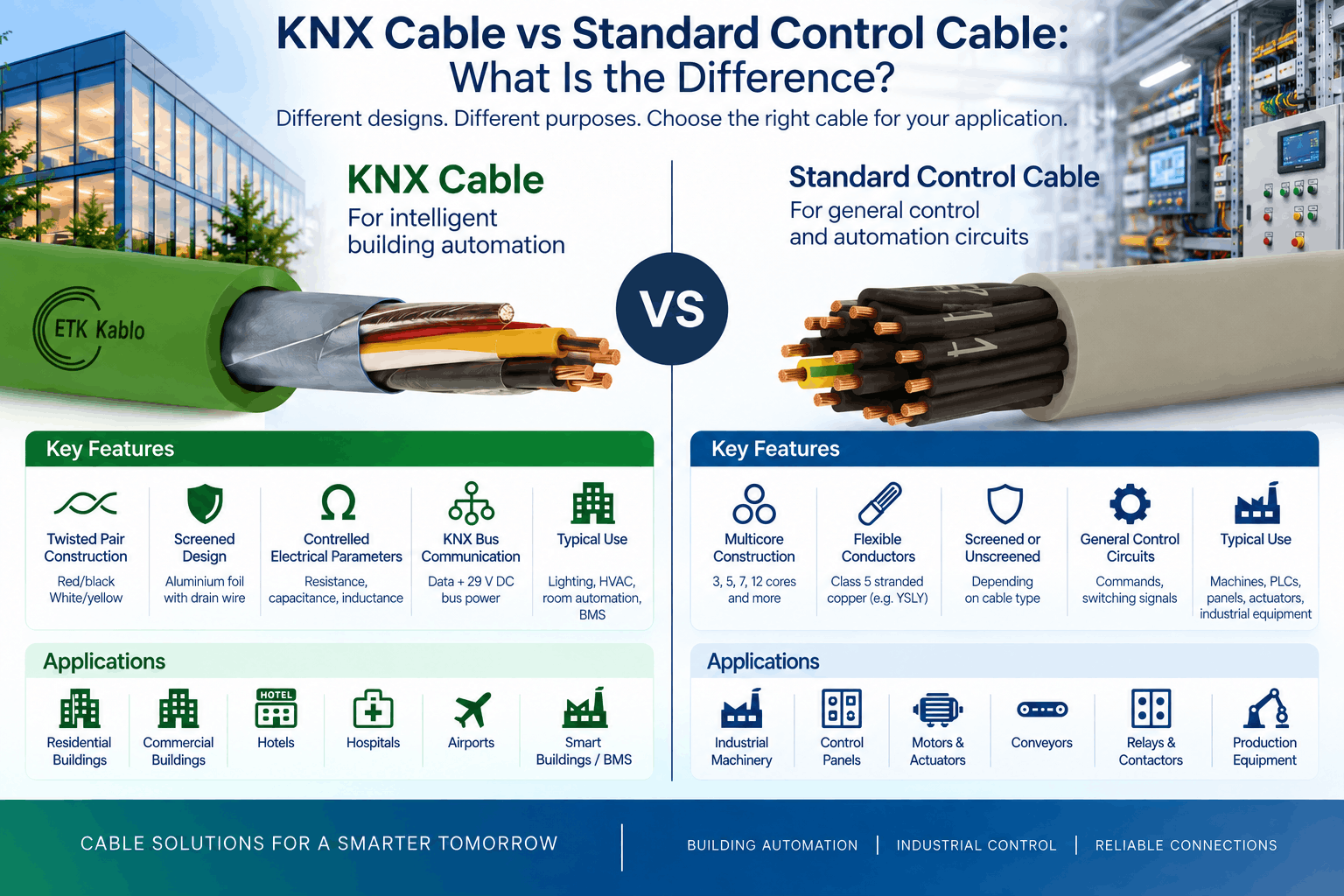
KNX Cable vs Standard Control Cable: What Is the Difference?
Reading Time: 17 minutes
KNX vs control cable selection can look deceptively simple because both cable types may contain copper conductors, insulation, an outer sheath and, in some versions, a metallic screen. However, the two cable families are designed around fundamentally different electrical and communication requirements.
A KNX cable is a purpose-designed twisted-pair bus cable used as the physical communication medium for KNX TP building automation systems. It carries both KNX communication and bus power between devices such as sensors, switches, actuators, room controllers and gateways.
A standard control cable, by contrast, is a broader cable category used to transmit commands, switching signals, auxiliary power or control functions between industrial and automation equipment. Common constructions include multicore YSLY, screened YSLYCY and halogen-free HSLH or HSLHCH cable families.
Therefore, matching conductor count or voltage alone does not make the two cables interchangeable. KNX communication depends on defined conductor dimensions, loop resistance, pair twisting, capacitance, inductance and screening characteristics. A general-purpose control cable may not be designed around these parameters.
Quick answer: KNX cable is a protocol-specific twisted-pair communication cable engineered for KNX TP networks. Standard control cable is a general-purpose multicore cable designed for command, switching and automation circuits. A control cable should not automatically replace KNX cable because conductor arrangement, resistance, twisting, capacitance, shielding and communication characteristics can differ significantly.
KNX vs Control Cable at a Glance
| Characteristic | KNX Cable | Standard Control Cable |
|---|---|---|
| Primary purpose | KNX TP building automation bus | General control and command circuits |
| Typical construction | Twisted pairs | Multicore |
| Standardized KNX conductor diameter | 0.8–1.0 mm | Usually specified by mm² cross-section |
| Common conductor type | Copper | Solid or stranded copper depending on design |
| Typical ETK control conductor | Application specific | Class 5 flexible copper in many YSL/HSL families |
| Pair twisting | Critical to KNX TP performance | Not inherent to conventional multicore construction |
| Overall screen | Typical standardized KNX feature | Optional depending on cable type |
| Loop resistance | Controlled for KNX network operation | Depends on conductor size and cable design |
| Capacitance | Controlled communication parameter | Not necessarily optimized for KNX |
| Inductance | Controlled communication parameter | Usually not a primary general control-cable parameter |
| Bus power | Carried with KNX communication | Depends on control circuit |
| Typical applications | BMS, lighting, HVAC, room automation | Machinery, relays, contactors, actuators, panels |
| Common cable families | EIB-Y(St)Y, EIB-H(St)H | YSLY, YSLYCY, HSLH, HSLHCH |
Consequently, KNX cable and conventional control cable can sometimes look similar from the outside while performing very different functions inside the automation system.
What Is a KNX Cable?
A KNX cable provides the wired physical medium for KNX Twisted Pair building automation networks.
The cable connects KNX devices such as:
- Wall switches
- Presence detectors
- Temperature sensors
- Lighting actuators
- Blind controllers
- Room controllers
- HVAC interfaces
- Energy meters
- KNX gateways
- Visualization interfaces
The principal red/black conductor pair carries both data communication and approximately 29 V DC bus power.
As a result, the cable performs two linked functions: it provides a communication channel and helps supply connected KNX bus electronics.
Therefore, electrical properties such as conductor resistance matter in addition to communication characteristics.
What Is a Standard Control Cable?
A standard control cable is generally used to connect electrical and automation equipment that exchanges commands, switching signals or auxiliary control functions.
Typical applications include:
- Industrial machinery
- Control panels
- PLC systems
- Relay circuits
- Contactors
- Limit switches
- Solenoid valves
- Actuators
- Conveyors
- Production equipment
General control cables frequently use multiple individually insulated conductors assembled together as one multicore cable.
Depending on the application, they can be screened or unscreened, PVC or LSZH, flexible or designed primarily for fixed installation.
Importantly, “standard control cable” is a general engineering description rather than one universal cable construction. Different products can have different voltage ratings, conductor classes, screening systems and materials.
KNX vs Control Cable: The Fundamental Difference
The clearest distinction is the intended electrical function.
A KNX cable forms part of a defined digital communication network.
A control cable generally connects equipment through individual control circuits.
For example, a KNX wall switch can send a digital telegram over the shared bus instructing a lighting actuator to switch several luminaires.
A conventional control system might instead use dedicated conductors between a switch, relay and control panel.
Therefore, KNX reduces the need for many individual point-to-point control connections by allowing multiple intelligent devices to share one communication bus.
Bus Communication vs Point-to-Point Control
Traditional control wiring commonly assigns conductors to individual functions.
One core might carry a start command. Another can carry a stop signal. Additional conductors can transmit interlocks, feedback or relay status.
KNX works differently.
Multiple KNX devices share a common bus and exchange digitally addressed messages.
Consequently, the information carried through a KNX cable depends on telegrams rather than assigning one cable core permanently to every automation function.
This system architecture is one reason a conventional multicore cable should not automatically be treated as a KNX replacement.
KNX Cable Uses Twisted Pairs
Pair twisting forms an important part of KNX TP cable construction.
In a standardized two-pair KNX cable, the conductor colours commonly include:
- Red / black
- White / yellow
The red/black pair serves the KNX bus.
The white/yellow pair provides the additional pair permitted by the cable design.
Twisting helps maintain controlled electrical geometry and improves resistance to external electromagnetic interference.
Therefore, pair construction is a functional part of KNX communication performance rather than merely a way of organizing conductors.
Control Cable Is Commonly Multicore
General control cables frequently arrange the conductors as multiple cores rather than communication pairs engineered for a particular bus system.
Typical configurations can include:
- 3 cores
- 5 cores
- 7 cores
- 12 cores
- 18 cores
- 25 cores
- Higher multicore constructions
The conductors can use colour identification or numerical coding.
For example, an industrial machine might require several auxiliary command and feedback circuits in one flexible cable.
A multicore construction is efficient for this purpose. Nevertheless, this arrangement does not automatically provide the pair geometry required by KNX TP communication.
KNX vs Control Cable: Why Twisting Matters
Electrical cables installed inside buildings operate near many sources of electromagnetic disturbance.
Examples include:
- Mains cables
- LED drivers
- Motors
- Transformers
- Switch-mode power supplies
- Elevators
- Variable-frequency drives
- Electrical distribution equipment
Twisting allows interference to influence the conductors of a balanced pair more similarly.
Consequently, the communication receiver can reject part of the common unwanted signal.
A generic multicore cable without appropriate pair construction may therefore behave differently from a purpose-designed KNX bus cable.
Conductor Size: KNX vs Control Cable
The way conductor size is stated also differs frequently between the two cable families.
Standardized KNX TP cable requirements define copper conductor diameter within:
0.8 mm to 1.0 mm
A familiar KNX cable construction is therefore written as:
2 × 2 × 0.8 mm
Control cables, meanwhile, are commonly specified by conductor cross-sectional area:
- 0.5 mm²
- 0.75 mm²
- 1.0 mm²
- 1.5 mm²
- 2.5 mm²
- Higher sizes
Therefore, the dimensional notation itself provides an important clue about the cable’s intended construction.
0.8 mm Is Not 0.8 mm²
This distinction deserves special attention when comparing KNX and control cable specifications.
A KNX conductor described as:
0.8 mm
refers to conductor diameter.
A control-cable conductor described as:
0.8 mm²
would refer to conductor cross-sectional area.
These are mathematically different dimensions.
Consequently, changing “0.8 mm” to “0.8 mm²” in a tender document materially changes the conductor specification.
Solid and Flexible Conductors
Fixed-installation KNX bus cables commonly use solid copper conductors.
Standard control cable families, meanwhile, frequently use stranded conductors to improve flexibility.
For example, many ETK YSLY, YSLYCY, HSLH and related control cable constructions use Class 5 stranded copper conductors.
This is useful in automation applications where cables must route conveniently through machines and control cabinets.
However, conductor flexibility does not determine communication compatibility.
Therefore, a more flexible control cable should not be considered technically superior to KNX cable simply because it is easier to bend.
KNX vs Control Cable: Loop Resistance
Loop resistance has particular importance in KNX because the red/black pair carries both data and bus power.
The standardized KNX cable declaration defines loop resistance within a controlled range.
Therefore, resistance affects:
- Voltage drop
- Maximum network distances
- Available voltage at bus devices
- System reliability
A generic control cable also has conductor resistance. However, the cable may not have been selected or tested according to the KNX network’s standardized electrical requirements.
Consequently, equal conductor count does not mean equal bus performance.
Why Voltage Drop Matters
The KNX power supply commonly provides approximately 29 V DC to the bus.
As current travels along the cable, conductor resistance causes voltage drop.
The amount depends on:
- Cable length
- Loop resistance
- Connected load
- Number of devices
- Topology
KNX network rules therefore place limits on distances such as power-supply-to-device and total cable length.
A thin generic communication cable might transmit a signal over a short test connection yet produce excessive voltage drop in a large installed network.
Therefore, successful bench communication does not prove long-distance KNX suitability.
KNX vs Control Cable: Capacitance Differences
Capacitance is another reason cable substitution requires caution.
Capacitance develops between conductors according to their:
- Spacing
- Insulation material
- Geometry
- Diameter
- Twist construction
KNX cable specifications control capacitance because the bus waveform must propagate reliably over substantial distances.
General control cables may provide capacitance information, but their construction is not necessarily optimized for the KNX transmission system.
Therefore, two cables with similar copper content can still have significantly different electrical behaviour.
Inductance and KNX Communication
Inductance also forms part of the KNX cable’s electrical transmission characteristics.
It interacts with resistance and capacitance as signals travel along the conductor pair.
For many ordinary relay or switching circuits, engineers do not choose the cable primarily according to inductance.
KNX communication, by contrast, operates as a defined bus system whose cable parameters must remain within an appropriate range.
Consequently, comparing KNX and control cable only by conductor diameter overlooks important electrical properties.
KNX vs Control Cable: Shielding Differences
Screening is another major distinction.
KNX TP cables commonly use an overall metallic foil screen around the cable core.
Typical construction can include:
- Aluminium/polyester foil
- Drain wire
A standard control cable can either be screened or unscreened.
For example:
- YSLY → typically unscreened
- YSLYCY → screened construction
- HSLH → typically unscreened halogen-free construction
- HSLHCH → screened halogen-free construction
Therefore, shielding alone does not turn a control cable into a KNX cable.
Does a Screened Control Cable Replace KNX Cable?
Not automatically.
This is a common specification mistake.
A screened control cable may provide excellent electromagnetic protection, particularly when copper braid surrounds the cable core.
However, KNX suitability also depends on:
- Pair construction
- Conductor dimensions
- Loop resistance
- Capacitance
- Inductance
- Transmission behaviour
Consequently, adding a metallic screen solves only one part of the communication requirement.
Foil Screen vs Copper Braid
KNX bus cables commonly use a foil-based overall screen.
Many industrial control cables instead use copper braid screening.
The two screen systems have different construction characteristics.
Foil can provide high coverage around the cable core while maintaining compact dimensions.
Copper braid can provide robust screening and greater mechanical flexibility in industrial applications.
However, neither screen should be considered universally superior.
Therefore, the correct screen depends on the cable’s electrical design and intended communication or control function.
KNX Cable Carries Data and Bus Power
One defining characteristic of KNX TP is that the main conductor pair carries both communication and low-voltage bus power.
The cable therefore connects intelligent devices without requiring a separate local bus-power cable for each individual KNX sensor or interface.
General control cable can also carry low-voltage electrical signals or auxiliary power.
However, that does not make it a bus cable.
The important difference is that KNX integrates power and a defined digital communication system on the same pair.
Control Cable Carries Dedicated Functions
A control cable frequently assigns cores to dedicated circuits.
For example:
- Core 1 → start
- Core 2 → stop
- Core 3 → status
- Core 4 → alarm
- Core 5 → auxiliary function
Different installations use different arrangements.
In contrast, KNX devices exchange addressed digital messages over the shared bus.
Consequently, one KNX cable can coordinate many automation functions without dedicating a separate conductor to each command.
KNX vs Control Cable for Building Automation
Both cable families can appear in the same building automation project.
KNX cable might connect:
- Room switches
- Temperature sensors
- Presence detectors
- Blind controls
- Lighting actuators
Meanwhile, conventional control cable can connect:
- Motorized equipment
- Control panels
- Pumps
- Fans
- Relays
- Auxiliary contacts
Therefore, KNX and control cables are often complementary rather than competing cable types.
KNX Cable for Lighting Automation
KNX lighting systems can use the shared bus to transmit commands for switching, dimming, scenes, occupancy control and daylight management.
The bus cable connects user interfaces and sensors with KNX actuators.
However, the KNX bus generally does not replace the mains power cables feeding luminaires.
Consequently, a lighting system can contain KNX communication cable, mains power cable and conventional control wiring simultaneously.
Control Cable for Lighting Systems
Standard control cable can also appear in lighting systems.
It can connect:
- Relays
- Contactors
- Control panels
- External control interfaces
- Auxiliary status contacts
Nevertheless, those functions do not necessarily use the KNX communication protocol.
Therefore, the phrase “lighting control cable” should not automatically be interpreted as KNX cable.
KNX vs Control Cable for HVAC
HVAC systems provide another example where both cable families can coexist.
KNX can connect:
- Room thermostats
- Temperature sensors
- Fan-coil controllers
- Valve actuators
- Air-quality sensors
- Building automation gateways
Meanwhile, standard control cable can connect pumps, fans, contactors, motorized dampers and conventional HVAC control equipment.
Consequently, cable selection depends on whether the connected devices communicate through KNX or through conventional electrical control circuits.
KNX vs Control Cable for BMS
A Building Management System can contain several communication technologies.
For example, a BMS can integrate:
- KNX
- BACnet
- Modbus
- Ethernet
- Conventional I/O
KNX cable serves the KNX TP segment.
Control cables can meanwhile connect conventional field devices to automation panels or controllers.
Therefore, “BMS cable” is not one universal cable type.
The protocol and circuit function should always be identified before choosing the cable.
KNX vs Control Cable for Industrial Automation
Industrial automation usually involves extensive control wiring between machinery, PLCs, relays, sensors and actuators.
General-purpose control cables are well suited to many of these circuits because they can provide:
- High core counts
- Flexible conductors
- PVC or LSZH materials
- Screened options
- Industrial mechanical performance
KNX, meanwhile, is primarily associated with building and room automation rather than serving as a universal industrial machine-control bus.
Consequently, YSLY or YSLYCY should not automatically be replaced by KNX cable in industrial equipment either.
EIB-Y(St)Y vs YSLY
EIB-Y(St)Y and YSLY illustrate the difference clearly.
EIB-Y(St)Y is a twisted-pair screened bus cable designed for KNX/EIB building automation.
YSLY is a flexible multicore control cable designed for general control and automation circuits.
Although both can use PVC materials, their core construction and electrical design differ.
Therefore, matching sheath chemistry does not make the two products interchangeable.
EIB-Y(St)Y vs YSLYCY
YSLYCY brings the comparison closer because it includes electromagnetic screening.
Nevertheless, the difference remains fundamental.
EIB-Y(St)Y uses bus-oriented twisted-pair construction.
YSLYCY uses flexible multicore conductors and a screen for industrial control applications.
Consequently, a purchasing specification should not replace EIB-Y(St)Y with YSLYCY merely because both products are screened.
EIB-H(St)H vs HSLH
The same principle applies to halogen-free products.
EIB-H(St)H provides a halogen-free screened bus-cable construction for suitable KNX/EIB building automation applications.
HSLH provides a halogen-free control-cable construction for general control functions.
Both may satisfy a project requirement for reduced smoke and halogen emissions.
However, their intended electrical functions remain different.
Therefore, LSZH material construction does not establish KNX compatibility.
Can YSLY Be Used as KNX Cable?
YSLY should not automatically be specified as a replacement for a purpose-designed KNX TP cable.
Although YSLY provides copper conductors and can transmit low-voltage control signals, conventional YSLY construction does not inherently provide the standardized KNX pair geometry and electrical characteristics.
The important missing comparison points can include:
- Twisted-pair arrangement
- KNX loop resistance limits
- Controlled capacitance
- Controlled inductance
- Required screening
Therefore, use the cable construction designed for the actual communication system.
Can YSLYCY Be Used as KNX Cable?
The addition of screening does not automatically make YSLYCY suitable for KNX.
YSLYCY is valuable for conventional control circuits exposed to electromagnetic interference.
However, KNX requires more than an EMI screen.
The cable core must also provide the appropriate communication-pair geometry and electrical characteristics.
Consequently, YSLYCY and KNX cable should remain separate products unless a specific cable has been engineered, tested and documented for the KNX application.
Can HSLH or HSLHCH Replace KNX Cable?
The same rule applies to halogen-free control cables.
HSLH and HSLHCH can provide excellent control-cable solutions where a project requires LSZH materials.
Nevertheless, LSZH describes fire-related material characteristics rather than communication protocol compatibility.
A suitable KNX application should instead use a KNX/EIB bus cable whose electrical characteristics satisfy the required network specification.
Therefore, fire performance and protocol performance should be evaluated independently.
Can Cat6 Cable Replace KNX Cable?
Cat6 is another cable sometimes considered because it also uses twisted copper pairs.
However, Cat6 is designed for high-frequency Ethernet transmission and has different:
- Conductor dimensions
- Pair geometry
- Characteristic impedance
- Frequency performance
- Resistance characteristics
Most importantly, conductor resistance can become significant because KNX also supplies bus power over the pair.
Consequently, Ethernet cable should not be treated as the normal substitute for a purpose-designed KNX cable.
Does Cable Colour Define KNX Compatibility?
No.
Green is strongly associated with KNX/EIB cable in the market, but sheath colour is not an electrical specification.
A green cable can still have unsuitable:
- Conductors
- Resistance
- Pair construction
- Capacitance
- Screening
- Fire performance
Likewise, technically appropriate KNX constructions can exist in other sheath colours where permitted by the applicable product and project requirements.
Therefore, cable colour should help identification rather than determine technical suitability.
KNX Cable Certification vs Control Cable Compliance
KNX Association operates a formal process for manufacturers that want to place the KNX trademark on TP cable.
The process requires technical documentation and test evidence covering relevant cable characteristics.
Standard control cables follow the standards and technical requirements applicable to their own cable families and projects.
Consequently, ordinary control-cable compliance does not automatically establish KNX certification.
If a tender specifically requires registered or certified KNX cable, buyers should request the corresponding documentary evidence.
KNX Compatible vs KNX Certified
These terms should not be used interchangeably.
A manufacturer can engineer a cable with characteristics intended for KNX-type applications.
Formal KNX trademark use, however, follows the KNX Association’s registration and certification process.
Therefore, procurement teams should distinguish between:
- Generic bus cable
- KNX-compatible cable
- Registered or certified KNX cable
The contractual requirement should determine which documentation the supplier must provide.
KNX vs Control Cable Fire Performance
Fire performance is independent from communication function.
Both KNX and control cables can be manufactured using different material systems.
Possible requirements include:
- PVC
- LSZH
- Flame-retardant performance
- CPR classification
- Low smoke
- Low acidity
Therefore, neither “KNX” nor “control cable” automatically defines the cable’s complete fire behaviour.
Project engineers should specify communication performance and fire performance separately.
PVC KNX vs PVC Control Cable
PVC can be used in suitable versions of both cable families.
EIB-Y(St)Y can provide a PVC-based KNX/EIB bus construction.
Meanwhile, YSLY and YSLYCY can provide PVC-based conventional control solutions.
However, sharing a sheath material does not make the internal designs equivalent.
Consequently, PVC should be evaluated as one construction parameter among many rather than a cable-function identifier.
LSZH KNX vs LSZH Control Cable
Halogen-free versions also exist on both sides of the comparison.
EIB-H(St)H provides an LSZH-style KNX/EIB bus solution.
HSLH and screened variants provide halogen-free control-cable solutions.
Both can be attractive in:
- Airports
- Hospitals
- Hotels
- Commercial buildings
- Transport infrastructure
- High-occupancy facilities
Nevertheless, LSZH chemistry does not change the fundamental distinction between bus communication and conventional control circuits.
CPR Classification for KNX and Control Cable
Cables permanently installed in applicable European construction works can require CPR reaction-to-fire classification.
Possible classes include:
- B2ca
- Cca
- Dca
- Eca
Depending on the class, additional smoke, flaming-droplet and acidity ratings can also apply.
A KNX cable and a control cable can potentially achieve the same CPR class while remaining entirely different electrically.
Therefore, CPR classification should not be used as evidence that one cable can replace the other.
KNX vs Control Cable Installation Environment
The physical installation environment also influences cable selection.
Indoor KNX bus cable can suit conventional building routes.
Outdoor or industrial areas can require additional:
- UV resistance
- Moisture resistance
- Mechanical protection
- Temperature capability
- Special sheath materials
Control cables face similar environmental decisions.
Consequently, choosing the correct communication architecture is only the first step; the cable construction must also match the physical environment.
When Should You Use KNX Cable?
Use an appropriate KNX TP cable when the cable forms part of a KNX twisted-pair network.
Typical applications include:
- Lighting automation
- Room control
- HVAC automation
- Blind and shutter control
- Presence detection
- Energy management
- Smart homes
- Hotels
- Office buildings
- Hospitals
- Airports
The exact construction should then match certification, fire and environmental requirements.
When Should You Use Standard Control Cable?
Use standard control cable when the circuit performs conventional command, switching, auxiliary or equipment-control functions and does not require KNX TP communication characteristics.
Typical applications include:
- Industrial machines
- PLC cabinets
- Relay circuits
- Contactors
- Actuators
- Motor controls
- Auxiliary circuits
- Production lines
- Conveyors
- Building-services equipment
Screening, conductor size, flexibility and sheath material can then be selected according to the application.
Common KNX vs Control Cable Selection Mistakes
1. Selecting by Conductor Count Alone
Four copper conductors do not automatically create a KNX-compatible cable.
2. Using YSLY Because the Voltage Is Low
Bus communication requires more than a suitable operating voltage.
3. Assuming Screening Makes YSLYCY Suitable for KNX
Screening does not establish pair geometry, capacitance or loop resistance.
4. Confusing 0.8 mm with 0.8 mm²
One measurement specifies diameter, while the other specifies cross-sectional area.
5. Ignoring Loop Resistance
Excessive resistance can cause unacceptable KNX bus voltage drop.
6. Ignoring Pair Twisting
KNX TP communication relies on suitable balanced pair construction.
7. Ignoring Capacitance
Matching copper size does not guarantee matching transmission behaviour.
8. Assuming Any Green Cable Is KNX Cable
Outer-sheath colour does not prove electrical compliance.
9. Assuming LSZH Means KNX Compatible
LSZH describes material characteristics, not communication performance.
10. Assuming CPR Class Defines Communication Performance
Reaction to fire and network compatibility are independent characteristics.
11. Using Cat6 as a Universal Substitute
Ethernet and KNX TP cables have different electrical design objectives.
12. Assuming KNX Cable Replaces Every Control Cable
Many conventional machine and equipment circuits still require dedicated control cables.
13. Ignoring Certification Requirements
A tender can explicitly require formally registered or certified KNX cable.
14. Confusing Compatible with Certified
The descriptions carry different documentary implications.
15. Ignoring Environmental Requirements
Indoor communication suitability does not establish outdoor or industrial durability.
How to Choose KNX vs Control Cable
Step 1: Identify the Communication Method
Determine whether the connected devices communicate through KNX TP or conventional control circuits.
Step 2: Check the Equipment Documentation
Review the controller, actuator, sensor or automation-system requirements.
Step 3: Define Conductor Construction
Determine whether the application needs twisted pairs or conventional multicore conductors.
Step 4: Check Resistance Requirements
For KNX, verify the applicable loop-resistance requirements and network distance.
Step 5: Review Transmission Parameters
Check capacitance, inductance and other communication characteristics where required.
Step 6: Define Shielding
Select the correct overall screen or screened control-cable construction according to the system.
Step 7: Select PVC or LSZH
Match sheath and insulation materials to the building’s fire requirements.
Step 8: Check CPR Requirements
Specify the required Euroclass for applicable European building installations.
Step 9: Evaluate the Environment
Add UV, temperature, moisture or mechanical protection requirements where necessary.
Step 10: Verify Certification
If the project requires formal KNX cable certification, request documentary evidence before approval.
What Should Buyers Include in a KNX or Control Cable RFQ?
A precise RFQ prevents suppliers from quoting cables that appear similar but serve different functions.
For KNX cable, relevant information can include:
- KNX TP application
- Number of pairs
- Conductor diameter
- Conductor material
- Colour coding
- Loop resistance
- Pair twisting
- Capacitance
- Inductance
- Overall screen
- Drain wire
- PVC or LSZH construction
- CPR class
- Indoor or outdoor application
- Certification requirement
For conventional control cable, the RFQ can instead specify:
- Number of cores
- Conductor cross-section
- Conductor class
- Voltage rating
- Screened or unscreened construction
- PVC or LSZH
- Flexibility requirement
- Fire performance
- Environmental requirements
Consequently, manufacturers can quote technically appropriate products rather than interpreting the phrase “automation cable” differently.
ETK Kablo KNX and Control Cable Solutions
ETK Kablo manufactures separate cable families for KNX/EIB building automation and conventional industrial control applications.
For KNX and EIB networks, ETK’s building automation portfolio includes constructions such as:
- EIB-Y(St)Y
- EIB-H(St)H
- EIB-2Y(St)Y
- EIB-2Y(St)H
Depending on the product, these cables combine twisted copper pairs, overall metallic screening and suitable PVC, halogen-free or outdoor material systems.
Meanwhile, ETK’s conventional control portfolio includes:
- YSLY
- YSLYCY
- HSLH
- HSLCH
- HSLHCH
- Other project-specific control constructions
These products provide different combinations of flexible multicore conductors, screening, sheath materials and fire performance for machinery, panels, industrial automation and building-services control.
Therefore, ETK approaches KNX vs control cable selection according to the communication system rather than attempting to use one general-purpose cable for every automation function.
Frequently Asked Questions About KNX vs Control Cable
What is the difference between KNX cable and control cable?
KNX cable is a purpose-designed twisted-pair bus cable for KNX TP building automation. Control cable is a broader multicore cable category used for conventional command and automation circuits.
Can control cable be used for KNX?
It should not be assumed suitable. The cable must satisfy the required KNX conductor, resistance, twisting, capacitance, inductance and screening characteristics.
Can YSLY be used as KNX cable?
Conventional YSLY is a general control cable and should not automatically replace a purpose-designed KNX TP cable.
Can YSLYCY be used for KNX?
Screening alone does not make YSLYCY equivalent to KNX cable. Pair geometry and electrical transmission characteristics also matter.
Is KNX cable a control cable?
It performs a building-control function, but technically it is better understood as a specialized bus communication cable rather than a conventional multicore control cable.
Why does KNX cable use twisted pairs?
Twisting supports balanced communication, consistent electrical characteristics and improved resistance to electromagnetic interference.
Why is KNX cable screened?
The overall metallic screen helps protect the bus against external electromagnetic interference.
Does control cable need screening?
Not always. Screening depends on the electromagnetic environment and connected equipment.
What conductor size does KNX cable use?
Standardized KNX TP cable requirements define copper conductor diameter between 0.8 and 1.0 mm.
Is KNX cable 0.8 mm²?
No. The common 2 × 2 × 0.8 mm designation refers to conductor diameter rather than 0.8 mm² conductor area.
What voltage does KNX cable carry?
The KNX TP bus typically operates around 29 V DC, while the cable itself can have higher insulation or voltage-withstand ratings.
Can Cat6 replace KNX cable?
Cat6 is engineered for Ethernet and has different electrical design objectives. Purpose-designed KNX TP cable remains the appropriate normal specification.
Is EIB cable the same as KNX cable?
EIB was a predecessor technology that became a major foundation of KNX. Therefore, KNX/EIB terminology remains common for compatible building automation bus cables.
What is EIB-Y(St)Y?
EIB-Y(St)Y is a screened PVC-based bus cable used for suitable KNX/EIB building automation applications.
What is EIB-H(St)H?
EIB-H(St)H is a screened halogen-free KNX/EIB building automation cable construction.
What is YSLY?
YSLY is a flexible multicore control cable commonly used for industrial automation, machinery and general control circuits.
What is YSLYCY?
YSLYCY is a screened control cable used where conventional control circuits require additional electromagnetic interference protection.
Is KNX cable LSZH?
KNX cables can use either PVC or halogen-free material systems depending on the product and project requirement.
Can control cable be LSZH?
Yes. HSLH and related cable families provide halogen-free options for conventional control applications.
Is KNX cable used for HVAC?
Yes. KNX networks can connect thermostats, room controllers, sensors, fan-coil controllers and HVAC interfaces.
Is control cable used for HVAC?
Yes. Conventional control cables are widely used for pumps, fans, valves, dampers, contactors and other HVAC control circuits.
Can KNX and control cable be used in the same building?
Yes. Large automation projects frequently use KNX for intelligent building communication while conventional control cables serve other equipment and auxiliary circuits.
Does green sheath mean KNX compliant?
No. Sheath colour provides identification but does not demonstrate electrical performance or certification.
Is KNX-compatible cable the same as KNX-certified cable?
Not necessarily. Formal KNX trademark use follows the KNX Association’s applicable registration and certification requirements.
How should KNX vs control cable be selected?
Identify the communication protocol first. Then evaluate conductor construction, resistance, pair geometry, screening, electrical characteristics, fire performance, environment and certification requirements.
Conclusion
The KNX vs control cable comparison is fundamentally a comparison between a specialized building automation bus and a general-purpose control-cable family.
KNX cable uses controlled twisted-pair construction to carry digital communication and bus power between intelligent building devices. Therefore, conductor dimensions, loop resistance, pair twisting, capacitance, inductance and screening all contribute to reliable operation.
Standard control cable serves a broader range of command and automation circuits. Multicore YSLY, YSLYCY, HSLH and HSLHCH constructions can provide excellent solutions for machinery, PLC systems, relays, actuators and building-services equipment.
However, these capabilities do not automatically provide KNX TP communication compatibility.
Do Not Select KNX Cable by Appearance Alone
A green sheath, four copper conductors or a metallic screen cannot prove that a cable meets KNX requirements.
Likewise, a KNX cable should not replace every conventional control cable simply because both products participate in automation systems.
The correct decision begins with the circuit function. If devices communicate over a KNX TP bus, use a cable engineered and documented for that network. If the circuit carries conventional switching, control or auxiliary functions, select the appropriate control cable according to conductor size, flexibility, screening and environmental requirements.
Fire performance should then be specified independently. Both cable families can use PVC or LSZH materials and can require different CPR classes according to the project.
Ultimately, the right cable is determined by the communication system and electrical requirements—not by visual similarity, conductor count or sheath colour.
Benzer yazılar
Ethernet Cable Testing: NEXT, Return Loss, Insertion Loss and ACR Explained
Ethernet cable testing verifies whether a twisted-pair copper cabling system can transmit data within the electrical performance limits...

Fiber Optic Cable Attenuation: 850, 1310, 1550 and 1625 nm Explained
Fiber optic cable attenuation describes the reduction in optical power as light travels through an optical fiber. It is normally expres...
A-02YSF(L)2Y vs A-2Y(L)2Y Outdoor Telephone Cable
A-02YSF(L)2Y vs A-2Y(L)2Y is an important comparison when selecting copper outdoor telephone cable for telecommunications networks, und...
RS-485 Cable vs Instrumentation Cable: Can Instrumentation Cable Be Used for Modbus RTU?
A Modbus RTU cable must do more than carry a low-voltage digital signal from one device to another. Modbus RTU commonly uses an RS-485 ...

Ethernet Cable for PoE: Conductor Size, Heat and Bundle Performance
A PoE Ethernet cable carries data and electrical power over the same balanced twisted-pair cabling system. This capability simplifies t...
NHXH vs N2XH vs N2XRH: Which Fire-Resistant Power Cable Should You Choose?
NHXH vs N2XH vs N2XRH is an important comparison when specifying 0.6/1 kV power cables for emergency and life-safety systems. Although ...

How to Specify Low Current Cables for Infrastructure Projects
A professional low current cable specification should define much more than a cable name, conductor count or sheath colour. Infrastruct...

Fire Resistant Cables for Hospitals and High-Rise Buildings
Fire resistant cable for hospitals and high-rise buildings supports electrical, communication and control systems that may need to rema...

Industrial Control Cable Selection for Automation and Machinery
Industrial control cable selection should begin with the function of the circuit and the mechanical conditions of the machine rather th...

FE180 Fiber Optic Cable: Fire Integrity, Applications and Selection
An FE180 fiber optic cable is designed for optical communication routes where continued transmission during fire can form part of the p...

Screened vs Unscreened Control Cable: What Is the Difference?
Control cable shielding is one of the most important design decisions when selecting cable for industrial automation, machinery, buildi...

BMS Cable Selection: Building Automation Cables for HVAC and Smart Buildings
BMS cable selection should begin with the communication protocol and physical layer rather than with a generic request for “building au...


