





 President’s Message
Blog
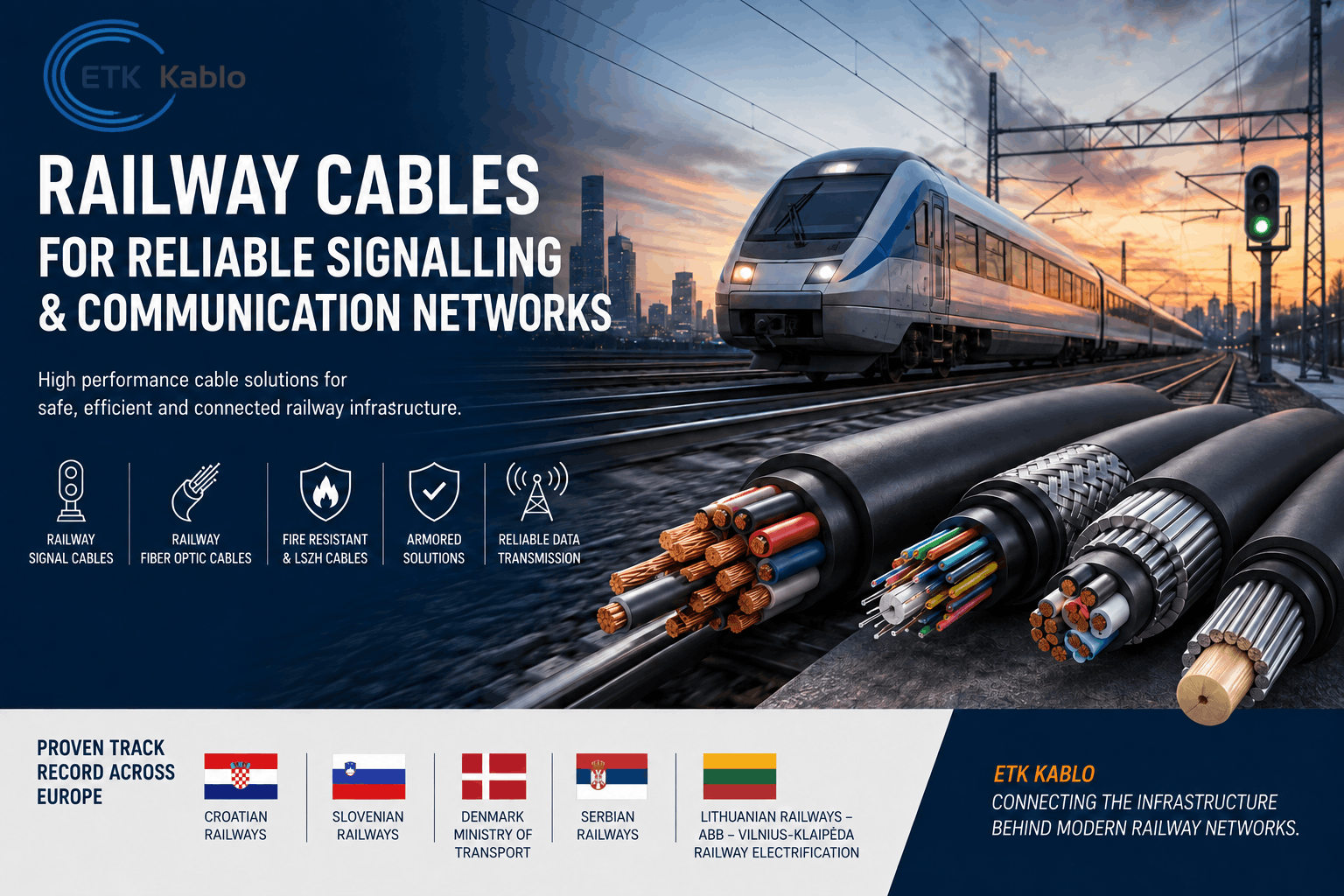
Railway Cables for Reliable Signalling and Communication Networks
Reading Time: 9 minutes
Modern railway infrastructure depends on far more than tracks, rolling stock and electrical power. Behind every safe and efficient railway network is an extensive communication infrastructure connecting signalling systems, control equipment, stations, telecommunications networks and operational systems across hundreds or even thousands of kilometers.
The railway cable is therefore a critical component of modern rail infrastructure.
From a railway signal cable transmitting control information between railway equipment to a railway fiber optic cable forming the high-speed communications backbone of an entire rail corridor, cable selection can directly affect network reliability, signal integrity and long-term infrastructure performance.
ETK Kablo manufactures a broad portfolio of copper and fiber optic cable solutions suitable for railway, metro, tunnel and transportation infrastructure projects. Our railway experience includes references connected with Croatian Railways, Slovenian Railways, Serbian Railways, the Denmark Ministry of Transport and Lithuanian Railways, demonstrating ETK Kablo’s experience in supplying cable solutions for demanding European transportation infrastructure.
What Is a Railway Cable?
A railway cable is a cable designed or selected for use within railway infrastructure, where communication reliability, mechanical durability, electromagnetic compatibility and, depending on the application, fire performance are particularly important.
Railway systems contain numerous interconnected electrical and communication networks. As a result, there is no single universal railway cable construction.
Different railway cable types may be required for:
- Railway signalling systems
- Trackside communication networks
- Station communication infrastructure
- Fiber optic backbones
- Control and monitoring systems
- SCADA networks
- Telecommunications
- Tunnel communication systems
- CCTV and security infrastructure
- Passenger information systems
- Data transmission
- Equipment monitoring
- Emergency communication networks
Cable construction must therefore be selected according to the electrical, environmental, mechanical and fire-safety requirements of each individual railway project.
For international projects, the same product category may also be described as a railroad cable. In particular, North American specifications and procurement searches frequently use terms such as railroad cable and railroad signal cable, while railway cable and railway signal cable are more commonly used across Europe and many other international markets.
Railway Signal Cables for Reliable Communication
Signalling is one of the most important elements of railway operations.
A railway signal cable transmits electrical signals between equipment used to control, monitor or communicate the status of railway infrastructure. Reliable signal transmission is particularly important because electrical interference, cable deterioration or transmission problems can compromise the performance of connected systems.
Depending on project requirements, railway signal cables can incorporate shielding to reduce the influence of electromagnetic interference generated by nearby electrical equipment and railway infrastructure.
ETK Kablo manufactures a wide variety of signal and control cables, including screened, unscreened and specially protected constructions.
Available configurations can include:
- Foil-screened signal cables
- Braided-screen signal cables
- Foil and braid screened constructions
- LSZH signal and control cables
- Steel wire braided cables
- Steel wire armored cables
- Multi-core constructions
- Twisted pair configurations
- Project-specific signal cable designs
For railway environments where electromagnetic compatibility is particularly important, screened constructions can help protect signal integrity against external electrical noise.
Where additional mechanical protection is required, armored or reinforced constructions can be evaluated according to the installation environment.
The result is a flexible portfolio from which the appropriate railroad signal cable or railway signal cable can be selected according to project specifications rather than relying on a single generic construction.
Railway Fiber Optic Cable for High-Speed Rail Communications
As railway infrastructure becomes increasingly digital, fiber optic communication is becoming a fundamental part of rail networks.
A railway fiber optic cable provides high-bandwidth, long-distance data transmission while remaining inherently immune to electromagnetic interference. This makes optical fiber particularly attractive for communication networks installed alongside electrically demanding railway infrastructure.
Railway fiber networks can connect stations, control centers, trackside equipment, communication nodes and operational systems over substantial distances.
Typical applications for railway fiber optic cable include:
- Railway telecommunications backbones
- Station-to-station connectivity
- Signalling communication networks
- SCADA infrastructure
- CCTV and security systems
- Passenger information systems
- Operational data networks
- Tunnel communication
- Traffic management infrastructure
- Trackside monitoring systems
ETK Kablo manufactures a broad selection of fiber optic cables that allows cable construction to be optimized according to the railway project’s installation method and environmental conditions.
Solutions can include single-mode and multimode fiber, central loose tube and multi-loose tube constructions, metallic and non-metallic armored cables, duct cables, aerial cables, fire-resistant designs and tailor-made special fiber optic cables.
This flexibility is particularly important because a railway fiber optic cable installed inside a station or tunnel may require a fundamentally different construction from a cable installed outdoors along a railway corridor.
Armored Railway Fiber Optic Cables
Railway corridors can expose cables to demanding mechanical and environmental conditions.
Where increased physical protection is required, armored railway fiber optic cable constructions can provide additional resistance against crushing, impact and other mechanical stresses.
Metallic armor solutions can be considered for installations requiring high mechanical protection, while non-metallic armored fiber optic cables provide reinforcement without introducing metallic elements into the cable structure.
Non-metallic constructions can be particularly useful in environments where electrical isolation or immunity from electromagnetic effects is desirable.
The optimum construction depends on the railway route, installation method, mechanical requirements and project specification.
Fire-Resistant and LSZH Cables for Railway Infrastructure
Fire safety is particularly important in transportation infrastructure, especially in enclosed environments such as railway stations, underground facilities, technical rooms and tunnels.
For these applications, Low Smoke Zero Halogen (LSZH) cable constructions can help reduce smoke and corrosive halogen gas emissions during a fire.
ETK Kablo’s portfolio includes LSZH signal and control cables as well as fire-resistant fiber optic cable solutions for safety-critical infrastructure.
Depending on the particular cable, project and certification requirement, solutions can be developed or selected around characteristics such as:
- Flame retardancy
- Low smoke emission
- Halogen-free materials
- Fire-resistant communication
- Mechanical protection
- Electromagnetic shielding
- UV resistance
- Water blocking
- Outdoor durability
The exact fire-performance requirement should always be determined according to the project’s technical specification and installation environment.
This is especially important for railway tunnels and underground stations, where cable behavior during fire can be a major part of the overall system design.
Railway Cable Types: Choosing the Right Solution
Because railway infrastructure integrates many different systems, understanding the main railway cable types is essential for project engineers, contractors and procurement departments.
1. Railway Signal Cable
Used for signalling, monitoring and control circuits where stable electrical signal transmission is required.
Screened versions can provide additional electromagnetic protection in electrically noisy environments.
2. Railway Fiber Optic Cable
Used for high-speed and long-distance communication between stations, control centers and trackside communication infrastructure.
Fiber provides high bandwidth and immunity to electromagnetic interference.
3. Railway Control Cable
Used to transmit commands and control signals between equipment, panels, monitoring devices and automation systems.
4. Railway Telecommunication Cable
Copper or fiber optic cables can be used for voice, communication, operational data and other telecommunications requirements across railway infrastructure.
5. Armored Railway Cable
Designed with additional mechanical protection for demanding environments, outdoor infrastructure or installations exposed to increased physical risk.
6. LSZH Railway Cable
Designed for locations where reduced smoke and halogen gas emission during fire is an important safety requirement, particularly tunnels, stations and enclosed public areas.
7. Fire-Resistant Railway Fiber Optic Cable
Used where communication integrity during fire conditions is required by the project specification.
Rather than defining a railway project around one cable family, ETK Kablo can support customers across multiple low-current cable categories, helping contractors and infrastructure companies consolidate their cable requirements with a single manufacturer.
Railway Cable Requirements for Outdoor and Trackside Applications
Trackside railway infrastructure can create particularly demanding operating conditions.
Cables installed along railway corridors may face:
- UV exposure
- Moisture and water ingress
- Temperature variations
- Mechanical impact
- Rodent risks
- Ground pressure
- Electromagnetic interference
- Long installation distances
Cable construction should therefore reflect the actual installation method.
Outdoor polyethylene jackets can provide enhanced environmental protection, while water-blocking elements can protect the internal cable structure against moisture migration.
For mechanically demanding installations, metallic or non-metallic reinforcement can provide additional protection.
For fiber optic railway networks installed close to high-voltage electrical infrastructure, non-metallic constructions can also be considered where electrical isolation is desirable.
There is consequently no universally “best” railway cable. The correct solution is the cable construction that matches the electrical, optical, mechanical, environmental and fire requirements defined by the project.
Network Rail Cable Requirements
Buyers working on UK railway projects may search specifically for network rail cable or Network Rail signalling cables.
It is important to distinguish between a general railway cable and a product requiring formal compliance or approval against a particular Network Rail specification.
Network Rail projects may define specific requirements for signalling, telecommunications, power or other railway cable categories. Where a project requires an approved Network Rail cable, the requested Network Rail specification and approval requirements should therefore be reviewed before the cable is offered.
ETK Kablo evaluates international railway inquiries according to the customer’s technical specification, cable construction and required standards. Buyers should identify any operator-specific approval requirements during the quotation process so that technical suitability can be evaluated correctly.
This project-by-project approach is equally important for railway authorities and infrastructure operators in other countries, where national specifications may supplement international cable standards.
Proven European Railway Project References
Railway infrastructure procurement places considerable importance on previous experience.
ETK Kablo has supplied cable solutions connected with railway and transportation projects across several European countries.
Our railway references include:
Croatian Railways – Croatia
ETK Kablo has railway project experience associated with Croatian Railways, adding Croatia to the company’s European transportation infrastructure references.
Slovenian Railways – Slovenia
ETK Kablo’s Slovenian Railways reference demonstrates additional experience within the Central and Southeastern European railway market.
Serbian Railways – Serbia
Serbian Railways represents another important railway infrastructure reference for ETK Kablo in the Balkans.
Denmark Ministry of Transport – Denmark
ETK Kablo’s experience also extends into Northern Europe through its Denmark Ministry of Transport railway reference.
Lithuanian Railways – ABB – Vilnius–Klaipėda Railway Electrification – Lithuania
ETK Kablo also lists the Lithuanian Railways – ABB railway electrification of the Vilnius–Klaipėda section among its railway industry references.
Together, these projects demonstrate ETK Kablo’s experience supporting railway infrastructure across different European markets and project environments.
Why Choose ETK Kablo as Your Railway Cable Manufacturer?
Railway contractors frequently need more than one type of cable from a project supplier.
A signalling contractor may simultaneously require signal cables, control cables, fiber optic cables, fire-resistant cables and other low-current solutions.
This is where ETK Kablo’s broad manufacturing portfolio creates an important procurement advantage.
Instead of approaching railway infrastructure as a single-product market, ETK Kablo can support multiple communication and control systems from one manufacturing platform.
Broad Cable Portfolio
Fiber optic, signal and control, instrumentation, telecommunications, data and fire-resistant cable solutions can be evaluated within the same project.
Customized Cable Designs
Cable constructions can be adapted according to conductor or fiber requirements, shielding, armoring, jacket materials, fire characteristics and environmental conditions.
Fiber and Copper Manufacturing Expertise
ETK Kablo combines optical and copper cable manufacturing capabilities, allowing customers to source multiple elements of railway communication infrastructure from one manufacturer.
Project-Oriented Engineering
Railway inquiries can be evaluated according to technical specifications rather than forcing customers into a limited standard product selection.
International Railway Experience
References across Croatia, Slovenia, Serbia, Denmark and Lithuania demonstrate ETK Kablo’s experience supporting railway infrastructure requirements in different European markets.
Railway Cables for New Rail, Metro and Infrastructure Projects
Rail networks are becoming increasingly connected.
Digital signalling, remote monitoring, fiber optic communications, CCTV, passenger information and centralized traffic management are continuously increasing the amount of data transmitted across railway infrastructure.
Cable infrastructure must evolve with these systems.
For contractors, system integrators, railway authorities and distributors, selecting the right railway cable manufacturer therefore involves more than comparing conductor sizes or cable prices.
Long-term mechanical performance, signal integrity, fire safety, environmental protection and the manufacturer’s ability to adapt cable constructions to project specifications are equally important.
Whether the requirement is a railway signal cable, railroad signal cable, railway fiber optic cable, armored railway cable or specialized communication cable, ETK Kablo can evaluate the required construction according to the technical requirements of the railway project.
Frequently Asked Questions About Railway Cables
What is a railway cable?
A railway cable is a cable used within railway infrastructure for signalling, communication, control, monitoring, telecommunications or other electrical and data transmission systems. Railway cables may use copper conductors or optical fibers and can incorporate shielding, armor, LSZH materials and other protective constructions depending on the application.
What is a railway signal cable?
A railway signal cable transmits electrical signals between signalling, monitoring or control equipment within railway infrastructure. Depending on the electrical environment, screened constructions may be used to improve protection against electromagnetic interference.
What is the difference between a railway cable and a railroad cable?
The terms railway cable and railroad cable generally describe the same overall product category. “Railway” is more common in European and international English, while “railroad” is more commonly used in North America. Similarly, buyers may search for either railway signal cable or railroad signal cable.
What are the main railway cable types?
Common railway cable types include railway signal cables, control cables, telecommunications cables, fiber optic cables, armored cables, LSZH cables and fire-resistant communication cables. The appropriate construction depends on the railway system and installation environment.
Why is fiber optic cable used in railway networks?
A railway fiber optic cable provides high-bandwidth communication over long distances and is immune to electromagnetic interference. It is therefore suitable for railway telecommunications, signalling communication, CCTV, SCADA, passenger information and trackside data networks.
What cable is suitable for railway tunnels?
Railway tunnels often require cables with enhanced fire performance, including LSZH and, where specified, fire-resistant constructions. The exact cable should be selected according to the tunnel’s fire strategy, system function and applicable project standards.
What does Network Rail cable mean?
A Network Rail cable generally refers to a cable intended for UK railway infrastructure where Network Rail specifications or approvals may apply. A generic railway cable should not automatically be considered Network Rail approved. The exact specification and approval requirement should be confirmed for each project.
Can railway cables be armored?
Yes. Railway cables can incorporate metallic or non-metallic reinforcement where increased mechanical protection is required. The appropriate armor depends on the installation method, electrical environment and mechanical risks.
Does ETK Kablo manufacture railway fiber optic cables?
ETK Kablo manufactures multiple fiber optic cable constructions suitable for railway communication infrastructure, including outdoor, armored, non-metallic armored, special and fire-resistant fiber optic solutions. Cable construction can be evaluated according to individual railway project requirements.
Discuss Your Railway Cable Project with ETK Kablo
Every railway network has different technical requirements.
Cable construction can vary according to installation environment, transmission technology, operator specification, fire requirements, mechanical protection and communication architecture.
ETK Kablo supports railway contractors, EPC companies, system integrators, distributors and infrastructure companies with railway signal cables, railway fiber optic cables and specialized low-current cable solutions engineered around project requirements.
If you are sourcing cables for a new railway, railway modernization, signalling upgrade, station, tunnel, metro or transportation infrastructure project, contact ETK Kablo with your technical specification.
ETK Kablo – Cable solutions connecting the infrastructure behind modern railway networks.
Benzer yazılar
Fiber Optic Cable for Railway and Metro Networks
A railway fiber optic cable forms part of the communications backbone that connects stations, signaling locations, control centers, CCT...


