





 President’s Message
Blog
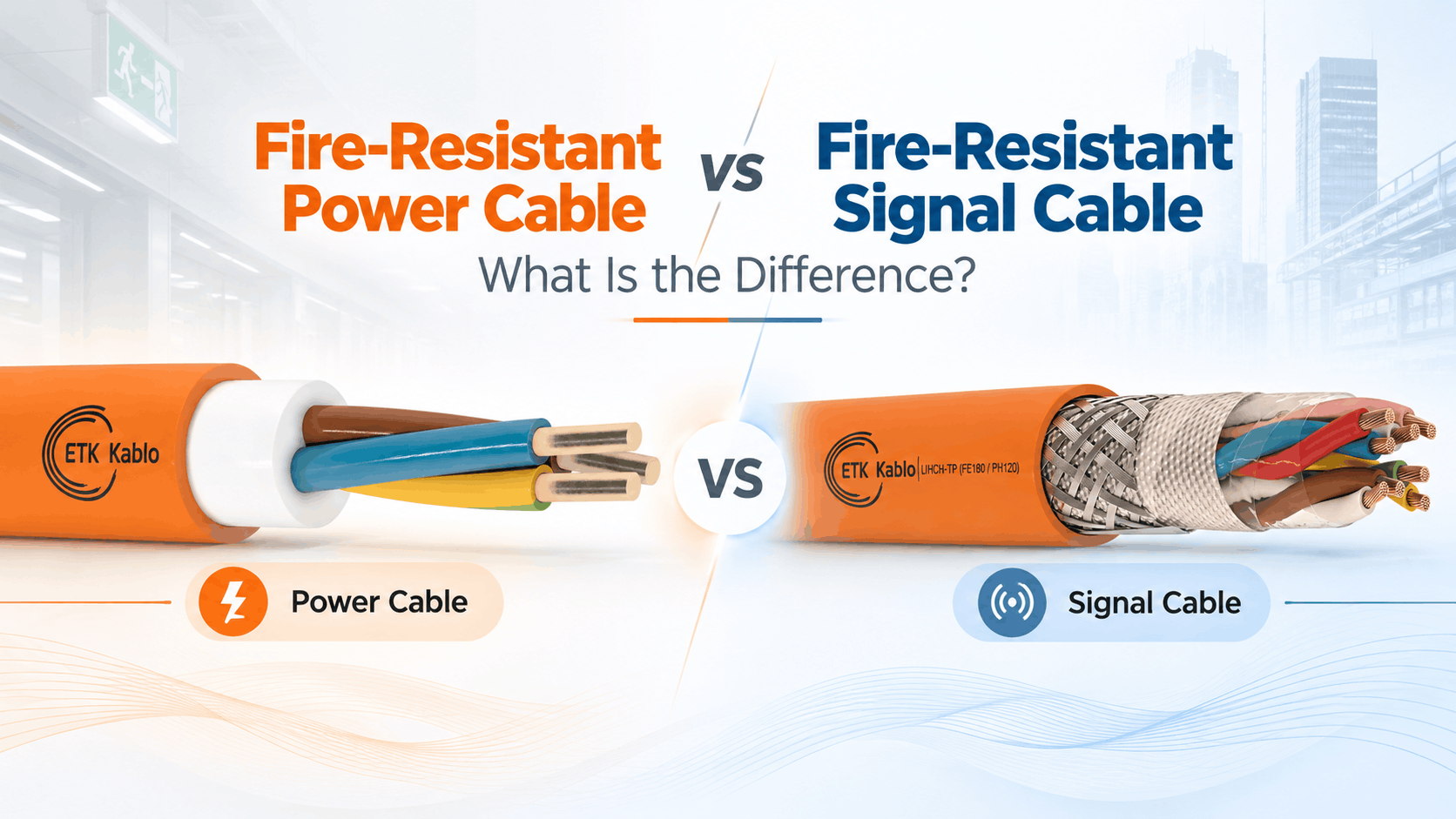
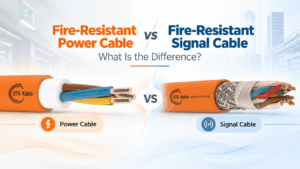
Fire-Resistant Power Cable vs Fire-Resistant Signal Cable: What Is the Difference?
Reading Time: 20 minutes
Power vs signal cable is an important distinction when specifying fire-resistant circuits. Two cables can both maintain circuit integrity during a defined fire test yet perform completely different electrical functions.
A fire-resistant power cable is designed to continue supplying electrical energy to critical equipment. A fire-resistant signal cable, by contrast, carries alarm, communication, monitoring or control information between devices.
Therefore, the same fire rating does not make the two cable types interchangeable. Voltage rating, conductor cross-section, current-carrying requirement, pair or core configuration, screening, capacitance and connected equipment must still match the circuit.
For example, an emergency ventilation fan can require a fire-resistant power cable to keep the motor energized. Meanwhile, the control signal telling that fan when to operate may travel through a much smaller screened fire-resistant signal cable.
ETK Kablo manufactures both fire-resistant power cables and fire-resistant signal, control and instrumentation cables for critical electrical systems.
Quick answer: fire-resistant power cable carries electrical power to critical loads, while fire-resistant signal cable carries information or control signals. Power cables are selected primarily from voltage, load current, conductor size, voltage drop and short-circuit requirements. Signal cables are selected primarily from circuit type, conductor or pair arrangement, electrical resistance, capacitance, screening and electromagnetic compatibility. Fire performance must then be specified separately for the exact cable and application.
Power vs Signal Cable at a Glance
| Characteristic | Fire-Resistant Power Cable | Fire-Resistant Signal Cable |
|---|---|---|
| Primary Function | Deliver electrical power | Transmit signals, commands, monitoring or communication |
| Typical ETK Families | (N)HXH, NHXH, N2XH, N2XRH | JE-H, J-H, LIH, RE-series |
| Typical ETK Voltage Direction | 0.6/1 kV power circuits | Extra-low-voltage or low-voltage signal/control circuits depending on product |
| Conductor Size | Selected mainly from electrical load and circuit design | Usually smaller; selected from signal/control requirements |
| Conductor Arrangement | Single core or multicore power construction | Cores, pairs, twisted pairs, triads or grouped communication units |
| Screening | Not automatically required for ordinary LV power distribution | Frequently important for EMI-sensitive circuits |
| Capacitance | Normally not the main selection parameter for conventional LV power circuits | Can be important for signal integrity and circuit behaviour |
| Current-Carrying Capacity | Major design requirement | Usually secondary to signal/control electrical requirements |
| Voltage Drop | Major power-system design consideration | Can still matter, especially on powered control loops |
| Typical Application | Emergency lighting, pumps, smoke-control equipment, critical distribution | Fire detection, evacuation control, BMS, interlocks, monitoring, communication |
| Fire Survival | Specified according to applicable circuit-integrity requirement | Specified according to applicable circuit-integrity requirement |
The most important lesson is simple: fire resistance describes how the cable behaves during specified fire conditions. It does not define what electrical job the cable performs.
What Is a Fire-Resistant Power Cable?
A fire-resistant power cable supplies electrical energy to equipment that the project fire strategy requires to remain energized during an emergency.
Typical loads can include:
- Emergency lighting
- Smoke extraction systems
- Emergency ventilation
- Firefighting equipment
- Safety-related pumps
- Selected evacuation systems
- Critical distribution equipment
- Other emergency electrical loads
Consequently, power-cable design begins with conventional electrical engineering requirements before fire performance is added.
The engineer must determine:
- System voltage
- Design current
- Conductor cross-section
- Voltage drop
- Short-circuit withstand
- Conductor class
- Core configuration
- Installation method
- Ambient temperature
- Mechanical protection
- Required fire-survival performance
ETK Kablo’s current fire-resistant power portfolio is centered on 0.6/1 kV constructions for critical fixed electrical circuits.
What Is a Fire-Resistant Signal Cable?
A fire-resistant signal cable carries information rather than substantial electrical power.
The signal may represent:
- A fire alarm condition
- A control command
- An equipment status
- A monitored input
- An evacuation message trigger
- A BMS command
- An emergency shutdown signal
- A process measurement
- A safety interlock
As a result, the cable architecture can look very different from a power cable.
Signal cables may use:
- Small solid copper conductors
- Flexible stranded conductors
- Twisted pairs
- Multiple pair groups
- Triads
- Overall foil screens
- Copper braid screens
- Individual pair screens
- Combined foil and braid screens
For example, ETK Kablo’s J-H(St)H FE180 PH120 uses solid copper conductors arranged as pairs together with an overall Al/PET screen.
Meanwhile, LIHCH FE180 PH120 uses Class 5 stranded copper conductors and a tinned copper braid screen for flexible signal and control applications.
Power vs Signal Cable: Electrical Function Comes First
Engineers should identify the circuit function before choosing the fire rating.
Consider a smoke-control system.
The fan motor needs electrical power. Therefore, the cable feeding the motor must satisfy the relevant power-system requirements.
However, the command telling that motor to start can come from a control panel through a low-current signal circuit.
These two circuits may operate as part of the same life-safety system, yet they require fundamentally different cable designs.
Accordingly, it would be incorrect to choose one generic “fire cable” for both simply because the same fire rating appears in the project specification.
Fire-Resistant Power Cable Voltage Ratings
Voltage rating is a primary design parameter for power cable.
The current ETK Kablo fire-resistant power category contains 0.6/1 kV constructions such as:
- (N)HXH-J
- NHXH-J
- N2XH-J
- N2XRH-J
These cables are designed around low-voltage electrical power distribution rather than low-level communication signals.
For example, the ETK Kablo (N)HXH-J 0.6/1 kV FE180 E90 family uses copper power conductors together with a dedicated fire-survival insulation system and halogen-free materials.
Therefore, the electrical insulation and test-voltage design differ substantially from those of a typical communication pair.
Fire-Resistant Signal Cable Voltage Ratings
Signal-cable operating voltages are commonly much lower.
For example, ETK Kablo’s J-H(St)H FE180 PH120 lists a 250 V DC operating voltage, while LIHCH FE180 PH120 lists a 300 V DC operating voltage.
However, engineers should not create one universal voltage limit for all fire-resistant signal cables.
Different signal, control and instrumentation families can use different voltage ratings.
Therefore, the product datasheet and connected equipment determine the correct electrical requirement.
Power vs Signal Cable: Why Conductor Size Is Different
Power conductors must safely carry the required load current.
Consequently, their cross-section can increase substantially as the connected load grows.
A critical power circuit can require conductor sizes such as:
- 1.5 mm²
- 2.5 mm²
- 4 mm²
- 6 mm²
- 10 mm²
- 16 mm²
- 25 mm²
- 35 mm²
- Or larger sizes according to the electrical design
Signal circuits normally operate at much lower current.
Therefore, signal cables often use smaller conductors.
For example, fire-resistant signal families can use conductor cross-sections such as 0.50 mm², 0.75 mm², 1.00 mm², 1.50 mm² or 2.50 mm², while telephone-style signal constructions can use conductor diameters such as 0.40, 0.50 or 0.80 mm.
Still, conductor size should never be selected from the words “signal cable” alone.
Why a Small Signal Cable Should Not Supply a Power Load
A signal conductor can be electrically continuous and still be unsuitable for supplying a substantial load.
Its conductor cross-section may create excessive:
- Current density
- Voltage drop
- Conductor heating
- Short-circuit stress
Furthermore, the cable’s voltage rating and installation requirements may not match the power circuit.
Therefore, a fire-resistant signal cable should never replace a correctly sized fire-resistant power cable simply because both have passed a circuit-integrity test.
Can a Fire-Resistant Power Cable Carry a Signal?
Electrical continuity alone does not make a power cable an appropriate signal cable.
A power conductor can technically carry changing electrical voltages. However, the cable may lack the pair geometry, capacitance control, screening or impedance characteristics required by the signaling system.
For example, a sensitive low-level analog signal may require tightly controlled pair balance and an overall screen.
A conventional multicore power cable does not automatically provide those characteristics.
Therefore, using an oversized power cable for signal circuits can be technically inappropriate even when conductor resistance appears low.
Power vs Signal Cable: Core Construction
Power cables usually organize insulated conductors as single-core or multicore electrical power constructions.
Common arrangements can include:
- 1 core
- 2 cores
- 3 cores
- 4 cores
- 5 cores
- Other project-specific multicore arrangements
Signal cables can use a much wider range of conductor organizations.
Depending on the circuit, these may include:
- Individual cores
- Twisted pairs
- Twisted triples
- Multiple pair units
- Pair or triad groups
- Individually screened pairs
- Overall screened cores
This internal geometry can directly affect electrical signal performance.
Why Twisted Pairs Matter in Fire-Resistant Signal Cable
Twisting two conductors together helps balance their exposure to external electromagnetic fields.
Consequently, the receiving circuit can reject a substantial amount of common-mode interference.
This becomes especially useful for:
- Fire detection
- Monitoring
- Building automation
- Emergency communication
- Instrumentation
- Other low-level control signals
A power cable does not normally use pair twisting for this purpose.
Therefore, pair geometry represents another reason why equal fire ratings do not make the products electrically equivalent.
Power vs Signal Cable: Why Screening Matters More for Signals
Signal circuits can be sensitive to electromagnetic interference because they often carry relatively low-level electrical information.
For this reason, many fire-resistant signal cables include an electromagnetic screen.
Possible screen architectures include:
- Overall Al/PET foil
- Tinned copper braid
- Foil plus braid
- Individual pair screens
- Individual and overall combined screens
The correct choice depends on the actual signal environment.
However, screening does not create the fire resistance.
The screen manages electromagnetic compatibility, while fire-survival barriers and insulation maintain circuit integrity under the specified fire conditions.
Does Fire-Resistant Power Cable Need Shielding?
Not automatically.
Conventional low-voltage power distribution often uses unshielded multicore cable because the circuit does not have the same low-level signal-susceptibility requirements.
Nevertheless, specialized power-system or EMC requirements can introduce metallic screens in certain designs.
Therefore, engineers should not apply the rule “power cable is always unshielded.”
The more useful distinction is that signal screening frequently forms a primary selection criterion, whereas ordinary LV power-cable selection is generally dominated by load, voltage and installation requirements.
Power vs Signal Cable: Current-Carrying Capacity
Current-carrying capacity is fundamental for power circuits.
The allowable current depends on factors such as:
- Conductor cross-section
- Conductor material
- Insulation temperature rating
- Ambient temperature
- Installation method
- Grouping
- Thermal insulation
- Number of loaded conductors
Therefore, the cable cross-section must come from an appropriate electrical calculation.
Signal cable selection normally follows a different process.
The designer may instead focus on loop resistance, operating current, voltage drop, signal attenuation, capacitance and equipment limitations.
Voltage Drop in Fire-Resistant Power Cable
A critical electrical load must receive sufficient voltage during normal operation and during the emergency condition defined by the design.
As conductor length and current increase, voltage drop also increases.
Consequently, conductor sizing may need to increase even if a smaller conductor would satisfy basic thermal current requirements.
This becomes particularly important for long emergency feeder circuits.
The fire rating does not change this electrical principle.
Voltage Drop in Fire-Resistant Signal Cable
Voltage drop can also matter in signal and control circuits, although its significance depends on the system.
For example, a powered two-wire control loop can combine communication with current delivery to field equipment.
Similarly, alarm devices or actuators may depend on a minimum voltage at the remote endpoint.
Therefore, describing signal cables as carrying “no power” would be incorrect.
The better distinction is that their primary circuit function is signaling, monitoring or control rather than general electrical power distribution.
Power vs Signal Cable: Electrical Resistance
Conductor resistance matters in both cable families, yet engineers use it differently.
In power circuits, resistance contributes directly to:
- Voltage drop
- Power loss
- Heat generation
- Fault-loop performance
In signal circuits, resistance can affect:
- Maximum loop length
- Sensor or device voltage
- Loop current
- Signal margin
- System supervision
Therefore, resistance remains important on both sides of the comparison even though the electrical objectives differ.
Why Capacitance Matters More in Signal Cable
Two insulated conductors separated by a dielectric form capacitance.
Long cable lengths can therefore add significant electrical capacitance to a signal circuit.
This can influence:
- Signal rise and fall times
- Analog response
- Communication distance
- Device compatibility
- Loop stability
Consequently, fire-resistant signal cable datasheets can specify mutual capacitance and related electrical characteristics.
For ordinary low-voltage power distribution, capacitance is normally not the first cable-selection parameter.
Fire-Resistant Power Cable Construction
Fire-resistant power cable must protect relatively large current-carrying conductors while maintaining the required electrical insulation during the applicable fire test.
Depending on the product family, the construction can include:
- Copper conductor
- Mica fire barrier
- Cross-linked insulation
- Ceramic-forming insulation
- Halogen-free filler
- Halogen-free outer sheath
- Steel wire armor where mechanical protection is required
ETK Kablo’s current range demonstrates more than one design philosophy.
(N)HXH-J uses a ceramic-forming cross-linked insulation system, while other families such as NHXH and N2XH use mica-based fire barriers in their published constructions.
Fire-Resistant Signal Cable Construction
Signal cable also requires a dedicated fire-survival system, yet its internal architecture must preserve signal-circuit characteristics.
A typical construction can combine:
- Small solid or stranded copper conductors
- Fire-resistant insulation
- Twisted pair arrangement
- Glass-yarn or mica-based protection
- Polyester wrapping
- Al/PET foil screen
- Copper braid screen
- Drain or earthing wire
- Halogen-free outer sheath
Thus, the fire-survival technology can coexist with signal-specific components rather than replacing them.
Mica Tape in Power and Signal Cables
Mica provides excellent thermal stability and dielectric performance at elevated temperatures.
Manufacturers can therefore use mica-based fire barriers around conductors in both power and signal cable constructions.
However, mica alone does not define the electrical function of the cable.
A large 0.6/1 kV power conductor with mica remains a power cable.
A small twisted pair with a suitable fire barrier remains a signal cable.
Therefore, the complete construction must be considered.
Ceramic-Forming Insulation in Fire-Resistant Cables
Ceramic-forming polymer systems provide another approach to maintaining electrical separation during severe heat exposure.
As temperature rises, the material can form a more stable protective structure around the conductor.
ETK Kablo uses ceramic-forming technology in selected power and signal cable families.
For example, the current (N)HXH-J power construction and J-H(St)H signal construction both use fire-survival insulation technology, yet their electrical designs remain entirely different.
Therefore, common fire-survival technology should not be mistaken for common cable application.
Can Power and Signal Cable Have the Same Fire Rating?
Yes.
Different cable families can meet comparable fire-survival classifications when they have been tested under the applicable requirements.
For example, the project may request cable-level integrity such as FE performance for both critical power and signal circuits.
However, identical labels do not prove identical construction.
The power cable may use large multicore conductors while the signal cable uses small screened pairs.
Furthermore, the exact test standard, test arrangement and certificate should be checked for each product.
Power vs Signal Cable: FE180 Does Not Define Cable Type
FE180 is associated with fire-integrity performance rather than electrical application.
Therefore, the designation can appear on very different cable families.
You may encounter FE180 on:
- Power cables
- Signal cables
- Control cables
- Instrumentation cables
- Communication cables
The correct specification must therefore contain more information than the fire classification.
For a detailed explanation of related ratings, see our FE180, PH120, E30, E60 and E90 cable ratings guide.
Power vs Signal Cable: PH120 Requirements
PH classifications address circuit integrity under fire together with mechanical shock according to the applicable test framework.
ETK Kablo publishes PH120 performance on several signal families such as J-H(St)H and LIHCH.
However, engineers should not assume that every fire-resistant power cable automatically carries the same PH classification.
Power products can follow different project and system-integrity requirements.
Therefore, PH performance should always be verified from the exact cable documentation.
Power vs Signal Cable: E30, E60 and E90
E30, E60 and E90 introduce another distinction because they refer to functional integrity of a tested installation system rather than only to the cable.
The approved system can include:
- Cable
- Cable tray
- Supports
- Clamps
- Anchors
- Fixing distances
- Installation arrangement
Consequently, both power and signal cables can participate in tested functional-integrity systems when the relevant configuration has been approved.
Nevertheless, an E90-approved power-cable system and an E90-approved signal-cable system should not be treated as interchangeable.
Does the Higher Fire Rating Determine the Better Cable?
No.
The highest number does not automatically identify the correct cable.
A signal circuit may require PH120 because mechanical disturbance during fire forms part of the project requirement.
A power circuit may instead require a specific functional-integrity installation system.
Therefore, the fire strategy must identify what stress the circuit should survive and for how long.
Choosing the “highest-looking” classification can create unnecessary cost without solving the actual engineering requirement.
Current IEC 60331 Considerations
Fire-cable specifications often contain historical IEC 60331 references.
Therefore, engineers should check the edition and current status of the exact standard rather than copying an old cable schedule into a new project.
The current IEC 60331 framework includes test methods for cables up to 0.6/1 kV, including power, control and lower-voltage metallic data or telecom cables. The applicable method depends on factors such as cable diameter and test configuration.
For power cables above 1 kV, a separate current IEC 60331 part addresses the higher-voltage range.
Consequently, the words “tested to IEC 60331” should be followed by the applicable current part, product scope and test documentation.
Power vs Signal Cable and EN 50200
EN 50200 provides a method for testing the resistance to fire of certain unprotected small cables used in emergency circuits.
Mechanical shock forms part of the test concept.
This framework is particularly relevant to many smaller fire-resistant signal and emergency-circuit cables.
However, the application of the standard should always be checked against its scope and the exact cable.
Therefore, a PH designation on a signal cable does not mean that every larger power cable follows the same test route.
Power vs Signal Cable and BS 6387 CWZ
Some specifications also require BS 6387 CWZ performance.
C, W and Z address separate fire-survival test protocols involving fire alone, fire with water and fire with mechanical shock.
However, the CWZ designation still does not determine whether the cable is a power or signal cable.
Its electrical function must remain separately defined through voltage rating, conductor construction and circuit requirements.
Power vs Signal Cable: Flame Retardancy
Both fire-resistant power and signal cables can also require flame-retardant performance.
Nevertheless, fire resistance and flame retardancy answer different questions.
Fire resistance asks whether the circuit remains electrically functional during defined fire exposure.
Flame retardancy asks how the cable contributes to flame propagation.
Therefore, a project can require both properties on either cable type.
For the broader distinction, see our fire resistant vs flame retardant cable guide.
Power vs Signal Cable: LSZH Requirements
LSZH describes low-smoke, halogen-free material behaviour.
It does not describe the cable’s electrical function.
Therefore, both fire-resistant power cables and fire-resistant signal cables can use halogen-free material systems.
LSZH can be particularly valuable in:
- Tunnels
- Metro systems
- Airports
- Hospitals
- High-rise buildings
- Public facilities
- Data centers
However, LSZH alone does not prove circuit integrity.
Power vs Signal Cable: CPR Classification
CPR reaction-to-fire classification is another independent requirement.
A CPR Euroclass addresses how the applicable cable reacts and contributes to fire under the European classification system.
It does not tell the designer whether the cable carries electrical power or information.
Likewise, CPR does not automatically establish FE, PH or system-functional-integrity performance.
Therefore, applicable CPR requirements should be specified separately for both cable types.
Fire-Resistant Power Cable for Emergency Lighting
Emergency lighting provides a clear example of a power-cable application.
The lighting equipment requires electrical energy to operate.
Therefore, where the fire strategy requires the supply circuit itself to survive fire, the cable must satisfy:
- System voltage
- Load current
- Voltage drop
- Protection-device requirements
- Fire-survival requirement
- Installation-system requirement where applicable
A small screened signal cable is not an equivalent substitute.
Fire-Resistant Power Cable for Smoke Extraction
Smoke extraction systems can require substantial electrical power.
Fans and associated equipment must receive enough current to perform their safety function.
Consequently, conductor sizing can become much larger than in alarm or control circuits.
The fire-resistant power feeder therefore needs to match the motor or equipment load as well as the required fire strategy.
Meanwhile, control and status wiring for the same smoke system may use separate fire-resistant signal cables.
Fire-Resistant Power Cable for Firefighting Equipment
Pumps and other firefighting equipment can represent demanding electrical loads.
Such circuits must be designed according to the applicable electrical and fire-safety requirements.
Therefore, specifying only “FE180 cable” does not provide enough information.
The electrical engineer still needs to determine:
- Voltage
- Load current
- Starting conditions where relevant
- Conductor cross-section
- Protection
- Route
- Required functional integrity
Fire-Resistant Signal Cable for Fire Detection
Fire detection systems primarily exchange information between detectors, modules, panels and alarm devices.
Consequently, signal integrity becomes the main electrical objective.
Depending on the system, the cable may require:
- Defined conductor resistance
- Controlled pair construction
- Overall screening
- Low capacitance
- Fire-survival performance
- LSZH materials
The exact requirement depends on the fire-alarm system and applicable specification.
Our fire alarm vs fire-resistant cable guide explains why the application name and circuit-integrity rating should not be treated as synonyms.
Fire-Resistant Signal Cable for Voice Evacuation
Voice evacuation infrastructure can contain several different circuit types.
Some cables carry audio or control signals, while other circuits can carry electrical power to equipment.
Therefore, one system may require multiple cable families.
Signal transmission should be designed according to the characteristics of the audio, control or communication circuit.
Meanwhile, power feeders should follow power-cable design rules.
Fire-Resistant Signal Cable for BMS and Smoke Control
Building management and smoke-control systems frequently combine sensors, controllers, actuators and power equipment.
As a result, cable functions can overlap within the same system diagram.
A sensor feedback pair is fundamentally different from a feeder supplying a large fan.
Likewise, a control output to an actuator may have different requirements from a communication bus.
Therefore, engineers should classify each circuit individually rather than labeling every BMS route as either “power” or “signal” from the system name alone.
Fire-Resistant Signal Cable for Industrial Control
Industrial safety systems can require fire-survival control and instrumentation cables in addition to power feeders.
Signal circuits may carry:
- Emergency shutdown commands
- Valve positions
- Temperature measurements
- Pressure measurements
- Detector signals
- Interlocks
- Supervisory information
These circuits can also face substantial electromagnetic interference.
Consequently, foil, braid or individually screened constructions can become important.
Where Fire-Resistant Instrumentation Cable Fits
Instrumentation cable is best treated as a specialist signal-cable family rather than ordinary power cable.
Process measurement systems often use twisted pairs or triads.
Moreover, the project can require:
- Individual pair screening
- Overall screening
- Combined individual and overall screens
- Mechanical armor
- Fire-survival barriers
This architecture protects small measurement and control signals in demanding process environments.
Our fire-resistant cable types guide explains where instrumentation cable sits within the wider fire-survival portfolio.
Can a Fire-Resistant Signal Cable Be Armored?
Yes.
Signal screening, mechanical armor and fire resistance perform three different functions.
A fire-resistant signal or instrumentation cable can therefore combine:
- Fire-survival insulation
- Electromagnetic screen
- Steel wire armor
- Halogen-free sheath
The screen helps manage EMI.
The armor protects against physical damage.
The dedicated fire-survival system maintains circuit integrity under the applicable test.
Therefore, these terms should never be used interchangeably.
Can a Fire-Resistant Power Cable Be Armored?
Yes.
ETK Kablo’s N2XRH-J FE180 family adds galvanized steel-wire armor to a fire-resistant power construction.
This can provide greater mechanical protection in routes exposed to crushing, impact or other physical hazards.
However, the armor does not create the fire resistance.
The dedicated fire barrier and insulation system provide the required circuit-integrity function.
Power vs Signal Cable: What Happens During a Fire?
Both cable types face severe thermal stress during fire exposure.
Conventional polymeric insulation can soften, decompose or carbonize.
Fire-resistant construction therefore aims to preserve sufficient electrical separation to prevent circuit failure under the defined test conditions.
However, the consequences of failure differ.
A failed power cable can remove electrical energy from critical equipment.
A failed signal cable can interrupt communication, monitoring or control even if the connected equipment still has power.
Therefore, both can be equally important to the complete life-safety system.
Why the Whole Safety Chain Matters
A critical system works only when every necessary link remains available.
Consider a smoke-extraction fan.
The installation may require:
- Power supply
- Fire-resistant power feeder
- Control panel
- Fire-resistant control cable
- Sensors
- Actuators
- Communication links
- Support systems
If the power feeder survives but the control signal fails, the fan may no longer receive the required command.
Conversely, a surviving control circuit cannot operate a motor that has lost its electrical supply.
Therefore, fire-survival design must protect the complete functional chain.
Does Fire-Resistant Cable Guarantee System Operation?
No.
Cable-level fire performance represents only one component of system reliability.
Complete operation can also depend on:
- Supports
- Clamps
- Junction boxes
- Terminations
- Switchgear
- Controllers
- Power supplies
- End devices
Therefore, cable fire resistance should not be treated as a substitute for a complete fire-safety system design.
Power vs Signal Cable in E30, E60 and E90 Systems
A tested functional-integrity system can include either power or signal cable depending on the approved configuration.
However, the system classification applies to the tested combination rather than to an abstract cable family.
For example, support spacing suitable for one small signal cable may not represent the arrangement tested for a much heavier power cable.
Consequently, engineers must review the exact approved system rather than transferring E90 language between unrelated products.
Why Cable Weight Matters for Power Circuits
Large power conductors can make a multicore fire-resistant power cable significantly heavier than a small signal cable.
This affects:
- Cable tray loading
- Support spacing
- Vertical installation
- Pulling tension
- Bending requirements
- Fire-tested support systems
Therefore, mechanical installation design becomes especially important as conductor size increases.
Why Bending Radius Can Differ
Cable diameter, conductor construction, armor and screening all influence flexibility.
A small LIH-series signal cable can therefore have very different handling characteristics from a large armored fire-resistant power cable.
Installers should follow the published minimum bending radius for the exact product.
Ignoring bending requirements can damage fire barriers or other cable layers before the system is even commissioned.
Power vs Signal Cable: How to Choose Correctly
1. Identify the Circuit Function
First, determine whether the cable primarily supplies electrical power or carries information, monitoring or control.
2. Define the Electrical Voltage
Specify the actual operating and rated voltage required by the equipment.
3. Calculate the Electrical Load
For power circuits, determine design current, starting conditions where applicable, voltage drop and short-circuit requirements.
4. Define the Signal Architecture
For signal circuits, determine whether the system requires individual cores, pairs, triads or another conductor arrangement.
5. Review Screening Requirements
Identify whether the signal circuit requires foil, braid, combined or individual screening.
6. Specify Fire-Survival Performance
Define the required fire test and duration from the fire strategy or project specification.
7. Define System Integrity Separately
If E30, E60 or E90 functional integrity is required, identify the approved complete installation system.
8. Define LSZH and Flame Requirements
Specify low-smoke, halogen-free and flame-propagation requirements independently from circuit integrity.
9. Define Mechanical Protection
Determine whether the cable needs standard construction, steel-wire armor or another mechanical-protection system.
10. Review the Installation Environment
Consider indoor, tunnel, transport, industrial, petrochemical and other route-specific conditions.
11. Verify the Current Standard
Check the current edition and applicable part of each specified test standard rather than copying an old reference.
12. Verify the Exact Product Documentation
Finally, confirm that the offered conductor size, cable construction and fire-test evidence match the product being purchased.
Power vs Signal Cable Decision Matrix
| Critical Circuit | Typical Starting Point | Why? |
|---|---|---|
| Emergency lighting feeder | Fire-resistant power cable | Electrical power must reach the luminaires |
| Smoke extraction fan feeder | Fire-resistant power cable | Motor requires substantial electrical power |
| Firefighting pump feeder | Fire-resistant power cable | High-current critical electrical load |
| Fire alarm detector loop | Fire-resistant signal cable where circuit integrity is required | Detection and communication function |
| Voice evacuation control | Fire-resistant signal/control cable | Control or communication function |
| BMS safety input | Fire-resistant signal cable where required | Monitoring function |
| Smoke damper command | Depends on actuator and circuit design | Control and power requirements must be reviewed separately |
| Emergency shutdown signal | Fire-resistant signal/control cable | Critical command transmission |
| Process transmitter | Fire-resistant instrumentation cable where required | Low-level measurement signal |
This matrix provides a starting point rather than replacing the electrical and fire-safety design.
What Should a Fire-Resistant Power Cable RFQ Include?
| RFQ Item | Information to Provide |
|---|---|
| Circuit Function | Emergency lighting, motor, pump, distribution or other critical load |
| Voltage Rating | Required system voltage |
| Core Count | Required conductor arrangement |
| Conductor Size | Required mm² cross-section |
| Conductor Class | Solid, stranded or specified class |
| Fire Integrity | Applicable cable-level requirement |
| System Integrity | E30, E60 or E90 where applicable |
| Mechanical Protection | Unarmored or armored |
| Material Requirement | Halogen-free / LSZH as required |
| CPR | Required Euroclass where applicable |
| Installation | Tray, conduit, tunnel, industrial route or other environment |
| Documentation | Datasheets, test reports and system documentation |
What Should a Fire-Resistant Signal Cable RFQ Include?
| RFQ Item | Information to Provide |
|---|---|
| Circuit Function | Fire alarm, PA/VA, BMS, control, communication or instrumentation |
| Operating Voltage | Equipment and system requirement |
| Configuration | Cores, pairs, triads or other required arrangement |
| Conductor Size | Diameter or mm² according to system design |
| Screening | Unscreened, foil, braid, combined or individually screened |
| Electrical Data | Resistance, capacitance or other system-specific limits |
| Fire Integrity | FE, PH or other applicable requirement |
| System Integrity | E30, E60 or E90 where required and approved |
| Mechanical Protection | Unarmored, SWA, wire braid or project-specific |
| Material Requirement | LSZH / halogen-free requirements |
| Documentation | Datasheet and relevant fire-test evidence |
Common Power vs Signal Cable Specification Mistakes
- Using the phrase “fire cable” without defining the circuit
- Assuming equal fire ratings make power and signal cable interchangeable
- Using a small signal cable to supply an electrical load
- Using power cable for a signal circuit without checking electrical compatibility
- Ignoring conductor cross-section on power circuits
- Ignoring capacitance on sensitive signal circuits
- Ignoring pair or triad construction
- Assuming every signal cable must be screened
- Assuming power cable never requires a screen
- Confusing electromagnetic screen with mechanical armor
- Assuming LSZH means fire resistant
- Assuming CPR classification means circuit integrity
- Assuming FE180 automatically means PH120
- Assuming E90 belongs to the cable independently of its installation system
- Using obsolete test-standard references without checking their current status
- Approving a certificate for a construction that differs from the ordered cable
- Ignoring voltage drop on long emergency power feeders
- Ignoring loop resistance on long signal circuits
- Ignoring the support system during fire-survival design
- Selecting the fire rating before identifying what the circuit actually does
ETK Kablo Fire-Resistant Power and Signal Cable Solutions
ETK Kablo manufactures separate fire-resistant product families for electrical power and critical signal transmission.
The fire-resistant power range includes 0.6/1 kV (N)HXH, NHXH, N2XH and N2XRH constructions with different insulation and mechanical-protection systems.
Meanwhile, the signal, control and instrumentation portfolio includes JE-H, J-H, LIH and RE-series cables with different conductor arrangements and screening architectures.
This distinction allows each circuit to receive the appropriate electrical construction before the required fire-survival performance is added.
For example, power projects can select conductor cross-section, core count and armor according to load requirements.
Signal projects can instead select pair formation, flexibility, foil screening, braid screening or individual pair screening according to the communication environment.
Therefore, ETK Kablo does not treat “fire-resistant cable” as one universal product architecture.
Frequently Asked Questions About Power vs Signal Cable
What is the main difference between fire-resistant power and signal cable?
Fire-resistant power cable supplies electrical energy to critical equipment. Fire-resistant signal cable carries alarm, communication, monitoring or control information. Both can require circuit integrity during fire, but their electrical designs are different.
Can a fire-resistant signal cable replace a power cable?
Normally no. Signal cables are not automatically designed for the current, voltage, conductor size and short-circuit requirements of electrical power circuits.
Can a fire-resistant power cable carry a control signal?
Electrical continuity may be possible, but the cable can lack the pair geometry, capacitance and screening characteristics required by the control or communication system. The connected equipment specification should determine the cable.
Can power and signal cable both be FE180?
Yes. Fire-integrity classifications can apply to different cable types when the exact construction has successfully met the applicable requirement. The common fire rating does not make their electrical functions identical.
Does PH120 apply only to signal cable?
No universal rule should be assumed. PH performance must be verified against the scope of the applicable test and the exact cable documentation. It is commonly encountered on smaller emergency and signal cable constructions.
Does E90 mean power cable?
No. E90 describes functional integrity of an approved cable installation system. Different approved systems can use different cable types according to the application.
Why are fire-resistant signal cables often shielded?
Many signal circuits carry relatively low-level electrical information that can be affected by electromagnetic interference. A foil or braid screen can provide additional EMI protection where required.
Why are power-cable conductors larger?
Power conductors must carry the electrical load safely while satisfying voltage-drop and short-circuit requirements. Higher electrical load generally requires greater conductor cross-section.
Does a fire-resistant signal cable carry no electrical power?
Not necessarily. Some signal and control circuits also deliver limited electrical energy to devices. The distinction is based on the primary circuit function rather than the idea that signal conductors carry zero current.
Is a fire alarm cable a signal cable?
Many fire-alarm circuits are signal or communication circuits, but the exact cable requirement depends on system architecture. The phrase “fire alarm cable” alone does not define circuit-integrity performance.
Is instrumentation cable a signal cable?
Instrumentation cable belongs to the broader signal and control family but uses specialized pair or triad constructions for process measurement and control applications.
Does LSZH tell me whether the cable is power or signal?
No. LSZH describes material smoke and halogen characteristics. Both power and signal cables can use LSZH material systems.
Does CPR tell me whether the cable is power or signal?
No. CPR describes reaction-to-fire performance for applicable construction cables. Electrical application and circuit-integrity performance remain separate requirements.
Can both power and signal cable be armored?
Yes. Either cable family can include additional mechanical protection where the project requires it. Armor does not determine whether the cable is used for power or signals.
Which cable should I use for emergency lighting?
If the cable supplies electrical energy to the emergency luminaires, select the appropriate power cable according to the electrical design and required fire performance.
Which cable should I use for a smoke extraction fan?
The fan power feeder normally requires a correctly sized fire-resistant power cable when circuit survival is required. Separate control and monitoring circuits can require fire-resistant signal or control cables.
Which cable should I use for a fire detector loop?
Select a cable compatible with the fire-alarm system’s electrical, signaling and fire-survival requirements. Depending on the system and project, this may be a screened fire-resistant signal cable.
Conclusion: Select the Circuit Before the Fire Rating
The power vs signal cable decision should begin with the electrical function that must survive during a fire.
Fire-resistant power cable delivers electrical energy to critical equipment. Therefore, voltage rating, current-carrying capacity, conductor cross-section, voltage drop, short-circuit performance and installation method form the foundation of the design.
Fire-resistant signal cable carries information, commands, monitoring or communication. Consequently, pair arrangement, conductor resistance, capacitance, screening and electromagnetic compatibility can become more important.
Both cable types can require fire-survival performance. However, the same FE, PH or other fire designation does not make their constructions interchangeable.
Likewise, LSZH, CPR classification, flame retardancy, mechanical armor and E30/E60/E90 system integrity remain separate specification parameters.
Most importantly, critical systems often depend on both cable families. A fire-resistant power feeder may keep emergency equipment energized while fire-resistant signal cables keep its sensors, controllers and commands operating.
Therefore, the strongest fire-safety design does not ask which cable type is universally better. It identifies every circuit that must remain functional and gives each one the correct electrical construction, fire performance and installation system.
Benzer yazılar
Cat6 B2ca Cable: CPR Fire Performance, Standards and Selection Guide
Cat6 B2ca cable combines Category 6 Ethernet transmission performance with a high reaction-to-fire classification for permanently insta...

Servo Motor Cable: Power, Encoder, Feedback, Shielding and Selection Guide
Servo motor cable connects a servo drive with the motor, feedback system or related control components in precision automation equipmen...

Hybrid Fiber Optic Cable for Power and Data: Design, Applications and Selection Guide
Hybrid fiber optic cable combines optical fibers for high-speed communication with copper conductors that can deliver electrical power ...
Composite Fiber Optic Cable: Fiber + Copper Hybrid Cable Design, Applications and Selection Guide
Composite fiber optic cable combines optical fibers with one or more additional transmission or electrical elements inside a coordinate...
LPCB Approved Cable: LPCB Certification, Standards and Fire-Resistant Cable Guide
LPCB approved cable is a cable whose specific product construction has received third-party certification under the Loss Prevention Cer...
PROFIBUS Cable: DP vs PA, Impedance, Shielding and Selection Guide
PROFIBUS cable is a purpose-designed industrial communication cable used to connect automation equipment over a defined fieldbus networ...
Fire-Resistant Power Cable vs Fire-Resistant Signal Cable: What Is the Difference?
Power vs signal cable is an important distinction when specifying fire-resistant circuits. Two cables can both maintain circuit integri...
Shielded vs Unshielded Outdoor Telephone Cable: When Is Screening Required?
Shielded outdoor telephone cable includes a metallic screen around the communication core to reduce the effect of external electromagne...
BS 6387 CWZ Cable Testing Explained
BS 6387 CWZ is a fire-resistance test designation used for cables that must maintain circuit integrity under defined fire conditions. I...
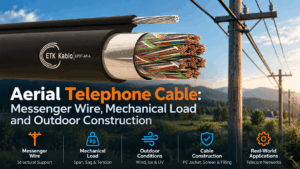
Aerial Telephone Cable: Messenger Wire, Mechanical Load and Outdoor Construction
Aerial telephone cable is designed for copper communication routes installed above ground between poles or other approved support point...
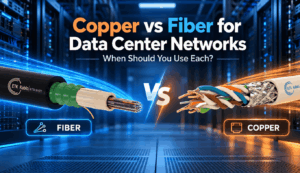
Copper vs Fiber for Data Center Networks: When Should You Use Each?
Copper vs fiber for data centers is not a question with one universal winner. Modern data centers commonly use both media because serve...

Cat6 vs Cat6A for PoE++ Networks: Which Should You Specify?
Cat6 vs Cat6A for PoE++ is no longer only a bandwidth decision. When an Ethernet cable carries both high-speed data and high levels of ...


