





 President’s Message
Blog
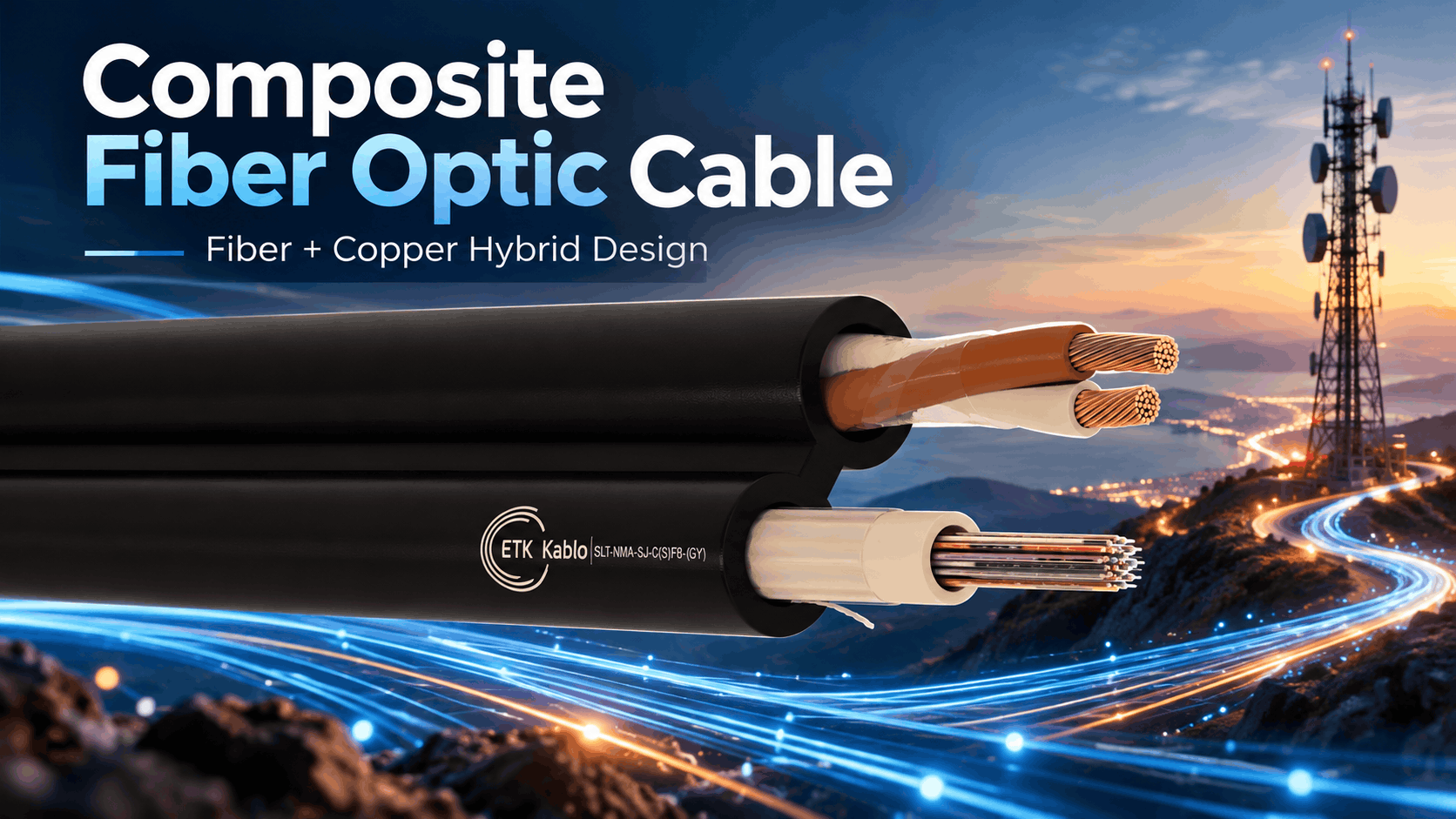
Composite Fiber Optic Cable: Fiber + Copper Hybrid Cable Design, Applications and Selection Guide
Reading Time: 19 minutes
Composite fiber optic cable combines optical fibers with one or more additional transmission or electrical elements inside a coordinated cable construction. In many telecommunications and industrial applications, this means optical fiber for high-speed data together with copper conductors for electrical power, control or auxiliary circuits.
As a result, one cable can deliver optical connectivity and electrical energy to remote equipment instead of requiring completely separate fiber and power routes.
However, a composite cable is not simply a standard fiber optic cable with copper wires added beside it. The optical fibers, copper conductors, mechanical strength members, water protection, armor, sheath and electrical requirements must work together as one engineered cable system.
Moreover, industry terminology varies. Manufacturers and project specifications may use terms such as composite fiber cable, hybrid fiber cable, fiber + copper cable or powered fiber cable for closely related constructions. Current IEC terminology commonly uses hybrid communication cable for cables that combine optical and metallic transmission or current-carrying elements.
ETK Kablo manufactures conventional fiber optic cables as well as special project-specific composite constructions combining optical fibers with stranded copper power elements.
Quick answer: a composite fiber optic cable combines optical fiber with copper or another transmission element in one coordinated construction. Fiber carries high-bandwidth data, while copper can provide power, control or auxiliary electrical functionality. The correct design depends on fiber type, fiber count, copper conductor size, voltage drop, current demand, distance, mechanical protection and installation environment.
Composite Fiber Optic Cable at a Glance
| Design Feature | Typical Function |
|---|---|
| Optical Fiber | High-speed data and telecommunications transmission |
| Copper Conductors | Remote equipment power, control or auxiliary electrical circuits |
| Loose Tube | Protects fibers against mechanical and environmental stresses |
| FRP Strength Member | Provides mechanical strength without acting as a power conductor |
| Water Blocking | Limits longitudinal water migration in outdoor constructions |
| Glass / Aramid Yarn | Provides tensile reinforcement and additional mechanical protection |
| Metallic Armor | Adds protection against impact, crushing or rodent damage |
| PE Outer Jacket | Provides environmental protection for many outdoor applications |
| LSZH Jacket | Can be specified where low-smoke and halogen-free performance is required |
| Typical Applications | Telecom, CCTV, industrial sites, remote equipment, FTTA, smart infrastructure and surveillance |
Therefore, composite cable selection requires both optical-network design and electrical-power design.
What Is a Composite Fiber Optic Cable?
A composite fiber optic cable contains more than one functional transmission medium within the same overall cable architecture.
The most common arrangement combines:
- Optical fibers for communication
- Copper conductors for electrical power or control
Nevertheless, the word “composite” can also describe other mixed constructions. For example, a project could combine different optical fiber types or several communication elements within the same cable.
For this reason, an RFQ should never state only “composite cable.”
Instead, buyers should identify:
- Optical fiber type
- Fiber count
- Copper conductor quantity
- Copper conductor cross-section
- Operating voltage
- Current requirement
- Mechanical construction
- Installation environment
Only then can the manufacturer design the complete cable correctly.
Composite Fiber Optic Cable vs Hybrid Fiber Cable
In commercial cable terminology, composite and hybrid are often used interchangeably.
However, the words do not have exactly the same meaning in every company, country or project specification.
A practical distinction is:
| Term | Common Industry Usage |
|---|---|
| Composite Fiber Optic Cable | Fiber combined with another functional element such as copper conductors or another transmission medium |
| Hybrid Fiber Cable | Often used specifically for fiber + electrical power or multiple media in one construction |
| Powered Fiber Cable | Fiber plus conductors specifically intended to supply remote network equipment |
| Fiber + Copper Cable | Plain-language description for a hybrid/composite optical and metallic cable |
Current IEC standardization primarily uses the term hybrid communication cable for combinations of optical fibers and metallic communication or current-carrying elements.
Therefore, manufacturers can legitimately market a product as a composite fiber optic cable while the project specification references IEC hybrid-cable terminology.
What Is a Copper Fiber Composite Cable?
A copper fiber composite cable combines optical fibers and copper conductors within one cable system.
The two elements perform different jobs.
Optical fibers transmit information as light. Consequently, they provide high bandwidth, long transmission distance and immunity to electromagnetic interference.
Copper conductors carry electrical current. Depending on the design, they can supply power to remote equipment or support another defined electrical function.
Therefore, the cable can simultaneously provide:
- High-speed optical communication
- Electrical energy
This architecture becomes particularly useful where network equipment is located far from a convenient local power source.
How Does a Composite Fiber Optic Cable Work?
The optical and electrical sections operate independently while sharing one physical cable route.
Data travels through the optical fibers using light from compatible optical transmitters and receivers.
Meanwhile, electrical current travels through the copper conductors.
Therefore, the copper conductors do not carry the optical signal, and the optical fibers do not carry electrical current.
The main engineering task is to combine these different transmission systems into one mechanically stable cable without compromising either one.
Does Fiber Carry Electrical Power?
No.
Standard glass optical fiber is a dielectric transmission medium. It carries optical signals rather than electrical current.
Consequently, a remote device connected only by standard optical fiber still requires a separate power source.
Composite fiber solves this problem by placing dedicated copper conductors beside the optical elements.
As a result, the same cable route can provide both connectivity and electrical power.
Is Composite Fiber the Same as Power over Ethernet?
No.
Power over Ethernet, or PoE, sends Ethernet data and electrical power through compatible balanced copper cabling.
A fiber + copper composite cable works differently.
The optical fibers carry the communication signal, while separate copper conductors carry electrical current.
Therefore, powered fiber can extend optical networking to locations where conventional PoE distance or copper bandwidth limitations are undesirable.
However, the complete power design must still account for voltage drop, equipment current and electrical protection.
Why Combine Fiber and Copper in One Cable?
The strongest reason is installation efficiency.
Without a composite design, the project may need to install:
- One fiber optic cable
- One electrical power cable
Each cable can require separate handling, drum management, pulling operations and route planning.
By contrast, one composite cable can combine both requirements.
Consequently, the installation may reduce:
- Number of cable runs
- Installation labour
- Pathway occupancy
- Drum handling
- Cable-management complexity
- Route coordination
Nevertheless, combining functions does not automatically make every project cheaper. Larger conductors, special construction, termination requirements and custom production can increase cable cost.
Composite Fiber Optic Cable Construction
There is no single universal composite construction.
Depending on the project, a cable can include:
- Single-mode or multimode optical fibers
- Central loose tube
- Multiple loose tubes
- PBT protective tubes
- Copper power conductors
- FRP central strength member
- Glass yarn
- Aramid yarn
- Water-swellable yarn
- Water-swellable tape
- Jelly filling
- Inner sheath
- Corrugated steel tape
- Steel wire armor
- PE, LSZH or other outer sheath material
Therefore, the term “composite” defines the combined functionality more than one fixed mechanical structure.
Central Loose Tube Composite Fiber Optic Cable
A central loose tube design places the optical fibers inside one principal protective tube.
This construction can provide a compact optical section for relatively low or medium fiber counts.
The copper power element can then be incorporated into the same overall cable or positioned alongside the optical element in a figure-8-style construction.
ETK Kablo’s A-D(ZN)T2Y Composite Fiber Optic Cable, for example, uses a central loose tube optical section together with a separate stranded copper power element connected through a web.
This architecture keeps the optical and electrical sections physically organized while allowing one integrated installation.
Multi Loose Tube Composite Fiber Optic Cable
Higher fiber counts can require a multi loose tube design.
Several PBT tubes are stranded around a central strength member, while copper conductors become part of the overall cable core.
This approach can support considerably higher fiber capacity.
Therefore, multi loose tube composite cables become attractive when one route must carry both remote power and larger optical networks.
The general difference between the optical architectures is explained in our tight-buffered vs loose-tube fiber cable guide.
Composite Fiber Optic Cable with Power Conductors
The copper conductor section should be engineered from the electrical load rather than selected as an afterthought.
Important parameters include:
- Conductor material
- Conductor cross-section
- Number of conductors
- Operating voltage
- Maximum current
- DC resistance
- Voltage drop
- Temperature rating
- Insulation system
- Short-circuit or protection requirements where applicable
Consequently, two cables with the same fiber count can require completely different copper sections.
Why Copper Conductor Size Matters
Electrical resistance decreases as conductor cross-section increases.
Therefore, larger copper conductors normally reduce voltage drop over long cable runs.
This becomes important when the composite cable powers remote devices hundreds of meters away.
However, increasing conductor size also increases:
- Cable diameter
- Cable weight
- Material cost
- Bending stiffness
- Drum size
As a result, the optimum conductor size balances electrical performance with mechanical and commercial requirements.
Composite Fiber Optic Cable and Voltage Drop
Voltage drop is one of the most important design calculations for powered composite fiber.
A copper conductor has electrical resistance. Therefore, the voltage available at the remote device decreases as current travels through the circuit.
Voltage drop increases with:
- Longer distance
- Higher current
- Smaller conductor cross-section
- Higher conductor resistance
- Higher operating temperature
Consequently, the cable designer needs to know both the power demand and the route length.
Specifying only “2 x 1.5 mm² copper + 12 fiber” may not be enough if the remote load and voltage are unknown.
How Far Can a Composite Fiber Optic Cable Deliver Power?
There is no universal maximum distance.
The optical fiber itself can support long communication distances according to fiber type, wavelength and transceiver.
However, the copper power section may become the limiting factor.
Maximum practical distance depends on:
- Supply voltage
- Remote equipment voltage range
- Current demand
- Copper cross-section
- Conductor resistance
- Permitted voltage drop
- Ambient temperature
Therefore, power reach should be calculated for the actual device rather than inferred from the optical distance.
Composite Fiber Optic Cable and DC Power
Many powered-fiber applications use DC because telecommunications and electronic equipment commonly operate from DC power architectures.
Nevertheless, the allowable power system depends on the cable construction and applicable electrical requirements.
Buyers should specify:
- Nominal voltage
- Maximum voltage
- Maximum current
- Protection arrangement
- Conductor insulation requirement
Current IEC hybrid communication cable standards also distinguish remote-equipment powering from ordinary mains electricity distribution.
Therefore, a hybrid communication cable should not automatically be treated as a general-purpose mains power cable.
Composite Fiber Optic Cable vs Separate Fiber and Power Cables
| Characteristic | Composite Fiber Cable | Separate Fiber + Power Cables |
|---|---|---|
| Number of Cable Runs | One coordinated run | Two independent runs |
| Installation Labour | Can be reduced | Normally requires separate handling |
| Route Space | Can reduce pathway complexity | Uses separate cable space |
| Design Flexibility | Custom construction required | Each cable can be selected independently |
| Replacement | Combined infrastructure | Fiber or power can be replaced separately |
| Termination | Requires management of both optical and electrical elements | Independent termination systems |
| Procurement | One specialized cable | Two standard cable families may be available |
Therefore, composite cable provides its greatest value when fiber and power consistently follow the same route toward the same remote equipment.
Composite Fiber Optic Cable for FTTA
Fiber to the Antenna, or FTTA, is one of the clearest examples of hybrid fiber + power architecture.
Remote radio or active antenna equipment needs both:
- High-speed optical communication
- Electrical power
Instead of routing independent optical and electrical cables up a tower or structure, a hybrid construction can combine both.
IEC 62807-3-10 specifically addresses outdoor FTTA hybrid communication cables.
Therefore, FTTA is not simply a marketing example; it has a dedicated international hybrid-cable standard framework.
Composite Fiber Optic Cable for CCTV
Remote surveillance cameras increasingly require high-bandwidth data connections.
Fiber provides useful advantages where camera locations exceed conventional copper Ethernet reach or where electromagnetic interference is significant.
However, the camera still requires power.
A composite cable can therefore provide:
- Fiber connection for video and control data
- Copper conductors for camera power
This architecture can be useful for:
- Highways
- Airports
- Industrial sites
- Large campuses
- Railway infrastructure
- Perimeter security
Composite Fiber Optic Cable for Industrial Networks
Industrial sites often place network devices far from centralized control rooms.
Remote devices may include:
- Industrial switches
- Gateways
- Remote I/O
- Cameras
- Sensors
- Communication cabinets
Fiber provides reliable data transmission even in high-EMI environments.
Meanwhile, integrated copper conductors can eliminate the need for a separate power route.
Consequently, composite fiber can simplify selected industrial infrastructure projects.
Does Composite Fiber Optic Cable Have EMI Immunity?
The optical communication path is inherently immune to electromagnetic interference.
However, the complete composite cable contains metallic conductors.
Therefore, it would be incorrect to describe the entire cable as completely dielectric or electrically isolated.
The copper section can still interact with:
- Electromagnetic fields
- Ground-potential differences
- Lightning-induced voltages
- Electrical faults
Consequently, grounding, bonding, surge protection and route separation may still require engineering review.
Is Composite Fiber Optic Cable All-Dielectric?
No, not when it contains copper conductors.
An all-dielectric fiber cable contains no conductive metallic component within the cable construction.
A fiber + copper composite cable, by definition, contains metallic electrical conductors.
Therefore, composite powered fiber should not be substituted for ADSS or another all-dielectric design where electrical isolation is a critical project requirement.
FRP Fiber Cable vs Composite Fiber Optic Cable
FRP can create confusion in search results.
FRP stands for Fiber-Reinforced Plastic and is commonly used as a non-metallic strength member inside fiber optic cables.
However, an FRP strength member does not transmit network data or electrical power.
Its purpose is mechanical.
Therefore:
| Term | Function |
|---|---|
| Optical Fiber | Data transmission |
| Copper Conductor | Electrical current |
| FRP | Mechanical strength |
Consequently, a conventional fiber cable containing FRP is not automatically a composite fiber optic cable.
Single-Mode Composite Fiber Optic Cable
Single-mode fiber is a strong choice for composite cables serving long-distance telecommunications and infrastructure routes.
Possible fiber types include:
- G.652.D
- G.657.A1
- G.657.A2
The correct choice depends on optical equipment, link distance and bending requirements.
For example, G.657 fibers can provide improved macrobending performance in routes with constrained installation geometry.
Our single-mode vs multimode fiber guide explains the optical differences in detail.
Multimode Composite Fiber Optic Cable
Composite construction can also incorporate multimode fiber where the network application requires it.
Possible fiber categories include:
- OM1
- OM2
- OM3
- OM4
- OM5
However, multimode should not be selected simply because the route is physically short.
The active optical equipment and required Ethernet or network interface should determine the fiber type.
How Many Fibers Should a Composite Cable Have?
Fiber count depends on the network architecture rather than the number of copper conductors.
Possible configurations can include:
- 2 fibers
- 4 fibers
- 6 fibers
- 8 fibers
- 12 fibers
- 24 fibers
- 48 fibers
- 72 fibers
- Higher counts for project-specific multi-tube constructions
Spare capacity can be valuable if future equipment or additional network links may use the same route.
Nevertheless, unnecessarily high fiber count can increase cable complexity and cost.
Our fiber optic cable core-count guide explains how to size optical capacity.
Composite Fiber Optic Cable with Steel Tape Armor
Outdoor and industrial routes can require additional mechanical protection.
Corrugated steel tape can help protect the cable from:
- Crushing
- Impact
- Rodent damage
- General mechanical exposure
For example, ETK Kablo’s A-DQ(ZN)(SR)2Y Composite Fiber Optic Cable combines optical fibers, copper power conductors, water-blocking elements, glass yarn and corrugated steel tape under an outdoor HDPE sheath.
Therefore, composite functionality and mechanical armor can coexist in the same cable.
Armored vs Unarmored Composite Fiber Cable
Armor should follow the route risk rather than being added automatically.
Consider armor when the installation faces:
- Rodents
- Crushing
- Direct burial
- Exposed industrial conditions
- High mechanical risk
By contrast, unarmored composite cable can remain appropriate inside protected ducts, trays or infrastructure pathways.
Our armored vs unarmored cable guide explains this decision in more detail.
Does Armor Make a Composite Cable Shielded?
Not automatically.
Metallic armor primarily provides mechanical protection.
Although metallic layers can influence electromagnetic behaviour, they should not automatically replace a dedicated electrical screen required for a copper communication circuit.
Moreover, optical fiber itself does not require EMI shielding for data transmission.
Therefore, screen and armor requirements should remain separate.
Outdoor Composite Fiber Optic Cable
Outdoor composite cable must protect both the optical and electrical sections against environmental exposure.
Typical requirements can include:
- UV-resistant PE jacket
- Water blocking
- Wide operating temperature
- High tensile strength
- Crush resistance
- Impact resistance
- Rodent protection where necessary
Current IEC 62807-3 provides a sectional framework for outdoor hybrid communication cables.
Therefore, project specifications should evaluate environmental performance in addition to fiber and copper parameters.
Indoor Composite Fiber Optic Cable
Indoor routes create different requirements.
Fire performance, flexibility, building regulations and low-smoke materials may become more important than UV exposure.
The current IEC 62807-2:2026 standard provides a sectional specification for indoor hybrid communication cables.
Depending on the project, indoor cable can therefore require:
- LSZH materials
- Defined flame propagation
- Low smoke density
- Low corrosive gas emissions
- Suitable bend radius
- Building-specific reaction-to-fire classification
Composite Fiber Optic Cable for Duct Installation
Duct installation can provide strong mechanical protection from the surrounding infrastructure.
However, underground ducts often contain moisture.
Therefore, the cable may still require:
- Water-swellable yarn
- Water-swellable tape
- Gel-filled tubes
- PE outer sheath
Conduit size and pulling distance must also accommodate the larger diameter and weight created by the copper section.
For comparison, ETK Kablo’s duct fiber optic cable portfolio demonstrates the environmental requirements of conventional underground optical routes.
Figure-8 Composite Fiber Optic Cable
A figure-8-style construction can physically separate the optical and electrical portions while joining them through a web.
This design can provide useful advantages during installation and termination because technicians can access the two sections independently.
Depending on the product, the structure can also simplify the integration of different cable diameters.
However, figure-8 geometry should not be confused automatically with a messenger-supported aerial cable.
The mechanical role of each section must be confirmed from the actual datasheet.
Aerial Composite Fiber Optic Cable
Composite cable can also serve overhead routes when the complete construction is designed for aerial mechanical loading.
The cable may require:
- Messenger support
- Self-supporting strength members
- Defined installation tension
- Span-length engineering
- Wind loading
- UV resistance
Therefore, the fact that a cable contains fiber and power conductors does not automatically make it suitable for pole-to-pole suspension.
The aerial mechanical design must be evaluated separately.
Composite Fiber Cable for Remote Network Equipment
Remote network equipment is one of the strongest applications for composite cable.
Examples include:
- Optical network units
- Industrial Ethernet switches
- Telecom radios
- Wireless access equipment
- Remote cabinets
- CCTV equipment
- Traffic-control devices
Fiber can provide communication over long distances, while copper conductors supply the electronics.
Consequently, a single cable can simplify distributed network architecture.
Composite Fiber Optic Cable for Smart Cities
Smart-city infrastructure often distributes powered network devices across long outdoor routes.
Applications can include:
- Traffic cameras
- ANPR cameras
- Environmental sensors
- Public Wi-Fi
- Traffic controllers
- Information displays
- Security devices
Because these devices require both data and power, composite fiber can provide a practical infrastructure option.
Nevertheless, each device has different voltage and current requirements, so one universal conductor size should not be assumed.
Composite Fiber Optic Cable for Railway Networks
Railway infrastructure can require long-distance communication together with power for remote telecom and monitoring equipment.
Fiber is attractive because optical data transmission is immune to traction-related electromagnetic interference.
However, the integrated copper section remains electrically conductive.
Therefore, railway projects should also assess:
- Induced voltage
- Grounding
- Lightning
- Mechanical protection
- Fire performance
- Route conditions
Accordingly, composite cable can be useful but should be engineered for the specific railway environment.
Composite Fiber Optic Cable for Oil and Gas
Oil and gas infrastructure can place remote communication devices across large industrial sites.
A composite cable can combine optical communication with electrical power for selected field equipment.
However, process environments can additionally require:
- Hydrocarbon resistance
- Oil resistance
- UV protection
- Mechanical armor
- LSZH materials
- Hazardous-area compliance
- Wide temperature range
Therefore, the cable design should follow both the communication architecture and the environmental specification.
Composite Fiber Optic Cable for Marine and Offshore Applications
Marine and offshore installations add moisture, salt, vibration and mechanical exposure.
Consequently, a suitable composite construction can require:
- Corrosion-resistant materials
- Water blocking
- Mechanical armor
- Oil-resistant sheath
- Fire-performance characteristics
- Special installation testing
One generic outdoor composite cable should not automatically be assumed suitable for offshore service.
Composite Fiber Optic Cable Standards
Modern specifications should distinguish between optical cable standards and hybrid communication cable standards.
IEC 60794 covers optical fiber cable construction and test methodologies.
Meanwhile, the IEC 62807 family addresses hybrid communication cables that combine optical and metallic elements.
| Standard | General Relevance |
|---|---|
| IEC 62807-1 | Generic requirements for hybrid telecommunication cables |
| IEC 62807-2 | Indoor hybrid communication cables |
| IEC 62807-3 | Outdoor hybrid communication cables |
| IEC 62807-3-10 | Outdoor FTTA hybrid communication cables |
| IEC 60794-1 Series | Optical cable test methods and optical cable requirements |
| IEC 60794-3 | Outdoor optical fiber cable requirements |
However, the exact standards required by one project depend on cable construction and application.
IEC 62807 and Composite Fiber Optic Cable
IEC 62807 provides the clearest current international standards framework for fiber + copper hybrid communication cables.
The generic standard covers combinations including:
- Optical fibers
- Twisted pairs or quads
- Coaxial elements
- Current-carrying conductors
These elements can exist under a common cable sheath.
Importantly, the IEC 62807 framework treats current-carrying conductors as part of a communication-network powering architecture rather than ordinary building mains distribution.
Therefore, engineers should define the electrical function explicitly.
IEC 60794 Testing for Composite Fiber Cables
Even when copper conductors are added, the optical part of the cable still needs reliable mechanical and environmental performance.
IEC 60794-1 test methods can evaluate characteristics such as:
- Tensile performance
- Crush resistance
- Impact
- Torsion
- Repeated bending
- Bending performance
- Temperature cycling
- Water penetration
IEC 60794-1-2 explicitly includes cables containing both optical fibers and electrical conductors within its test-method guidance.
Consequently, the combined cable still needs to protect optical attenuation and fiber strain during mechanical testing.
Why Mechanical Testing Is Especially Important
The copper section adds weight and stiffness to a fiber cable.
Therefore, mechanical forces during installation can differ from those of a conventional optical cable with the same fiber count.
The cable must protect the glass fibers during:
- Pulling
- Bending
- Drum handling
- Crushing
- Twisting
- Temperature changes
As a result, maximum pulling tension and minimum bend radius should always come from the exact composite cable datasheet.
Composite Fiber Optic Cable Bending Radius
Combining copper and optical elements can increase overall cable diameter and bending stiffness.
Excessively tight bends can stress both:
- Optical fibers
- Copper insulation
Therefore, installers should follow the published minimum bending radius for the actual construction.
A generic “10 x cable diameter” or “20 x cable diameter” rule should not replace the manufacturer’s specified values.
Composite Fiber Optic Cable Pulling Tension
Optical fiber is sensitive to excessive tensile strain.
Therefore, the cable’s strength members should carry the principal pulling load during installation.
The copper conductors should not be used as improvised strength members unless the cable design specifically assigns them a structural function.
Consequently, installation crews should follow the published maximum installation tension and pulling method.
Composite Fiber Optic Cable Water Protection
Outdoor composite cables often need longitudinal water protection.
Possible systems include:
- Thixotropic filling gel
- Water-swellable yarn
- Water-swellable tape
- Water-resistant PBT tubes
- PE jacket systems
The optical and copper sections can require coordinated protection.
Therefore, buyers should not assume that a waterproof optical tube automatically protects every electrical element in the complete cable.
Composite Fiber Optic Cable Fire Performance
Fire performance depends on the complete cable materials and application.
Possible requirements can include:
- Flame retardancy
- LSZH materials
- Low smoke density
- Low corrosive gas emissions
- CPR classification in applicable European building installations
However, composite construction itself does not imply any particular fire rating.
A PE outdoor hybrid cable and an indoor LSZH hybrid cable can have completely different fire behaviour.
Composite Fiber Cable vs Conventional Fiber Optic Cable
| Characteristic | Conventional Fiber Cable | Composite Fiber Cable |
|---|---|---|
| Optical Transmission | Yes | Yes |
| Integrated Copper Power | No | Can be included |
| Electrical Conductivity | Depends on metallic cable elements | Yes when copper conductors are included |
| Remote Power Delivery | Requires separate solution | Can be integrated |
| Cable Weight | Generally lower for comparable optical architecture | Often higher due to copper |
| Design Complexity | Optical/mechanical | Optical + electrical + mechanical |
| Termination | Optical termination | Optical and electrical termination |
Therefore, composite cable provides additional functionality but also requires more complete engineering.
Composite Fiber Optic Cable vs Fiber + Separate Power Cable
The decision should consider lifecycle cost rather than cable price alone.
A composite cable can reduce installation runs, yet a separate-cable architecture offers greater independence between the power and optical systems.
Consider composite cable when:
- Fiber and power share the same route
- The remote equipment requires both
- Pathway space is limited
- Installation labour is significant
- One coordinated cable simplifies deployment
By contrast, separate cables can be attractive when electrical and optical infrastructure may change independently.
Common Composite Fiber Optic Cable Specification Mistakes
- Using “composite cable” without defining the copper element
- Assuming composite and hybrid always have one universal definition
- Ignoring copper conductor voltage drop
- Choosing conductor size only from current rating
- Ignoring power-supply voltage
- Ignoring the minimum device operating voltage
- Assuming optical distance equals electrical power distance
- Assuming the whole cable is immune to EMI because it contains fiber
- Calling a fiber + copper cable all-dielectric
- Confusing FRP strength members with copper power conductors
- Ignoring mechanical tension created by copper weight
- Using standard fiber bending-radius assumptions without checking the composite datasheet
- Ignoring water protection on outdoor routes
- Adding steel armor automatically without evaluating mechanical risk
- Assuming armor provides the required electrical screening
- Using indoor cable outdoors
- Using PE outdoor cable inside a building without checking fire requirements
- Ignoring electrical protection for remote equipment
- Specifying fiber count without network-capacity planning
- Selecting a standard product before defining the complete power and data requirements
How to Specify a Composite Fiber Optic Cable
1. Define the Optical Application
Identify network speed, optical equipment, wavelength and required link distance.
2. Select the Fiber Type
Specify G.652.D, G.657.A1, G.657.A2, OM3, OM4 or another appropriate optical fiber.
3. Define the Fiber Count
Include active fibers, redundancy and realistic future capacity.
4. Define the Remote Equipment
State what device the copper conductors will power.
5. Provide the Supply Voltage
The manufacturer needs the actual power-system voltage.
6. Provide Maximum Current
Include maximum device demand rather than only average consumption.
7. Define Maximum Distance
Electrical voltage-drop calculations depend directly on route length.
8. Calculate the Copper Conductor Size
Select cross-section from voltage drop, current and electrical requirements.
9. Define Cable Architecture
Select central loose tube, multi loose tube, figure-8 or another project-specific design.
10. Define Water Protection
Specify gel-filled or dry water-blocking requirements where necessary.
11. Define Mechanical Protection
Add steel tape, wire armor or non-metallic reinforcement according to the route.
12. Define the Outer Sheath
Choose PE, LSZH or another material according to environment and fire requirements.
13. Define Applicable Standards
Identify IEC 62807, IEC 60794 and other project-specific requirements as applicable.
14. Verify the Complete Datasheet
Finally, review optical, electrical, mechanical and environmental values together.
What Should a Composite Fiber Optic Cable RFQ Include?
| RFQ Item | Information to Provide |
|---|---|
| Application | FTTA, CCTV, industrial, telecom, smart city or other |
| Fiber Type | G.652.D, G.657.A1/A2, OM3, OM4 or required type |
| Fiber Count | Required number of optical fibers |
| Optical Architecture | Central loose tube, multi loose tube or other |
| Copper Conductors | Quantity and required cross-section |
| Supply Voltage | Nominal and maximum operating voltage |
| Load Current | Maximum remote equipment current |
| Route Length | Maximum cable distance |
| Voltage Drop | Maximum permitted value or device minimum voltage |
| Water Protection | Gel, dry water blocking or project requirement |
| Armor | Unarmored, steel tape, SWA or other requirement |
| Outer Jacket | PE, LSZH or other compound |
| Installation | Indoor, outdoor, duct, aerial, direct burial or industrial |
| Temperature | Storage, installation and operating range |
| Fire Performance | Applicable flame, smoke, halogen or CPR requirement |
| Standards | Applicable IEC 62807, IEC 60794 and project requirements |
ETK Kablo Composite Fiber Optic Cable Solutions
ETK Kablo manufactures special fiber optic cables for projects requiring constructions beyond conventional optical cable designs.
The portfolio includes composite fiber optic cables that combine optical fibers with stranded copper power conductors.
Depending on the project, ETK Kablo can combine:
- Single-mode or multimode fibers
- Central or multi loose tube construction
- Stranded copper power conductors
- FRP strength members
- Glass yarn reinforcement
- Water-blocking systems
- PE outer sheaths
- Corrugated steel tape protection
However, the correct product should be selected from the actual optical, electrical and environmental requirements rather than from the word “composite” alone.
ETK Kablo’s composite range demonstrates both compact central-tube fiber + power designs and higher-capacity multi-tube armored constructions.
For buyers preparing custom specifications, our fiber optic cable specification guide provides additional guidance on reading fiber, mechanical and environmental datasheet parameters.
Frequently Asked Questions About Composite Fiber Optic Cable
What is a composite fiber optic cable?
A composite fiber optic cable combines optical fibers with another functional element, commonly copper conductors, within one coordinated cable construction.
What is a composite fiber cable?
Composite fiber cable is a shorter commercial term for a cable combining optical fiber with copper power, another transmission element or multiple optical media within one cable system.
Is composite fiber optic cable the same as hybrid fiber cable?
The terms are frequently used interchangeably. Current IEC standards generally use “hybrid communication cable” for constructions that combine optical and metallic elements.
What is a copper fiber composite cable?
A copper fiber composite cable includes optical fibers for data transmission and copper conductors for electrical power, control or another defined electrical function.
Can composite fiber carry power and data at the same time?
Yes. The optical fibers carry data while the copper conductors simultaneously carry electrical current.
Does the power travel through the optical fiber?
No. Standard optical fiber carries light, not electrical current. Separate copper conductors provide electrical power.
Is powered fiber the same as PoE?
No. PoE carries power and Ethernet over copper pairs. Powered fiber normally uses optical fiber for data and separate copper conductors for electrical power.
Is composite fiber cable immune to EMI?
The optical communication path is immune to electromagnetic interference, but the integrated copper conductors remain electrically conductive and can still require EMC, grounding and surge consideration.
Is composite fiber cable all-dielectric?
No, not when it contains copper or another metallic conductor.
Is FRP fiber cable a composite fiber cable?
Not automatically. FRP is usually a non-metallic mechanical strength member. Its presence alone does not create a fiber + copper composite cable.
Can composite fiber cable use single-mode fiber?
Yes. G.652.D, G.657.A1 and G.657.A2 are possible depending on cable design and project requirements.
Can composite fiber cable use multimode fiber?
Yes. Multimode fiber can be incorporated when the network equipment and transmission distance require it.
Can composite fiber optic cable be armored?
Yes. Steel tape, steel wire or another mechanical protection system can be added where the route requires it.
Can composite fiber cable be installed underground?
Yes, provided the construction has the required water protection, sheath, mechanical strength and burial or duct suitability.
Can composite fiber cable be used outdoors?
Yes. Outdoor hybrid constructions commonly use UV-resistant PE sheaths and appropriate water-blocking systems.
Can composite fiber cable be LSZH?
Yes. Indoor or project-specific composite cables can use low-smoke halogen-free materials where the required cable design supports them.
What standard applies to composite fiber optic cable?
Current IEC terminology uses the IEC 62807 series for hybrid communication cables. Optical cable performance and test methods can also involve the IEC 60794 series.
What is IEC 62807?
IEC 62807 is the international standards family covering hybrid communication cables that can combine optical fibers, copper communication elements and current-carrying conductors.
How do I choose the copper conductor size?
Choose conductor size from supply voltage, maximum current, route length, permitted voltage drop, temperature and applicable electrical requirements.
How far can powered fiber run?
The maximum distance depends primarily on the power system and copper conductor design. Optical communication may reach much farther than the electrical power section can operate effectively.
Can composite fiber be used for CCTV?
Yes. Composite cable can provide fiber communication and electrical power to remote surveillance cameras where the project design supports it.
Can composite fiber be used for FTTA?
Yes. Fiber + power hybrid cable is widely suited to FTTA systems, and IEC 62807-3-10 specifically covers outdoor FTTA hybrid communication cables.
Is composite fiber better than separate fiber and power cables?
Not universally. Composite cable can reduce installation runs and pathway complexity, while separate cables provide greater independence between power and optical infrastructure. The project architecture should determine the choice.
Conclusion: When Should You Use Composite Fiber Optic Cable?
Composite fiber optic cable provides a practical way to combine high-speed optical communication with copper power or another electrical function in one engineered cable system.
The optical section provides high bandwidth, long transmission distance and immunity to electromagnetic interference. Meanwhile, the copper conductors can supply remote network or field equipment.
However, combining these functions also creates additional engineering requirements. Fiber type, fiber count, copper cross-section, current demand, voltage drop, mechanical strength, water protection, armor, outer sheath and installation environment must all be evaluated together.
Moreover, terminology should be interpreted carefully. Composite fiber cable, hybrid fiber cable, powered fiber cable and fiber + copper cable often describe overlapping concepts, while current IEC standards generally classify these combinations as hybrid communication cables.
Therefore, the strongest specification does not simply request a “composite fiber cable.” It identifies the required optical network, remote electrical load, route length and environmental conditions first.
Ultimately, composite cable provides the greatest value when the same remote equipment needs both fiber connectivity and electrical power along the same route. In that situation, one correctly engineered hybrid construction can simplify installation while preserving the optical, electrical and mechanical performance required by the project.
Benzer yazılar

Cat6 B2ca Cable: CPR Fire Performance, Standards and Selection Guide
Cat6 B2ca cable combines Category 6 Ethernet transmission performance with a high reaction-to-fire classification for permanently insta...

Servo Motor Cable: Power, Encoder, Feedback, Shielding and Selection Guide
Servo motor cable connects a servo drive with the motor, feedback system or related control components in precision automation equipmen...

Hybrid Fiber Optic Cable for Power and Data: Design, Applications and Selection Guide
Hybrid fiber optic cable combines optical fibers for high-speed communication with copper conductors that can deliver electrical power ...
Composite Fiber Optic Cable: Fiber + Copper Hybrid Cable Design, Applications and Selection Guide
Composite fiber optic cable combines optical fibers with one or more additional transmission or electrical elements inside a coordinate...

LPCB Approved Cable: LPCB Certification, Standards and Fire-Resistant Cable Guide
LPCB approved cable is a cable whose specific product construction has received third-party certification under the Loss Prevention Cer...

PROFIBUS Cable: DP vs PA, Impedance, Shielding and Selection Guide
PROFIBUS cable is a purpose-designed industrial communication cable used to connect automation equipment over a defined fieldbus networ...
Fire-Resistant Power Cable vs Fire-Resistant Signal Cable: What Is the Difference?
Power vs signal cable is an important distinction when specifying fire-resistant circuits. Two cables can both maintain circuit integri...
Shielded vs Unshielded Outdoor Telephone Cable: When Is Screening Required?
Shielded outdoor telephone cable includes a metallic screen around the communication core to reduce the effect of external electromagne...
BS 6387 CWZ Cable Testing Explained
BS 6387 CWZ is a fire-resistance test designation used for cables that must maintain circuit integrity under defined fire conditions. I...

Aerial Telephone Cable: Messenger Wire, Mechanical Load and Outdoor Construction
Aerial telephone cable is designed for copper communication routes installed above ground between poles or other approved support point...
Copper vs Fiber for Data Center Networks: When Should You Use Each?
Copper vs fiber for data centers is not a question with one universal winner. Modern data centers commonly use both media because serve...

Cat6 vs Cat6A for PoE++ Networks: Which Should You Specify?
Cat6 vs Cat6A for PoE++ is no longer only a bandwidth decision. When an Ethernet cable carries both high-speed data and high levels of ...


