





 President’s Message
Blog
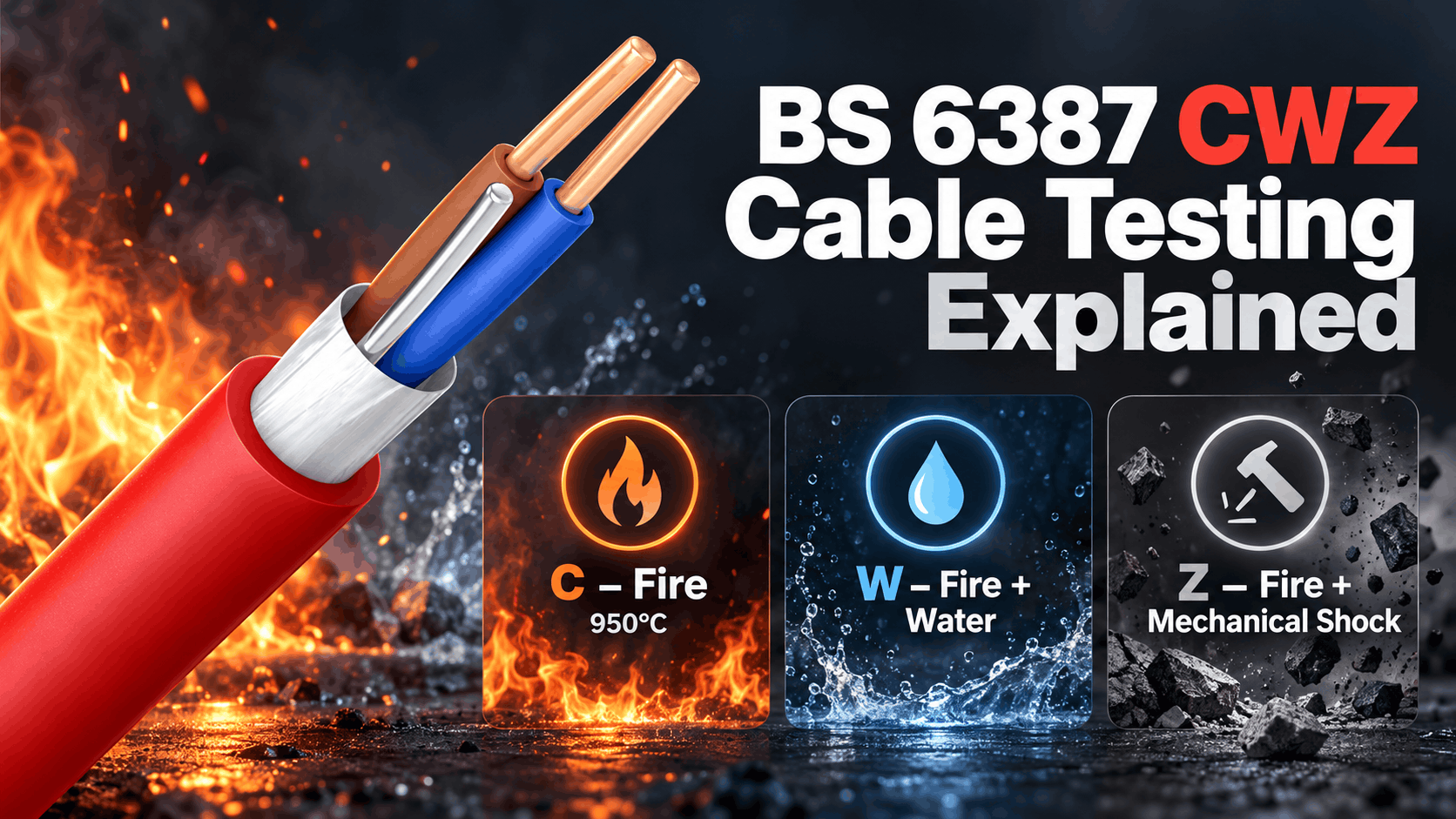
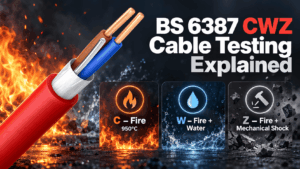
BS 6387 CWZ Cable Testing Explained
Reading Time: 17 minutes
BS 6387 CWZ is a fire-resistance test designation used for cables that must maintain circuit integrity under defined fire conditions. Instead of evaluating only flame exposure, the test framework separately examines fire alone, fire with water and fire with mechanical shock.
However, CWZ is often misunderstood. It does not mean that one cable sample survives fire, water and mechanical impact simultaneously for three hours. Instead, BS 6387:2013 uses three separate protocols identified as C, W and Z.
Protocol C evaluates circuit integrity during prolonged high-temperature fire exposure. Protocol W adds water spray to a defined fire condition. Protocol Z evaluates the cable during fire together with repeated indirect mechanical shock.
Therefore, buyers should treat CWZ as a test classification rather than a cable construction. A cable does not become CWZ simply because it contains mica tape, LSZH compounds or ceramic-forming insulation. The finished cable must demonstrate the required circuit integrity under the applicable BS 6387 test protocols.
ETK Kablo manufactures a broad range of fire-resistant cables for critical signal, control, communication and instrumentation circuits where continued operation during fire forms part of the project requirement.
Quick answer: BS 6387 CWZ means that the tested cable construction has met Protocol C for fire alone, Protocol W for fire with water and Protocol Z for fire with mechanical shock. The three protocols use different temperatures, durations and stresses, so engineers should review the complete test report rather than interpreting the letters as one combined three-hour fire test.
BS 6387 CWZ at a Glance
| Protocol | Primary Test Condition | Nominal Temperature | Duration | Additional Stress |
|---|---|---|---|---|
| C | Resistance to fire alone | 950°C ±40°C | 3 hours | None |
| W | Resistance to fire with water | 650°C ±40°C | 15 min fire + 15 min fire and water | Water spray |
| Z | Resistance to fire with mechanical shock | 950°C ±40°C | 15 minutes | Repeated indirect mechanical shock |
A cable that successfully meets the requirements of all three protocols can be designated Category CWZ.
Nevertheless, the table should be treated as an engineering summary rather than a substitute for the complete standard. The official test method also defines test arrangements, electrical monitoring, specimen preparation, burner conditions, mechanical apparatus and reporting requirements.
What Is BS 6387?
BS 6387 is a British Standard test method for cables that are required to maintain circuit integrity under fire conditions.
The current edition is BS 6387:2013.
Importantly, BS 6387 is a test-method standard. It does not by itself define every construction requirement for a complete cable family.
Instead, the method determines whether the tested cable can maintain its electrical circuit during the specified fire-survival conditions.
Consequently, project engineers should distinguish between:
- The cable product specification
- The required electrical characteristics
- The required fire-test method
- The required BS 6387 protocol or CWZ designation
- Other smoke, halogen and flame-propagation requirements
- Installation-system requirements
This distinction prevents one fire-related term from being used as a substitute for the complete cable specification.
What Does BS 6387 CWZ Mean?
The letters C, W and Z identify three different test protocols.
Each protocol challenges the cable in a different way.
C addresses prolonged exposure to fire alone.
W addresses fire together with water exposure.
Z addresses fire together with mechanical shock.
Therefore, the complete CWZ designation demonstrates that the cable has been evaluated against three different failure mechanisms.
That distinction matters because real fire emergencies can expose critical circuits to more than temperature alone.
For example, a cable route can experience:
- Direct flame exposure
- Operation of sprinkler systems
- Firefighting water
- Movement of supports
- Falling debris
- Structural deformation
- Mechanical disturbance
BS 6387 does not reproduce every possible real-fire scenario. However, its separate C, W and Z protocols allow engineers to evaluate cable circuit integrity under several defined stresses.
BS 6387 CWZ Protocol C Explained
Protocol C tests resistance to fire alone.
The cable test piece faces direct flame exposure corresponding to a nominal temperature of 950°C, with the standard tolerance applied around that target.
The test continues for three hours.
Throughout the test, the monitoring arrangement checks whether the required electrical circuit remains intact.
Therefore, Protocol C answers a relatively focused question:
Can the tested cable maintain circuit integrity during prolonged high-temperature fire exposure?
No water spray forms part of Protocol C.
Likewise, the test does not add the repeated mechanical shock used in Protocol Z.
Consequently, passing C does not automatically prove W or Z performance.
Why Does Protocol C Use 950°C?
BS 6387 uses standardized test conditions so that laboratories can evaluate different cable constructions under repeatable exposure.
The 950°C condition provides a severe thermal challenge for the cable’s insulation system, fire barriers and overall construction.
However, engineers should not interpret the result as a prediction that every real building fire will remain at exactly 950°C for three hours.
Laboratory fire testing provides comparative and compliance information under controlled conditions.
Real fires can have different temperature curves, ventilation conditions, mechanical damage and installation effects.
Does Protocol C Mean Three Hours of Guaranteed Operation?
No.
A Protocol C result demonstrates performance during the defined BS 6387 laboratory test.
It does not guarantee that an installed electrical system will operate for exactly three hours in every possible fire.
For example, actual system operation can also depend on:
- Cable supports
- Fixings
- Junction boxes
- Terminations
- Distribution equipment
- Power sources
- Connected devices
- Structural conditions
Therefore, cable-level circuit integrity and complete system functionality should remain separate engineering concepts.
Our FE180, PH120, E30, E60 and E90 guide explains the important difference between cable-level fire testing and complete installation-system integrity.
BS 6387 CWZ Protocol W Explained
Protocol W evaluates resistance to fire with water.
The cable first experiences fire at approximately 650°C under the defined test arrangement.
After the initial fire period, the test introduces water while fire exposure continues.
The commonly referenced test sequence is:
- 15 minutes of fire exposure
- Followed by 15 minutes of simultaneous fire and water spray
- Total test duration: 30 minutes
Therefore, W does not simply mean that water is sprayed onto an unheated cable.
The test challenges a cable that is already operating under elevated-temperature fire conditions.
Why Is Water Included in BS 6387?
Water can create a major additional challenge for a cable whose insulation and protective materials have already experienced fire.
During an emergency, water may come from:
- Automatic sprinkler systems
- Firefighting systems
- Hose streams reaching the cable route
- Other suppression equipment
Water can cool some surfaces rapidly while entering damaged or carbonized cable layers.
As a result, electrical insulation may face a different failure mechanism from fire exposure alone.
Protocol W therefore provides information that Protocol C cannot provide by itself.
Does W Mean Waterproof Cable?
No.
A BS 6387 W result should not be interpreted as a general waterproofing classification.
The protocol evaluates circuit integrity during a specific fire-and-water test.
It does not replace environmental requirements for:
- Outdoor water resistance
- Submersion
- Longitudinal water blocking
- Ingress protection of accessories
- Underground installation
Therefore, a cable can pass Protocol W while still requiring separate environmental evaluation for outdoor or wet-location service.
BS 6387 CWZ Protocol Z Explained
Protocol Z evaluates circuit integrity during fire together with mechanical shock.
The fire exposure uses a nominal temperature of approximately 950°C.
The test duration is 15 minutes.
During this period, the test arrangement receives repeated indirect mechanical shocks.
The impacts occur at defined intervals while the cable remains energized and exposed to flame.
Consequently, Protocol Z evaluates a failure mechanism that simple fire-only testing cannot reproduce.
Why Does Mechanical Shock Matter?
Buildings and infrastructure can experience physical disturbance during a fire.
Possible sources include:
- Falling materials
- Movement of cable supports
- Structural deformation
- Vibration
- Impact from nearby components
- Thermally induced movement
A cable construction may maintain insulation integrity when left completely stationary yet perform differently once the fire-damaged materials experience movement.
Therefore, mechanical shock provides an additional test of cable robustness.
Our fire-resistant cable guide for tunnels, airports and stations explains why combined thermal and mechanical stresses become especially relevant in critical infrastructure.
Does the Z Test Hit the Cable Directly?
Not in the simplistic sense often shown in marketing diagrams.
Protocol Z uses an indirect mechanical-shock arrangement associated with the cable mounting or test support system.
Therefore, engineers should avoid describing the test as someone repeatedly striking the cable itself with a hammer.
The standard defines the apparatus, mounting method, impact mechanism and electrical monitoring arrangement.
This controlled method allows laboratories to reproduce the test consistently.
Are C, W and Z Tested at the Same Time?
No. This is one of the most important points in understanding BS 6387 CWZ.
C, W and Z are separate protocols.
Separate test pieces from the cable sample undergo the different test conditions.
Therefore, Category CWZ does not mean:
“950°C for three hours while water is continuously sprayed and mechanical impact occurs at the same time.”
Instead:
- C tests prolonged fire alone
- W tests fire followed by fire with water
- Z tests fire with mechanical shock
When the tested cable meets all three protocol requirements, it can receive the CWZ designation.
This distinction is particularly important when comparing BS 6387 with other test methods that use different combined stress sequences.
BS 6387:2013 Scope
The current BS 6387:2013 edition has a defined technical scope.
It applies to relevant cables with:
- Rated voltage not exceeding 600/1000 V
- Overall diameter not exceeding 20 mm
- Two or more insulated conductors, with or without additional metallic elements
The method can also apply to a cable with one insulated conductor when the cable includes at least one additional metallic element.
However, it does not apply to a cable that contains only one insulated conductor and no other metallic element.
Consequently, procurement teams should never assume that every large fire-resistant power cable falls within BS 6387 simply because a project specification requests CWZ.
Why the 20 mm Diameter Limit Matters
The overall-diameter limit is easy to overlook.
Large multicore power cables can exceed 20 mm relatively quickly as conductor size, core count, armour and sheath thickness increase.
If the finished cable falls outside the BS 6387 scope, the project should review the applicable product standard and alternative fire-resistance test requirements.
Therefore, an RFQ such as “BS 6387 CWZ 4 x 120 mm² power cable” should not be accepted automatically without first checking the actual finished cable diameter and applicable standard framework.
The correct compliance route comes from the complete cable and project requirements, not from copying a CWZ phrase from another specification.
BS 6387:2013 vs Older BS 6387 Categories
Older technical documents can create confusion because previous BS 6387 editions included additional classification letters.
Historic tables may show designations such as:
- A
- B
- S
- X
- Y
However, the 2013 revision focuses on protocols C, W and Z.
The older categories should therefore not be copied blindly into a new specification that claims compliance with BS 6387:2013.
Furthermore, BS 6387:1994 was withdrawn when the 2013 edition replaced it.
As a result, engineers reviewing legacy specifications should always check the standard edition rather than reading only the letters printed next to the cable description.
Is CWZ the Cable Construction?
No.
There is no universal physical construction called a “CWZ cable.”
Manufacturers can use different fire-survival technologies to achieve the required circuit-integrity performance.
Possible construction elements include:
- Mica fire barriers
- Ceramic-forming insulation
- Cross-linked fire-resistant compounds
- Glass-yarn tapes
- Special fillers
- Halogen-free bedding
- LSZH outer sheaths
- Metallic screens
- Mechanical armour where required
However, none of these materials proves CWZ performance individually.
The complete cable construction must pass the applicable test.
For a broader explanation of fire-survival cable design, see our fire-resistant cable types and selection guide.
BS 6387 CWZ vs Flame Retardant Cable
Fire resistance and flame retardancy answer different questions.
BS 6387 focuses on whether the required electrical circuit remains intact during defined fire conditions.
Flame-retardant testing instead evaluates the propagation of flame along a cable under another standardized method.
| Performance | Main Question |
|---|---|
| BS 6387 CWZ | Does the cable maintain circuit integrity under C, W and Z fire-survival protocols? |
| Flame Retardancy | How does flame propagate along the cable? |
Therefore, a flame-retardant cable is not automatically BS 6387 CWZ.
Likewise, CWZ performance should not replace a separately required flame-propagation classification.
Our fire resistant vs flame retardant cable guide explains this distinction in greater detail.
BS 6387 CWZ vs LSZH
LSZH means Low Smoke Zero Halogen.
It describes material behaviour related to smoke and halogen emissions rather than circuit continuity during fire.
A cable can therefore be:
- LSZH but not fire resistant
- Fire resistant but subject to different material requirements
- Both LSZH and fire resistant
Consequently, the phrase “LSZH fire cable” still does not provide enough information for a critical-circuit specification.
The project should identify the required:
- Fire-survival test
- Smoke performance
- Halogen or corrosive-gas performance
- Flame propagation performance
- CPR classification where applicable
BS 6387 CWZ vs CPR Classification
CPR Euroclasses and BS 6387 evaluate different fire-performance concepts.
A CPR classification such as B2ca or Cca primarily addresses a cable’s reaction to fire under the European Construction Products Regulation framework.
BS 6387, by contrast, addresses continued circuit integrity during defined fire-survival tests.
Therefore, B2ca does not mean CWZ.
Similarly, CWZ does not automatically establish a particular CPR Euroclass.
A project can require both when the building specification demands high reaction-to-fire performance as well as continued circuit operation.
BS 6387 CWZ vs IEC 60331
Both BS 6387 and the IEC 60331 family relate to cable circuit integrity under fire conditions.
However, they use different test methods, apparatus and performance frameworks.
Therefore, one should not simply be substituted for the other.
For example, writing:
“BS 6387 CWZ = IEC 60331”
would remove important information about the actual test conditions.
A project requiring either standard should identify:
- Exact standard
- Standard edition
- Applicable part or protocol
- Required duration
- Tested cable construction
- Required documentation
Our IEC 60331 vs IEC 60332 guide provides more detail on IEC fire-integrity and flame-propagation testing.
BS 6387 CWZ vs EN 50200
EN 50200 provides another important European method for evaluating fire-resistant cables used in emergency circuits.
The test incorporates fire together with mechanical shock.
Classifications such as PH ratings are associated with this framework.
However, PH120 should not be described as another name for CWZ.
The temperatures, durations, apparatus, classification system and test sequence differ.
| Framework | Primary Concept |
|---|---|
| BS 6387 CWZ | Separate C, W and Z fire-survival protocols |
| EN 50200 / PH | Fire with mechanical shock under its defined emergency-circuit test method |
Consequently, a cable can carry both types of fire-performance documentation when the construction has been separately tested to each requirement.
BS 6387 CWZ vs FE180 and PH120
FE180, PH120 and CWZ frequently appear in the same international cable specifications.
Nevertheless, they should not be ranked only by the numbers or durations involved.
For example:
- Protocol C involves 950°C fire exposure for three hours
- PH120 involves its own fire-and-mechanical test framework
- FE180 relates to another fire-integrity concept
Therefore, the fact that one designation includes 180 minutes does not automatically make it technically equivalent to Protocol C.
Different tests expose the cable to different conditions.
For this reason, project engineers should compare the actual standard rather than only the duration printed beside the cable designation.
BS 6387 CWZ vs E30, E60 and E90
CWZ is fundamentally a cable test designation.
E30, E60 and E90 belong to a different system-level functional-integrity concept associated with tested installation arrangements.
Those systems can involve:
- Cable
- Tray
- Ladder
- Clamps
- Supports
- Anchors
- Fixing intervals
Therefore, a cable passing BS 6387 CWZ does not automatically create an E90 installation.
Likewise, E90 system approval should not be used as proof that an individual cable has passed BS 6387 C, W and Z protocols.
Does BS 6387 CWZ Test the Complete Installed System?
No.
This distinction is critical.
BS 6387 evaluates cable circuit integrity under the defined laboratory test arrangement.
It does not certify every component of the final building installation.
For example, real emergency-circuit functionality can also depend on:
- Fire-rated supports
- Metal clips
- Junction boxes
- Cable glands
- Terminations
- Switchgear
- Emergency power supplies
Consequently, engineers should coordinate the cable certificate with the overall fire-safety system design.
What Counts as Failure During BS 6387 Testing?
The principal requirement is continued circuit integrity.
The test arrangement monitors the electrical circuits while the sample experiences the specified protocol.
A failure of the required electrical integrity means the cable does not satisfy that particular protocol.
However, visual damage alone does not necessarily define the result.
Fire-resistant cables can experience substantial changes to their outer materials while internal fire barriers continue protecting the electrical path.
Therefore, the test evaluates functionality according to the standard’s electrical criteria rather than simply asking whether the cable still looks undamaged.
Why Mica Tape Is Common in Fire-Resistant Cables
Mica provides strong thermal stability and electrical insulation at elevated temperatures.
Manufacturers therefore commonly use mica tape around copper conductors in fire-survival power, control and signal cables.
During fire exposure, surrounding polymeric materials can decompose or lose their normal mechanical properties.
The mica layer can then help preserve electrical separation between conductors.
However, mica does not automatically equal CWZ.
Tape overlap, conductor geometry, insulation compound, fillers, screens, sheath materials and manufacturing quality all influence the finished cable’s performance.
Therefore, compliance comes from the tested complete construction.
Ceramic-Forming Compounds and BS 6387 CWZ
Some fire-resistant cable designs use ceramic-forming polymer compounds instead of, or together with, conventional fire barriers.
When exposed to severe heat, these compounds can create a more stable inorganic structure around the conductor.
This transformation can help preserve dielectric separation after the normal polymer structure begins to degrade.
Nevertheless, the presence of a ceramic-forming material remains only one construction feature.
The manufacturer must still demonstrate the required cable-level performance through the relevant test program.
Why Water Makes Fire-Survival Cable Design More Difficult
Fire alone already attacks insulation, tapes, fillers and sheath materials.
Water adds a second challenge.
For example, water can reach carbonized surfaces and damaged insulation zones.
Rapid cooling can also create additional mechanical stresses between cable layers.
Furthermore, moisture can create electrical leakage paths when insulation performance has already deteriorated.
Therefore, a cable that performs strongly in Protocol C can still require separate verification under Protocol W.
Why Mechanical Shock Makes Fire-Survival Design More Difficult
Heat can make conventional cable materials brittle, soft or structurally weak.
Under a stationary laboratory flame, these layers may remain positioned around the conductor.
Once mechanical movement occurs, however, damaged material can crack or shift.
That movement can expose the electrical path and create short-circuit risk.
Consequently, Protocol Z evaluates whether the fire-survival construction can retain sufficient integrity when mechanical disturbance accompanies high-temperature exposure.
Where Are BS 6387 CWZ Cables Used?
A CWZ requirement can appear in projects where critical electrical or signal circuits must continue operating during emergency conditions.
Typical environments can include:
- High-rise buildings
- Hospitals
- Airports
- Railway stations
- Metro systems
- Tunnels
- Power plants
- Industrial facilities
- Petrochemical sites
- Public buildings
- Data centers
- Emergency-control facilities
However, the building type alone should not determine the cable rating.
Instead, the required performance should follow the fire strategy, local regulations, circuit function and project specification.
Which Circuits Can Require BS 6387 CWZ?
Critical circuits can include:
- Fire alarm systems
- Emergency lighting
- Voice alarm and evacuation systems
- Smoke-control systems
- Emergency communication circuits
- Firefighting systems
- Emergency control panels
- Critical shutdown circuits
- Safety interlocks
- Selected BMS safety circuits
Nevertheless, not every circuit inside these systems automatically requires CWZ.
The project engineer should determine the fire-survival requirement according to the specific circuit function.
Our fire alarm vs fire-resistant cable guide explains why an alarm application name alone does not prove a particular circuit-integrity rating.
Does Every Fire Alarm Cable Need BS 6387 CWZ?
No.
Fire alarm cable requirements vary according to country, code, system type and project fire strategy.
Some circuits may require a specific EN 50200 classification.
Others may use another national or project-defined circuit-integrity method.
Therefore, engineers should not automatically add CWZ to every fire alarm cable specification.
The fire alarm cable types guide explains how general alarm, LSZH and fire-survival cable requirements should be separated.
Does BS 6387 CWZ Mean LSZH?
No.
BS 6387 tests circuit integrity.
LSZH relates to material behaviour involving smoke and halogen emissions.
A project may require both characteristics, especially in:
- Tunnels
- Airports
- Hospitals
- Metro stations
- High-rise buildings
- Public facilities
However, the procurement specification should list them independently.
Does BS 6387 CWZ Mean CPR B2ca?
No.
CWZ and B2ca evaluate fundamentally different characteristics.
B2ca belongs to the CPR reaction-to-fire classification system.
BS 6387 CWZ addresses cable circuit integrity under the C, W and Z protocols.
Therefore, one test result cannot automatically substitute for the other.
Can an Armored Cable Be BS 6387 CWZ?
Potentially, yes, if the product falls within the applicable BS 6387 scope and the tested construction meets the required protocols.
The presence of armour does not prevent a cable from being fire resistant.
However, armour does not create CWZ performance by itself.
The fire-survival system must protect the insulated conductors and maintain circuit integrity throughout the test.
Furthermore, engineers should check the finished overall diameter because BS 6387:2013 includes an important 20 mm scope limit.
Can a Screened Cable Be BS 6387 CWZ?
Yes, provided the complete tested construction meets the applicable requirements.
BS 6387 can apply to cables containing metallic elements such as screens.
A screened fire-resistant cable can therefore combine:
- Circuit-integrity performance
- Electromagnetic screening
- LSZH materials
- Other project-specific characteristics
Nevertheless, each characteristic should be verified separately from the relevant datasheet or test documentation.
How to Read a BS 6387 CWZ Test Report
Procurement teams should look beyond the letters printed on a commercial datasheet.
A useful test-document review should confirm:
- Test standard: BS 6387:2013
- Protocols tested
- CWZ result where claimed
- Tested cable description
- Core or pair configuration
- Conductor size
- Rated voltage
- Finished cable diameter
- Laboratory
- Test-report number
- Test date
- Any limitations or qualification notes
Most importantly, the tested cable should correspond to the product being offered.
A certificate for one construction should not automatically be extended to every cable in a manufacturer’s portfolio unless the applicable certification or test rules support that extension.
Why the Exact Cable Construction Matters
Small construction changes can influence fire performance.
Examples include changes to:
- Conductor size
- Core count
- Insulation thickness
- Fire-barrier overlap
- Filler material
- Screen construction
- Inner sheath
- Armour
- Outer sheath
- Overall diameter
Therefore, buyers should avoid accepting statements such as “our cable family is CWZ” without checking how the qualification applies to the requested construction.
How to Specify BS 6387 CWZ in an RFQ
A professional RFQ should state more than “fire resistant cable.”
Include:
- Required cable type
- Rated voltage
- Core or pair configuration
- Conductor size
- Screening requirement
- Armour requirement
- LSZH or other sheath requirement
- BS 6387:2013
- Required designation: Category CWZ
- Any additional IEC 60331 or EN 50200 requirement
- Required flame-propagation standard
- Smoke-density requirement
- Halogen / corrosive-gas requirement
- CPR Euroclass where applicable
- Required test reports and third-party documentation
This approach makes the technical requirement clear to all bidders.
By contrast, writing only “fireproof CWZ cable” creates unnecessary ambiguity.
Common BS 6387 CWZ Specification Mistakes
- Assuming CWZ is a cable construction rather than a test designation
- Assuming C, W and Z occur simultaneously in one three-hour test
- Describing W as a general waterproof test
- Describing Z as a direct hammer impact on the cable
- Ignoring the BS 6387:2013 20 mm overall-diameter scope limit
- Ignoring the 600/1000 V rated-voltage scope
- Using an old BS 6387 edition without checking its current status
- Copying obsolete A, B, S, X or Y classifications into a 2013 specification
- Treating CWZ as equivalent to PH120
- Treating CWZ as equivalent to FE180
- Treating CWZ as equivalent to E90
- Assuming LSZH proves circuit integrity
- Assuming B2ca proves circuit integrity
- Assuming mica tape automatically proves CWZ compliance
- Ignoring the exact tested cable construction
- Accepting a certificate for a different cable without checking applicability
- Ignoring the complete installed emergency circuit
- Specifying the highest fire rating without reviewing the real safety function
BS 6387 CWZ Selection Checklist
- Does the circuit need to continue operating during fire?
- Does the project specifically require BS 6387?
- Is BS 6387:2013 stated?
- Is Category CWZ required?
- Does the cable rated voltage fall within the standard scope?
- Is the finished cable diameter 20 mm or less?
- Does the offered construction match the tested construction?
- Has Protocol C been demonstrated?
- Has Protocol W been demonstrated?
- Has Protocol Z been demonstrated?
- Are separate EN 50200 or IEC 60331 requirements present?
- Is LSZH required?
- Is flame retardancy specified separately?
- Is CPR classification required?
- Are screening and armour requirements defined?
- Has the project reviewed cable-support and installation requirements?
- Are valid test reports available?
ETK Kablo Fire-Resistant Cable Solutions
ETK Kablo manufactures fire-resistant signal, control, communication and instrumentation cables for life-safety and mission-critical circuits.
Depending on the cable family and project requirement, constructions can combine:
- Fire-survival insulation systems
- Mica barriers
- Ceramic-forming compounds
- LSZH materials
- Foil or braid screens
- Mechanical armour
- Different conductor and pair configurations
However, buyers should always distinguish between a cable family’s general fire-resistant construction and the exact test certification required by the project.
A BS 6387 CWZ requirement should therefore be confirmed against the documentation for the actual product being offered rather than inferred from FE180, PH120, LSZH or another fire-related designation.
Frequently Asked Questions About BS 6387 CWZ
What does BS 6387 CWZ mean?
BS 6387 CWZ means that a cable has met the applicable C, W and Z test protocols for circuit integrity under fire alone, fire with water and fire with mechanical shock.
What is Protocol C in BS 6387?
Protocol C evaluates resistance to fire alone at a nominal 950°C for three hours while circuit integrity is monitored.
What is Protocol W in BS 6387?
Protocol W evaluates circuit integrity during fire with water exposure. The test uses approximately 650°C, with an initial fire period followed by fire together with water spray.
What is Protocol Z in BS 6387?
Protocol Z evaluates circuit integrity during approximately 950°C fire exposure together with repeated indirect mechanical shock for 15 minutes.
Are C, W and Z tested simultaneously?
No. They are separate protocols carried out on separate test pieces. CWZ indicates successful performance across all three protocols.
Does BS 6387 C mean three-hour fire resistance?
Protocol C uses a three-hour laboratory fire test. However, the result should not be interpreted as a guarantee of exactly three hours of complete system operation in every real fire.
Is BS 6387:2013 still current?
Yes. BS 6387:2013 is the current edition listed by BSI.
What happened to BS 6387:1994?
The 1994 edition was withdrawn when BS 6387:2013 replaced it.
Are BS 6387 categories A, B, S, X and Y still current?
The 2013 edition focuses on C, W and Z. Older classifications may still appear in legacy documentation, so engineers should always confirm the applicable edition.
Does BS 6387 apply to every fire-resistant power cable?
No. BS 6387:2013 has defined scope limits, including a rated voltage not exceeding 600/1000 V and finished cable diameter not exceeding 20 mm.
Is BS 6387 CWZ the same as PH120?
No. CWZ and PH120 belong to different test frameworks with different conditions and classifications.
Is BS 6387 CWZ the same as FE180?
No. They represent different fire-integrity test concepts. Always review the exact standard and certificate.
Is BS 6387 CWZ the same as E90?
No. E90 relates to functional integrity of an approved installation system, while CWZ is a cable fire-test designation.
Does CWZ mean the cable is LSZH?
No. LSZH and CWZ describe different properties. A project can require both, but one does not automatically prove the other.
Does B2ca mean BS 6387 CWZ?
No. B2ca is a CPR reaction-to-fire class. BS 6387 CWZ addresses continued circuit integrity under specific fire-survival protocols.
Can screened fire-resistant cable achieve CWZ?
Yes, if the screened cable construction falls within the applicable scope and successfully meets the required test protocols.
Can armored cable achieve BS 6387 CWZ?
Potentially, yes. However, the finished construction must fall within the standard scope and the exact tested cable must satisfy C, W and Z.
Is mica tape enough to claim BS 6387 CWZ?
No. Mica tape can form part of a fire-survival design, but only successful testing of the complete cable construction demonstrates CWZ performance.
Conclusion: Understand the Tests Behind BS 6387 CWZ
BS 6387 CWZ provides a structured way to evaluate cable circuit integrity under three different fire-survival conditions.
Protocol C tests prolonged fire exposure at approximately 950°C. Protocol W introduces water to a cable already subjected to fire. Meanwhile, Protocol Z adds repeated mechanical shock during high-temperature fire exposure.
Most importantly, these are separate protocols. CWZ does not mean that fire, water and mechanical shock act simultaneously for three hours.
Engineers should also confirm that the proposed cable falls within the BS 6387:2013 scope, including the relevant voltage and finished-diameter limits.
Furthermore, CWZ should remain separate from LSZH, CPR, flame retardancy, FE180, PH120 and E30/E60/E90 because each designation describes a different aspect of cable or installation fire performance.
Therefore, the strongest specification does not simply request a “fireproof cable.” It identifies the exact circuit-integrity test, cable construction, application requirements and documentation needed for the safety function.
Ultimately, a BS 6387 CWZ claim is only as useful as the test evidence behind it. Review the applicable standard edition, protocols, cable construction and test report before approving the product for a critical circuit.
Benzer yazılar
Cat6 B2ca Cable: CPR Fire Performance, Standards and Selection Guide
Cat6 B2ca cable combines Category 6 Ethernet transmission performance with a high reaction-to-fire classification for permanently insta...

Servo Motor Cable: Power, Encoder, Feedback, Shielding and Selection Guide
Servo motor cable connects a servo drive with the motor, feedback system or related control components in precision automation equipmen...
Hybrid Fiber Optic Cable for Power and Data: Design, Applications and Selection Guide
Hybrid fiber optic cable combines optical fibers for high-speed communication with copper conductors that can deliver electrical power ...
Composite Fiber Optic Cable: Fiber + Copper Hybrid Cable Design, Applications and Selection Guide
Composite fiber optic cable combines optical fibers with one or more additional transmission or electrical elements inside a coordinate...
LPCB Approved Cable: LPCB Certification, Standards and Fire-Resistant Cable Guide
LPCB approved cable is a cable whose specific product construction has received third-party certification under the Loss Prevention Cer...
PROFIBUS Cable: DP vs PA, Impedance, Shielding and Selection Guide
PROFIBUS cable is a purpose-designed industrial communication cable used to connect automation equipment over a defined fieldbus networ...
Fire-Resistant Power Cable vs Fire-Resistant Signal Cable: What Is the Difference?
Power vs signal cable is an important distinction when specifying fire-resistant circuits. Two cables can both maintain circuit integri...
Shielded vs Unshielded Outdoor Telephone Cable: When Is Screening Required?
Shielded outdoor telephone cable includes a metallic screen around the communication core to reduce the effect of external electromagne...
BS 6387 CWZ Cable Testing Explained
BS 6387 CWZ is a fire-resistance test designation used for cables that must maintain circuit integrity under defined fire conditions. I...
Aerial Telephone Cable: Messenger Wire, Mechanical Load and Outdoor Construction
Aerial telephone cable is designed for copper communication routes installed above ground between poles or other approved support point...
Copper vs Fiber for Data Center Networks: When Should You Use Each?
Copper vs fiber for data centers is not a question with one universal winner. Modern data centers commonly use both media because serve...

Cat6 vs Cat6A for PoE++ Networks: Which Should You Specify?
Cat6 vs Cat6A for PoE++ is no longer only a bandwidth decision. When an Ethernet cable carries both high-speed data and high levels of ...


