





 President’s Message
Blog
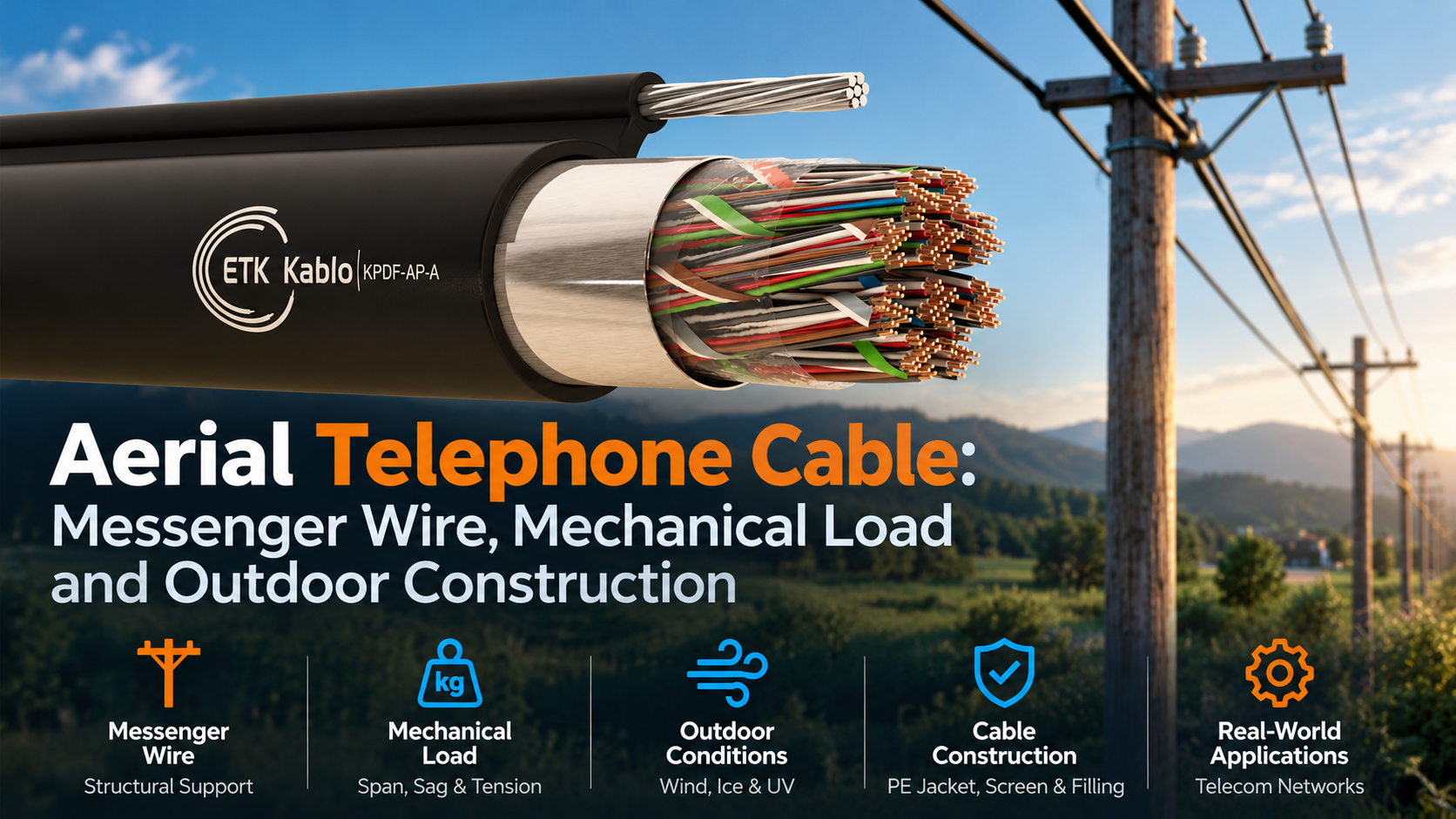
Aerial Telephone Cable: Messenger Wire, Mechanical Load and Outdoor Construction
Reading Time: 15 minutes
Aerial telephone cable is designed for copper communication routes installed above ground between poles or other approved support points. Unlike a conventional outdoor telephone cable, an aerial construction must address continuous mechanical loading in addition to electrical transmission and weather exposure.
For this reason, many aerial copper telecom cables use a galvanized steel messenger wire. The messenger carries the structural load of the suspended span while the communication core carries the telephone or low-frequency signal.
However, choosing an aerial cable involves much more than confirming that a messenger exists. Cable weight, messenger strength, span length, sag, installation tension, wind, ice where applicable, pole loading, conductor diameter and environmental conditions all affect the final design.
Moreover, outdoor protection remains essential. The cable may also require a UV-resistant polyethylene jacket, moisture protection, metallic screening and suitable conductor insulation according to the project.
ETK Kablo manufactures a wide range of outdoor telephone cables, including messenger-supported constructions for aerial telecommunications networks.
Quick answer: an aerial telephone cable should use a construction specifically designed for overhead loading. The messenger wire supports the span, while the telecom core provides electrical transmission. Engineers should therefore evaluate mechanical loading, sag, pole spacing, weather conditions and cable construction together rather than suspending an ordinary outdoor cable between poles.
Aerial Telephone Cable at a Glance
| Design Parameter | Why It Matters |
|---|---|
| Messenger Wire | Provides structural support for the suspended cable span |
| Cable Weight | Contributes to continuous vertical mechanical loading |
| Span Length | Influences sag, tension and support requirements |
| Sag | Allows the suspended system to accommodate mechanical loading without excessive tension |
| Wind | Adds horizontal load to the cable and messenger |
| Ice or Snow Loading | Can significantly increase effective cable weight in applicable climates |
| Pair Count | Influences cable diameter, weight and electrical capacity |
| Conductor Diameter | Affects resistance, copper weight and total cable weight |
| PE Outer Jacket | Provides outdoor protection against UV and environmental exposure |
| Moisture Protection | Helps protect the telecom core from water ingress |
| Screening | May provide electromagnetic screening and form part of the cable construction |
| Pole Hardware | Transfers messenger tension into the support structure |
Therefore, aerial cable selection is both an electrical and a mechanical engineering decision.
What Is an Aerial Telephone Cable?
An aerial telephone cable is an outdoor copper communication cable designed for installation across overhead spans.
The communication core normally contains solid copper conductors arranged as twisted pairs or star quads. Depending on the cable family, the conductors may use solid polyethylene or foam-skin polyethylene insulation.
In addition, the cable construction can include:
- Galvanized steel messenger wire
- Polyester core wrapping
- Jelly filling compound
- Metallic aluminum screen
- UV-resistant polyethylene outer jacket
- Project-specific moisture protection
The messenger is the defining mechanical feature in many conventional aerial telephone cable designs.
For example, ETK Kablo’s A-2YST2Y outdoor telephone cable combines solid copper conductors with solid PE insulation, a galvanized steel messenger and an outdoor polyethylene jacket.
Why Does Aerial Telephone Cable Need a Messenger Wire?
A suspended cable experiences continuous mechanical force from its own weight.
If a normal communication cable carried this load directly, its copper pairs, insulation, screen and jacket could experience unwanted tensile stress.
The messenger wire solves this problem by acting as the structural suspension element.
Consequently, the messenger accepts the principal tensile load while the communication portion of the cable remains mechanically supported.
This division of functions is important:
| Component | Primary Function |
|---|---|
| Copper Conductors | Carry electrical communication signals |
| Insulation | Maintains dielectric separation and electrical performance |
| Screen | Provides electrical screening where included |
| Outer Jacket | Provides environmental and mechanical surface protection |
| Messenger Wire | Supports the mechanical load of the aerial span |
Therefore, the messenger should not be treated as simply another metallic cable component.
Is the Messenger Wire the Same as Armor?
No. Messenger wire and cable armor serve different mechanical purposes.
A messenger primarily supports tensile loading across an overhead span.
Armor, by contrast, normally surrounds or protects the communication cable against mechanical threats such as impact, crushing or other external forces.
For example, ETK Kablo’s A-02Y(L)2YR2Y armored telephone cable uses round galvanized steel wires around an inner sheath. These wires form an armor layer rather than an aerial messenger.
Therefore, an armored telephone cable should not automatically be suspended between poles. Likewise, a messenger-supported cable should not automatically be described as armored.
Aerial Telephone Cable vs Standard Outdoor Telephone Cable
Both products can use outdoor-grade materials, yet their mechanical design differs.
| Feature | Standard Outdoor Telephone Cable | Aerial Telephone Cable |
|---|---|---|
| Outdoor PE Jacket | Common | Common |
| Moisture Protection | Depends on construction | Depends on construction |
| Metallic Screen | Optional / construction-dependent | Optional / construction-dependent |
| Messenger Support | Normally absent | Included in messenger-supported designs |
| Pole-to-Pole Span | Not automatically suitable | Designed for appropriate overhead applications |
| Mechanical Design | Focused on route and installation environment | Must also address continuous aerial loading |
For comparison, A-02YSF(L)2Y is a jelly-filled screened outdoor telephone construction intended for outside-plant telecom applications. However, the aerial variant requires an appropriate structural support concept rather than merely an outdoor-rated jacket.
How Mechanical Load Acts on an Aerial Telephone Cable
Aerial loading comes from several forces acting simultaneously.
First, the cable and messenger have their own mass. Gravity creates continuous vertical loading across the span.
Second, wind produces lateral force on the exposed cable surface.
Third, ice or snow may add substantial mass in climates where accumulation occurs.
Additionally, temperature changes can alter system geometry and tension.
Therefore, engineers should not evaluate messenger capacity from cable weight alone.
The mechanical assessment can include:
- Cable mass per unit length
- Messenger mass
- Messenger breaking strength
- Allowed working tension
- Span length
- Initial installation tension
- Required sag
- Wind loading
- Ice loading where applicable
- Temperature range
- Pole height and geometry
- Support hardware
- Local design requirements
As a result, two cables with identical pair counts may still require different aerial designs if their total diameters, weights or route conditions differ.
Aerial Telephone Cable and Span Length
Span length is the horizontal distance between consecutive support points.
As the span increases, the suspended system must bridge a greater distance. Consequently, the relationship between sag and mechanical tension becomes increasingly important.
Short pole spacing can reduce some loading challenges. However, adding poles also increases installation cost and infrastructure complexity.
Longer spans may reduce the number of supports, yet they can increase mechanical demands on:
- The messenger
- Pole attachments
- Anchors
- Dead-end hardware
- The poles themselves
Therefore, the cable supplier needs the expected span length when evaluating an aerial construction.
Why Sag Matters in Aerial Telephone Cable Installation
Sag is the vertical displacement of the suspended cable between its support points.
An aerial cable should not normally be installed as a perfectly straight, rigid line between poles.
Instead, controlled sag allows the suspended system to accommodate mechanical forces more appropriately.
If the installer applies excessive tension to reduce sag, the messenger and support hardware can experience greater mechanical stress.
Conversely, excessive sag can create:
- Clearance problems
- Greater movement in wind
- Unsuitable cable geometry
- Conflicts with roads or other utilities
- Poor visual and installation quality
Therefore, the correct sag is a calculated project parameter rather than a visual preference.
Aerial Telephone Cable Tension: Why More Is Not Better
Installers may assume that higher messenger tension creates a stronger aerial route. However, excessive tension can create new mechanical problems.
Higher tension increases the forces transferred to:
- Messenger wire
- Dead-end attachments
- Suspension hardware
- Poles
- Anchoring systems
Moreover, aerial strand guidance warns that unsuitable messenger tension can contribute to fatigue problems under certain conditions.
Therefore, messenger tension should follow the engineered sag/tension design rather than an arbitrary installation preference.
How Wind Affects Aerial Telephone Cable
Wind produces force on the exposed side area of an overhead cable.
Consequently, a larger cable diameter can experience a greater aerodynamic load than a smaller construction under the same wind conditions.
The load also acts horizontally rather than only vertically. As a result, the messenger and pole system must resist a combined force vector.
Wind can additionally cause movement and vibration. Therefore, the support system should suit the local environmental exposure.
Important inputs include:
- Expected wind speed
- Cable diameter
- Span length
- Route exposure
- Pole position
- Local climatic design requirements
For this reason, a cable that performs well on a sheltered campus route may require a different mechanical assessment for an exposed rural line.
Ice and Snow Loading on Aerial Telephone Cable
Cold-climate aerial networks may also experience ice accumulation.
Ice adds weight and can increase the effective exposed diameter of the suspended cable.
Therefore, it can increase both vertical loading and wind loading at the same time.
A project located in a warm climate may not require the same ice-loading assumptions. Nevertheless, the designer should never omit the environmental review simply because the cable itself is outdoor rated.
The jacket protects the cable from environmental exposure; it does not eliminate external mechanical loading.
How Pair Count Affects Aerial Telephone Cable Load
Pair count affects far more than telecommunications capacity.
More pairs generally require a larger cable core. In turn, the larger core can increase:
- Total cable diameter
- Copper content
- Insulation content
- Jacket material
- Overall cable weight
Consequently, a 10-pair aerial cable and a 100-pair aerial cable should not be treated as mechanically identical simply because both contain a messenger.
The complete product dimensions and weight must be evaluated for the required span.
How Conductor Diameter Affects Mechanical Load
Telephone cable conductor diameter affects both electrical and mechanical characteristics.
Larger solid copper conductors generally provide lower conductor resistance. However, they also contain more copper and therefore increase cable weight.
ETK Kablo’s outdoor telephone cable families include several published conductor diameters, depending on construction, such as:
- 0.40 mm
- 0.50 mm
- 0.60 mm
- 0.63 mm
- 0.65 mm
- 0.80 mm
- 0.90 mm
Therefore, specifying only pair count is insufficient.
A 50-pair cable with one conductor diameter can have a different electrical resistance and total weight from another 50-pair cable with a larger conductor.
Messenger Wire Construction
A messenger used for aerial telecom infrastructure commonly uses galvanized or otherwise metallic-coated steel because the material provides high tensile strength with practical outside-plant durability.
The current ASTM A475 standard covers metallic-coated steel wire strand intended for applications that include messengers, guys and span wires.
However, the standard contains different strand grades and strength characteristics. Therefore, writing only “steel messenger” into a technical specification may not provide enough engineering information.
A professional project may need to define or confirm:
- Messenger material
- Strand construction
- Nominal diameter
- Minimum breaking strength
- Metallic coating
- Corrosion protection
- Required working load
The actual selection should follow the cable and aerial-route design.
Integrated Messenger vs Separate Messenger
Aerial communication systems can use different support concepts.
In one approach, the messenger forms part of the manufactured cable construction. Many such cables visually resemble a figure-8 arrangement because the telecom core and support element run alongside each other.
In another approach, installers first erect a separate suspension strand. They then lash the communication cable to that strand.
| Construction | Basic Concept |
|---|---|
| Integrated Messenger | Support element forms part of the cable construction |
| Lashed Cable | Separate cable is attached to an independently installed messenger |
Each system requires compatible hardware and installation procedures.
Therefore, a project should specify the intended support method before cable selection.
Aerial Telephone Cable with Solid PE Insulation
Solid polyethylene provides a durable dielectric layer around each copper conductor.
ETK Kablo uses solid PE insulation in several outdoor telephone cable families.
For example, the PTT Serie 98 A-2Y(L)T2Y construction uses solid polyethylene insulation together with an aluminum screen, galvanized steel messenger and UV-resistant polyethylene outer jacket.
Solid PE therefore remains a proven option for aerial telecom designs where the selected cable specification calls for it.
Aerial Telephone Cable with Foam-Skin PE Insulation
Foam-skin polyethylene uses a foamed dielectric layer combined with a solid external skin.
This construction can provide favorable electrical characteristics while the solid skin protects the underlying cellular insulation.
ETK Kablo’s TK 53U aerial telephone cable uses foam-skin PE insulation together with jelly filling, a galvanized steel messenger and an outdoor PE jacket.
However, foam-skin should not automatically be described as universally superior to solid PE.
Instead, the insulation system should follow the required electrical design, telecom specification and product construction.
Dry-Core vs Jelly-Filled Aerial Telephone Cable
Aerial installation does not eliminate moisture risk.
Rain, humidity, damaged jackets and termination points can still expose outside-plant cable systems to water.
Therefore, some aerial telephone cable constructions include jelly filling compound inside the cable core.
The filling material occupies air spaces and helps limit longitudinal water migration if the cable’s protective layers become compromised.
By contrast, a dry-core construction omits conventional jelly filling.
| Characteristic | Dry-Core | Jelly-Filled |
|---|---|---|
| Core Filling | No conventional jelly compound | Special filling compound within the core |
| Termination | Generally cleaner preparation | Requires removal of filling material |
| Moisture Strategy | Depends on complete construction | Filling helps restrict longitudinal water movement |
| Selection | Project-specific | Project-specific |
Consequently, aerial should not automatically mean dry or filled. The required construction depends on the network specification.
Does Aerial Telephone Cable Need a Screen?
Not every aerial telephone cable requires the same screen structure.
Some constructions use a longitudinal aluminum tape screen around the cable core. Others may use a different design according to the network requirements.
A metallic screen can contribute to controlled electrical characteristics and provide protection against external electromagnetic influences.
However, the screen and messenger perform different functions.
The messenger supports mechanical load. Meanwhile, the screen forms part of the communication cable’s electrical construction.
Therefore, neither component should substitute for the other.
Why the PE Jacket Matters Outdoors
An overhead cable can remain exposed to sunlight, temperature cycles, rain and other weather conditions for many years.
Consequently, the outer sheath must suit prolonged outdoor service.
ETK Kablo aerial telephone constructions typically use black UV-resistant polyethylene outer jackets.
PE provides strong outdoor performance because it offers:
- Moisture resistance
- Weather resistance
- Good abrasion resistance
- Low water absorption
- Suitability for outdoor exposure
Nevertheless, “PE jacket” does not by itself prove that a cable is suitable for aerial suspension.
The complete cable must also have the required support structure and mechanical design.
Aerial Telephone Cable vs Drop Wire
Aerial distribution cable and telephone drop wire serve different parts of the access network.
A multi-pair aerial cable can carry many circuits along a distribution route.
Drop wire, meanwhile, normally provides a smaller final connection toward an individual subscriber, building or endpoint.
ETK Kablo’s aerial drop wire uses tinned copper conductors, galvanized steel messenger support and an outdoor polyethylene jacket.
| Application | Typical Cable Concept |
|---|---|
| Main Aerial Distribution | Multi-pair messenger-supported telephone cable |
| Local Distribution | Smaller multi-pair aerial cable |
| Subscriber / Final Connection | Aerial drop wire |
Therefore, selecting a large distribution cable for a simple final drop can add unnecessary weight and cost.
Aerial Telephone Cable vs Aerial Ethernet Cable
Both cables can use a messenger, yet their electrical applications differ substantially.
Traditional telephone cable supports voice, low-frequency communication, signaling and legacy copper telecom networks.
Ethernet cable, by contrast, must meet category-specific high-frequency transmission requirements.
ETK Kablo also manufactures Cat 5e aerial data cable constructions with messenger support for outdoor Ethernet installations.
Therefore, an aerial telephone cable should not automatically replace a Category-rated LAN cable merely because both use twisted copper conductors.
Aerial Telephone Cable vs Aerial Fiber Optic Cable
Aerial copper and aerial fiber can share similar installation environments while serving different network requirements.
Copper telephone cable carries electrical communication signals and can support legacy telephone and low-frequency communication networks.
Fiber carries optical signals and offers much greater transmission bandwidth and distance capability.
Moreover, modern fiber networks may use different aerial support concepts, including integrated messenger designs or all-dielectric self-supporting systems.
ETK Kablo’s aerial fiber optic cable portfolio includes constructions for overhead telecom and infrastructure routes.
Consequently, network technology should determine whether the project needs copper telephone cable, Ethernet cable or fiber rather than the aerial installation method alone.
Messenger Wire, Electrical Bonding and Grounding
A steel messenger is electrically conductive.
Therefore, aerial infrastructure may require bonding, grounding and electrical-safety measures according to the local regulations, utility requirements and project design.
The same consideration can apply to metallic cable screens and other conductive elements.
However, grounding practice varies by installation environment and jurisdiction.
For this reason, the cable specification should identify the metallic elements, while the system designer should establish the required bonding and grounding scheme.
Can Aerial Telephone Cable Run Near Power Lines?
Routes near electrical power infrastructure require additional engineering review.
A metallic messenger and copper telecom conductors introduce electrical considerations that do not exist in a completely dielectric communication cable.
Projects may therefore need to review:
- Required separation distances
- Pole ownership rules
- Grounding requirements
- Induced voltage risk
- Fault conditions
- Lightning exposure
- Local utility regulations
Consequently, an outdoor rating does not automatically make a metallic aerial cable suitable for every power-line corridor.
Pole Hardware and Aerial Telephone Cable
The cable itself forms only one part of an overhead system.
Mechanical forces must transfer from the messenger into compatible pole hardware.
Depending on the route, hardware can include:
- Suspension clamps
- Dead-end clamps
- Anchoring hardware
- Brackets
- Messenger attachments
- Guying systems
Therefore, messenger strength cannot compensate for weak or unsuitable support hardware.
The entire mechanical path should carry the design load safely.
Why Pole Loading Matters
Increasing messenger strength does not automatically improve the whole installation.
A stronger or larger messenger can also change:
- System weight
- Wind loading
- Hardware requirements
- Forces transferred to poles
Moreover, an existing pole route may already carry other telecommunications or utility infrastructure.
Therefore, engineers should evaluate available pole capacity rather than considering the cable in isolation.
Aerial Telephone Cable in Rural Networks
Rural telecom routes often cover large distances between relatively dispersed users.
Aerial construction can reduce the excavation and civil work required for underground installation.
However, exposed rural routes can also face significant:
- Wind
- Temperature variation
- Long pole spacing
- Storm exposure
- Vegetation interference
As a result, mechanical and environmental design can become especially important even when the electrical communication requirement is relatively simple.
Aerial Telephone Cable for Campus Networks
Campuses, industrial facilities and large properties may still require copper communication between separate buildings.
An aerial route can provide a practical solution where underground ducts are unavailable.
Nevertheless, the designer should also evaluate whether copper remains the correct transmission technology.
For example, fiber may provide stronger electrical isolation between buildings and greater network bandwidth.
Therefore, aerial telephone cable makes the most sense where the project specifically requires copper telephone, analog communication, intercom or similar circuits.
Aerial Telephone Cable for Railway and Industrial Communication
Railway and industrial sites can use copper telephone infrastructure for operational voice, intercom, signaling-support and supervisory communication functions.
Overhead routes can simplify deployment across selected areas.
However, industrial environments may add:
- Strong electromagnetic fields
- High mechanical exposure
- Vibration
- Temperature variation
- Power infrastructure
Consequently, the route may require screening, greater mechanical protection or an alternative transmission medium.
A messenger wire alone does not address every industrial risk.
ETK Kablo Aerial Telephone Cable Constructions
ETK Kablo manufactures several aerial copper telephone cable families with different electrical and environmental constructions.
| Construction Example | Main Design Features |
|---|---|
| A-2YST2Y | Solid PE insulation, messenger-supported outdoor construction |
| A-02YSFT2Y / TK 53U | Foam-skin PE insulation, jelly-filled core, steel messenger |
| A-2Y(L)T2Y / PTT Serie 98 | Solid PE insulation, aluminum screen, galvanized steel messenger |
| A-02YSF(L)T2Y | Foam-skin PE, filled and screened aerial telephone construction |
| Aerial Drop Wire | Compact low-pair-count outdoor connection with steel messenger |
However, these names do not remove the need to check the complete product specification.
Conductor diameter, pair count, filling, screen, weight, messenger design and electrical values can vary between constructions.
How to Specify an Aerial Telephone Cable
1. Define the Communication Requirement
First, identify whether the cable carries voice, intercom, low-frequency signaling, legacy telecom or another copper communication service.
2. Define the Pair Count
Next, determine the number of working pairs plus the required spare capacity.
3. Select the Conductor Diameter
Then, choose the conductor diameter according to resistance, route length and network requirements.
4. Define the Insulation
Specify solid PE or foam-skin PE if the project requires a particular dielectric construction.
5. Decide Whether Filling Is Required
Evaluate moisture risk and determine whether the project calls for jelly-filled or dry-core construction.
6. Define the Screen Requirement
Specify the required metallic screening construction where applicable.
7. Provide the Span Length
State typical and maximum pole spacing so the mechanical design reflects the actual route.
8. Provide Environmental Loading
Include wind, ice and temperature requirements where they form part of the project specification.
9. Define the Messenger Requirement
Confirm the messenger material, strength or project-specific structural requirement.
10. Define the Outer Jacket
Specify an appropriate outdoor PE construction and any project-specific environmental requirements.
11. Review Pole and Hardware Conditions
Confirm that support hardware and existing pole infrastructure can accommodate the proposed route.
12. Verify the Complete Datasheet
Finally, review mechanical dimensions, electrical values and cable weight for the actual requested pair count and conductor size.
What Should an Aerial Telephone Cable RFQ Include?
| RFQ Item | Information to Provide |
|---|---|
| Application | Telephone, intercom, signaling or other communication service |
| Pair Count | Required number of copper pairs |
| Conductor Diameter | 0.40 mm, 0.50 mm, 0.60 mm or required project size |
| Insulation | Solid PE, foam-skin PE or specified construction |
| Core | Dry or jelly-filled |
| Screen | Required screen construction |
| Messenger | Required steel messenger specification |
| Typical Span | Normal distance between poles |
| Maximum Span | Longest required span |
| Wind Loading | Project or local design requirement |
| Ice Loading | Project requirement where applicable |
| Temperature | Installation and operating environment |
| Outer Jacket | Outdoor PE or project-specific requirement |
| Electrical Performance | Resistance, capacitance, dielectric and other requirements |
| Documentation | Datasheet, test reports and project certificates |
| Delivery | Quantity, drum length and marking requirements |
This information allows the manufacturer to assess both electrical and mechanical requirements rather than quoting a cable from pair count alone.
Common Mistakes When Specifying Aerial Telephone Cable
- Suspending a standard outdoor cable that has no suitable support system
- Assuming messenger wire and armor are the same thing
- Specifying only pair count
- Ignoring cable weight
- Ignoring conductor diameter
- Ignoring maximum span length
- Trying to eliminate sag by applying excessive tension
- Ignoring wind loading
- Ignoring ice loading in cold climates
- Assuming a stronger messenger automatically improves the complete system
- Ignoring pole capacity
- Ignoring dead-end and suspension hardware
- Assuming all PE-jacketed cables are suitable for aerial installation
- Confusing screen with messenger wire
- Assuming an aerial cable is automatically armored
- Ignoring grounding requirements for metallic elements
- Ignoring power-line proximity
- Using telephone cable where Category-rated Ethernet is required
- Using a large multi-pair distribution cable where drop wire is sufficient
- Selecting the cable before defining route conditions
Aerial Telephone Cable Selection Checklist
- What service will the cable carry?
- How many pairs are required?
- What conductor diameter is required?
- Is solid PE or foam-skin PE specified?
- Is the core dry or jelly-filled?
- Is a metallic screen required?
- What is the cable weight?
- What messenger construction is required?
- What is the typical span?
- What is the maximum span?
- What sag criteria apply?
- What wind load applies?
- Does ice loading apply?
- What temperature range applies?
- What pole hardware will support the messenger?
- Are grounding or bonding requirements defined?
- Does the route approach electrical power infrastructure?
- Is a UV-resistant PE outer jacket required?
- Are there local clearance requirements?
- Does the supplied datasheet cover the exact requested construction?
Frequently Asked Questions About Aerial Telephone Cable
What is an aerial telephone cable?
An aerial telephone cable is an outdoor copper communication cable designed for overhead installation. Messenger-supported versions use a steel support element to carry mechanical span loads.
What does the messenger wire do?
The messenger wire provides structural support for the suspended cable. It carries mechanical tension so the communication core does not have to support the entire aerial load directly.
Is messenger wire the same as steel armor?
No. A messenger supports tensile load across an aerial span. Armor surrounds the cable to provide mechanical protection against external damage.
Can any outdoor telephone cable be installed between poles?
No. An outdoor jacket alone does not make a cable suitable for unsupported aerial spans. The cable must use an appropriate aerial support design.
Why is sag required?
Controlled sag helps manage mechanical loading in the suspended system. Excessively low sag can require unnecessarily high messenger tension.
Does a longer span require a stronger messenger?
Potentially, but messenger selection depends on more than span length. Cable weight, sag, wind, ice, temperature and support conditions must also be considered.
Can an aerial telephone cable be jelly-filled?
Yes. Some aerial constructions include filling compound to help limit longitudinal water migration.
Can an aerial telephone cable use foam-skin insulation?
Yes. ETK Kablo manufactures selected aerial telephone cables with foam-skin polyethylene insulation as well as other constructions with solid PE insulation.
Does aerial telephone cable need shielding?
Not every product uses the same screen design. The required screening should follow the telecom specification and electrical environment.
Why is PE commonly used for the outer jacket?
Polyethylene provides strong moisture, weather and outdoor performance. UV-resistant black PE is therefore widely used for outside-plant telecom cables.
Can aerial telephone cable be installed near power lines?
Only after the route has been assessed against the applicable utility, electrical-safety, clearance and grounding requirements. Metallic messenger-supported telecom cable should not automatically be approved for every power corridor.
What is the difference between aerial telephone cable and drop wire?
Aerial multi-pair cable usually serves distribution routes, while drop wire typically provides a smaller final connection toward an individual endpoint or subscriber.
Is aerial telephone cable suitable for Ethernet?
Not automatically. Ethernet requires Category-rated cable with defined high-frequency transmission performance. Telephone cable and LAN cable should be selected according to their intended communication standard.
Conclusion: Specify the Complete Aerial System
Aerial telephone cable must satisfy both telecommunications and structural requirements.
The copper core determines electrical communication performance, while insulation, filling, screening and the PE outer jacket protect the signal system. Meanwhile, the messenger wire supports the mechanical load created by the suspended span.
Therefore, messenger strength should never be selected in isolation. Cable weight, pair count, conductor diameter, span length, sag, wind, ice, temperature, poles and support hardware all contribute to the final mechanical design.
Likewise, an outdoor-rated cable should not automatically be suspended overhead simply because its jacket resists weather. The cable must use a construction designed for the required aerial load.
For reliable long-term performance, specify the actual communication requirement first. Then define the pair count, conductor size, environmental construction and mechanical route conditions.
Ultimately, the best aerial telephone cable is not simply the cable with the strongest messenger. It is the complete cable and support system whose electrical, environmental and mechanical characteristics match the real overhead network.
Benzer yazılar

Cat6 B2ca Cable: CPR Fire Performance, Standards and Selection Guide
Cat6 B2ca cable combines Category 6 Ethernet transmission performance with a high reaction-to-fire classification for permanently insta...

Servo Motor Cable: Power, Encoder, Feedback, Shielding and Selection Guide
Servo motor cable connects a servo drive with the motor, feedback system or related control components in precision automation equipmen...

Hybrid Fiber Optic Cable for Power and Data: Design, Applications and Selection Guide
Hybrid fiber optic cable combines optical fibers for high-speed communication with copper conductors that can deliver electrical power ...
Composite Fiber Optic Cable: Fiber + Copper Hybrid Cable Design, Applications and Selection Guide
Composite fiber optic cable combines optical fibers with one or more additional transmission or electrical elements inside a coordinate...
LPCB Approved Cable: LPCB Certification, Standards and Fire-Resistant Cable Guide
LPCB approved cable is a cable whose specific product construction has received third-party certification under the Loss Prevention Cer...

PROFIBUS Cable: DP vs PA, Impedance, Shielding and Selection Guide
PROFIBUS cable is a purpose-designed industrial communication cable used to connect automation equipment over a defined fieldbus networ...
Fire-Resistant Power Cable vs Fire-Resistant Signal Cable: What Is the Difference?
Power vs signal cable is an important distinction when specifying fire-resistant circuits. Two cables can both maintain circuit integri...
Shielded vs Unshielded Outdoor Telephone Cable: When Is Screening Required?
Shielded outdoor telephone cable includes a metallic screen around the communication core to reduce the effect of external electromagne...
BS 6387 CWZ Cable Testing Explained
BS 6387 CWZ is a fire-resistance test designation used for cables that must maintain circuit integrity under defined fire conditions. I...
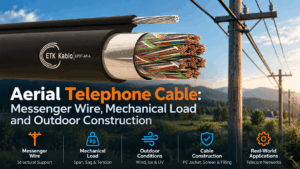
Aerial Telephone Cable: Messenger Wire, Mechanical Load and Outdoor Construction
Aerial telephone cable is designed for copper communication routes installed above ground between poles or other approved support point...

Copper vs Fiber for Data Center Networks: When Should You Use Each?
Copper vs fiber for data centers is not a question with one universal winner. Modern data centers commonly use both media because serve...

Cat6 vs Cat6A for PoE++ Networks: Which Should You Specify?
Cat6 vs Cat6A for PoE++ is no longer only a bandwidth decision. When an Ethernet cable carries both high-speed data and high levels of ...


