





 President’s Message
Blog
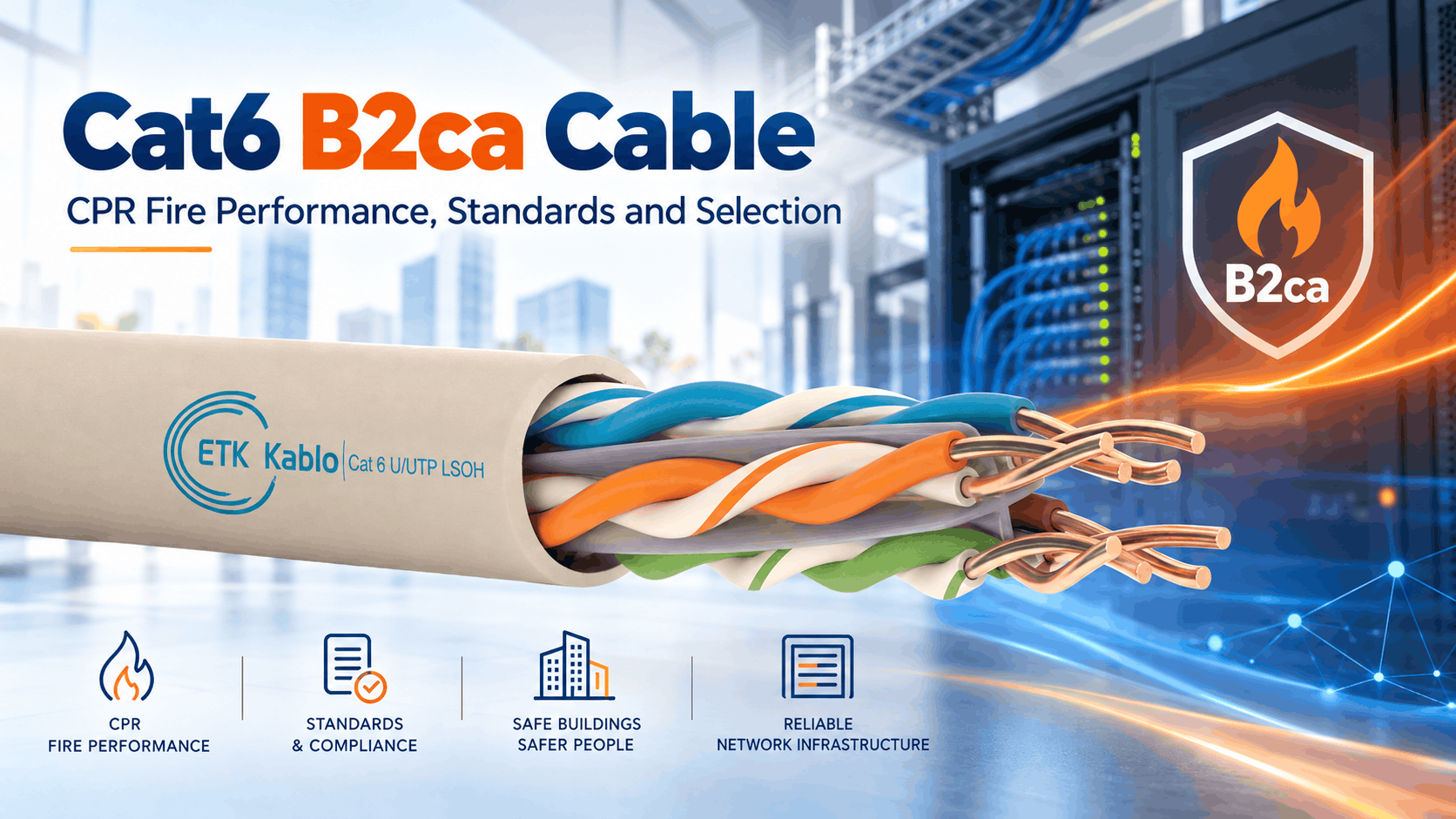
Cat6 B2ca Cable: CPR Fire Performance, Standards and Selection Guide
Reading Time: 15 minutes
Cat6 B2ca cable combines Category 6 Ethernet transmission performance with a high reaction-to-fire classification for permanently installed cabling in buildings and infrastructure projects.
However, Cat6 and B2ca describe two completely different aspects of the cable. Cat6 defines electrical transmission performance, while B2ca describes how the complete cable reacts when exposed to fire under the European CPR classification framework.
Therefore, a cable can meet Cat6 transmission requirements without achieving B2ca. Likewise, a B2ca-rated communication cable is not automatically Cat6 unless its electrical construction also satisfies the applicable Category 6 requirements.
For consultants and procurement teams, this distinction is important. A complete specification may need to define Cat6 performance, conductor size, screening, PoE requirements, B2ca classification, smoke performance, flaming droplets, acidity and installation environment separately.
ETK Kablo manufactures a broad range of Data and LAN Cables for structured cabling, industrial networks and infrastructure projects. ETK Kablo also lists B2ca-certified Cat 6–6A constructions within its quality and CPR certification portfolio, including U/UTP, F/UTP, U/FTP and F/FTP families.
Quick answer: Cat6 B2ca cable is a Category 6 data cable with a B2ca reaction-to-fire classification under the European CPR framework. Cat6 determines network transmission performance up to 250 MHz, while B2ca addresses fire growth, heat release and flame spread. Additional ratings such as s1a, d1 and a1 describe smoke, flaming droplets and acidity. The complete CPR designation should always be checked on the exact product documentation.
Cat6 B2ca Cable at a Glance
| Parameter | What It Means |
|---|---|
| Cat6 | Category 6 balanced data cable performance |
| Frequency | Up to 250 MHz |
| Typical Ethernet Application | 1000BASE-T and other compatible Ethernet applications |
| B2ca | High reaction-to-fire Euroclass for cables |
| Product Framework | EN 50575 for applicable construction cables |
| Main Fire Test | EN 50399 together with applicable supporting tests |
| Smoke Classification | s1, s1a, s1b, s2 or s3 depending on declared performance |
| Flaming Droplets | d0, d1 or d2 |
| Acidity | a1, a2 or a3 |
| Possible Screening | U/UTP, F/UTP and other certified constructions |
| PoE Compatibility | Must be evaluated separately from CPR classification |
| Fire Resistance | Not established by B2ca alone |
Consequently, the expression “Cat6 B2ca” already contains two independent technical requirements: network performance and reaction-to-fire performance.
What Is B2ca in a Cat6 Cable?
B2ca is one of the Euroclasses used to classify the reaction-to-fire performance of cables intended for applicable permanent installations in construction works.
The cable classes include:
- Aca
- B1ca
- B2ca
- Cca
- Dca
- Eca
- Fca
These classes create a common European language for describing cable behaviour during fire.
B2ca represents a demanding level of reaction-to-fire performance. Nevertheless, engineers should avoid interpreting the classification as a universal statement that one cable is simply “fireproof.”
Instead, B2ca evaluates defined characteristics such as flame spread, heat release and contribution to fire growth under standardized test conditions.
For a broader comparison of the complete Euroclass hierarchy, see ETK Kablo’s CPR Cable Classes: B2ca, Cca, Dca and Eca guide.
Cat6 and B2ca Measure Different Things
Category 6 belongs to structured cabling and data transmission.
Its electrical characteristics include parameters such as:
- Insertion loss
- NEXT
- PSNEXT
- Return loss
- Characteristic impedance
- Resistance
- Resistance unbalance
- Propagation characteristics
B2ca, by contrast, belongs to fire-performance classification.
It does not determine:
- Ethernet speed
- Bandwidth
- Characteristic impedance
- Conductor diameter
- PoE capability
- Screen configuration
Therefore, both requirements must appear independently in a professional specification.
What Does Category 6 Provide?
Cat6 balanced copper cable operates with transmission characteristics specified up to 250 MHz.
It is widely used for:
- Office LAN networks
- Commercial buildings
- IP surveillance
- Wireless access points
- VoIP
- Building automation
- Industrial Ethernet
- General structured cabling
Gigabit Ethernet remains one of its most common applications.
In suitable installations, Cat6 can also support higher-speed Ethernet over shorter distances. Nevertheless, projects requiring 10GBASE-T over a conventional full-length 100 m channel normally begin with Cat6A instead.
What Does CPR Regulate for Data Cables?
The Construction Products Regulation provides a harmonized framework for construction products placed on the European market.
For cables subject to reaction-to-fire requirements, the system allows manufacturers to declare performance using a standardized classification language.
As a result, an engineer in one European market can interpret a B2ca designation using the same core classification system as an engineer elsewhere in the EU.
However, CPR does not tell every country which Euroclass must be installed in every building.
National regulations, building codes, project requirements and fire strategies determine the required performance for a particular installation.
CPR 2024 and Data Cables
The European construction-products framework is currently transitioning from the original CPR system to Regulation (EU) 2024/3110.
The new regulation entered into force in January 2025, while its main provisions began to apply in January 2026.
However, product families do not move to the new technical framework simultaneously. Instead, the old and new systems coexist during a lengthy transition.
Consequently, cable buyers should continue checking the applicable harmonized technical specification and current Declaration of Performance rather than assuming that every historical CPR document became invalid in 2026.
EN 50575 and Cat6 Data Cable
EN 50575 provides the harmonized product framework historically used for power, control and communication cables intended for permanent installation in construction works and subject to reaction-to-fire requirements.
Importantly, the standard covers communication cables used for data transmission.
Therefore, balanced Cat6 Ethernet cable can fall within this framework when it is intended for an applicable permanent building installation.
Nevertheless, EN 50575 does not replace the electrical standards that establish Category 6 transmission performance.
A compliant data cable still needs to satisfy the relevant network-cabling requirements independently.
How B2ca Fire Performance Is Evaluated
B2ca classification relies on standardized fire testing rather than on the appearance or jacket description of the cable.
Important test methods include EN 50399 and EN 60332-1-2.
EN 50399 evaluates cable behaviour under grouped fire conditions and provides information connected with:
- Heat release
- Fire growth
- Flame spread
- Smoke production
- Flaming droplets and particles
Meanwhile, EN 60332-1-2 evaluates vertical flame propagation on a single insulated wire or cable.
Therefore, achieving B2ca involves substantially more than simply using an LSZH jacket compound.
How to Read B2ca-s1a,d1,a1
A complete CPR designation can provide much more information than the main B2ca class alone.
| Classification | Performance Area |
|---|---|
| B2ca | Main reaction-to-fire class |
| s1a | Very low smoke production with the more demanding s1 transmittance subclass |
| d1 | Limited persistence of flaming droplets or particles |
| a1 | Lowest acidity / conductivity category |
Accordingly, a specification such as B2ca-s1a,d1,a1 communicates substantially more than simply requesting “B2ca cable.”
The project should therefore state the complete required classification whenever supplementary performance matters.
Smoke Classification: s1, s1a and s1b
Smoke is particularly important in occupied buildings because dense smoke can reduce visibility during evacuation.
The CPR system therefore includes smoke classifications.
Within the higher-performing s1 class, additional subclasses such as s1a and s1b can describe light-transmission performance under the applicable smoke test.
Consequently, two B2ca cables can carry different smoke classifications.
For example:
B2ca-s1a,d1,a1
and
B2ca-s2,d1,a1
share the same primary B2ca class but do not provide identical smoke performance.
Flaming Droplets: d0, d1 and d2
The “d” classification addresses flaming droplets and particles produced during the relevant fire test.
Broadly:
- d0 represents the most restrictive performance within this classification
- d1 allows limited flaming particles within defined criteria
- d2 represents performance outside the d0 and d1 limits or where the relevant performance is not declared
This parameter can matter in escape routes and occupied areas because burning material falling from cable routes can contribute to secondary fire hazards.
Therefore, the full designation should be reviewed rather than focusing only on B2ca.
Acidity Classification: a1, a2 and a3
The “a” classification addresses characteristics associated with the acidity and conductivity of gases generated from non-metallic cable materials during combustion.
a1 represents the most demanding level within this supplementary classification.
Low acidity can be valuable in environments containing:
- People
- Electronic equipment
- Data systems
- Control equipment
- Critical infrastructure
However, B2ca itself does not automatically mean a1.
The exact declared classification remains the controlling requirement.
Is Cat6 B2ca the Same as LSZH?
No.
LSZH and B2ca describe different concepts.
LSZH refers to cable materials designed to produce low smoke and limited halogen-related corrosive gases when they burn.
B2ca, by contrast, is a reaction-to-fire Euroclass based on standardized cable performance.
Therefore, an LSZH cable does not automatically achieve B2ca.
Likewise, buyers should not use the terms LSZH, B2ca, fire resistant and flame retardant as interchangeable descriptions.
For a detailed material comparison, see our LSZH vs PVC Cable guide.
Why an Ordinary Cat6 LSOH Cable Is Not Automatically B2ca
A standard Cat6 LSOH cable can provide low-smoke and halogen-free material characteristics while carrying another CPR class.
B2ca performance depends on the complete cable design.
Relevant factors can include:
- Jacket compound
- Insulation materials
- Cable diameter
- Separator construction
- Metallic screen
- Total combustible material
- Complete fire-test behaviour
For example, ETK Kablo manufactures Cat 6 U/UTP LSOH Ethernet Cable for halogen-free structured cabling applications. However, the LSOH designation alone should never be used as proof that every construction carries B2ca classification.
Consequently, changing only the outer jacket material does not automatically convert a standard Cat6 cable into a B2ca-certified product.
U/UTP B2ca Data Cable
U/UTP means that the cable has no overall metallic screen and no individual pair screens.
A Cat6 U/UTP design can still achieve B2ca reaction-to-fire performance when the exact construction has been tested, assessed and certified accordingly.
ETK Kablo offers a dedicated Cat 6 U/UTP cable range with different outer-jacket constructions for professional network projects.
U/UTP can provide advantages including:
- Smaller diameter
- Lower weight
- Simpler termination
- No cable-screen bonding requirement
However, it provides less external electromagnetic shielding than screened constructions.
Therefore, U/UTP works best where the installation environment does not require additional EMI protection.
F/UTP B2ca Data Cable
F/UTP adds an overall foil screen around the four unshielded twisted pairs.
This screen can improve protection against external electromagnetic interference and can also help control emissions from the cable.
Consequently, F/UTP can be attractive in:
- Commercial buildings
- Hospitals
- Data infrastructure
- Industrial buildings
- Routes near electrical equipment
ETK Kablo’s Cat 6 F/UTP cable range uses an overall foil screen to provide additional electromagnetic protection compared with U/UTP construction.
Nevertheless, the screen needs correct installation and bonding to provide its intended EMC benefit.
B2ca remains a separate characteristic. An F/UTP cable is not automatically B2ca simply because it contains a foil screen.
U/UTP vs F/UTP for B2ca Projects
| Characteristic | U/UTP | F/UTP |
|---|---|---|
| Overall Screen | No | Foil |
| External EMI Protection | Lower | Higher when correctly installed |
| Termination Complexity | Lower | Higher |
| Grounding / Bonding | No cable screen | Screen system requires correct bonding |
| Cat6 Capability | Possible | Possible |
| B2ca Capability | Possible on certified construction | Possible on certified construction |
Thus, CPR class should not determine the screening architecture by itself.
The network environment determines the screen requirement, while the fire strategy determines the required CPR performance.
Where both halogen-free materials and screening are needed, ETK Kablo also manufactures Cat 6 F/UTP LSOH Ethernet Cable. As with any CPR project, the exact certification scope of the offered construction should be checked separately.
Does B2ca Affect Ethernet Speed?
No direct relationship exists between the CPR class and network speed.
A correctly designed B2ca Cat6 cable must still satisfy the required Category 6 transmission parameters.
Therefore, achieving a higher fire-performance class should not be accepted as a reason for poorer electrical performance.
Likewise, a cable with excellent NEXT and insertion-loss results does not automatically provide B2ca fire performance.
The two groups of tests serve different purposes.
Does B2ca Change the 250 MHz Cat6 Requirement?
No.
Category 6 remains characterized for transmission performance up to 250 MHz.
B2ca adds a separate reaction-to-fire requirement to the finished cable.
Consequently, a well-designed product needs to achieve both objectives simultaneously:
- Cat6 electrical performance
- Required CPR fire performance
This creates a more demanding cable-design task because fire-performance compounds must not compromise transmission geometry or electrical characteristics.
Cat6 B2ca Cable and PoE
B2ca classification does not determine Power over Ethernet capability.
PoE performance depends more directly on factors such as:
- Conductor material
- Conductor diameter
- DC resistance
- Resistance unbalance
- Bundle size
- Ambient temperature
- Installation method
Therefore, a B2ca label should not replace PoE engineering checks.
A project using high-power PoE should evaluate both fire performance and current-carrying behaviour independently.
Why Solid Copper Matters for PoE Networks
Professional horizontal structured cabling typically uses solid copper conductors.
Pure copper provides predictable electrical resistance and supports the transmission and powering performance expected from standards-based data cabling.
By contrast, copper-clad aluminium conductors can introduce higher resistance and should not be treated as equivalent to standards-compliant solid-copper horizontal cable.
For PoE applications, resistance becomes even more important because electrical current produces conductor heating.
Consequently, conductor material and diameter remain critical even when the cable already carries a high CPR class.
High-Power PoE and Cable Bundles
Higher-power PoE applications can energize all four pairs and increase thermal loading inside large cable bundles.
Temperature rise can affect conductor resistance and transmission performance.
Therefore, designers should consider:
- PoE type
- Number of energized cables
- Bundle size
- Conductor diameter
- Ambient temperature
- Containment system
B2ca reaction-to-fire performance remains important, but it does not replace this thermal design.
B2ca vs Cca for Cat6 Networks
B2ca and Cca are both CPR reaction-to-fire classes, but B2ca imposes more demanding main-class performance criteria.
However, this does not mean every building should automatically use B2ca.
The required class should come from:
- National regulations
- Building type
- Fire strategy
- Escape-route requirements
- Consultant specification
- Client requirements
Therefore, using B2ca everywhere can increase project cost without necessarily being required.
B2ca vs Dca and Eca
Dca and Eca represent less demanding reaction-to-fire classes than B2ca.
Nevertheless, a lower class is not automatically an inferior cable in every engineering sense.
A Dca or Eca Cat6 cable can still provide excellent Ethernet transmission performance.
The difference lies in the declared reaction-to-fire behaviour.
Consequently, engineers should specify the CPR class from the fire-risk requirement rather than from network bandwidth.
Where Is Higher CPR Performance Commonly Considered?
High-performance reaction-to-fire cables can become particularly relevant in buildings where evacuation, occupancy or infrastructure continuity creates stricter fire-safety objectives.
Examples can include:
- Airports
- Railway stations
- Metro systems
- Hospitals
- Care facilities
- High-rise buildings
- Data centers
- Public buildings
- Transport infrastructure
- Critical commercial facilities
However, project teams should not infer the legally required Euroclass from this list alone.
National building regulations and project documentation remain decisive.
Data Centers and Higher Fire Performance
Data centers can contain very high cable densities.
Consequently, the cumulative amount of polymeric cable material in pathways can become significant.
Network designers may therefore need to balance:
- Transmission performance
- Cable density
- PoE thermal behaviour
- Smoke generation
- Reaction-to-fire performance
- Pathway capacity
Nevertheless, B2ca should not automatically be assumed for every data center. The project fire strategy and applicable local regulations determine the actual requirement.
Hospitals and Public Buildings
Hospitals present special evacuation challenges because many occupants cannot leave independently.
Meanwhile, communication networks can support clinical systems, IP devices, Wi-Fi and building infrastructure.
Therefore, fire performance can become an important part of data-cable procurement.
Still, the required CPR class should come from the applicable regulatory and project framework rather than from a generic statement that all hospital cables must be B2ca.
Cat6 B2ca Cable in Railway Stations and Airports
Transport buildings combine large numbers of occupants with extensive communication networks.
Cat6 cabling can serve:
- Information displays
- CCTV
- Access control
- Wi-Fi
- VoIP
- Building automation
- Operational networks
Consequently, both data performance and fire behaviour can become significant procurement parameters.
However, cables installed inside rolling stock, dedicated railway signaling infrastructure or specialized railway systems can fall under different standards and should not automatically use a building Cat6 specification.
Is B2ca Cable Fire Resistant?
No.
This distinction is essential.
B2ca describes reaction to fire. It evaluates how much the cable contributes to fire development under specified conditions.
Fire resistance, by contrast, concerns maintaining electrical or signal continuity during fire for a defined period under an applicable test.
Therefore:
B2ca ≠ FE180
B2ca ≠ PH120
B2ca ≠ circuit integrity
A high CPR-class Cat6 cable should not be assumed to continue transmitting Ethernet data during a fire unless a completely separate fire-resistance requirement and evidence applies.
Flame Retardant vs B2ca
A simple flame-retardant cable test and a B2ca classification also represent different levels of assessment.
For example, IEC/EN 60332-1-2 evaluates flame propagation on one cable.
B2ca classification includes a more extensive reaction-to-fire assessment using additional test methods.
Therefore, a cable that passes a single vertical-flame test does not automatically achieve B2ca.
Does the Jacket Colour Identify B2ca?
No.
There is no universal jacket colour that proves a Cat6 cable is B2ca.
Manufacturers can use different colours according to product family, project requirements or customer requests.
Consequently, certification should never be inferred from:
- Orange jacket
- Blue jacket
- Green jacket
- White jacket
- LSZH wording alone
The DoP and product identification provide much stronger evidence.
Declaration of Performance for Cat6 B2ca
A Declaration of Performance, or DoP, is an important document for CPR-covered cable products.
It connects the marketed product with its declared performance.
Depending on the applicable framework and product, the document provides information including:
- Product identification
- Intended use
- Manufacturer
- Applicable harmonized technical specification
- Declared reaction-to-fire class
- Assessment system
- Relevant notified-body information
Therefore, procurement teams should request the DoP for the exact offered construction rather than accepting a generic brochure statement.
B2ca and AVCP System 1+
B2ca belongs to the group of higher cable reaction-to-fire classes subject to a demanding assessment and verification framework.
Under the established CPR cable system, B2ca uses AVCP System 1+.
This framework involves an independent notified product-certification body as part of conformity assessment and ongoing surveillance.
Consequently, B2ca certification is not simply a manufacturer declaring that its jacket compound is flame retardant.
Why the Exact Construction Must Be Certified
Fire behaviour depends on the complete cable.
Changing apparently small construction details can influence test performance.
Examples include:
- Conductor diameter
- Insulation thickness
- Separator geometry
- Foil screen
- Drain wire
- Outer diameter
- Jacket compound
Therefore, buyers should verify that the actual cable being purchased falls within the declared and certified construction scope.
A certificate for one Cat6 family should not automatically be applied to every unrelated Cat6 SKU.
Cat6 B2ca vs Cat6A B2ca
Cat6 and Cat6A can both be manufactured with high CPR performance.
The main network difference remains the transmission category.
| Feature | Cat6 | Cat6A |
|---|---|---|
| Frequency | 250 MHz | 500 MHz |
| Typical Full-Channel Ethernet Target | 1 Gigabit Ethernet | 10GBASE-T |
| 100 m 10GBASE-T Design | Not the normal full-channel design target | Yes |
| B2ca Possible? | Yes | Yes |
| CPR Determines Data Speed? | No | No |
Therefore, a project should select Cat6 or Cat6A from its network requirements and select B2ca from its fire-performance requirements.
For a wider technical comparison, see Cat6 vs Cat6A vs Cat7 vs Cat7A.
Should You Choose Cat6 or Cat6A for a B2ca Project?
Begin with the network architecture.
Cat6 is a strong option when Gigabit Ethernet provides sufficient capacity and the project values compact, cost-effective structured cabling.
Cat6A becomes more attractive when the design requires:
- 10GBASE-T over a full structured-cabling channel
- Greater transmission headroom
- Longer infrastructure lifecycle
- Higher-bandwidth endpoints
ETK Kablo’s Cat 6A cable portfolio includes multiple screening constructions for 10 Gigabit structured networks.
After choosing the network category, apply the required CPR class.
This sequence avoids using B2ca as if it were a data-performance specification.
Industrial Ethernet and B2ca Requirements
Industrial Ethernet installations can combine network transmission requirements with demanding fire, EMC and environmental conditions.
For example, a project can require Cat6 performance together with foil screening, low-smoke materials and a specific CPR class.
However, industrial use does not automatically mean that the highest CPR class is required.
The network category, electromagnetic environment, mechanical protection, sheath material and fire classification should all be selected independently.
Our Industrial Ethernet Cable Selection Guide explains how these requirements interact in factories, infrastructure and process environments.
How to Select the Correct Construction
1. Define the Network Category
Determine whether Cat6 provides the required network performance or whether Cat6A is more suitable.
2. Confirm the Required CPR Class
Use the project fire strategy and applicable national requirements to establish B2ca, Cca or another class.
3. Specify the Complete CPR Designation
If smoke, droplets and acidity requirements matter, include the exact s, d and a subclasses.
4. Choose U/UTP or Screened Cable
Base the screening decision on the electromagnetic environment and structured-cabling architecture.
5. Check Conductor Construction
Confirm solid copper conductor size, resistance and electrical performance.
6. Review PoE Requirements
For powered devices, consider current, resistance unbalance, temperature and bundle size.
7. Confirm the Installation Environment
Indoor pathways, risers, data centers and infrastructure projects can impose different mechanical and fire requirements.
8. Request the DoP
Verify that the exact cable construction carries the declared CPR classification.
9. Check Category Test Data
Confirm transmission performance through the applicable cable datasheet and compliance documentation.
10. Compare Complete Products
Do not compare suppliers solely on the words “Cat6 B2ca.” Compare conductor, screening, CPR subclass, dimensions and electrical data.
What Should a Cat6 B2ca RFQ Include?
| RFQ Requirement | Example Information |
|---|---|
| Category | Cat6 |
| Frequency | 250 MHz |
| Pair Count | 4 pairs |
| Conductor | Solid bare copper |
| Conductor Size | Project-required AWG / diameter |
| Screen | U/UTP or F/UTP |
| CPR Class | B2ca |
| Smoke Class | Specify required s subclass |
| Droplet Class | Specify required d subclass |
| Acidity Class | Specify required a subclass |
| Jacket | Halogen-free / project-specific construction |
| PoE | Required PoE application and bundle conditions |
| Installation | Indoor structured cabling / project environment |
| Documentation | Datasheet, DoP and CPR certification evidence |
This approach creates a substantially stronger RFQ than requesting only “Cat6 B2ca cable.”
Common Specification Mistakes
- Assuming every Cat6 LSZH cable is B2ca
- Assuming B2ca means fire resistant
- Specifying B2ca without the required smoke, droplet and acidity subclasses
- Choosing B2ca from network speed rather than fire requirements
- Assuming all European countries require the same CPR class in the same building type
- Accepting a generic CPR certificate that does not cover the offered construction
- Ignoring the Declaration of Performance
- Confusing EN 50575 with the Cat6 transmission standard
- Assuming screened cable automatically has a higher CPR class
- Assuming U/UTP cannot achieve B2ca
- Ignoring conductor material
- Using CCA conductors as an alternative to standards-based solid copper horizontal cable
- Ignoring DC resistance in PoE applications
- Ignoring bundle temperature in high-power PoE systems
- Assuming B2ca improves Ethernet speed
- Assuming Cat6A is required simply because the project requires B2ca
- Using outdoor PE cable inside a building without checking its CPR status
- Using cable colour as proof of classification
- Accepting the words “flame retardant” as proof of B2ca
- Failing to check the exact product identification on the DoP
ETK Kablo B2ca Data Cable Solutions
ETK Kablo manufactures Category 6 and Category 6A data cable constructions for professional structured cabling systems.
The current ETK Kablo CPR certificate portfolio lists B2ca-certified Cat 6–6A constructions including:
- U/UTP
- F/UTP
- U/FTP
- F/FTP
However, the certification scope should always be verified against the exact cable offered for a project.
ETK’s standard Cat6 portfolio also contains multiple jacket and screening constructions for different environments. Consequently, a generic Cat6 product page should not be interpreted as proof that every configuration carries the same CPR class.
For a B2ca project, the quotation should identify the exact construction together with its declared reaction-to-fire performance and supporting documentation.
Frequently Asked Questions
What is Cat6 B2ca cable?
It is a Category 6 Ethernet cable whose exact construction has achieved a B2ca reaction-to-fire classification under the applicable European CPR framework.
What does B2ca mean?
B2ca is a cable reaction-to-fire Euroclass. It describes fire-growth and heat-release performance under standardized test conditions and can be combined with additional smoke, droplet and acidity classifications.
Is Cat6 B2ca fire resistant?
No. B2ca describes reaction to fire. Fire resistance or circuit integrity requires a different performance specification and test framework.
Is B2ca better than Cca?
B2ca has more demanding main reaction-to-fire criteria than Cca. However, the correct class is the one required by the project, national regulations and fire strategy.
Is every Cat6 LSZH cable B2ca?
No. LSZH describes material-related smoke and halogen characteristics, while B2ca is a tested and classified reaction-to-fire performance for the complete cable.
Can Cat6 U/UTP be B2ca?
Yes. An unshielded Cat6 construction can achieve B2ca when the exact finished cable meets the applicable requirements and is covered by the necessary assessment documentation.
Can F/UTP cable be B2ca?
Yes. F/UTP describes the screening architecture and does not determine the CPR class. A certified F/UTP construction can achieve B2ca.
Does B2ca support 1 Gigabit Ethernet?
B2ca itself does not determine Ethernet speed. A cable that independently meets Category 6 requirements can support the applicable Cat6 Ethernet applications while also carrying B2ca fire classification.
Does B2ca make Cat6 a 10 Gigabit cable?
No. CPR fire classification does not alter the transmission category. For full-length 100 m 10GBASE-T structured cabling, Cat6A is normally the appropriate starting category.
Can Cat6 B2ca support PoE?
Yes, when the cable’s electrical construction and complete channel are suitable for the required PoE application. B2ca itself does not define PoE capability.
What is B2ca-s1a,d1,a1?
B2ca is the main reaction-to-fire class, s1a describes very low smoke performance, d1 covers flaming droplets and particles, and a1 represents the most demanding acidity category.
What standard applies to B2ca data cables?
EN 50575 provides the harmonized cable product framework for applicable construction cables subject to reaction-to-fire requirements. EN 50399 and other related standards provide test methods used in classification.
What is EN 50399?
EN 50399 is a fire test method for cables that evaluates parameters including heat release, fire growth, flame spread, smoke and flaming particles under defined conditions.
Does a B2ca cable need a DoP?
For a CPR-covered product placed on the applicable European market, the Declaration of Performance connects the exact product with its declared reaction-to-fire performance.
Can outdoor Cat6 PE cable be B2ca?
Only when the exact construction has been designed, tested, classified and documented accordingly. A conventional PE outdoor jacket should not be assumed to carry B2ca performance.
Does cable screening improve the B2ca class?
Not automatically. Screening primarily serves electromagnetic performance. The CPR class depends on the fire behaviour of the complete cable construction.
Does Cat6 B2ca need to be halogen-free?
The exact supplementary acidity and smoke classifications should determine the required fire-related material performance. Do not infer the full classification from the B2ca label alone.
Where is Cat6 B2ca commonly specified?
Higher CPR performance can be considered in airports, hospitals, transport buildings, public facilities, data centers and other demanding infrastructure. However, the legally required class depends on national rules and project specifications.
Does ETK Kablo manufacture B2ca data cable?
Yes. ETK Kablo’s current CPR certificate portfolio lists B2ca Cat 6–6A constructions including U/UTP, F/UTP, U/FTP and F/FTP. The exact offered product and certification scope should be verified during procurement.
Conclusion: Specify Network Performance and Fire Performance Separately
Cat6 B2ca cable combines two important but independent requirements.
Category 6 establishes the electrical transmission performance needed for professional Ethernet networks. Meanwhile, B2ca defines a demanding reaction-to-fire class under the European CPR framework.
Therefore, neither term can replace the other.
A professional specification should first establish the network architecture: Cat6 or Cat6A, U/UTP or F/UTP, conductor size, PoE requirements and channel design.
Next, the fire strategy should define the required CPR classification. Where necessary, that specification should include smoke, flaming droplets and acidity rather than stating only B2ca.
Moreover, buyers should verify the exact cable through its Declaration of Performance and certification documentation. A generic LSZH description, flame test or family certificate should not substitute for evidence covering the offered construction.
Ultimately, the correct cable is not simply the product with the highest Euroclass. It is the cable that simultaneously satisfies the network, fire-safety, electrical and installation requirements of the actual project.
Benzer yazılar
Cat6 B2ca Cable: CPR Fire Performance, Standards and Selection Guide
Cat6 B2ca cable combines Category 6 Ethernet transmission performance with a high reaction-to-fire classification for permanently insta...

Servo Motor Cable: Power, Encoder, Feedback, Shielding and Selection Guide
Servo motor cable connects a servo drive with the motor, feedback system or related control components in precision automation equipmen...

Hybrid Fiber Optic Cable for Power and Data: Design, Applications and Selection Guide
Hybrid fiber optic cable combines optical fibers for high-speed communication with copper conductors that can deliver electrical power ...

Composite Fiber Optic Cable: Fiber + Copper Hybrid Cable Design, Applications and Selection Guide
Composite fiber optic cable combines optical fibers with one or more additional transmission or electrical elements inside a coordinate...
LPCB Approved Cable: LPCB Certification, Standards and Fire-Resistant Cable Guide
LPCB approved cable is a cable whose specific product construction has received third-party certification under the Loss Prevention Cer...
PROFIBUS Cable: DP vs PA, Impedance, Shielding and Selection Guide
PROFIBUS cable is a purpose-designed industrial communication cable used to connect automation equipment over a defined fieldbus networ...
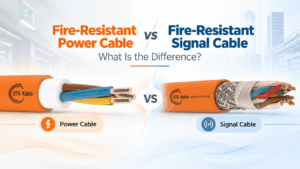
Fire-Resistant Power Cable vs Fire-Resistant Signal Cable: What Is the Difference?
Power vs signal cable is an important distinction when specifying fire-resistant circuits. Two cables can both maintain circuit integri...
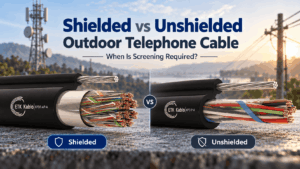
Shielded vs Unshielded Outdoor Telephone Cable: When Is Screening Required?
Shielded outdoor telephone cable includes a metallic screen around the communication core to reduce the effect of external electromagne...
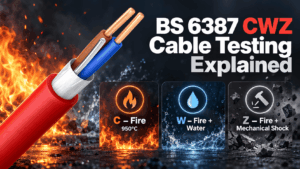
BS 6387 CWZ Cable Testing Explained
BS 6387 CWZ is a fire-resistance test designation used for cables that must maintain circuit integrity under defined fire conditions. I...

Aerial Telephone Cable: Messenger Wire, Mechanical Load and Outdoor Construction
Aerial telephone cable is designed for copper communication routes installed above ground between poles or other approved support point...
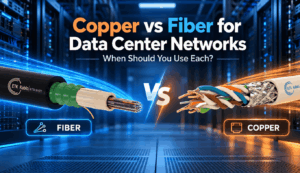
Copper vs Fiber for Data Center Networks: When Should You Use Each?
Copper vs fiber for data centers is not a question with one universal winner. Modern data centers commonly use both media because serve...

Cat6 vs Cat6A for PoE++ Networks: Which Should You Specify?
Cat6 vs Cat6A for PoE++ is no longer only a bandwidth decision. When an Ethernet cable carries both high-speed data and high levels of ...


