





 President’s Message
Blog
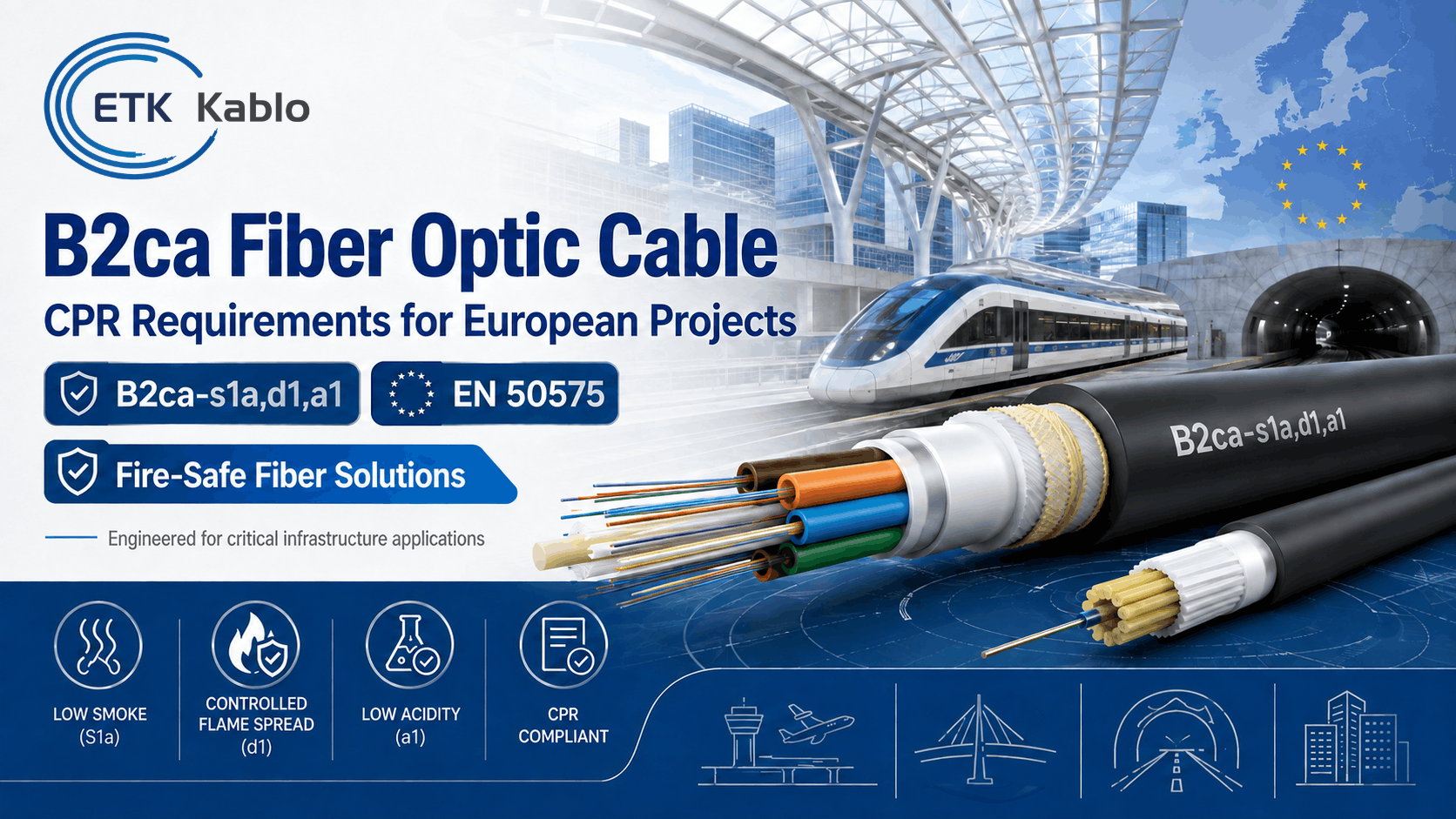
B2ca Fiber Optic Cable: CPR Requirements for European Projects
Reading Time: 10 minutes
Fire performance has become an increasingly important part of fiber optic cable specification for European construction and infrastructure projects.
Fiber optic networks now run through airports, railway stations, tunnels, hospitals, data centers, commercial buildings, public facilities and other environments where large quantities of permanently installed cable may become part of the building infrastructure.
For procurement teams, consultants, contractors and system integrators working on these projects, specifying the correct fiber type is no longer enough.
The cable’s reaction to fire can be equally important.
This is where the B2ca fiber optic cable becomes particularly relevant.
B2ca is one of the higher reaction-to-fire performance classes used under the European Construction Products Regulation framework for cables. When combined with additional classifications such as s1a, d1 and a1, it describes how the cable performs in relation to flame spread, heat release, smoke, flaming droplets and acidity of combustion gases.
ETK Kablo manufactures B2ca-s1a,d1,a1 fiber optic cable solutions for demanding infrastructure projects and also offers specialized constructions combining high CPR reaction-to-fire performance with separate fire-resistance characteristics such as FE180 and PH120 where required.
Understanding the difference between these characteristics is essential when specifying fiber optic cable for critical European projects.
B2ca Fiber Optic Cable at a Glance
| Requirement | B2ca Fiber Optic Cable |
|---|---|
| Main classification | B2ca |
| Regulation area | Construction Products Regulation |
| Main concern | Reaction to fire |
| Harmonized cable standard | EN 50575 |
| Additional smoke class | s1a, s1b, s2 or s3 depending on certified performance |
| Flaming droplets classification | d0, d1 or d2 |
| Acidity classification | a1, a2 or a3 |
| ETK Kablo available classification | B2ca-s1a,d1,a1 on specified fiber optic constructions |
| Typical project focus | High fire-safety infrastructure |
| Fiber options | Single-mode and multimode depending on construction |
| Fire resistance | Separate characteristic from B2ca; available on specialized ETK constructions |
| Typical applications | Airports, railways, tunnels, hospitals, data centers and critical infrastructure |
What Does B2ca Mean for Fiber Optic Cable?
Under the European CPR cable classification system, cables are categorized according to their reaction to fire.
The principal Euroclasses for cables are:
| CPR Cable Class | Relative Reaction-to-Fire Performance |
|---|---|
| Aca | Highest reaction-to-fire performance class |
| B1ca | Very high performance |
| B2ca | High performance |
| Cca | High/intermediate performance |
| Dca | Intermediate performance |
| Eca | Basic flame performance |
| Fca | Performance not meeting Eca or not determined |
The classification concerns how much the cable itself contributes to fire development.
For classes such as B2ca, testing considers characteristics including fire growth, heat release and flame spread.
Additional classifications provide further information about smoke production, flaming droplets and acidity.
This is why buyers will frequently see a full cable classification written as:
B2ca-s1a,d1,a1
rather than simply B2ca.
For fiber optic cable installed in high-safety environments, those additional classifications can be just as important as the main Euroclass.
Understanding B2ca-s1a,d1,a1
A CPR classification such as B2ca-s1a,d1,a1 communicates several different aspects of cable behavior during fire.
| Classification | Performance Area | What It Describes |
|---|---|---|
| B2ca | Reaction to fire | Flame spread, heat release and contribution to fire development |
| s1a | Smoke | Very low smoke performance within the s1 category |
| d1 | Flaming droplets | Restricted persistence of flaming droplets or particles |
| a1 | Acidity | Very low acidity and corrosivity of combustion gases |
B2ca: Reaction to Fire
The B2ca portion is the main Euroclass.
It represents a high level of reaction-to-fire performance compared with lower classes such as Cca, Dca and Eca.
The classification is established using standardized fire testing and forms part of the CPR framework applied to cables intended for permanent incorporation into construction works where reaction-to-fire requirements apply.
s1a: Very Low Smoke Production
Smoke can be one of the most dangerous elements of a building fire.
In airports, hospitals, tunnels, stations and other occupied environments, visibility during evacuation can become critical.
The letter s refers to smoke production.
Within the s1 category, s1a represents particularly demanding smoke-transmission performance.
For this reason, B2ca-s1a fiber optic cable can be attractive for projects where limiting smoke generation forms an important part of the fire-safety strategy.
d1: Flaming Droplets and Particles
The d classification relates to flaming droplets or particles released during combustion.
Flaming particles can contribute to secondary fire propagation by transferring burning material away from the original fire location.
A d1 classification demonstrates controlled performance against the defined criteria for persistent flaming droplets and particles.
a1: Acidity and Corrosivity
The a classification relates to the acidity and conductivity of gases generated during combustion.
An a1 classification represents the most demanding level within the acidity subclasses.
Reducing corrosive combustion gases can be especially important around electronics, communication infrastructure, control systems and sensitive equipment.
B2ca Does Not Automatically Mean Fire Resistant
This distinction is extremely important.
A B2ca fiber optic cable and a fire-resistant fiber optic cable are not automatically the same thing.
B2ca primarily describes the cable’s reaction to fire.
Fire resistance concerns whether the cable or communication system can continue performing for a defined period while exposed to fire.
| Characteristic | Reaction to Fire | Fire Resistance |
|---|---|---|
| Main question | How does the cable contribute to a fire? | Can the cable continue functioning during fire? |
| Example designation | B2ca-s1a,d1,a1 | FE180 / PH120 |
| Flame spread | Evaluated | Not the primary purpose |
| Heat release | Evaluated | Not the primary purpose |
| Smoke | May be classified | Separate issue |
| Flaming droplets | May be classified | Separate issue |
| Acidity | May be classified | Separate issue |
| Operational integrity during fire | Not automatically guaranteed | Central performance objective |
| Typical use | Fire-safe building cable selection | Critical communication and emergency systems |
A cable could therefore have excellent B2ca reaction-to-fire performance without necessarily providing the fire-resistance characteristics required for a critical communication circuit.
Conversely, a project may require both.
ETK Kablo B2ca and Fire-Resistant Fiber Optic Cable Solutions
ETK Kablo‘s specialized fiber optic portfolio includes constructions capable of combining B2ca-s1a,d1,a1 reaction-to-fire performance with additional fire-resistance requirements.
For example, specified ETK Kablo fire-resistant fiber optic constructions can incorporate characteristics such as:
- B2ca-s1a,d1,a1 CPR classification
- FE180 fire-resistance performance
- PH120 functionality depending on the specific cable
- Halogen-free construction
- Low smoke emission
- Single-mode optical fibers
- Multimode optical fibers
- Metallic armor
- Non-metallic reinforcement
- Indoor and outdoor fixed installation capability
- Project-specific fiber counts and constructions
This combination can be valuable in projects where both limiting fire development and maintaining critical communication are important.
The exact cable should always be selected against the complete project specification.
EN 50575 and CPR Fiber Optic Cable
EN 50575 is a central harmonized standard used for power, control and communication cables intended for general applications in construction works subject to reaction-to-fire requirements.
Fiber optic cables intended for applicable permanent installations therefore fall within this cable CPR framework.
A manufacturer’s declared CPR performance needs to correspond to the specific cable or product family being supplied.
Professional buyers should not assume that every LSZH fiber optic cable manufactured by a supplier automatically carries the same CPR class.
This is particularly important when specifying B2ca fiber optic cable.
B2ca Certification Requires More Than a Cable Test
Higher CPR cable classifications involve a stricter conformity-assessment system.
For B2ca cables, the applicable system involves independent third-party certification and ongoing factory production control.
A professional B2ca sourcing process therefore involves more than receiving a one-time laboratory test result.
| B2ca Compliance Element | Purpose |
|---|---|
| Reaction-to-fire testing | Determines cable fire performance |
| Notified Body involvement | Independent certification |
| Factory Production Control | Helps maintain production consistency |
| Factory surveillance | Verifies continued manufacturing control |
| Product sampling and testing | Confirms ongoing performance |
| Classification report | Documents tested performance |
| Certificate of Constancy of Performance | Supports System 1+ certification |
| Declaration of Performance | Declares the manufacturer’s product performance |
| CE marking | Required within the applicable CPR framework |
For procurement teams, this makes documentation an important part of evaluating a B2ca fiber optic cable supplier.
B2ca and AVCP System 1+
B2ca belongs to the higher-performing cable classes that use Assessment and Verification of Constancy of Performance System 1+ within the established cable CPR framework.
System 1+ places greater requirements on both the manufacturer and the independent certification body than the conformity routes used for lower reaction-to-fire classes.
For the buyer, the important principle is simple:
B2ca should represent a controlled and continuously verified manufacturing system, not simply a marketing claim printed on a datasheet.
When sourcing B2ca cable, customers should therefore confirm the relevant CPR documentation rather than relying exclusively on product descriptions.
What Documents Should You Request for a B2ca Fiber Optic Cable?
International contractors and procurement departments should verify the complete product documentation before approving a B2ca fiber cable.
| Document or Information | What the Buyer Should Check |
|---|---|
| Declaration of Performance | Correct product identification and declared CPR class |
| CPR classification | Exact B2ca subclass such as B2ca-s1a,d1,a1 |
| Harmonized standard | Applicable EN 50575 reference |
| Notified Body | Correct certification body information |
| Certificate | Valid Certificate of Constancy of Performance where applicable |
| CE marking | Correctly associated with the product |
| Manufacturer | Actual manufacturing company clearly identified |
| Product code | Matches the cable being supplied |
| Datasheet | Construction corresponds to project requirements |
| Fiber specification | G.652.D, G.657.A1/A2, OM3, OM4, OM5, etc. |
| Additional fire performance | FE180, PH120 or other requirements if specified |
The most important issue is traceability.
The document supplied should clearly correspond to the actual cable being purchased.
CPR Is Not the Same as LSZH
Another common mistake is assuming that LSZH automatically means B2ca.
It does not.
LSZH generally refers to a Low Smoke Zero Halogen material or cable construction.
CPR is a classification system based on measured cable reaction-to-fire performance.
A cable can therefore use LSZH materials but have different CPR classifications depending on its complete design and test results.
| Term | Meaning |
|---|---|
| LSZH | Low Smoke Zero Halogen cable or material concept |
| B2ca | CPR reaction-to-fire Euroclass |
| s1a | Smoke-production subclass |
| d1 | Flaming-droplet subclass |
| a1 | Acidity subclass |
| FE180 | Separate fire-resistance characteristic |
| PH120 | Separate functional-integrity or fire-performance designation |
For specifications, these terms should therefore not be treated as interchangeable.
A project requiring B2ca-s1a,d1,a1 should explicitly specify that performance rather than simply writing “LSZH fiber optic cable.”
Is B2ca Mandatory Everywhere in Europe?
No.
This is another important procurement distinction.
The CPR provides a common European system for declaring and comparing cable reaction-to-fire performance, but it does not mean that B2ca is automatically the minimum cable class for every European building or every application.
Required cable classes can depend on:
- Country
- National building regulations
- Building type
- Project specification
- Fire-risk category
- Occupancy level
- Escape strategy
- Local authority requirements
- Infrastructure operator requirements
- Consultant specifications
Therefore, a buyer should not assume:
Europe = B2ca required everywhere.
Instead, the appropriate approach is:
Identify the CPR classification required by the project’s applicable regulation and technical specification, then source a cable certified for that exact performance.
Where Is B2ca Fiber Optic Cable Commonly Considered?
Higher-performance CPR fiber optic cables are particularly relevant in projects where fire safety, evacuation, continuity of communication or large concentrations of people increase the consequences of fire.
| Application | Why Enhanced Fire Performance Matters |
|---|---|
| Airports | High passenger density and extensive communication infrastructure |
| Railway stations | Public occupancy and critical transport systems |
| Metro systems | Enclosed environments and evacuation requirements |
| Tunnels | Restricted evacuation and ventilation conditions |
| Hospitals | Vulnerable occupants and critical communication systems |
| Data centers | High-value digital infrastructure |
| High-rise buildings | Complex evacuation routes |
| Public buildings | Large numbers of occupants |
| Shopping centers | High occupancy and extensive cabling |
| Industrial facilities | Concentrated operational infrastructure |
| Critical infrastructure | Reliability and emergency communication requirements |
The required CPR class should nevertheless always be confirmed against the project’s actual specification.
B2ca Fiber Optic Cable for Airports
Airports contain enormous communication networks.
Fiber optic cable can connect:
- Terminal networks
- CCTV systems
- Security systems
- Access control
- Data networks
- Operational systems
- Baggage systems
- Flight information systems
- Building management systems
- Emergency communication infrastructure
Because many of these cables run through populated terminal buildings and technical areas, fire performance can become a major specification criterion.
A B2ca fiber optic cable can therefore be relevant where the airport design requires a high reaction-to-fire classification.
Where communication must also remain functional during a fire, a separate fire-resistant fiber optic construction may additionally be required.
B2ca Fiber Optic Cable for Railway and Metro Projects
Railway and metro infrastructure combines communication-critical systems with demanding fire environments.
Fiber optic cable may be deployed for:
- Railway telecommunications
- Signalling communication
- Station connectivity
- CCTV
- Passenger information
- SCADA
- Operational networks
- Tunnel communication
- Control systems
For underground stations and tunnels in particular, smoke production, fire propagation and gas characteristics can become extremely important.
ETK Kablo’s experience in railway cable projects and specialized fire-performance fiber optic cable manufacturing allows these requirements to be evaluated within the context of the complete infrastructure specification.
B2ca Fiber Optic Cable for Data Centers
Data centers can contain significant concentrations of communication cable.
The objective is not only protecting the cable itself but limiting how installed materials contribute to fire development and smoke within the building.
A B2ca-classified fiber optic cable may therefore be specified for high-safety data center environments depending on local regulation, customer requirements and the project’s fire strategy.
ETK Kablo can offer single-mode and multimode fiber constructions for different data center and infrastructure applications.
B2ca Fiber Optic Cable for Hospitals
Hospitals present particularly challenging fire-safety requirements because rapid evacuation may not always be possible.
Communication, security, medical infrastructure and building-control systems may also need to operate reliably during emergency situations.
For these reasons, cable fire performance can be particularly important in healthcare facilities.
Where a specification requires B2ca-s1a,d1,a1 fiber optic cable, the combination of reduced fire contribution, very low smoke performance and low acidity can make the classification appropriate for demanding hospital infrastructure.
Where continued communication during fire is also required, separate fire-resistant performance needs to be specified.
Choosing the Correct Fiber Type for a B2ca Cable
CPR classification describes the reaction-to-fire behavior of the cable.
It does not determine the optical fiber type.
B2ca cables can therefore be designed around different optical fibers depending on the network.
| Fiber Type | Category | Typical Use |
|---|---|---|
| G.652.D | Single-mode | Telecom backbone and infrastructure |
| G.657.A1 | Single-mode | Bend-insensitive access and building networks |
| G.657.A2 | Single-mode | Applications requiring greater bend performance |
| OM1 | Multimode | Legacy networks |
| OM2 | Multimode | Enterprise networks |
| OM3 | Multimode | High-speed data networks |
| OM4 | Multimode | Data centers and high-bandwidth networks |
| OM5 | Multimode | Wideband multimode applications |
The project should therefore specify both:
Optical performance + fire performance
For example:
24 Fiber G.652.D – B2ca-s1a,d1,a1
rather than simply requesting “B2ca fiber.”
What Should a B2ca Fiber Optic Cable RFQ Include?
A detailed inquiry helps the manufacturer select or design the correct cable.
| RFQ Requirement | Example |
|---|---|
| Fiber type | G.652.D |
| Fiber count | 24 fibers |
| CPR class | B2ca-s1a,d1,a1 |
| Construction | Single loose tube |
| Armor | Steel tape |
| Sheath | Halogen-free |
| Installation | Indoor/outdoor |
| Fire resistance | FE180 if required |
| Functional integrity | PH120 if required |
| Project | Railway, airport, tunnel or data center |
| Quantity | 50 km |
| Drum length | 2,000 m |
| Documentation | CPR certificate, DoP and datasheet |
| Special standard | Customer or project specification |
Providing this information at the RFQ stage reduces technical ambiguity and makes quotation comparisons between manufacturers more meaningful.
Why Choose ETK Kablo for B2ca Fiber Optic Cable?
B2ca cable manufacturing requires more than modifying the outer sheath of a standard fiber optic cable.
Materials, cable geometry, construction, processing and quality control all influence reaction-to-fire performance.
ETK Kablo combines decades of cable manufacturing experience with specialized fiber optic production and high-performance fire cable expertise.
| ETK Kablo Capability | Benefit for the Buyer |
|---|---|
| Cable manufacturing since 1979 | Long-term manufacturing experience |
| Fiber optic cable manufacturing since 2001 | Established optical cable expertise |
| B2ca-certified cable portfolio | Support for demanding European projects |
| B2ca-s1a,d1,a1 fiber solutions | High reaction-to-fire performance |
| FE180 fiber constructions | Additional fire-resistance capability |
| PH120 solutions | Support for critical infrastructure specifications |
| Single-mode and multimode fibers | Broad optical flexibility |
| Metallic and non-metallic constructions | Mechanical design flexibility |
| In-house laboratories | Technical testing capability |
| Customized manufacturing | Project-specific cable engineering |
| International exports | Experience with international procurement |
| Broad low-current portfolio | Fiber and complementary cable sourcing |
ETK Kablo’s B2ca portfolio includes B2ca fiber optic cable constructions, including specialized fire-resistant fiber optic cable solutions.
This makes ETK Kablo particularly relevant to contractors and distributors requiring more than a conventional LSZH fiber optic cable.
CPR Requirements in Europe in 2026
The European construction-product framework is evolving.
Regulation (EU) 2024/3110 introduced the new Construction Products Regulation framework and applies generally from 8 January 2026.
For cables, however, migration to the new CPR framework depends on the development and adoption of updated harmonized standards incorporating the new requirements.
This means procurement teams should continue to verify the currently applicable harmonized cable standards, Declaration of Performance and CE documentation for the specific product being purchased rather than making assumptions based solely on the publication date of the new Regulation.
For actual projects, the latest national regulation and project specification should always be checked.
Frequently Asked Questions About B2ca Fiber Optic Cable
What is B2ca fiber optic cable?
B2ca fiber optic cable is an optical cable classified according to the European CPR reaction-to-fire system at B2ca level. The full classification can additionally describe smoke production, flaming droplets and acidity, such as B2ca-s1a,d1,a1.
What does B2ca-s1a,d1,a1 mean?
B2ca describes the primary reaction-to-fire performance. The s1a classification relates to very low smoke production, d1 relates to flaming droplets or particles, and a1 relates to low acidity and corrosivity of combustion gases.
Is B2ca better than Cca?
In the CPR hierarchy, B2ca represents a higher reaction-to-fire performance class than Cca.
However, the correct classification should always be selected according to the applicable project and national requirements rather than automatically specifying the highest available class.
Is B2ca fiber optic cable fire resistant?
Not necessarily.
B2ca is primarily a reaction-to-fire classification. Fire resistance or continued functionality during fire is a separate characteristic.
ETK Kablo offers specialized fiber optic cable constructions where B2ca CPR performance can be combined with additional fire-resistance characteristics such as FE180 and PH120.
Is B2ca the same as LSZH?
No.
LSZH refers to Low Smoke Zero Halogen material characteristics, whereas B2ca is a tested CPR reaction-to-fire classification.
A cable being LSZH does not automatically mean it is B2ca.
What standard applies to CPR fiber optic cable?
EN 50575 is the key harmonized standard traditionally used for cables intended for general applications in construction works subject to reaction-to-fire requirements. Additional standardized tests and classification procedures are used to determine the full CPR performance.
Is B2ca mandatory in Europe?
Not for every application.
The required CPR class depends on national rules, project specifications, building type and other regulatory requirements.
Can B2ca fiber cable be single-mode?
Yes. B2ca describes cable reaction-to-fire performance rather than optical transmission type. A B2ca cable can incorporate single-mode fiber such as G.652.D, G.657.A1 or G.657.A2.
Can B2ca fiber cable use OM3, OM4 or OM5 multimode fiber?
Yes. Depending on the certified cable design and manufacturer capability, B2ca constructions can incorporate multimode optical fibers such as OM3, OM4 and OM5.
Does ETK Kablo manufacture B2ca fiber optic cable?
Yes. ETK Kablo offers B2ca-classified fiber optic cable solutions, including specified constructions with B2ca-s1a,d1,a1 reaction-to-fire performance and specialized fire-resistant fiber optic cable options for demanding infrastructure projects.
Source B2ca Fiber Optic Cable from ETK Kablo
Selecting a B2ca fiber optic cable should involve much more than checking a single line on a technical datasheet.
Professional buyers should evaluate the complete B2ca classification, smoke performance, flaming droplets, acidity, optical fiber specification, mechanical construction, CPR documentation, certification, project requirements and any separate fire-resistance requirement.
For airports, railway systems, metro projects, tunnels, hospitals, data centers, public buildings and other demanding infrastructure, the correct combination of optical, mechanical and fire performance can significantly affect long-term network reliability and project compliance.
ETK Kablo manufactures specialized B2ca-s1a,d1,a1 fiber optic cable solutions alongside fire-resistant fiber optic cable constructions engineered for critical infrastructure.
For project-specific requirements, customers can provide the desired fiber type, fiber count, cable construction, CPR classification, fire-resistance requirement and applicable technical specification for evaluation.
ETK Kablo – High-performance fiber optic cable solutions for safer, more reliable infrastructure.


