





 President’s Message
Blog
Industrial Control Cable Selection for Automation and Machinery
Reading Time: 17 minutes
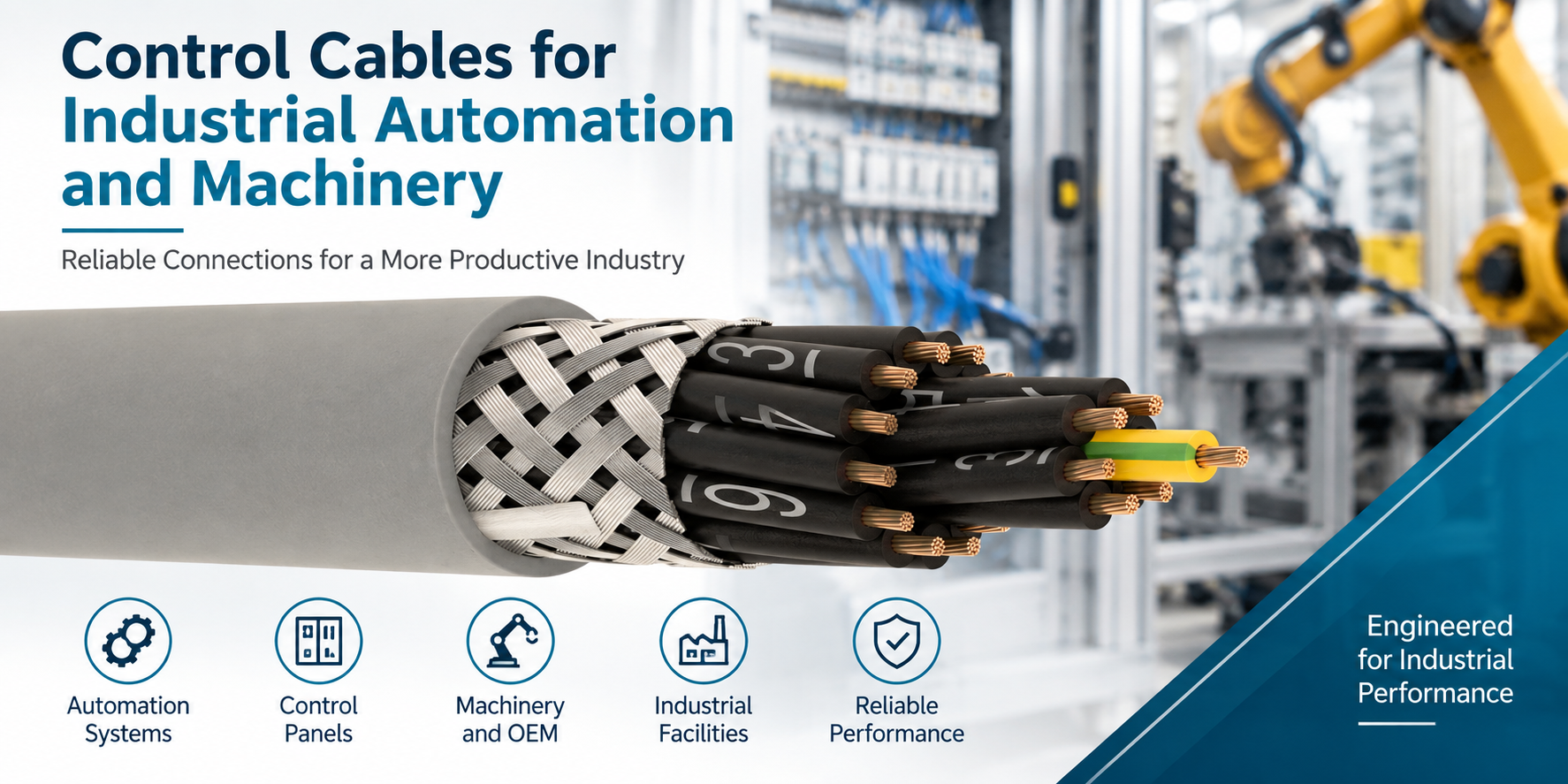
Industrial control cable selection should begin with the function of the circuit and the mechanical conditions of the machine rather than with a familiar cable designation. Modern automation equipment can combine PLCs, relays, contactors, sensors, actuators, variable-frequency drives, motors, valves and feedback systems within the same production line, yet these connections do not necessarily require the same cable construction.
For example, a multicore unscreened control cable can be appropriate for conventional relay commands in a relatively low-noise environment. By contrast, sensitive feedback wiring routed near motors or drives can require electromagnetic screening. Meanwhile, machinery exposed to oils, abrasion or continuous movement can require a different sheath and mechanical design from a cable installed permanently inside a control cabinet.
Therefore, the phrase “flexible control cable” is not enough to define a suitable machinery cable. Conductor class, screen construction, core count, voltage rating, sheath material, bending conditions, movement frequency and environmental resistance all need to match the actual application.
Another important distinction concerns movement. A cable manufactured with flexible Class 5 conductors can be convenient to route and install, but that does not automatically make it suitable for continuous flexing inside a drag chain, repeated torsion on a robot or other dynamic applications. Those operating conditions require cable constructions specifically designed for the intended movement.
Quick answer: industrial control cables should be selected according to circuit function, conductor cross-section, number of cores, electromagnetic environment, installation movement, mechanical stress, fire requirements and exposure to oils, chemicals, moisture or UV. YSLY-type unscreened PVC control cables can suit general automation circuits, screened YSLYCY or similar constructions can provide additional EMI protection, and halogen-free HSL-family cables can be selected where LSZH materials are required. Continuous-flex and robotic applications require additional mechanical evaluation.
Industrial Control Cable Selection at a Glance
| Application Condition | Typical Cable Requirement | Main Selection Factor |
|---|---|---|
| General relay and command circuits | Unscreened multicore control cable | Core count and conductor size |
| Electrically noisy machinery | Screened control cable | EMI protection |
| Analogue feedback | Screened signal/control or instrumentation cable | Signal integrity |
| PLC digital I/O | Multicore control cable | Core identification and voltage |
| VFD environment | Screened cable where required | Electromagnetic compatibility |
| Fixed machine wiring | Flexible or fixed control cable according to design | Installation method |
| Continuous movement | Purpose-designed continuous-flex cable | Flex life and bend radius |
| Robotic torsion | Purpose-designed torsion cable | Torsional endurance |
| Oil-exposed machinery | Oil-resistant sheath where required | Chemical compatibility |
| Public or enclosed buildings | LSZH control cable where specified | Fire and smoke requirements |
| Outdoor automation | UV and environmental-resistant construction | Weather exposure |
Consequently, no single control-cable construction can cover every industrial automation application efficiently.
What Is an Industrial Control Cable?
An industrial control cable connects electrical and automation equipment that exchanges commands, status information or low-voltage electrical signals.
Typical connected equipment includes:
- PLCs
- Relays
- Contactors
- Sensors
- Actuators
- Solenoid valves
- Limit switches
- Motor-control equipment
- Control panels
- Machine interfaces
Unlike a power feeder, the primary purpose of many control circuits is not to transfer large amounts of electrical power. Instead, they transmit commands or operating states between different elements of a machine or automation system.
However, control cable remains a broad product family. Therefore, the circuit function must be defined before the cable construction can be selected correctly.
Industrial Control Cable Selection Starts with Circuit Function
The first question should be:
What does this conductor actually carry?
A machine can contain several types of control circuits, including:
- Digital inputs
- Digital outputs
- Relay commands
- Contactor commands
- Analogue signals
- Equipment status signals
- Feedback circuits
- Low-voltage auxiliary power
For example, a 24 V DC digital output controlling a relay does not necessarily have the same signal-integrity requirements as a low-level analogue feedback circuit.
Therefore, industrial control cable selection should begin with the electrical function instead of using one cable type across an entire machine.
Control Cable vs Power Cable in Machinery
Control and power cables can appear beside each other inside industrial machinery, but they perform different functions.
Power cables primarily supply electrical energy to equipment such as:
- Motors
- Heaters
- Pumps
- Large actuators
- Machine distribution circuits
Control cables, meanwhile, carry commands, switching functions, status information and other automation signals.
As a result, conductor cross-section, voltage rating and electromagnetic requirements can differ significantly.
Therefore, designers should not select a control cable merely because its conductor count matches an available power cable.
Control Cable vs Instrumentation Cable
Instrumentation cable is another product family that can appear inside industrial automation systems.
Instrumentation cables commonly use twisted pairs or triads and can include individual or overall screens for low-level measurement signals.
Typical instrumentation applications include:
- 4–20 mA loops
- Pressure transmitters
- Temperature transmitters
- Flow measurement
- Process sensors
Control cable commonly uses multicore construction for command and switching functions.
Consequently, a screened multicore control cable should not automatically replace a dedicated instrumentation cable when the circuit requires controlled pair geometry or individual pair screening.
Conductor Size in Industrial Control Cable Selection
Industrial control cable selection requires an appropriate conductor cross-section for the electrical circuit.
Control-cable sizes can include:
- 0.5 mm²
- 0.75 mm²
- 1.0 mm²
- 1.5 mm²
- 2.5 mm²
- Larger sizes where required
The correct size depends on factors such as:
- Current
- Voltage drop
- Route length
- Protection device
- Equipment requirements
- Installation conditions
For example, increasing conductor size can reduce voltage drop on a long low-voltage control circuit.
However, oversized conductors can also increase cable diameter, bending radius and cost. Therefore, conductor sizing should follow the actual electrical requirement.
Why Control Cables Use Flexible Conductors
Many industrial control cables use finely stranded copper conductors because flexible conductors make routing and termination easier inside machines and control systems.
IEC conductor classifications can distinguish different conductor constructions, including flexible conductor classes.
Class 5 copper conductors are widely encountered in flexible control-cable families.
For example, a cable routed through a crowded electrical panel can be easier to handle when the conductors and overall cable have greater flexibility.
Nevertheless, flexibility during installation does not automatically establish suitability for repeated movement.
Flexible Does Not Automatically Mean Continuous Flex
This distinction is critical in machinery applications.
A conventional flexible control cable can use stranded conductors and bend easily during installation.
However, a drag-chain cable experiences thousands or millions of repeated bending cycles during operation.
Similarly, robotic cable can experience repeated torsion around several axes.
Therefore:
flexible cable ≠ continuous-flex cable.
Industrial control cable selection must identify whether the cable moves only during installation or continuously during machine operation.
Industrial Control Cable Selection for Fixed Machinery
Many control cables inside machinery remain stationary after installation.
Typical fixed applications include:
- Control cabinets
- Machine frames
- Fixed sensor connections
- Relay wiring
- Terminal-box connections
- Equipment interfaces
In these cases, the cable does not need continuous flexing performance.
Instead, engineers can prioritize core count, conductor size, screening, sheath material and installation environment.
Consequently, general flexible control cables such as YSLY-type constructions can provide practical solutions for many fixed automation circuits.
Industrial Control Cable Selection for Moving Machinery
Moving machinery creates additional mechanical requirements.
A cable can experience:
- Repeated bending
- Acceleration
- Tension
- Abrasion
- Twisting
- Compression
For example, machine-tool axes, gantries and automated handling systems can move continuously during every production cycle.
Therefore, the cable design must explicitly support the intended movement rather than relying only on a flexible conductor class.
Industrial Control Cable Selection for Drag Chains
Drag chains guide cables along predictable repeated-motion paths.
A suitable cable must tolerate:
- Repeated flexing
- Defined minimum bending radius
- Acceleration
- Travel speed
- Mechanical abrasion
- Cycle life
Moreover, conductor stranding, insulation, core assembly and sheath materials all influence dynamic performance.
Consequently, a conventional YSLY-style cable should not automatically be placed in a drag chain unless the specific product documentation confirms suitability for that movement.
Control Cable for Robotic Applications
Robotic systems can impose different mechanical loads from ordinary drag chains.
For instance, robot arms can combine bending with torsion as several joints rotate simultaneously.
A robotic cable can therefore require:
- High torsional endurance
- Flexible conductor design
- Special core assembly
- Abrasion-resistant sheath
- Controlled torsion capability
Therefore, industrial control cable selection for robotic applications should include torsion data rather than assuming that a continuous-flex cable designed only for linear bending will be sufficient.
Industrial Control Cable Selection: Screened vs Unscreened
Screening becomes another major decision in industrial automation.
Unscreened control cables can be suitable for conventional command circuits in environments where electromagnetic interference is limited.
Screened cables include a conductive layer intended to reduce electromagnetic interference.
Potential screen constructions include:
- Aluminium/polyester foil
- Tinned copper braid
- Bare copper braid
- Combined foil and braid
Therefore, screening should be selected according to signal sensitivity and the surrounding electromagnetic environment rather than specified universally.
Industrial Control Cable Selection Near VFDs
Industrial control cable selection deserves particular attention around variable-frequency drives.
VFDs switch electrical power rapidly to control motor speed. As a result, they can create substantial electromagnetic noise.
Sensitive nearby circuits can include:
- Analogue signals
- Feedback wiring
- Encoder circuits
- Low-level sensors
- Communication networks
Screened control cable can provide additional protection for appropriate circuits.
However, cable routing, bonding and separation from power conductors remain important parts of the complete EMC strategy.
Control Cables Near Motors
Motors and motor-power circuits can also influence nearby control wiring.
For example, an automation panel can contain feedback circuits only a short distance from high-current motor conductors.
Accordingly, sensitive circuits can benefit from screened construction and appropriate physical separation.
Meanwhile, robust relay commands may require less protection.
Consequently, machine designers can legitimately use screened and unscreened control cables within the same equipment.
YSLY for General Industrial Automation
YSLY is a commonly used unscreened flexible PVC control-cable family.
Typical applications can include:
- Machine wiring
- Control panels
- Relay circuits
- Automation equipment
- Fixed control connections
Its multicore construction can provide an economical solution when additional electromagnetic screening is unnecessary.
However, the exact voltage, temperature, movement and environmental capabilities should be verified from the product datasheet.
YSLYCY for Screened Industrial Control
YSLYCY and related screened control-cable constructions provide additional electromagnetic protection for suitable automation circuits.
Screened constructions can be useful near:
- VFDs
- Motors
- Power cables
- Transformers
- Switchgear
Moreover, screening can support signal integrity for sensitive feedback and control functions.
Nevertheless, a screened multicore control cable should not automatically replace protocol-specific communication or instrumentation cable.
YSLCY and Other Screened Variants
Industrial control-cable portfolios can include several screened constructions.
For example, cable families can differ in whether they use:
- Foil screen
- Copper braid
- Foil plus braid
- Different insulation materials
- Different sheath systems
Therefore, product designation alone should not replace the construction table.
Buyers should confirm the actual screen material, coverage and drain-wire arrangement where these parameters matter.
HSLH for Halogen-Free Machinery Applications
HSLH represents a halogen-free control-cable construction for suitable applications.
LSZH materials can be important in environments where smoke and corrosive combustion products need to be reduced.
Potential applications can include machinery installed in:
- Airports
- Hospitals
- Metro facilities
- Public buildings
- Data centers
- Commercial infrastructure
However, LSZH does not determine whether the cable is screened or suitable for repeated movement.
Therefore, material, EMC and mechanical requirements must remain separate specification parameters.
Screened Halogen-Free Control Cable
Halogen-free materials can also be combined with electromagnetic screening.
This allows a cable to address both:
- Fire-related material requirements
- EMI protection
For example, HSLCH or HSLHCH-type constructions can provide screened halogen-free options depending on the exact product design.
Consequently, engineers do not need to choose between LSZH construction and screening when both are technically required.
Industrial Control Cable Selection for PLC Systems
Industrial control cable selection for PLC-based systems depends on the specific I/O circuit.
A PLC cabinet can include:
- Digital inputs
- Digital outputs
- Analogue inputs
- Analogue outputs
- Relay outputs
- Communication modules
Digital I/O can often use multicore control cable.
By contrast, analogue signals can justify twisted or screened constructions depending on equipment requirements and noise conditions.
Meanwhile, Ethernet, RS-485, Profibus or other communication interfaces require their own protocol-appropriate cable designs.
Industrial Control Cable Selection for Sensors
Sensors can generate very different electrical outputs.
Examples include:
- 24 V switching output
- 0–10 V
- 4–20 mA
- Pulse output
- Digital communication
Therefore, “sensor cable” does not identify one universal product.
A simple proximity switch can require a different cable from a precision analogue sensor or networked field device.
Consequently, the sensor datasheet should determine the electrical cable requirements.
Industrial Control Cable Selection for Actuators
Actuators can also use several control methods.
For example, equipment can require:
- Simple on/off command
- Open/close control
- 0–10 V positioning
- Three-point floating control
- Digital communication
Accordingly, conductor count and signal type can vary substantially.
Industrial control cable selection should therefore account for both command wiring and any position-feedback circuits.
Control Cable for Solenoid Valves
Solenoid valves are common throughout industrial automation.
The cable can carry switching voltage from a PLC output, relay or valve terminal unit.
Important parameters can include:
- Operating voltage
- Current
- Route length
- Conductor size
- Number of valves
- Environmental exposure
Moreover, oil, chemicals or moisture around process equipment can influence sheath selection.
Control Cable for Relays and Contactors
Relay and contactor circuits are among the most conventional control-cable applications.
These circuits often use robust switching signals rather than low-level precision measurements.
Therefore, unscreened multicore control cable can frequently provide an efficient solution when the surrounding EMI environment is acceptable.
However, the cable must still satisfy voltage, current, temperature and installation requirements.
Control Cable for Feedback Systems
Feedback circuits can be more sensitive to interference than simple command circuits.
Applications can include:
- Position feedback
- Speed feedback
- Analogue measurements
- Machine condition signals
For this reason, screened cable can become more relevant.
Nevertheless, specialized encoder or instrumentation cables may be more appropriate when the equipment manufacturer requires controlled electrical characteristics.
Encoder Cable vs General Control Cable
An encoder cable can carry high-frequency pulse or digital feedback signals.
Therefore, it can require specific:
- Pair geometry
- Shielding
- Capacitance
- Impedance
- Conductor arrangement
A generic screened control cable does not automatically satisfy those requirements.
Consequently, machine builders should follow the encoder manufacturer’s cable specification rather than selecting cable only by core count.
Oil Resistance in Industrial Control Cable Selection
Industrial control cable selection often requires consideration of oils and lubricants.
Machinery environments can expose cable jackets to:
- Hydraulic oil
- Lubricating oil
- Cutting fluids
- Grease
- Cleaning chemicals
Long-term exposure can affect unsuitable sheath materials.
Therefore, the actual chemical environment should be identified before approving a control cable for machine use.
PVC Sheath for Industrial Control Cable
PVC provides a practical material system for many general-purpose control-cable applications.
Advantages can include:
- Good general flexibility
- Cost efficiency
- Ease of processing
- Availability across many multicore constructions
However, PVC formulations vary in resistance to oil, temperature and chemicals.
Consequently, the presence of a PVC sheath alone does not establish suitability for every industrial environment.
PUR Control Cable for Demanding Machinery
Polyurethane, commonly abbreviated as PUR, can provide strong abrasion and mechanical characteristics for appropriate machinery applications.
Depending on formulation, PUR can also offer useful resistance to oils and industrial exposure.
Therefore, PUR-sheathed control cables can be considered for demanding machine environments and dynamic applications when the complete cable construction is designed accordingly.
However, a PUR sheath by itself does not guarantee drag-chain or robotic performance. The conductor and core design must also support the intended movement.
Industrial Control Cable Selection for Wet Areas
Moisture can influence cable performance and long-term durability.
For example, machinery used in food processing, washing systems or outdoor installations can experience frequent water exposure.
Therefore, engineers should verify:
- Sheath water resistance
- Ingress conditions
- Temperature
- Chemical cleaning agents
- Connector sealing
Meanwhile, a cable suitable for occasional damp conditions should not automatically be considered suitable for permanent immersion.
Outdoor Control Cable for Machinery
Outdoor machinery adds environmental stresses that indoor cable may not encounter.
Potential requirements include:
- UV resistance
- Temperature resistance
- Moisture resistance
- Mechanical protection
- Weather-resistant sheath
As a result, standard indoor grey PVC control cable should not automatically be used outdoors without confirming the product’s environmental capability.
Industrial Control Cable Selection for Temperature Requirements
Industrial machinery can operate across a wide temperature range.
For example, cable near furnaces, industrial ovens or process equipment can experience elevated ambient temperatures.
Meanwhile, outdoor machinery can face low winter temperatures.
Therefore, both operating and installation temperature ranges should be checked.
A cable can remain electrically suitable yet become difficult to install or mechanically vulnerable outside its permitted temperature range.
Minimum Bending Radius
Bending a cable too tightly can damage conductors, insulation, screen layers or the outer sheath.
Therefore, manufacturers specify minimum bending-radius requirements.
The required radius can differ between:
- Fixed installation
- Occasional movement
- Continuous flexing
Consequently, machine design should provide sufficient routing space rather than forcing the cable around excessively tight corners.
Core Count in Industrial Control Cable Selection
Industrial control cable selection also requires the correct number of cores.
Machine-control cables can contain:
- A few conductors for simple equipment
- Multiple cores for actuators or interfaces
- High core counts for complex control panels
Additional spare conductors can sometimes provide future flexibility.
However, unnecessary cores increase diameter, weight and cost.
Therefore, cable schedules should balance current circuit requirements with reasonable future needs.
Numbered Cores vs Colour-Coded Cores
Core identification becomes increasingly important as conductor count grows.
Industrial control cables can use:
- Numbered black cores
- Colour-coded conductors
- Green/yellow protective conductor where applicable
Number coding can simplify identification in cables with many conductors.
Meanwhile, colour coding can be convenient for smaller or standardized circuits.
Consequently, JZ, OZ and related core-identification conventions should be understood when preparing purchase specifications.
What Does JZ Mean?
In commonly used German-style control-cable designations, JZ generally indicates numbered conductors together with a green/yellow protective conductor.
This arrangement can be useful when the cable includes a protective-earth connection.
However, naming conventions should always be confirmed against the manufacturer’s datasheet.
Therefore, engineers should avoid relying entirely on a short product code without reviewing the conductor identification table.
What Does OZ Mean?
OZ generally refers to a numbered-core construction without a green/yellow protective conductor in commonly used cable designations.
This can suit circuits where a PE conductor is not required inside the same control cable.
Consequently, choosing JZ or OZ should reflect the actual electrical circuit rather than product availability.
Voltage Rating in Industrial Control Cable Selection
The cable’s rated voltage must exceed the requirements of the intended circuit under the applicable installation rules.
Control-cable families can be designed for ratings such as:
- 300/500 V
- 450/750 V
- Other application-specific ratings
For example, ETK’s current control-cable portfolio includes standard constructions as well as 0.45/0.75 kV variants.
Therefore, buyers should specify rated voltage explicitly rather than assuming every cable with the same family name has the same rating.
Current IEC Control Cable Requirements
IEC 60227-7:2024 covers particular requirements for PVC-insulated screened and unscreened control cables with rated voltages up to and including 300/500 V within its scope.
Therefore, the standard provides a current international reference for relevant flexible control-cable constructions.
Meanwhile, conductor requirements can reference IEC 60228 where applicable to the product design.
However, not every industrial control cable belongs to IEC 60227-7. Project specifications should identify the actual standard applicable to the selected product.
Fire Performance in Industrial Control Cable Selection
Industrial control cable selection can also include fire-performance requirements.
For fixed cables installed within buildings, project specifications can address:
- Flame propagation
- LSZH materials
- Smoke production
- Acidity
- CPR classification where applicable
However, fire performance should not be confused with electromagnetic screening or mechanical flexibility.
Each characteristic addresses a different project requirement.
IEC 60332 and Flame Propagation
IEC 60332-1-2 provides a test method for vertical flame propagation on a single insulated wire or cable using a 1 kW premixed flame.
The current edition is IEC 60332-1-2:2025.
Therefore, specifications should avoid continuing to reference superseded editions without considering current project requirements.
Nevertheless, passing a single-cable flame test does not automatically establish the complete fire behaviour required for every industrial installation.
LSZH Control Cable for Machinery
LSZH cable can be selected where reducing smoke and halogen-containing combustion products is important.
Examples can include machinery installed inside:
- Airports
- Hospitals
- Transport buildings
- Data centers
- Public facilities
However, many industrial plants can still use PVC control cables where the project permits them.
Therefore, LSZH should be specified according to the fire strategy rather than treated as an automatic requirement for all automation systems.
CPR and Industrial Machinery Control Cable
CPR becomes relevant to cables placed on the market for permanent incorporation into applicable European construction works.
However, machinery and building installation can create different regulatory contexts.
Therefore, engineers should determine whether a particular control cable forms part of the building installation and falls within the applicable CPR requirement rather than assigning a Euroclass automatically to every machine cable.
Industrial Control Cable Selection for Factory Automation
Industrial control cable selection in a factory can involve several cable families operating together.
A production line can include:
- Unscreened control cables
- Screened control cables
- Instrumentation cables
- Ethernet cables
- Fieldbus cables
- Motor cables
- Power cables
Consequently, “automation cable” should not be treated as one universal product category.
The correct cable architecture follows the electrical and communication function of each circuit.
Industrial Control Cable Selection for Packaging Machinery
Packaging machines can include high numbers of sensors, actuators, motors and control devices within compact spaces.
As a result, cable selection can require attention to:
- Flexibility
- EMI
- Repeated movement
- Core count
- Abrasion
Furthermore, high machine speeds can increase the mechanical demands on cables installed in moving sections.
Therefore, fixed and moving cable routes should be specified separately.
Control Cables for Conveyor Systems
Conveyors can use control circuits for:
- Photoelectric sensors
- Limit switches
- Emergency stops
- Motor starters
- Actuators
- Status feedback
Long conveyor routes can also increase voltage-drop and environmental considerations.
Consequently, conductor size and cable construction should reflect both electrical distance and the surrounding industrial conditions.
Industrial Control Cable Selection for Machine Tools
Machine tools can create demanding combinations of motion, coolant exposure, oil and electromagnetic noise.
Therefore, engineers can need to evaluate:
- Oil resistance
- Abrasion resistance
- Continuous flex capability
- Screening
- Minimum bend radius
- Temperature range
Moreover, spindle drives and servo systems can generate EMI that affects nearby low-level control wiring.
Control Cables for Process Machinery
Process machinery often combines conventional control wiring with instrumentation circuits.
For example, the same equipment can contain:
- Solenoid valves
- Pressure transmitters
- Temperature sensors
- Pumps
- Motorized valves
- PLC I/O
Therefore, control cable and instrumentation cable should be selected according to individual circuit functions rather than consolidated into one generic multicore cable.
Common Industrial Control Cable Selection Mistakes
1. Using One Cable Type for the Entire Machine
Different circuits can require different electrical, EMC and mechanical characteristics.
2. Assuming Flexible Means Drag-Chain Suitable
Continuous movement requires a cable specifically designed for repeated flexing.
3. Using an Ordinary Drag-Chain Cable for Robotic Torsion
Linear bending and torsion create different mechanical stresses.
4. Ignoring EMI Around VFDs
Sensitive signals can require screening and appropriate route separation.
5. Screening Every Circuit Automatically
Robust control circuits may not benefit from additional screening.
6. Using Screened Control Cable Instead of Instrumentation Cable
Low-level measurement circuits can require dedicated pair or triad constructions.
7. Using Control Cable for Ethernet or Fieldbus
Protocol-specific networks can require controlled impedance and other transmission parameters.
8. Ignoring Oil Exposure
An unsuitable jacket can deteriorate under long-term chemical exposure.
9. Assuming PUR Automatically Means Continuous Flex
Dynamic suitability depends on the complete cable construction.
10. Using Indoor Cable Outdoors Without Verification
Outdoor installations can require UV, moisture and temperature resistance.
11. Ignoring Minimum Bending Radius
Excessive bending can damage the cable structure.
12. Confusing JZ and OZ
The presence of a green/yellow protective conductor should match the circuit design.
13. Selecting Conductor Size Only by Habit
Current, voltage drop and route length should determine the required cross-section.
14. Assuming LSZH Means Flame Resistant
Material composition and fire-test performance are separate characteristics.
15. Assuming CPR Class Determines Machinery Suitability
Reaction-to-fire classification does not establish mechanical or automation performance.
16. Ignoring Connector and Gland Compatibility
Outside diameter and screen termination can affect accessories.
17. Ignoring Installation Temperature
A cable can have different limits for installation and normal operation.
18. Buying by Cable Code Alone
The complete technical datasheet should control the final approval.
How to Perform Industrial Control Cable Selection
Step 1: Identify the Circuit Function
Define whether the cable carries digital control, analogue feedback, auxiliary power or another function.
Step 2: Determine Current and Voltage
Select an appropriate conductor size and cable voltage rating.
Step 3: Define Core Count
Include the required conductors and any justified spare capacity.
Step 4: Determine Movement
Classify the cable as fixed, occasionally moved, continuously flexed or torsionally moved.
Step 5: Assess EMI
Identify nearby motors, drives, transformers and power circuits.
Step 6: Select Screening
Where required, choose an appropriate foil, braid or combined-screen construction.
Step 7: Review Mechanical Stress
Consider abrasion, tension, crush, bend radius and movement cycles.
Step 8: Review Chemicals
Identify oils, coolants, cleaning agents and other substances that can contact the cable.
Step 9: Choose PVC, LSZH or Special Sheath
Select the material system according to mechanical, fire and environmental requirements.
Step 10: Review Temperature
Check both operating and installation limits.
Step 11: Define Fire Performance
Specify flame propagation, LSZH or CPR requirements where applicable.
Step 12: Verify the Datasheet
Finally, confirm that every selected parameter appears in the proposed product documentation.
Industrial Control Cable Selection Checklist for an RFQ
A detailed RFQ makes industrial control cable selection easier for both buyers and manufacturers.
Useful information includes:
- Machine or automation application
- Circuit function
- Rated voltage
- Conductor cross-section
- Number of cores
- Conductor class
- JZ or OZ identification
- Green/yellow conductor requirement
- Screened or unscreened
- Required screen type
- Fixed or moving installation
- Drag-chain requirement where applicable
- Torsion requirement where applicable
- Minimum bending radius
- Required cycle life where applicable
- PVC, LSZH or PUR sheath
- Oil resistance
- Chemical resistance
- UV resistance
- Operating temperature
- Installation temperature
- Flame performance
- CPR classification where applicable
- Outer diameter limitations
- Required standards
- Packaging length
- Cable marking
Consequently, suppliers can compare technically equivalent constructions rather than quoting products based only on a generic request for “automation cable.”
ETK Kablo Solutions for Industrial Control Cable Selection
ETK Kablo manufactures a broad range of control cables for automation, machinery, building services and industrial infrastructure.
The current control-cable portfolio includes families such as:
- YSLY-JZ
- HSLH-JZ
- YSLCY-JZ
- HSLCH-JZ
- 2YSLCY-JZ
- YSLYCY-JZ
- HSLHCH-JZ
- HSL(St)CH-JZ
- Higher-voltage variants
- Project-specific constructions
Depending on the application, ETK control cables can combine flexible copper conductors with PVC or halogen-free insulation and sheath systems, screened or unscreened construction and different core counts and cross-sections.
In addition, project-specific solutions can address particular mechanical or environmental requirements where the requested construction falls within the manufacturing and qualification scope.
Therefore, ETK approaches industrial control cable selection according to circuit function, EMI, mechanical movement, fire requirements and environmental exposure rather than treating every machine connection as the same control-cable application.
Frequently Asked Questions About Industrial Control Cable Selection
What cable is used for industrial automation?
Industrial automation can use control cable, instrumentation cable, Ethernet, fieldbus, motor cable and other cable families depending on the circuit.
What is the most common general control cable?
Flexible multicore YSLY-type cables are widely used for suitable general-purpose machine and control circuits.
When should a control cable be screened?
Screening can be useful where sensitive signals operate in electrically noisy environments near motors, drives or power equipment.
Can unscreened control cable be used in machinery?
Yes. Unscreened cable can suit conventional command and relay circuits where electromagnetic interference is limited.
Can YSLY be used for machinery?
Yes, for appropriate applications that fall within the cable’s electrical, mechanical and environmental ratings.
Can YSLY be used in a drag chain?
Do not assume so. The exact cable must be specifically documented for continuous-flex use before installation in a drag chain.
Does Class 5 mean continuous flex?
No. Class 5 describes flexible conductor construction; it does not by itself establish continuous-flex cycle performance.
Is PUR cable suitable for drag chains?
PUR can provide useful mechanical properties, but the complete cable must still be designed and rated for continuous movement.
What cable should be used near a VFD?
The correct cable depends on the circuit. Sensitive control and feedback circuits can require screened construction and careful routing.
Can screened control cable be used for encoders?
Only when it satisfies the encoder manufacturer’s electrical requirements. Many encoders require dedicated cable constructions.
Can control cable carry 4–20 mA signals?
Some circuits can technically operate over suitable cable, but dedicated twisted and screened instrumentation cable is often preferred where signal integrity is important.
What is JZ control cable?
JZ commonly indicates numbered cores together with a green/yellow protective conductor in German-style cable naming.
What is OZ control cable?
OZ commonly indicates numbered cores without a green/yellow protective conductor.
Should machinery use PVC or LSZH cable?
The choice depends on the fire strategy, installation environment and project requirements.
Can control cable be oil resistant?
Yes. Specific cable constructions can use materials formulated for oil exposure. The relevant resistance should be confirmed in the datasheet.
Can industrial control cable be used outdoors?
Only when the product provides the required UV, moisture and temperature resistance.
What conductor size should control cable use?
Conductor size depends on current, voltage drop, circuit length, protection and connected equipment.
What voltage rating is used for control cable?
Control-cable families can use different voltage ratings, including 300/500 V and 450/750 V constructions. The required rating depends on the circuit and product.
Does LSZH mean fire resistant?
No. LSZH describes smoke and halogen-related material characteristics rather than continued circuit operation during fire.
Does screened cable provide mechanical protection?
Not necessarily. Electromagnetic screening and mechanical armour perform different functions.
How should industrial control cable be selected?
Identify the circuit, voltage, current, core count, movement, EMI environment, mechanical stress, sheath material, fire requirements and environmental exposure before selecting the cable.
Conclusion
Effective industrial control cable selection starts by treating each automation circuit according to its actual electrical and mechanical function.
General relay and command circuits can often use economical unscreened multicore control cables. Meanwhile, sensitive signals operating near motors, VFDs and power equipment can require additional electromagnetic screening.
Mechanical conditions are equally important. A flexible Class 5 cable can simplify machine installation, but it should not automatically be treated as a continuous-flex or robotic cable. Drag chains, repeated bending and torsion require purpose-designed constructions.
Environmental exposure adds another layer to the decision. Oils, coolants, moisture, UV, temperature and abrasion can determine whether PVC, LSZH, PUR or another material system is appropriate.
Match the Cable to the Machine, Not the Other Way Around
Engineers should therefore begin with circuit function, followed by conductor size, core count, screening and movement requirements.
Next, mechanical and environmental conditions should define the sheath and cable architecture.
Finally, fire performance, core identification, voltage rating and documentation should be verified against the project specification.
Ultimately, the best industrial control cable is not the most complex cable available. It is the construction that provides the electrical, EMC, mechanical and environmental performance required by the machine without unnecessary cost or over-specification.
Benzer yazılar
Ethernet Cable Testing: NEXT, Return Loss, Insertion Loss and ACR Explained
Ethernet cable testing verifies whether a twisted-pair copper cabling system can transmit data within the electrical performance limits...

Fiber Optic Cable Attenuation: 850, 1310, 1550 and 1625 nm Explained
Fiber optic cable attenuation describes the reduction in optical power as light travels through an optical fiber. It is normally expres...
A-02YSF(L)2Y vs A-2Y(L)2Y Outdoor Telephone Cable
A-02YSF(L)2Y vs A-2Y(L)2Y is an important comparison when selecting copper outdoor telephone cable for telecommunications networks, und...
RS-485 Cable vs Instrumentation Cable: Can Instrumentation Cable Be Used for Modbus RTU?
A Modbus RTU cable must do more than carry a low-voltage digital signal from one device to another. Modbus RTU commonly uses an RS-485 ...
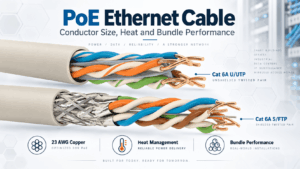
Ethernet Cable for PoE: Conductor Size, Heat and Bundle Performance
A PoE Ethernet cable carries data and electrical power over the same balanced twisted-pair cabling system. This capability simplifies t...
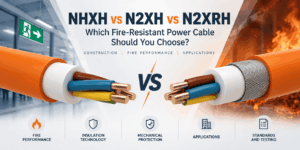
NHXH vs N2XH vs N2XRH: Which Fire-Resistant Power Cable Should You Choose?
NHXH vs N2XH vs N2XRH is an important comparison when specifying 0.6/1 kV power cables for emergency and life-safety systems. Although ...

How to Specify Low Current Cables for Infrastructure Projects
A professional low current cable specification should define much more than a cable name, conductor count or sheath colour. Infrastruct...
Fire Resistant Cables for Hospitals and High-Rise Buildings
Fire resistant cable for hospitals and high-rise buildings supports electrical, communication and control systems that may need to rema...
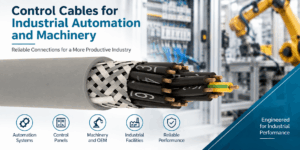
Industrial Control Cable Selection for Automation and Machinery
Industrial control cable selection should begin with the function of the circuit and the mechanical conditions of the machine rather th...
FE180 Fiber Optic Cable: Fire Integrity, Applications and Selection
An FE180 fiber optic cable is designed for optical communication routes where continued transmission during fire can form part of the p...
Screened vs Unscreened Control Cable: What Is the Difference?
Control cable shielding is one of the most important design decisions when selecting cable for industrial automation, machinery, buildi...

BMS Cable Selection: Building Automation Cables for HVAC and Smart Buildings
BMS cable selection should begin with the communication protocol and physical layer rather than with a generic request for “building au...


