





 President’s Message
Blog
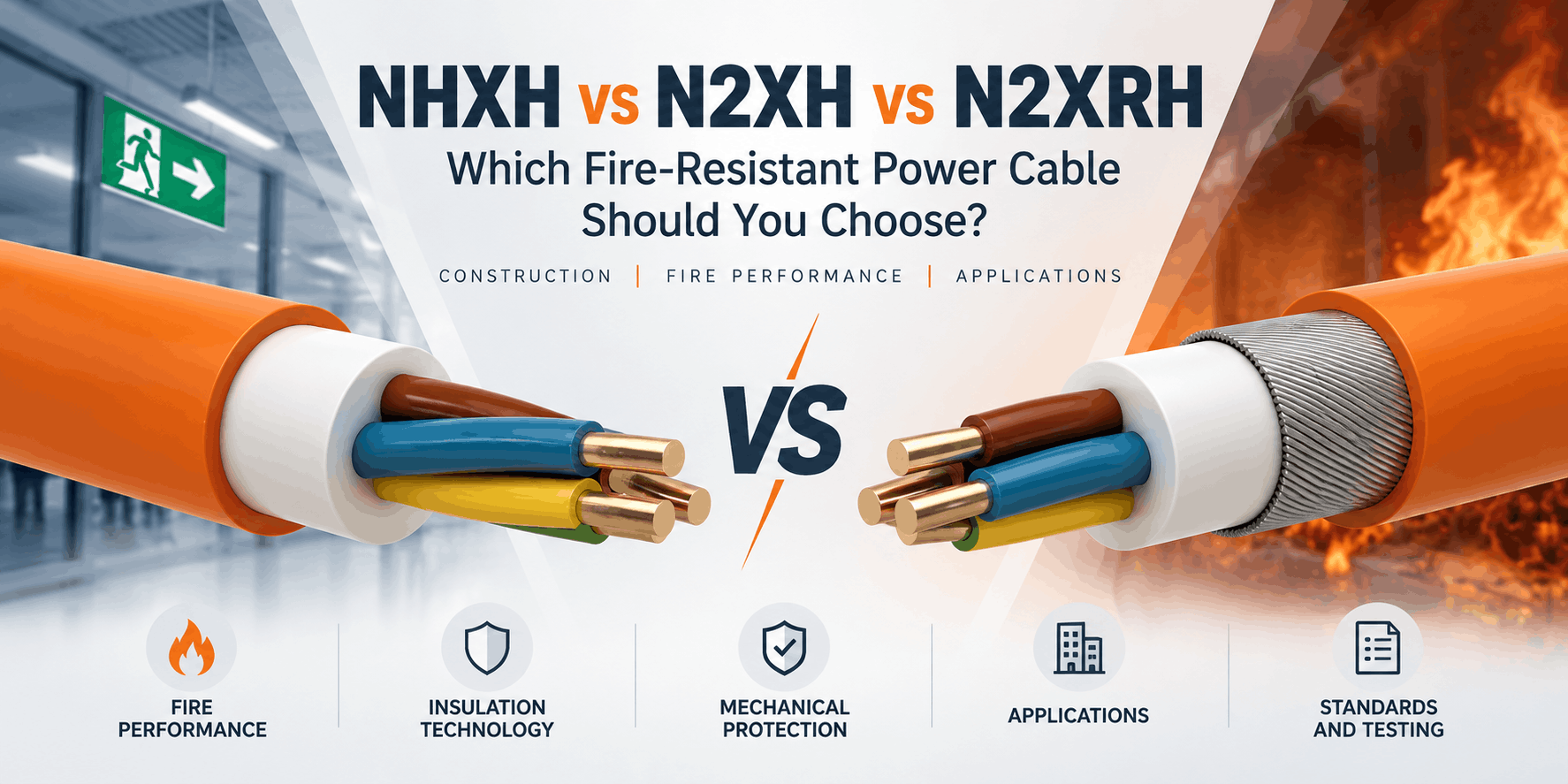
NHXH vs N2XH vs N2XRH: Which Fire-Resistant Power Cable Should You Choose?
Reading Time: 14 minutes
NHXH vs N2XH vs N2XRH is an important comparison when specifying 0.6/1 kV power cables for emergency and life-safety systems. Although these cable families can appear together in fire-resistant power cable portfolios, they do not use identical constructions and should not be selected interchangeably.
In particular, NHXH, N2XH and N2XRH differ in insulation design, mechanical protection and the fire-performance options available for the specific cable construction. NHXH-J FE180 E90 can combine a dedicated fire barrier, halogen-free insulation and system-level functional-integrity capability. ETK’s N2XH-J FE180 uses mica tape together with XLPE insulation, while N2XRH-J FE180 adds galvanized steel-wire armour for applications that also require increased mechanical protection.
However, the cable designation alone does not establish fire resistance. A conventional N2XH cable can be halogen-free and flame retardant without providing circuit integrity during fire. Therefore, a specification requiring fire survival must identify the complete cable designation, applicable fire test and required performance rather than simply requesting “N2XH.”
Likewise, N2XRH normally describes an armoured XLPE/LSZH power-cable construction, but armour itself does not create fire integrity. A fire-resistant N2XRH construction requires an appropriate fire barrier and supporting test evidence.
Quick answer: choose NHXH-J FE180 E90 when the project requires a halogen-free fire-resistant power cable and an approved E30/E60/E90 functional-integrity system is required. Choose N2XH-J FE180 when XLPE insulation and FE180 fire integrity are required without steel-wire armour. Choose N2XRH-J FE180 when the same type of fire-resistant power circuit also requires additional mechanical protection from steel-wire armour.
NHXH vs N2XH vs N2XRH at a Glance
| Characteristic | NHXH-J FE180 E90 | N2XH-J FE180 | N2XRH-J FE180 |
|---|---|---|---|
| Typical voltage rating | 0.6/1 kV | 0.6/1 kV | 0.6/1 kV |
| Conductor | Copper | Copper | Copper |
| Fire barrier | Mica-based fire barrier in applicable construction | Mica tape | Mica tape |
| Main insulation | Cross-linked HFFR compound | XLPE | XLPE |
| Outer sheath | Halogen-free | Halogen-free | Halogen-free |
| Steel-wire armour | No | No | Yes |
| FE180 version | Yes | Yes, when specifically designated FE180 | Yes, when specifically designated FE180 |
| E30 / E60 / E90 option | Available with tested system configuration | Not implied by FE180 designation | Not implied by FE180 designation |
| Primary differentiator | Fire-survival and functional-integrity applications | XLPE-insulated unarmoured fire-resistant power cable | XLPE-insulated armoured fire-resistant power cable |
Consequently, the correct choice depends on more than fire duration. Engineers must also consider insulation technology, mechanical hazards, installation environment and whether the requirement applies to the cable itself or to the complete cable-support system.
NHXH vs N2XH vs N2XRH: Understanding NHXH
NHXH is a halogen-free power-cable family commonly associated with safety circuits and fire-resistant electrical installations when supplied in an appropriate FE180 or E-class construction.
In ETK’s NHXH-J 0.6/1 kV FE180 E90 construction, the copper conductor is protected by mica tape. The cable then uses cross-linked halogen-free insulation, halogen-free filling and an LSZH outer sheath.
Therefore, NHXH-J FE180 E90 is fundamentally different from an ordinary flame-retardant power cable. The construction contains a dedicated thermal barrier intended to protect conductor insulation and electrical continuity during fire exposure.
Moreover, the E90 version is intended for applications where functional integrity of the complete installed cable system is required under the applicable tested configuration.
NHXH vs N2XH vs N2XRH: Understanding N2XH
N2XH generally describes a copper power cable with XLPE insulation and a halogen-free outer sheath for fixed low-voltage installations.
A conventional N2XH cable offers characteristics such as:
- XLPE insulation
- Halogen-free materials
- Low smoke performance according to the applicable product design
- Flame-retardant performance where tested
- 0.6/1 kV power distribution capability
However, those characteristics do not automatically provide circuit integrity during fire.
For this reason, N2XH-J FE180 should be treated as a specific enhanced construction rather than assuming every N2XH cable provides FE180 performance.
ETK’s N2XH-J FE180 construction adds mica tape around the conductors before XLPE insulation. Consequently, the fire barrier distinguishes this specific cable from a conventional N2XH installation cable.
NHXH vs N2XH vs N2XRH: Understanding N2XRH
N2XRH is an armoured version of the XLPE-insulated, halogen-free power-cable concept.
The key mechanical difference is the addition of steel-wire armour.
A typical construction can include:
- Copper conductor
- XLPE insulation
- Halogen-free bedding
- Galvanized steel-wire armour
- Halogen-free outer sheath
Therefore, N2XRH is particularly relevant where the cable route requires greater resistance to mechanical stress.
Nevertheless, a normal N2XRH designation does not automatically mean FE180. ETK’s N2XRH-J FE180 construction additionally uses mica tape to provide the required fire-resistant barrier.
NHXH vs N2XH vs N2XRH: The Main Difference
The simplest way to understand NHXH vs N2XH vs N2XRH is to separate three questions.
First: does the circuit need fire integrity?
Second: which insulation construction does the project require?
Third: does the cable require mechanical armour?
NHXH FE180/E90 is strongly associated with safety-circuit installations requiring maintained functionality and can form part of an approved E30/E60/E90 cable system.
By contrast, N2XH FE180 uses an XLPE-insulated construction without steel-wire armour.
Meanwhile, N2XRH FE180 adds steel-wire armour to the XLPE-based fire-resistant design.
Consequently, N2XRH should not simply be described as a “better” N2XH. The armour addresses a separate mechanical requirement.
HXH vs N2XH vs N2XRH: Insulation Construction
One of the most important differences between NHXH and N2XH lies in the insulation system.
ETK’s NHXH-J FE180 E90 uses a mica fire barrier together with cross-linked HFFR insulation.
N2XH-J FE180, meanwhile, uses mica tape followed by XLPE insulation.
XLPE, or cross-linked polyethylene, provides strong electrical insulation and supports a typical conductor operating temperature up to 90°C in suitable 0.6/1 kV power-cable constructions.
However, insulation material alone does not determine fire-survival performance.
Therefore, engineers should not conclude that one cable provides FE180 merely because its insulation is cross-linked or halogen-free.
Why Mica Tape Matters
Mica is widely used in fire-resistant cable construction because of its ability to maintain an insulating barrier at elevated temperatures.
During normal operation, the primary insulation provides the cable’s ordinary electrical insulation.
However, during severe fire exposure, conventional polymer insulation can degrade.
The mica layer can then help preserve separation between the conductor and surrounding conductive or structural elements.
Consequently, mica tape plays a fundamentally different role from an LSZH outer sheath.
LSZH materials primarily address smoke and halogen-related behaviour, while mica contributes directly to the fire-survival architecture.
NHXH vs N2XH vs N2XRH: Armour
Mechanical protection is the clearest distinction in the NHXH vs N2XH vs N2XRH comparison.
In the ETK constructions discussed here:
- NHXH-J FE180 E90 is unarmoured
- N2XH-J FE180 is unarmoured
- N2XRH-J FE180 includes galvanized steel-wire armour
Therefore, N2XRH is the logical option when the route requires an armoured fire-resistant cable and the complete specification matches the product design.
For example, mechanical protection can become relevant in service areas, industrial environments, exposed cable routes or installations where cables face impact or crushing risk.
Nevertheless, engineers should verify whether armour is actually required. Adding steel-wire armour increases cable diameter, weight and bending requirements.
Does Steel-Wire Armour Improve Fire Resistance?
Steel-wire armour and circuit integrity are different characteristics.
Armour primarily provides mechanical protection.
Meanwhile, fire resistance depends on the complete insulation and fire-barrier design together with successful testing.
Therefore, adding armour to an ordinary cable does not transform it into an FE180 cable.
Likewise, an unarmoured NHXH or N2XH construction can provide fire integrity when its specific construction has been designed and tested for that purpose.
NHXH vs N2XH vs N2XRH: FE180 Performance
NHXH vs N2XH vs N2XRH should never be compared only by the letters in the cable designation when FE180 is required.
The complete product designation must state the fire-integrity requirement.
For example:
- NHXH-J 0.6/1 kV FE180 E90
- N2XH-J 0.6/1 kV FE180
- N2XRH-J 0.6/1 kV FE180
This distinction is essential because standard N2XH and N2XRH constructions can exist without an FE180 fire barrier.
Consequently, procurement teams should never shorten the RFQ line to only “N2XH” when fire survival is required.
FE180 Does Not Mean E90
FE180 and E90 answer different engineering questions.
FE180 describes a cable fire-integrity characteristic under the applicable test framework.
E90, however, relates to functional integrity of a complete tested cable installation system.
The system can include:
- Cable
- Tray
- Ladder
- Clamps
- Supports
- Anchors
- Fixing distances
Therefore, a cable carrying FE180 evidence should not automatically be described as E90.
Likewise, an E90 approval should not be separated from the exact tested installation arrangement.
Why NHXH Is Commonly Associated with E30, E60 and E90
NHXH fire-survival cable families are frequently used in tested functional-integrity systems.
Depending on certification and installation arrangement, these systems can provide classifications such as:
- E30
- E60
- E90
For example, E90 may be required where a safety-critical electrical system needs to remain operational for the corresponding functional-integrity period under the applicable system test.
However, the cable alone does not create the E90 classification.
Consequently, specifying NHXH FE180 E90 requires coordination between cable, supporting system and approved installation method.
NHXH vs N2XH for Emergency Power Circuits
Both NHXH-J FE180 and N2XH-J FE180 can serve appropriate emergency power applications when their certified construction satisfies the project requirements.
Potential circuits can include:
- Emergency lighting
- Smoke-control equipment
- Emergency panels
- Safety-system power supplies
- Fire alarm power supplies
- Emergency communication equipment
However, the correct choice depends on the required fire classification and cable-system approval.
If the project explicitly requires an E90 functional-integrity system, NHXH-J FE180 E90 can be the more relevant starting point where the complete certified system is available.
By contrast, where the requirement is an FE180 XLPE-insulated unarmoured power cable without an E-class system requirement, N2XH-J FE180 can provide a more direct match.
When Should You Choose N2XRH FE180?
N2XRH-J FE180 becomes particularly relevant when the project combines two requirements:
fire integrity + mechanical protection.
Potential applications can include:
- Industrial plant routes
- Technical service areas
- Infrastructure projects
- Mechanically exposed installations
- Power distribution routes requiring steel-wire armour
Moreover, the steel-wire armour can provide substantially greater mechanical robustness than an unarmoured construction.
However, the installation engineer must still check the route, cable support, earthing arrangement, glands and applicable local installation requirements.
NHXH vs N2XH vs N2XRH for Hospitals
Hospitals can contain emergency systems that need continued electrical supply during fire.
Applications can include emergency lighting, smoke-control equipment, alarm infrastructure and other selected life-safety systems.
Therefore, NHXH vs N2XH vs N2XRH should be evaluated according to the required operational duration and mechanical environment.
For protected indoor routes, an unarmoured construction can be sufficient where the approved fire system permits it.
Meanwhile, service areas exposed to mechanical risk can justify an armoured solution such as N2XRH FE180.
NHXH vs N2XH vs N2XRH for High-Rise Buildings
High-rise buildings can depend on long vertical electrical routes serving multiple floors.
For example, critical circuits can support:
- Stair pressurization
- Smoke extraction
- Emergency lighting
- Emergency control systems
- Fire-fighting equipment
Accordingly, cable fire survival must be coordinated with the complete electrical and evacuation strategy.
In addition, vertical risers place particular importance on support systems and mechanical loading.
Therefore, an E-class system requirement cannot be solved by cable selection alone.
NHXH vs N2XH vs N2XRH for Tunnels and Transport Infrastructure
Tunnels, metro facilities and transport infrastructure can contain long emergency-power routes in enclosed environments.
Low smoke and halogen-free materials can therefore be particularly valuable.
Moreover, selected circuits can require continued operation during fire.
For mechanically protected indoor routes, NHXH or N2XH FE180 can be appropriate according to the specification.
By contrast, exposed or mechanically demanding routes can favour an armoured N2XRH FE180 construction.
Consequently, fire integrity, smoke behaviour and mechanical protection should appear as separate specification requirements.
NHXH vs N2XH vs N2XRH for Data Centers
Data centers require reliable power for critical infrastructure, but not every power cable in a data center needs fire integrity.
Therefore, designers should distinguish between ordinary power distribution and safety-critical circuits.
Where the project requires LSZH fixed power distribution without continued functionality during fire, a conventional N2XH cable can be sufficient.
However, where a specific emergency circuit must maintain power during fire, the specification must identify an FE180 or other relevant fire-resistant construction.
This distinction prevents unnecessary over-specification while preserving safety where circuit integrity is genuinely required.
Halogen-Free Does Not Mean Fire Resistant
This is one of the most important lessons in the NHXH vs N2XH vs N2XRH comparison.
A halogen-free cable can provide:
- Reduced halogen acid gas emissions
- Low-corrosivity combustion behaviour
- Low-smoke performance where tested
- Improved conditions for people and sensitive equipment
However, none of those characteristics automatically proves continued electrical operation during fire.
Therefore:
LSZH ≠ FE180.
The fire-integrity requirement must be supported separately by the relevant test evidence.
Flame Retardant Does Not Mean Fire Resistant
Flame retardancy also answers a different question.
A flame-retardant cable aims to limit flame propagation under defined test conditions.
A fire-resistant cable aims to maintain the required electrical circuit during specified fire exposure.
Consequently, a conventional N2XH cable can be flame retardant and halogen-free while still providing no specified circuit integrity.
By contrast, N2XH-J FE180 adds a dedicated fire-survival requirement.
Smoke Density and Halogen-Free Performance
Fire-resistant power cables used in public or enclosed infrastructure often combine circuit integrity with low-smoke and halogen-free material systems.
Relevant cable testing can address:
- Smoke density
- Halogen acid gas content
- Gas acidity
- Electrical conductivity of combustion gases
- Flame propagation
For example, IEC 61034 addresses smoke-density testing under defined cable-burning conditions.
Meanwhile, IEC 60754 addresses characteristics of gases evolved from cable materials.
Therefore, engineers should state individual fire-performance requirements instead of assuming that the term “LSZH” covers every characteristic.
NHXH vs N2XH vs N2XRH and IEC 60502-1
IEC 60502-1 provides an important international framework for extruded-insulation power cables in the relevant low-voltage range.
The standard addresses construction, dimensions and testing of power cables for fixed installations.
N2XH and N2XRH constructions can therefore be specified within an extruded-insulation power-cable framework while also carrying additional project requirements.
However, IEC 60502-1 alone does not establish FE180 circuit integrity.
Consequently, fire-survival requirements must be specified separately.
IEC 60228 and Copper Conductor Classes
IEC 60228 defines standardized conductor cross-sections, resistance requirements and conductor classes for insulated power cables.
Depending on cable construction, fire-resistant power cables can use:
- Class 1 solid copper conductor
- Class 2 stranded copper conductor
- Other permitted conductor constructions where specified
Therefore, conductor class should be verified in the product datasheet rather than inferred from the cable family name.
In addition, conductor construction can affect cable flexibility, diameter and termination requirements.
A Note on IEC 60331 Fire Testing
Fire-cable specifications require particular care because test standards evolve.
Legacy product certificates and technical documentation can reference earlier IEC 60331 parts for circuit-integrity testing.
Meanwhile, current IEC 60331-1 and IEC 60331-2 test methods address fire with mechanical shock at a temperature of at least 830°C for applicable cables rated up to 0.6/1 kV, with the appropriate part determined partly by overall cable diameter.
Therefore, engineers should verify the exact test standard, edition, certificate scope and project requirement rather than replacing one fire classification with another automatically.
NHXH vs N2XH vs N2XRH: Cable Size and Weight
Construction differences also affect physical cable dimensions.
For equivalent conductor configurations, an armoured N2XRH cable generally requires additional layers around the cable core.
These can include:
- Halogen-free bedding
- Steel-wire armour
- Separator tape
- Outer sheath
As a result, N2XRH can have greater outside diameter and weight than a comparable unarmoured N2XH.
Consequently, engineers should consider cable trays, supports, glands, pulling loads and minimum bending radius when changing from an unarmoured to an armoured construction.
Does N2XRH Require Different Cable Glands?
Armoured cable termination requires accessories suitable for the armour construction.
Therefore, glands and bonding arrangements should be selected according to the actual cable and project requirements.
For example, the termination design can need to provide:
- Mechanical retention
- Armour continuity
- Earthing or bonding where required
- Environmental sealing
- Ingress protection
Accordingly, replacing N2XH with N2XRH is not merely a procurement change. It can affect the complete installation system.
Does Armour Replace a Fire-Survival Support System?
No.
Steel-wire armour can improve the cable’s resistance to mechanical damage, but it does not replace fire-resistant supports and fixings where system functional integrity is required.
For example, an armoured cable can still lose its intended circuit function if the tray or support system collapses during fire.
Therefore, E30/E60/E90 applications must consider the complete tested installation arrangement rather than armour alone.
NHXH vs N2XH vs N2XRH: Cost Considerations
Price should follow technical requirements rather than determine the cable construction first.
Nevertheless, each additional performance requirement can influence cable cost.
For example:
- Fire-resistant barriers add specialized materials and manufacturing steps
- Steel-wire armour adds metal content and manufacturing complexity
- Larger cable diameter can increase logistics and installation costs
- E-class system requirements can affect trays, clamps and supports
Consequently, specifying N2XRH where mechanical armour is unnecessary can increase both material and installation cost without adding useful functionality.
Likewise, specifying a conventional N2XH where FE180 is required can fail the project’s fundamental safety requirement.
Common NHXH vs N2XH vs N2XRH Specification Mistakes
Assuming Every N2XH Cable Is Fire Resistant
Standard N2XH can be halogen-free and flame retardant without providing specified circuit integrity. FE180 must be explicitly identified where required.
Assuming Every N2XRH Cable Is FE180
Steel-wire armour provides mechanical protection but does not prove fire survival. The fire-resistant version requires an appropriate fire barrier and test evidence.
Treating NHXH and N2XH as Identical
The insulation systems can differ even where both products provide fire-resistant performance.
Using E90 as a Cable-Only Rating
E90 depends on the complete tested installation system, including supports and fixings.
Assuming LSZH Means Circuit Integrity
Halogen-free and low-smoke properties are separate from continued electrical operation during fire.
Assuming Armour Is Always Better
Armour should correspond to an actual mechanical hazard because it increases diameter, weight and installation requirements.
Ignoring Cable Accessories
Armoured cable can require different glands, bonding arrangements and support systems.
Using an Old Fire-Test Reference Without Checking Its Status
Fire-test standards evolve, so certificates and project references should be checked against current requirements.
How to Choose NHXH vs N2XH vs N2XRH
Identify the Required Fire-Survival Function
Begin by determining whether the circuit must remain operational during fire and for what purpose.
Define the Required Fire Classification
Specify FE180, an E-class system requirement or another applicable project classification precisely.
Check Whether E30, E60 or E90 Is Required
If system functional integrity is required, verify the approved cable-support configuration rather than cable performance alone.
Select the Insulation System
Determine whether the specification calls for the NHXH-type HFFR construction or an XLPE-insulated N2XH/N2XRH design.
Assess Mechanical Risk
Where the cable faces impact, crushing or other significant physical hazards, evaluate an armoured N2XRH construction.
Define Conductor Size and Core Count
Calculate current carrying capacity, voltage drop and circuit requirements before selecting cable dimensions.
Check LSZH Requirements
Define smoke, halogen and corrosive-gas requirements separately from fire integrity.
Review Cable Routing
Consider trays, risers, shafts, service areas, fire compartments and route separation.
Review Glands and Supports
Ensure that accessories match the cable construction and required installation performance.
Verify the Complete Documentation
Finally, review datasheets, fire-test reports, certificates and system approvals for the exact cable construction being supplied.
NHXH vs N2XH vs N2XRH RFQ Checklist
A professional NHXH vs N2XH vs N2XRH specification should define the complete requirement rather than asking the manufacturer simply to quote “fire-resistant power cable.”
Useful RFQ parameters include:
- Cable designation
- Fire-resistant version explicitly identified
- Rated voltage
- Core count
- Conductor cross-section
- Conductor class
- Protective conductor requirement
- FE180 requirement where applicable
- E30 / E60 / E90 requirement where applicable
- Required fire-test method
- Insulation material
- Mica fire barrier
- LSZH requirements
- Smoke-density requirement
- Halogen requirement
- Flame-propagation requirement
- Armour requirement
- Steel-wire armour where required
- UV resistance where relevant
- Operating temperature
- Bending radius
- Installation environment
- Cable-support system
- Required certificates
- Required test reports
- Project-specific approval requirements
Consequently, suppliers can compare technically equivalent products and avoid substituting a normal LSZH cable for a genuine fire-survival construction.
ETK Kablo NHXH, N2XH and N2XRH Fire-Resistant Power Cables
ETK Kablo’s fire-resistant power cable portfolio includes several 0.6/1 kV constructions designed for critical power circuits.
The portfolio includes:
- NHXH-J 0.6/1 kV FE180 E90
- (N)HXH-J 0.6/1 kV FE180 E90
- N2XH-J 0.6/1 kV FE180
- N2XRH-J 0.6/1 kV FE180
NHXH-J combines a dedicated fire barrier with cross-linked halogen-free insulation and can support functional-integrity applications according to the certified installation system.
Meanwhile, N2XH-J FE180 combines mica tape with XLPE insulation and a halogen-free sheath for an unarmoured fire-resistant power-cable construction.
N2XRH-J FE180 adds galvanized steel-wire armour where the route also requires increased mechanical protection.
Therefore, ETK approaches NHXH vs N2XH vs N2XRH according to the required fire performance, insulation technology, mechanical environment and complete installation system rather than treating the three cable types as direct substitutes.
Frequently Asked Questions About NHXH vs N2XH vs N2XRH
What is the main difference between NHXH and N2XH?
The specific ETK fire-resistant constructions use different insulation systems. NHXH-J FE180 E90 uses cross-linked HFFR insulation over the fire barrier, while N2XH-J FE180 uses XLPE insulation over mica tape.
What is the difference between N2XH and N2XRH?
N2XRH adds steel-wire armour for greater mechanical protection, while N2XH is unarmoured in the constructions discussed here.
Is every N2XH cable FE180?
No. A conventional N2XH cable does not automatically provide circuit integrity. The fire-resistant construction must explicitly identify FE180 or the applicable fire-survival requirement.
Is every N2XRH cable fire resistant?
No. Armour and LSZH construction do not establish circuit integrity by themselves. Fire-resistant N2XRH requires the appropriate fire barrier and supporting test evidence.
Is NHXH always E90?
No. The complete cable and installation system must have the appropriate functional-integrity evidence for E90.
Does FE180 mean E90?
No. FE180 describes a cable fire-integrity characteristic, while E90 concerns functional integrity of the tested installation system.
Which cable is armoured?
N2XRH is the steel-wire-armoured construction among the three cable families discussed in this comparison.
Which cable should be used where mechanical protection is required?
N2XRH FE180 can be considered when both fire integrity and steel-wire mechanical protection are required.
Which cable is suitable for emergency lighting?
NHXH, N2XH or another certified fire-resistant power cable can serve appropriate emergency-lighting circuits when its fire performance matches the project specification.
Can N2XH be used instead of NHXH?
Not automatically. The required fire classification, insulation construction, certification and system functional-integrity requirements must first be compared.
Can N2XRH replace N2XH?
Only when the armoured construction is acceptable and all electrical, mechanical and installation requirements are satisfied.
Are NHXH, N2XH and N2XRH halogen free?
The specific ETK fire-resistant constructions discussed here use halogen-free filling and outer-sheath systems.
Does LSZH mean FE180?
No. LSZH describes material behaviour related to smoke and halogen emissions, whereas FE180 concerns fire integrity.
Does steel-wire armour improve circuit integrity?
Armour primarily improves mechanical protection. Circuit integrity depends on the complete fire-resistant cable design and test performance.
What voltage are these cables typically rated for?
The ETK NHXH-J FE180 E90, N2XH-J FE180 and N2XRH-J FE180 products discussed here are rated 0.6/1 kV.
How should NHXH vs N2XH vs N2XRH be specified?
Define the fire-survival requirement first, followed by conductor configuration, insulation type, armour, LSZH characteristics, installation system and required certification.
Conclusion
The NHXH vs N2XH vs N2XRH comparison is ultimately a choice between different fire-resistant power-cable architectures rather than three interchangeable product names.
NHXH-J FE180 E90 is particularly relevant where a halogen-free fire-survival cable must form part of an approved E30, E60 or E90 functional-integrity system.
By contrast, N2XH-J FE180 uses mica tape and XLPE insulation to provide an unarmoured fire-resistant 0.6/1 kV power-cable construction.
Meanwhile, N2XRH-J FE180 adds galvanized steel-wire armour where the cable also requires increased protection against mechanical stress.
However, the most important specification rule is that the base cable designation alone does not prove fire integrity. Generic N2XH and N2XRH products can exist without FE180 performance.
Specify the Fire Performance Before the Cable Code
Engineers should therefore begin by defining what the circuit must continue doing during fire and for how long.
Next, the required cable-level and system-level fire classifications should be identified separately.
Afterward, insulation construction and mechanical protection can determine whether NHXH, N2XH or N2XRH provides the most appropriate architecture.
Finally, test reports, certificates, support systems, glands and installation requirements should be checked against the exact cable being supplied.
Ultimately, the correct fire-resistant power cable is not the model with the most complex designation. It is the construction whose documented electrical, fire, mechanical and installation performance matches the actual safety function of the project.
Benzer yazılar
Ethernet Cable Testing: NEXT, Return Loss, Insertion Loss and ACR Explained
Ethernet cable testing verifies whether a twisted-pair copper cabling system can transmit data within the electrical performance limits...

Fiber Optic Cable Attenuation: 850, 1310, 1550 and 1625 nm Explained
Fiber optic cable attenuation describes the reduction in optical power as light travels through an optical fiber. It is normally expres...
A-02YSF(L)2Y vs A-2Y(L)2Y Outdoor Telephone Cable
A-02YSF(L)2Y vs A-2Y(L)2Y is an important comparison when selecting copper outdoor telephone cable for telecommunications networks, und...
RS-485 Cable vs Instrumentation Cable: Can Instrumentation Cable Be Used for Modbus RTU?
A Modbus RTU cable must do more than carry a low-voltage digital signal from one device to another. Modbus RTU commonly uses an RS-485 ...
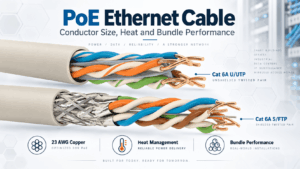
Ethernet Cable for PoE: Conductor Size, Heat and Bundle Performance
A PoE Ethernet cable carries data and electrical power over the same balanced twisted-pair cabling system. This capability simplifies t...
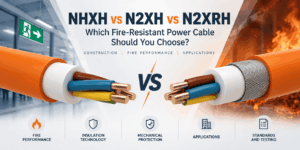
NHXH vs N2XH vs N2XRH: Which Fire-Resistant Power Cable Should You Choose?
NHXH vs N2XH vs N2XRH is an important comparison when specifying 0.6/1 kV power cables for emergency and life-safety systems. Although ...
How to Specify Low Current Cables for Infrastructure Projects
A professional low current cable specification should define much more than a cable name, conductor count or sheath colour. Infrastruct...
Fire Resistant Cables for Hospitals and High-Rise Buildings
Fire resistant cable for hospitals and high-rise buildings supports electrical, communication and control systems that may need to rema...
Industrial Control Cable Selection for Automation and Machinery
Industrial control cable selection should begin with the function of the circuit and the mechanical conditions of the machine rather th...
FE180 Fiber Optic Cable: Fire Integrity, Applications and Selection
An FE180 fiber optic cable is designed for optical communication routes where continued transmission during fire can form part of the p...

Screened vs Unscreened Control Cable: What Is the Difference?
Control cable shielding is one of the most important design decisions when selecting cable for industrial automation, machinery, buildi...

BMS Cable Selection: Building Automation Cables for HVAC and Smart Buildings
BMS cable selection should begin with the communication protocol and physical layer rather than with a generic request for “building au...


