





 President’s Message
Blog
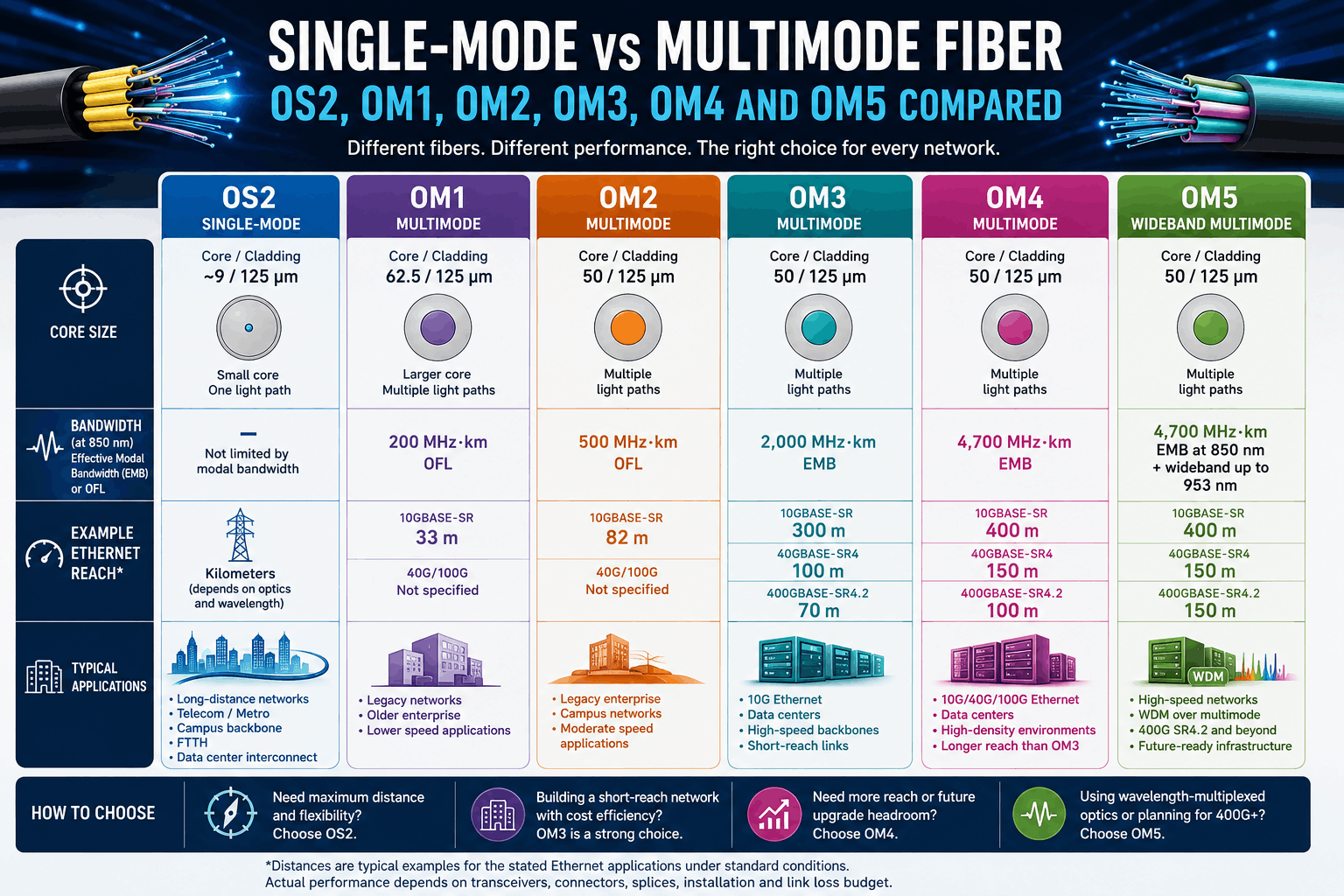
Single-Mode vs Multimode Fiber: OS2, OM1, OM2, OM3, OM4 and OM5 Compared
Reading Time: 13 minutes
Choosing single-mode vs multimode fiber is one of the most important decisions when designing a fiber optic network. OS2, OM1, OM2, OM3, OM4 and OM5 may all appear in fiber specifications, but they differ significantly in core size, transmission behaviour, bandwidth, supported distance and the optical equipment normally used with them.
Single-mode OS2 fiber is primarily designed for longer-distance transmission and uses a much smaller optical core. Multimode fiber uses a larger core and is commonly selected for shorter links in buildings, enterprise networks and data centers. Within the multimode family, OM1 and OM2 represent older fiber generations, while OM3, OM4 and OM5 were developed for higher-bandwidth laser-based networks.
The correct choice cannot be made by looking at the highest OM number alone. Network speed, link distance, transceiver type, fiber count, connector architecture, existing infrastructure and future upgrade plans all influence the most appropriate fiber.
Quick answer: Choose OS2 when the network requires kilometer-scale transmission, telecom backbone capability or maximum long-term distance flexibility. OM1 and OM2 are primarily relevant to legacy installations. OM3 supports modern short-reach Ethernet, while OM4 provides greater reach at the same data rate. OM5 adds wideband multimode performance for applications that use multiple short wavelengths, but it does not automatically provide an advantage over OM4 with every standard 850 nm optical transceiver.
Single-Mode vs Multimode Fiber: Key Differences
| Fiber Type | Mode | Typical Core / Cladding | Primary Transmission Characteristic | Typical Network Role |
|---|---|---|---|---|
| OS2 | Single-mode | Approximately 9/125 µm | Low attenuation and very low modal dispersion | Telecom, campus backbone, metro, long-distance and data center interconnect |
| OM1 | Multimode | 62.5/125 µm | Legacy multimode performance | Existing low-speed enterprise networks |
| OM2 | Multimode | 50/125 µm | Improved legacy multimode bandwidth | Existing enterprise and short-distance networks |
| OM3 | Multimode | 50/125 µm | Laser-optimized multimode fiber | 10G and short-reach higher-speed networks |
| OM4 | Multimode | 50/125 µm | Higher modal bandwidth than OM3 | Modern data centers and high-speed enterprise networks |
| OM5 | Wideband multimode | 50/125 µm | OM4-level 850 nm performance plus wideband capability | High-speed networks using suitable wavelength-multiplexed optics |
The fundamental difference between OS2 and the OM fiber categories is the number of optical propagation modes supported by the fiber.
Single-mode fiber allows essentially one propagation mode to travel through the core. Multimode fiber allows multiple modes to propagate simultaneously.
This difference has major consequences for transmission distance and bandwidth.
What Is Single-Mode Fiber?
Single-mode fiber uses a small optical core compared with multimode fiber. The smaller core restricts light propagation primarily to a single fundamental mode.
Because different light paths are not travelling through the fiber at significantly different lengths and arrival times, single-mode fiber largely avoids the modal dispersion that limits multimode transmission distance.
This allows single-mode networks to support:
- Longer transmission distances
- High-capacity telecommunications networks
- Campus and metropolitan backbones
- Fiber-to-the-home infrastructure
- Data center interconnects
- High-speed industrial communication
- Long-distance Ethernet
- Wavelength-division multiplexing systems
The actual distance and data rate still depend on the optical transceivers, wavelength, link-loss budget and network standard rather than the fiber alone.
What Is OS2 Fiber?
OS2 is a single-mode optical cabling category widely used for modern telecommunications and structured cabling infrastructure.
OS2 fiber systems commonly operate with optical equipment in wavelength regions including 1310 nm and 1550 nm. These wavelengths provide low attenuation and are suitable for transmission over distances measured in kilometers rather than the tens or hundreds of meters typical of multimode short-reach networks.
OS2 is commonly considered for:
- Telecommunications backbones
- Metro networks
- FTTH infrastructure
- Campus links between buildings
- Industrial networks covering large sites
- Data center interconnection
- Long-distance Ethernet networks
- Carrier and service-provider infrastructure
Is OS2 the Same as G.652.D?
Not exactly.
This distinction is useful when reading fiber specifications.
OS2 is a cabling category used within structured cabling standards.
Specifications such as G.652.D, G.657.A1 and G.657.A2 describe characteristics of the single-mode optical fiber itself under ITU-T recommendations.
An OS2 cable can therefore use a suitable single-mode optical fiber that complies with the required optical and cabling standards.
Project engineers should not assume that the terms OS2 and G.652.D are simply two names for exactly the same specification.
What Is Multimode Fiber?
Multimode fiber has a larger optical core than single-mode fiber and allows multiple optical modes to propagate through it.
These modes follow slightly different paths through the fiber.
As transmission distance increases, the light arriving through the different paths can become increasingly separated in time. This phenomenon is known as modal dispersion.
Modal dispersion is one of the main reasons multimode fiber has shorter transmission-distance limits than single-mode fiber at comparable high data rates.
However, multimode networks provide several practical benefits for shorter links.
They are widely used in:
- Data centers
- Enterprise buildings
- Server rooms
- Campus networks within shorter distances
- Industrial facilities
- High-speed equipment interconnections
- Structured cabling backbones
Multimode transceivers designed for short-reach applications can also offer an economically attractive solution where kilometer-scale transmission is unnecessary.
What Is OM1 Fiber?
OM1 is a legacy multimode fiber category with a 62.5/125 µm core and cladding geometry.
Its larger core distinguishes it from OM2, OM3, OM4 and OM5, which normally use 50/125 µm multimode fiber.
OM1 was widely deployed in older enterprise and campus networks, particularly when LED-based optical transmission and lower Ethernet speeds were common.
At 850 nm, OM1 has considerably lower modal bandwidth than modern laser-optimized multimode fibers.
Should OM1 Be Used for a New Network?
In most new high-speed network designs, OM1 would not normally be the first choice.
The main reason is upgrade flexibility.
For example, standardized 10GBASE-SR operation over OM1 supports only a relatively short link compared with OM3 or OM4.
OM1 remains important when maintaining or extending existing installations, but specifying it for a new high-capacity network can restrict future transmission options.
What Is OM2 Fiber?
OM2 uses a 50/125 µm multimode fiber geometry and provides higher modal bandwidth than OM1.
It became common in enterprise networks that required improved performance compared with older 62.5 µm multimode infrastructure.
However, OM2 predates the widespread adoption of the laser-optimized multimode fiber technologies represented by OM3 and later categories.
As a result, OM2 is now primarily encountered in:
- Existing enterprise installations
- Legacy building backbones
- Older campus networks
- Short links operating at moderate data rates
Like OM1, OM2 can still operate successfully where the equipment and transmission distance remain within the permitted link budget. However, it provides less future flexibility for modern high-speed Ethernet than OM3, OM4 or OM5.
What Is OM3 Fiber?
OM3 represented a major development in multimode networking because it was optimized for laser-based transmission.
OM3 uses a 50/125 µm core and is designed to work efficiently with 850 nm VCSEL-based optical equipment.
Its minimum effective modal bandwidth at 850 nm is significantly higher than the performance available from OM1 and OM2.
As a result, OM3 became widely used for:
- 10 Gigabit Ethernet
- Data center cabling
- Enterprise backbone networks
- Short-reach 40G connections
- Short-reach 100G connections
- High-speed equipment rooms
How Far Can OM3 Transmit?
There is no single maximum distance for OM3.
Distance depends on the Ethernet application and optical transceiver.
For example, 10GBASE-SR can operate over substantially longer distances on OM3 than on OM1 or OM2. As data rates rise and parallel optical architectures are introduced, supported distances change again.
This is why fiber should never be purchased based on a generic statement such as “OM3 supports 100 Gbps.”
The correct question is:
Which Ethernet interface must operate, and over what channel length?
What Is OM4 Fiber?
OM4 is also a laser-optimized 50/125 µm multimode fiber, but it provides higher modal bandwidth than OM3.
At 850 nm, OM4 has a minimum effective modal bandwidth of approximately 4,700 MHz·km, compared with approximately 2,000 MHz·km for OM3.
The additional bandwidth generally allows supported Ethernet applications to operate over longer distances.
OM4 is therefore widely suited to:
- Modern data centers
- High-density server environments
- 10G Ethernet backbones
- 40G and 100G short-reach links
- 200G and 400G short-reach architectures
- Enterprise networks requiring additional upgrade margin
OM3 vs OM4: What Is the Difference?
The principal difference is modal bandwidth.
| Characteristic | OM3 | OM4 |
|---|---|---|
| Core / cladding | 50/125 µm | 50/125 µm |
| Laser optimized | Yes | Yes |
| Effective modal bandwidth at 850 nm | 2,000 MHz·km | 4,700 MHz·km |
| 10GBASE-SR example | Up to 300 m | Up to 400 m |
| 40GBASE-SR4 example | Up to 100 m | Up to 150 m |
| Typical selection logic | Modern high-speed short reach | Greater distance and upgrade margin |
For many new multimode installations, OM4 provides useful additional headroom where the cost difference is justified by the expected life of the cabling infrastructure.
What Is OM5 Fiber?
OM5 is known as wideband multimode fiber.
Like OM3 and OM4, it uses a 50/125 µm core and supports high-performance laser transmission.
At 850 nm, OM5 provides the same minimum effective modal bandwidth as OM4: approximately 4,700 MHz·km.
The major distinction is that OM5 also specifies modal bandwidth at longer short wavelengths, including approximately 953 nm.
This enables network architectures that use more than one wavelength across the same multimode fiber.
Is OM5 Faster Than OM4?
Not automatically.
This is one of the most important points when comparing OM4 and OM5.
When both fibers are used with a conventional Ethernet transceiver operating only around 850 nm, OM5 does not gain additional 850 nm modal bandwidth over OM4.
Therefore, an ordinary 850 nm short-reach Ethernet link may provide the same standardized reach on OM4 and OM5.
OM5 becomes more differentiated when optical equipment uses multiple wavelengths and can take advantage of the fiber’s wideband performance.
Where Can OM5 Provide a Real Advantage?
A good example is wavelength-multiplexed multimode Ethernet.
400GBASE-SR4.2 uses two wavelengths over multimode fiber. Under this architecture, supported reach can increase from approximately 100 m on OM4 to approximately 150 m on OM5.
This demonstrates why OM5 should not simply be described as “a higher-speed OM4.”
Its unique value is primarily linked to wideband multimode transmission.
OS2 vs OM1 vs OM2 vs OM3 vs OM4 vs OM5
| Fiber | Core | Fiber Family | Bandwidth / Transmission Characteristic | Typical Role |
|---|---|---|---|---|
| OS2 | Approx. 9/125 µm | Single-mode | Low attenuation, no multimode modal-bandwidth limitation | Long-distance and high-capacity backbone |
| OM1 | 62.5/125 µm | Multimode | 200 MHz·km OFL at 850 nm | Legacy networks |
| OM2 | 50/125 µm | Multimode | 500 MHz·km OFL at 850 nm | Legacy / moderate-speed enterprise networks |
| OM3 | 50/125 µm | Laser-optimized multimode | 2,000 MHz·km EMB at 850 nm | Modern 10G and short-reach high-speed networks |
| OM4 | 50/125 µm | Laser-optimized multimode | 4,700 MHz·km EMB at 850 nm | Modern data centers and higher-speed short reach |
| OM5 | 50/125 µm | Wideband multimode | 4,700 MHz·km at 850 nm plus wideband specification | High-speed MMF including suitable wavelength-multiplexed systems |
How Do OM1, OM2, OM3, OM4 and OM5 Distances Compare?
Fiber distance must always be linked to a specific network application.
The following examples demonstrate how dramatically supported reach can change even though the physical fiber remains the same.
| Ethernet Application | OM1 | OM2 | OM3 | OM4 | OM5 |
|---|---|---|---|---|---|
| 10GBASE-SR | 33 m | 82 m | 300 m | 400 m | 400 m |
| 40GBASE-SR4 | Not typically specified | Not typically specified | 100 m | 150 m | 150 m |
| 400GBASE-SR4.2 | Not specified | Not specified | 70 m | 100 m | 150 m |
These figures are examples for the stated Ethernet interfaces. They should not be interpreted as universal maximum distances for each fiber category.
Actual channel design must also account for:
- Transceiver specification
- Connector insertion loss
- Number of connection points
- Splice loss
- Channel-loss budget
- Fiber quality
- Network equipment
- Applicable Ethernet standard
Why OS2 Distance Cannot Be Compared Directly with OM4 Distance
Comparing an OS2 cable and an OM4 cable by asking which one “supports more Gbps” can be misleading.
The two fiber families normally use different optical transceiver technologies.
For example, short-reach multimode Ethernet commonly uses SR-type optics, while single-mode networks can use LR, ER and other longer-reach optical interfaces.
A 10GBASE-SR multimode transceiver and a 10GBASE-LR single-mode transceiver both carry 10 Gigabit Ethernet, but they are designed for very different transmission distances and optical media.
The network designer must therefore select the fiber and the active optics as one system.
Does Single-Mode Fiber Have More Bandwidth Than Multimode Fiber?
For long-distance and very high-capacity applications, single-mode fiber provides substantially greater transmission potential because it avoids multimode modal dispersion.
However, this does not mean that multimode fiber is slow.
Modern OM3, OM4 and OM5 networks support extremely high data rates over the short distances for which they were designed.
For data centers where many links are below 100 meters, multimode infrastructure can remain highly effective.
The distinction is therefore better expressed as:
Single-mode optimizes transmission distance and long-term optical capacity.
Multimode optimizes high-speed short-reach network architectures.
Single-Mode vs Multimode Fiber for Data Centers
Data centers can use both single-mode and multimode fiber.
The correct choice depends on the physical architecture of the facility.
Multimode OM3 and OM4 have historically been widely deployed for:
- Rack-to-rack links
- Equipment rows
- Short backbone connections
- Leaf-spine network architectures
- High-speed parallel optics
OM5 can also be considered where the selected optical architecture can benefit from wideband multimode transmission.
OS2 becomes increasingly attractive where:
- Links extend between buildings
- Large campuses are involved
- Data center interconnect distances increase
- The design requires greater long-term distance flexibility
- Single-mode transceiver economics support the project
Large data centers can therefore deploy both technologies within the same overall network.
Single-Mode vs Multimode Fiber for Campus Networks
Campus networks often provide a strong case for OS2 because links between buildings can extend beyond the economical reach of multimode systems.
OS2 also gives network designers greater flexibility if additional buildings or longer routes are introduced in the future.
Inside an individual building, however, OM3 or OM4 may still be appropriate for shorter enterprise backbone connections.
A campus specification does not therefore need to force one fiber type into every part of the network.
Should You Replace Existing OM1 or OM2 Fiber?
Not automatically.
If an installed OM1 or OM2 network supports the required Ethernet application, remains within its loss budget and passes testing, replacing the fiber solely because a newer OM category exists may provide little immediate value.
Upgrade pressure normally appears when:
- Network speed increases
- Existing links exceed the permitted distance
- New transceivers no longer support the installed infrastructure efficiently
- Additional network capacity is required
- Major renovation makes recabling economical
For a completely new installation, however, OM1 and OM2 generally provide less upgrade flexibility than modern laser-optimized multimode fiber.
OM3 vs OM4 vs OM5: Which Should You Choose?
For many modern projects, the practical multimode decision is no longer OM1 versus OM2. It is OM3 versus OM4 versus OM5.
| Project Requirement | Fiber to Consider | Reason |
|---|---|---|
| Cost-sensitive modern short-reach network | OM3 | Strong laser-optimized performance for many 10G and higher-speed links |
| Greater reach and upgrade margin | OM4 | Higher 850 nm modal bandwidth than OM3 |
| Modern high-speed data center | OM4 or OS2 depending architecture | Selection depends on reach, optics and migration strategy |
| Wideband wavelength-multiplexed multimode architecture | OM5 | Additional bandwidth characterization at longer short wavelengths |
| Long-distance backbone | OS2 | Designed for kilometer-scale single-mode transmission |
OM5 should therefore be selected because the network can use its wideband capability, not simply because five is a higher number than four.
Does a Higher OM Number Always Mean Better Fiber?
Within comparable multimode applications, newer OM categories generally offer improved transmission capability.
However, “better” still depends on the application.
An OM5 cable used with an optical system that gains no benefit from wideband transmission may provide little practical advantage over OM4.
Likewise, even the highest-performance multimode fiber does not replace OS2 when the network must operate over many kilometers.
The fiber category must match the optical system rather than being chosen solely from the category number.
Fiber Type and Cable Construction Are Separate Decisions
OS2, OM1, OM2, OM3, OM4 and OM5 describe optical transmission media. They do not fully define the physical cable.
The same optical fiber may be incorporated into different fiber optic cable types, including:
- Central loose tube cables
- Multi loose tube cables
- Tight-buffered fiber optic cables
- Armored fiber optic cables
- Non-metallic armored cables
- Indoor cables
- Outdoor cables
- Aerial cables
- Microduct cables
For example, an OS2 optical fiber can be incorporated into an outdoor steel-armored cable or an indoor LSZH cable. Likewise, an OM4 fiber can be supplied in a tight-buffered data center cable or a protected indoor/outdoor construction.
The optical fiber selection determines transmission characteristics. The cable construction determines how that fiber is mechanically and environmentally protected.
Common Mistakes When Choosing Single-Mode or Multimode Fiber
1. Choosing Fiber Only by Data Rate
Saying that a project requires “100G fiber” is not sufficient.
The supported distance depends on the exact optical interface, fiber category and channel architecture.
2. Assuming OM5 Is Automatically Better Than OM4
OM4 and OM5 have the same minimum effective modal bandwidth at 850 nm. OM5’s additional value comes from its wideband performance when suitable optics use additional wavelengths.
3. Treating OS2 and G.652.D as Identical Terms
OS2 is a structured-cabling category, while G.652.D defines optical fiber characteristics under a different standards framework.
4. Ignoring the Transceiver
A fiber cable cannot provide a particular Ethernet distance by itself.
The transceiver determines wavelength, launch characteristics, receiver sensitivity and optical link budget.
5. Selecting OM1 or OM2 for a New High-Speed Network Because It Is Cheaper
The initial cable saving may be offset by restricted upgrade options or the need for future recabling.
6. Selecting OS2 Solely Because It Has the Longest Reach
Long distance may not be required. Network architecture, transceiver cost and operational strategy should also influence the decision.
7. Confusing Optical Fiber Type with Cable Construction
An OM4 designation does not indicate whether the cable is armored, indoor, outdoor, loose tube or tight buffered.
8. Using Generic Distance Claims
Statements such as “OM4 supports 100 Gbps for 150 meters” are incomplete unless the specific Ethernet interface is identified.
What Should a Buyer Include in a Fiber Optic Cable RFQ?
A professional RFQ should define both the optical requirements and the physical cable construction.
Consider specifying:
- Single-mode or multimode requirement
- OS2, OM3, OM4, OM5 or other required fiber category
- Required Ethernet application
- Maximum link distance
- Fiber count
- Loose tube or tight-buffered construction
- Indoor, outdoor or indoor/outdoor use
- Duct, aerial, tray or direct-burial installation
- Metallic or non-metallic armour
- Outer sheath material
- LSZH requirement
- CPR Euroclass where applicable
- Required attenuation and optical performance
- Applicable ISO, IEC, ITU-T or project standards
- Drum length
- Cable marking
- Required test documentation
The network equipment specification should also identify the intended optical transceiver architecture so the fiber and active equipment can be evaluated together.
ETK Kablo Single-Mode and Multimode Fiber Optic Cable Solutions
ETK Kablo manufactures fiber optic cables for telecommunications networks, data centers, enterprise infrastructure, industrial facilities, FTTH projects and large-scale international infrastructure.
The portfolio includes single-mode optical fiber options such as G.652.D, G.657.A1 and G.657.A2 as well as multimode OM1, OM2, OM3, OM4 and OM5 options depending on the product and project specification.
These optical fibers can be incorporated into different cable constructions, including central loose tube, multi loose tube, tight-buffered, aerial, microduct, metallic armored, non-metallic armored and indoor/outdoor designs.
This allows the optical transmission medium and physical cable protection to be selected independently according to the network.
For long-distance telecommunications or campus backbone projects, single-mode fiber can provide the required transmission reach. For shorter high-capacity enterprise and data center networks, OM3, OM4 or OM5 multimode fiber may provide an efficient solution when matched with the correct optical equipment.
The appropriate ETK Kablo solution should therefore be specified according to transmission distance, Ethernet application, transceiver technology, installation environment and expected network migration path.
Frequently Asked Questions
What is the main difference between single-mode and multimode fiber?
Single-mode fiber uses a much smaller core and primarily supports one optical propagation mode, allowing longer-distance transmission with minimal modal dispersion. Multimode fiber uses a larger core and supports multiple propagation modes, making it well suited to shorter high-speed network links.
What is OS2 fiber?
OS2 is a single-mode cabling category used for long-distance and high-capacity optical networks. It is commonly deployed in telecom, campus backbone, metro, FTTH and data center interconnect applications.
What is the difference between OM1 and OM2?
OM1 normally uses a 62.5/125 µm core, while OM2 uses a 50/125 µm core and provides higher multimode bandwidth. Both are primarily associated with legacy networks compared with modern OM3, OM4 and OM5 fiber.
What is the difference between OM3 and OM4?
Both are 50/125 µm laser-optimized multimode fibers. OM4 provides higher effective modal bandwidth at 850 nm, allowing many Ethernet applications to operate over longer distances than OM3.
What is the difference between OM4 and OM5?
OM4 and OM5 provide the same minimum effective modal bandwidth at 850 nm. OM5 additionally specifies wideband performance at longer short wavelengths, allowing suitable wavelength-multiplexed optical systems to take advantage of additional transmission capability.
Is OM5 faster than OM4?
Not automatically. With conventional 850 nm optics, standardized performance may be identical because OM4 and OM5 have the same 850 nm effective modal bandwidth. OM5 can offer an advantage when the optical system uses its wideband characteristics.
Is single-mode fiber faster than multimode fiber?
Both can support very high data rates. Single-mode fiber has greater long-distance transmission potential because it avoids modal dispersion, while modern multimode fiber is optimized for very high-speed short-reach networks.
How far can OM3 fiber transmit 10 Gigabit Ethernet?
For 10GBASE-SR, OM3 supports distances up to approximately 300 meters under the applicable standardized channel conditions.
How far can OM4 fiber transmit 10 Gigabit Ethernet?
10GBASE-SR can operate up to approximately 400 meters over OM4 under the specified channel conditions.
Should I use OM4 or OS2 in a data center?
Both can be appropriate. OM4 is widely suited to short-reach high-speed connections, while OS2 provides greater distance flexibility and can be attractive for longer links and long-term network migration. The best choice depends on transceiver architecture, distance and total system strategy.
Is OM1 still used?
Yes. OM1 remains installed in many existing enterprise and campus networks. However, it is generally less attractive for new high-speed infrastructure because its supported reach at modern Ethernet speeds is significantly lower than OM3 or OM4.
Can OM3 and OM4 be connected together?
They can be physically interconnected using compatible multimode connectivity, but the complete channel should be designed and evaluated according to the lowest-performing fiber segment and the requirements of the optical application. Mixing fiber categories is therefore generally avoided in new permanent cabling where consistent performance is important.
Can OS2 and multimode fiber be connected directly?
Single-mode and multimode fibers use different optical propagation characteristics and normally require different optical transceivers. They should not be treated as interchangeable media within the same optical link.
Conclusion
The choice between single-mode vs multimode fiber should begin with the network architecture rather than the fiber category number.
OS2 provides long-distance single-mode transmission suitable for telecommunications, campus backbones and other kilometer-scale networks. OM1 and OM2 remain important in legacy installations, while OM3 and OM4 provide laser-optimized multimode performance for modern short-reach high-speed networks.
OM5 extends multimode capability by adding wideband performance beyond the conventional 850 nm operating region. However, it should be selected where the planned optical equipment can genuinely benefit from those additional wavelength characteristics rather than simply because it has the highest OM designation.
Distance also cannot be separated from the optical transceiver. The same OM4 fiber can support different maximum channel lengths depending on whether the network uses 10GBASE-SR, 40GBASE-SR4, 100G or another optical interface.
For project engineers and purchasing teams, the correct specification therefore combines fiber category, transmission distance, optical interface, cable construction and expected future network requirements.
By evaluating these factors together, the selected fiber optic cable can provide both the required performance today and a practical migration path for the network in the years ahead.
Benzer yazılar
SWA Fiber Optic Cable: The Ultimate Guide to Steel Wire Armoured Connectivity Solutions
What Is SWA Fiber Optic Cable?
A SWA Fiber Optic Cable, or Steel Wire Armoured Fibre Optic Cable, is a type of armored fiber cable d...


