





 President’s Message
Blog
JZ vs OZ Control Cable: What Do the Core Identification Codes Mean?
Reading Time: 14 minutes
JZ vs OZ control cable is a common comparison when specifying flexible multicore cables for industrial machinery, control panels, automation systems and building services. The two suffixes can appear on otherwise very similar cables, yet they indicate an important difference in core identification and protective-conductor configuration.
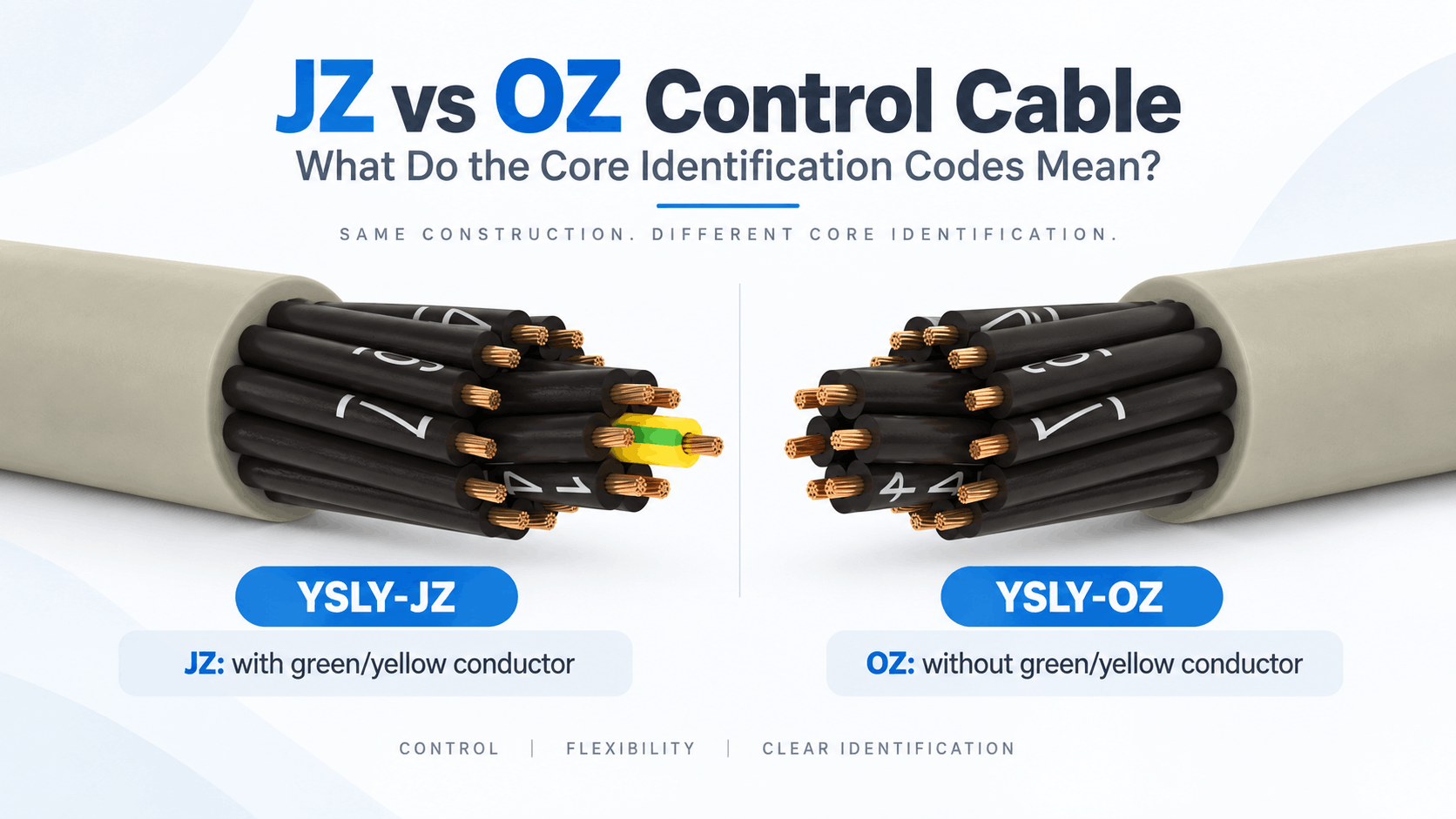
In a typical JZ construction, the working cores are black and identified with white numbers, while the cable also includes a green-yellow protective conductor. An OZ construction also uses black number-coded cores, but it does not include the green-yellow protective conductor.
Therefore, the difference between JZ and OZ is not primarily electrical performance, shielding or voltage rating. Instead, the suffix tells engineers how the cores are identified and whether a dedicated protective earth conductor forms part of the cable.
For example, YSLY-JZ and YSLY-OZ can use the same basic PVC insulation, flexible copper conductors and PVC outer sheath. However, JZ includes the green-yellow core, whereas OZ uses only numbered functional cores.
Quick answer: choose JZ when the cable needs a green-yellow protective conductor together with black number-coded cores. Choose OZ when the circuit does not require a green-yellow protective conductor inside the multicore cable. In both cases, the “Z” indicates number-coded black cores. The complete cable designation must still define insulation, shielding, voltage, conductor size and outer sheath separately.
JZ vs OZ Control Cable at a Glance
| Characteristic | JZ | OZ |
|---|---|---|
| Working-core identification | Black cores with white numbers | Black cores with white numbers |
| Green-yellow protective conductor | Yes | No |
| Number coded | Yes | Yes |
| Typically used when PE is required | Yes | No |
| Defines shielding? | No | No |
| Defines PVC or LSZH? | No | No |
| Defines voltage rating? | No | No |
| Defines conductor flexibility? | No | No |
| Typical control-cable use | Control circuits requiring PE | Control circuits without internal PE |
Consequently, JZ and OZ should be read as part of the complete product designation rather than as complete cable types by themselves.
What Does JZ Mean in a Control Cable?
Within the commonly used German-style control-cable identification system, JZ describes a cable with black number-coded working cores and a green-yellow protective conductor.
The two letters communicate different pieces of information:
- J indicates the presence of a green-yellow protective conductor.
- Z indicates black cores identified by printed numbers.
For example, a multicore JZ cable can contain cores marked 1, 2, 3, 4 and so on together with one dedicated green-yellow core.
Therefore, electricians can identify individual control circuits quickly while maintaining a clearly recognizable protective conductor.
What Does OZ Mean in a Control Cable?
OZ also uses black cores with white or contrasting number identification.
However, the cable does not include a green-yellow protective conductor.
In this designation:
- O indicates that the cable has no green-yellow protective conductor.
- Z again identifies the numbered-core system.
Consequently, all insulated cores remain available for functional control, signal or auxiliary circuits according to the project design.
JZ vs OZ Control Cable: The Main Difference
The central distinction in JZ vs OZ control cable selection is the protective conductor.
Both versions can use the same conductor material.
Both can use the same insulation.
Likewise, both can have the same nominal voltage and outer sheath.
However, JZ includes a green-yellow protective core while OZ does not.
Therefore, the engineer should first determine whether the equipment requires a protective conductor within that cable.
What Does the Z Mean in JZ and OZ?
The letter Z identifies the numbered-core approach.
Instead of giving each control core a different insulation colour, the cable typically uses black insulation with consecutive white numbers.
For example:
- Core 1
- Core 2
- Core 3
- Core 4
- Core 5
This method becomes particularly useful in cables containing many conductors.
Consequently, numbered cores are common in industrial control cables, where 10, 20, 30 or more circuits can run inside the same cable.
Why Number-Coded Cores Are Used in Control Cables
Industrial automation often requires multicore cables with substantially more conductors than an ordinary power circuit.
Assigning a unique colour to every core becomes increasingly impractical as core count rises.
Number identification solves this problem efficiently.
It can provide:
- Clear terminal identification
- Easy cross-reference with wiring diagrams
- Faster panel wiring
- Simpler commissioning
- More efficient troubleshooting
- Consistent identification in high-core-count cables
Therefore, the Z coding system is particularly well suited to industrial control and machinery wiring.
JZ vs OZ Control Cable and the Green-Yellow Core
The green-yellow conductor has a safety function and should not be treated as an ordinary spare control core.
Its visual identification distinguishes the protective conductor from functional conductors.
Current international conductor-identification principles reserve green-yellow identification for protective purposes where applicable.
Therefore, a JZ cable should not be selected simply because an additional core is convenient.
The green-yellow conductor must correspond to the electrical protection concept of the installation.
When Should You Choose JZ Control Cable?
A JZ construction is appropriate when the multicore cable needs to carry a protective conductor together with the control or auxiliary circuits.
Potential applications include:
- Industrial machinery
- Control panels
- Motor-control equipment
- Conveyor systems
- Production machinery
- HVAC equipment
- Pumps
- Actuators
- Building automation equipment
For example, a machine component can require several control conductors together with protective bonding.
In that case, a JZ construction can provide the green-yellow conductor within the same cable assembly.
When Should You Choose OZ Control Cable?
OZ becomes relevant when the control circuit does not require a green-yellow protective conductor within the cable.
This can occur when:
- The connected device does not require a PE conductor through that cable
- Protective bonding is provided separately
- The multicore cable carries only isolated control circuits
- The equipment architecture defines another protective arrangement
- Every core is required for functional circuits
However, engineers should base this decision on the electrical design and applicable installation rules.
Therefore, OZ should never be selected merely to gain one extra usable conductor if the circuit actually requires protective earthing.
JZ vs OZ Control Cable Core Count
Core count can initially cause confusion because the green-yellow conductor normally forms part of the stated conductor count.
For example, a typical 5-core JZ cable may contain:
- 1 green-yellow protective conductor
- 4 black numbered conductors
A comparable 5-core OZ construction can contain:
- 5 black numbered conductors
- No green-yellow conductor
Therefore, the same nominal core count does not always provide the same number of functional control conductors.
Why JZ Usually Starts from Three Cores
JZ constructions commonly begin with three-core configurations because one core performs the protective-conductor function while the remaining cores carry functional circuits.
By contrast, two-core OZ cable is common because both cores can serve the functional circuit.
Nevertheless, product ranges and manufacturer catalogues can differ.
Therefore, procurement teams should always verify the actual core configuration in the manufacturer datasheet rather than infer it only from the suffix.
JZ vs OZ Control Cable: Does Voltage Rating Change?
No direct voltage difference comes from the JZ or OZ suffix itself.
Voltage rating depends on the complete cable design, including insulation thickness, materials and applicable product construction.
For example, manufacturers can offer JZ/OZ control cables at:
- 300/500 V
- 450/750 V
- 0.6/1 kV
depending on the cable family.
Therefore, JZ should not be interpreted as one voltage class and OZ as another.
Does JZ or OZ Define Cable Shielding?
No.
This is one of the most common specification mistakes.
JZ and OZ identify the core arrangement, not the presence of electromagnetic screening.
For example, a cable can be:
The YSLY versions are typically unscreened.
Meanwhile, YSLYCY adds a conductive screen construction, such as a tinned-copper braid, depending on the manufacturer’s design.
Consequently, shielding and JZ/OZ designation should be specified independently.
JZ vs OZ Control Cable in Screened Designs
A screened control cable can still use either JZ or OZ identification.
For example, a YSLYCY-JZ cable can combine:
- Flexible copper conductors
- PVC insulation
- Black numbered cores
- Green-yellow protective conductor
- Tinned-copper braid screen
- PVC outer sheath
A YSLYCY-OZ version can use the same basic screened architecture without the green-yellow core.
Therefore, the choice between screened and unscreened cable answers a different engineering question from the choice between JZ and OZ.
JZ vs OZ Control Cable: PVC and LSZH Constructions
The core identification system also does not determine whether the cable uses PVC or halogen-free materials.
For example, JZ identification can appear in both PVC control cables and halogen-free control-cable families.
Likewise, an OZ configuration can be produced with the insulation and sheath materials required by the project.
Therefore:
JZ/OZ = core identification and protective-conductor configuration.
PVC/LSZH = insulation and sheath material system.
These specifications should not be combined into one assumption.
What Are JB and OB Control Cable Codes?
JZ and OZ are not the only core-identification suffixes commonly used in European-style control-cable catalogues.
Two related codes are JB and OB.
| Code | Core Identification | Green-Yellow Protective Conductor |
|---|---|---|
| JZ | Black numbered cores | Yes |
| OZ | Black numbered cores | No |
| JB | Colour-coded cores | Yes |
| OB | Colour-coded cores | No |
Therefore, the first letter primarily distinguishes whether the protective conductor is present, while the second letter distinguishes numbered versus colour-based core identification in this commonly used convention.
JZ vs JB: What Is the Difference?
Both JZ and JB include a green-yellow protective conductor.
The difference is how the remaining conductors are identified.
JZ normally uses black insulation with printed numbers.
JB uses colour coding according to the relevant cable design or colour-identification system.
Consequently, JZ becomes attractive for high-core-count industrial systems, while JB can be practical in lower-core-count applications where individual colours remain easy to manage.
OZ vs OB: What Is the Difference?
Neither OZ nor OB contains the green-yellow protective conductor.
Again, the difference lies in core identification.
OZ uses black numbered cores.
OB uses colour-coded cores.
Therefore, the choice between Z and B is largely an identification-system decision rather than an earthing decision.
JZ vs OZ Control Cable and EN 50334
Number marking of cable cores can be governed by EN 50334 when the applicable cable standard calls for it.
EN 50334 establishes requirements for identifying individual cores by numbers printed or otherwise inscribed on their extruded insulation.
The objective is to provide clear and unique conductor identification.
Therefore, manufacturers using numbered-core systems should control mark visibility, repetition and identification according to the applicable product requirements.
Core Identification and IEC 60445
IEC 60445 provides general safety principles for identifying conductors, terminals and conductor terminations.
The current consolidated edition incorporates IEC 60445:2021 together with Amendment 1:2026.
The standard establishes general rules for colours and alphanumeric identification to reduce ambiguity in electrical systems.
Consequently, protective-conductor identification should follow the applicable safety and installation requirements rather than manufacturer preference alone.
JZ vs OZ Control Cable and HD 308
HD 308 S2 provides harmonized European colour-identification principles for relevant cable and cord applications.
It distinguishes configurations that include a green-yellow protective conductor from those that do not.
However, its scope does not cover every industrial-control application or every internal machine circuit.
Therefore, engineers should not treat HD 308 as a universal rule for every control-cable construction.
The applicable cable and machine standards still need to be considered.
Why the Green-Yellow Core Must Remain Distinct
Control cabinets can contain dozens or hundreds of conductors.
Clear identification reduces the risk of wiring errors during installation and maintenance.
The green-yellow combination provides an immediately recognizable safety reference.
Therefore, the protective conductor should remain visibly distinct from the black numbered working conductors.
Using the green-yellow core as an ordinary digital input, neutral or spare conductor defeats the purpose of that identification system.
JZ vs OZ Control Cable for Machinery
Industrial machinery represents one of the most common applications for numbered control cables.
A machine can require conductors for:
- Start and stop circuits
- Limit switches
- Relays
- Contactors
- Solenoid valves
- Sensors
- Safety circuits
- Motor-control functions
JZ becomes useful when the same cable also needs to provide protective bonding.
OZ can be appropriate when the cable carries functional circuits only and the protective conductor is not required within that cable.
JZ vs OZ Control Cable for Control Panels
Panel builders often work directly from terminal schedules and wiring diagrams.
Number-coded cores simplify this workflow because each conductor can correspond directly to a numbered terminal or circuit reference.
For example, core 17 can terminate at terminal 17 according to the project wiring scheme.
Consequently, the Z identification system can simplify panel assembly and troubleshooting.
The J/O selection then determines whether one additional protective conductor forms part of the cable.
Control Cable Selection for Automation Systems
Automation systems require more than correct core identification.
Engineers should also determine:
- Required conductor cross-section
- Voltage rating
- Flexibility
- Shielding
- Oil resistance
- Temperature range
- Flame performance
- PVC or LSZH materials
- Installation environment
Therefore, JZ/OZ should appear as only one line in the complete control-cable specification.
JZ vs OZ Control Cable and Conductor Size
The suffix does not determine conductor cross-section.
Control cables can be manufactured across a wide range of sizes, such as:
- 0.50 mm²
- 0.75 mm²
- 1.00 mm²
- 1.50 mm²
- 2.50 mm²
- 4.00 mm²
- 6.00 mm²
- 10.00 mm²
- 16.00 mm²
Conductor size influences resistance, current capacity, voltage drop, cable diameter and flexibility.
Consequently, engineers should select conductor cross-section independently from JZ or OZ identification.
Class 5 Conductors in Flexible Control Cable
Many flexible control-cable families use Class 5 stranded copper conductors.
IEC 60228:2023 is the current international standard defining conductor classes, nominal cross-sections and resistance requirements for insulated power cables and cords within its scope.
Compared with solid conductors, fine-stranded Class 5 copper improves flexibility and routing inside machinery and control systems.
However, JZ and OZ do not themselves mean Class 5.
Therefore, conductor class should always be confirmed separately in the datasheet.
JZ vs OZ Control Cable for HVAC and Building Automation
HVAC systems contain pumps, dampers, actuators, fans and control panels that can require multicore control cables.
Number-coded conductors simplify identification across plant rooms and equipment panels.
Where the connected equipment requires a protective conductor inside the same cable, a JZ construction can provide it.
Meanwhile, OZ can serve suitable isolated or control-only circuits.
Therefore, BMS and HVAC cable schedules should specify JZ/OZ according to the actual electrical function rather than apply one type across every circuit.
JZ vs OZ Control Cable Near Motors and Drives
The presence of a motor or variable-frequency drive does not determine JZ or OZ selection by itself.
However, these environments can create substantial electromagnetic interference.
Therefore, the project may require a screened control cable such as a CY-type construction.
The complete specification could then call for a screened JZ or screened OZ version depending on the protective-conductor requirement.
Consequently, core identification and EMC protection remain separate design decisions.
Does JZ Mean the Cable Is Grounded?
Not by itself.
JZ means the cable contains a green-yellow conductor intended for protective use.
Actual protective bonding depends on how electricians terminate and integrate that conductor into the electrical system.
Therefore, the presence of a green-yellow core does not prove that the installation has been correctly earthed.
The complete protective-conductor path must satisfy the applicable electrical design and installation requirements.
Can an OZ Cable Have a Metallic Screen?
Yes.
A screen and a protective conductor perform different functions.
The screen primarily controls electromagnetic interference.
A protective conductor primarily provides a safety function.
Therefore, an OZ cable can still contain foil or copper-braid screening while having no green-yellow core.
This distinction is especially important when procurement teams use terms such as “screened earth cable” loosely.
Can a Cable Screen Replace the Green-Yellow Core?
Engineers should not automatically treat a metallic screen as a substitute for a dedicated protective conductor.
A braid or foil screen may be designed primarily for EMC purposes rather than fault-current carrying capability.
Whether a metallic component can perform any protective function depends on the specific cable design and applicable installation rules.
Therefore, selecting OZ because the cable already contains a braid screen can create a serious specification error if the electrical design actually requires a PE conductor.
JZ vs OZ Control Cable for Fixed and Flexible Use
Neither suffix defines whether a cable is intended for continuous flexing.
Many standard control cables use fine-stranded conductors and can tolerate installation flexibility or occasional movement.
However, continuous-flex applications such as drag chains require cables specifically engineered for repeated dynamic movement.
Therefore, a standard YSLY-JZ should not automatically be selected for millions of flex cycles simply because its conductor is flexible.
The dynamic application requirement must be specified separately.
JZ vs OZ Control Cable for Indoor and Outdoor Use
The suffix also does not establish weather resistance.
Outdoor suitability depends on factors such as:
- Outer-sheath material
- UV resistance
- Moisture resistance
- Temperature range
- Installation method
Therefore, an OZ or JZ cable should not be installed outdoors merely because the designation appears familiar.
The complete product datasheet must confirm environmental suitability.
Common JZ vs OZ Control Cable Specification Mistakes
Assuming JZ Means Shielded
JZ identifies number-coded cores plus a green-yellow protective conductor. Shielding requires a separate construction designation.
Assuming OZ Means Unscreened
OZ can appear in both screened and unscreened cable families.
Using OZ When the Circuit Requires PE
An OZ cable has no dedicated green-yellow protective conductor, so the protective arrangement must be considered separately.
Using the Green-Yellow Core as a Spare
The green-yellow identification is intended for protective purposes and should not be reassigned casually to another circuit function.
Confusing Core Count with Functional Core Count
In JZ cable, the protective conductor generally forms part of the stated total core count.
Assuming Z Defines Black Outer Sheath
Z refers to numbered core identification in this convention, not the cable-jacket colour.
Assuming JZ Defines PVC
JZ identification can appear in different material systems. The complete cable code must define PVC, LSZH or another construction.
Choosing JZ or OZ Before Reviewing the Wiring Diagram
The protective-conductor requirement should come from the electrical design rather than purchasing preference.
Ignoring EMC Requirements
JZ/OZ does not indicate whether screening is required near drives, motors or other electrical-noise sources.
Assuming Every Manufacturer Uses Codes Identically
JZ/OZ is a widely used European catalogue convention, but engineers should still confirm the manufacturer’s published construction.
How to Choose JZ vs OZ Control Cable
Determine Whether a Protective Conductor Is Required
Start with the electrical diagram and identify whether the cable must contain a dedicated PE conductor.
Choose Number-Coded Core Identification
If black numbered cores suit the panel and wiring philosophy, the Z system provides clear circuit identification.
Define the Required Core Count
Remember that the green-yellow conductor normally forms part of the total stated core count in JZ constructions.
Select Conductor Cross-Section
Determine the required size from current, voltage drop, circuit function and project requirements.
Choose the Voltage Rating
Specify 300/500 V, 450/750 V or another required rating independently from the JZ/OZ suffix.
Evaluate Shielding
Where electromagnetic interference presents a risk, consider an appropriate screened control-cable construction.
Select PVC or LSZH Materials
Match the cable material system to fire, smoke and environmental requirements.
Check Mechanical Requirements
Review flexibility, bending radius, movement, abrasion and installation conditions.
Verify Indoor or Outdoor Suitability
Confirm UV resistance and environmental characteristics where relevant.
Check the Manufacturer Datasheet
Finally, verify the exact JZ/OZ construction instead of relying on suffix interpretation alone.
JZ vs OZ Control Cable RFQ Checklist
A professional JZ vs OZ control cable specification should include more than the suffix.
Useful RFQ parameters include:
- JZ or OZ core identification
- Required number of cores
- Required functional-core count
- Green-yellow protective conductor requirement
- Conductor cross-section
- Conductor class
- Rated voltage
- Test voltage
- PVC or halogen-free insulation
- PVC or LSZH outer sheath
- Screened or unscreened construction
- Foil or braid screen where required
- Flame-performance requirement
- CPR class where applicable
- Oil resistance where required
- UV resistance where required
- Operating temperature
- Minimum bending radius
- Fixed or flexible installation
- Core-numbering system
- Outer-sheath colour
- Cable marking
- Applicable standards
- Required test documentation
Consequently, manufacturers can quote the actual cable required rather than interpret a request containing only “JZ control cable” or “OZ control cable.”
ETK Kablo JZ and OZ Control Cable Solutions
ETK Kablo manufactures a broad range of flexible control cables for industrial automation, machinery, HVAC, panel wiring and infrastructure applications.
ETK’s current YSLY-JZ construction uses Class 5 stranded copper conductors, PVC insulation, black cores with white number coding and a green-yellow protective conductor.
The standard cable also uses a PVC outer sheath and is available across multiple conductor cross-sections and core counts.
For projects without an internal protective conductor, ETK can provide the corresponding OZ configuration. In addition, JZ/OZ core arrangements can be combined with screened constructions where electromagnetic compatibility requires additional protection.
Therefore, ETK approaches JZ vs OZ control cable selection according to the protective-conductor requirement, core count, conductor size, shielding, material system and installation environment.
Frequently Asked Questions About JZ vs OZ Control Cable
What does JZ mean on a control cable?
JZ commonly indicates black number-coded conductors together with a green-yellow protective conductor.
What does OZ mean on a control cable?
OZ indicates black number-coded cores without a green-yellow protective conductor.
What does the J mean in JZ?
The J indicates that the cable includes a green-yellow protective conductor in this commonly used identification system.
What does the O mean in OZ?
The O indicates that the cable does not contain a green-yellow protective conductor.
What does Z mean in control cable terminology?
Z identifies the black number-coded core system rather than individually colour-coded working cores.
Is JZ cable shielded?
Not necessarily. JZ defines core identification and the protective conductor. Shielding depends on the complete cable construction.
Can OZ cable be screened?
Yes. An OZ cable can include foil or braid shielding while still having no green-yellow core.
What is the difference between JZ and JB?
Both typically include a green-yellow protective conductor. JZ uses numbered black cores, while JB uses colour-coded cores.
What is the difference between OZ and OB?
Neither includes a green-yellow conductor. OZ uses numbered black cores, while OB uses colour-coded conductors.
Does JZ mean 300/500 V?
No. JZ does not determine voltage rating. The complete cable specification must state the rated voltage separately.
Does OZ mean there is no earth connection at all?
No. It only means the cable itself does not contain a green-yellow protective conductor. The equipment can use another protective-earthing arrangement.
Can the green-yellow core be used for a control signal?
It should remain dedicated to its protective function where the cable and installation use it as a protective conductor.
Is the green-yellow core included in the cable core count?
Typically yes. For example, a five-core JZ cable commonly contains four numbered cores plus one green-yellow core.
Which is better, JZ or OZ?
Neither is inherently better. The correct choice depends on whether the cable requires an internal protective conductor.
Is JZ only used with YSLY cable?
No. JZ identification can appear across several control-cable constructions, including screened and halogen-free variants.
What standard covers numbered cable-core identification?
EN 50334 specifies requirements for identification by inscription where the relevant cable standard calls for numbered core marking.
Can JZ cable be used for industrial automation?
Yes. Number-coded JZ control cables are commonly used in machinery, automation, control panels and related industrial circuits.
When should OZ cable be selected?
OZ is appropriate when the circuit requires numbered control cores but does not require a green-yellow protective conductor within that cable.
Does JZ or OZ determine conductor size?
No. Conductor cross-section must be specified separately according to the electrical and mechanical requirements.
How should JZ vs OZ control cable be specified?
Start with the protective-conductor requirement, then define core count, conductor size, voltage, shielding, insulation, sheath, fire performance and installation environment.
Conclusion
The JZ vs OZ control cable comparison is primarily about core identification and protective-conductor configuration.
Both systems use black number-coded working cores, which simplifies wiring, terminal identification and troubleshooting in multicore industrial control circuits.
The defining difference is that JZ includes a green-yellow protective conductor, while OZ does not.
However, neither suffix defines shielding, voltage rating, conductor cross-section, PVC versus LSZH materials or suitability for continuous movement.
Therefore, engineers should never use JZ or OZ as a complete cable specification.
Choose the Protective-Conductor Requirement First
Begin by reviewing the wiring diagram and deciding whether the multicore cable must contain a protective conductor.
If the circuit requires one, a JZ construction provides the familiar green-yellow core together with numbered working conductors.
Where no protective conductor is needed within the cable, OZ makes all cores available for functional circuits.
Next, conductor size, voltage rating, shielding, material system and installation environment should complete the specification.
Ultimately, JZ and OZ are identification codes, not complete cable-performance classes. Correct interpretation helps engineers, panel builders and purchasing teams order the right construction without confusing core identification with the electrical or mechanical properties of the cable.
Benzer yazılar
JZ vs OZ Control Cable: What Do the Core Identification Codes Mean?
JZ vs OZ control cable is a common comparison when specifying flexible multicore cables for industrial machinery, control panels, autom...
Ethernet Cable Testing: NEXT, Return Loss, Insertion Loss and ACR Explained
Ethernet cable testing verifies whether a twisted-pair copper cabling system can transmit data within the electrical performance limits...

Fiber Optic Cable Attenuation: 850, 1310, 1550 and 1625 nm Explained
Fiber optic cable attenuation describes the reduction in optical power as light travels through an optical fiber. It is normally expres...
A-02YSF(L)2Y vs A-2Y(L)2Y Outdoor Telephone Cable
A-02YSF(L)2Y vs A-2Y(L)2Y is an important comparison when selecting copper outdoor telephone cable for telecommunications networks, und...
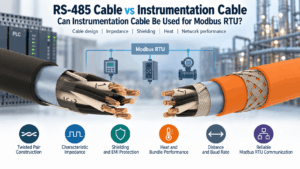
RS-485 Cable vs Instrumentation Cable: Can Instrumentation Cable Be Used for Modbus RTU?
A Modbus RTU cable must do more than carry a low-voltage digital signal from one device to another. Modbus RTU commonly uses an RS-485 ...

Ethernet Cable for PoE: Conductor Size, Heat and Bundle Performance
A PoE Ethernet cable carries data and electrical power over the same balanced twisted-pair cabling system. This capability simplifies t...
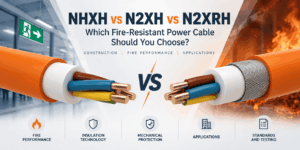
NHXH vs N2XH vs N2XRH: Which Fire-Resistant Power Cable Should You Choose?
NHXH vs N2XH vs N2XRH is an important comparison when specifying 0.6/1 kV power cables for emergency and life-safety systems. Although ...

How to Specify Low Current Cables for Infrastructure Projects
A professional low current cable specification should define much more than a cable name, conductor count or sheath colour. Infrastruct...

Fire Resistant Cables for Hospitals and High-Rise Buildings
Fire resistant cable for hospitals and high-rise buildings supports electrical, communication and control systems that may need to rema...

Industrial Control Cable Selection for Automation and Machinery
Industrial control cable selection should begin with the function of the circuit and the mechanical conditions of the machine rather th...
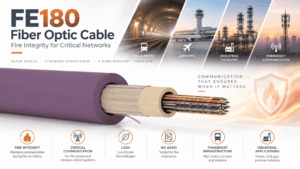
FE180 Fiber Optic Cable: Fire Integrity, Applications and Selection
An FE180 fiber optic cable is designed for optical communication routes where continued transmission during fire can form part of the p...

Screened vs Unscreened Control Cable: What Is the Difference?
Control cable shielding is one of the most important design decisions when selecting cable for industrial automation, machinery, buildi...


