





 President’s Message
Blog
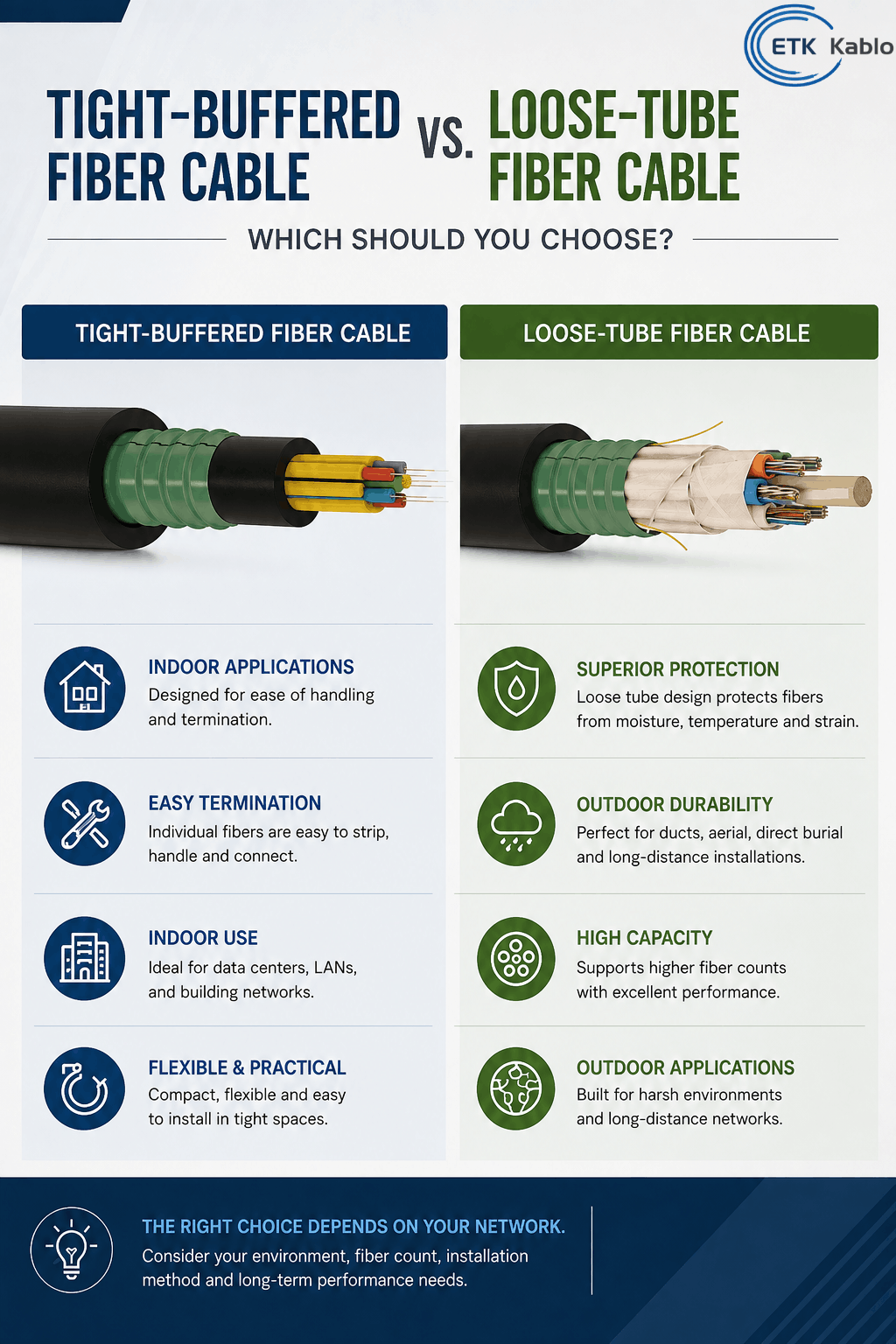
Tight-Buffered Fiber Cable vs. Loose-Tube Fiber Cable: Which Should You Choose?
Reading Time: 14 minutes
Choosing the correct fiber optic cable requires more than selecting single-mode or multimode fiber.
One of the most important construction decisions is whether the network should use a tight-buffered fiber cable or a loose-tube fiber cable.
Both constructions protect optical fibers and enable reliable high-speed data transmission, but they achieve this in fundamentally different ways.
A tight buffer fiber optic cable places an additional protective buffer directly around each individual optical fiber, making the fibers easier to handle, strip and terminate. This construction is widely associated with indoor networks, data centers, telecommunications rooms and structured cabling environments.
A loose tube fiber cable, by contrast, places optical fibers loosely inside one or more protective tubes. The fibers have controlled freedom of movement within those tubes, helping isolate them from mechanical strain, temperature changes and environmental stresses.
Loose-tube constructions are therefore particularly important for outdoor telecommunications, backbone, duct, aerial and infrastructure networks.
Neither design is universally better.
The correct choice depends on the installation environment, fiber count, termination method, moisture exposure, mechanical requirements, temperature conditions and network architecture.
ETK Kablo manufactures both tight-buffered fiber optic cables and multiple loose-tube fiber optic cable constructions, allowing cable design to be matched to the actual technical requirements of each project.
Tight Buffered vs Loose Tube Fiber Cable at a Glance
The fundamental differences between tight buffered fiber and loose tube fiber can be summarized as follows:
| Comparison | Tight-Buffered Fiber Cable | Loose-Tube Fiber Cable |
|---|---|---|
| Fiber protection | Individual buffer applied directly around each fiber | Fibers positioned loosely inside a protective tube |
| Typical buffered fiber diameter | Commonly 900 µm | Commonly 250 µm coated fibers inside tube |
| Primary environment | Indoor and controlled environments | Outdoor and demanding environments |
| Water protection | Depends on cable design | Often gel-filled or dry water-blocked |
| Temperature variation | Best suited to controlled environments unless specially designed | Particularly suitable for changing outdoor conditions |
| Mechanical isolation | Fiber follows surrounding buffer more directly | Fibers are isolated from external cable strain |
| Termination | Easier direct handling and connectorization | Usually requires tube preparation and fiber management |
| Typical fiber count | Low to medium | Medium to very high |
| Cable density | More material around individual fibers | Efficient packing of multiple fibers |
| Typical applications | Data centers, LANs, buildings and equipment rooms | Telecom backbone, duct, aerial, campus and infrastructure |
| Common variants | Simplex, duplex, distribution and breakout | Central loose tube and multi loose tube |
| Outdoor suitability | Possible with purpose-designed indoor/outdoor cables | Naturally well suited to outdoor construction |
| Buyer priority | Easy handling and termination | Environmental and mechanical protection |
The most useful general rule is:
Tight-buffered fiber is usually preferred where indoor handling and termination are important. Loose-tube fiber is generally preferred where environmental protection, distance, temperature variation and mechanical isolation are more important.
However, modern indoor/outdoor constructions mean this should be treated as a selection guideline rather than an absolute rule.
What Is Tight Buffered Fiber?
A tight buffered fiber contains an optical fiber surrounded by an additional protective buffer layer applied closely around the primary-coated fiber.
The optical glass fiber itself is already protected by its primary coating during fiber manufacturing. In a typical tight-buffered construction, this coated fiber is further protected to create a buffered fiber commonly around 900 µm in diameter.
The result is a robust individual fiber that can be handled more easily during installation and termination.
This construction gives tight buffer fiber cable several practical advantages in indoor networks.
Typical Tight Buffered Fiber Structure
| Component | Function |
|---|---|
| Optical core | Carries the light signal |
| Cladding | Keeps light confined within the optical core |
| Primary coating | Protects the glass fiber |
| Tight buffer | Provides additional handling and mechanical protection |
| Strength members | Provide tensile support |
| Outer sheath | Protects the complete cable |
Depending on cable construction, multiple tight-buffered fibers may be placed together with aramid strength members beneath a common outer jacket.
Why Use a Tight Buffer?
The main purpose of the tight buffer is to make the individual optical fiber easier to handle and protect during installation, routing and termination.
Primary-coated optical fibers are extremely small and require careful handling.
The additional buffer increases the physical size of the fiber and provides additional mechanical protection.
This can be particularly valuable when technicians need to:
- Route individual fibers
- Access fibers inside equipment rooms
- Terminate connectors
- Splice fibers
- Install patching infrastructure
- Manage short indoor links
- Work inside telecommunications cabinets
- Install structured cabling networks
For this reason, tight buffer fiber optic cable is commonly associated with building and equipment-level fiber infrastructure.
Advantages of Tight Buffered Fiber Optic Cable
Easier Fiber Handling
The additional buffer provides more protection around each individual fiber.
Technicians can therefore handle the fibers more easily during preparation, routing and termination.
Easier Termination
One of the greatest advantages of tight buffered fiber is termination convenience.
Individual buffered fibers can often be routed directly toward connectors, termination equipment or splice trays without requiring the same type of loose-tube breakout process.
Clean Indoor Installation
Tight-buffered cables are typically dry constructions without traditional gel-filled loose tubes.
This makes cable preparation cleaner inside equipment rooms, data centers and telecommunications areas.
Good Flexibility
Many tight buffer cable designs provide good flexibility for routing through indoor pathways and around equipment.
Suitable for Structured Cabling
Tight-buffered fiber optic cables are widely used in structured cabling environments where fibers need to transition between backbone pathways, equipment rooms and network hardware.
Where Is Tight Buffered Fiber Cable Used?
| Application | Why Tight Buffer Is Suitable |
|---|---|
| Data centers | Easy routing and termination |
| Enterprise LAN | Convenient structured cabling |
| Telecom rooms | Individual fiber handling |
| Equipment rooms | Efficient termination and patching |
| Building backbones | Indoor fiber distribution |
| Campus buildings | Indoor connectivity |
| Server rooms | Flexible fiber management |
| Patch infrastructure | Convenient connectorization |
| FTTB / MDU | Indoor building distribution |
| Industrial buildings | Protected internal data networks |
ETK Kablo’s tight-buffered fiber optic cable portfolio includes solutions for indoor data, telecommunications and structured cabling networks using both single-mode and multimode optical fibers.
What Is Loose Tube Fiber?
A loose tube fiber cable uses a fundamentally different method of protecting the optical fibers.
Instead of applying a thick protective buffer directly around each fiber, multiple primary-coated fibers are placed loosely inside a protective plastic tube.
The internal diameter of the tube provides controlled space around the fibers.
This allows the fibers to move slightly relative to the cable structure rather than being mechanically coupled directly to every movement of the outer cable.
The purpose is mechanical and environmental isolation.
This is particularly valuable in outdoor networks.
How Does Loose Tube Construction Protect Optical Fiber?
Outdoor cables experience stresses that indoor cables may rarely encounter.
These can include:
- Temperature expansion and contraction
- Tensile loads
- Pulling forces
- Moisture
- Ground movement
- Wind loading
- Ice loading
- Mechanical pressure
- Crush forces
- Long installation distances
The loose tube structure helps prevent these stresses from being transferred directly to the optical fibers.
Water-blocking systems can additionally be incorporated into the cable.
Depending on construction, the tube or cable core may use:
- Thixotropic filling compounds
- Water-swellable yarns
- Water-blocking tapes
- Dry water-blocking technologies
The exact construction depends on the application and cable specification.
Advantages of Loose Tube Fiber Cable
Mechanical Isolation
Because fibers are not tightly attached to the protective tube, external cable strain can be absorbed by the cable structure rather than transferred directly to the glass fibers.
Temperature Performance
Outdoor cables can experience considerable temperature changes.
Loose-tube designs allow cable components and fibers to accommodate expansion and contraction while protecting optical performance.
Moisture Protection
Loose tube fiber cables frequently incorporate gel-filled or dry water-blocking technologies.
This makes the construction particularly suitable for outdoor telecommunications infrastructure.
Higher Fiber Counts
Loose tube designs can efficiently accommodate substantial numbers of optical fibers.
This makes them attractive for telecom backbones, metropolitan networks and high-capacity infrastructure.
Outdoor Durability
Loose tube construction can be combined with:
- PE jackets
- HDPE jackets
- Corrugated steel tape
- Steel wire armor
- Non-metallic reinforcement
- Aramid yarn
- FRP strength members
- ADSS constructions
- Rodent-resistant designs
As a result, fiber optic cable loose tube constructions can be engineered for highly demanding environments.
Where Is Loose Tube Fiber Cable Used?
| Application | Why Loose Tube Is Suitable |
|---|---|
| Telecom backbone | Long distances and high capacity |
| Metropolitan network | Scalable fiber counts |
| Underground duct | Moisture and mechanical protection |
| Direct burial | Robust environmental construction |
| Aerial network | Mechanical and temperature resilience |
| FTTH backbone | High-capacity network distribution |
| Smart cities | Outdoor infrastructure |
| Railway networks | Long-distance communication |
| Utility networks | Environmental protection |
| Industrial infrastructure | Mechanical durability |
| Campus backbone | Interbuilding connectivity |
| Long-haul networks | Efficient high-capacity transmission |
Tight Buffered Fiber vs Loose Tube Fiber: Detailed Comparison
Understanding the engineering differences helps buyers avoid choosing cable based only on price.
| Feature | Tight Buffered Fiber | Loose Tube Fiber |
|---|---|---|
| Individual fiber protection | Thick buffer around individual fiber | Fibers protected collectively inside tube |
| Fiber movement | Limited relative movement | Controlled movement within tube |
| Typical environment | Indoor | Outdoor |
| Field termination | Generally easier | More preparation usually required |
| Fiber handling | Easier | More delicate after tube access |
| Water blocking | Not inherent to every design | Commonly incorporated |
| Temperature cycling | Less isolated | Better fiber isolation |
| Mechanical stress isolation | Lower | Higher |
| High fiber counts | Possible but less space-efficient | Highly scalable |
| Cable preparation | Generally simpler | Tube preparation required |
| Gel | Generally absent | May be gel-filled or dry |
| Armor compatibility | Available in specialized designs | Wide variety available |
| Aerial applications | Specialized constructions | Common |
| Duct applications | Possible with suitable construction | Very common |
| Direct burial | Requires purpose-built design | Common with appropriate protection |
| Data center use | Very common | Possible, especially backbone or interbuilding |
| Telecom backbone | Less common | Very common |
Central Loose Tube Fiber Optic Cable
Not all loose-tube cables use the same architecture.
One major construction is the central loose tube cable.
A central tube fiber optic cable places the optical fibers together inside one primary loose tube positioned near the center of the cable.
This produces a compact and relatively simple structure.
ETK Kablo manufactures central loose tube constructions supporting up to approximately 48 optical fibers, depending on the particular cable design.
Central Loose Tube Structure
A typical central loose tube cable can include:
- Optical fibers
- Central PBT loose tube
- Filling gel or water-blocking system
- Strength members
- Aramid yarn or other reinforcement
- Optional metallic or non-metallic armor
- PE, HDPE or LSZH outer sheath
Advantages of Central Loose Tube Cable
| Advantage | Explanation |
|---|---|
| Compact construction | All fibers share one central tube |
| Efficient diameter | Suitable for moderate fiber counts |
| Moisture protection | Water-blocking can be incorporated |
| Mechanical protection | Compatible with armor and reinforcement |
| Cost efficiency | Relatively simple construction |
| Outdoor suitability | Appropriate for duct, infrastructure and aerial designs |
| Fiber flexibility | Supports various single-mode and multimode fibers |
A central tube cable can therefore be particularly useful when the project requires robust outdoor protection without extremely high fiber counts.
Multi Loose Tube Fiber Optic Cable
When fiber capacity increases, multi loose tube construction becomes particularly attractive.
Instead of placing all fibers inside one central tube, several loose tubes are typically arranged around a central strength member.
Each tube contains a group of optical fibers.
This construction allows significantly larger fiber counts while maintaining organized fiber management.
Typical Multi Loose Tube Construction
A multi loose tube cable may contain:
- Central strength member
- Multiple loose tubes
- Optical fibers distributed between tubes
- Filling compounds or dry water blocking
- Additional strength elements
- Optional armoring
- Protective outer sheath
ETK Kablo’s multi loose tube fiber optic cables support high-fiber-count telecommunications and infrastructure networks, including configurations of 144 fibers and higher depending on cable construction.
Central Loose Tube vs Multi Loose Tube
Buyers sometimes use the term “loose tube” without determining which loose-tube architecture is appropriate.
The distinction can be important.
| Feature | Central Loose Tube | Multi Loose Tube |
|---|---|---|
| Number of main fiber tubes | One | Multiple |
| Fiber organization | Fibers grouped in central tube | Fibers divided between multiple tubes |
| Typical fiber capacity | Low to medium | Medium to very high |
| Cable construction | Compact | More complex stranded structure |
| Network scale | Access, campus and moderate backbone | Metro, backbone and large infrastructure |
| Fiber management | One principal group | Multiple organized groups |
| High-count scalability | More limited | Excellent |
| Typical ETK capability | Up to approximately 48 fibers depending on design | 144 fibers and higher depending on design |
The correct selection therefore depends on network capacity and cable architecture rather than simply choosing “loose fiber optic cable.”
Tight Buffer vs Central Loose Tube
For projects comparing tight buffer directly with central loose tube, the installation environment should normally lead the decision.
A tight-buffered construction is generally more attractive when the cable terminates frequently inside controlled building environments.
A central loose tube construction becomes attractive when the cable needs environmental protection for longer outdoor or infrastructure routes.
| Requirement | Better Starting Point |
|---|---|
| Indoor structured cabling | Tight buffered |
| Data center equipment areas | Tight buffered |
| Easy field termination | Tight buffered |
| Outdoor duct | Central loose tube |
| Interbuilding backbone | Central loose tube or suitable indoor/outdoor construction |
| Moisture exposure | Loose tube |
| Temperature variation | Loose tube |
| Moderate outdoor fiber count | Central loose tube |
| Very high outdoor fiber count | Multi loose tube |
These are starting points rather than absolute specifications.
The final cable should always be chosen according to the complete project requirements.
Which Cable Is Better for Indoor Installation?
For conventional indoor structured cabling, tight buffered fiber optic cable is generally the more practical construction.
The reasons include:
- Easier fiber handling
- Faster preparation
- Cleaner termination
- No traditional tube-filling gel
- Convenient routing
- Good flexibility
- Compatibility with indoor fiber management
Examples include data centers, office buildings, telecommunications rooms and enterprise networks.
Fire performance should also be considered.
Depending on the building and market, indoor cable may require LSZH materials and a specific CPR reaction-to-fire classification.
ETK Kablo can manufacture tight-buffered indoor fiber optic cable constructions with different single-mode and multimode fibers and project-specific fire-performance requirements.
Which Cable Is Better for Outdoor Installation?
For most traditional outdoor telecom applications, loose tube fiber cable is generally preferred.
Outdoor routes expose cables to environmental and mechanical stresses that loose-tube construction is specifically designed to address.
These can include:
- Moisture
- Temperature cycling
- UV exposure
- Long pulling distances
- Ground pressure
- Mechanical loads
- Aerial tension
- Rodent exposure
The loose tube protects the fibers from direct strain, while water-blocking elements and robust sheathing protect the cable from the environment.
Can Tight Buffered Fiber Be Used Outdoors?
Yes, provided the complete cable is specifically designed and approved for the intended outdoor or indoor/outdoor environment.
The assumption that:
tight buffer = always indoor
is too simplistic.
Manufacturers can engineer tight-buffered cables with outdoor-resistant jackets, water protection and additional mechanical elements.
The key point is that the complete cable construction, not only the buffering method, must satisfy the application requirements.
ETK Kablo manufactures indoor/outdoor fiber optic solutions designed for routes that may transition between environmental conditions.
Can Loose Tube Fiber Be Used Indoors?
Loose tube cable can also enter or be used within buildings when the cable construction, fire classification and applicable installation rules permit it.
However, conventional PE-jacketed outdoor loose tube cable may not provide the fire performance required for extensive indoor installation.
For building environments, factors such as the following must be evaluated:
- Flame propagation
- Smoke production
- Halogen content
- CPR classification
- Local building regulations
For routes transitioning from outdoor infrastructure into buildings, an appropriately rated indoor/outdoor construction can simplify network design.
Tight Buffer vs Loose Tube for Data Centers
Within data center environments, tight-buffered constructions can provide excellent handling and termination characteristics.
They can be particularly useful for equipment rooms, indoor backbone links, fiber termination and patch infrastructure.
Loose tube fiber may also be used for interbuilding data center campuses, outside-plant routes and large-capacity backbone infrastructure.
| Data Center Area | Common Construction Consideration |
|---|---|
| Equipment room | Tight buffered |
| Indoor distribution | Tight buffered |
| Campus interbuilding backbone | Loose tube or indoor/outdoor construction |
| Outdoor duct between facilities | Loose tube |
| High-fiber-count campus route | Multi loose tube |
| Short indoor termination-intensive run | Tight buffered |
Tight Buffered vs Loose Tube for Telecom Networks
Telecommunication infrastructure generally favors loose-tube construction for outside-plant networks.
Long-distance telecom routes require cables capable of handling:
- Long pulling distances
- Moisture
- Temperature variation
- High fiber counts
- Outdoor mechanical stress
Central loose tube cables can provide compact solutions for moderate capacity.
Multi loose tube cables provide additional scalability for larger backbone networks.
Tight-buffered fiber can then be used when the optical network transitions into buildings, equipment rooms and termination environments.
A complete telecom network may therefore use both cable constructions, each in the location where its characteristics provide the greatest value.
Tight Buffer vs Loose Tube for Fiber Count
Fiber count can influence cable selection significantly.
Tight-buffered designs place additional material around every individual fiber.
This improves handling but uses more internal space.
Loose tube construction places multiple smaller coated fibers inside shared tubes, enabling more efficient packing.
| Fiber Capacity Requirement | Construction Typically Considered |
|---|---|
| 1–2 fibers | Tight buffered, simplex or duplex |
| Small indoor distribution | Tight buffered |
| Moderate outdoor fiber count | Central loose tube |
| Higher-capacity backbone | Multi loose tube |
| Very high fiber density | Multi loose tube or specialized high-density construction |
The exact limits vary by manufacturer and cable design, so fiber count alone should not determine construction.
Tight Buffer vs Loose Tube for Termination
Termination is one of the clearest practical differences between these cable constructions.
Tight Buffered Cable
Individual buffered fibers are easier to access and manipulate.
This can reduce preparation time when direct connectorization or individual fiber routing is required.
Loose Tube Cable
The installer must first access the loose tube and prepare the individual fibers.
Depending on design, this can involve removing filling compound or handling dry water-blocking components.
Loose tube cable is therefore often spliced to pigtails or transitioned into indoor fiber management systems rather than directly connectorized in the same way as tight-buffered fiber.
Tight Buffer vs Loose Tube for Moisture Protection
Loose tube construction generally provides the stronger starting point for environments with significant moisture exposure.
The tubes can use gel or dry water-blocking systems to prevent longitudinal water migration.
Tight-buffered cables do not inherently provide equivalent moisture protection simply because the buffer is tightly applied.
If a tight-buffered cable is intended for a wet or outdoor location, the complete cable must be specifically designed with appropriate water-blocking and environmental protection.
Does Tight Buffer or Loose Tube Affect Optical Performance?
Both constructions can deliver excellent optical transmission performance when correctly manufactured and installed.
The buffering method does not determine whether the cable is single-mode or multimode.
Either construction can potentially incorporate optical fibers such as:
| Fiber Type | Category |
|---|---|
| G.652.D | Single-mode |
| G.657.A1 | Bend-insensitive single-mode |
| G.657.A2 | Enhanced bend-insensitive single-mode |
| OM1 | Multimode |
| OM2 | Multimode |
| OM3 | Laser-optimized multimode |
| OM4 | High-bandwidth multimode |
| OM5 | Wideband multimode |
The correct optical fiber should therefore be selected separately from the cable construction.
A buyer might specify:
24 Fiber G.652.D Central Loose Tube Cable
or:
12 Fiber OM4 Tight-Buffered Fiber Optic Cable
The first part defines optical transmission requirements.
The second defines cable architecture and application behavior.
How to Choose Between Tight Buffered and Loose Tube Fiber Cable
A procurement team should evaluate the complete installation before making a decision.
| Question | If Yes, Consider |
|---|---|
| Is the cable mainly installed indoors? | Tight buffered |
| Is easy termination important? | Tight buffered |
| Will technicians frequently access individual fibers? | Tight buffered |
| Is the cable exposed to outdoor weather? | Loose tube |
| Will the cable encounter moisture? | Loose tube |
| Are large temperature variations expected? | Loose tube |
| Is high fiber capacity required? | Multi loose tube |
| Is a compact moderate-count outdoor cable needed? | Central loose tube |
| Is the route partly indoor and partly outdoor? | Purpose-designed indoor/outdoor cable |
| Is mechanical armor required? | Appropriate armored loose tube or specialized construction |
| Is fire classification critical? | Evaluate the complete certified cable construction |
The most important conclusion is that tight buffer and loose tube describe only part of the cable specification.
Buyers should also consider fiber type, fiber count, sheath material, armor, water blocking, tensile strength, crush resistance, cable diameter, fire performance, CPR classification, installation method and environmental conditions.
What Should an RFQ for Fiber Optic Cable Include?
Instead of requesting only “tight buffer fiber” or “loose tube cable,” professional buyers should provide a complete specification.
| RFQ Information | Example |
|---|---|
| Buffer construction | Tight buffered, central loose tube or multi loose tube |
| Fiber type | G.652.D |
| Fiber count | 24 fibers |
| Application | Outdoor duct |
| Water blocking | Dry water-blocking |
| Armor | Corrugated steel tape |
| Outer sheath | PE |
| Fire classification | If applicable |
| Mechanical requirements | Tensile and crush requirements |
| Installation environment | Telecom backbone |
| Quantity | 50 km |
| Drum length | 2,000 m |
| Required standard | IEC 60794 or project specification |
| Documentation | Datasheet, test report and compliance documents |
A detailed inquiry allows the manufacturer to identify the correct cable construction and prevents different suppliers from quoting technically different products against the same RFQ.
Why Choose ETK Kablo for Tight Buffered and Loose Tube Fiber Cables?
ETK Kablo manufactures a broad portfolio of fiber optic cables rather than specializing in only one cable architecture.
This allows the cable construction to be selected according to the project rather than forcing every network into the same product family.
| ETK Kablo Fiber Capability | Application |
|---|---|
| Tight-buffered fiber cables | Indoor structured cabling and data networks |
| Central loose tube cables | Outdoor and moderate-capacity backbone networks |
| Multi loose tube cables | High-capacity telecom and infrastructure networks |
| Metallic armored fiber | Mechanically demanding routes |
| Non-metallic armored fiber | Metal-free protected networks |
| Duct fiber optic cable | Underground telecom infrastructure |
| ADSS fiber optic cable | Aerial networks |
| Fire-performance fiber cable | Critical infrastructure |
| Single-mode fiber | Long-distance telecom and infrastructure |
| Multimode fiber | Data centers and enterprise networks |
| Customized fiber cables | Project-specific requirements |
ETK Kablo’s central loose tube fiber optic cable portfolio can support configurations up to approximately 48 fibers depending on cable design, while multi loose tube constructions provide higher-capacity solutions for major telecommunications and infrastructure networks.
Its tight-buffered portfolio provides indoor fiber solutions designed for data centers, enterprise networks, telecommunications rooms and structured cabling applications.
This gives contractors, distributors, telecom operators and infrastructure companies access to different fiber cable architectures from the same manufacturer.
Frequently Asked Questions About Tight Buffer and Loose Tube Fiber
What is tight buffered fiber?
Tight buffered fiber is an optical fiber with an additional protective buffer applied closely around the primary-coated fiber. A common tight-buffered fiber diameter is approximately 900 µm. The construction improves handling and facilitates termination, making it particularly suitable for indoor applications.
What is a tight buffer fiber optic cable?
A tight buffer fiber optic cable contains one or more individually tight-buffered optical fibers within a complete cable construction. These cables are commonly used in data centers, enterprise networks, telecom rooms and indoor structured cabling.
What is loose tube fiber?
Loose tube fiber refers to optical fibers positioned loosely inside a protective plastic tube. The design allows controlled movement between the fibers and cable structure, helping protect the optical fibers from mechanical and thermal stress.
What is the difference between tight buffer and loose tube fiber?
Tight-buffered cable applies a protective buffer closely around each individual fiber, improving handling and termination. Loose tube cable places multiple fibers inside protective tubes, providing greater isolation from environmental and mechanical stresses.
Which is better, tight buffered or loose tube fiber?
Neither construction is universally better. Tight buffered fiber is generally better suited to termination-intensive indoor networks, while loose tube cable is generally better suited to outdoor, long-distance and environmentally demanding infrastructure.
What is a central loose tube cable?
A central loose tube cable places multiple optical fibers inside one central protective tube. This provides a compact and efficient construction for outdoor telecommunications, duct, campus and infrastructure networks.
What is a central tube fiber optic cable?
Central tube fiber optic cable is another term commonly used for a fiber cable where the optical fibers are located inside one principal central tube. Depending on manufacturer terminology, it may also be called central loose tube cable or single loose tube cable.
What is multi loose tube fiber cable?
Multi loose tube cable contains several fiber-bearing loose tubes typically stranded around a central strength member. It provides scalable capacity for high-fiber-count telecom backbones and major infrastructure networks.
Is loose tube fiber better for outdoor use?
In most conventional outdoor telecommunications applications, loose tube construction is preferred because it provides excellent mechanical isolation and can incorporate robust water-blocking systems.
Can tight buffered fiber cable be installed outdoors?
Yes, if the complete tight-buffered cable is specifically designed and rated for outdoor or indoor/outdoor installation. Buffer construction alone does not determine whether the cable is suitable outdoors.
Can loose tube fiber cable be installed indoors?
Yes, provided the complete cable construction satisfies the applicable building, fire and installation requirements. Conventional outdoor PE-jacketed loose tube cable may not be appropriate for unrestricted indoor installation.
Is tight buffer fiber single-mode or multimode?
It can be either. Tight-buffered construction can use single-mode fibers such as G.652.D and G.657.A1/A2 or multimode fibers including OM1, OM2, OM3, OM4 and OM5.
Can loose tube fiber be single-mode or multimode?
Yes. Loose tube describes the cable construction rather than the optical transmission type. Both single-mode and multimode fibers can be incorporated into loose tube cables.
Is central loose tube the same as multi loose tube?
No. A central loose tube cable normally places fibers inside one central tube. A multi loose tube cable uses several fiber-bearing tubes arranged around a central strength member and generally enables significantly higher fiber counts.
Does ETK Kablo manufacture both tight buffered and loose tube fiber optic cables?
Yes. ETK Kablo manufactures tight-buffered fiber optic cables as well as central loose tube and multi loose tube fiber optic cable constructions for indoor, outdoor, telecom, data center and infrastructure applications.
Choose the Right Fiber Cable Construction with ETK Kablo
The choice between tight-buffered fiber cable and loose-tube fiber cable should ultimately be based on the environment and network architecture rather than a general assumption that one construction is superior.
Choose tight buffered fiber when easy fiber handling, termination and indoor routing are the main priorities.
Choose central loose tube when a compact outdoor construction with environmental protection is required.
Choose multi loose tube when a large-scale telecommunications or infrastructure network requires higher fiber counts, mechanical stability and long-term scalability.
When one route crosses several different environments, evaluate an indoor/outdoor or project-specific construction rather than forcing a conventional indoor or outdoor cable into the wrong application.
ETK Kablo manufactures all three major construction families: tight-buffered fiber optic cable, central loose tube fiber optic cable and multi loose tube fiber optic cable, with single-mode and multimode fiber options and multiple mechanical, environmental and fire-performance configurations.
For project-specific requirements, buyers can provide the fiber type, fiber count, installation method, armor, sheath, fire requirements and applicable standards so that the most appropriate cable construction can be evaluated.
ETK Kablo – Fiber optic cable solutions engineered around the network, environment and application.
Benzer yazılar

Fiber Optic Cable for Data Centers: OS2, OM3, OM4 or OM5?
Selecting the right data center fiber cable requires more than choosing between single-mode and multimode fiber. Modern data centers ca...
Duct Fiber Optic Cable: How to Select Cable for Underground Networks
Selecting the right underground fiber cable for a duct network requires more than choosing a fiber count and an outdoor jacket. The cab...
What Is a Fiber Optic Cable? Types, Structure & Selection Guide
A fiber optic cable carries information as light through one or more optical fibers. Instead of transmitting electrical signals through...
Fiber Optic Cable Types: Complete Selection Guide
Fiber optic cable types differ according to optical fiber, cable construction, installation environment, mechanical protection, water b...


