





 President’s Message
Blog
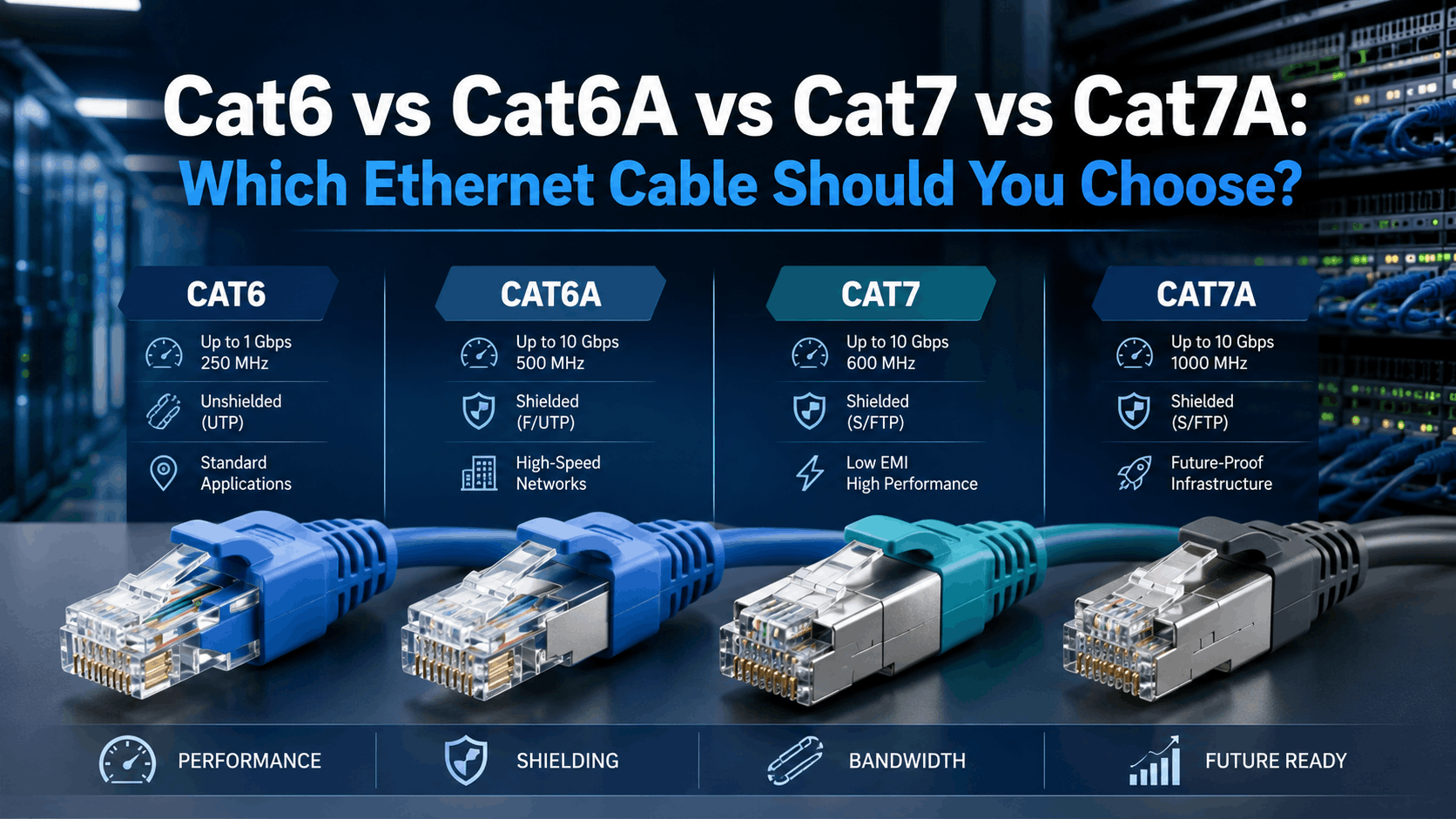
Cat6 vs Cat6A vs Cat7 vs Cat7A: Which Ethernet Cable Should You Choose?
Reading Time: 9 minutes
Choosing between Cat6 vs Cat6A vs Cat7 vs Cat7A is not simply a matter of selecting the highest cable category available. Each Ethernet cable category differs in bandwidth, shielding, transmission performance and the network environments for which it is best suited.
For a commercial building with standard Gigabit Ethernet requirements, Cat6 may be more than sufficient. A data center or enterprise network designed around 10 Gigabit Ethernet may justify Cat6A. Industrial facilities with significant electromagnetic interference may benefit from the shielding offered by Cat7 or Cat7A.
The right choice therefore depends on the network architecture, transmission distance, electromagnetic environment, applicable standards and expected service life of the installation.
This guide compares Cat6 vs Cat6A vs Cat7 vs Cat7A Ethernet cables from a practical project and procurement perspective.
Cat6 vs Cat6A vs Cat7 vs Cat7A at a Glance
| Cable Category | Standard Bandwidth | Typical Ethernet Capability | Typical Shielding Options | Typical Applications |
|---|---|---|---|---|
| Cat6 | 250 MHz | 1 GbE up to 100 m; 10 GbE possible over shorter links | U/UTP, F/UTP and other screened constructions | Offices, commercial buildings, CCTV, general LAN |
| Cat6A | 500 MHz | 10 GbE up to 100 m | U/UTP, U/FTP, F/FTP, S/FTP | Enterprise networks, data centers, smart buildings |
| Cat7 | 600 MHz | 10 GbE up to 100 m | Typically S/FTP | Industrial networks, high-EMI environments, critical LAN |
| Cat7A | 1,000 MHz | 10 GbE up to 100 m with greater transmission headroom | Typically S/FTP | High-density networks, industrial systems, broadcast and demanding infrastructure |
One important point is often overlooked: MHz and Gbps are not the same thing.
The frequency rating of a cable describes the transmission bandwidth for which the cabling system is characterized. Ethernet speed describes the data rate of a network application. A cable with twice the frequency rating does not automatically provide twice the Ethernet speed.
This distinction becomes particularly important when comparing Cat6A, Cat7 and Cat7A.
What Is Cat6 Ethernet Cable?
Cat6 is one of the most widely used Ethernet cable categories in structured cabling.
It is specified for frequencies up to 250 MHz and provides reliable support for Gigabit Ethernet over standard 100-meter channels. It can also support 10GBASE-T over shorter distances under suitable channel and interference conditions, but it should not be considered the default solution when 10 GbE over the full 100 meters is a project requirement.
Cat6 cables are available in several constructions depending on the required level of electromagnetic protection.
Common examples include:
An unshielded Cat6 U/UTP cable can be an efficient solution for conventional offices and commercial buildings where electromagnetic interference is relatively low. Screened versions such as Cat6 F/UTP provide additional protection when the cable is installed in electrically more demanding environments.
When Should You Choose Cat6?
Cat6 remains a practical choice for:
- Office networks
- Commercial buildings
- Schools and universities
- IP CCTV networks
- VoIP systems
- Wi-Fi access point connections
- General Gigabit Ethernet infrastructure
If the network is expected to operate predominantly at 1 GbE and there is no firm requirement for 10 GbE over long horizontal links, moving immediately to a higher category may add unnecessary cost.
For many projects, Cat6 continues to provide an effective balance between performance and economics.
What Is Cat6A Ethernet Cable?
Cat6A, meaning Category 6 Augmented, represents a significant performance step above Cat6.
Its specified frequency range extends to 500 MHz, twice that of Cat6, and it is designed to support 10GBASE-T over a full 100-meter structured cabling channel.
This distinction is one of the main reasons Cat6A has become an important choice for new enterprise and high-performance network installations.
Compared with Cat6, Cat6A places greater emphasis on controlling parameters such as alien crosstalk. This becomes increasingly important when numerous Ethernet cables are installed in dense bundles and operate simultaneously at high data rates.
Cat6A can be manufactured in both unshielded and shielded constructions, including:
- U/UTP
- U/FTP
- F/FTP
- S/FTP
This gives engineers and project buyers considerable flexibility when matching cable construction to the electromagnetic conditions of the installation.
When Should You Choose Cat6A?
Cat6A is particularly suitable for:
- 10 Gigabit Ethernet networks
- Data centers
- Enterprise offices
- Server and equipment rooms
- High-density structured cabling
- Smart buildings
- Wi-Fi infrastructure requiring higher uplink capacity
- High-performance IP surveillance systems
For many modern structured cabling projects, Cat6A represents a practical balance between performance, compatibility and future capacity.
A project may not require 10 GbE on every connection today, but installing Cat6A can reduce the need to replace horizontal cabling if network requirements increase later.
What Is Cat7 Ethernet Cable?
Cat7 takes a different approach to high-performance copper cabling.
Under ISO/IEC structured cabling standards, Cat7 is associated with Class F performance and frequencies up to 600 MHz.
Cat7 cables typically use an S/FTP construction. Each twisted pair is individually screened with foil, while an additional overall braid surrounds the complete cable core.
This combination provides strong protection against:
- Electromagnetic interference
- Radio-frequency interference
- Pair-to-pair crosstalk
- Alien crosstalk
The additional shielding makes Cat7 particularly attractive in environments where reliable data transmission must be maintained close to electrical equipment, motors, drives or other potential sources of interference.
When Should You Choose Cat7?
Cat7 can be considered for:
- Industrial facilities
- Automation networks
- Hospitals and laboratories
- Broadcast infrastructure
- High-density commercial networks
- Smart buildings
- Data centers
- Areas with significant electromagnetic interference
Cat7 supports 10 Gigabit Ethernet over standard channel distances while providing more frequency headroom and strong shielding performance.
However, this does not automatically mean that Cat7 is the correct choice for every 10 GbE network.
Cat6A already supports 10GBASE-T over 100 meters and is well established in conventional structured cabling. Cat7 therefore tends to make the most sense when shielding performance, ISO/IEC Class F specifications or demanding environmental conditions justify the additional construction.
What Is Cat7A Ethernet Cable?
Cat7A extends the performance of the Cat7 family further.
It corresponds to ISO/IEC Class FA performance and is characterized up to 1,000 MHz.
Like Cat7, Cat7A normally uses a fully screened S/FTP construction with individually foil-screened pairs and an overall metallic braid. The higher category provides greater electrical performance margins and improved crosstalk characteristics at higher frequencies.
Cat7A is therefore particularly relevant where a project specification requires a very high-performance copper cabling system with substantial frequency headroom.
Typical applications include:
- High-density network environments
- Industrial facilities
- Broadcast and media systems
- Hospitals and laboratories
- Smart buildings
- Mission-critical communication networks
- High-interference environments
- Advanced structured cabling systems
Does Cat7A Support 40 Gbps?
This question requires an important distinction.
Cat7A offers significantly more bandwidth than Cat6A, but higher cable frequency does not automatically create a higher standardized Ethernet data rate.
Cat7A is commonly used for 10 Gigabit Ethernet over 100-meter channels. For standardized 25GBASE-T and 40GBASE-T copper Ethernet applications, Category 8 cabling was specifically developed, using frequencies up to 2,000 MHz and shorter channel lengths.
For this reason, buyers should be cautious with generic claims that describe Cat7A simply as a “40 Gbps Ethernet cable.”
Network performance should always be evaluated against the complete cabling system and the Ethernet application it is intended to support.
Cat6 vs Cat6A: What Is the Main Difference?
For most projects, this is the first comparison that matters.
Cat6 operates up to 250 MHz and is an established choice for Gigabit Ethernet. Cat6A doubles the specified bandwidth to 500 MHz and provides standardized 10 Gigabit Ethernet capability over the full 100-meter channel.
In simple terms:
Choose Cat6 when 1 GbE is sufficient and cost efficiency is important.
Choose Cat6A when 10 GbE, higher network density or future capacity is a priority.
For a new enterprise building expected to remain in operation for many years, the additional capacity of Cat6A can make it a compelling option even when the initial network operates below 10 GbE.
Cat6A vs Cat7: Which Is Better?
Cat7 has a higher frequency specification and typically more comprehensive shielding than Cat6A.
However, higher does not necessarily mean better for every project.
Both can support 10 Gigabit Ethernet over 100-meter channels.
The main difference is therefore not simply speed.
Cat6A is widely used for mainstream 10 GbE structured cabling and offers a broad range of shielded and unshielded constructions.
Cat7 provides 600 MHz Class F performance and normally uses S/FTP shielding, making it especially attractive for demanding electromagnetic environments.
For conventional enterprise offices and many data centers, Cat6A may provide everything the network requires.
For industrial environments or specifications that specifically require Class F cabling and extensive screening, Cat7 can provide additional value.
Cat7 vs Cat7A: Is Cat7A Worth It?
Cat7 operates up to 600 MHz, while Cat7A increases this to 1,000 MHz.
Both are highly screened cable categories and both can support 10 GbE over standard channel lengths.
The case for Cat7A is therefore primarily based on:
- Greater frequency headroom
- More demanding electrical performance
- Improved high-frequency crosstalk margins
- Long-term infrastructure planning
- Project specifications requiring Class FA
If the project only requires reliable 10 GbE in a screened environment, Cat7 may already satisfy the requirement.
If the infrastructure specification calls for maximum copper cabling performance below Cat8 or specifically requests Class FA, Cat7A becomes a logical choice.
Shielding Can Matter as Much as Cable Category
Cable category should never be evaluated in isolation.
A Cat6A U/UTP cable and a Cat6A S/FTP cable belong to the same performance category, but their physical construction and resistance to electromagnetic interference are very different.
The installation environment must therefore be considered.
A conventional office building may perform perfectly with an unshielded cable.
An industrial plant containing variable-frequency drives, motors, power distribution equipment and other electromagnetic noise sources may require a screened construction.
This is why the complete cable designation matters.
Terms such as U/UTP, F/UTP, U/FTP, F/FTP and S/FTP describe how the twisted pairs and the overall cable are screened. These shielding constructions should be evaluated according to the requirements of the network environment.
Don’t Forget Jacket Material and Fire Performance
Choosing between Cat6, Cat6A, Cat7 and Cat7A only addresses transmission performance.
Project buyers should also consider the physical environment in which the cable will operate.
Depending on the application, Ethernet cables may be supplied with different jacket materials and constructions.
LSZH Jackets
LSZH jackets are used for applications where low smoke and halogen-free performance is required by the project specification.
PVC Jackets
PVC jackets are widely used for general-purpose installations where permitted by the applicable specification and regulations.
PE Jackets
PE jackets can be used for outdoor environments where resistance to moisture, weathering and UV exposure is required.
Armored Constructions
Armored Ethernet cables may be selected where additional mechanical protection is required because of the installation environment.
For projects within the European construction market, the required CPR Euroclass should also be evaluated separately from the data category.
A higher Ethernet category does not automatically mean a higher fire classification.
For example, Cat6A describes transmission performance, while classifications such as B2ca, Cca, Dca or Eca describe reaction-to-fire performance under CPR.
Both requirements must therefore be defined independently in a cable specification.
Which Ethernet Cable Should You Choose?
There is no single category that is best for every network.
Choose Cat6 if:
The network is primarily Gigabit Ethernet, the electromagnetic environment is manageable and project economics are important.
Choose Cat6A if:
The infrastructure requires 10 GbE over full-length structured cabling channels or the project needs additional capacity for future network upgrades.
Choose Cat7 if:
The project requires Class F performance, comprehensive shielding or reliable 10 GbE operation in an electrically demanding environment.
Choose Cat7A if:
The specification calls for Class FA performance, greater frequency headroom and highly screened copper cabling for demanding or high-density infrastructure.
The best decision is therefore based on application requirements rather than category number alone.
ETK Kablo Ethernet Cable Solutions
ETK Kablo manufactures a broad range of Ethernet and Data/LAN cables for commercial buildings, telecommunications infrastructure, data centers, industrial facilities and international infrastructure projects.
The portfolio includes Cat6, Cat6A, Cat7 and Cat7A data cables with different shielding, jacket and mechanical protection options.
ETK Kablo’s Cat6 range includes unshielded and screened constructions for general and EMI-sensitive network applications.
For higher-performance systems, Cat6A cables are available in U/UTP, U/FTP, F/FTP and S/FTP constructions, allowing the shielding level to be selected according to the project environment.
Cat7 and Cat7A products use highly screened constructions for applications requiring increased electromagnetic immunity and transmission performance.
Depending on the product and project requirements, cable constructions can also be supplied with LSZH, PVC or PE jackets as well as mechanically protected designs such as steel wire armored or steel wire braided cables.
By considering transmission category, shielding, fire performance, environmental conditions and mechanical protection together, project buyers can specify an Ethernet cable that matches the actual requirements of the infrastructure rather than simply selecting the highest category available.
Frequently Asked Questions
Is Cat6A better than Cat6?
Cat6A provides higher transmission performance than Cat6. Cat6 is characterized up to 250 MHz and is widely used for 1 GbE networks, while Cat6A operates up to 500 MHz and supports 10GBASE-T over 100-meter channels. Cat6A is therefore generally preferred where 10 GbE or additional future capacity is required.
Is Cat7 better than Cat6A?
Cat7 offers higher bandwidth and typically more extensive shielding, but Cat6A already supports 10 GbE over 100 meters. Cat7 becomes particularly valuable where Class F performance or strong EMI protection is required. For many conventional enterprise networks, Cat6A remains a highly practical choice.
What is the difference between Cat7 and Cat7A?
Cat7 corresponds to Class F performance up to 600 MHz, while Cat7A corresponds to Class FA performance up to 1,000 MHz. Both typically use S/FTP shielding, but Cat7A provides greater high-frequency performance headroom.
Is Cat7A a 40 Gbps cable?
Cat7A should not automatically be described as a standardized 40 GbE cable. It is commonly used for 10 GbE over 100-meter channels. Category 8 cabling was specifically standardized for 25GBASE-T and 40GBASE-T applications over shorter copper links.
Is Cat6 enough for an office network?
For many office networks operating at 1 GbE, Cat6 provides more than adequate performance. Cat6A may be preferred in new buildings where 10 GbE, high-performance wireless access points or future network expansion are anticipated.
Which Ethernet cable is best for data centers?
The answer depends on network architecture. Cat6A is widely suited to 10 GbE structured cabling over 100 meters. Cat7 and Cat7A can be considered where additional shielding and ISO/IEC Class F or Class FA performance are specified. Very high-speed short-reach copper server connections may instead require Cat8, while many higher-speed data center architectures use fiber optic cabling.
Conclusion
The difference between Cat6, Cat6A, Cat7 and Cat7A Ethernet cables is about much more than speed.
Cat6 provides a cost-effective foundation for Gigabit Ethernet. Cat6A extends copper structured cabling to reliable 10 GbE operation over 100 meters. Cat7 combines 10 GbE performance with Class F bandwidth and extensive shielding, while Cat7A increases the available frequency range and electrical performance further with Class FA cabling.
The most suitable cable should be selected according to bandwidth requirements, channel length, electromagnetic conditions, fire performance, mechanical protection and the standards specified for the project.
For professional structured cabling projects, defining these requirements before procurement helps ensure that the selected Ethernet cable provides the necessary performance without unnecessary over-specification.


