





 President’s Message
Blog
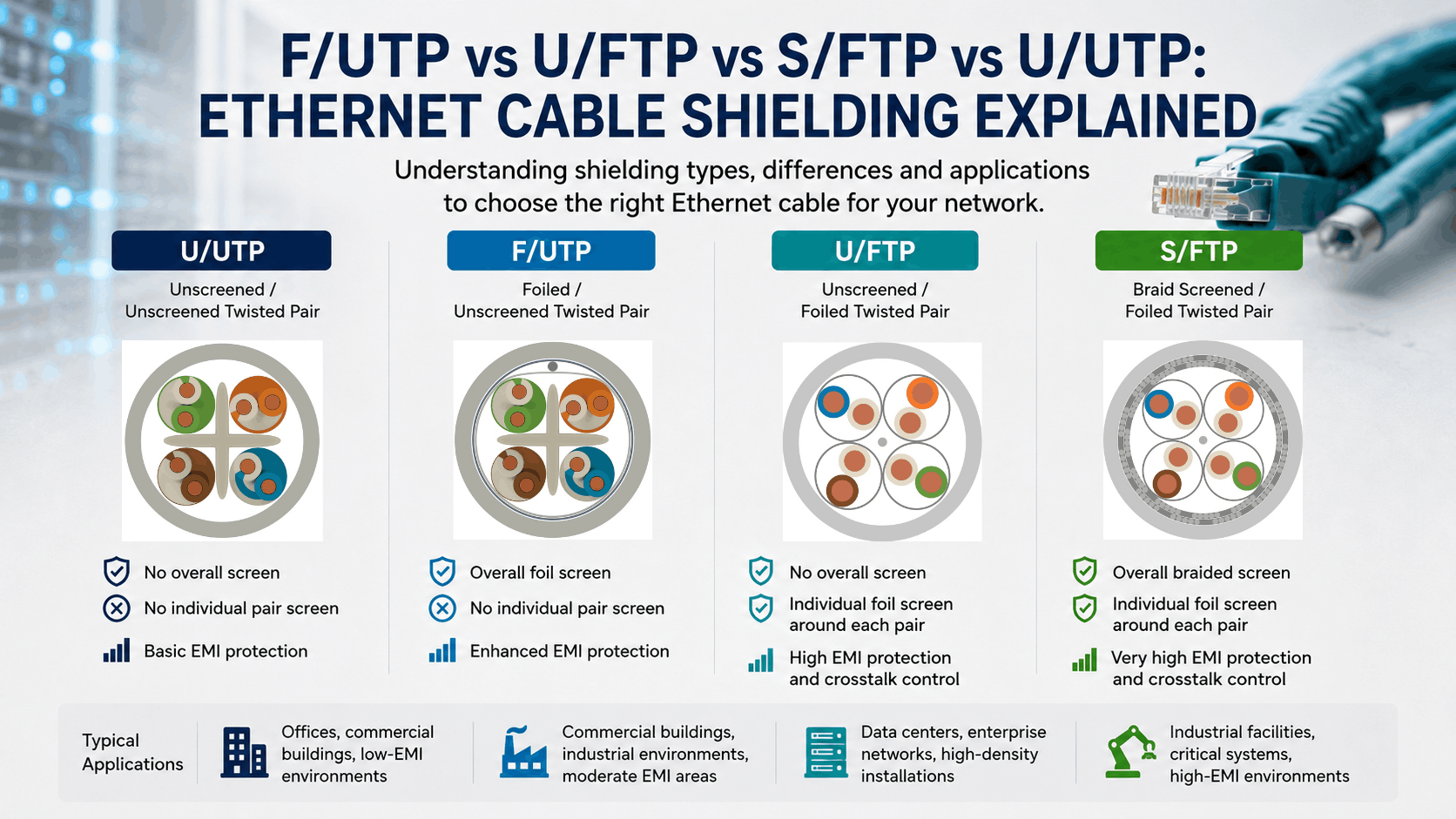
F/UTP vs U/FTP vs S/FTP vs U/UTP: Ethernet Cable Shielding Explained
Reading Time: 10 minutes
Ethernet cable shielding can have a major influence on how reliably a network performs in environments affected by electromagnetic interference, crosstalk and dense cable installations. However, designations such as U/UTP, F/UTP, U/FTP and S/FTP are often misunderstood or used interchangeably.
The difference is not simply whether an Ethernet cable is “shielded” or “unshielded.” Some constructions place a screen around all four twisted pairs, others protect each pair individually, while fully screened designs combine both methods.
Understanding these differences helps engineers, consultants and purchasing teams select a cable construction that matches the electrical environment of a project without unnecessarily over-specifying the network.
Quick answer: U/UTP has no metallic shielding, F/UTP uses an overall foil screen around all twisted pairs, U/FTP individually foil-screens each pair without an overall screen, and S/FTP combines individually foil-screened pairs with an overall braided screen. The most suitable construction depends on electromagnetic interference, cable density, network performance requirements and the complete structured cabling system.
What Do U/UTP, F/UTP, U/FTP and S/FTP Mean?
The standardized naming system for balanced twisted-pair cables describes two separate parts of the cable construction.
The letters before the slash describe the overall screen around the complete group of twisted pairs. The letters after the slash describe the screening around the individual twisted pairs.
| Letter | Meaning | Function |
|---|---|---|
| U | Unscreened | No metallic screen |
| F | Foil screened | Metallic foil provides screening |
| S | Braid screened | Metallic braid provides overall screening |
| SF | Braid + foil screened | Combination of braid and foil around the cable core |
| UTP | Unscreened twisted pair | Individual pairs do not have metallic screens |
| FTP | Foil screened twisted pair | Individual twisted pairs are protected by foil |
This makes the cable designation much easier to understand.
U/UTP means there is no overall screen and no individual pair screen.
F/UTP means an overall foil surrounds the group of twisted pairs, while the individual pairs remain unscreened.
U/FTP means there is no overall metallic screen, but each twisted pair is individually foil-screened.
S/FTP means each pair is individually foil-screened and an additional metallic braid surrounds the complete cable core.
Other constructions also exist. For example, F/FTP combines an overall foil screen with individually foil-screened pairs, while SF/UTP combines an overall foil and braid around otherwise unscreened twisted pairs.
U/UTP vs F/UTP vs U/FTP vs S/FTP at a Glance
| Construction | Overall Screen | Individual Pair Screen | Typical EMI Protection | Main Advantage | Typical Consideration |
|---|---|---|---|---|---|
| U/UTP | None | None | Basic | Simple, flexible and economical | Less protection from external electromagnetic interference |
| F/UTP | Foil | None | Enhanced | Overall protection from external interference | Shield continuity must be considered throughout the system |
| U/FTP | None | Foil around each pair | High | Strong pair isolation and crosstalk control | Requires compatible screened connectivity |
| S/FTP | Braid | Foil around each pair | Very high | Comprehensive EMI and crosstalk protection | More complex and typically larger than U/UTP |
This table provides a useful overview, but shielding should not be evaluated independently from cable category, frequency, conductor construction, channel design, grounding, fire performance or installation environment.
What Is U/UTP Ethernet Cable?
U/UTP stands for Unscreened/Unscreened Twisted Pair.
There is no metallic foil or braid around the complete cable core and no metallic shielding around the individual twisted pairs. Signal integrity instead depends heavily on the balanced transmission characteristics of the cable and the controlled twisting of the conductor pairs.
U/UTP is widely used because the construction is relatively simple, flexible and economical.
Where Is U/UTP Commonly Used?
U/UTP can be suitable for:
- Office networks
- Commercial buildings
- Schools and universities
- General structured cabling
- IP telephony
- Wireless access point connections
- IP CCTV networks
- Low-EMI indoor environments
In a conventional office environment with appropriate pathway design and separation from interference sources, a properly specified U/UTP system can provide excellent network performance.
The absence of metallic shielding also makes the cable easier to handle in many installations and eliminates the need to maintain a cable shield through the complete channel.
When Might U/UTP Be Less Suitable?
Unscreened cabling may be less attractive when cables must operate close to significant electromagnetic noise sources such as industrial machinery, variable-frequency drives, large electrical equipment or certain power distribution environments.
Dense high-performance cable bundles may also justify consideration of screened constructions depending on the category, application and overall network design.
What Is F/UTP Ethernet Cable?
F/UTP stands for Foiled/Unscreened Twisted Pair.
In this construction, the four twisted pairs are surrounded together by an overall metallic foil. The individual pairs themselves do not have separate foil screens.
The overall foil acts as an additional barrier against electromagnetic interference entering or leaving the cable.
F/UTP therefore offers an intermediate approach between completely unscreened U/UTP and constructions that screen every twisted pair individually.
Advantages of F/UTP
- Overall metallic shielding against external interference
- Improved electromagnetic compatibility compared with an equivalent unscreened construction
- Useful in commercial and industrial environments with moderate EMI
- Can provide an effective balance between shielding and cable complexity
Typical F/UTP Applications
F/UTP cables may be considered for:
- Commercial buildings
- Industrial facilities
- Control rooms
- Telecommunications rooms
- Building automation networks
- Networks installed near potential sources of electromagnetic interference
The performance of a screened cabling system depends on more than the cable itself. Compatible screened connectors, patch panels and proper bonding practices should be considered as part of the complete channel.
What Is U/FTP Ethernet Cable?
U/FTP stands for Unscreened/Foiled Twisted Pair.
Unlike F/UTP, there is no overall metallic screen around the complete cable core. Instead, each twisted pair is individually enclosed in foil.
This construction provides direct separation between the four pairs and can be particularly effective in controlling pair-to-pair coupling and crosstalk.
U/FTP is frequently associated with high-performance structured cabling systems where maintaining electrical performance in dense cable environments is important.
Advantages of U/FTP
- Each twisted pair is individually screened
- Strong pair-to-pair isolation
- Effective crosstalk control
- Suitable for high-performance structured cabling
- Useful in dense network installations
Typical U/FTP Applications
U/FTP may be selected for:
- 10 Gigabit Ethernet networks
- Data centers
- Enterprise networks
- High-density cable pathways
- Server and communications rooms
- Commercial infrastructure requiring screened cabling
As with other screened constructions, the complete cabling system should be designed to maintain the intended shielding performance from cable to connectivity.
What Is S/FTP Ethernet Cable?
S/FTP stands for Braid Screened/Foiled Twisted Pair.
This is one of the most comprehensively screened twisted-pair Ethernet cable constructions.
Each individual pair is wrapped in metallic foil, while an additional braided metallic screen surrounds the entire group of pairs.
The individual foil screens help isolate the twisted pairs from one another, while the overall braid provides an additional layer of protection against external electromagnetic interference.
Advantages of S/FTP
- Individual foil shielding around every pair
- Overall braided metallic screen
- High resistance to external electromagnetic interference
- Strong crosstalk control
- Suitable for electrically demanding environments
- Common in high-performance cable categories
Typical S/FTP Applications
S/FTP may be particularly appropriate for:
- Industrial networks
- Data centers
- Automation systems
- Manufacturing facilities
- Hospitals and laboratories
- Broadcast infrastructure
- High-density structured cabling
- Locations with significant electromagnetic interference
The additional screening can increase cable diameter, weight and installation requirements compared with simpler constructions. For this reason, S/FTP should be selected because the project benefits from its electrical characteristics rather than simply because it appears to be the highest shielding option.
F/UTP vs U/FTP: What Is the Difference?
F/UTP and U/FTP are both screened Ethernet cable constructions, but they place the metallic screen in different locations.
F/UTP: one overall foil surrounds all four twisted pairs.
U/FTP: each twisted pair receives its own foil screen, but there is no common overall screen.
F/UTP therefore focuses on shielding the cable core as a group from external electromagnetic influences.
U/FTP provides direct electrical separation between individual pairs, making it particularly useful where pair-to-pair crosstalk performance is important.
It would therefore be misleading to say that one construction is universally “better” than the other. They use different shielding architectures and should be evaluated against the requirements of the complete cabling system.
U/FTP vs S/FTP: Which Provides More Shielding?
Both U/FTP and S/FTP individually foil-screen each twisted pair.
The key difference is the additional overall screen.
U/FTP has no overall metallic screen, while S/FTP adds an overall braid around the foil-screened pairs.
S/FTP therefore provides another layer of protection against external electromagnetic interference in addition to the pair isolation provided by the individual foil screens.
This can make S/FTP attractive for industrial environments, critical communication systems and other applications where electromagnetic compatibility is a major project consideration.
However, additional screening can also increase cable size, weight, cost and installation complexity. If the electrical environment does not require this level of protection, U/FTP may provide a more efficient solution.
U/UTP vs S/FTP: Do You Always Need Shielded Cable?
No.
The fact that S/FTP provides greater metallic screening does not make U/UTP obsolete or technically inadequate.
Modern balanced twisted-pair cabling relies on controlled conductor geometry and pair twisting to achieve strong noise rejection even without a metallic screen.
For conventional office and commercial environments, U/UTP can be an effective and economical solution when the cable category, channel design and installation practices meet the required standards.
S/FTP becomes more relevant when the project has demanding electromagnetic conditions, requires a highly screened architecture or specifies cable categories that commonly use individually screened pairs.
The correct comparison is therefore not simply:
Unshielded = bad
Shielded = good
Instead, the question should be:
What shielding architecture is appropriate for this network environment and specification?
Which Ethernet Cable Shielding Should You Choose?
| Project Condition | Construction to Consider | Reason |
|---|---|---|
| Conventional office with low EMI | U/UTP | Simple, flexible and cost-efficient where additional screening is unnecessary |
| Commercial building with moderate interference concerns | F/UTP | Overall foil provides additional EMI protection |
| High-density 10 GbE structured cabling | U/FTP | Individual pair screening provides strong crosstalk control |
| Industrial or electrically demanding environment | S/FTP | Individual pair foil plus overall braid provides comprehensive shielding |
| Project specification requires a particular cable construction | As specified | Category, shielding and applicable standards should be evaluated together |
This table should be treated as a selection guide rather than a substitute for project engineering.
The actual choice should also consider cable category, required Ethernet application, channel length, installation pathway, grounding system, fire classification, mechanical protection and local or project-specific standards.
Shielding Type and Cable Category Are Not the Same Thing
One of the most common misunderstandings in network cabling is treating shielding terminology as if it describes the Ethernet category.
It does not.
Cat6, Cat6A, Cat7 and Cat7A describe performance categories or classes with defined transmission requirements.
U/UTP, F/UTP, U/FTP and S/FTP describe the physical shielding construction.
A cable specification therefore needs both pieces of information.
For example:
Simply requesting a “shielded Cat6A cable” may not provide enough information for a manufacturer or supplier to determine the required construction.
Grounding and Shield Continuity Matter
A screened Ethernet cable should be considered as part of a complete screened cabling system.
The metallic screen is most effective when shield continuity is maintained through the relevant connectors, patch panels and other components, with bonding and grounding implemented according to the applicable cabling and electrical requirements.
Using a screened cable while ignoring the rest of the channel may prevent the installation from achieving the electromagnetic performance expected from the selected construction.
This is particularly important in industrial facilities, large commercial buildings and high-performance structured cabling systems where screened cabling has been specified deliberately.
Does More Shielding Mean Faster Ethernet?
No.
Shielding does not directly determine Ethernet data rate.
A highly screened cable is not automatically faster than an unscreened cable simply because it contains more metal.
Network speed depends on factors including:
- Cable category
- Transmission frequency
- Channel length
- Connector performance
- Installation quality
- Network equipment
- Compliance of the complete channel
Shielding helps protect signal integrity against specific forms of electromagnetic disturbance and crosstalk. It should therefore be viewed as one part of the overall cable design rather than as a speed rating.
Common Mistakes When Selecting Shielded Ethernet Cable
1. Assuming More Shielding Is Always Better
A heavily screened cable may provide excellent electromagnetic performance, but it may also be larger, less flexible and more expensive. The shielding level should correspond to the actual installation environment.
2. Confusing Cable Category with Shielding
Cat6A does not automatically mean S/FTP, and U/UTP does not automatically mean a low-performance cable. Category and shielding construction describe different characteristics.
3. Specifying Only “STP Cable”
The generic term STP can be ambiguous because several different screened constructions exist. A precise designation such as F/UTP, U/FTP, F/FTP or S/FTP provides much clearer information to the manufacturer and purchasing team.
4. Ignoring the Complete Cabling Channel
A screened cable should be matched with appropriate connectivity and system components so that the intended shielding architecture is maintained.
5. Selecting Shielding Without Considering the Environment
A conventional office, a data center and a heavy industrial plant do not present the same electromagnetic conditions. Cable selection should reflect the environment in which the network will operate.
6. Ignoring Jacket and Fire Requirements
U/UTP or S/FTP only describes shielding. The project may separately require LSZH, PVC or PE jackets, a specific CPR Euroclass or additional mechanical protection.
What Should a Buyer Include in an Ethernet Cable RFQ?
A precise request for quotation reduces technical uncertainty and helps manufacturers offer the correct cable construction.
For an Ethernet cable project, buyers should consider specifying:
- Ethernet category such as Cat6, Cat6A, Cat7 or Cat7A
- Shielding construction such as U/UTP, F/UTP, U/FTP, F/FTP or S/FTP
- Conductor size and construction
- Solid or stranded conductor requirement
- Required transmission frequency
- Indoor or outdoor application
- Outer jacket material
- LSZH, PVC or PE requirement
- CPR fire classification where applicable
- Required mechanical protection or armour
- Applicable international or project standards
- Packaging and drum length requirements
- Required testing or certification documentation
Providing this information is considerably more useful than requesting only “Cat6A network cable” because multiple technically different constructions can exist within the same Ethernet category.
ETK Kablo Ethernet Cable Shielding Solutions
ETK Kablo manufactures Data/LAN cables with multiple shielding constructions for commercial buildings, telecommunications networks, data centers, industrial facilities and infrastructure projects.
The portfolio includes unshielded and screened Ethernet cable constructions across different performance categories, allowing projects to select the combination of transmission performance and electromagnetic protection appropriate for their network.
Available constructions include U/UTP, F/UTP, U/FTP, F/FTP and S/FTP options depending on cable category and product specification.
ETK Kablo also manufactures Ethernet cables with different outer jacket materials and mechanical protection options for indoor, outdoor and demanding infrastructure applications.
Rather than choosing a network cable solely according to category or shielding level, professional specifications should consider category, screen construction, installation environment, fire performance and mechanical requirements together.
Frequently Asked Questions About Ethernet Cable Shielding
What is Ethernet cable shielding?
Ethernet cable shielding uses metallic foil, braid or a combination of both to help protect balanced twisted-pair conductors from electromagnetic interference and crosstalk. The shielding may surround the complete cable core, individual twisted pairs or both.
What is the difference between U/UTP and F/UTP?
U/UTP has no metallic shielding. F/UTP adds an overall foil screen around all four twisted pairs while leaving the individual pairs unscreened.
What is the difference between F/UTP and U/FTP?
F/UTP places one foil screen around the entire group of pairs. U/FTP has no overall screen but individually foil-screens each twisted pair. The two constructions therefore use different approaches to controlling electromagnetic interference and crosstalk.
What is the difference between U/FTP and S/FTP?
Both constructions individually foil-screen each twisted pair. S/FTP additionally uses an overall metallic braid around the complete cable core, providing another layer of electromagnetic screening.
Is S/FTP better than U/UTP?
S/FTP provides substantially more metallic screening, but that does not mean it is necessary for every network. U/UTP may be entirely appropriate for conventional low-EMI structured cabling, while S/FTP is more suitable when the project requires comprehensive shielding.
Does shielded Ethernet cable increase speed?
Shielding itself does not determine Ethernet speed. It helps protect signal integrity against interference. Data rate is determined by the cable category, channel performance, network equipment and other system parameters.
Which Ethernet cable is best for industrial environments?
Screened constructions such as F/UTP, U/FTP or S/FTP may be appropriate where electromagnetic interference is significant. S/FTP provides particularly comprehensive screening, but the final selection should be based on the actual electrical environment and project specification.
Which Ethernet cable shielding is suitable for data centers?
The answer depends on network architecture and performance requirements. U/FTP and S/FTP can provide strong crosstalk control and electromagnetic protection for high-density systems, while properly designed U/UTP systems may also be used in suitable environments. Cable category and complete channel design remain essential considerations.
Conclusion
Ethernet cable shielding should be selected according to the network environment rather than by assuming that the construction with the most metal is automatically the best choice.
U/UTP offers a simple and efficient solution for many conventional networks. F/UTP adds an overall foil screen for increased protection from external interference. U/FTP individually screens each pair to provide strong pair isolation and crosstalk control. S/FTP combines individual pair foils with an overall braid for demanding environments where comprehensive electromagnetic protection is required.
The most effective specification considers shielding together with cable category, transmission requirements, installation environment, grounding, fire performance and mechanical protection.
By defining these requirements before procurement, network designers and buyers can select a cable that provides the required electrical performance without unnecessary complexity or over-specification.
Benzer yazılar
Cat6A Cable for Data Centers: U/FTP, F/FTP or S/FTP?
Choosing the right Cat6A cable for data centers involves more than specifying 10 Gigabit Ethernet and 500 MHz performance. U/FTP, F/FTP...


