





 President’s Message
Blog
Fire Resistant vs Flame Retardant Cable: What Is the Difference?
Reading Time: 12 minutes
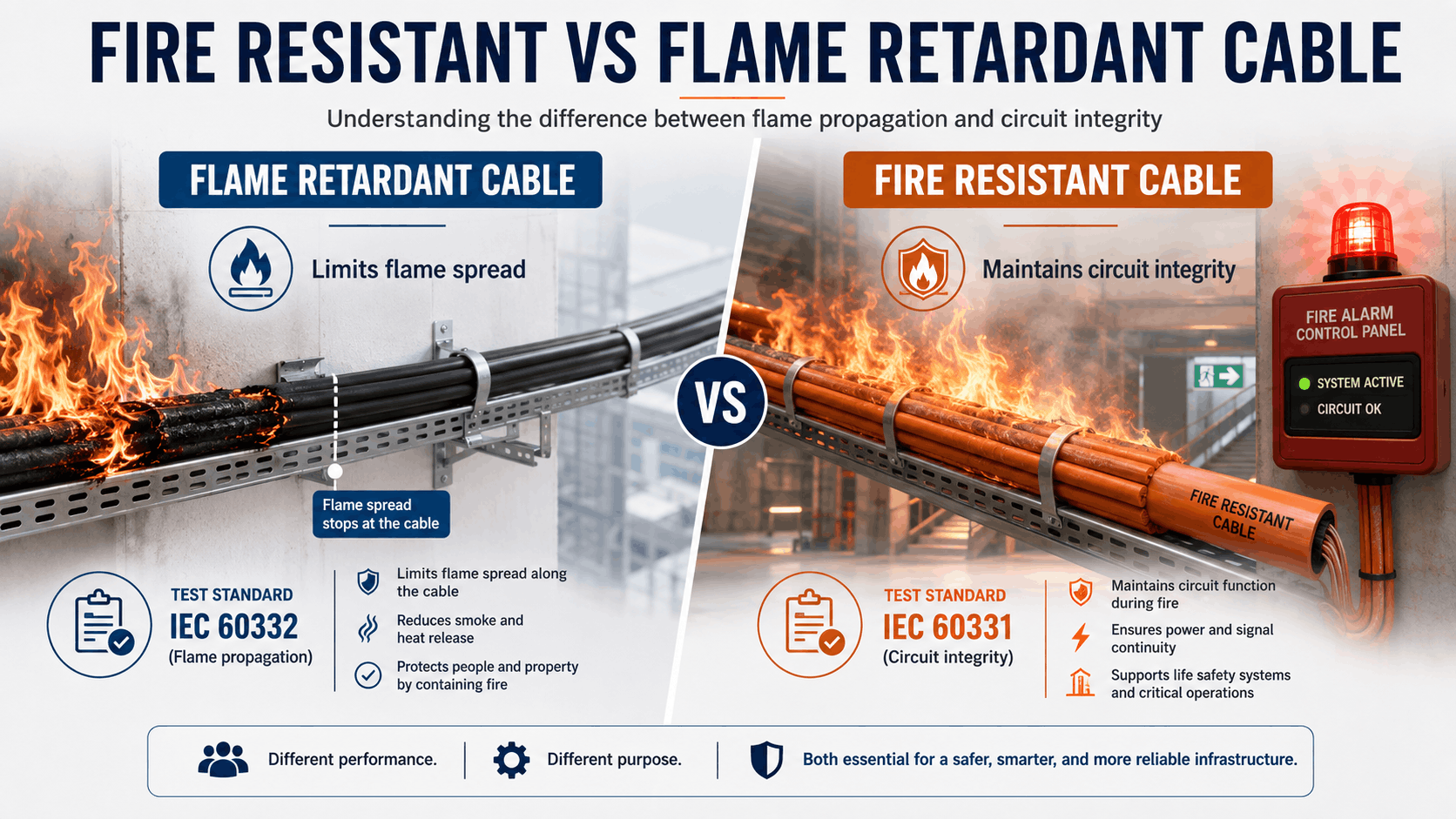
The difference between a fire resistant vs flame retardant cable is one of the most important distinctions in cable fire performance. Although the two terms are often used interchangeably, they describe different safety functions and are verified through different types of fire tests.
A flame retardant cable is designed primarily to limit the spread of flame along the cable. A fire resistant cable, by contrast, is designed to maintain electrical circuit integrity for a defined period while exposed to specified fire conditions.
This distinction matters in projects such as hospitals, airports, tunnels, railway stations, high-rise buildings, data centers and industrial facilities. Specifying a flame retardant cable where circuit continuity is required can leave an emergency system without the fire-survival performance intended by the project.
Quick answer: Flame retardant cables help prevent fire from propagating along a cable route. Fire resistant cables are designed to keep power, control or signal circuits operating for a specified time during a fire. A cable can also have separate low-smoke, halogen-free and CPR reaction-to-fire characteristics, so these terms should not be treated as synonyms.
Fire Resistant vs Flame Retardant Cable at a Glance
| Characteristic | Flame Retardant Cable | Fire Resistant Cable |
|---|---|---|
| Primary objective | Limit flame propagation | Maintain circuit integrity during fire |
| Main safety function | Reduce the spread of fire along cabling | Keep critical electrical or signal circuits operational |
| Typical test family | IEC 60332 | IEC 60331, EN 50200 or other applicable circuit-integrity tests |
| Must continue operating during fire? | Not necessarily | Yes, for the performance period and test conditions specified |
| Typical construction approach | Flame-retardant insulation and/or sheath compounds | Fire-survival insulation or barriers combined with suitable cable construction |
| Typical applications | General building, industrial and infrastructure cabling | Fire alarms, emergency lighting, evacuation, smoke control and other critical systems |
| LSZH automatically included? | No | No |
| CPR class automatically determined? | No | No |
The most important point is that flame propagation and circuit integrity are different performance characteristics. Passing one type of test does not automatically demonstrate compliance with the other.
What Is a Flame Retardant Cable?
A flame retardant cable is designed to resist or limit the propagation of flame along the cable when exposed to a defined ignition source.
The purpose is to reduce the possibility that cabling itself becomes an efficient pathway for fire to spread from one location to another.
This is especially important because cables are often installed vertically and horizontally through:
- Cable trays
- Risers
- Service shafts
- Technical rooms
- Ceiling voids
- Industrial cable routes
- Telecommunications pathways
If flame can travel rapidly along these routes, a localized fire can contribute to fire development in other parts of a building or facility.
How Is Flame Retardancy Tested?
The IEC 60332 family contains commonly referenced tests for flame propagation on electric and optical fiber cables.
IEC 60332-1-2 addresses vertical flame propagation on a single insulated conductor or cable. The IEC 60332-3 series addresses flame spread characteristics of vertically installed bunched cables under defined test conditions.
This distinction is important because a cable tested individually does not necessarily behave identically when installed in a large bundle.
For this reason, project specifications should identify the exact flame-propagation requirement rather than simply stating “flame retardant.”
Does a Flame Retardant Cable Continue Working During a Fire?
Not necessarily.
A cable can successfully limit flame propagation while still losing electrical continuity relatively quickly when directly exposed to fire.
Flame-retardant performance addresses how the cable contributes to flame spread. It does not, by itself, establish how long the cable will continue transmitting power or signals during fire exposure.
If the connected system must remain operational during a fire, a separate circuit-integrity requirement is needed.
What Is a Fire Resistant Cable?
A fire resistant cable is designed to maintain the integrity of an electrical circuit for a specified period when exposed to the conditions defined by an applicable fire test.
Depending on the cable and standard, these conditions can involve flame exposure and may also include mechanical shock or other additional stresses.
Fire resistant cables are therefore used where the failure of the cable during the early or critical stages of a fire could prevent an emergency system from performing its function.
Typical Fire Resistant Cable Applications
Fire resistant cables may be specified for systems such as:
- Fire detection and alarm systems
- Emergency lighting
- Public address and voice evacuation systems
- Smoke extraction and ventilation systems
- Fire-fighting equipment
- Emergency control circuits
- Evacuation systems
- Safety-related building management functions
- Emergency communication systems
- Critical power and control circuits
The exact requirement depends on the applicable building code, fire strategy, system design and project specification.
How Does a Fire Resistant Cable Maintain Circuit Integrity?
The complete cable construction is designed to protect the electrical path when exposed to fire.
Depending on the product design, fire-survival constructions may use elements such as:
- Mica-based fire barriers
- Ceramic-forming insulation compounds
- Special heat-resistant insulation systems
- Glass-fiber or other protective tapes
- Halogen-free flame-retardant sheath compounds
These elements are selected so that the cable can continue performing its intended electrical function for the duration required by the applicable test.
However, the presence of mica tape or a special compound should not be treated as certification by itself. Performance must be demonstrated against the required cable test and classification.
Fire Resistant vs Flame Retardant Cable: Key Differences
The simplest way to understand fire resistant vs flame retardant cable performance is to ask two different questions.
Question 1: Will the cable help limit the spread of flame?
This is the main purpose of flame-retardant performance.
Question 2: Will the electrical circuit continue operating while the cable is exposed to fire?
This is the main purpose of fire-resistant or circuit-integrity performance.
They address different risks and should therefore be specified separately.
| Project Question | Required Performance Concept |
|---|---|
| Should the cable limit flame spread? | Flame retardancy |
| Must an emergency circuit continue operating during fire? | Fire resistance / circuit integrity |
| Should smoke generation be limited? | Low-smoke performance |
| Should halogen emissions be restricted? | Halogen-free performance |
| Does the project require a European reaction-to-fire class? | CPR Euroclass |
A safety-critical project may require several of these properties in the same cable.
Can a Fire Resistant Cable Also Be Flame Retardant?
Yes.
Fire resistance and flame retardancy are not mutually exclusive.
Many fire resistant cable designs also meet specified flame-propagation requirements because preventing fire spread and maintaining critical circuits can both be important within the same installation.
However, engineers and buyers should verify each performance requirement separately.
A fire-resistant designation should not be assumed to prove every possible flame-propagation, smoke, halogen or CPR requirement unless the relevant test documentation confirms it.
Can a Flame Retardant Cable Be Fire Resistant?
Only if the cable has also been designed and tested for the required circuit-integrity performance.
Flame retardancy alone does not establish fire resistance.
For example, a general-purpose cable may use a flame-retardant outer sheath and successfully pass an applicable IEC 60332 flame-propagation test. That does not automatically mean the cable can maintain power or signal continuity under IEC 60331 or EN 50200 fire-survival conditions.
This is one of the most important distinctions for project buyers to understand.
IEC 60332 vs IEC 60331: What Is the Difference?
The two IEC test families address fundamentally different fire-performance objectives.
IEC 60332
IEC 60332 focuses on flame propagation characteristics of cables under defined fire-test conditions.
Depending on the part of the standard, testing can address individual cables or cables installed in defined bunch configurations.
The key question is how the flame develops or propagates along the cable specimen.
IEC 60331
The IEC 60331 family focuses on circuit integrity under fire conditions.
It is used for cables required to maintain electrical continuity when exposed to specified fire conditions, with particular parts also incorporating mechanical shock.
The key question is therefore not simply whether the cable burns, but whether the electrical circuit remains functional for the required test period.
| Standard Family | Main Purpose | What It Does Not Automatically Prove |
|---|---|---|
| IEC 60332 | Flame propagation performance | Circuit integrity during fire |
| IEC 60331 | Electrical circuit integrity under specified fire conditions | Every reaction-to-fire, smoke or halogen classification |
A project specification may require compliance with both families because they address separate aspects of fire safety.
What Does EN 50200 Mean for Fire Resistant Cables?
EN 50200 is another important reference associated with circuit-integrity testing of certain cables used for emergency circuits.
The test subjects the cable to defined fire conditions while mechanical impact is applied.
Performance classifications such as PH ratings can therefore represent a different test concept from basic flame propagation.
When a project specifies PH performance, the exact classification and applicable standard should be stated in the cable schedule or RFQ.
Buyers should avoid using PH, FE, IEC 60331 and flame-retardancy terminology as interchangeable labels because each relates to a defined performance concept and test method.
What Is the Difference Between Fire Resistance and FE180?
FE terminology is frequently encountered in European and international project specifications for cables that must maintain insulation integrity under defined fire exposure.
When a project calls for FE180, the designation should be reviewed together with the referenced test standard rather than interpreted from the number alone.
ETK Kablo manufactures fire-resistant cable constructions designed for projects requiring FE180 and other circuit-integrity performance classifications.
However, FE180 should not be confused with a flame-retardant classification, a CPR Euroclass or an automatic statement that every installed cable system will remain operational for exactly 180 minutes under real building-fire conditions.
Laboratory classifications represent performance under the conditions of the applicable test.
PH120 Is Not the Same as Flame Retardancy
PH classifications are associated with maintaining electrical functionality under specified fire-test conditions that include mechanical effects.
For example, a PH120 requirement is fundamentally different from specifying that a cable pass an IEC 60332 flame-propagation test.
One evaluates circuit-survival performance under defined conditions; the other evaluates flame propagation.
This distinction is particularly relevant for:
- Fire alarm systems
- Voice evacuation circuits
- Emergency communication
- Critical signal circuits
- Life-safety systems
The cable should therefore be selected according to the exact emergency-system requirement rather than by using the generic term “fire cable.”
Flame Retardant vs LSZH Cable: Are They the Same?
No.
Flame retardant describes behaviour related to flame propagation.
LSZH, meaning Low Smoke Zero Halogen, describes material characteristics related to smoke generation and halogen content when the cable materials burn.
A cable can therefore be:
- Flame retardant with a PVC-based construction
- Flame retardant and LSZH
- Fire resistant and LSZH
- Fire resistant, flame retardant and LSZH
The required combination depends on the project.
Why Is LSZH Important?
In occupied or enclosed environments, smoke and corrosive gases can create serious hazards during fire.
Low-smoke and halogen-free compounds are commonly selected for locations such as:
- Airports
- Metro stations
- Tunnels
- Hospitals
- Hotels
- Shopping centers
- Public buildings
- Data centers
- High-rise buildings
However, LSZH should never be used as a substitute term for fire resistance.
An LSZH cable is not automatically capable of maintaining circuit integrity during a fire.
Fire Resistant Cable vs CPR Euroclass
Another important distinction involves the European Construction Products Regulation and cable Euroclasses.
Classifications such as:
- B2ca
- Cca
- Dca
- Eca
describe reaction-to-fire performance for cables covered by the relevant CPR framework.
They address characteristics associated with how the cable contributes to fire development and can also include additional smoke, flaming-droplet and acidity classifications where applicable.
They should not be treated as circuit-integrity classifications.
A B2ca cable is therefore not automatically a fire-resistant cable in the circuit-survival sense.
Likewise, a cable designed to maintain circuit integrity under a fire-resistance test does not automatically receive a particular CPR Euroclass.
| Term | Primary Performance Question |
|---|---|
| Flame retardant | How effectively does the cable limit flame propagation? |
| Fire resistant | Does the electrical circuit remain functional during specified fire exposure? |
| LSZH | How does the cable material behave regarding smoke and halogen emissions? |
| CPR Euroclass | How does the cable react and contribute to fire under the applicable European classification system? |
This four-way distinction can prevent many specification and procurement errors.
Fire Resistant vs Flame Retardant Cable Construction
The construction differences depend on the individual cable design, but the engineering priorities are different.
Typical Flame Retardant Construction
A flame-retardant design may rely primarily on specially formulated insulation or sheath compounds that limit ignition and flame propagation.
Depending on the product, these compounds may be PVC-based or halogen-free.
Typical Fire Resistant Construction
A fire-resistant cable usually requires additional measures to protect the electrical path when insulation materials are exposed to high temperatures.
Depending on cable type, these can include:
- Mica tape around conductors
- Ceramic-forming insulation
- Specialized cross-linked fire-survival compounds
- Protective tapes and barriers
- Heat-resistant internal construction
The exact construction depends on whether the cable is intended for signal, control, communication, fiber optic or power applications and which performance standard must be achieved.
Which Cable Should You Choose?
| Project Requirement | Cable Performance to Specify | Reason |
|---|---|---|
| General cable route where flame spread must be limited | Flame retardant | Reduces flame propagation along cabling |
| Fire alarm circuit that must remain operational | Fire resistant / circuit integrity | Maintains critical signals during specified fire conditions |
| Emergency lighting | Fire resistant according to project requirements | Supports continued operation during evacuation |
| Smoke extraction system | Fire resistant according to required duration and system design | Critical equipment may need continued electrical supply |
| Occupied building requiring reduced smoke and corrosive gases | LSZH plus required flame/fire performance | Smoke and halogen behaviour must be addressed separately |
| European building project requiring CPR classification | Specified CPR Euroclass | Reaction-to-fire performance must match regulatory/project requirements |
| Critical circuit plus strict reaction-to-fire requirement | Fire resistant plus applicable flame/CPR/LSZH performance | Several independent fire characteristics may be required simultaneously |
The correct specification should therefore begin with the function of the circuit and the fire-safety strategy of the project.
Where Are Flame Retardant Cables Used?
Flame-retardant requirements can apply across a very broad range of electrical and communication infrastructure.
Typical applications include:
- Commercial buildings
- Industrial facilities
- Structured cabling
- Control systems
- Telecommunications networks
- Building automation
- General power and signal distribution
- Data infrastructure
In these applications, the main fire-related objective may be limiting flame spread rather than maintaining the circuit during direct fire exposure.
Where Are Fire Resistant Cables Used?
Fire-resistant cables are generally specified where the connected system needs to remain operational during a fire for life safety, evacuation, emergency response or critical process control.
Common project environments include:
- Hospitals
- Airports
- Metro and railway stations
- Tunnels
- High-rise buildings
- Hotels
- Shopping centers
- Public buildings
- Power plants
- Industrial facilities
- Petrochemical plants
- Data centers
The precise cable performance should follow the system requirement rather than simply the type of building.
Common Mistakes When Specifying Fire Performance
1. Using “Fire Retardant” and “Fire Resistant” Interchangeably
This creates ambiguity because flame propagation and circuit integrity are different properties.
The specification should state the required performance and test standard explicitly.
2. Assuming LSZH Means Fire Resistant
LSZH addresses smoke and halogen characteristics. It does not automatically demonstrate circuit integrity.
3. Assuming B2ca Means Fire Resistant
B2ca is a CPR reaction-to-fire classification. It should not be confused with a circuit-survival test.
4. Specifying Only “IEC Fire Rated Cable”
IEC includes different fire-test families with different objectives.
A complete specification should identify the relevant standard and part, such as the applicable IEC 60332 or IEC 60331 requirement.
5. Assuming a Fire Resistant Cable Meets Every Fire Test
Circuit integrity, flame propagation, smoke density, halogen emissions and CPR classification are independent characteristics unless documentation demonstrates each requirement.
6. Selecting the Highest Rating Without Reviewing the System
More demanding performance can increase cable complexity and cost.
The cable should meet the actual fire strategy and required operating period rather than being over-specified without an engineering basis.
7. Ignoring the Installed Cable System
For certain functional-integrity requirements, cable supports, fixing systems and installation methods can be part of the overall performance concept.
The cable classification should therefore be interpreted together with the relevant system and installation requirements.
What Should a Fire Cable RFQ Include?
Instead of requesting only “fire resistant cable” or “flame retardant cable,” a project buyer should define the required fire-performance characteristics separately.
A useful RFQ may include:
- Cable type and application
- Number and size of conductors or pairs
- Operating voltage
- Required flame-propagation standard
- Required circuit-integrity standard
- Required duration or performance classification
- Mechanical shock requirement where applicable
- Smoke-density requirement
- Halogen-free requirement
- Corrosive-gas requirement
- CPR Euroclass where applicable
- Screening requirement
- Armour or mechanical protection
- Outer sheath material
- Indoor or outdoor installation
- Applicable product standard
- Certificates and test reports required
- Drum lengths and cable marking
This allows cable manufacturers to offer a construction that matches the actual project requirements and makes technical comparison between suppliers more reliable.
ETK Kablo Fire Resistant and Flame Retardant Cable Solutions
ETK Kablo manufactures a broad range of low-current, communication, control and fiber optic cables with different fire-performance characteristics for commercial buildings, industrial facilities and infrastructure projects.
For installations where flame propagation must be controlled, ETK Kablo offers cable constructions manufactured with flame-retardant materials and tested according to the requirements applicable to the individual product.
For life-safety and emergency circuits requiring continued operation during fire, ETK Kablo’s fire-resistant portfolio includes specialized constructions designed for circuit-integrity applications, including products with FE180 and PH120 performance requirements.
Depending on the cable family and project specification, ETK solutions can also combine:
- Fire-resistant construction
- Flame-retardant performance
- Halogen-free materials
- Low-smoke characteristics
- Screening for electromagnetic compatibility
- Mechanical protection
- CPR reaction-to-fire classifications
The correct solution should be selected according to the complete project requirement rather than from a single generic term such as “fire cable.”
Frequently Asked Questions
What is the main difference between fire resistant and flame retardant cable?
The main difference is function. Flame retardant cable is designed to limit flame propagation, while fire resistant cable is designed to maintain electrical circuit integrity for a specified period under defined fire conditions.
Is flame retardant cable fire resistant?
Not automatically. A flame retardant cable may limit the spread of fire but can still lose electrical continuity during fire exposure. Fire-resistance performance must be verified separately.
Is fire resistant cable also flame retardant?
Many fire resistant cables also meet flame-propagation requirements, but this should be confirmed from the applicable test documentation rather than assumed.
What is the difference between IEC 60332 and IEC 60331?
IEC 60332 addresses flame-propagation behaviour, while IEC 60331 addresses circuit integrity of cables required to remain functional under specified fire conditions.
Does LSZH mean flame retardant?
LSZH primarily describes low-smoke and halogen-free material characteristics. A cable’s flame-propagation performance should be verified against the required flame test.
Does LSZH mean fire resistant?
No. An LSZH cable is not automatically fire resistant. Circuit-integrity performance requires separate cable construction and testing.
Is B2ca a fire resistance rating?
No. B2ca is a CPR reaction-to-fire class. It describes how a cable performs in the relevant reaction-to-fire classification system rather than how long an electrical circuit remains functional during fire.
What cables are used for emergency systems?
Systems that must remain operational during a fire generally require cables with appropriate circuit-integrity performance. The exact cable and classification depend on the system, required operating period, applicable standards and local project requirements.
What does FE180 mean?
FE180 is associated with insulation-integrity performance under a defined fire-test method. The classification should always be interpreted together with its referenced standard rather than treated as a universal real-fire operating-time guarantee.
What does PH120 mean?
PH120 is associated with circuit-integrity performance under the defined conditions of the applicable EN 50200 classification, including mechanical effects. It is different from a simple flame-propagation rating.
Can fiber optic cable be fire resistant?
Yes. Fiber optic cables can be designed with fire barriers, halogen-free materials and other construction elements to achieve specified fire-survival performance. Optical continuity requirements and applicable test methods should be defined by the project.
Conclusion
Understanding fire resistant vs flame retardant cable performance begins with recognizing that the two cables solve different fire-safety problems.
Flame retardant cables are designed to limit the spread of flame along cable routes. Fire resistant cables are designed to maintain electrical circuit integrity for a specified period during defined fire exposure.
Other properties such as LSZH performance, smoke emission, halogen content and CPR Euroclass classification address additional aspects of cable behaviour and should be specified independently.
For project engineers and purchasing teams, the safest approach is therefore not to ask simply for a “fire-rated cable.” Instead, define exactly which flame-propagation, circuit-integrity, smoke, halogen and reaction-to-fire requirements the cable must satisfy.
A clear specification allows the cable manufacturer to select the correct construction and helps ensure that the installed cable performs the intended safety function when it matters most.
Benzer yazılar
FE180, PH120, E30, E60 and E90 Cable Ratings Explained
Understanding FE180, PH120, E30, E60 and E90 cable ratings is essential when specifying fire-resistant cables for emergency, life-safet...


