





 President’s Message
Blog
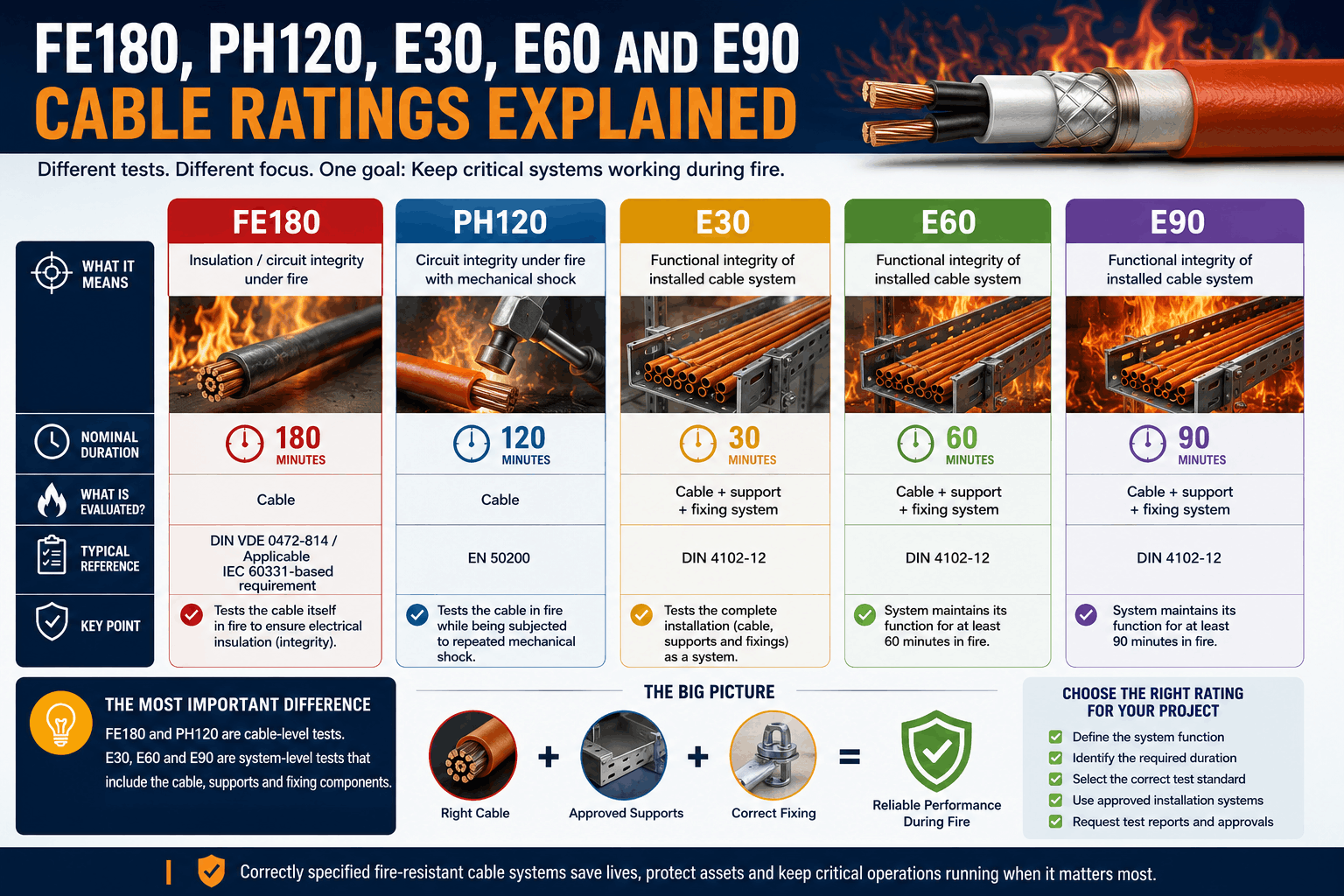
FE180, PH120, E30, E60 and E90 Cable Ratings Explained
Reading Time: 11 minutes
Understanding FE180, PH120, E30, E60 and E90 cable ratings is essential when specifying fire-resistant cables for emergency, life-safety and critical infrastructure systems. Although these classifications are often printed together on cable specifications, they do not describe the same test or the same level of fire performance.
FE180 primarily describes the ability of a cable to maintain insulation or circuit integrity under defined fire exposure. PH120 evaluates circuit integrity under fire together with mechanical shock. E30, E60 and E90 go further by evaluating the functional integrity of the complete installed cable system, including the cable, supports, fixing components and installation arrangement.
For this reason, a cable described as FE180 should not automatically be treated as an E90 system, and an E90 classification cannot normally be assigned to a cable independently of the tested installation system.
Quick answer: FE180 relates to 180-minute cable integrity under a defined fire test. PH120 represents 120-minute circuit integrity under fire with mechanical shock according to the applicable test method. E30, E60 and E90 represent 30, 60 and 90 minutes of functional integrity for a tested cable installation system under DIN 4102-12.
FE180, PH120, E30, E60 and E90 Cable Ratings at a Glance
| Rating | Primary Meaning | Nominal Duration | What Is Evaluated? | Typical Reference |
|---|---|---|---|---|
| FE180 | Insulation / circuit integrity under fire | 180 minutes | Cable | DIN VDE 0472-814 / applicable IEC 60331-based requirement |
| PH120 | Circuit integrity under fire with mechanical shock | 120 minutes | Cable | EN 50200 |
| E30 | Functional integrity of installed cable system | 30 minutes | Cable + support + fixing system | DIN 4102-12 |
| E60 | Functional integrity of installed cable system | 60 minutes | Cable + support + fixing system | DIN 4102-12 |
| E90 | Functional integrity of installed cable system | 90 minutes | Cable + support + fixing system | DIN 4102-12 |
The numbers may look similar, but they should not be compared as though they form one simple ranking system.
For example, FE180 does not automatically mean that an emergency installation will remain fully operational for 180 minutes in a real building fire. Likewise, E90 does not simply mean that the cable itself survives for 90 minutes.
The test object and test conditions are different.
What Does FE180 Mean?
FE180 is widely used in European fire-resistant cable specifications to describe insulation integrity under fire for a period of 180 minutes under the conditions of the referenced test method.
The classification is associated with the cable itself rather than the complete installation system.
During the test, the cable is exposed to a defined flame while electrical continuity and insulation performance are monitored. The objective is to determine whether the conductors can remain electrically separated and maintain the required circuit condition during the test period.
The “180” therefore refers to 180 minutes of performance under the specified laboratory fire conditions.
Does FE180 Mean the Cable Will Work for Three Hours in Any Fire?
No.
This is one of the most important misunderstandings surrounding fire-resistant cable terminology.
FE180 is a laboratory classification. It represents performance under the flame exposure, cable arrangement, electrical loading and pass/fail criteria defined by the applicable test.
A real building fire can involve additional factors such as:
- Mechanical collapse
- Falling objects
- Deformation of cable trays
- Failure of clips or supports
- Water from fire-fighting systems
- Different temperature profiles
- Structural movement
FE180 alone does not evaluate all of these conditions.
This is one reason other classifications such as PH120 and E30/E60/E90 exist.
FE180 Is Not the Same as E180
The letters are important.
FE refers to the cable-level fire or insulation-integrity concept used in this classification system.
E classifications under DIN 4102-12 describe functional integrity of an installed cable system.
Therefore, FE180 should never automatically be interpreted as E180.
What Does PH120 Mean?
PH120 represents circuit-integrity performance for at least 120 minutes under the conditions associated with the relevant PH classification and EN 50200 test method.
Unlike a basic fire exposure test, EN 50200 subjects the cable to both fire and repeated mechanical shock.
This makes PH testing particularly relevant to emergency circuits because cables installed in buildings may experience mechanical stresses during a fire.
The classification therefore addresses a different and generally more mechanically demanding scenario than a flame-only integrity test.
What Does the “120” in PH120 Mean?
The number represents the duration for which the required circuit integrity is maintained under the defined test conditions.
PH classifications may include durations such as:
- PH15
- PH30
- PH60
- PH90
- PH120
PH120 therefore indicates the highest of these commonly referenced PH durations: 120 minutes.
Does PH120 Automatically Include Water Spray?
No. This distinction is important.
The core EN 50200 PH classification involves fire exposure and mechanical shock. Additional test arrangements can introduce water exposure, but a generic PH120 designation should not automatically be described as a “fire + impact + water” classification unless the relevant additional test requirement has also been specified and demonstrated.
Project engineers should therefore identify the exact standard, annex or additional fire-with-water requirement instead of assuming that every PH120 cable has been subjected to the same water test.
FE180 vs PH120: What Is the Difference?
The difference between FE180 and PH120 is not simply 180 minutes versus 120 minutes.
The test methods evaluate different stresses.
| Characteristic | FE180 | PH120 |
|---|---|---|
| Test subject | Cable | Cable |
| Primary purpose | Insulation / circuit integrity during fire exposure | Circuit integrity during fire with mechanical shock |
| Nominal duration | 180 minutes | 120 minutes |
| Mechanical shock included? | Not as the defining FE180 feature | Yes |
| Complete support system evaluated? | No | No |
| Typical use | Cable fire-survival requirement | Emergency circuits requiring enhanced mechanical fire performance |
It would therefore be misleading to say that FE180 is “better” than PH120 simply because 180 is greater than 120.
A PH120 test introduces a mechanical component that FE180 does not represent in the same way.
They are complementary classifications rather than steps on one universal scale.
What Do E30, E60 and E90 Mean?
E30, E60 and E90 represent functional-integrity classifications for complete electrical cable installations under DIN 4102-12.
This is fundamentally different from testing an isolated cable specimen.
The system test considers components such as:
- Fire-resistant cable
- Cable trays
- Support rails
- Clamps
- Brackets
- Anchors
- Fixing distances
- Installation arrangement
The purpose is to determine whether the installed electrical system can continue performing its required function for the specified period while exposed to the standard fire conditions.
What Does E30 Mean?
E30 indicates functional integrity of the tested installation system for at least 30 minutes.
This level may be relevant where an emergency circuit needs to operate during an initial evacuation period or for a defined short-term safety function.
What Does E60 Mean?
E60 indicates that the approved cable installation system maintains functional integrity for at least 60 minutes under the defined test conditions.
The longer duration can be required for systems that must remain available for an extended evacuation or emergency-response period.
What Does E90 Mean?
E90 represents at least 90 minutes of functional integrity for the tested cable installation system.
This classification is commonly associated with critical installations requiring extended operational continuity during fire.
However, the crucial word is system.
Why E90 Is Not Just a Cable Rating
A cable may be marketed or described with terms such as “FE180/E90,” but technically the E90 performance depends on the tested installation arrangement.
The cable cannot create E90 functional integrity on its own.
During a severe fire, metallic support systems can:
- Expand
- Sag
- Twist
- Lose mechanical strength
- Transfer tensile stress to the cable
- Allow cables to fall from their intended route
Therefore, a cable with excellent fire-survival properties could still fail to deliver the required system function if its support structure collapses.
DIN 4102-12 addresses this issue by evaluating the cable together with its relevant installation components.
This is why project documentation should specify the tested system configuration rather than simply writing “E90 cable” and ignoring installation details.
E30 vs E60 vs E90: What Changes?
The main difference is the required duration of system functional integrity.
| Classification | Functional Integrity | What Must Maintain Performance? | Typical Project Logic |
|---|---|---|---|
| E30 | 30 minutes | Approved installed cable system | Initial evacuation and short-duration emergency functions |
| E60 | 60 minutes | Approved installed cable system | Extended evacuation or emergency operation |
| E90 | 90 minutes | Approved installed cable system | Critical systems requiring longer operational continuity |
The appropriate duration should come from applicable regulations, the building fire strategy and the function of the connected equipment.
Choosing E90 simply because it is the highest commonly requested value can lead to unnecessary specification complexity if the project only requires E30.
FE180 PH120 E30 E60 E90: Key Differences
The easiest way to understand FE180, PH120, E30, E60 and E90 cable ratings is to separate them according to what is actually being tested.
| Performance Level | Rating | Test Focus |
|---|---|---|
| Cable under fire | FE180 | Integrity of the cable during specified fire exposure |
| Cable under fire + mechanical stress | PH120 | Circuit integrity with repeated mechanical shock |
| Complete installed cable system | E30 / E60 / E90 | Functional integrity of cable plus support and fixing system |
This progression is more useful than comparing only the time values.
Each classification answers a different engineering question.
Can One Cable Have FE180, PH120 and E90 Performance?
Yes, but the terminology should be used carefully.
A cable can successfully meet the cable-level FE180 and PH120 requirements and also be approved for use as part of an E90 cable system.
For example, ETK Kablo offers fire-resistant signal cable constructions where product documentation identifies:
- FE180 cable integrity performance
- PH120 circuit integrity with mechanical shock
- E30, E60 or E90 system-integrity suitability when installed in the appropriately tested system
The last point is important.
The E classification should always be connected to the approved installation arrangement.
Installing the same cable on a completely different tray, clamp spacing or support system does not automatically reproduce the tested E90 result.
Which Systems May Require These Fire Ratings?
Fire-survival classifications are commonly specified where loss of power, control or communication during fire could compromise evacuation or emergency operations.
Applications can include:
- Fire detection systems
- Fire alarm systems
- Voice evacuation and public address systems
- Emergency lighting
- Smoke extraction systems
- Fire-fighting pumps
- Emergency ventilation
- Firefighter lifts
- Emergency control circuits
- Safety-related building automation
- Critical communication circuits
The required classification depends on the function of the system and the applicable fire-safety design.
Where Are FE180, PH120 and E30-E90 Cables Commonly Used?
Fire-resistant cable systems are frequently specified in environments where evacuation is complex, occupancy is high or critical services must continue operating during a fire.
Examples include:
- Airports
- Metro systems
- Railway stations
- Tunnels
- Hospitals
- High-rise buildings
- Hotels
- Shopping centers
- Data centers
- Power plants
- Industrial facilities
- Petrochemical plants
- Large public buildings
However, a building type by itself does not determine the required rating. The specification should come from the fire engineering requirements for each individual circuit.
Do FE180 and PH120 Mean the Cable Is Flame Retardant?
Not automatically.
Fire resistance and flame retardancy describe different characteristics.
FE180 and PH120 deal with maintaining electrical integrity during specified fire conditions.
Flame-retardant tests such as IEC 60332 examine flame propagation.
A professional cable specification may therefore require both:
- Fire-survival performance such as FE180 or PH120
- Flame-propagation performance according to the applicable IEC 60332 requirement
The two should be verified independently.
Does FE180 or PH120 Mean the Cable Is LSZH?
No.
LSZH refers to Low Smoke Zero Halogen material characteristics. It addresses smoke and halogen-related behaviour during combustion rather than electrical circuit survival.
Many modern fire-resistant cables use halogen-free materials because they are intended for populated or enclosed areas, but the classifications remain separate.
A cable specification may therefore include several requirements at the same time:
- FE180
- PH120
- E30 / E60 / E90 system integrity
- IEC 60332 flame retardancy
- IEC 61034 smoke density
- IEC 60754 halogen and corrosive gas performance
None of these terms should automatically be used as a substitute for the others.
Are FE180, PH120 and E90 the Same as CPR Classes?
No.
CPR Euroclasses such as B2ca, Cca, Dca and Eca describe reaction-to-fire performance for applicable construction cables placed on the European market.
They evaluate a different fire-safety concept from circuit integrity.
For example:
| Classification | Main Question |
|---|---|
| FE180 | Does the cable maintain the required integrity under the specified cable fire test? |
| PH120 | Does the cable maintain circuit integrity under fire with mechanical shock? |
| E30 / E60 / E90 | Does the complete installed cable system continue functioning? |
| CPR Euroclass | How does the cable react and contribute to fire? |
| IEC 60332 | How does flame propagate along the cable under the specified test? |
| LSZH | What are the smoke and halogen characteristics of the cable materials? |
A single project can require several of these properties simultaneously.
How Should Engineers Specify E30, E60 or E90?
The specification should identify more than the cable designation.
For a system-integrity requirement, engineers should consider:
- Required E classification
- Approved cable type
- Cable cross-section or pair configuration
- Permitted support system
- Tray or ladder type
- Clamp arrangement
- Maximum fixing distance
- Permitted cable loading
- Mounting orientation
- Approved anchors and brackets
- Test certificate or approval reference
This ensures that the installation built on site corresponds to the configuration for which functional integrity was demonstrated.
How Should Buyers Read a Cable Marked FE180 / PH120 / E30-E90?
A designation such as:
JE-H(St)H Bd FE180 / PH120 / E30-E90
contains several layers of information.
JE-H(St)H Bd describes the cable family and construction.
FE180 identifies the relevant cable-level fire integrity performance.
PH120 identifies 120-minute circuit integrity under the applicable fire-and-mechanical-shock test.
E30-E90 indicates that the cable can form part of appropriately tested functional-integrity installation systems covering the stated E classifications.
The notation should not be interpreted as meaning that simply laying the cable on any available tray automatically produces an E90 installation.
Which Rating Should You Specify?
| Project Requirement | Performance to Consider | Why |
|---|---|---|
| Cable must retain integrity during direct fire exposure | FE classification / applicable circuit-integrity test | Evaluates cable-level fire survival |
| Cable must withstand fire plus mechanical impact | PH classification | Adds mechanical shock to circuit-integrity evaluation |
| Complete emergency circuit must remain operational for 30 minutes | E30 system | Evaluates cable and installation support together |
| Complete emergency circuit must remain operational for 60 minutes | E60 system | Provides extended functional integrity |
| Complete emergency circuit must remain operational for 90 minutes | E90 system | Provides extended system-level functional integrity |
| Flame spread must also be controlled | Applicable IEC 60332 requirement | Fire survival and flame propagation are separate characteristics |
| Low smoke and halogen-free materials are required | Applicable IEC 61034 / IEC 60754 requirements | Smoke and gas behaviour must be specified separately |
Project engineers should select the rating according to the required safety function rather than choosing the longest time value by default.
Common Mistakes When Reading Fire Cable Ratings
1. Assuming FE180 Means E180
FE and E classifications describe different test concepts. FE180 does not automatically provide 180 minutes of complete installed-system functional integrity.
2. Assuming E90 Belongs to the Cable Alone
E90 evaluates an approved cable installation system. Supports, fixings and installation arrangement are part of the result.
3. Assuming FE180 Is Better Than PH120 Because 180 Is Higher Than 120
The test conditions differ. PH120 includes mechanical shock, so the numbers should not be compared directly as one performance scale.
4. Assuming PH120 Always Includes Water Spray
PH120 primarily refers to the applicable fire-and-mechanical-shock classification. Water exposure must be verified from the exact additional test requirement where relevant.
5. Assuming Fire Resistance Means Flame Retardancy
A cable can maintain circuit integrity and still require separate verification of flame-propagation performance.
6. Assuming LSZH Means FE180 or PH120
LSZH concerns material smoke and halogen characteristics, not circuit-integrity duration.
7. Ignoring the Test Certificate for an E-Rated System
An E30, E60 or E90 installation should match the approved installation parameters. Changing the support system or fixing arrangement can affect the validity of the functional-integrity classification.
8. Treating Laboratory Time as a Guaranteed Real-Fire Survival Time
Fire classifications describe performance under standardized test conditions. Real fires vary in temperature, duration, mechanical damage and environmental conditions.
What Should Be Included in a Fire-Resistant Cable RFQ?
A technically complete RFQ should specify the individual fire-performance requirements rather than using only the phrase “fire-rated cable.”
Consider including:
- Cable type and application
- Number and size of conductors or pairs
- Operating voltage
- FE requirement where applicable
- PH classification where applicable
- E30, E60 or E90 system requirement
- Applicable test standards
- Required approved installation system
- Flame-propagation requirement
- Low-smoke requirement
- Halogen-free requirement
- CPR Euroclass where applicable
- Screening requirement
- Mechanical protection
- Indoor or outdoor application
- Cable marking
- Drum length
- Certificates and test reports
- System approval documentation
This allows the manufacturer and installer to understand whether the project requires cable-level fire survival, complete-system functional integrity or both.
ETK Kablo FE180, PH120 and E30-E90 Cable Solutions
ETK Kablo manufactures fire-resistant signal, control, communication and power cable solutions for safety-critical infrastructure.
The portfolio includes cable constructions with FE180 and PH120 performance as well as products designed for use within approved E30, E60 and E90 functional-integrity systems.
ETK Kablo fire-resistant cable constructions can also combine additional characteristics depending on the product and project requirement, including:
- Halogen-free outer sheaths
- Low-smoke performance
- Flame-retardant properties
- Overall screening
- Copper braid screening
- Fire-survival insulation systems
- Power, signal and control constructions
Examples include JE-H(St)H Bd fire-resistant signal cables and other fire-survival cable families intended for emergency communication, fire detection, control and critical building systems.
When an E30, E60 or E90 requirement applies, cable selection should always be coordinated with the approved support and fixing system required by the installation certification.
Frequently Asked Questions
What does FE180 mean on a cable?
FE180 indicates 180-minute cable integrity under the conditions of the referenced fire test. It is a cable-level classification and should not be interpreted as 180 minutes of complete installed-system functional integrity.
What does PH120 mean?
PH120 indicates at least 120 minutes of circuit integrity under the applicable fire test with mechanical shock. It evaluates the cable rather than a complete cable-support installation system.
What does E30 mean?
E30 identifies 30 minutes of functional integrity for an approved cable installation system under DIN 4102-12.
What does E60 mean?
E60 identifies 60 minutes of functional integrity for the tested cable, support and fixing system.
What does E90 mean?
E90 identifies 90 minutes of functional integrity for an approved cable installation system under DIN 4102-12.
Is E90 better than FE180?
They cannot be compared directly. FE180 and E90 evaluate different things. FE180 relates to cable-level fire integrity, while E90 evaluates functional integrity of the complete installed cable system.
Is PH120 better than FE180?
Neither classification is universally better. PH120 includes mechanical shock, while FE180 uses a different fire-integrity test concept and longer nominal duration. The correct requirement depends on the project.
Can an FE180 cable be used for an E90 installation?
Potentially, but only if that cable is part of an installation system tested and approved for E90 according to the applicable DIN 4102-12 requirements. FE180 alone does not establish E90 performance.
Does E90 include the cable tray?
Yes. E30, E60 and E90 functional-integrity classifications evaluate the cable installation system, which includes the relevant support and fixing components according to the tested configuration.
Does PH120 include mechanical impact?
Yes. Mechanical shock is a defining element of the EN 50200 circuit-integrity test concept associated with PH classifications.
Does PH120 always include water?
No. Water exposure should be verified against the exact additional standard or test requirement. A generic PH120 classification should not automatically be interpreted as including a water-spray test.
Is FE180 the same as flame retardant?
No. FE180 addresses cable integrity under fire. Flame retardancy addresses the propagation of flame and is evaluated separately using standards such as IEC 60332.
Is an FE180 cable automatically LSZH?
No. LSZH is a separate material-performance characteristic. Many fire-resistant cables combine FE180 with halogen-free materials, but both requirements should be verified independently.
Conclusion
Understanding FE180, PH120, E30, E60 and E90 cable ratings requires looking beyond the number printed beside each classification.
FE180 evaluates cable integrity under defined fire conditions. PH120 evaluates circuit integrity under fire together with mechanical shock. E30, E60 and E90 evaluate the functional integrity of the complete installed cable system for 30, 60 or 90 minutes.
The distinction between cable performance and system performance is particularly important. An E90 result depends not only on the cable, but also on the tested trays, clamps, supports, fixing distances and installation arrangement.
Project engineers and purchasing teams should therefore specify each requirement independently and reference the applicable test method rather than simply requesting the cable with the largest fire-rating number.
A correctly specified fire-resistant cable system combines the appropriate cable construction, fire-survival classification and approved installation method to provide the required level of operational continuity during an emergency.
Benzer yazılar
Fire Resistant vs Flame Retardant Cable: What Is the Difference?
The difference between a fire resistant vs flame retardant cable is one of the most important distinctions in cable fire performance. A...


