





 President’s Message
Blog
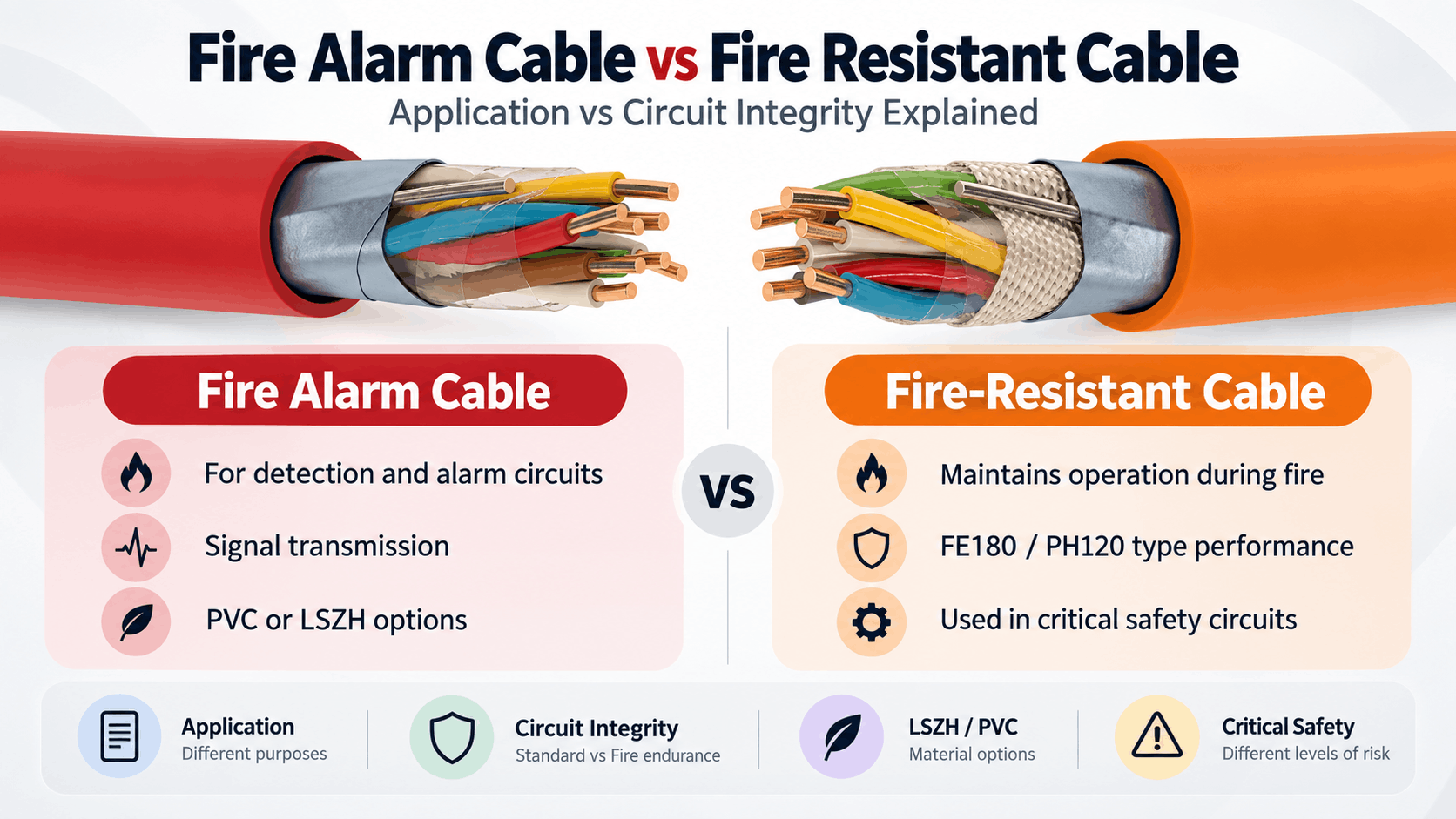
Fire Alarm Cable vs Fire Resistant Cable
Reading Time: 14 minutes
Fire alarm vs fire resistant cable terminology is frequently misunderstood because the two descriptions refer to different aspects of cable design. A fire alarm cable is identified primarily by its application within a fire detection or alarm system. A fire-resistant cable, by contrast, is designed to maintain electrical or signal continuity during fire exposure under a defined test method.
Therefore, a cable can be designed for fire alarm signalling without having circuit-integrity performance. Likewise, a fire-resistant cable can be used for emergency lighting, smoke extraction, evacuation systems or other safety circuits without being primarily described as a fire alarm cable.
This distinction becomes especially important when engineers specify alarm loops, detectors, sounders, voice evacuation systems and other life-safety circuits. Some circuits may require only appropriate flame, smoke, halogen and reaction-to-fire performance. Others must continue operating during fire and therefore require a verified fire-resistant construction.
For example, a screened J-Y(St)Y or J-H(St)H cable can be suitable for particular fire alarm and communication circuits depending on local requirements. However, neither construction automatically provides FE180 or PH120 circuit integrity. Where operation during fire is required, a purpose-designed construction such as JE-H(St)H Bd FE180 PH120 can be specified.
Quick answer: Fire alarm cable describes what the cable is used for. Fire-resistant cable describes what the cable can continue doing during fire. Fire alarm cables can be PVC or LSZH, screened or unscreened, flame retardant or fire resistant according to the project. Fire-resistant cables can serve fire alarms as well as emergency lighting, smoke control, evacuation, communication and other critical systems.
Fire Alarm vs Fire Resistant Cable at a Glance
| Characteristic | Fire Alarm Cable | Fire-Resistant Cable |
|---|---|---|
| Primary meaning | Application | Fire-survival performance |
| Main purpose | Fire detection and alarm signal transmission | Maintain circuit operation during fire |
| Always fire resistant? | No | Yes, according to its declared test performance |
| Can be flame retardant? | Yes | Yes |
| Can be LSZH? | Yes | Yes |
| Can be PVC? | Yes, where permitted | Construction dependent |
| Can be screened? | Yes | Yes |
| Typical circuit-integrity ratings | Only where specifically required | FE180, PH classifications or other specified performance |
| Typical applications | Detectors, alarm loops, signalling | Fire alarm, emergency lighting, smoke control, safety systems |
Consequently, the words printed in a product category should never replace verification of the actual cable construction, tests and project requirements.
What Is a Fire Alarm Cable?
A fire alarm cable is a low-voltage signal or communication cable designed for use within a fire detection and alarm system.
Typical connections can include:
- Smoke detectors
- Heat detectors
- Manual call points
- Fire alarm control panels
- Input and output modules
- Alarm loops
- Notification devices
- Monitoring circuits
- Interfaces with other safety systems
Depending on the system, fire alarm cable can carry analogue, digital or conventional signalling.
Therefore, important electrical characteristics can include conductor resistance, capacitance, screening, voltage rating and signal integrity.
However, the fact that a cable is intended for a fire alarm system does not automatically mean that it can continue transmitting signals while directly exposed to fire.
What Is a Fire-Resistant Cable?
A fire-resistant cable is engineered to maintain the required electrical or signal circuit integrity during fire exposure under specified test conditions.
This can require specialized construction elements such as:
- Mica fire barriers
- Fire-resistant insulation
- Ceramic-forming compounds
- Glass tapes
- Fire-resistant fillers
- Suitable LSZH outer sheath systems
During the applicable test, the cable must maintain the required circuit condition for the specified duration.
Therefore, fire-resistant performance is fundamentally different from simply resisting flame propagation.
Fire Alarm vs Fire Resistant Cable: The Fundamental Difference
The easiest way to distinguish the two categories is to ask two questions.
Fire alarm cable:
What system is this cable intended to connect?
Fire-resistant cable:
Can the circuit continue operating while the cable is exposed to fire?
Consequently, one description concerns application, while the other concerns performance.
A cable can satisfy both descriptions simultaneously. However, satisfying one does not automatically satisfy the other.
Can a Fire Alarm Cable Be Non-Fire-Resistant?
Yes.
This is one of the most important points in the comparison.
Some fire alarm signal cables provide:
- Flame-retardant performance
- Suitable signal transmission
- EMC screening
- LSZH construction where required
- CPR reaction-to-fire classification where applicable
but do not provide defined circuit integrity under fire.
For example, ETK’s J-Y(St)Y Lg is a PVC screened fire alarm and communication cable. Meanwhile, J-H(St)H Lg provides a halogen-free alternative. Neither product is classified as FE180/PH120 in its current technical documentation.
Therefore, fire alarm application and fire-survival capability must be checked separately.
When Does Fire Alarm Cable Need Fire Resistance?
The answer depends on the system design, national regulations, project specification and required safety function.
Some fire alarm circuits must continue functioning while people evacuate or emergency personnel respond.
Potential examples include:
- Critical detection loops
- Alarm notification circuits
- Voice evacuation systems
- Emergency communication
- Interfaces to fire-safety equipment
However, the required survival time and test standard are not universal.
Consequently, engineers should determine the applicable fire-alarm system requirement first and then specify the appropriate cable.
Fire Alarm vs Fire Resistant Cable and Circuit Integrity
Circuit integrity describes whether a circuit remains functional during fire exposure according to a defined test.
Standards such as EN 50200 and the IEC 60331 family can be used for relevant fire-survival cable constructions.
Depending on the test and project, designations can include:
- PH30
- PH60
- PH90
- PH120
- FE180
Meanwhile, cable-system classifications such as E30, E60 and E90 address another level of functional integrity involving the installed cable-support system.
Therefore, the phrase “fire alarm cable” alone does not communicate any of these performance levels.
Fire Alarm Cable vs Flame-Retardant Cable
Flame retardancy describes the ability of a cable to limit flame propagation under defined test conditions.
A flame-retardant cable may still lose electrical functionality relatively quickly after direct exposure to fire.
Therefore:
Flame retardant does not mean fire resistant.
A fire alarm cable can be flame retardant without providing circuit integrity.
Likewise, a fire-resistant fire alarm cable will normally need additional suitable flame-performance characteristics according to the overall project specification.
Fire Alarm Cable vs LSZH Cable
LSZH means Low Smoke Zero Halogen.
This describes material-related behaviour rather than the cable’s application or circuit-integrity performance.
For example, an LSZH fire alarm cable can reduce smoke and corrosive halogen-containing gases during combustion.
However:
LSZH does not automatically mean fire resistant.
Likewise, LSZH does not by itself establish a specific CPR Euroclass.
Consequently, LSZH, circuit integrity and reaction-to-fire classification should be specified independently.
PVC vs LSZH Fire Alarm Cable
Fire alarm cables can be manufactured using PVC or halogen-free material systems depending on local regulations and project requirements.
PVC constructions can provide:
- Practical installation characteristics
- Mechanical durability
- Cost efficiency
- Flame-retardant options
LSZH constructions, meanwhile, are designed to reduce smoke and halogen-containing corrosive gases.
Therefore, LSZH is often preferred in applications where evacuation and equipment protection are important.
However, the sheath material still does not determine whether the cable has circuit integrity.
J-Y(St)Y Fire Alarm Cable
J-Y(St)Y is a commonly used screened communication and fire alarm cable construction.
A typical design includes:
- Solid copper conductors
- PVC insulation
- Twisted conductor groups
- Aluminium/polyester overall screen
- Drain or earthing conductor
- PVC outer sheath
The screen helps protect low-level signalling against electromagnetic interference.
Nevertheless, a conventional J-Y(St)Y construction should not be assumed to provide FE180 or PH120 circuit integrity.
J-H(St)H Fire Alarm Cable
J-H(St)H provides a halogen-free alternative for suitable fire alarm, security and communication systems.
Compared with PVC-based construction, the principal difference is the use of halogen-free insulation and sheath materials.
This can provide advantages regarding:
- Smoke generation
- Corrosive combustion gases
- Halogen emissions
However, a standard J-H(St)H cable remains different from a purpose-designed FE180/PH120 construction.
Therefore, the letter H should not be interpreted as proof of circuit integrity.
J-Y(St)Y vs J-H(St)H
| Characteristic | J-Y(St)Y | J-H(St)H |
|---|---|---|
| Typical application | Fire alarm / communication | Fire alarm / communication |
| Insulation system | PVC based | Halogen-free |
| Outer sheath | PVC | Halogen-free |
| Overall screen | Yes | Yes |
| LSZH | No | Yes |
| Automatically FE180? | No | No |
| Automatically PH120? | No | No |
Consequently, the choice between the two primarily concerns material and fire-behaviour requirements rather than circuit integrity.
What Is JE-H(St)H Bd FE180 PH120?
JE-H(St)H Bd FE180 PH120 represents a substantially different fire-safety construction.
The cable is designed to maintain signal circuit performance during fire while also using halogen-free materials.
Depending on the exact product construction, fire barriers can include mica-based insulation systems.
Such cables can be suitable for critical:
- Fire detection circuits
- Alarm systems
- Emergency communication
- Safety signalling
- Evacuation-related circuits
Therefore, this type represents the area where the fire alarm and fire-resistant cable categories clearly overlap.
Fire Alarm vs Fire Resistant Cable: FE180 Explained
FE180 is associated with cable integrity under prolonged fire exposure according to the applicable specification.
It is not a general description for every red fire alarm cable.
Moreover, the designation should always be checked together with:
- The applicable test standard
- The exact cable construction
- Certificate documentation
- Other required fire classifications
Consequently, engineers should not select a cable merely because the catalogue contains “FE180” in the product name.
Fire Alarm vs Fire Resistant Cable: PH120 Explained
PH120 describes circuit-integrity performance for a defined period under the applicable fire and mechanical test conditions.
Mechanical shock is an important part of the relevant EN 50200-type testing framework.
Therefore, PH120 and FE180 should not automatically be treated as interchangeable classifications.
A project can require both if the fire strategy demands both types of demonstrated performance.
What Is EN 50200?
EN 50200 provides a test method for the fire resistance of small unprotected cables intended for emergency circuits.
The test combines flame exposure with mechanical shock.
Accordingly, it evaluates whether the circuit can remain functional under a more demanding scenario than simple flame exposure alone.
Depending on the relevant classification and project specification, PH performance can be associated with this type of test.
Therefore, EN 50200 is particularly relevant when a fire alarm or other emergency circuit must continue operating during fire.
What Is IEC 60331?
The IEC 60331 family provides international test methods for cables required to maintain circuit integrity under fire conditions.
Current parts cover different cable dimensions and test configurations.
For low-voltage cables, the tests can include fire together with mechanical shock.
Consequently, an RFQ should identify the applicable IEC 60331 part rather than simply stating “IEC 60331.”
The exact cable diameter, voltage and test arrangement can determine which part applies.
Fire Alarm Cable and CPR Reaction to Fire
Fire alarm cable installed permanently in European construction works can also require CPR reaction-to-fire classification.
Possible Euroclasses include:
- B2ca
- Cca
- Dca
- Eca
Higher classifications can additionally include smoke, flaming-droplet and acidity subclasses.
For example:
Cca-s1b,d1,a1
communicates much more reaction-to-fire information than simply stating “LSZH fire alarm cable.”
However, CPR class still does not demonstrate circuit integrity.
B2ca Fire Alarm Cable vs Fire-Resistant Cable
A B2ca fire alarm cable provides demanding reaction-to-fire performance.
However, B2ca primarily controls characteristics such as fire growth and heat release.
It does not automatically prove that alarm communication continues during the fire.
Therefore, a project can legitimately specify:
B2ca + PH120
or another suitable combination.
In that case, one requirement addresses the cable’s contribution to fire while the other addresses continued circuit operation.
Does Red Sheath Mean Fire Resistant?
No.
Red is commonly used as an identification colour for fire alarm and fire-safety cables.
However, outer-sheath colour is not a fire-resistance classification.
A red cable can be:
- PVC
- LSZH
- Flame retardant
- Fire resistant
- CPR classified at different levels
Consequently, engineers should never determine fire performance from cable colour alone.
Does a Mica Tape Mean Fire Resistance?
Mica tapes are widely used as fire barriers in circuit-integrity cable constructions.
During fire exposure, mica helps maintain electrical separation around the conductor.
However, the presence of mica alone does not establish a certified fire rating.
The complete cable must perform under the applicable test.
Therefore, fire-resistance claims should be based on tested finished-cable performance rather than construction materials alone.
Screened Fire Alarm Cable
Fire alarm circuits can operate near power cables, motors, switchgear and other sources of electromagnetic interference.
For this reason, screened fire alarm constructions are widely used.
A typical overall screen can include:
- Aluminium/polyester foil
- Drain wire
- Earth conductor
The screen primarily addresses electromagnetic compatibility.
However, screening does not make the cable fire resistant.
Therefore, EMC performance and fire-survival performance should be treated separately.
Can a Fire-Resistant Cable Be Screened?
Yes.
Fire-resistant cables can incorporate metallic screens where the connected circuit requires interference protection.
Examples can include:
- Foil screens
- Copper braid screens
- Combined screening systems
For example, fire-resistant signal and control cable constructions can combine circuit integrity with copper-braid screening.
Consequently, fire resistance does not prevent the cable from also providing EMC protection.
Fire Alarm Cable for Conventional Systems
Conventional fire alarm systems normally organize detectors and alarm devices into defined zones or circuits.
Cable requirements can include:
- Reliable low-voltage signal transmission
- Suitable conductor resistance
- Correct pair or core count
- Screening where required
- Applicable fire performance
However, the required circuit-integrity level still depends on the design and local regulation.
Therefore, “conventional fire alarm” should not automatically be translated into one universal cable construction.
Fire Alarm Cable for Addressable Systems
Addressable fire detection systems allow individual devices to communicate with the control panel over loops or networked circuits.
Reliable signal transmission therefore becomes particularly important.
Depending on the system manufacturer, relevant characteristics can include:
- Conductor resistance
- Capacitance
- Screening
- Maximum loop length
- Cable fire performance
Consequently, the alarm-system manufacturer’s cable requirements should always be coordinated with the building fire specification.
Fire Alarm Cable for Voice Evacuation Systems
Voice evacuation systems have a different functional role from ordinary detector loops.
The system may need to continue transmitting evacuation instructions while a fire develops.
Therefore, fire-survival requirements can become particularly important.
Depending on system architecture, cable types can include:
- Fire-resistant signal cables
- Fire-resistant loudspeaker cables
- Fire-resistant power cables
- Fire-resistant communication cables
As a result, voice evacuation projects should not use the generic phrase “fire alarm cable” without defining the actual circuit.
Fire-Resistant Cables Beyond Fire Alarm Systems
Fire-resistant cable is a much broader category than fire alarm cable.
Other critical applications can include:
- Emergency lighting
- Smoke extraction
- Fire-fighting pumps
- Pressurization systems
- Emergency elevators
- Critical communication
- Safety-control circuits
- Railway and metro systems
- Tunnel systems
Therefore, a fire-resistant cable does not become a fire alarm cable merely because both products are associated with fire safety.
Fire Alarm vs Fire Resistant Cable for Hospitals
Hospitals can contain complex alarm, evacuation and life-safety systems while rapid evacuation may be difficult.
Consequently, different circuits can require different levels of:
- Reaction to fire
- Low smoke
- Low acidity
- Circuit integrity
A detector loop and an emergency power circuit are not necessarily served by the same cable construction.
Therefore, hospital specifications should identify each circuit function independently.
Fire Alarm vs Fire Resistant Cable for High-Rise Buildings
High-rise buildings create long evacuation routes and large vertical cable networks.
Fire alarm signalling must therefore remain reliable according to the applicable safety strategy.
Meanwhile, other systems such as emergency lighting, pressurization and smoke extraction can require separate fire-resistant power or control cables.
Consequently, the building may contain several different fire-safety cable families rather than one universal red cable.
Fire Alarm vs Fire Resistant Cable for Tunnels
Tunnels can combine restricted evacuation with significant smoke and heat hazards.
Therefore, cable specifications frequently place strong emphasis on:
- Low smoke
- Halogen-free construction
- Reaction-to-fire performance
- Circuit integrity for critical systems
However, detector loops, fiber communication systems and emergency-power circuits can require different cable constructions.
Consequently, tunnel cable selection should follow each system’s safety function.
Fire Alarm vs Fire Resistant Cable for Airports
Airports contain large public spaces, control systems and extensive emergency infrastructure.
Fire alarm cables can connect detectors, panels and notification equipment.
Meanwhile, fire-resistant cables can serve emergency lighting, evacuation, smoke control and other critical functions.
Therefore, airport projects illustrate clearly why fire alarm cable and fire-resistant cable should not be treated as synonyms.
Common Fire Alarm vs Fire Resistant Cable Mistakes
1. Assuming Every Fire Alarm Cable Is Fire Resistant
Fire alarm application does not automatically establish circuit integrity.
2. Assuming Every Red Cable Is Fire Resistant
Sheath colour does not define fire performance.
3. Assuming J-H(St)H Means FE180
Halogen-free construction alone does not demonstrate fire survival.
4. Assuming LSZH Means PH120
LSZH and circuit integrity are separate properties.
5. Assuming B2ca Means Circuit Integrity
B2ca is a reaction-to-fire classification.
6. Assuming Flame Retardant Means Fire Resistant
Limiting flame propagation does not guarantee continued circuit operation.
7. Selecting Fire Alarm Cable Only by Colour
Electrical and fire-performance parameters must also be checked.
8. Ignoring Alarm-System Manufacturer Requirements
Loop capacitance, resistance and topology can affect cable suitability.
9. Specifying Only “Fire Rated”
This phrase does not identify the required performance.
10. Assuming Mica Automatically Means FE180
The complete cable must achieve the required test result.
11. Ignoring CPR Classification
Circuit integrity does not replace reaction-to-fire requirements.
12. Ignoring Screening
Fire resistance does not automatically provide electromagnetic compatibility.
13. Using Fire Alarm Cable for Emergency Power
Signal and power cable requirements can be completely different.
14. Using the Highest Fire Rating Everywhere
The cable should match the safety function and applicable regulation.
15. Treating All Fire Alarm Circuits as Identical
Detector loops, sounders, voice evacuation and ancillary systems can have different requirements.
How to Choose Fire Alarm vs Fire Resistant Cable
1. Identify the Circuit Function
Determine whether the cable serves detection, signalling, alarm notification, evacuation, power or another safety function.
2. Determine Whether Operation During Fire Is Required
If the circuit must continue operating, define a circuit-integrity requirement.
3. Check the Applicable Fire Alarm Standard
Use the national regulations, system standard and project specification applicable to the installation.
4. Define Circuit-Integrity Performance
Specify EN 50200, the applicable IEC 60331 part, FE, PH or other required performance where relevant.
5. Define Reaction to Fire
Select the required CPR Euroclass for applicable European building installations.
6. Define Smoke and Halogen Requirements
Specify LSZH and supplementary CPR smoke/acidity requirements separately.
7. Define Screening
Determine whether the alarm or communication circuit requires EMI protection.
8. Check Electrical Characteristics
Verify conductor resistance, capacitance, voltage and cable length requirements.
9. Verify the Exact Product Documentation
Finally, confirm that certificates and technical data correspond to the actual cable supplied.
What Should Buyers Include in a Fire Alarm Cable RFQ?
A professional RFQ should avoid asking simply for “red fire alarm cable.”
Useful specification information includes:
- Fire alarm system type
- Circuit function
- Number of cores or pairs
- Conductor diameter or cross-section
- Rated voltage
- Maximum conductor resistance
- Capacitance requirement where applicable
- Screening requirement
- Drain wire requirement
- PVC or LSZH construction
- Flame-retardant requirement
- CPR Euroclass where applicable
- Smoke subclass
- Flaming-droplet subclass
- Acidity subclass
- Circuit-integrity requirement
- EN 50200 requirement where applicable
- IEC 60331 requirement where applicable
- FE180 requirement where applicable
- PH120 requirement where applicable
- E30 / E60 / E90 system requirement where applicable
- Installation environment
- UV resistance where applicable
- Required cable colour
- Project or end-user standard
- Test certificates
- Declaration of Performance where applicable
Consequently, manufacturers can quote the correct construction rather than guessing what the phrase “fire alarm cable” is intended to mean.
ETK Kablo Fire Alarm and Fire-Resistant Cable Solutions
ETK Kablo manufactures separate fire alarm and fire-resistant cable families for different safety requirements.
For general alarm and communication applications, ETK manufactures J-Y(St)Y Lg screened PVC fire alarm cable and J-H(St)H Lg screened halogen-free fire alarm cable.
These products are designed for signal transmission, electromagnetic compatibility and the appropriate flame/material performance of their respective constructions.
However, they should not be confused with FE180/PH120 circuit-integrity cables.
For systems that must remain operational during fire, ETK manufactures specialized constructions such as JE-H(St)H Bd FE180 PH120 and other fire-resistant signal, control and power cables.
Additional products such as LIHCH FE180 PH120 combine fire survival, LSZH construction and metallic screening for suitable critical control and communication circuits.
Meanwhile, CPR classifications such as B2ca, Cca, Dca and Eca can be specified independently according to the particular cable family and project requirement.
Therefore, ETK can distinguish between fire detection application, reaction-to-fire performance and circuit-integrity requirements rather than treating every fire-safety cable as the same product.
Frequently Asked Questions About Fire Alarm vs Fire Resistant Cable
Is fire alarm cable fire resistant?
Not automatically. Some fire alarm cables provide only the signal, screening, flame and material characteristics required for their application, while others additionally provide fire-resistant circuit integrity.
What is the difference between fire alarm and fire-resistant cable?
Fire alarm cable is defined primarily by its use in fire detection and alarm systems. Fire-resistant cable is defined by its ability to maintain circuit function during fire under a specified test.
Is J-Y(St)Y fire resistant?
A conventional J-Y(St)Y construction is generally a screened PVC communication or alarm cable and should not be assumed to provide FE180 or PH120 circuit integrity.
Is J-H(St)H fire resistant?
Standard J-H(St)H provides halogen-free alarm and communication performance but should not automatically be classified as FE180 or PH120.
What fire alarm cable is FE180 PH120?
Purpose-designed products such as JE-H(St)H Bd FE180 PH120 can provide fire-survival performance for appropriate alarm and safety circuits.
Does LSZH mean fire resistant?
No. LSZH relates to smoke and halogen characteristics rather than continued circuit operation.
Does B2ca mean fire resistant?
No. B2ca describes reaction to fire and does not by itself demonstrate circuit integrity.
Does flame retardant mean fire resistant?
No. Flame retardancy limits flame propagation, whereas fire resistance addresses continued circuit operation.
Does a red sheath mean fire resistance?
No. Red is an identification colour and provides no proof of fire-survival performance.
Can fire alarm cable be PVC?
Yes, where permitted by the applicable system design and regulations. J-Y(St)Y is one example of a PVC-based alarm and communication cable.
Can fire alarm cable be LSZH?
Yes. J-H(St)H is an example of a halogen-free screened alarm and communication cable.
What does PH120 mean on fire alarm cable?
PH120 indicates defined circuit-integrity performance under the applicable fire and mechanical test classification for the specified duration.
What does FE180 mean?
FE180 is associated with cable fire-integrity performance under the applicable test specification and should be verified through the exact product documentation.
Can a fire alarm cable be B2ca and PH120?
Yes, if the finished product independently satisfies both the required reaction-to-fire and circuit-integrity specifications.
Do all fire alarm systems require PH120 cable?
No. The required circuit-integrity level depends on the system function, national regulation and project fire strategy.
Can fire-resistant cable be used for emergency lighting?
Yes. Fire-resistant cables are widely applicable to emergency lighting and other circuits that must remain operational during fire.
Can fire-resistant cable be used for smoke extraction?
Yes, suitable fire-resistant power or control cables can serve smoke-control equipment where required by the system design.
Is screened fire alarm cable fire resistant?
Not necessarily. Screening provides electromagnetic interference protection and is independent of circuit integrity.
Which standard tests fire-resistant cable?
Common test frameworks include EN 50200 and the IEC 60331 family, depending on the cable and project specification.
Which cable should I use for a fire alarm system?
Use a cable that satisfies the alarm-system electrical requirements, local fire code, reaction-to-fire requirements and any specified circuit-integrity performance.
Conclusion
The fire alarm vs fire resistant cable distinction becomes straightforward once application and performance are separated.
Fire alarm cable describes a product intended to carry signals within a fire detection or alarm system. It can be screened or unscreened, PVC or halogen free, and can have different reaction-to-fire characteristics depending on the construction.
However, fire alarm application does not automatically establish circuit integrity.
A conventional J-Y(St)Y or J-H(St)H cable can provide appropriate alarm and communication performance without being an FE180/PH120 fire-survival cable.
Fire-resistant cable, by contrast, is designed to maintain circuit function under defined fire-test conditions. Therefore, it can serve fire alarms but also many other critical systems such as emergency lighting, evacuation, smoke extraction and safety controls.
Specify Application and Fire Performance Separately
The most reliable specification strategy is therefore to define the system application and fire performance independently.
First, identify whether the circuit is a detector loop, alarm signal, notification circuit, evacuation system, emergency power circuit or another safety function.
Next, determine whether continued operation during fire is required and specify EN 50200, IEC 60331, FE180, PH120 or another applicable circuit-integrity requirement where necessary.
Meanwhile, CPR reaction-to-fire class, LSZH construction, smoke, acidity and flame propagation should be defined separately.
Ultimately, neither “fire alarm cable” nor “fire-resistant cable” provides enough information by itself. The correct cable is the construction whose electrical characteristics, material behaviour, reaction to fire and circuit integrity precisely match the safety function it is expected to perform.
Benzer yazılar
Ethernet Cable Testing: NEXT, Return Loss, Insertion Loss and ACR Explained
Ethernet cable testing verifies whether a twisted-pair copper cabling system can transmit data within the electrical performance limits...

Fiber Optic Cable Attenuation: 850, 1310, 1550 and 1625 nm Explained
Fiber optic cable attenuation describes the reduction in optical power as light travels through an optical fiber. It is normally expres...
A-02YSF(L)2Y vs A-2Y(L)2Y Outdoor Telephone Cable
A-02YSF(L)2Y vs A-2Y(L)2Y is an important comparison when selecting copper outdoor telephone cable for telecommunications networks, und...
RS-485 Cable vs Instrumentation Cable: Can Instrumentation Cable Be Used for Modbus RTU?
A Modbus RTU cable must do more than carry a low-voltage digital signal from one device to another. Modbus RTU commonly uses an RS-485 ...

Ethernet Cable for PoE: Conductor Size, Heat and Bundle Performance
A PoE Ethernet cable carries data and electrical power over the same balanced twisted-pair cabling system. This capability simplifies t...
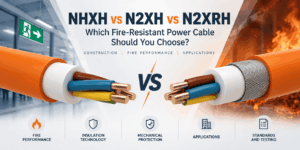
NHXH vs N2XH vs N2XRH: Which Fire-Resistant Power Cable Should You Choose?
NHXH vs N2XH vs N2XRH is an important comparison when specifying 0.6/1 kV power cables for emergency and life-safety systems. Although ...

How to Specify Low Current Cables for Infrastructure Projects
A professional low current cable specification should define much more than a cable name, conductor count or sheath colour. Infrastruct...
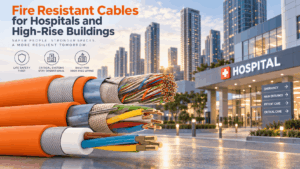
Fire Resistant Cables for Hospitals and High-Rise Buildings
Fire resistant cable for hospitals and high-rise buildings supports electrical, communication and control systems that may need to rema...

Industrial Control Cable Selection for Automation and Machinery
Industrial control cable selection should begin with the function of the circuit and the mechanical conditions of the machine rather th...
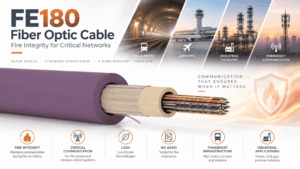
FE180 Fiber Optic Cable: Fire Integrity, Applications and Selection
An FE180 fiber optic cable is designed for optical communication routes where continued transmission during fire can form part of the p...

Screened vs Unscreened Control Cable: What Is the Difference?
Control cable shielding is one of the most important design decisions when selecting cable for industrial automation, machinery, buildi...

BMS Cable Selection: Building Automation Cables for HVAC and Smart Buildings
BMS cable selection should begin with the communication protocol and physical layer rather than with a generic request for “building au...


