





 President’s Message
Blog
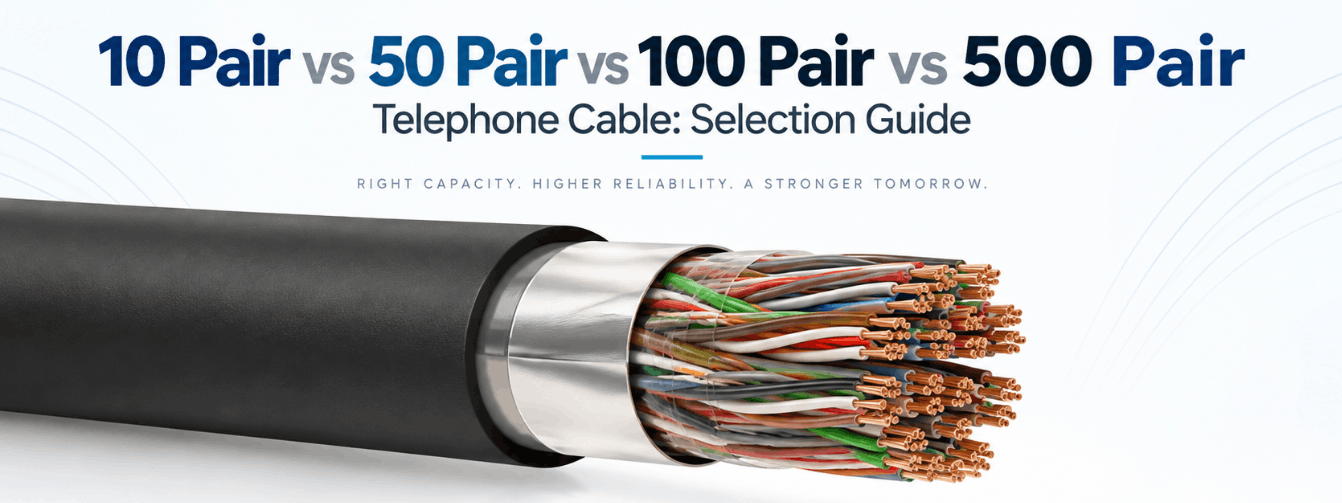
10 Pair vs 50 Pair vs 100 Pair vs 500 Pair Telephone Cable: Selection Guide
Reading Time: 17 minutes
Telephone cable pair count is one of the first specifications engineers and procurement teams must define when selecting a multi-pair copper telecommunications cable. A 10-pair cable and a 500-pair cable can use the same conductor material, insulation technology, filling compound, screen and outer sheath, yet they serve completely different network capacities and installation conditions.
Pair count determines how many two-conductor communication circuits the cable can accommodate. Therefore, increasing pair count expands network capacity but also increases cable diameter, copper content, total weight, drum size and installation effort.
However, the largest cable is not automatically the best choice. An oversized cable can add unnecessary material and handling cost, while an undersized cable can leave too little spare capacity for future subscribers, extensions, faults or network reconfiguration.
For this reason, engineers should select pair count according to the actual distribution architecture rather than simply choose the highest number available.
Quick answer: 10-pair telephone cable is suitable for small local branches and limited connection points. 50-pair cable can serve medium distribution sections, industrial facilities or smaller telecom branches. 100-pair cable provides more substantial feeder or building-distribution capacity. 500-pair cable is a large outside-plant trunk or feeder construction intended for networks where hundreds of circuits must be consolidated into one route. The correct choice should include spare-pair allowance, conductor diameter, transmission distance, cable construction and physical installation constraints.
Telephone Cable Pair Count at a Glance
| Pair Count | Number of Conductors | Typical Network Role | Main Advantage | Main Trade-Off |
|---|---|---|---|---|
| 10 Pair | 20 | Small branch or local distribution | Compact and easy to install | Limited future capacity |
| 50 Pair | 100 | Medium distribution cable | Good balance of capacity and size | Larger than local branch cables |
| 100 Pair | 200 | Feeder or major building distribution | High circuit capacity | Higher weight and larger bend requirements |
| 500 Pair | 1000 | Large outside-plant trunk or feeder | Very high network consolidation | Heavy, large and installation-intensive |
Consequently, telephone cable pair count should be treated as a network-capacity parameter rather than a quality level.
What Does Telephone Cable Pair Count Mean?
A telephone pair consists of two insulated copper conductors that are twisted together to form one balanced communication circuit.
Therefore:
- 10 pairs = 20 insulated conductors
- 50 pairs = 100 insulated conductors
- 100 pairs = 200 insulated conductors
- 500 pairs = 1000 insulated conductors
Each pair can be identified through a color-coding and grouping system so that technicians can locate the correct circuit during installation, splicing and maintenance.
As pair count increases, manufacturers organize the conductors into progressively larger cable units rather than twisting hundreds of independent pairs randomly into one bundle.
Why Telephone Cables Use Pair Groups
Large multi-pair cables require structured organization.
Manufacturers therefore assemble pairs into units and then strand those units together into the complete cable core.
A typical outside-plant design can use:
- 10-pair basic units
- 25-pair groups
- 50-pair groups
- 100-pair groups
This modular architecture improves:
- Pair identification
- Manufacturing consistency
- Splicing
- Fault location
- Network documentation
Therefore, a 500-pair cable is not simply a larger version of a 10-pair bundle. Its internal organization becomes an important part of the cable engineering.
Pair Construction vs Star Quad Construction
Outdoor telephone cables can be manufactured using conventional twisted pairs or star-quad constructions depending on the network specification.
A twisted pair contains two conductors.
A star quad contains four conductors arranged so that two balanced circuits can be derived from the quad.
Consequently, manufacturers can still express large star-quad cables in an equivalent pair count.
This is important when reading datasheets because:
pair count describes network capacity, while the internal stranding method can still be pair or quad based.
10 Pair Telephone Cable
A 10-pair cable represents a relatively small multi-pair construction.
It is particularly useful where a network branch serves only a limited number of connection points.
Potential applications include:
- Small industrial buildings
- Security and gatehouse communication
- Local telecom branches
- Small control facilities
- Remote equipment areas
- Roadside infrastructure
- Utility installations
Because the cable contains only 20 conductors, its diameter and total weight can remain relatively low compared with larger feeder cables.
Advantages of 10 Pair Telephone Cable
The principal advantage is easy handling.
A smaller cable can provide:
- Lower drum weight
- Smaller duct occupancy
- Lower pulling force
- Smaller bending radius
- Easier termination
- Faster splicing
- Lower copper consumption
Therefore, specifying 50 or 100 pairs for a route that will realistically use only six or eight circuits can create unnecessary cost and physical bulk.
Limitations of 10 Pair Telephone Cable
The main limitation is future capacity.
Suppose eight of the ten pairs are allocated immediately.
The route would then contain only two unused pairs for:
- Expansion
- Fault replacement
- Temporary circuits
- New equipment
Therefore, 10 pairs can become restrictive when the network is expected to grow.
When Should You Choose 10 Pair Telephone Cable?
10-pair cable is most logical when:
- The endpoint count is genuinely low
- The route is a final branch rather than a main feeder
- Future expansion is limited
- Duct space is constrained
- Low cable weight is important
It can also be useful when a large feeder cable branches into several smaller local distribution cables.
50 Pair Telephone Cable
A 50-pair cable represents a major step up in capacity while still remaining manageable in many field installations.
It contains 100 insulated copper conductors.
This pair count can be attractive for:
- Medium commercial facilities
- Factories
- Industrial campuses
- Infrastructure branches
- Utility networks
- Telecom distribution cabinets
- Small outside-plant feeders
As a result, 50 pairs often provide a useful middle ground between small branch cables and large feeder constructions.
Advantages of 50 Pair Telephone Cable
Compared with 10 pairs, the additional capacity provides considerably more flexibility.
Engineers can allocate pairs for:
- Active circuits
- Future extensions
- Spare capacity
- Different network zones
- Maintenance replacement
At the same time, a 50-pair cable can remain significantly easier to handle than a 500-pair trunk.
Therefore, it can be an efficient choice for decentralized distribution.
When Should You Choose 50 Pair Telephone Cable?
50 pairs can make sense when the route serves several equipment areas or buildings but does not justify a very large trunk cable.
For example, an industrial site can use one 50-pair outdoor cable from the main communication room to a remote distribution cabinet.
Smaller cables can then continue from the cabinet to individual facilities.
Consequently, network hierarchy becomes just as important as total pair demand.
100 Pair Telephone Cable
A 100-pair cable contains 200 insulated copper conductors and represents a substantial communications feeder.
This capacity can be suitable for:
- Large buildings
- Industrial sites
- Airports
- Railway infrastructure
- Transport facilities
- Large campuses
- Telecom cabinets
- Utility distribution systems
At this level, pair allocation and documentation become increasingly important because one cable can serve many independent circuits.
Advantages of 100 Pair Telephone Cable
A 100-pair cable allows substantial consolidation.
Instead of pulling multiple 10- or 20-pair cables through the same route, one larger cable can carry the required circuits.
This can reduce:
- Number of cable pulls
- Number of individual cable jackets
- Route complexity
- Cable identification requirements
- Number of separate drums
However, the overall cable becomes heavier and larger.
Therefore, project engineers must consider pulling equipment, duct dimensions and bend geometry before deciding that consolidation is always preferable.
When Should You Choose 100 Pair Telephone Cable?
100 pairs make sense when the cable acts as a feeder toward a distribution point serving many downstream circuits.
The design can also be attractive where future expansion is expected but a 500-pair trunk would be excessive.
For example, if current requirements total approximately 60 to 70 pairs, a 100-pair cable can provide useful spare capacity without moving immediately to a very large construction.
500 Pair Telephone Cable
A 500-pair cable contains 1000 insulated conductors.
This is no longer a small distribution cable. It is a major outside-plant feeder or trunk construction.
Potential applications include:
- Telecommunications distribution networks
- Large industrial complexes
- Major transport infrastructure
- Utility communication systems
- Legacy public telephone networks
- Large campus backbones
- Central distribution routes
Such cables can consolidate hundreds of circuits into one physical route.
However, the practical engineering requirements become much more demanding.
Why 500 Pair Telephone Cable Is a Different Installation Class
Moving from 100 to 500 pairs does not simply multiply capacity by five.
It also significantly increases:
- Cable diameter
- Copper weight
- Total cable weight
- Drum weight
- Bending radius
- Pulling effort
- Splicing time
- Joint-closure size
Consequently, a 500-pair cable should be treated as a planned network asset rather than a convenient way to create extra spare pairs.
10 Pair vs 50 Pair vs 100 Pair vs 500 Pair
| Characteristic | 10 Pair | 50 Pair | 100 Pair | 500 Pair |
|---|---|---|---|---|
| Conductors | 20 | 100 | 200 | 1000 |
| Network capacity | Low | Medium | High | Very high |
| Typical network position | Final branch | Distribution | Feeder | Main feeder / trunk |
| Installation difficulty | Low | Moderate | Higher | High |
| Splicing workload | Low | Moderate | High | Very high |
| Duct space | Low | Moderate | Higher | Significant |
| Future capacity | Limited | Good | High | Very high |
Therefore, telephone cable pair count should be selected according to the position of the cable inside the network hierarchy.
Pair Count Does Not Determine Transmission Distance
This distinction is essential.
A 500-pair cable does not automatically transmit farther than a 10-pair cable.
Transmission distance depends much more strongly on parameters such as:
- Conductor diameter
- Conductor resistance
- Mutual capacitance
- Operating frequency
- Signal technology
- Insulation construction
Therefore, pair count primarily determines capacity rather than electrical reach.
Conductor Diameter and Telephone Cable Pair Count
Telephone cables can be produced using conductor diameters such as:
- 0.40 mm
- 0.50 mm
- 0.60 mm
- 0.63 mm
- 0.65 mm
- 0.80 mm
- 0.90 mm
Larger conductors provide lower DC resistance.
However, they also increase cable diameter and copper weight.
Consequently, a 500-pair cable using 0.8 mm conductors can become dramatically larger and heavier than a 500-pair cable using 0.4 or 0.5 mm conductors.
Why Pair Count and Conductor Diameter Must Be Selected Together
Consider two independent requirements:
Pair count answers: How many circuits must the cable carry?
Conductor diameter answers: What electrical resistance and transmission reach are required?
A project can therefore require:
- 10 pairs × 0.8 mm
- 50 pairs × 0.5 mm
- 100 pairs × 0.6 mm
- 500 pairs × 0.4 mm
Each combination serves a different engineering requirement.
Pair Count and Cable Diameter
As pair count increases, the physical cable core must accommodate more insulated conductors.
Therefore, outside diameter generally rises significantly.
However, the exact increase depends on:
- Conductor diameter
- Insulation thickness
- Pair or quad stranding
- Filling compound
- Wrapping
- Screen
- Armour
- Outer jacket thickness
Consequently, engineers should never estimate duct fill from pair count alone.
ETK Example: Pair Count vs Cable Diameter
ETK Kablo’s A-02YSF(L)2Y / KPDF-AP provides a useful real-world example.
Using the same 0.5 mm conductor diameter in the quad construction, published approximate dimensions increase substantially with pair count:
| Pair Count | Approx. Cable Diameter | Approx. Cable Weight | Published Packing Length |
|---|---|---|---|
| 10 Pair | 9 mm | 102 kg/km | 1500 m |
| 50 Pair | 17 mm | 362 kg/km | 1000 m |
| 100 Pair | 21 mm | 658 kg/km | 500 m |
| 500 Pair | 43 mm | 2953 kg/km | 500 m |
This example demonstrates why high pair count affects much more than electrical capacity.
From 10 pairs to 500 pairs, the published cable diameter grows from approximately 9 mm to 43 mm, while total cable weight increases from roughly 102 kg/km to almost 3 tonnes per kilometre.
Therefore, pair-count selection has direct implications for installation logistics.
Pair Count and Copper Weight
Copper content rises almost directly with the number of conductors when conductor diameter remains the same.
For example, increasing from 10 pairs to 100 pairs increases the number of copper conductors from 20 to 200.
This affects:
- Material cost
- Drum weight
- Transport cost
- Handling requirements
- Cable support loads
Consequently, unnecessary pair capacity has a tangible physical and financial cost.
Pair Count and Cable Weight
The increase in total cable weight is not caused only by copper.
Larger pair counts also require more:
- Insulation
- Filling compound
- Binders
- Wrapping tape
- Screen material
- Outer-jacket polymer
Therefore, total cable weight can increase considerably as the core becomes larger.
Pair Count and Drum Length
Large cables occupy more drum volume and add considerably more weight per metre.
As a result, manufacturers often supply shorter standard drum lengths for high-pair-count cables.
A small 10-pair cable can be supplied in relatively long lengths, while very large trunk cables can require shorter drums.
This matters because each additional drum can create another:
- Joint
- Splice location
- Handling operation
- Logistics requirement
Therefore, drum planning should form part of the initial cable selection.
Pair Count and Duct Capacity
Duct space is often limited.
A 500-pair cable can consume substantially more cross-sectional area than a 10- or 50-pair cable.
Consequently, choosing one very large cable can affect the future ability to install:
- Additional copper cables
- Fiber optic cables
- Power cables where permitted
- Other communications infrastructure
Therefore, engineers should consider both current network consolidation and long-term pathway utilization.
One Large Cable vs Several Smaller Cables
This is an important design decision.
Suppose a route requires approximately 100 pairs.
The network designer could theoretically use:
- One 100-pair cable
- Two 50-pair cables
- Ten 10-pair cables
Each strategy has different advantages.
Advantages of One Large Cable
- Fewer cable pulls
- Fewer external jackets
- Cleaner route management
- Centralized pair allocation
- Potentially simpler feeder architecture
Advantages of Several Smaller Cables
- Easier handling
- Smaller individual bend radius
- Greater route flexibility
- Potential separation between network zones
- Failure of one cable affects fewer circuits
Therefore, pair capacity alone does not determine the optimal architecture.
Pair Count and Network Redundancy
Consolidating hundreds of circuits into one cable creates efficiency but also concentration risk.
If a 500-pair trunk suffers severe mechanical damage, many circuits can be affected simultaneously.
By contrast, dividing capacity across several routes or cables can reduce the impact of one physical failure.
Therefore, critical infrastructure should evaluate:
- Route diversity
- Cable redundancy
- Spare pairs
- Alternative pathways
rather than simply maximize the pair count of one cable.
How Many Spare Pairs Should Be Included?
There is no universal percentage that suits every project.
Spare-pair requirements depend on:
- Expected network growth
- Project lifetime
- Criticality
- Difficulty of adding new cables
- Available duct space
- Maintenance philosophy
For example, a route that is easy to access later might require less spare capacity than a cable buried beneath major infrastructure where replacement is extremely disruptive.
Why Spare Pairs Are Useful
Unused pairs can provide several forms of operational flexibility.
They can be used for:
- Future extensions
- Fault replacement
- Temporary services
- Network reconfiguration
- Additional equipment
Therefore, designing exactly the current active-pair requirement can create unnecessary future risk.
Why Too Many Spare Pairs Can Be Wasteful
Reserve capacity is valuable, but extreme oversizing can become inefficient.
If a site realistically needs 20 pairs and is unlikely ever to exceed 30, installing a 500-pair cable would add enormous unused copper and physical bulk.
Consequently, spare capacity should reflect a plausible expansion scenario rather than an arbitrary preference for the largest cable.
Telephone Cable Pair Count for Industrial Plants
Industrial sites can contain numerous communication circuits distributed between:
- Control buildings
- Security systems
- Remote substations
- Process areas
- Gatehouses
- Utility buildings
- Maintenance facilities
A hierarchical approach can be effective.
For example, a 100-pair feeder can connect a main communications room to a remote area, while 10- or 20-pair cables distribute circuits from that point to smaller facilities.
Therefore, one project can use several pair counts simultaneously.
Telephone Cable Pair Count for Airports
Airports can contain long outdoor routes and many distributed service locations.
Multi-pair copper cables can support legacy or dedicated communication circuits between:
- Terminal buildings
- Maintenance areas
- Security facilities
- Airfield infrastructure
- Utility buildings
Larger feeder counts can be useful between central distribution points, while smaller pair counts can serve local branches.
Telephone Cable Pair Count for Railway Infrastructure
Railway routes can also require geographically distributed copper communications.
Potential network points include:
- Stations
- Signal cabins
- Maintenance buildings
- Level-crossing infrastructure
- Tunnels
- Trackside facilities
Consequently, large feeder cables and smaller branch cables can coexist within the same network architecture.
Telephone Cable Pair Count for Utility Networks
Utilities can maintain copper communication systems alongside power, water, natural gas or other infrastructure.
In these networks, cable replacement can be difficult because routes can extend through remote or buried infrastructure.
Therefore, spare-pair capacity can be particularly valuable.
However, engineers should still balance future reserve against cable size and installation constraints.
Telephone Cable Pair Count for Buildings
Indoor telephone cables can also use multiple pair counts.
Smaller constructions can connect local zones, while 50- or 100-pair cables can serve building risers or main distribution routes.
However, indoor cable requirements differ from outdoor cables in areas such as:
- Flame performance
- LSZH requirements
- CPR classification
- Outer-jacket material
Therefore, pair count should never be used as the only product-selection criterion.
Outdoor vs Indoor Telephone Cable Pair Count
The same pair count can appear in both indoor and outdoor cable families.
For example, a 50-pair indoor cable and a 50-pair outdoor cable provide similar nominal circuit capacity but can have very different constructions.
An outdoor cable can include:
- PE insulation
- Jelly filling
- Water blocking
- Aluminum moisture barrier
- UV-resistant PE jacket
An indoor product can instead prioritize:
- Flame retardancy
- LSZH construction
- Building safety
Therefore, pair count answers only the capacity question.
Pair Count and Jelly-Filled Cable
Jelly filling becomes particularly valuable in large outdoor telephone cables because water entering one location can otherwise migrate through a substantial cable core.
Hydrophobic filling compound occupies internal voids and restricts longitudinal water movement.
Consequently, a 500-pair outdoor feeder can use the same basic jelly-filled protection principle as a 10-pair cable, although the total quantity of filling material is much greater.
Pair Count and Dry-Core Cable
Dry-core designs eliminate conventional jelly filling.
Some can also incorporate dry water-blocking materials.
High pair counts can make dry handling attractive because technicians may need to splice hundreds of conductors.
However, moisture protection must still match the route.
Therefore, convenience during splicing should not override environmental requirements.
Pair Count and Foam-Skin vs Solid PE
Insulation architecture is another independent selection variable.
A large telephone cable can use:
- Foam-skin PE
- Solid PE
Foam-skin provides dielectric advantages, while solid PE provides a robust homogeneous insulation structure.
Therefore, pair count and insulation technology should be specified separately.
Pair Count and Metallic Screening
Large outside-plant telephone cables commonly use a metallic aluminum-based screen around the cable core.
This can contribute to:
- Electrostatic shielding
- EMI protection
- Moisture-barrier performance
As pair count increases, the overall core circumference also increases, which affects the amount of screening material required.
However, pair count itself does not determine whether screening is necessary.
Pair Count and Cable Armour
Armour addresses mechanical risks rather than circuit capacity.
A project can require:
- 10-pair armored cable
- 50-pair armored cable
- 100-pair armored cable
- 500-pair armored cable
depending on route conditions.
However, applying armour to a large high-pair-count cable can increase diameter and weight significantly.
Therefore, duct dimensions and installation equipment should be reviewed carefully.
Pair Count and Bending Radius
Minimum bending radius is usually related to overall cable diameter.
As pair count grows, diameter generally increases.
Consequently, large cables require more space at:
- Duct bends
- Manholes
- Joint chambers
- Building entrances
- Cable trays
This is particularly important for high-pair-count armored cables.
Pair Count and Pulling Tension
Large cables create greater pulling loads because they are heavier and have more contact area with ducts and rollers.
Long routes with several bends can magnify this effect.
Therefore, large-pair-count installation planning can require:
- Pulling equipment
- Rollers
- Winches
- Lubrication
- Intermediate access points
A cable should not be selected purely because its pair capacity fits the electrical requirement if the physical route cannot accommodate it safely.
Pair Count and Splicing Time
Splicing workload rises sharply with pair count.
A 10-pair cable requires management of only 20 conductors.
A 500-pair cable contains 1000 conductors.
Therefore, jointing high-pair-count cable requires:
- Accurate pair identification
- Proper unit organization
- Larger splice closures
- More technician time
- Detailed documentation
Consequently, fewer physical cables do not always mean less total installation work.
Pair Count and Fault Management
A large cable creates many potential circuits inside one physical asset.
Proper records are therefore essential.
Documentation should identify:
- Pair number
- Service assignment
- Origin
- Destination
- Spare status
- Fault status
Without accurate records, high-pair-count networks can become difficult to maintain even when the cable itself performs perfectly.
Pair Count Does Not Equal Number of Subscribers
It is tempting to assume that 100 pairs always equal 100 subscribers.
In practice, network planning can reserve pairs for:
- Spare capacity
- Multiple circuits per location
- Maintenance
- Control systems
- Different services
Therefore, pair count should be translated into usable network capacity through the actual engineering design.
Should Pair Count Be Rounded Up?
Often, yes.
Manufacturers produce common standardized pair-count increments such as:
- 10
- 20
- 25
- 30
- 50
- 100
- 200
- 500
If the calculated requirement is 43 pairs, specifying 50 pairs is usually more practical than requesting a custom 43-pair construction.
Likewise, 82 required pairs can naturally lead to a 100-pair selection.
When Should Pair Count Be Split Between Cables?
Capacity can be split when:
- Different destinations are involved
- Route redundancy is required
- One large cable is difficult to pull
- Duct geometry favors smaller cables
- Network ownership differs
- Failure domains should be separated
Therefore, one 500-pair cable is not necessarily superior to five 100-pair cables even when total capacity is identical.
Common Telephone Cable Pair Count Mistakes
Choosing Pair Count Without Spare Capacity
A cable sized exactly to present demand can become obsolete as soon as the network expands.
Oversizing Dramatically “Just in Case”
Excessive spare capacity increases copper, diameter, weight and installation cost.
Assuming More Pairs Mean Longer Transmission Distance
Pair count controls circuit capacity, while conductor size and electrical characteristics determine transmission performance.
Ignoring Cable Diameter
Large pair-count cables can exceed duct, tray or chamber constraints.
Ignoring Cable Weight
High-pair-count construction can require specialized handling and pulling equipment.
Ignoring Drum Length
Large cables can be supplied on shorter drums, creating additional splice points.
Ignoring Splicing Work
A 500-pair joint is a much larger field operation than a 10-pair termination.
Confusing Pair Count with Conductor Diameter
These are separate specifications and must be selected independently.
Ignoring Water Protection
Outdoor pair capacity does not determine whether jelly filling or dry water blocking is required.
Ignoring Armour Requirements
A high-capacity cable still needs mechanical protection appropriate to the installation route.
Ignoring Network Hierarchy
Main feeders, distribution cables and final branches rarely need the same pair count.
Using One Pair Count Throughout the Entire Project
A hierarchical network often benefits from progressively smaller pair counts toward the endpoints.
How to Select Telephone Cable Pair Count
Count the Required Active Circuits
Begin with the number of circuits the route must support at commissioning.
Add Realistic Spare Capacity
Include room for growth, maintenance and network reconfiguration.
Identify the Network Position
Determine whether the cable is a trunk, feeder, distribution cable or final branch.
Choose Conductor Diameter
Select the copper diameter according to resistance and transmission-distance requirements.
Check Cable Diameter
Confirm that the selected pair count and conductor size fit available ducts, trays and entries.
Check Cable Weight
Verify that drums, supports and pulling equipment can handle the finished cable.
Review Drum Length
Minimize unnecessary intermediate joints while staying within practical transport and handling limits.
Select Pair or Quad Construction
Follow the telecom operator or project specification.
Select Foam-Skin or Solid PE
Define conductor insulation according to the required electrical design.
Select Jelly-Filled or Dry-Core Construction
Match internal moisture protection to the installation environment.
Define Screening
Specify the required metallic screen and moisture-barrier architecture.
Add Armour Where Required
Direct burial, rodents or mechanical exposure can justify additional protection.
Review Installation Logistics
Check duct bends, pulling equipment, manholes, cable trays and splice locations.
Telephone Cable Pair Count RFQ Checklist
A professional telephone cable pair count specification should include more than simply “100 pair telephone cable.”
Useful RFQ parameters include:
- Required pair count
- Required spare-pair capacity
- Pair or star-quad construction
- Solid copper conductor
- Conductor diameter
- Maximum conductor resistance
- Insulation type
- Insulation resistance
- Mutual capacitance
- Capacitance unbalance
- Dielectric-strength requirement
- Jelly-filled or dry-core construction
- Dry water blocking where applicable
- Metallic screen
- Moisture barrier
- PE outer jacket
- UV resistance
- Armour where required
- Messenger wire where required
- Maximum cable diameter
- Maximum acceptable cable weight
- Drum length
- Installation environment
- Applicable IEC 60708 requirements
- Cable marking
- Test documentation
Consequently, manufacturers can optimize the complete cable rather than merely supply the requested number of copper pairs.
IEC 60708 and Telephone Cable Pair Count
IEC 60708 provides an international framework for low-frequency copper telecommunications cables with polyolefin insulation and moisture-barrier polyolefin sheaths.
The standard covers filled and unfilled outdoor telephone cable constructions using solid or cellular polyolefin insulation.
It defines constructional, electrical, mechanical and environmental requirements for the cable family.
Therefore, pair count should be specified together with the complete IEC-compatible cable construction rather than treated as an isolated product description.
ETK Kablo Telephone Cable Pair Count Options
ETK Kablo manufactures outdoor telephone cables across a very broad range of pair counts and conductor diameters.
The A-02YSF(L)2Y / KPDF-AP family uses:
- Electrolytic annealed solid copper conductors
- Foam-skin polyethylene insulation
- Pair or star-quad stranding
- Jelly-filled cable core
- Secondary filling compound
- Aluminum-based metallic screen
- UV-resistant polyethylene outer sheath
ETK organizes the cable core using 10-pair units and larger 25-, 50- or 100-pair groups depending on the final cable size.
The available range extends from very small pair counts to constructions containing well over 1000 pairs, allowing the same cable family to serve local branches, distribution networks and major outside-plant feeders.
ETK Example: 10 Pair vs 50 Pair vs 100 Pair vs 500 Pair
The 0.5 mm KPDF-AP quad range provides a clear illustration of how capacity affects finished-cable dimensions.
A 10-pair version is approximately 9 mm in diameter and weighs around 102 kg/km.
At 50 pairs, the same conductor size increases to approximately 17 mm and 362 kg/km.
The 100-pair construction reaches approximately 21 mm and 658 kg/km.
At 500 pairs, diameter increases to approximately 43 mm and total weight reaches about 2953 kg/km.
Therefore, the move from branch capacity to trunk capacity changes the mechanical and logistical character of the product substantially even though the conductor diameter and basic cable family remain the same.
ETK Pair Count Beyond 500 Pairs
Large telecom networks can require substantially more than 500 pairs.
ETK’s outdoor telephone cable families include high-capacity constructions extending into four-digit pair counts for project-specific outside-plant requirements.
These cables require careful consideration of:
- Duct dimensions
- Drum weight
- Transport
- Pulling force
- Splice planning
- Joint chambers
Consequently, very high pair counts are normally associated with engineered network infrastructure rather than ordinary building distribution.
Frequently Asked Questions About Telephone Cable Pair Count
What does 10-pair telephone cable mean?
It contains ten communication pairs, equivalent to twenty insulated copper conductors.
How many wires are in a 50-pair cable?
A conventional 50-pair construction contains 100 insulated conductors.
How many wires are in a 100-pair telephone cable?
It contains 200 insulated copper conductors.
How many conductors are in a 500-pair cable?
A 500-pair cable contains 1000 insulated conductors.
Does 100 pairs mean 100 telephone lines?
It provides 100 physical copper pairs, but actual service capacity depends on spare pairs, network design and how each pair is allocated.
Is a 500-pair telephone cable better than a 100-pair cable?
No. It simply provides more circuit capacity. It is also much larger, heavier and more difficult to install.
Does higher pair count increase transmission distance?
No. Conductor diameter and electrical parameters are more important for transmission reach.
What pair count should I choose?
Choose the smallest practical standard size that satisfies current demand, realistic spare capacity and the network hierarchy.
How much spare pair capacity should I include?
There is no universal percentage. It depends on expected expansion, criticality and the difficulty of installing additional cable later.
Is 10-pair cable suitable for outdoor use?
Yes, when the complete cable uses an appropriate outdoor construction such as moisture protection, metallic screening and UV-resistant PE sheathing.
Can 500-pair cable be jelly filled?
Yes. Large outside-plant cables commonly use jelly filling to restrict longitudinal water migration.
Can a telephone cable be dry core?
Yes. Dry-core versions can be supplied where the project construction and water-exposure requirements permit them.
Does pair count affect cable diameter?
Yes. More pairs generally require a larger cable core and therefore a larger outside diameter.
Does pair count affect weight?
Yes. More copper, insulation, filling, screening and jacket material substantially increase total cable weight.
Why are large pair-count cables supplied in shorter lengths?
Large diameter and high weight limit how much cable can practically fit on and be transported on one drum.
Is one 100-pair cable better than two 50-pair cables?
Not always. One larger cable reduces the number of pulls, while two smaller cables can provide easier handling, routing flexibility and fault separation.
Can 500 pairs be split into several cables?
Yes. Network architecture can use several smaller feeder cables instead of one very large trunk where redundancy or route constraints justify it.
What conductor size is used in telephone cables?
Common outdoor telephone cable conductor diameters include approximately 0.4, 0.5, 0.6, 0.63, 0.65, 0.8 and 0.9 mm depending on cable family and project requirements.
What is the difference between pair count and conductor diameter?
Pair count determines circuit capacity, while conductor diameter primarily influences resistance, transmission performance and physical cable size.
What is a star-quad telephone cable?
A star quad uses four conductors in a symmetrical configuration capable of representing two balanced communication pairs.
Are high pair-count cables still used?
Yes. Fiber has replaced copper in many high-capacity applications, but multi-pair copper remains relevant in legacy telecom systems, infrastructure networks, industrial sites and project-specific communication circuits.
Should I use fiber instead of a 500-pair copper cable?
That depends on the service. Fiber provides much higher bandwidth and smaller cable size for digital data networks, while copper pairs can still be required for specific analog, low-frequency, control or legacy communication circuits.
How should pair count be written in an RFQ?
Specify pair count together with conductor diameter, insulation, filling, screening, outer sheath, armour, electrical parameters and applicable standard.
Conclusion
Telephone cable pair count determines how many balanced copper communication circuits a cable can carry, but it also has major consequences for diameter, weight, drum size, splicing and installation logistics.
10-pair cable is well suited to small final branches where only limited circuit capacity is needed.
50-pair cable provides a practical middle ground for distribution networks and medium facilities.
100-pair cable can function as a substantial feeder serving many downstream circuits.
500-pair cable belongs to a different scale of outside-plant infrastructure, consolidating hundreds of circuits into one large trunk or feeder.
However, the highest pair count is not automatically the best engineering solution.
Select Capacity According to the Network Hierarchy
First, determine the number of active circuits required at commissioning.
Next, add realistic spare capacity for future growth and maintenance.
Then, determine whether the route functions as a trunk, feeder, distribution cable or final branch.
Afterward, select conductor diameter, insulation, moisture protection, screening and mechanical protection independently.
Finally, verify cable diameter, weight, drum length, duct capacity, bending requirements and splicing logistics before approving the final construction.
Ultimately, the correct 10-, 50-, 100- or 500-pair telephone cable is the one that provides enough network capacity without imposing unnecessary material, installation or lifecycle cost on the project.
Benzer yazılar
EN 45545-2 HL1 vs HL2 vs HL3: Railway Cable Fire Requirements
EN 45545-2 hazard levels define different fire-performance requirements for materials and components installed on railway vehicles. For...

0.4 mm vs 0.6 mm vs 0.8 mm Telephone Cable Conductors: How to Select
Telephone cable conductor diameter directly affects electrical resistance, transmission performance, copper content, cable size, weight...

RE-Y vs RE-2Y vs RE-2X Instrumentation Cable: PVC, PE and XLPE Insulation Compared
RE-Y vs RE-2Y vs RE-2X is fundamentally a comparison of the insulation materials surrounding the copper conductors inside an instrument...

10 Pair vs 50 Pair vs 100 Pair vs 500 Pair Telephone Cable: Selection Guide
Telephone cable pair count is one of the first specifications engineers and procurement teams must define when selecting a multi-pair c...

Cat8 vs Cat7A Cable: Where Does Cat8 Actually Make Sense?
Cat8 vs Cat7A is often presented as a simple comparison in which Cat8 is assumed to be the newer, faster and therefore better Ethernet ...
Fiber Optic Cable Bend Radius: Macrobending vs Microbending Explained
Fiber optic bend radius is one of the most important installation limits in an optical cable system. A fiber cable can meet its attenua...

Foam-Skin vs Solid PE Insulation in Telephone Cables
Foam-skin vs solid PE is an important insulation choice in outdoor copper telephone cables because the material surrounding each conduc...

Cat6A Alien Crosstalk Explained: Why ANEXT Matters
Cat6A alien crosstalk is one of the most important performance considerations in high-speed copper structured cabling. As Ethernet freq...

Fiber Optic Cable Mechanical Tests: Tensile, Crush, Impact and Bend Performance
Fiber optic cable testing is essential because good optical performance alone does not prove that a cable can survive installation and ...
Jelly-Filled vs Dry-Core Outdoor Telephone Cable
Jelly-filled vs dry-core is an important construction choice when specifying outdoor telephone cable for telecom distribution networks,...
0.5 vs 0.75 vs 1.0 vs 1.5 mm² Control Cable: How to Select Conductor Size
Control cable conductor size affects resistance, voltage drop, current-carrying capability, cable diameter, flexibility and cost. Among...

300/500 V vs 450/750 V Control Cable: When Is the Higher Voltage Rating Required?
Control cable voltage rating is one of the most important electrical parameters to check when selecting cables for industrial machinery...


