





 President’s Message
Blog
What Are Fire-Resistant Cables?
Reading Time: 4 minutes
With the advancement of urban infrastructure, smart buildings, and industrial automation systems, fire safety today goes beyond smoke detectors and alarms. The uninterrupted operation of critical systems during a fire plays a vital role in minimizing loss of life and property. In this context, fire-resistant cables have become one of the most essential components of modern buildings and infrastructure.
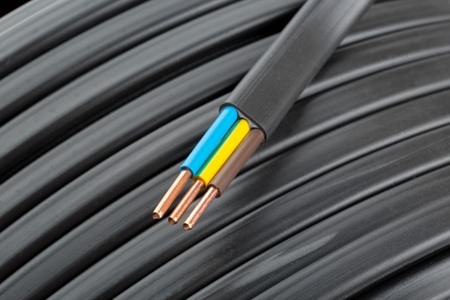
Fire-resistant cables are specially designed cables capable of maintaining energy and signal transmission for a certain period during a fire. Their primary function is to ensure the uninterrupted operation of life-critical systems such as voice evacuation, emergency lighting circuits, fire alarms, and safety infrastructures. While conventional cables often fail within minutes under fire, fire-resistant cables maintain circuit integrity, offering valuable time for safe evacuation and emergency response.
These cables are typically classified based on fire performance standards such as FE180, PH120, and E30, E60, E90. FE180 indicates the cable’s ability to function for 180 minutes under direct flame, while PH120 confirms its ability to maintain circuit integrity for 120 minutes under combined exposure to flame, mechanical impact, and water spray. E30–E90 define how long the cable can remain operational depending on its installation conditions within a building. Most fire-resistant cables are equipped with a halogen-free outer sheath (LSZH/LSOH/LS0H), which reduces the emission of toxic gases and dense smoke during fire, facilitating safer evacuation and easier access for rescue teams.
Where Are Fire-Resistant Cables Used?
Fire-resistant cables have become a standard requirement in buildings with high fire risk or complex evacuation procedures. For large-scale structures and critical infrastructure, national and international regulations mandate the use of these cables to ensure safety and compliance.
In hospitals and healthcare facilities, continuity of electrical supply is critical for intensive care units and operating rooms. Systems in these environments must remain operational even during fire emergencies. Similarly, shopping malls, hotels, and conference halls, with high human occupancy, depend on reliable evacuation and emergency systems. Fire-resistant cables form the backbone of these infrastructures.
In metro systems, tunnels, and airports, evacuation is more difficult due to limited access and confined space. Therefore, cables with E60 or E90 fire performance classifications are preferred to ensure maximum operational duration during a fire. Fire-resistant cables are also essential in industrial facilities, energy plants, petrochemical refineries, and data centers, where system continuity and operational safety are paramount.
Beyond evacuation systems, these cables are used in fire detection and suppression systems, smoke extraction fans, emergency signage, elevator rescue circuits, and building automation systems.
Safety Advantages of Fire-Resistant Cables
In a fire emergency, ensuring the operation of vital systems is only one part of the equation. Protecting human health and ensuring the safety of emergency responders is equally crucial. Fire-resistant cables combine these goals to deliver significant safety advantages.
First, they maintain electrical circuit integrity during a fire, allowing emergency systems such as alarms, lighting, and suppression units to remain functional. Cables that comply with FE180 and PH120 standards continue to operate even under extreme conditions like direct flame, mechanical stress, and water spray.
Second, the use of halogen-free outer jackets prevents the release of toxic gases. Materials labeled LSZH (Low Smoke Zero Halogen), LSOH, or LS0H minimize the emission of chlorine, bromine, and fluorine-based gases, reducing health risks for occupants and first responders.
Another key benefit is the prevention of excessive smoke. Dense smoke can obstruct visibility and increase panic during evacuation. Fire-resistant cables produced with HFFR (Halogen-Free Flame Retardant) technology limit smoke generation, improving evacuation times and enabling safer working conditions for rescue teams.
Additionally, fire-resistant cables with screened constructions—such as the JE-H(St)H Bd type—offer electromagnetic interference protection (EMI). This ensures reliable signal transmission and minimizes data loss or distortion in critical communication and control lines.
How to Select the Right Fire-Resistant Cable for Your Project
Choosing the right fire-resistant cable depends heavily on the specifics of the project and installation environment. Accurate cable selection not only ensures system safety but also contributes to long-term infrastructure sustainability.
To begin with, it’s essential to evaluate the environmental conditions where the cable will be installed. If the location involves humidity, mechanical stress, or temperature fluctuations, the outer sheath material, insulation type, and screen configuration must be compatible with these factors. Buildings requiring longer evacuation times should be equipped with E60 or E90-rated cables, while lower-risk areas may use E30-rated alternatives.
Next, cables with halogen-free outer jackets—such as LSZH, LSOH, or LS0H—should be prioritized. These materials comply with modern fire safety codes and ensure regulatory conformity, preventing penalties during inspection processes.
The third consideration is the type of system being supported. For example, low-signal-loss screened cables are needed for voice evacuation systems, while higher conductor cross-sections are required for emergency lighting and power distribution.
Finally, it is important to work with a reputable manufacturer who can provide customization options, such as color coding, screen type, sheath material, and cable length.
ETK Kablo’s Innovative Approach to Fire-Resistant Cables
ETK Kablo is one of Turkey’s leading manufacturers offering advanced engineering solutions in the field of fire-resistant cables. Through its modern production technologies, extensive testing capabilities, and diverse product portfolio, ETK Kablo serves a wide range of public and private sector projects.
The JE-H(St)H Bd fire-resistant cable series is compliant with FE180 and PH120 performance classes. Its aluminum-PET screened structure provides strong protection against electromagnetic interference, while the LSZH outer sheath supports both operational safety and human health.
ETK Kablo’s use of HFFR (Halogen-Free Flame Retardant) compounds helps limit flame spread while maintaining environmental sustainability. Every fire-resistant cable is tested in the company’s advanced laboratories in accordance with both national and international fire performance standards.
Furthermore, ETK Kablo provides custom production capabilities for large-scale projects, offering flexibility in conductor size, screening, sheath color, and length, tailored to specific customer needs. This customer-centric approach ensures that every project receives a reliable, compliant, and application-specific solution.
Fire-resistant cables are not just infrastructure elements; they are critical safety components that directly affect life safety and system continuity. By enabling systems to operate during emergencies, they extend evacuation times, maintain power and signal flows, and reduce the risk of injury or death.
Selecting the right cable requires a combination of technical knowledge, project experience, and certified manufacturing quality. With its JE-H(St)H Bd series, FE180 PH120 compliance, LSZH sheath options, and engineering support, ETK Kablo delivers fire-resistant cable solutions that meet the highest expectations for reliability, safety, and long-term performance.
Benzer yazılar
LSZH vs PVC Cable: Which Should You Specify?
Choosing between LSZH vs PVC cable is primarily a material and fire-safety decision rather than a simple question of which cable is “be...
Cat6A Cable for Data Centers: U/FTP, F/FTP or S/FTP?
Choosing the right Cat6A cable for data centers involves more than specifying 10 Gigabit Ethernet and 500 MHz performance. U/FTP, F/FTP...
Instrumentation Cable Shielding: Individual Screen vs Overall Screen
Instrumentation cable shielding plays a critical role in protecting low-level analogue and digital signals from electromagnetic interfe...
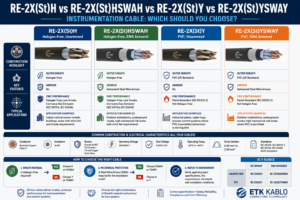
RE-2X(St)H vs RE-2X(St)HSWAH vs RE-2X(St)Y vs RE-2X(St)YSWAY: Which Should You Choose?
Choosing the right RE-2X(St) instrumentation cable is not simply a matter of comparing four similar product codes. RE-2X(St)H, RE-2X(St...
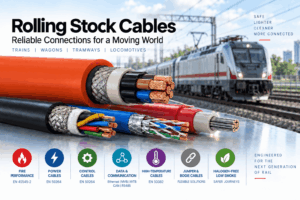
Rolling Stock Cables: Standards, Types and Applications
Rolling stock cables are specialized electrical and communication cables designed for installation onboard railway vehicles such as tra...
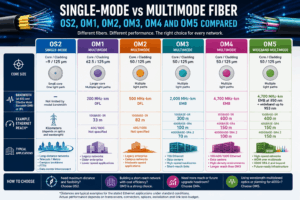
Single-Mode vs Multimode Fiber: OS2, OM1, OM2, OM3, OM4 and OM5 Compared
Choosing single-mode vs multimode fiber is one of the most important decisions when designing a fiber optic network. OS2, OM1, OM2, OM3...
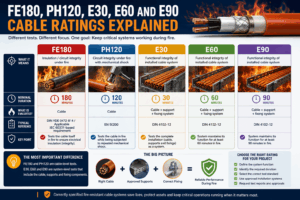
FE180, PH120, E30, E60 and E90 Cable Ratings Explained
Understanding FE180, PH120, E30, E60 and E90 cable ratings is essential when specifying fire-resistant cables for emergency, life-safet...
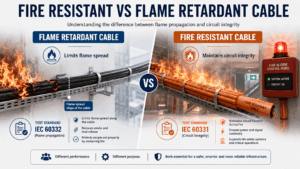
Fire Resistant vs Flame Retardant Cable: What Is the Difference?
The difference between a fire resistant vs flame retardant cable is one of the most important distinctions in cable fire performance. A...
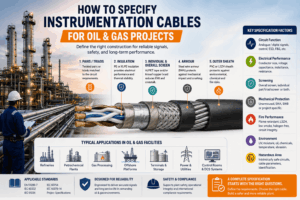
How to Specify Instrumentation Cables for Oil & Gas Projects
Selecting oil and gas instrumentation cables requires much more than choosing a conductor size and adding a screen. Refineries, petroch...
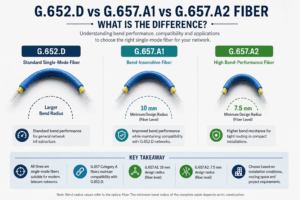
G.652.D vs G.657.A1 vs G.657.A2 Fiber: What Is the Difference?
Choosing between G.652.D, G.657.A1 and G.657.A2 fiber is primarily a question of how the optical fiber will behave when the network is ...
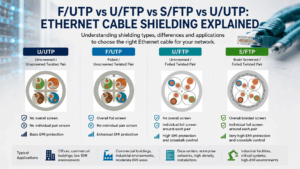
F/UTP vs U/FTP vs S/FTP vs U/UTP: Ethernet Cable Shielding Explained
Ethernet cable shielding can have a major influence on how reliably a network performs in environments affected by electromagnetic inte...
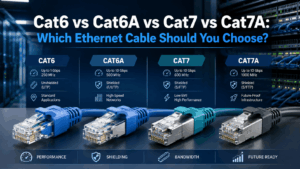
Cat6 vs Cat6A vs Cat7 vs Cat7A: Which Ethernet Cable Should You Choose?
Choosing between Cat6 vs Cat6A vs Cat7 vs Cat7A is not simply a matter of selecting the highest cable category available. Each Ethernet...


