





 President’s Message
Blog
Signal Control Cables: Types, Applications, and How to Choose the Right Signal Control Cable
Reading Time: 3 minutes
Signal control cables play a crucial role in data and signal transmission, ranging from industrial automation systems and building management systems (BMS) to power plants and manufacturing facilities. In applications where accurate, reliable, and uninterrupted data transmission is vital, selecting the correct type of signal cable becomes critical.
In this blog post, we will explore what signal cables are, their different types—including shielded, braided, and foil shielded signal cables—the advantages of PVC-jacketed and halogen-free cables, and important considerations for signal cable selection.
What is a Signal Control Cable?
A signal control cable is specifically designed to transmit analog or digital signals in electrical and electronic systems. These cables protect transmitted signals from external interference and electromagnetic noise, thus ensuring high-quality communication. Particularly in environments prone to electromagnetic interference (EMI), shielded signal cables are widely preferred. A shielded cable consists of an electromagnetic shielding layer—usually aluminum foil or copper braiding—that effectively prevents external interference.
Braided signal cables use a braided copper shield, offering excellent mechanical strength and flexibility. Shielded cables are vital in industrial environments, areas close to power lines, or locations with high radio frequency (RF) interference, as they provide a robust barrier against EMI and RFI.
Types of Signal Control Cables
Signal cables can be categorized based on their application areas, outer jacket materials, and shielding methods. The most commonly used signal cable types include shielded, braided, foil-screened, halogen-free, and PVC-jacketed cables.
Shielded Signal Control Cables
Shielded signal control cables, especially braided and foil-shielded types, are critical in industrial environments where high levels of electromagnetic interference are present. Braided signal cables use woven copper strands for shielding, providing excellent mechanical durability and flexibility.
Additionally, double-shielded signal cables—combining foil and braided shielding—deliver the highest protection against interference, making them ideal for sensitive automation systems, sensor connections, robotics, and precision control signal transmission in manufacturing facilities.
Unshielded Signal Control Cables
In environments with lower electromagnetic interference, unshielded signal cables are generally preferred due to their cost-effectiveness. They are commonly used in basic control applications, building wiring, and low-frequency signal transmission.
PVC Jacketed Cables
PVC (Polyvinyl Chloride) jacketed signal cables are among the most widely used cable types due to their economic advantages, durability, and mechanical protection capabilities. Their flexibility makes installation easier, making them popular for outdoor or less crowded indoor areas.
However, PVC cables can release high levels of smoke and toxic gases in case of fire, which makes them less suitable for densely populated or enclosed areas.
PVC jacketed signal cables are available as shielded or unshielded variants. Shielded PVC signal cables are widely used in industrial environments for improved EMI protection, whereas PVC braided signal cables offer economical solutions for less demanding applications.
Halogen-Free (LSOH / LSZH) Cables
Halogen-free signal cables (LSZH—Low Smoke Zero Halogen) minimize smoke emission and toxic gas release during fires. Their reduced smoke density and low toxicity contribute significantly to safer evacuation in emergency situations. Due to these properties, halogen-free cables are predominantly used in densely occupied spaces, including hospitals, schools, airports, hotels, shopping centers, and public buildings.
Halogen-free signal cables typically feature braided or foil-shielded configurations to offer high resistance to EMI and enhanced fire safety. Halogen-free shielded cables are particularly recommended for applications requiring stringent safety criteria.
Choosing the Right Signal Control Cable
When selecting signal cables, it’s crucial to analyze your specific project requirements and operating conditions carefully. The appropriate cable type will significantly impact the performance, reliability, and cost-efficiency of your system. The following considerations should be evaluated in the selection process:
1. Electromagnetic Interference (EMI/RFI)
For high electromagnetic interference environments, shielded cables (braided and foil-shielded) should always be preferred. Double-shielded cables, combining both foil and braid, provide maximum EMI/RFI protection.
2. Environmental Conditions
The installation environment significantly impacts the cable jacket selection. PVC jacketed cables with additional armor or shielding are recommended for challenging industrial environments and outdoor installations. Conversely, halogen-free cables are preferred in enclosed or densely occupied indoor areas due to enhanced fire safety.
3. Cable Length and Data Transmission Speed
Signal attenuation and interference risks increase with cable length. Thus, high-quality shielded signal cables should be utilized for long-distance transmission. For systems requiring high data speeds (Ethernet, industrial automation networks), braided and foil-shielded signal cables are essential to maintain signal integrity.
4. Mechanical Durability
In environments where cables are subject to mechanical stress, armored or braided shielded signal cables should be used to withstand physical impacts, abrasion, and harsh external factors.
5. Regulatory Compliance
Ensure that selected signal cables comply with relevant international standards and regulations such as CPR (Construction Products Regulation), RoHS, and REACH. CPR compliance classes like B2ca or Cca are crucial in European construction projects, reflecting fire safety standards.
Signal cables remain essential components in modern industrial automation, building management, energy facilities, and critical infrastructure projects. With a variety of cable types, including shielded signal cables, braided and foil-screened cables, and options such as PVC or halogen-free jackets, signal cables offer customized solutions for virtually any application scenario. Selecting the appropriate signal cable requires careful consideration of environmental conditions, EMI levels, mechanical durability, regulatory standards, and the application’s specific requirements.
At ETK Kablo, we offer high-quality, performance-oriented shielded signal cables specifically designed for industrial automation, building management systems, power plants, and critical infrastructure applications. With ETK Kablo’s reliable signal cable solutions, you can ensure optimal performance and enhanced reliability in your projects, empowering you to maintain consistent and secure data transmission under any condition.
Benzer yazılar
LSZH vs PVC Cable: Which Should You Specify?
Choosing between LSZH vs PVC cable is primarily a material and fire-safety decision rather than a simple question of which cable is “be...
Cat6A Cable for Data Centers: U/FTP, F/FTP or S/FTP?
Choosing the right Cat6A cable for data centers involves more than specifying 10 Gigabit Ethernet and 500 MHz performance. U/FTP, F/FTP...
Instrumentation Cable Shielding: Individual Screen vs Overall Screen
Instrumentation cable shielding plays a critical role in protecting low-level analogue and digital signals from electromagnetic interfe...
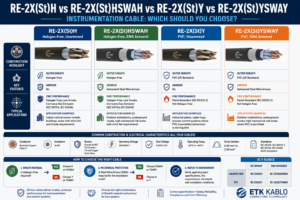
RE-2X(St)H vs RE-2X(St)HSWAH vs RE-2X(St)Y vs RE-2X(St)YSWAY: Which Should You Choose?
Choosing the right RE-2X(St) instrumentation cable is not simply a matter of comparing four similar product codes. RE-2X(St)H, RE-2X(St...
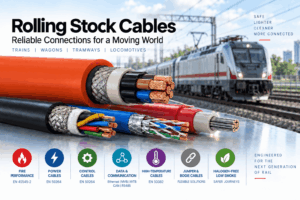
Rolling Stock Cables: Standards, Types and Applications
Rolling stock cables are specialized electrical and communication cables designed for installation onboard railway vehicles such as tra...
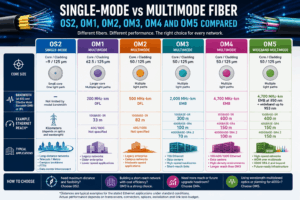
Single-Mode vs Multimode Fiber: OS2, OM1, OM2, OM3, OM4 and OM5 Compared
Choosing single-mode vs multimode fiber is one of the most important decisions when designing a fiber optic network. OS2, OM1, OM2, OM3...
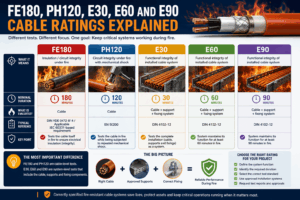
FE180, PH120, E30, E60 and E90 Cable Ratings Explained
Understanding FE180, PH120, E30, E60 and E90 cable ratings is essential when specifying fire-resistant cables for emergency, life-safet...
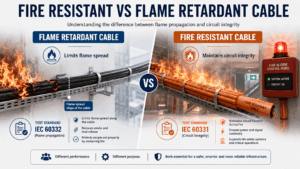
Fire Resistant vs Flame Retardant Cable: What Is the Difference?
The difference between a fire resistant vs flame retardant cable is one of the most important distinctions in cable fire performance. A...
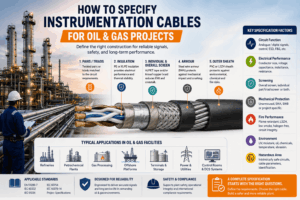
How to Specify Instrumentation Cables for Oil & Gas Projects
Selecting oil and gas instrumentation cables requires much more than choosing a conductor size and adding a screen. Refineries, petroch...
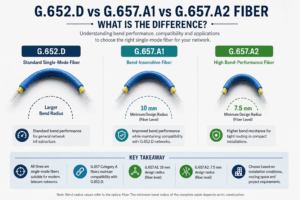
G.652.D vs G.657.A1 vs G.657.A2 Fiber: What Is the Difference?
Choosing between G.652.D, G.657.A1 and G.657.A2 fiber is primarily a question of how the optical fiber will behave when the network is ...
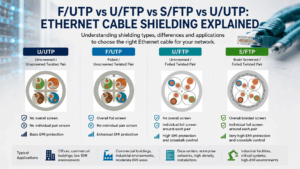
F/UTP vs U/FTP vs S/FTP vs U/UTP: Ethernet Cable Shielding Explained
Ethernet cable shielding can have a major influence on how reliably a network performs in environments affected by electromagnetic inte...
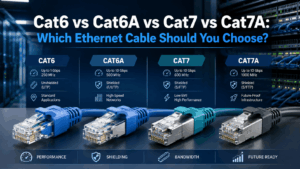
Cat6 vs Cat6A vs Cat7 vs Cat7A: Which Ethernet Cable Should You Choose?
Choosing between Cat6 vs Cat6A vs Cat7 vs Cat7A is not simply a matter of selecting the highest cable category available. Each Ethernet...


