





 President’s Message
Blog
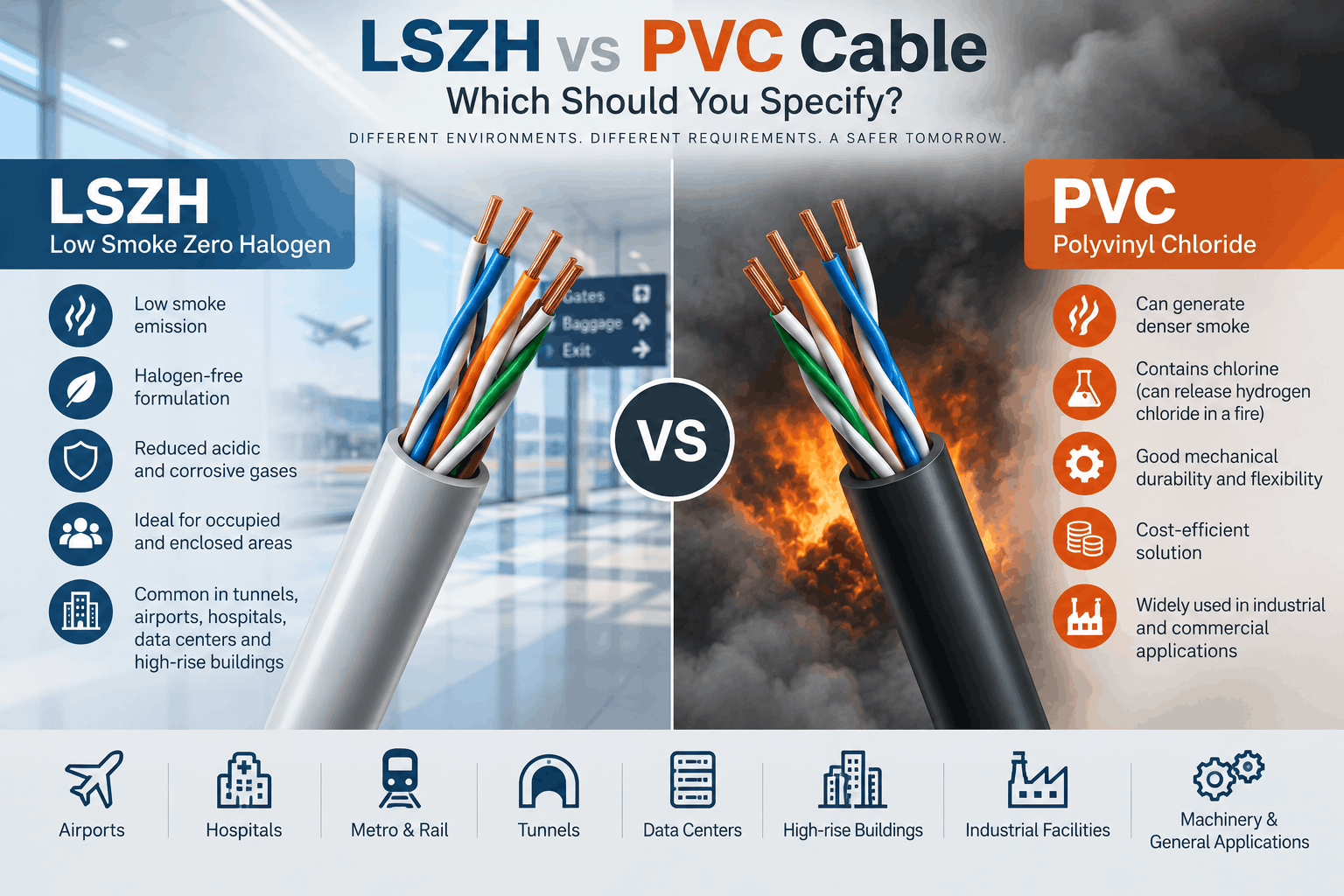
LSZH vs PVC Cable: Which Should You Specify?
Reading Time: 13 minutes
Choosing between LSZH vs PVC cable is primarily a material and fire-safety decision rather than a simple question of which cable is “better.” Both materials are widely used in electrical, signal, control, instrumentation, data and fiber optic cable constructions, but they behave differently when exposed to fire and can offer different advantages in installation, flexibility, environmental resistance and project cost.
However, PVC remains a practical and widely used cable material for many industrial and commercial applications. It can provide good mechanical durability, flexibility and cost efficiency, and properly formulated PVC cables can also meet specified flame-retardancy requirements.
LSZH, meaning Low Smoke Zero Halogen, is selected where smoke generation and halogen-containing combustion gases are a major safety concern. This makes LSZH particularly important in enclosed, occupied or evacuation-sensitive environments such as tunnels, airports, hospitals, data centers, metro systems and high-rise buildings.
Quick answer: Choose LSZH when the project requires low smoke and halogen-free cable materials, especially in occupied or enclosed areas. Choose PVC when the project permits halogenated materials and priorities include cost efficiency, flexibility or general industrial performance. Neither LSZH nor PVC alone determines flame retardancy, fire resistance, CPR classification or outdoor suitability; these characteristics must be specified separately.
LSZH vs PVC Cable at a Glance
| Characteristic | LSZH Cable | PVC Cable |
|---|---|---|
| Halogen content | Halogen-free formulation according to applicable requirements | PVC contains chlorine |
| Smoke during combustion | Designed for low smoke emission | Can generate substantially denser smoke depending on formulation |
| Corrosive combustion gases | Designed to minimize acidic and corrosive gas emissions | Can release hydrogen chloride and other combustion products |
| Typical fire-safety application | Enclosed, occupied and safety-sensitive environments | General applications where PVC is permitted |
| Flame retardant automatically? | No; verify relevant flame test | No; verify relevant flame test |
| Fire resistant automatically? | No | No |
| CPR class automatically determined? | No | No |
| Flexibility | Depends on compound; can be less flexible than comparable PVC | Often offers very good flexibility |
| Cost | Typically higher | Typically more economical |
| Outdoor use | Possible if specifically formulated for the environment | Possible if specifically formulated for the environment |
The key point is that LSZH and PVC describe cable material systems. They do not completely define the electrical, mechanical or fire performance of the finished cable.
What Is LSZH Cable?
LSZH stands for Low Smoke Zero Halogen. Other abbreviations such as LSOH, LS0H and sometimes HFFR are also encountered in cable specifications, although exact material terminology and test requirements should always be checked.
LSZH cable compounds are designed to produce relatively low smoke and very low levels of halogen-related acidic gases when subjected to specified combustion tests.
The primary objective is to reduce hazards associated with:
- Smoke obscuring escape routes
- Reduced visibility during evacuation
- Acidic and corrosive combustion gases
- Damage to sensitive electronic equipment
- Corrosion of metallic infrastructure
- Exposure to combustion products in enclosed areas
This makes LSZH particularly relevant where people may need to evacuate through enclosed spaces or where expensive electronic equipment could be exposed to corrosive fire gases.
Where Is LSZH Commonly Specified?
Typical applications include:
- Airports
- Hospitals
- Metro stations
- Railway infrastructure
- Tunnels
- Data centers
- High-rise buildings
- Hotels
- Shopping centers
- Schools and universities
- Control rooms
- Offshore installations
- Large public buildings
- Industrial facilities with strict fire-safety specifications
Therefore, the building type alone should not determine the material.
The project specification, local regulations, cable route and fire strategy should define whether LSZH performance is necessary.
What Is PVC Cable?
PVC, or polyvinyl chloride, is one of the most established materials used for electrical cable insulation and outer sheaths.
PVC compounds can be formulated to provide a useful combination of:
- Flexibility
- Mechanical durability
- Abrasion resistance
- Electrical insulation
- Chemical resistance
- Flame-retardant behaviour
- Cost efficiency
- Ease of processing
For these reasons, PVC remains widely used in industrial automation, control systems, instrumentation, structured cabling and general low-voltage cable applications.
The presence of chlorine in PVC is the main reason its fire behaviour differs from LSZH materials.
When PVC burns, combustion can produce hydrogen chloride and dense smoke. In the presence of moisture, acidic combustion products can also contribute to corrosion of equipment and metallic surfaces.
Where Is PVC Still an Appropriate Choice?
PVC can remain a technically suitable solution in:
- General industrial facilities
- Protected machinery installations
- Automation systems
- Control cabinets
- Dry or damp indoor industrial areas
- Outdoor applications using appropriately formulated PVC
- Installations where project regulations permit PVC
- Applications where low-smoke halogen-free performance is not required
Therefore, a PVC cable should not be considered an inferior product simply because it is not LSZH.
The correct question is whether the material satisfies the requirements of the intended installation.
LSZH vs PVC Cable: Key Differences
The most important difference between LSZH vs PVC cable becomes apparent during combustion.
LSZH compounds are designed to limit smoke generation and avoid significant halogen-related acidic gas emissions.
PVC contains chlorine and can generate hydrogen chloride during combustion.
| Fire Scenario | LSZH | PVC |
|---|---|---|
| Smoke generation | Designed to remain comparatively low | Can be considerably higher |
| Halogen acid gas | Designed to meet halogen-free requirements | Chlorine-containing polymer can generate hydrogen chloride |
| Corrosivity concern | Lower when compliant with specified LSZH tests | Greater concern due to acidic combustion products |
| Visibility during evacuation | Low-smoke design can provide an advantage | Dense smoke can reduce visibility |
| Protection of electronics | Lower corrosive-gas exposure can reduce secondary damage | Acidic combustion products can increase corrosion risk |
This distinction explains why LSZH is frequently required in transportation infrastructure, public buildings and data centers.
Does LSZH Mean Flame Retardant?
Not automatically.
This distinction is extremely important when preparing a cable specification.
LSZH describes smoke and halogen-related material behaviour.
Flame retardancy describes the ability of the cable to limit flame propagation under a specified test.
A cable can therefore be:
- LSZH and flame retardant
- PVC and flame retardant
- LSZH with a particular CPR classification
- PVC with a particular CPR classification
- Fire resistant and LSZH
- Fire resistant with other material constructions
The flame-propagation requirement must be verified separately against the relevant standard.
Can PVC Cable Be Flame Retardant?
Yes.
PVC cable compounds can be formulated to limit flame propagation and can comply with applicable flame-retardancy tests.
For example, cable specifications frequently reference the IEC 60332 family for flame-propagation performance.
This is why the statement “PVC burns but LSZH does not burn” would be technically incorrect.
Both material systems can burn under sufficiently severe fire exposure.
The difference is in their formulation, flame behaviour, smoke production and combustion-gas characteristics.
Does LSZH Mean Fire Resistant?
No.
LSZH should not be confused with fire resistant cable or circuit-integrity performance.
A cable may produce very little smoke and meet halogen-free requirements but still lose electrical continuity shortly after direct fire exposure.
Fire-resistant cables use specialized constructions designed to maintain electrical or signal continuity under defined fire conditions.
These can involve:
- Mica fire barriers
- Special fire-survival insulation
- Ceramic-forming compounds
- Protective tapes
- Specific tested cable constructions
Therefore:
LSZH = smoke and halogen behaviour.
Fire resistance = circuit survival under specified fire conditions.
A project can require both properties in the same cable.
IEC 60754: Halogen and Corrosive Gas Performance
The IEC 60754 family is commonly referenced when evaluating gases released from cable materials during combustion.
IEC 60754-1
IEC 60754-1 addresses determination of halogen acid gas content from materials used in electric and optical fiber cable constructions.
This provides a method for verifying requirements relating to halogen-containing combustion products.
IEC 60754-2
IEC 60754-2 evaluates the acidity and conductivity of gases evolved during combustion.
These measurements provide information relevant to the potential corrosivity of combustion gases.
For procurement, simply writing “LSZH” may therefore be less precise than specifying the actual required IEC 60754 performance.
IEC 61034: Why Smoke Density Matters
IEC 61034 is commonly used to evaluate the smoke density produced by burning cables under defined test conditions.
This performance is particularly relevant in enclosed environments.
During a fire, dense smoke can:
- Reduce visibility
- Make emergency exits harder to locate
- Complicate evacuation
- Make emergency response more difficult
- Increase contamination of equipment and interiors
LSZH cables intended for safety-sensitive applications are therefore frequently specified with both low-smoke and halogen-related test requirements.
IEC 60332: Flame Propagation Is a Separate Requirement
IEC 60332 addresses cable behaviour related to flame propagation.
For example, IEC 60332-1-2 evaluates vertical flame propagation on a single cable under defined fire exposure.
The IEC 60332-3 series addresses bundled cable arrangements under different test conditions.
This distinction reinforces an important specification principle:
Smoke, halogen content and flame propagation should be defined independently.
LSZH vs PVC: Which Produces More Smoke?
When comparing cable compounds specifically engineered for the two material philosophies, LSZH is designed to produce significantly lower smoke density than conventional PVC under relevant fire-test conditions.
This can make a major difference in:
- Tunnels
- Metro stations
- Airports
- Ships
- Underground facilities
- Server rooms
- Data centers
- High-occupancy buildings
However, smoke behaviour should still be confirmed using test documentation rather than assumed solely from the cable’s marketing description.
LSZH vs PVC: Which Is More Flexible?
PVC often has an advantage in flexibility because plasticized PVC compounds can be engineered to bend and handle efficiently.
Some LSZH compounds can be stiffer than comparable PVC materials because they use different polymer and filler systems to achieve the required fire properties.
However, this is not a universal rule.
Modern LSZH compounds have improved significantly, and cable flexibility also depends on:
- Conductor class
- Conductor size
- Cable diameter
- Insulation material
- Sheath thickness
- Screening
- Armour
- Overall cable construction
Therefore, buyers should compare the actual cable bending radius and datasheet rather than assuming all LSZH cables are rigid.
LSZH vs PVC: Which Is More Mechanically Durable?
There is no universal winner.
PVC is well established for abrasion resistance, flexibility and general mechanical performance.
LSZH compounds can also provide strong mechanical properties, but the exact performance depends heavily on formulation.
For demanding environments, the outer sheath material should be evaluated against requirements such as:
- Abrasion resistance
- Tensile stress
- Impact
- Oil exposure
- Chemical exposure
- Temperature
- UV radiation
- Water
- Flexing
A generic “LSZH” or “PVC” label does not prove all of these characteristics.
Is LSZH Better for Data Centers?
LSZH is frequently specified in data centers because these facilities combine high cable density, occupied technical spaces and large quantities of sensitive electronic equipment.
In a fire, reducing smoke and acidic combustion gases can be valuable for both personnel safety and equipment protection.
For this reason, LSZH is commonly considered for:
- Ethernet cabling
- Fiber optic cables
- Control cables
- Building-management cabling
- Security systems
- Technical-room infrastructure
However, local building regulations and the project fire strategy should determine the requirement.
A data center specification should not assume that the term LSZH alone defines the complete fire performance of the cable.
LSZH vs PVC Cable for Industrial Applications
Industrial facilities create a different decision environment.
Some industrial cable routes are located in:
- Open production halls
- Protected cable trays
- Machinery
- Control cabinets
- Outdoor process areas
- Power plants
- Refineries
- Petrochemical plants
In many of these areas, PVC can remain an appropriate material when permitted by the project specification.
In other areas, particularly enclosed control rooms or evacuation routes, LSZH may be preferred.
This means one industrial project can legitimately use both PVC and LSZH cable families in different locations.
LSZH vs PVC Cable for Tunnels and Transportation Projects
Tunnels and underground transportation networks provide one of the strongest use cases for LSZH.
These environments can involve:
- Restricted evacuation routes
- Limited ventilation
- High passenger density
- Long cable runs
- Large quantities of combustible material
- Critical emergency systems
Low smoke can help maintain visibility, while reduced acidic gas emissions can limit secondary hazards and corrosion.
For this reason, transportation specifications often place strict requirements on smoke density, halogen content, flame propagation and sometimes circuit integrity.
These requirements should all be listed individually rather than represented only by the term LSZH.
LSZH vs PVC Cable for Hospitals and Public Buildings
Hospitals and public buildings often contain occupants who may require additional time or assistance during evacuation.
Reducing smoke and corrosive combustion gases can therefore be particularly important.
LSZH may be specified for:
- Communication systems
- Data cabling
- Building automation
- Fire alarm systems
- Emergency communication
- Control circuits
- Fiber optic networks
Again, the exact cable must meet the project-specific fire-performance requirements rather than relying solely on material terminology.
PVC vs LSZH for Outdoor Cables
Neither PVC nor LSZH automatically means that a cable is suitable for outdoor installation.
Outdoor cables may need additional resistance to:
- UV radiation
- Water
- Temperature cycling
- Humidity
- Mechanical damage
- Chemicals
- Oil
- Weathering
Both PVC and halogen-free compounds can be formulated for outdoor use.
Therefore, the project should verify the environmental properties of the actual compound rather than assuming that one material family is universally better outdoors.
LSZH vs PVC and CPR Euroclass
Another common mistake is assuming that LSZH automatically means a high CPR Euroclass.
It does not.
CPR reaction-to-fire classifications such as B2ca, Cca, Dca and Eca evaluate the behaviour of the finished cable under the applicable European classification system.
LSZH describes material-related smoke and halogen characteristics.
A cable can therefore be LSZH and have different CPR classifications depending on its complete construction and tested performance.
Likewise, PVC-based cables can receive CPR classifications where their tested construction meets the required criteria.
Therefore:
LSZH is not a CPR class.
CPR class is not a sheath-material designation.
LSZH vs PVC vs XLPE: Do These Terms Describe the Same Thing?
No.
This terminology frequently creates confusion because several materials can appear in one cable.
PVC can be used as insulation, outer sheath or both.
LSZH generally describes halogen-free, low-smoke compounds used for insulation and/or sheath components.
XLPE is cross-linked polyethylene, an insulation material valued for electrical and thermal characteristics.
A cable can therefore combine:
XLPE insulation + LSZH outer sheath.
This is common in instrumentation and other industrial cable constructions.
Likewise, a cable can use:
XLPE insulation + PVC outer sheath.
Therefore, asking whether “XLPE is better than LSZH” is not necessarily a valid comparison because the two terms can describe different layers and functions within the same cable.
LSZH vs LSF vs HFFR: Are They the Same?
Several abbreviations appear in international cable specifications.
LSZH / LSOH / LS0H are commonly used to indicate Low Smoke Zero Halogen cable materials.
HFFR generally means Halogen-Free Flame Retardant.
LSF or Low Smoke and Fume can be a less precise term because a material described as low smoke may not necessarily satisfy the same halogen-free requirements as an LSZH construction.
For this reason, procurement specifications should preferably reference the required test standards rather than relying only on abbreviations.
Is LSZH Always Safer Than PVC?
Under fire conditions where smoke and acidic halogen gases are important hazards, LSZH provides clear advantages when it meets the specified low-smoke and halogen-free tests.
However, “safer” depends on the complete application.
A cable system also needs to meet requirements relating to:
- Electrical performance
- Flame propagation
- Circuit integrity
- Mechanical strength
- Temperature
- Chemical resistance
- Installation method
- Regulatory compliance
A poorly selected LSZH cable is not automatically safer than a correctly specified PVC cable in every possible environment.
The cable must be evaluated as a complete engineered product.
Which Should You Specify: LSZH or PVC?
| Project Condition | Material to Consider | Reason |
|---|---|---|
| Enclosed public building | LSZH | Low smoke and reduced acidic gas emissions can support evacuation safety |
| Tunnel or metro | LSZH | Restricted evacuation and ventilation make smoke control particularly important |
| Data center | LSZH often preferred | Protects occupied technical spaces and sensitive electronics from corrosive combustion products |
| Hospital | LSZH often preferred | Evacuation conditions can justify stricter smoke and halogen requirements |
| Protected industrial area where PVC is permitted | PVC | Practical and cost-efficient general industrial solution |
| Flexible machinery or control application | Evaluate PVC and LSZH datasheets | Actual flexibility depends on cable design and material formulation |
| Outdoor industrial installation | Either, if appropriately formulated | UV, moisture and environmental requirements must be verified separately |
| Emergency circuit that must operate during fire | Fire-resistant construction plus required sheath | LSZH or PVC alone does not provide circuit integrity |
The table illustrates why material selection should follow the actual installation conditions.
LSZH should not be specified simply because it appears to be a premium version of PVC.
Likewise, PVC should not be rejected automatically when it fully satisfies the project requirements.
What Should Buyers Specify Instead of Writing Only “LSZH Cable”?
A procurement specification should define measurable requirements rather than depending solely on broad material descriptions.
Consider including:
- Cable type
- Application
- Conductor size and construction
- Insulation material
- Outer sheath material
- LSZH or PVC requirement
- IEC 60754 halogen or gas-acidity requirements
- IEC 61034 smoke-density requirement
- IEC 60332 flame-propagation requirement
- Fire-resistance or circuit-integrity requirement where applicable
- CPR Euroclass where applicable
- UV resistance
- Oil resistance where required
- Chemical resistance where required
- Operating temperature
- Mechanical protection or armour
- Applicable product standard
- Required certificates and test reports
This makes it much easier to compare technically equivalent quotations from different cable suppliers.
Common Mistakes When Comparing LSZH and PVC Cable
1. Assuming LSZH Means Fire Resistant
LSZH addresses smoke and halogen-related combustion characteristics. Circuit integrity requires separate fire-survival construction and testing.
2. Assuming PVC Cannot Be Flame Retardant
PVC compounds can meet applicable flame-propagation requirements. Flame retardancy and halogen content are separate properties.
3. Assuming All LSZH Cables Have the Same Performance
Different compounds and cable constructions can have different smoke, mechanical, flame and environmental characteristics.
4. Specifying LSZH Without Naming the Required Test
IEC 60754, IEC 61034 and IEC 60332 evaluate different characteristics. A professional specification should identify the required tests.
5. Assuming LSZH Automatically Means B2ca or Cca
CPR Euroclass is determined through testing of the complete cable and is not automatically created by using an LSZH sheath.
6. Assuming PVC Is Always Cheaper Overall
PVC is generally more economical as a cable material, but total installed cost also depends on cable design, installation method, regulatory requirements and project risk.
7. Ignoring Mechanical Properties
Smoke and halogen performance should not be evaluated without also reviewing flexibility, bending radius, tensile strength and environmental resistance.
8. Assuming LSZH Means Outdoor
Outdoor capability depends on UV resistance, moisture performance and the complete cable construction.
9. Confusing XLPE with LSZH
XLPE commonly describes conductor insulation, while LSZH can describe insulation or sheath materials with a different fire-safety purpose.
10. Choosing Material Without Reviewing the Cable Route
The same building or industrial plant may use LSZH in one area and PVC in another because the fire and environmental risks differ.
ETK Kablo LSZH and PVC Cable Solutions
ETK Kablo manufactures LSZH and PVC cable constructions across multiple low-current and fiber optic product families.
In signal and control cables, PVC constructions such as LIYY and LIYCY provide practical solutions for general automation and signal applications, while halogen-free constructions such as LIHH and LIHCH are available where low-smoke and halogen-free performance is required.
Instrumentation cable families also provide both material approaches. For example, RE-2X(St)Y uses a PVC outer sheath, while RE-2X(St)H uses a halogen-free outer sheath while retaining XLPE conductor insulation and overall screening.
The same selection principle extends to armored instrumentation constructions, where PVC and halogen-free options can be combined with steel wire armour according to the project requirements.
ETK Kablo’s Data/LAN portfolio also includes Cat6A cables with LSZH, PVC and other sheath options depending on the application, shielding construction and required fire performance.
Fiber optic cables can likewise use LSZH constructions for indoor and safety-sensitive environments or alternative outer sheath systems for outdoor and infrastructure applications.
The correct ETK cable should therefore be selected according to the complete specification: electrical performance, fire behaviour, installation environment, mechanical protection and material requirements.
Frequently Asked Questions
What is the main difference between LSZH and PVC cable?
LSZH cables use halogen-free compounds designed to generate low smoke and low levels of acidic combustion gases. PVC contains chlorine and can generate denser smoke and hydrogen chloride during combustion. PVC remains widely used where the project permits it.
Is LSZH better than PVC?
LSZH provides clear advantages in enclosed or occupied areas where smoke and corrosive combustion gases are major concerns. PVC can be more appropriate in general industrial applications where these requirements do not apply. The correct material depends on the project.
Is LSZH cable fire resistant?
Not automatically. LSZH describes smoke and halogen characteristics. Fire resistance requires the cable to maintain circuit integrity under a separate specified fire test.
Is LSZH cable flame retardant?
Many LSZH cables are also flame retardant, but the flame-propagation requirement should be verified separately against the applicable standard.
Can PVC cable be flame retardant?
Yes. PVC compounds can be formulated to meet specified flame-propagation tests such as applicable parts of IEC 60332.
Does PVC contain halogens?
Yes. Polyvinyl chloride contains chlorine, which is a halogen. Combustion of PVC can therefore produce hydrogen chloride and other combustion products.
What standards are used for LSZH cable?
Specifications commonly reference IEC 60754 for halogen-related gas characteristics and IEC 61034 for smoke density. Flame-propagation performance can additionally be specified using IEC 60332.
Is LSZH the same as HFFR?
The terms are closely related but should not always be treated as identical without checking the specification. HFFR generally means Halogen-Free Flame Retardant, while LSZH emphasizes low-smoke and zero-halogen characteristics. Required tests should be stated explicitly.
Is LSZH the same as XLPE?
No. XLPE is cross-linked polyethylene and is commonly used as an electrical insulation material. A cable can use XLPE insulation together with an LSZH outer sheath.
Is LSZH cable suitable for outdoor use?
It can be, provided the compound and complete cable design meet the required UV, moisture, temperature and environmental conditions. LSZH alone does not automatically indicate outdoor suitability.
Should data center cables be LSZH?
LSZH is frequently specified in data centers because low smoke and reduced corrosive combustion gases can be beneficial around people and sensitive electronic equipment. The final requirement should follow the building regulations and project fire strategy.
Is PVC cable allowed in industrial facilities?
PVC remains widely used in industrial facilities where regulations and project specifications permit it. The cable should still meet the required flame, mechanical, environmental and electrical performance.
Does LSZH automatically meet CPR B2ca or Cca?
No. CPR Euroclass is a separate reaction-to-fire classification for the tested finished cable. An LSZH material does not automatically result in a particular CPR class.
Which cable produces less smoke, LSZH or PVC?
LSZH compounds are specifically designed for lower smoke emission than conventional PVC cable materials under relevant fire-test conditions. Actual performance should be confirmed using the required smoke-density test documentation.
Conclusion
The choice between LSZH vs PVC cable should be based on the hazards and requirements of the actual installation rather than a simple assumption that one material is universally superior.
LSZH is particularly valuable where low smoke, halogen-free materials and reduced corrosive combustion gases are important. This commonly includes tunnels, transportation infrastructure, hospitals, public buildings, data centers and other enclosed or occupied environments.
PVC remains a practical material for many industrial and commercial applications. It can provide flexibility, durability, flame-retardant performance and cost efficiency where halogen-free construction is not required.
Most importantly, neither material defines the complete fire performance of a cable.
Flame propagation, smoke density, halogen-related gas characteristics, CPR Euroclass and circuit integrity are separate properties that should be specified and verified independently.
For engineers and purchasing teams, the best approach is therefore to define the required tests, environmental conditions and material properties first, then select LSZH or PVC according to the real project requirement.


