





 President’s Message
Blog
Cat6A Cable for Data Centers: U/FTP, F/FTP or S/FTP?
Reading Time: 11 minutes
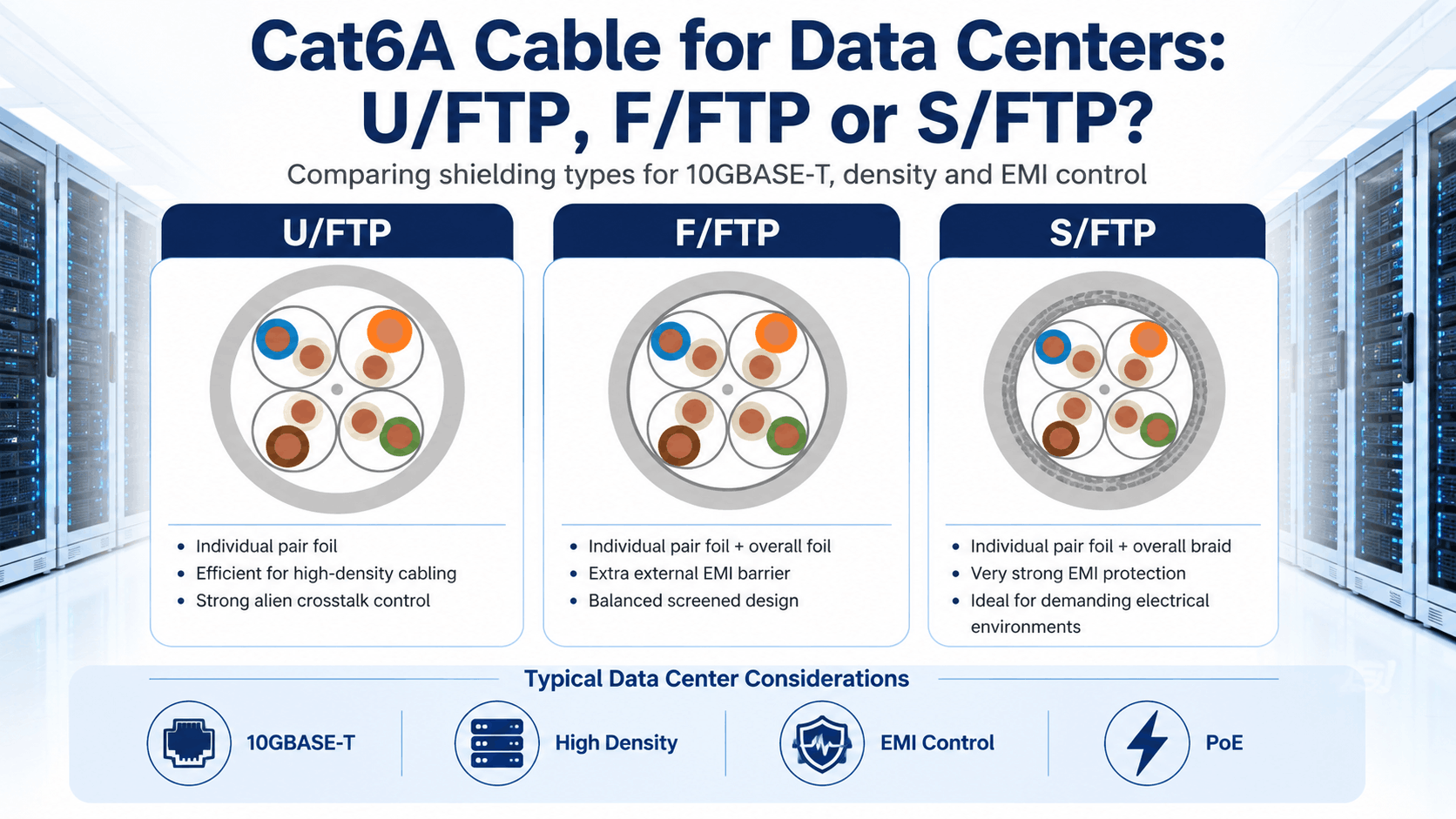
Choosing the right Cat6A cable for data centers involves more than specifying 10 Gigabit Ethernet and 500 MHz performance. U/FTP, F/FTP and S/FTP can all be used to build high-performance Cat6A structured cabling systems, but they use different shielding architectures and create different trade-offs in electromagnetic protection, cable size, flexibility, installation, grounding and cost.
In a relatively controlled data hall, U/FTP may provide an effective balance of pair isolation, cable size and installation efficiency. F/FTP adds an overall foil screen around the individually screened pairs, while S/FTP combines individually foil-screened pairs with an overall braid for a more comprehensive shielding architecture.
The best construction therefore depends on the actual data center environment. Rack density, cable-bundle size, 10GBASE-T requirements, Power over Ethernet, proximity to electrical equipment, pathway capacity, grounding infrastructure and future network strategy all influence the decision.
Quick answer: U/FTP is often a strong choice for high-density Cat6A data center cabling because each pair is individually foil-screened without adding an overall screen. F/FTP adds an overall foil where additional electromagnetic protection is desired, while S/FTP adds an overall braid and is particularly suitable for demanding EMI environments. None is automatically the best solution for every data center.
How to Choose Cat6A Cable for Data Centers
| Construction | Individual Pair Screen | Overall Screen | EMI Protection | Typical Data Center Advantage |
|---|---|---|---|---|
| U/FTP | Foil around each pair | None | High | Strong pair isolation with relatively efficient cable construction |
| F/FTP | Foil around each pair | Overall foil | Very high | Individual pair protection plus an additional overall electromagnetic barrier |
| S/FTP | Foil around each pair | Overall braid | Very high | Comprehensive screening for demanding EMI environments |
All three constructions can be engineered to meet Category 6A transmission requirements. The primary difference is therefore not basic Ethernet speed.
The decision is mainly about how the cable manages electromagnetic interference and how the resulting physical construction fits the data center installation.
Why Cat6A Is Important in Data Center Copper Cabling
Category 6A was developed to support 10GBASE-T over a full 100-meter structured cabling channel.
It operates at frequencies up to 500 MHz and places greater emphasis on controlling crosstalk than lower copper categories.
For data centers, Cat6A can support applications such as:
- 10 Gigabit Ethernet switch-to-server links
- Management networks
- Storage and equipment connectivity where copper is specified
- Top-of-rack and end-of-row architectures
- Network appliance connectivity
- Wireless and security infrastructure
- High-power PoE devices in associated technical spaces
Fiber increasingly dominates many higher-speed and longer-distance data center links, but Cat6A remains highly relevant wherever RJ45-based 10GBASE-T provides the required performance, compatibility and economics.
Why Alien Crosstalk Matters for Cat6A
Crosstalk does not occur only between pairs inside one Ethernet cable.
At higher frequencies, signals from neighbouring cables can couple into one another. This phenomenon is known as alien crosstalk.
It becomes particularly important in high-density installations because data center cables are frequently:
- Installed in large bundles
- Placed closely together in trays
- Routed through high-density cabinets
- Organized through vertical and horizontal cable managers
- Operated simultaneously at high data rates
Cat6A systems are designed with alien-crosstalk performance in mind. Shielded constructions can provide a significant advantage because metallic screens help isolate adjacent cables from one another.
However, shielding does not eliminate the need for good system design.
Pathway fill, cable geometry, installation practices, connectors, patch panels and shield continuity remain important.
What Is Cat6A U/FTP Cable?
Cat6A U/FTP uses individually foil-screened twisted pairs without an additional overall metallic screen around the complete cable core.
Each pair receives its own foil barrier.
This architecture provides direct separation between the four twisted pairs and helps control both internal crosstalk and electromagnetic coupling.
Why Is U/FTP Attractive for Data Centers?
U/FTP can offer a particularly useful balance for dense structured cabling.
Its advantages can include:
- Individual foil protection around every pair
- Strong pair-to-pair isolation
- Good alien-crosstalk performance
- High immunity to electromagnetic interference
- No additional overall foil or braid layer
- Potentially efficient cable diameter compared with more heavily screened alternatives
- Suitability for high-density 10 GbE cabling
Reducing cable diameter can matter more than it initially appears.
Data centers can contain thousands of copper links. Even a relatively small difference in cable diameter can affect:
- Cable tray capacity
- Raised-floor or overhead pathway utilization
- Rack cable-management density
- Airflow around cabling
- Bundle size
- Installation labour
For this reason, a well-designed U/FTP cable can be an efficient choice where engineers want individual pair screening without the additional material of an overall metallic screen.
When Should You Consider U/FTP?
U/FTP can be particularly suitable where:
- 10GBASE-T is required
- Cable density is high
- Alien crosstalk must be tightly controlled
- The electrical environment is moderately demanding
- Pathway space is valuable
- A screened Cat6A architecture is required
- The project does not specifically require an overall foil or braid screen
What Is Cat6A F/FTP Cable?
Cat6A F/FTP takes the individual pair screening used in U/FTP and adds another foil screen around the complete group of pairs.
The construction therefore contains:
- Individual foil around each twisted pair
- An additional overall foil screen
This provides two levels of electromagnetic screening.
The individual foils isolate the pairs, while the overall foil creates another barrier between the cable core and the surrounding environment.
Why Choose F/FTP in a Data Center?
F/FTP can be useful when a project wants additional external EMI protection beyond the individual pair foils.
Potential advantages include:
- Strong internal pair isolation
- Additional overall electromagnetic screening
- Excellent alien-crosstalk control
- Suitability for electrically demanding technical spaces
- High-performance Cat6A channel design
However, the additional foil also introduces more material into the construction.
Depending on the cable design, this can influence:
- Diameter
- Weight
- Flexibility
- Termination
- Grounding requirements
- Cost
F/FTP should therefore be selected because the additional overall foil provides a meaningful benefit to the project rather than simply because it contains more shielding than U/FTP.
What Is Cat6A S/FTP Cable?
Cat6A S/FTP combines individually foil-screened pairs with an overall metallic braid.
The pair foils provide direct isolation around each twisted pair, while the braid surrounds the complete cable core.
This construction provides comprehensive electromagnetic protection and is commonly considered where EMI immunity is a major requirement.
Why Choose S/FTP for a Data Center?
S/FTP can be attractive in environments where network cabling operates near significant electrical noise sources.
Potential applications include areas near:
- High-capacity power distribution
- UPS systems
- Electrical switchgear
- Power conversion equipment
- Large motors or cooling infrastructure
- Electrically demanding industrial systems connected to the data center
Its potential advantages include:
- Individual pair shielding
- Overall braid screening
- Very strong electromagnetic immunity
- Excellent crosstalk control
- Robust screening architecture
However, the trade-off is that braid adds metallic content and can affect cable weight, size and flexibility.
Therefore, S/FTP is particularly logical where its stronger overall shielding provides a genuine engineering advantage.
U/FTP vs F/FTP: What Is the Difference in a Data Center?
Both constructions individually foil-screen all four twisted pairs.
The difference is the overall screen.
U/FTP: no overall screen.
F/FTP: additional overall foil screen.
| Data Center Consideration | U/FTP | F/FTP |
|---|---|---|
| Individual pair screening | Yes | Yes |
| Overall shielding | No | Foil |
| Pair isolation | High | High |
| External EMI protection | High | Higher overall screening architecture |
| Construction complexity | Lower | Higher |
| High-density suitability | Very strong | Very strong where additional overall screen is justified |
For many conventional data halls, U/FTP may already provide the electromagnetic performance required by the design.
F/FTP becomes particularly interesting when the consultant or network designer wants another overall foil barrier around the screened pairs.
F/FTP vs S/FTP: Foil or Braid Overall Screen?
F/FTP and S/FTP both individually foil-screen each pair.
The main difference is the material used for the additional overall screen.
F/FTP uses overall foil.
S/FTP uses overall braid.
A metallic braid can provide robust screening performance and good protection across demanding electromagnetic environments.
Foil provides high coverage with a relatively thin metallic layer.
Neither should automatically be described as universally better.
The cable manufacturer must engineer the complete construction to meet the required Category 6A electrical performance.
U/FTP vs S/FTP: Is More Shielding Always Better?
No.
This is particularly important in data center design.
S/FTP contains an additional overall braid, but that does not automatically make it a better cable for every rack or data hall.
If a U/FTP design already provides:
- Full Category 6A compliance
- Reliable 10GBASE-T operation
- Required alien-crosstalk performance
- Adequate EMI immunity
- Compatible shielded connectivity
then adding an overall braid may provide little operational benefit in that specific environment.
Meanwhile, the additional construction can increase:
- Cable diameter
- Weight
- Material consumption
- Bend stiffness
- Termination effort
- Cost
The goal should therefore be appropriate shielding, not maximum shielding.
Which Cat6A Shielding Is Best for High-Density Racks?
High-density rack environments create a strong case for considering physical cable dimensions alongside electrical performance.
A data center may route dozens or hundreds of cables through:
- Vertical managers
- Horizontal managers
- Overhead trays
- Underfloor pathways
- Patch-panel fields
- Cabinet entry points
A smaller cable diameter can simplify routing and preserve pathway capacity.
Therefore, a compact U/FTP design can be particularly attractive where individual pair screening provides the required electrical performance without an additional overall screen.
However, exact outside diameter varies by manufacturer and product construction.
Engineers should compare actual datasheets rather than assuming every U/FTP cable will be smaller than every F/FTP or S/FTP product.
Cat6A Shielding and Power over Ethernet
Power over Ethernet adds another consideration because current passing through copper conductors generates heat.
This becomes increasingly relevant when many powered cables are grouped into bundles.
Data center and technical-building designers should consider:
- Conductor gauge
- DC resistance
- Bundle size
- Ambient temperature
- Pathway ventilation
- Number of energized pairs
- PoE power level
- Cable temperature rating
Category 6A commonly uses relatively large conductors, such as 23 AWG in many horizontal cable designs, which can help reduce conductor resistance compared with smaller-gauge constructions.
Metallic shielding can also influence thermal behaviour, but shielding type alone should not be used as a substitute for proper PoE thermal design.
Therefore, the cable’s documented remote-powering capability and applicable cabling standards should be reviewed for the intended installation.
Does Shielding Improve 10GBASE-T Speed?
Shielding does not change 10 Gigabit Ethernet into a faster Ethernet standard.
U/FTP, F/FTP and S/FTP Cat6A cables can all support 10GBASE-T when the complete channel complies with the applicable Category 6A requirements.
Shielding instead helps the cabling system maintain signal integrity in the presence of electromagnetic noise and crosstalk.
Therefore, the key benefit is not a higher nominal data rate.
It is greater protection of the signal conditions required for reliable high-speed transmission.
Grounding and Shield Continuity in Data Centers
A shielded Cat6A cable should not be evaluated independently from the rest of the cabling channel.
The screen forms part of a complete shielded system that can include:
- Shielded keystone jacks
- Shielded patch panels
- Shielded RJ45 connectors
- Equipment bonding
- Rack bonding
- Telecommunications grounding infrastructure
If screen continuity is interrupted, the installed system may not provide the shielding performance expected from the cable specification.
This means installation quality is particularly important.
A well-engineered S/FTP cable with poorly terminated shield continuity can perform worse than expected, while a correctly installed U/FTP system can provide excellent electromagnetic performance.
Should Every Data Center Use Shielded Cat6A?
Not necessarily.
Cat6A U/UTP systems also exist and can support 10GBASE-T when properly designed and installed.
However, screened constructions can be attractive in data centers because they provide strong noise immunity and can simplify alien-crosstalk management.
The choice should depend on:
- Network design
- Cable density
- EMI environment
- Grounding infrastructure
- Local standards
- Consultant specification
- Total installed cost
- Operational preferences
A project should not choose shielded cable solely because the facility is called a data center.
LSZH, PVC and CPR Requirements Still Matter
U/FTP, F/FTP and S/FTP describe shielding architecture only.
They do not define the outer sheath or reaction-to-fire classification.
A Cat6A data center cable can therefore separately require:
- LSZH outer sheath
- PVC outer sheath where permitted
- Specific CPR Euroclass
- Low-smoke performance
- Halogen-free performance
- Project-specific flame requirements
For European data center projects, the applicable CPR classification should be specified independently from the Ethernet category and shielding type.
For example, specifying “Cat6A S/FTP” does not tell the manufacturer whether the project requires B2ca, Cca, Dca or another applicable reaction-to-fire classification.
Cat6A Cable Selection for Different Data Center Conditions
| Project Condition | Construction to Consider | Selection Logic |
|---|---|---|
| High-density 10GBASE-T structured cabling | U/FTP | Strong individual pair screening with efficient construction |
| High-density network plus additional overall EMI protection | F/FTP | Adds overall foil around individually screened pairs |
| Electrically demanding environment | S/FTP | Individual foil plus overall braid provides comprehensive shielding |
| Pathway capacity is highly constrained | Compare U/FTP first | Can offer an efficient screened architecture, subject to actual cable diameter |
| Installation near major power infrastructure | F/FTP or S/FTP | Additional overall screening may provide useful EMI protection |
| Consultant specifies overall braid | S/FTP | Matches the required screening architecture |
| Consultant specifies individual plus overall foil | F/FTP | Matches the required construction |
This table should be treated as a project-selection guide rather than a universal ranking.
The final decision should be verified against the actual cable datasheet and complete structured cabling system.
What About F/UTP Cat6A?
F/UTP is another shielding architecture in which one overall foil surrounds otherwise unscreened twisted pairs.
It should not be confused with F/FTP.
In F/FTP, each pair is individually foil-screened and another foil surrounds the overall cable core.
Therefore:
F/UTP = overall foil + unscreened pairs
F/FTP = overall foil + individually foil-screened pairs
Both constructions can be engineered for different structured cabling applications, but buyers should specify the exact nomenclature because writing only “foil-screened Cat6A” can be ambiguous.
What Should Data Center Buyers Specify in a Cat6A RFQ?
A technically complete RFQ should describe more than “Cat6A shielded cable.”
Consider defining:
- Category 6A performance
- 10GBASE-T requirement
- 500 MHz performance
- U/FTP, F/FTP or S/FTP construction
- Solid conductor size
- Maximum DC resistance
- Required cable outside diameter
- Maximum pathway or bundle limitations
- LSZH or PVC jacket
- CPR Euroclass where applicable
- PoE requirement
- Operating temperature
- Horizontal cabling or other application
- Compatible shielded connectivity
- Applicable ISO/IEC, EN or TIA requirements
- Permanent-link or channel testing requirements
- Alien-crosstalk testing requirements where applicable
- Cable marking
- Packaging length
- Certificates and test documentation
This makes supplier quotations much easier to compare technically.
Common Mistakes When Selecting Cat6A Cable for Data Centers
1. Assuming S/FTP Is Automatically the Best
S/FTP provides comprehensive shielding, but the additional braid only creates value when the environment or specification benefits from it.
2. Confusing F/UTP with F/FTP
F/UTP has an overall foil around unscreened pairs. F/FTP has individually foil-screened pairs plus an overall foil. These are materially different constructions.
3. Choosing Cable Without Reviewing Outside Diameter
Electrical performance alone does not determine how efficiently thousands of cables fit into pathways and rack managers.
4. Ignoring Alien Crosstalk
10GBASE-T operates at frequencies where interference from neighbouring cables becomes an important design consideration.
5. Ignoring Shield Continuity
A shielded cable should be installed as part of a compatible shielded system with proper termination and bonding.
6. Assuming Shielding Determines Ethernet Speed
All compliant Cat6A constructions can support 10GBASE-T. Shielding primarily addresses noise immunity and crosstalk.
7. Ignoring PoE Thermal Conditions
Large energized cable bundles can experience temperature rise. Conductor resistance, bundle size and ambient conditions should be evaluated.
8. Specifying Only “LSZH Cat6A”
LSZH describes jacket material characteristics. The project must still define the shielding architecture and required Cat6A performance.
9. Selecting Copper Without Reviewing Fiber Architecture
Not every data center connection should necessarily use copper.
Higher-speed, longer-distance and high-density backbone applications may be better served by fiber optic cabling.
Cat6A should be selected where 10GBASE-T and RJ45-based copper connectivity provide the appropriate architecture.
ETK Kablo Cat6A Cable Solutions for Data Centers
ETK Kablo manufactures Cat6A cable for data centers and other high-performance structured cabling applications with multiple shielding constructions.
The Cat6A portfolio includes U/UTP, U/FTP, F/FTP and S/FTP designs as well as mechanically protected constructions for applications requiring additional physical protection.
For screened data center networks, U/FTP provides individually foil-screened pairs without an overall metallic screen. F/FTP combines individual pair foils with an additional overall foil, while S/FTP combines individual pair foils with an overall tinned-copper braid.
These constructions can be manufactured with different outer sheath materials depending on the product and project specification, including LSZH, PVC and PE variants.
ETK Kablo’s Cat6A range is designed around 10 Gigabit Ethernet and transmission frequencies up to 500 MHz, allowing project engineers to choose the shielding architecture according to network density, electromagnetic environment, pathway requirements and installation philosophy.
The appropriate cable should therefore be selected as part of the complete data center cabling system rather than by choosing the shielding type in isolation.
Frequently Asked Questions
Which Cat6A cable is best for data centers?
There is no universal best construction. U/FTP can provide an effective balance of individual pair shielding and cable efficiency for high-density networks. F/FTP adds an overall foil, while S/FTP adds an overall braid for demanding EMI environments.
Is U/FTP good for data centers?
Yes. U/FTP individually foil-screens each twisted pair and can provide strong crosstalk and EMI performance for high-density 10GBASE-T structured cabling.
What is the difference between U/FTP and F/FTP?
Both individually foil-screen each pair. F/FTP additionally uses an overall foil screen around all four screened pairs, while U/FTP has no overall metallic screen.
What is the difference between F/FTP and S/FTP?
Both individually foil-screen the twisted pairs. F/FTP uses an overall foil screen, while S/FTP uses an overall metallic braid.
Is S/FTP better than U/FTP?
S/FTP provides an additional overall braid, but U/FTP may already provide all the electrical performance required in many data centers. The correct choice depends on EMI, pathway constraints, grounding and project specifications.
Does Cat6A support 10 Gbps over 100 meters?
Yes. Properly designed and installed Category 6A structured cabling is intended to support 10GBASE-T over a full 100-meter channel.
What is alien crosstalk?
Alien crosstalk is electromagnetic interference coupled into a cable pair from pairs in neighbouring cables rather than from pairs within the same cable. It is an important consideration for 10GBASE-T structured cabling.
Does shielded Cat6A eliminate alien crosstalk?
Shielded cabling can substantially reduce alien crosstalk, but correct connectors, shield continuity, bonding and installation practices remain necessary for reliable system performance.
Is F/UTP the same as F/FTP?
No. F/UTP uses one overall foil around unscreened twisted pairs. F/FTP individually foil-screens each pair and also adds an overall foil around the complete cable core.
Is Cat6A suitable for PoE?
Cat6A can support Power over Ethernet when the complete cabling system is designed for the required PoE application. Bundle size, conductor gauge, DC resistance, ambient temperature and cable temperature rating should all be considered.
Should Cat6A data center cable be LSZH?
LSZH may be required by building regulations, fire strategy or project specifications, particularly in enclosed technical spaces. However, LSZH is a separate requirement from Category 6A performance and shielding construction.
Should a data center use Cat6A or fiber?
Both technologies can be appropriate. Cat6A is useful for 10GBASE-T and RJ45-based copper links, while fiber is commonly preferred for higher data rates, longer links, backbone infrastructure and many high-density architectures.
Conclusion
Selecting the right Cat6A cable for data centers requires balancing electrical performance with the physical realities of a high-density cabling environment.
U/FTP individually foil-screens each pair and can provide an efficient combination of crosstalk control, EMI protection and cable density. F/FTP adds an overall foil where another layer of electromagnetic screening is required. S/FTP adds an overall braid and can provide a particularly robust shielding architecture in electrically demanding environments.
The construction with the most shielding is not automatically the best choice.
Cable diameter, pathway utilization, alien crosstalk, PoE thermal conditions, grounding, shield continuity, fire classification and installation complexity all affect total system performance.
For project engineers and data center buyers, the best approach is to define the 10GBASE-T application, electromagnetic environment and physical installation requirements first, then select the Cat6A shielding architecture that satisfies those requirements without unnecessary over-specification.
Benzer yazılar
F/UTP vs U/FTP vs S/FTP vs U/UTP: Ethernet Cable Shielding Explained
Ethernet cable shielding can have a major influence on how reliably a network performs in environments affected by electromagnetic inte...


