





 President’s Message
Blog
Armored vs Unarmored Cable: When Is Mechanical Protection Required?
Reading Time: 13 minutes
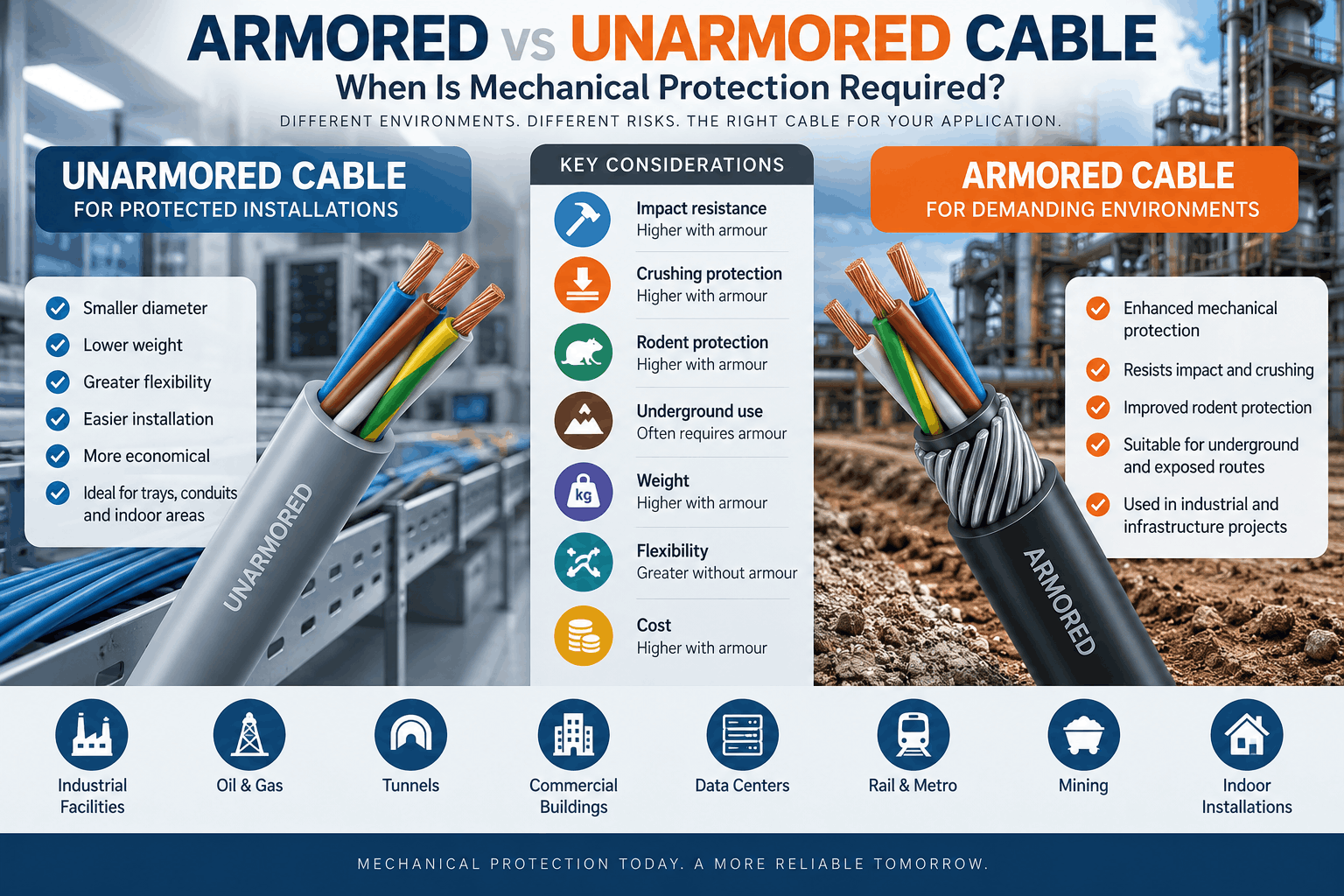
Choosing between armored vs unarmored cable should begin with the mechanical risks of the installation route rather than the assumption that more protection automatically means a better cable. Armour can provide valuable resistance to impact, crushing, rodent damage and other physical stresses, but it also increases cable diameter, weight, stiffness, installation complexity and cost.
An unarmored cable can therefore be the correct engineering choice when trays, conduits, cabinets or other infrastructure already provide sufficient physical protection. An armored construction becomes more appropriate when the cable itself must tolerate a higher level of mechanical exposure.
The decision is relevant across instrumentation cables, signal and control cables, Ethernet cables and fiber optic cables. However, the type of mechanical protection can differ significantly. Steel wire armour, steel wire braid, steel tape and non-metallic protective constructions solve different problems and should not be treated as interchangeable.
Quick answer: Choose an unarmored cable when the route already protects the cable against impact, crushing and other physical damage. Consider an armored cable when the installation is mechanically exposed, subject to rodent risk, installed underground or in demanding industrial infrastructure, or when the project specification explicitly requires additional mechanical protection. Armour should still be selected according to the actual hazard rather than added automatically.
Armored vs Unarmored Cable at a Glance
| Characteristic | Unarmored Cable | Armored Cable |
|---|---|---|
| Additional mechanical protection | No dedicated armour layer | Yes |
| Typical cable diameter | Smaller | Larger |
| Typical cable weight | Lower | Higher |
| Flexibility | Generally greater | Generally lower depending on armour type |
| Installation complexity | Lower | Higher |
| Mechanical impact resistance | Depends primarily on sheath and installation protection | Enhanced by the armour system |
| Rodent protection | Limited unless another protective construction is used | Can be significantly improved depending on armour design |
| Typical application | Protected trays, conduits, indoor technical areas | Industrial, outdoor, underground and mechanically exposed routes |
| Cost | Generally lower | Generally higher |
The difference is primarily mechanical.
Armour should not automatically be interpreted as higher electrical performance, better data transmission, greater fire resistance or superior electromagnetic shielding.
What Is an Unarmored Cable?
An unarmored cable does not include a dedicated armour layer around the cable core.
The cable still contains the construction elements required for its electrical, optical and environmental function. Depending on the product, these can include:
- Conductors or optical fibers
- Insulation
- Twisted pairs or triads
- Loose tubes or tight buffers
- Signal screens
- Strength members
- Water-blocking elements
- Inner or outer sheaths
What is absent is an additional dedicated mechanical layer such as galvanized steel wire armour, steel wire braid or corrugated metallic armour.
Why Use an Unarmored Cable?
An unarmored design can provide several practical advantages:
- Smaller outside diameter
- Lower weight
- Greater flexibility
- Easier pulling and routing
- Smaller cable glands
- Easier termination
- Greater tray capacity
- Lower material cost
These advantages become important in installations containing hundreds or thousands of cable runs.
If a control room, data center or industrial building already protects cables inside trays or conduits, adding heavy metallic armour to every cable may provide limited additional value.
What Is an Armored Cable?
An armored cable incorporates an additional protective layer intended to increase resistance to physical damage.
Depending on the cable type, the armour can use:
- Galvanized steel wires
- Steel wire braid
- Corrugated steel tape
- Steel tape
- Other metallic tapes
- Glass yarns
- Aramid yarns
- Other non-metallic reinforcing elements
The precise armour construction should reflect the expected mechanical hazard.
For example, a heavy steel-wire-armored instrumentation cable and a non-metallic armored fiber optic cable are both mechanically protected, but they achieve that protection through very different constructions.
Why Is Cable Armour Used?
The main purpose of armour is to protect the functional elements inside the cable from external mechanical stresses.
Depending on the installation, these stresses can include:
- Impact
- Crushing forces
- Compression
- Rodent attack
- Accidental contact with tools
- Damage during cable pulling
- Soil movement
- Exposed industrial routing
- Mechanical stress in underground infrastructure
A cable installed in a protected office ceiling does not face the same risks as a cable running across an industrial process area or underground route.
Therefore, mechanical protection should be selected according to the installation environment.
When Is Mechanical Protection Required?
Mechanical protection should be considered when credible physical hazards exist along the cable route.
| Installation Condition | Mechanical Protection | Reason |
|---|---|---|
| Protected indoor cable tray | Often unarmored | The pathway already provides substantial physical protection |
| Control cabinet or technical room | Often unarmored | Low risk of crushing or external impact |
| Exposed industrial tray | Armour may be justified | Greater risk of impact or accidental damage |
| Underground route | Armored construction often considered | Soil pressure, installation damage and other mechanical risks may apply |
| High rodent-risk environment | Armored or specialized protective construction | Additional physical barrier can reduce cable damage |
| Mining or heavy industrial area | Armored construction frequently appropriate | Higher mechanical exposure |
| Data center rack and pathway | Usually unarmored unless special risk exists | Density and flexibility are often more important than armour |
| Outdoor infrastructure route | Depends on route | Outdoor exposure alone does not automatically require armour |
The last point is particularly important.
Outdoor does not automatically mean armored.
An outdoor cable may be routed through a protected duct or installed in an environment where mechanical exposure is low. Conversely, an indoor industrial cable can require armour if the route presents significant physical risk.
Steel Wire Armour: When Is SWA Used?
Steel wire armour, or SWA, uses a layer of galvanized steel wires around the cable construction.
SWA is commonly selected when substantial mechanical protection is required.
Typical benefits can include increased resistance to:
- Crushing
- Impact
- Mechanical stress
- Installation damage
- Rodent attack
ETK Kablo uses galvanized steel wire armour in several instrumentation and data cable families designed for demanding industrial environments.
Where Is SWA Commonly Considered?
SWA can be relevant for:
- Oil and gas facilities
- Refineries
- Petrochemical plants
- Power plants
- Mining projects
- Tunnels
- Industrial infrastructure
- Outdoor process areas
- Underground routes where the complete cable is specified for the installation
However, the presence of SWA should not be used as the only criterion for determining whether a cable is suitable for direct burial or another specific installation method.
The complete cable construction, sheath, moisture protection and manufacturer specification must also support the intended application.
Steel Wire Braid: How Is SWB Different?
Steel wire braid, or SWB, forms a braided metallic protective layer around the cable rather than using the more longitudinal wire arrangement associated with SWA.
SWB can provide mechanical protection while retaining different flexibility characteristics compared with a heavy SWA construction.
It can be particularly useful where the cable requires:
- Additional protection against abrasion
- Mechanical reinforcement
- Industrial durability
- Greater flexibility than some heavy wire-armored constructions
The choice between SWA and SWB should therefore follow the project requirement rather than treating both terms as generic synonyms for armour.
Steel Tape Armour in Fiber Optic Cables
Fiber optic cables frequently use metallic tape armour rather than the same wire constructions used in some copper instrumentation cables.
A common example is corrugated steel tape armour.
This layer can provide strong protection against:
- Crushing
- Impact
- Rodent damage
- Mechanical stress
Because optical fibers themselves are extremely small and sensitive to excessive mechanical stress, the surrounding cable structure plays a major role in protecting the optical transmission medium.
ETK Kablo’s A-D(ZN)(SR)2Y family, for example, uses corrugated steel tape around the loose-tube cable construction before the PE outer jacket.
What Is Non-Metallic Armoured Fiber Optic Cable?
Not all armour needs to be metallic.
Fiber optic cables can also use non-metallic armored constructions based on materials such as glass yarns, aramid yarns or dielectric reinforcing elements.
These designs can provide mechanical reinforcement while preserving an all-dielectric cable construction.
Potential advantages include:
- No metallic armour layer
- No electrical conduction through the armour
- No armour grounding requirement
- Suitability for environments where metallic components are undesirable
- Additional tensile or rodent protection depending on design
Non-metallic armour is particularly relevant to fiber optic networks because optical transmission itself does not require metallic conductors.
Therefore, the choice is not always simply “armored steel cable vs unarmored cable.”
There can also be a third option: mechanically protected but completely dielectric cable.
Armored vs Unarmored Instrumentation Cable
Instrumentation cable provides one of the clearest examples of the armour decision.
Consider the difference between:
RE-2X(St)H and RE-2X(St)HSWAH.
Both can use XLPE-insulated conductors and overall instrumentation screening. The HSWAH version adds an inner sheath and galvanized steel wire armour.
Likewise:
RE-2X(St)Y is the unarmored PVC construction, while RE-2X(St)YSWAY adds PVC inner sheath and SWA.
The armour does not fundamentally change the instrumentation signal function.
Instead, it changes how much mechanical exposure the cable can tolerate.
When Should Instrumentation Cable Be Armored?
Armour can be justified where instrumentation cables:
- Run through exposed process areas
- Face impact risk
- Are installed underground according to the approved cable construction
- Cross heavy industrial areas
- Face rodent risk
- Require additional protection under the project specification
Inside a protected control room or closed cable tray, the unarmored version may provide all the mechanical protection the route requires.
Armored vs Unarmored Ethernet Cable
Ethernet cable can also be supplied in armored constructions.
For example, Cat6 and Cat6A cables can use SWA or SWB protection for industrial and infrastructure environments.
Armored Ethernet cables can be useful where high-speed data links pass through:
- Factories
- Industrial plants
- Outdoor networks
- Tunnels
- Oil and gas facilities
- Mechanically exposed infrastructure
However, typical office and data center structured cabling usually benefits from smaller, lighter and more flexible unarmored cables.
In those installations, cable trays, racks and pathways already provide physical protection, while high cable density makes outside diameter particularly important.
Does Armour Improve Ethernet Speed?
No.
Adding SWA or SWB does not transform Cat6 into Cat6A or increase Ethernet data rate.
Ethernet performance depends on:
- Cable category
- Conductor geometry
- Pair twisting
- Screening
- Insertion loss
- Return loss
- Crosstalk performance
- Connectors
- Channel design
Armour primarily addresses mechanical protection.
Armored vs Unarmored Fiber Optic Cable
The same distinction applies to fiber optic networks.
An unarmored fiber optic cable can be entirely appropriate when ducts, trays or building infrastructure protect the cable from mechanical damage.
Armored fiber becomes more attractive where the route exposes the cable to:
- Rodents
- Crushing
- Soil movement
- Impact
- Heavy industrial conditions
- External mechanical stress
The armour type can then be selected from options such as:
- Corrugated steel tape
- Steel wire armour
- Multiple metallic protective layers
- Glass-yarn reinforcement
- Other non-metallic protective systems
As with copper cables, the highest level of armour is not automatically necessary.
Does Armour Provide EMI Shielding?
This question requires an important distinction.
Metallic armour can influence electromagnetic behaviour, but armour should not automatically be treated as a substitute for the dedicated electrical screen required by a cable specification.
For example, an instrumentation cable may contain:
- Individual pair screens
- An overall Al/PET screen
- A tinned-copper earth wire
- A separate steel wire armour layer
The screen is engineered primarily for signal protection.
The armour is engineered primarily for mechanical protection.
If EMI performance matters, buyers should define the required screening construction independently from the armour requirement.
Does Armored Cable Mean Fire Resistant?
No.
Mechanical protection and fire resistance are separate cable characteristics.
A steel-wire-armored cable can use:
- PVC materials
- LSZH materials
- Flame-retardant materials
- Fire-resistant construction
- Standard non-fire-resistant construction
Therefore, specifying SWA does not automatically provide:
- FE180
- PH120
- E30
- E60
- E90
- A specific CPR Euroclass
Fire performance must be specified separately.
Does Armored Cable Mean Outdoor Cable?
No.
Armour and outdoor suitability solve different problems.
Armour primarily addresses mechanical stress.
Outdoor suitability can require properties such as:
- UV resistance
- Water resistance
- Temperature resistance
- Moisture protection
- Weathering resistance
- Appropriate sheath material
An armored cable with the wrong outer sheath may not be suitable for a particular outdoor environment.
Conversely, an unarmored cable with a properly designed PE outer sheath can be entirely suitable for an outdoor duct installation if the route provides adequate mechanical protection.
Does Armored Cable Mean Direct Burial Cable?
Not automatically.
This is one of the most important procurement distinctions.
Direct burial exposes a cable to a combination of risks that can include:
- Soil pressure
- Moisture
- Water ingress
- Rodents
- Stone impact
- Ground movement
- Installation forces
Armour can address some of the mechanical risks, but the complete cable must still be designed and approved for the intended underground installation.
Therefore, buyers should not specify only:
“SWA cable.”
If direct burial is required, the RFQ should state that installation condition explicitly.
Armored Cable and Rodent Protection
Rodent damage can be a serious concern in telecommunications, industrial and infrastructure networks.
Metallic armour can provide a strong physical barrier against rodents reaching the functional cable elements.
Corrugated steel tape is particularly common in outdoor fiber optic cable designs where crush and rodent protection are important.
However, rodent protection can also be achieved using selected non-metallic cable designs.
The required solution depends on:
- Rodent severity
- Installation environment
- Whether metallic components are permitted
- Cable flexibility requirements
- Electrical grounding considerations
- Project standards
Armour and Cable Bending Radius
Adding mechanical protection generally affects how easily a cable can bend.
An armored cable usually requires a larger minimum bending radius than a lighter equivalent construction.
This matters during:
- Cable pulling
- Tray routing
- Entry into cabinets
- Glanding
- Changes in direction
- Installation around structural obstacles
Trying to force an armored cable through an excessively tight route can damage the armour, sheath or internal cable elements.
Installers should therefore follow the minimum bending radius stated in the manufacturer’s technical data.
Armour and Cable Weight
Steel adds substantial mass to a cable.
This can affect:
- Drum size
- Transport
- Manual handling
- Pulling tension
- Tray loading
- Support spacing
- Installation labour
For long cable routes, these factors can materially affect total project cost.
Therefore, armour should be treated as an engineering requirement rather than a free upgrade.
Armoured Cable and Grounding
Metallic armour can introduce electrical bonding and grounding considerations.
The required treatment depends on:
- Cable construction
- Voltage level
- Electrical system
- Local regulations
- Equipment
- Hazardous-area philosophy
- Project grounding design
Where metallic armour needs to be bonded or earthed, the cable glands, terminations and grounding system must support the required arrangement.
Non-metallic armored fiber optic cables can avoid these metallic-armour grounding considerations because the protective elements remain dielectric.
When Should You Choose an Unarmored Cable?
An unarmored cable is often appropriate when:
- The cable is inside a protected tray
- The cable runs through conduit
- The cable is inside cabinets or technical rooms
- Mechanical impact risk is low
- The network requires high cable density
- Flexibility is important
- Low cable weight is valuable
- The project does not require armour
In these conditions, the installation infrastructure itself provides much of the required physical protection.
Adding armour can simply duplicate a protection function already provided by the route.
When Should You Choose an Armored Cable?
An armored cable should be considered when:
- The cable route is mechanically exposed
- Impact or crushing is credible
- Rodent damage is a concern
- The cable runs through heavy industrial areas
- Underground installation introduces significant mechanical risk
- The project specification requires SWA, SWB or metallic tape
- Mining or tunnel conditions require additional protection
- The cable must tolerate a more severe installation environment
The armour type should then be selected according to the specific mechanical hazard.
Armored vs Unarmored Cable: Which Should You Choose?
| Project Requirement | Construction to Consider | Reason |
|---|---|---|
| Protected indoor tray | Unarmored | Existing pathway provides mechanical protection |
| High-density data center | Unarmored | Smaller diameter and greater flexibility are advantageous |
| Control room instrumentation | Unarmored | Mechanical risk is usually limited |
| Exposed industrial installation | Armored | Additional resistance to impact and physical damage |
| Oil and gas process area | Depends on route | Some routes require armour while protected routes may not |
| Rodent-prone fiber route | Armored or specialized protective cable | Additional physical barrier may be required |
| Underground infrastructure | Armored cable may be appropriate | Complete construction must match burial and environmental requirements |
| High-voltage environment requiring dielectric fiber | Non-metallic armored fiber | Provides mechanical reinforcement without metallic armour |
The decision should always be based on risk.
Neither armored nor unarmored cable is universally superior.
Common Mistakes When Specifying Cable Armour
1. Assuming Armored Cable Is Always Better
Armour adds protection, but it also adds weight, diameter, stiffness and cost. If the route already provides sufficient mechanical protection, these disadvantages may outweigh the benefit.
2. Specifying SWA for Every Industrial Project
Industrial facilities contain many different cable environments. A protected control room and an exposed process route do not require identical cable construction.
3. Assuming Armour Replaces the Signal Screen
Instrumentation and data cables can require dedicated screens for electromagnetic performance. Armour primarily provides mechanical protection.
4. Assuming Armored Means Fire Resistant
Fire-survival performance requires separate construction and testing.
5. Assuming Armored Means LSZH
Armored cables can use PVC, LSZH, PE or other sheath materials depending on their design.
6. Assuming Armored Means Outdoor
UV, water, temperature and weather resistance need to be verified separately.
7. Assuming SWA Automatically Means Direct Burial
The complete cable design must be suitable for the installation conditions, including moisture and environmental exposure.
8. Ignoring Bending Radius
Armour can make a cable substantially stiffer. The route must accommodate the manufacturer’s minimum bending radius.
9. Ignoring Cable Weight
Large armored cables can significantly increase tray loads, pulling forces and installation effort.
10. Ignoring Metallic Armour Grounding Requirements
Where applicable, metallic armour should be incorporated into the project’s bonding and grounding design.
11. Assuming All Armour Types Provide the Same Protection
SWA, SWB, corrugated steel tape and non-metallic reinforcement use different structures and should be selected according to the specific mechanical requirements.
What Should Buyers Include in an Armored Cable RFQ?
A request such as “armored cable” leaves many important questions unanswered.
A technically useful RFQ should consider:
- Cable type
- Application
- Required electrical or optical performance
- Installation environment
- Indoor or outdoor use
- Direct burial requirement where applicable
- Duct or tray installation
- Expected mechanical risk
- Required armour type
- SWA or SWB where specified
- Steel tape where specified
- Non-metallic armour where required
- Rodent protection requirement
- Outer sheath material
- UV resistance
- Water resistance
- Chemical or oil resistance where required
- Fire-performance requirements
- LSZH or PVC requirement
- Minimum bending radius
- Maximum pulling tension
- Required standards
- Cable marking
- Drum length
- Required certificates and test reports
This allows the manufacturer to select a cable construction that responds to the actual mechanical problem rather than simply adding the heaviest available armour.
ETK Kablo Armored and Unarmored Cable Solutions
ETK Kablo manufactures armored and unarmored cable constructions across instrumentation, Data/LAN, signal and control, and fiber optic cable families.
For instrumentation systems, ETK Kablo offers unarmored overall-screened and individually screened cables alongside SWA and SWB protected versions for applications requiring greater mechanical protection.
The RE-2X(St) family demonstrates this selection clearly. RE-2X(St)H and RE-2X(St)Y provide unarmored constructions, while RE-2X(St)HSWAH and RE-2X(St)YSWAY add galvanized steel wire armour for mechanically demanding routes.
ETK Kablo also manufactures armored Cat6 and Cat6A Ethernet cables with SWA or SWB protection for industrial, outdoor and infrastructure networks where conventional structured cabling would face higher physical risk.
Within fiber optic cables, metallic armour options include steel tape and steel wire constructions for demanding outdoor networks. Non-metallic armored fiber optic cables are also available where mechanical reinforcement is required without introducing conductive metallic elements.
The correct ETK cable should therefore be selected by combining transmission requirements with the environmental and mechanical risks of the route.
Frequently Asked Questions
What is the main difference between armored and unarmored cable?
Armored cable contains an additional protective layer designed to increase resistance to physical damage. Unarmored cable relies on its normal cable construction and the surrounding installation infrastructure for mechanical protection.
When is armored cable required?
Armored cable should be considered where the route presents meaningful mechanical risks such as impact, crushing, rodent attack, heavy industrial exposure or demanding underground conditions. The exact requirement should follow the project specification and installation risk.
Is armored cable better than unarmored cable?
Not universally. Armored cable provides greater mechanical protection but is typically larger, heavier, stiffer and more expensive. Unarmored cable is often more efficient in protected routes.
What does SWA mean?
SWA means steel wire armour. Galvanized steel wires are applied around the cable to provide additional mechanical protection.
What does SWB mean?
SWB means steel wire braid. Steel wires are braided around the cable to provide mechanical reinforcement while offering different flexibility characteristics from conventional SWA.
Does armored cable protect against rodents?
Metallic armour can provide a strong physical barrier against rodent damage. Specialized non-metallic protective constructions can also be used in certain fiber optic cable applications.
Does armored cable need conduit?
The answer depends on the cable construction, installation environment and applicable regulations. Armour can reduce the need for separate mechanical protection in some applications, but it does not automatically eliminate all pathway or installation requirements.
Can unarmored cable be used outdoors?
Yes, if the complete cable construction is suitable for outdoor conditions and the installation provides adequate mechanical protection. Outdoor suitability and armour are separate requirements.
Can unarmored cable be installed underground?
It can be possible in protected underground ducts when the cable is designed for that environment. Direct burial and unprotected underground installation impose different mechanical and moisture requirements that must be verified separately.
Does SWA make a cable fire resistant?
No. SWA provides mechanical protection. Fire resistance, flame retardancy, LSZH performance and CPR classification must be specified independently.
Does armour replace cable shielding?
No. Armour primarily provides mechanical protection, while dedicated cable screens are engineered for electromagnetic performance and signal integrity.
Is armored fiber optic cable always metallic?
No. Fiber optic cables can use metallic armour such as corrugated steel tape or steel wires, but they can also use non-metallic protective constructions based on glass or aramid materials.
Which cable is better for a data center, armored or unarmored?
Unarmored cables are generally more practical in conventional protected data center pathways because smaller diameter, lower weight and flexibility are valuable. Armour may be justified if a specific part of the route is mechanically exposed.
Which cable is better for oil and gas projects?
Both armored and unarmored cables can be appropriate. Protected control rooms may use unarmored constructions, while exposed process routes can justify SWA or another mechanical protection system.
Conclusion
The choice between armored vs unarmored cable should be based on the physical risks of the installation rather than the assumption that the most heavily protected cable is always the safest specification.
Unarmored cables provide advantages in flexibility, weight, diameter, termination and cost when trays, conduits or building infrastructure already provide adequate protection.
Armored cables become valuable where impact, crushing, rodents, underground installation or heavy industrial conditions create a genuine risk of physical damage.
The armour itself must also be selected carefully. SWA, SWB, corrugated steel tape and non-metallic reinforcement provide different forms of mechanical protection and can affect flexibility, weight, grounding and installation requirements.
Most importantly, armour should not be confused with other cable characteristics. Mechanical protection, electromagnetic shielding, fire resistance, LSZH performance, CPR classification and outdoor suitability are independent specification decisions.
For engineers and purchasing teams, the most effective approach is to evaluate the cable route first, identify the credible mechanical hazards and then select the lightest cable construction that provides the required level of reliable protection.
Benzer yazılar
SWA vs SWB Cable: Steel Wire Armour and Steel Wire Braid Explained
Choosing between SWA vs SWB cable requires understanding how two different steel protection systems affect mechanical strength, flexibi...


