





 President’s Message
Blog
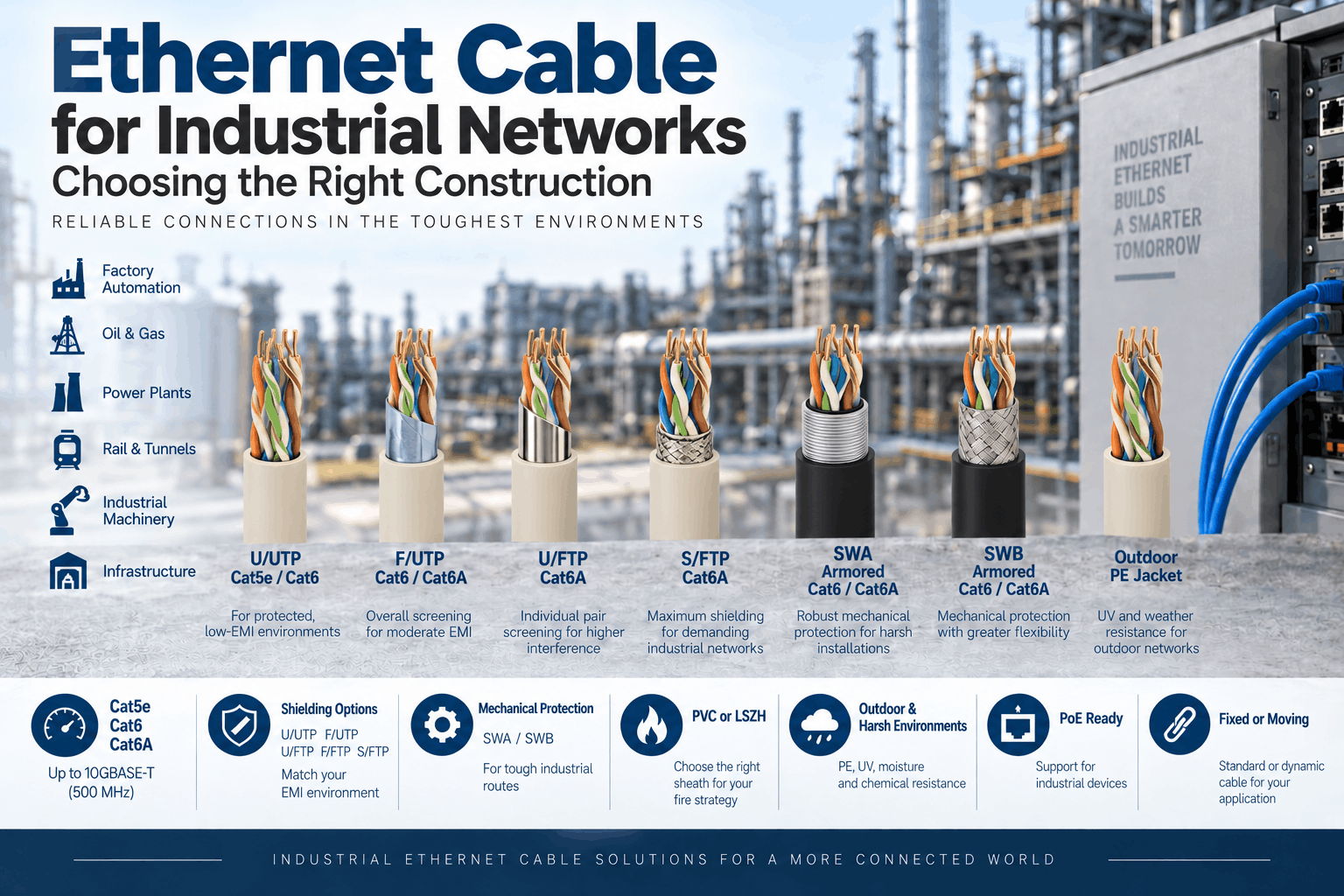
Ethernet Cable for Industrial Networks: Choosing the Right Construction
Reading Time: 15 minutes
Choosing the right industrial Ethernet cable involves much more than selecting Cat5e, Cat6 or Cat6A. Industrial networks can expose Ethernet cabling to electromagnetic interference, mechanical impact, vibration, oil, chemicals, moisture, UV radiation, temperature changes and demanding cable routes that are rarely encountered in a conventional office.
A cable that performs perfectly inside a protected control cabinet may not be suitable beside variable-frequency drives, on an exposed refinery cable tray or in an outdoor industrial network. Likewise, adding maximum shielding and heavy steel armour to every Ethernet cable can create unnecessary diameter, stiffness, grounding requirements and installation cost.
The correct construction should therefore combine the required Ethernet performance with the actual electromagnetic, mechanical, environmental and fire conditions of the installation.
Quick answer: Start by defining the required network speed and distance. Cat5e or Cat6 can remain suitable for many 1 Gigabit industrial networks, while Cat6A provides 10GBASE-T capability over a full 100-meter structured cabling channel. Then select shielding according to EMI exposure, choose PVC, LSZH or PE according to the installation environment, and add SWA or SWB only where mechanical protection is genuinely required. A standard fixed Ethernet cable should also not be assumed suitable for continuous robotic or drag-chain movement unless its complete construction has been designed and tested for that application.
Industrial Ethernet Cable Selection at a Glance
| Project Requirement | Construction to Consider | Main Reason |
|---|---|---|
| Protected low-EMI industrial network | Cat5e, Cat6 or Cat6A U/UTP | Simple construction where additional shielding is unnecessary |
| Moderate EMI | F/UTP or another screened construction | Overall screen helps protect against external electromagnetic interference |
| High EMI / sensitive high-speed network | U/FTP, F/FTP or S/FTP | Individual pair screening provides stronger pair isolation |
| 10GBASE-T over full structured cabling distance | Cat6A | Designed for 10 Gigabit Ethernet over a 100 m channel |
| Protected indoor industrial installation | PVC or LSZH according to fire strategy | No outdoor sheath may be necessary |
| Occupied or enclosed industrial building | LSZH where specified | Low-smoke and halogen-free material performance |
| Outdoor industrial route | Appropriate UV- and weather-resistant construction, often PE | Environmental protection must match outdoor exposure |
| Mechanically exposed route | Armored Ethernet cable | Additional physical protection |
| Heavy fixed mechanical exposure | SWA | Robust steel wire armour |
| Mechanical protection plus greater flexibility | SWB | Braided steel protection with easier routing |
| Continuous movement | Dedicated dynamic industrial Ethernet cable | Standard fixed-installation cable is not automatically suitable |
The important point is that “industrial Ethernet” does not identify one universal cable construction.
The network environment determines which combination of category, shielding, sheath and mechanical protection is appropriate.
What Makes an Industrial Ethernet Cable Different?
Ethernet uses the same fundamental networking principles whether the cable is installed in an office, factory or refinery.
What changes is the environment around the cable.
Industrial installations can contain:
- Electric motors
- Variable-frequency drives
- Servo drives
- Transformers
- High-current power cables
- Switchgear
- Welding equipment
- Industrial machinery
- Vibration
- Oil and process chemicals
- Moisture
- Outdoor exposure
- Mechanical impact
- Rodent risk
Therefore, an industrial Ethernet cable must be evaluated not only according to Ethernet transmission parameters but also according to the physical conditions of the installation.
Start with the Required Ethernet Speed
The first decision should still be network performance.
Mechanical robustness cannot compensate for selecting a cable category that does not meet the required Ethernet application.
| Category | Nominal Frequency | Common Ethernet Application | Typical Industrial Selection Logic |
|---|---|---|---|
| Cat5e | 100 MHz | 1 Gigabit Ethernet | Existing or cost-sensitive 1 GbE industrial networks |
| Cat6 | 250 MHz | 1 Gigabit Ethernet and selected higher-speed applications over shorter distances | Professional industrial networks requiring additional transmission margin |
| Cat6A | 500 MHz | 10GBASE-T over a full 100 m structured cabling channel | New high-performance industrial networks and future-ready backbone links |
The highest category is not automatically required for every industrial device.
A PLC, sensor gateway or machine controller operating at 100 Mbps or 1 Gbps may not gain any immediate operational benefit from a 10 Gigabit connection.
However, Cat6A can still be attractive for new infrastructure when the project wants additional bandwidth headroom and a longer useful cabling lifecycle.
Cat5e for Industrial Ethernet
Cat5e remains relevant in industrial networks where 1 Gigabit Ethernet provides sufficient bandwidth.
Many automation and control applications transmit relatively modest amounts of data compared with data centers.
Cat5e can therefore remain suitable for connections involving:
- PLC systems
- Industrial controllers
- HMIs
- Remote I/O
- Building automation
- Monitoring equipment
- Industrial switches
The important question is not whether Cat5e is an older category, but whether its electrical performance meets the actual network requirement.
For a new project with expected bandwidth growth, however, Cat6 or Cat6A may provide more useful future capacity.
Cat6 for Industrial Ethernet
Cat6 increases nominal bandwidth to 250 MHz and provides improved crosstalk performance compared with Cat5e.
It is widely suitable for professional Ethernet networks requiring stable 1 Gigabit operation and additional transmission margin.
In industrial applications, Cat6 can provide a practical middle ground between:
- Cost
- Cable diameter
- Flexibility
- Transmission capability
- Future network requirements
ETK Kablo also manufactures armored Cat6 constructions with SWA and SWB protection for industrial routes where conventional unarmored structured cabling would face greater physical risk.
Cat6A for Industrial Ethernet
Cat6A is particularly relevant to new industrial networks that require higher bandwidth or greater long-term transmission headroom.
Category 6A operates up to 500 MHz and is designed to support 10GBASE-T over a complete 100-meter structured cabling channel.
This makes Cat6A attractive for:
- Industrial network backbones
- High-resolution machine vision
- Large industrial data flows
- Edge computing
- Industrial servers
- High-speed supervisory systems
- Advanced automation networks
- Connections between industrial switches
However, Cat6A can have a larger outside diameter than lower cable categories, particularly in heavily screened or armored constructions.
Therefore, pathway capacity and bending radius should be considered during the design stage.
Shielding Is a Major Industrial Ethernet Decision
Industrial facilities can produce considerably more electromagnetic interference than conventional office environments.
Potential noise sources include motors, drives, power conversion equipment, welding systems and high-current conductors.
Ethernet cables can therefore use different shielding architectures depending on the severity of the environment.
U/UTP
U/UTP contains no metallic overall screen and no individual pair screens.
Twist geometry provides the primary crosstalk and noise-control mechanism.
For this reason, U/UTP can be suitable where:
- EMI levels are low
- Power and data routes are properly separated
- The cable remains inside protected technical areas
- A simpler and more flexible cable is desirable
F/UTP
F/UTP adds an overall foil around otherwise unscreened twisted pairs.
The common foil provides an additional barrier against external electromagnetic interference while retaining a relatively straightforward cable structure.
U/FTP
U/FTP individually foil-screens each twisted pair but does not use an additional overall metallic screen.
This arrangement provides strong pair-to-pair isolation and can be particularly useful in demanding high-speed networks.
F/FTP
F/FTP combines foil around every pair with another overall foil around the complete cable core.
This provides both individual pair isolation and another external electromagnetic barrier.
S/FTP
S/FTP typically uses individual foil screens around each twisted pair together with an overall braid.
This construction provides a comprehensive shielding architecture for high-interference environments.
Which Shielding Should an Industrial Ethernet Cable Use?
| EMI Environment | Construction to Consider | Selection Logic |
|---|---|---|
| Low | U/UTP | Twisted-pair geometry may provide adequate performance |
| Low to moderate | F/UTP | Overall foil adds external EMI protection |
| Moderate to high | U/FTP | Individual pair screening improves circuit isolation |
| High | F/FTP | Individual foils plus overall foil |
| Very demanding | S/FTP | Individual pair foil plus overall braid |
This table is a selection guide rather than a universal rule.
A well-designed U/FTP cable may outperform a poorly designed cable with more metallic layers. Category compliance and complete channel performance remain more important than simply counting screens.
Shield Continuity and Grounding Matter
A screened Ethernet cable should be considered part of a complete shielded cabling system.
The system can include:
- Shielded cable
- Shielded RJ45 connectors
- Shielded patch panels
- Industrial connectors
- Equipment interfaces
- Bonding infrastructure
If shield continuity is interrupted, the installed system may not provide the electromagnetic performance expected from the cable specification.
Therefore, choosing S/FTP or F/FTP alone does not guarantee good EMC performance.
Correct termination, bonding, routing and separation from power circuits remain important.
Do Industrial Ethernet Cables Need Armour?
Not automatically.
Shielding and armour solve different problems.
Shielding primarily addresses electromagnetic interference.
Armour primarily addresses mechanical protection.
An industrial network inside a protected tray can experience substantial EMI while facing very little mechanical risk. In that case, a shielded but unarmored cable may be entirely appropriate.
Conversely, an outdoor route may need strong mechanical protection while also requiring a separate electrical shielding system.
When Should You Use an Armored Industrial Ethernet Cable?
Armour can be considered when the cable route involves credible risks such as:
- Impact
- Crushing
- Rodent attack
- Heavy machinery
- Exposed cable trays
- Underground infrastructure
- Industrial construction activity
- External mechanical stress
Therefore, armored Cat5e, Cat6 and Cat6A cables allow the Ethernet transmission structure to remain protected in these environments.
SWA Industrial Ethernet Cable
Steel Wire Armour, or SWA, provides a robust mechanical layer around the cable.
SWA can be particularly suitable for:
- Heavy fixed installations
- Oil and gas infrastructure
- Mining
- Outdoor process routes
- Underground industrial networks
- Mechanically exposed installations
The disadvantage is additional diameter, weight and stiffness.
Therefore, SWA should be selected when the mechanical risk justifies the heavier construction.
SWB Industrial Ethernet Cable
Steel Wire Braid, or SWB, uses interwoven steel wires to provide mechanical reinforcement with greater flexibility than a typical SWA design.
SWB can be attractive where:
- Mechanical protection remains necessary
- The route contains tighter bends
- Installation flexibility is important
- Cable weight should be controlled
- The industrial pathway is complex
However, SWB should not automatically be treated as a continuous-flex or robotic cable. Dynamic movement requires a cable specifically engineered for repeated bending and torsion.
PVC, LSZH or PE Outer Sheath?
The outer sheath represents another independent industrial Ethernet cable decision.
Shielding determines the level of electromagnetic protection, while armour addresses mechanical protection.
Meanwhile, the outer jacket helps determine environmental and fire-related material performance.
PVC Ethernet Cable
PVC can provide:
- Good general mechanical durability
- Flexibility
- Abrasion resistance
- Practical industrial performance
- Cost efficiency
Consequently, PVC remains suitable where project regulations permit it and low-smoke zero-halogen materials are not required.
LSZH Ethernet Cable
LSZH is particularly relevant to enclosed or occupied industrial environments where reducing smoke and halogen-related combustion gases is important.
Examples can include:
- Control buildings
- Tunnels
- Railway infrastructure
- Power stations
- Industrial data rooms
- Public infrastructure
However, LSZH does not automatically mean fire resistant or outdoor-rated.
PE Ethernet Cable
Polyethylene outer jackets are widely used for outdoor cable constructions because suitable PE formulations can provide strong resistance to moisture and environmental exposure.
However, UV resistance and the complete environmental specification should still be verified from the actual product data.
Indoor vs Outdoor Industrial Ethernet Cable
Outdoor suitability should not be inferred from Ethernet category or armour alone.
An outdoor cable can require:
- UV-resistant sheath
- Moisture resistance
- Appropriate temperature range
- Water-blocking features where required
- Mechanical protection depending on route
- Chemical resistance depending on environment
Likewise, an armored cable with an unsuitable sheath should not automatically be treated as an outdoor cable.
The complete construction must match the environment.
Oil and Chemical Resistance
Industrial networks may run through environments containing lubricants, hydraulic fluids, hydrocarbons or process chemicals.
It is important not to assume that every cable described as “industrial” automatically resists every substance.
If oil or chemical resistance matters, the RFQ should identify:
- The expected substance
- Exposure duration
- Temperature
- Required test method
- Sheath material
The manufacturer can then confirm whether the specified construction provides the required compatibility.
Temperature Range Matters
Factories and infrastructure projects can expose cables to temperatures outside the range found in commercial buildings.
Potential environments include:
- Outdoor winter conditions
- Hot process areas
- Industrial ovens
- Power-generation equipment
- Unconditioned cabinets
- Rooftop installations
Operating temperature affects both material life and electrical performance.
Therefore, the cable’s documented temperature range should be checked against both normal operation and installation conditions.
Industrial Ethernet Cable and Power over Ethernet
Power over Ethernet allows data and electrical power to share the same balanced copper pairs.
Industrial applications can use PoE for devices such as:
- IP cameras
- Wireless access points
- Industrial sensors
- Access-control devices
- VoIP equipment
- Edge devices
PoE introduces additional current into the cable and therefore creates heat.
The project should consider:
- Conductor size
- DC resistance
- Bundle size
- Ambient temperature
- Cable temperature rating
- PoE power level
Cat6A commonly uses relatively large copper conductors and can therefore be attractive for higher-power remote-powering applications, but the actual cable data should always be checked.
Solid vs Stranded Conductors
The conductor construction should match the installation method.
Solid copper conductors are commonly used for permanent horizontal and fixed industrial cabling.
They typically provide:
- Lower conductor resistance for equivalent size
- Stable permanent-link performance
- Suitability for fixed cable trays and pathways
Stranded conductors provide greater flexibility and are commonly used in patch cords and applications where more movement is expected.
However, conductor stranding alone does not make a cable suitable for continuous industrial motion.
Fixed Industrial Ethernet vs Continuous-Movement Cable
This is an important specification boundary.
A standard industrial Ethernet installation cable can be mechanically robust and still be intended only for fixed installation.
Continuous-motion applications can involve:
- Robots
- Drag chains
- Gantry systems
- Repeated flexing
- Torsional movement
- Automated machinery
These applications require specialized cable constructions engineered for a defined number of bending cycles, bend radius, acceleration and torsion.
Therefore, neither SWB nor a stranded conductor should automatically be interpreted as proof of continuous-flex capability.
Vibration and Industrial Ethernet Cabling
Vibration can affect more than the cable itself.
Industrial Ethernet reliability also depends on:
- Connector retention
- Termination quality
- Cable support
- Strain relief
- Bending radius
- Equipment interfaces
A cable installed near rotating machinery may therefore require a different overall connection system from the same Ethernet cable installed in a fixed control cabinet.
RJ45 vs Industrial Ethernet Connectors
Many industrial Ethernet installations use standard RJ45 connectivity in protected cabinets and technical rooms.
However, harsher environments can require connectors with additional:
- Ingress protection
- Mechanical locking
- Vibration resistance
- Dust protection
- Water protection
M12 Ethernet connectivity is one example used in industrial automation environments.
The cable category and connector should be coordinated because the complete link must support the required electrical performance.
EtherNet/IP, PROFINET and Modbus TCP: Does the Cable Change?
Industrial Ethernet protocols such as EtherNet/IP, PROFINET and Modbus TCP operate over Ethernet-based network architectures.
However, the protocol name alone does not fully specify the cable.
The cable must still be selected according to:
- Required physical Ethernet interface
- Transmission speed
- Distance
- Connector system
- EMI environment
- Mechanical exposure
- Environmental conditions
A purchasing specification should therefore avoid requesting only “PROFINET cable” or “industrial Ethernet cable” without also defining the required physical construction.
When Should Industrial Networks Use Fiber Instead of Copper?
Copper Ethernet is not always the correct solution for every industrial network link.
Fiber optic cables can provide important advantages when:
- Transmission distances exceed copper Ethernet limits
- Electrical isolation is required
- Electromagnetic interference is extremely severe
- Links connect separate buildings
- High-voltage infrastructure is nearby
- Higher network bandwidth is required
Because optical fibers do not carry electrical signals, they are inherently immune to electromagnetic interference.
Large industrial facilities can therefore use copper Ethernet for machine-level and local connections while using fiber for plant backbones and long-distance links.
Industrial Ethernet Cable for Factories
Factory networks can contain a mixture of control cabinets, machine areas and high-power electrical equipment.
A practical cable strategy may therefore use:
- Unarmored Ethernet inside protected cabinets
- Shielded cable near motors and drives
- Armored cable on exposed plant routes
- Dedicated dynamic cables on moving machinery
- Fiber optic cable between production areas or buildings
This layered approach is often more efficient than forcing one construction into every part of the plant.
Industrial Ethernet Cable for Oil and Gas Projects
Oil and gas facilities can create simultaneous electromagnetic, mechanical and environmental requirements.
Potential design considerations include:
- High EMI
- Outdoor exposure
- Hydrocarbons
- Mechanical risk
- Hazardous-area equipment
- Long distances
- UV radiation
- Temperature variation
An industrial Ethernet cable for a protected control building may therefore be completely different from one routed through an exposed refinery process area.
Cat6A S/FTP with an appropriate outer sheath and mechanical protection may be justified in a demanding route, while a simpler screened construction can be sufficient elsewhere.
Industrial Ethernet Cable for Power Plants
Power-generation facilities contain substantial sources of electromagnetic interference and often include long cable routes.
Shielded Ethernet constructions can therefore be important around:
- Generators
- Transformers
- Switchgear
- Motor control centers
- Power converters
Where mechanical exposure is also significant, screened Ethernet cabling can be combined with appropriate armour.
In addition, Fiber can also provide a strong backbone solution because it eliminates susceptibility to EMI.
Industrial Ethernet Cable for Rail and Tunnel Infrastructure
Railway and tunnel networks add strict environmental and fire requirements to the Ethernet selection process.
Projects can require combinations of:
- LSZH materials
- CPR classification
- Shielding
- Mechanical protection
- Low smoke
- Halogen-free performance
- UV or moisture resistance
No single “railway Ethernet cable” construction should therefore be assumed suitable without reviewing the project specification.
How to Choose the Right Industrial Ethernet Cable
| Question | If Yes | What to Consider |
|---|---|---|
| Is 10GBASE-T required over the full channel? | Yes | Cat6A |
| Is the environment electrically noisy? | Yes | Screened U/FTP, F/FTP, S/FTP or other appropriate construction |
| Is the route mechanically exposed? | Yes | SWA, SWB or another suitable protective construction |
| Is the installation occupied or evacuation-sensitive? | Yes | LSZH and applicable fire requirements |
| Is the cable outdoors? | Yes | UV-, moisture- and weather-resistant sheath |
| Will the cable contact oil or chemicals? | Yes | Verify specific compound resistance |
| Will the cable move continuously? | Yes | Dedicated dynamic Ethernet cable |
| Does the route exceed copper distance or face extreme EMI? | Yes | Consider fiber optic cable |
| Will high-power PoE be used? | Yes | Review conductor size, resistance, bundling and temperature |
This sequence prevents the common mistake of selecting one cable feature in isolation.
Common Mistakes When Choosing Industrial Ethernet Cable
1. Assuming “Industrial” Is a Complete Cable Specification
The term does not define category, shielding, sheath, armour, temperature range or motion capability.
2. Choosing the Highest Category Without Reviewing the Network
A 1 Gigabit machine connection may not require Cat6A, although Cat6A can still provide useful future capacity.
3. Assuming Maximum Shielding Is Always Best
More metallic layers can increase diameter, stiffness and installation complexity. Shielding should match the EMI environment.
4. Ignoring Shield Continuity
Shielded cable should form part of a properly terminated and bonded shielded channel.
5. Using Armour to Solve an EMI Problem
SWA and SWB primarily provide mechanical protection. Dedicated Ethernet shielding should be selected independently.
6. Assuming SWB Means Continuous Flex
Steel braid can improve flexibility, but robotic and drag-chain applications require dedicated dynamic cable designs.
7. Assuming Armored Means Outdoor
Outdoor suitability also depends on sheath material, UV resistance, moisture and temperature.
8. Assuming PE, PVC or LSZH Defines Ethernet Performance
Outer sheath material does not determine whether the cable meets Cat6 or Cat6A transmission requirements.
9. Ignoring PoE Heating
Large energized bundles can experience temperature rise, making conductor size and cable temperature rating important.
10. Ignoring Oil and Chemical Exposure
Industrial environments vary widely. Resistance to a specific chemical should be verified rather than assumed.
11. Using Copper Where Fiber Is More Appropriate
Long distance and severe EMI can make fiber a technically cleaner solution.
12. Selecting Cable Without Reviewing Connectors
The complete Ethernet link includes connectors, panels, equipment interfaces and grounding arrangements.
What Should Be Included in an Industrial Ethernet Cable RFQ?
A request that states only “industrial Cat6A cable” leaves many technical decisions unresolved.
A useful RFQ should define:
- Required Ethernet category
- Network speed
- Maximum link or channel distance
- Shielding construction
- Conductor size
- Solid or stranded conductor requirement
- Fixed or moving installation
- Armour requirement
- SWA or SWB where applicable
- Outer sheath material
- PVC, LSZH or PE requirement
- Indoor or outdoor use
- UV resistance
- Oil resistance where applicable
- Chemical resistance where applicable
- Operating temperature
- Minimum bending radius
- PoE requirement
- Maximum cable outside diameter where relevant
- CPR Euroclass where applicable
- Flame and smoke requirements
- Connector type
- Applicable ISO/IEC, EN or TIA standards
- Required Ethernet testing
- Cable marking
- Packaging length
- Certificates and test reports
This allows cable manufacturers to quote constructions that solve the actual industrial network requirement rather than simply offering the most heavily protected Ethernet cable available.
ETK Kablo Industrial Ethernet Cable Solutions
ETK Kablo manufactures industrial Ethernet cable constructions across Cat5e, Cat6 and Cat6A network categories for factory automation, infrastructure, oil and gas, power, transportation and other demanding applications.
The Data/LAN portfolio includes unshielded and screened Ethernet constructions for different electromagnetic environments. Depending on the category, available shielding architectures include U/UTP, F/UTP, U/FTP, F/FTP and S/FTP designs.
Cat6A solutions support transmission frequencies up to 500 MHz and 10 Gigabit Ethernet applications, providing a high-performance option for industrial networks requiring additional bandwidth and long-term network capacity.
Where mechanical protection is required, ETK Kablo also manufactures armored Cat5e, Cat6 and Cat6A Ethernet cables with Steel Wire Armour and Steel Wire Braid constructions.
Different outer sheath systems including PVC, LSZH and PE allow the cable construction to be matched to indoor, occupied, outdoor and infrastructure environments according to the individual product and project specification.
The correct ETK solution should therefore be selected by combining four questions: required Ethernet performance, electromagnetic environment, mechanical exposure and environmental conditions.
Frequently Asked Questions
What is an industrial Ethernet cable?
An industrial Ethernet cable is a balanced copper Ethernet cable whose complete construction is selected for an industrial environment. Depending on the application, it can require additional shielding, mechanical protection, environmental resistance or specialized sheath materials beyond a conventional commercial Ethernet cable.
Which Ethernet cable is best for industrial networks?
There is no single best construction. Cat5e or Cat6 can suit many 1 Gigabit applications, while Cat6A provides 10GBASE-T capability over a full 100-meter channel. Shielding, armour and sheath material should then be selected according to the environment.
Is Cat6A suitable for industrial Ethernet?
Yes. Cat6A is particularly suitable for new industrial networks requiring high bandwidth, strong transmission margin or 10GBASE-T connectivity up to a full 100-meter channel.
Is Cat6 enough for industrial Ethernet?
Yes, for many networks. Cat6 supports 1 Gigabit Ethernet over standard structured cabling distances and can provide strong performance for automation and control applications where 10GBASE-T is unnecessary.
Do industrial Ethernet cables need to be shielded?
Not always. Shielding becomes increasingly useful where motors, drives, power cables and other equipment create significant electromagnetic interference. Low-EMI protected environments can still use unshielded Ethernet cable where the complete system meets the required performance.
Which shielding is best for industrial Ethernet?
The answer depends on EMI severity. F/UTP adds an overall foil, U/FTP individually screens pairs, F/FTP combines individual and overall foil, and S/FTP combines individual pair foils with an overall braid. More shielding is not automatically necessary in every installation.
What is the difference between industrial Ethernet shielding and armour?
Shielding primarily protects Ethernet signals against electromagnetic interference. Armour such as SWA or SWB primarily protects the cable against mechanical damage.
When should industrial Ethernet cable use SWA?
SWA can be useful in heavy fixed installations where impact, crushing, rodents or substantial mechanical stress are credible risks.
When should industrial Ethernet cable use SWB?
SWB can provide mechanical reinforcement where greater cable flexibility and easier routing are desirable compared with a heavier SWA construction.
Is armored Ethernet cable suitable for outdoor use?
It can be, but armour alone does not establish outdoor suitability. The outer sheath, UV resistance, moisture performance and temperature range must also support the environment.
Can industrial Ethernet cable be installed underground?
Yes, when the complete cable construction is designed for the intended underground environment. Armour, moisture protection, sheath material and installation method should all be verified.
Should industrial Ethernet cable use PVC, LSZH or PE?
PVC can suit general industrial environments, LSZH is useful where low smoke and halogen-free materials are required, and PE is commonly considered for appropriate outdoor constructions. The exact compound should match the project environment.
Can standard industrial Ethernet cable be used in a drag chain?
Not automatically. Drag chains and robotics require cables engineered for repeated dynamic flexing. A flexible or SWB-armored fixed cable should not be assumed suitable for continuous movement.
Is industrial Ethernet cable suitable for PoE?
It can be. The cable should meet the electrical requirements of the intended PoE system, including conductor resistance, temperature rating and bundle conditions.
Can Ethernet cable be used near VFDs?
Ethernet can operate in industrial environments containing VFDs, but appropriate shielding, cable routing, separation, grounding and termination become particularly important.
Should industrial networks use copper or fiber?
Copper Ethernet is effective for many local machine and equipment connections. Fiber becomes particularly attractive for longer distances, high-speed backbones, electrical isolation and environments with extremely severe electromagnetic interference.
Does EtherNet/IP require a special cable?
The protocol name alone does not completely define the cable. The physical Ethernet interface, category, shielding, distance, connector and environmental construction must still match the actual installation.
Does PROFINET require a special industrial Ethernet cable?
The cable should match the physical and environmental requirements of the PROFINET system and applicable project specification. Simply selecting a generic cable based only on the protocol name is not sufficient.
Conclusion
Choosing the right industrial Ethernet cable requires treating network performance, electromagnetic protection, mechanical protection and environmental resistance as separate but connected engineering decisions.
Cat5e and Cat6 remain effective for many industrial networks operating at 1 Gigabit Ethernet. Cat6A provides additional bandwidth and supports 10GBASE-T over a full 100-meter structured cabling channel where higher network capacity is required.
Shielding should then match the electromagnetic environment. U/UTP can remain suitable in controlled areas, while F/UTP, U/FTP, F/FTP and S/FTP provide progressively different screening architectures for more demanding installations.
Mechanical protection should be added only where the route requires it. SWA provides robust protection for heavy fixed installations, while SWB can combine protection with greater routing flexibility.
Finally, PVC, LSZH and PE sheath systems address different environmental and fire-related requirements, while specialized dynamic cables are necessary where the Ethernet connection moves continuously.
For engineers and purchasing teams, the most effective approach is therefore to define the network speed first, evaluate EMI and mechanical risks second, and then select the sheath, armour and installation characteristics required by the actual industrial environment.
Benzer yazılar
SWA vs SWB Cable: Steel Wire Armour and Steel Wire Braid Explained
Choosing between SWA vs SWB cable requires understanding how two different steel protection systems affect mechanical strength, flexibi...
Cat6A Cable for Data Centers: U/FTP, F/FTP or S/FTP?
Choosing the right Cat6A cable for data centers involves more than specifying 10 Gigabit Ethernet and 500 MHz performance. U/FTP, F/FTP...
F/UTP vs U/FTP vs S/FTP vs U/UTP: Ethernet Cable Shielding Explained
Ethernet cable shielding can have a major influence on how reliably a network performs in environments affected by electromagnetic inte...


