





 President’s Message
Blog
Circuit Integrity vs Reaction to Fire: Cable Fire Ratings Explained
Reading Time: 15 minutes
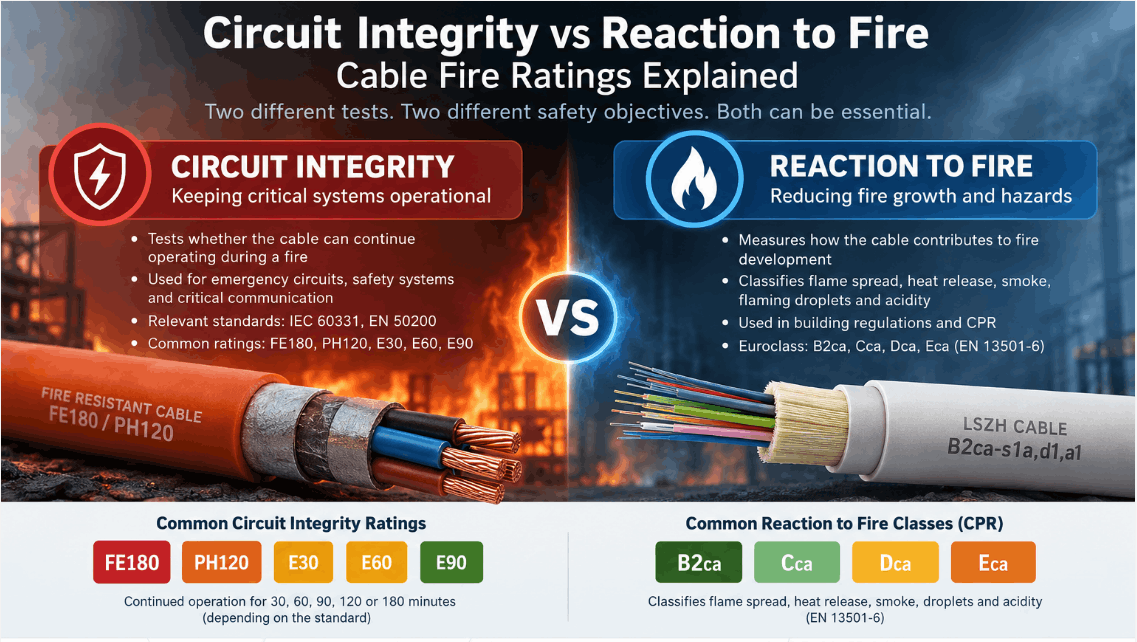
Circuit integrity vs reaction to fire describes two fundamentally different ways of evaluating cable performance during a fire. Reaction to fire measures how much a cable contributes to the development and spread of fire. Circuit integrity, by contrast, evaluates whether an electrical or optical circuit can continue operating while the cable is exposed to fire under defined test conditions.
This distinction is essential because a cable can perform extremely well in one area without automatically meeting the requirements of the other. For example, a B2ca cable can provide very high reaction-to-fire performance by limiting heat release, flame spread and other fire effects. However, B2ca alone does not prove that the cable will continue supplying power or transmitting signals during the fire.
Conversely, a cable tested for circuit integrity can maintain an emergency circuit for a defined period while exposed to flame, but this does not automatically establish a B2ca, Cca or other CPR reaction-to-fire classification.
Therefore, engineers should treat reaction to fire and circuit integrity as separate specification parameters. In safety-critical projects, both may be required in the same cable or cable system.
Quick answer: Reaction-to-fire ratings such as B2ca, Cca, Dca and Eca describe how a cable contributes to fire development. Circuit-integrity ratings and tests such as IEC 60331, EN 50200 PH classifications and cable-system ratings such as E30, E60 and E90 address continued operation during fire. LSZH and flame-retardant characteristics add further information, but neither is automatically equivalent to circuit integrity.
Circuit Integrity vs Reaction to Fire at a Glance
| Characteristic | Reaction to Fire | Circuit Integrity |
|---|---|---|
| Main question | How does the cable contribute to fire? | Can the circuit continue operating during fire? |
| Primary concern | Fire growth and combustion behaviour | Continued electrical or optical operation |
| Typical classifications | B2ca, Cca, Dca, Eca | PH ratings, FE designations, IEC 60331 test performance |
| Typical system ratings | Not applicable | E30, E60, E90 |
| Heat release | Important for higher CPR classes | Not the principal classification objective |
| Flame spread | Important | Separate characteristic |
| Smoke | Can be classified | Separate characteristic |
| Flaming droplets | Can be classified | Separate characteristic |
| Acidity | Can be classified | Separate characteristic |
| Electrical continuity | Not demonstrated by CPR class | Central requirement |
| Optical continuity | Not demonstrated by CPR class | Can be evaluated for suitable fiber cables |
Consequently, specifying only “fire-rated cable” can be dangerously ambiguous because that phrase does not identify which type of fire performance is required.
What Is Reaction to Fire?
Reaction to fire describes how a material or product behaves as part of a developing fire.
For cables, relevant characteristics can include:
- Flame spread
- Heat release
- Fire growth rate
- Smoke production
- Flaming droplets or particles
- Acidity and conductivity of combustion gases
In Europe, power, control and communication cables, including optical fiber cables, can be classified through the cable Euroclass system.
The main hierarchy includes:
- Aca
- B1ca
- B2ca
- Cca
- Dca
- Eca
- Fca
Therefore, reaction-to-fire classification primarily addresses the cable’s behaviour as a combustible construction product rather than whether the circuit remains functional.
What Is Circuit Integrity?
Circuit integrity describes the ability of a cable or cable circuit to continue performing its intended electrical or optical function while exposed to fire under specified test conditions.
For an electrical cable, continued operation can involve maintaining:
- Conductor continuity
- Electrical insulation
- Acceptable short-circuit behaviour
- Power or signal transmission
For an optical fiber cable, the objective is continued optical transmission within the applicable test requirements.
As a result, circuit integrity becomes particularly important where equipment must remain operational during evacuation, firefighting or emergency response.
Circuit Integrity vs Reaction to Fire: The Fundamental Difference
The distinction can be understood through two questions.
Reaction to fire asks:
What happens to the fire because this cable is present?
Circuit integrity asks:
What happens to the circuit while the cable is exposed to fire?
Those questions address different safety objectives.
For example, reducing heat release and smoke can help limit fire development and support safer evacuation. Meanwhile, maintaining an emergency-lighting circuit can keep escape routes illuminated while the fire continues.
Therefore, a complete fire-safety design may need both characteristics simultaneously.
Reaction to Fire Under CPR
The European cable reaction-to-fire system classifies cables from Aca through Fca.
Among commercially common cable constructions:
- B2ca provides very high reaction-to-fire performance
- Cca provides high reaction-to-fire performance
- Dca provides an intermediate level
- Eca provides a more basic defined flame-propagation level
For B1ca, B2ca, Cca and Dca, supplementary classifications can also communicate smoke, flaming-droplet and acidity performance.
Consequently, a complete declaration such as B2ca-s1a,d1,a1 provides substantially more information than simply stating that a cable is flame retardant.
What Does B2ca Measure?
B2ca places demanding limits on characteristics associated with developing fire.
Relevant classification criteria include:
- Flame spread
- Total heat release
- Peak heat-release rate
- Fire growth rate
Additional classes can then define smoke, droplets and acidity.
However, none of those parameters measures whether electrical power continues reaching an emergency fan or whether an optical signal remains available to a communication system.
Therefore, B2ca does not mean circuit integrity.
Understanding s, d and a Classifications
Higher CPR cable classes can be supplemented by three additional performance indicators.
| Letter | Performance Area | Examples |
|---|---|---|
| s | Smoke production | s1a, s1b, s1, s2, s3 |
| d | Flaming droplets / particles | d0, d1, d2 |
| a | Acidity and conductivity | a1, a2, a3 |
For example, a1 represents more demanding acidity performance than a2 or a3.
Likewise, d0 represents more demanding control of flaming droplets than d1 or d2.
Nevertheless, even an excellent combination such as B2ca-s1a,d0,a1 does not by itself demonstrate continued circuit operation.
What Is IEC 60332?
The IEC 60332 family addresses flame propagation of electrical and optical fiber cables under fire conditions.
For example, IEC 60332-1-2 evaluates vertical flame propagation on a single insulated conductor or cable using a defined flame source.
Meanwhile, the IEC 60332-3 series addresses vertically mounted bunched cables.
Therefore, IEC 60332 tests primarily answer a flame-spread question.
They do not demonstrate that the cable can continue carrying power or data throughout a fire.
Flame Retardant Does Not Mean Circuit Integrity
A flame-retardant cable is designed to limit flame propagation under defined test conditions.
However, its insulation can still lose electrical integrity after sufficient fire exposure.
As a result, a standard flame-retardant cable may stop powering an emergency system even though it does not propagate flame aggressively.
This is why fire resistant vs flame retardant cable terminology needs to be used carefully.
Where uninterrupted operation matters, a separate circuit-integrity requirement should be specified.
What Is IEC 60331 Circuit Integrity?
The IEC 60331 family contains fire-test methods for cables required to maintain circuit integrity under specified fire conditions.
The current framework includes tests involving fire and mechanical shock for relevant cable constructions.
For low-voltage cables, different IEC 60331 parts apply according to cable diameter and test arrangement.
Current methods can cover:
- Power cables
- Control cables
- Metallic communication cables
- Optical fiber cables
Therefore, the exact IEC 60331 part should be identified on technical documentation rather than specifying only “IEC 60331 compliant.”
Current IEC 60331 Test Structure
The present IEC framework includes:
| Standard | General Application |
|---|---|
| IEC 60331-1 | Fire with mechanical shock for LV cables over 20 mm diameter |
| IEC 60331-2 | Fire with mechanical shock for LV cables up to 20 mm diameter |
| IEC 60331-3 | Fire with mechanical shock for relevant cables tested in a metal enclosure |
| IEC 60331-4 | Fire with shock for power cables above 1 kV up to the standard’s defined voltage range |
Consequently, modern procurement specifications should identify the applicable current part, cable construction and required survival time.
A Note About IEC 60331-21 and IEC 60331-25
Older cable specifications and datasheets frequently reference:
- IEC 60331-21 for low-voltage electrical cables
- IEC 60331-25 for optical fiber cables
These legacy editions were widely used for many years. However, both were withdrawn at the end of 2024.
Therefore, when evaluating a new 2026 project, engineers should check the date and scope of the test certificate and confirm which current or contractually accepted standard applies.
Existing products and legacy specifications can still legitimately reference historical test reports, but the standard number should never be assumed from a marketing designation alone.
What Is FE180?
FE180 is a widely used market and specification designation associated with maintaining cable integrity during prolonged fire exposure.
However, FE180 should always be accompanied by the actual test standard and certificate because terminology can differ between markets and product families.
Historically, FE180 products have commonly been associated with IEC 60331 or VDE fire-integrity test methods.
Therefore, an RFQ should not simply state:
FE180 required.
Instead, it should identify the required test standard, cable type and any additional shock, water or system-integrity performance.
What Is EN 50200?
EN 50200 provides a test method for small unprotected cables intended for emergency circuits.
The test exposes the cable to fire together with mechanical shock under specified conditions.
It applies to relevant power, control, data and optical fiber cable applications within its defined dimensional scope.
Therefore, EN 50200 provides a more mechanically demanding fire scenario than a simple flame-integrity test without impact.
What Does PH120 Mean?
PH classifications describe circuit-integrity survival under the applicable European fire-resistance classification framework using EN 50200 test data.
Common project terminology includes:
- PH15
- PH30
- PH60
- PH90
- PH120
A longer PH time indicates a longer demonstrated survival duration under the relevant test conditions.
However, PH120 does not automatically establish every other fire-performance characteristic.
For example, a PH120 cable still needs separate reaction-to-fire classification if B2ca or Cca is required.
PH120 vs B2ca
| Characteristic | PH120 | B2ca |
|---|---|---|
| Performance concept | Circuit integrity | Reaction to fire |
| Continued operation | Yes, according to applicable test/classification | Not demonstrated |
| Mechanical shock during fire | Part of relevant test | Not the principal concept |
| Heat-release classification | No | Yes |
| Smoke subclasses | No | Available |
| Flaming-droplet subclasses | No | Available |
| Acidity subclasses | No | Available |
Consequently, a project can legitimately require both PH120 and B2ca.
FE180 vs PH120
FE180 and PH120 are both associated with cable survival during fire, but they should not be treated as interchangeable.
The test arrangements, thermal exposure and mechanical conditions differ according to the applicable standards.
PH testing includes mechanical shock during fire exposure.
Meanwhile, FE terminology is commonly associated with a different fire-integrity test framework.
Therefore, specifying FE180 does not automatically mean that PH120 performance has been achieved.
Likewise, PH120 does not automatically establish an FE180 designation.
What Are E30, E60 and E90?
E30, E60 and E90 introduce another important distinction because they generally address the functional integrity of an installed cable system rather than the cable alone.
Under DIN 4102-12 practice, the tested system can include:
- The cable
- Cable trays
- Clamps
- Supports
- Fixings
- Installation spacing
The designation indicates the period for which the tested installation arrangement maintains the required function.
Therefore:
- E30 → 30-minute system integrity
- E60 → 60-minute system integrity
- E90 → 90-minute system integrity
Cable Integrity vs Cable-System Integrity
A cable can perform well in a fire test while the installed circuit still fails if the support system collapses.
For example, a fire-resistant power cable attached to unsuitable plastic fixings could fall from its intended route during a fire.
Consequently, safety-critical design must sometimes evaluate both:
the cable itself
and
the complete installed cable system.
This is the conceptual reason E30, E60 and E90 should not be treated as simple cable-material ratings.
FE180 vs E90
FE180 and E90 address different levels of the installation.
| Characteristic | FE180 | E90 |
|---|---|---|
| Primary focus | Cable integrity | Installed cable-system integrity |
| Tested cable | Yes | Yes, as part of system |
| Supports and fixings | Not the main FE concept | Part of tested installation |
| Typical duration designation | 180 minutes | 90 minutes |
| Can one replace the other? | No | No |
Therefore, an FE180 cable should not automatically be described as E90 unless the relevant tested system configuration supports that classification.
Reaction to Fire vs Functional Integrity
The term functional integrity is sometimes used when discussing complete safety circuits or cable systems.
This creates another terminology challenge because different standards can evaluate different levels of functionality.
In practical specification work, engineers should identify whether the requirement applies to:
- The cable alone
- The electrical circuit
- The optical circuit
- The installed cable-support system
- The complete emergency system
Accordingly, the relevant test and classification should then be named explicitly.
Can a Cable Have Both Circuit Integrity and High Reaction-to-Fire Performance?
Yes.
In fact, this can be desirable for many safety-critical installations.
A cable can be engineered to combine:
- B2ca or Cca reaction-to-fire performance
- Low smoke
- Low acidity
- Halogen-free materials
- Circuit integrity
For example, a fire-resistant fiber optic cable can achieve B2ca-s1a,d1,a1 reaction-to-fire performance while separately demonstrating fire-survival characteristics.
As a result, one product can address both fire-development control and continuity of critical communication.
Why B2ca + Circuit Integrity Can Be Valuable
Consider a metro tunnel communication backbone.
Reaction-to-fire performance can help:
- Reduce fire growth
- Limit heat release
- Reduce smoke
- Limit corrosive combustion effects
Meanwhile, circuit integrity can help keep emergency communication operational during the fire.
Therefore, combining the two characteristics addresses both sides of the safety problem.
LSZH vs Circuit Integrity
LSZH means Low Smoke Zero Halogen.
This generally describes material-related smoke and halogen characteristics.
It does not tell the engineer whether the cable remains electrically operational during fire.
Consequently:
LSZH ≠ circuit integrity.
A standard LSZH cable can stop functioning during a fire.
Likewise, a circuit-integrity cable still needs suitable smoke and halogen performance if the project requires those characteristics.
LSZH vs Reaction to Fire
LSZH also does not establish a CPR Euroclass.
A halogen-free cable can potentially achieve different reaction-to-fire classes depending on its complete construction.
For example, two LSZH cables can have different:
- Heat release
- Flame spread
- Smoke production
- Euroclasses
Therefore, procurement specifications should identify both material requirements and formal fire classification.
Fire Resistant vs Flame Retardant vs Reaction to Fire
These terms are related but not synonymous.
| Term | Primary Meaning |
|---|---|
| Flame retardant | Limits propagation of flame |
| Reaction to fire | Classifies contribution to fire development |
| Fire resistant | Commonly describes continued circuit operation under fire |
| LSZH | Low-smoke and halogen-related material properties |
| Functional integrity | Continued operation of cable/system according to applicable test |
Consequently, a project specification should avoid relying on the generic phrase “fire-rated cable.”
Circuit Integrity for Fire Alarm Cables
Fire detection and alarm systems can need to remain operational while occupants evacuate.
Therefore, cable specifications can require continued circuit operation for:
- Fire detection
- Alarm circuits
- Voice evacuation
- Emergency communications
However, the required test method and survival duration depend on the relevant national code, system design and project specification.
Circuit Integrity for Emergency Lighting
Emergency lighting can become essential when normal building power fails during a fire.
Accordingly, power circuits serving selected emergency-lighting systems may require fire-survival performance.
The required duration should correspond to the building’s evacuation and fire strategy rather than automatically selecting the longest available cable rating.
Smoke Extraction and Fire-Fighting Systems
Smoke-control equipment can need electrical power while the building is exposed to fire.
Likewise, selected fire-fighting systems can require continued control or power.
Depending on the design, relevant circuits can include:
- Smoke extraction fans
- Fire dampers
- Pressurization systems
- Fire-fighting pumps
- Fire-fighting lifts
Therefore, cable-system integrity can become as important as the cable’s own fire resistance.
Fire-Resistant Fiber Optic Cable and Circuit Integrity
Optical networks can also carry safety-critical communications.
Potential applications include:
- Emergency communication
- CCTV
- Operational telecom networks
- Control-system backbones
- Railway and metro communications
A fire-resistant fiber optic cable must maintain suitable optical continuity during the defined fire test.
However, the reaction-to-fire classification remains a separate requirement.
Why Fiber Optic Cable Still Needs Reaction-to-Fire Testing
Glass optical fibers themselves contribute relatively little combustible material.
Nevertheless, the complete cable can contain substantial polymer materials, including:
- PBT tubes
- Buffers
- Fillers
- Yarns
- Inner jackets
- Outer jackets
Consequently, fiber optic cable can still contribute heat, flame and smoke during a fire and can require CPR classification for relevant permanent building installations.
Circuit Integrity for Railway and Metro Networks
Railway stations and metro tunnels can combine difficult evacuation conditions with critical communication requirements.
Therefore, some network sections can require both:
- High reaction-to-fire performance
- Continued circuit integrity
For example, one project can specify B2ca for fire-development performance together with a separate fire-survival requirement for critical communication.
However, the exact combination should follow the railway, tunnel and fire-engineering specification.
Circuit Integrity in Airports
Airports combine high occupancy, long evacuation distances and large amounts of electronic infrastructure.
As a result, fire-performance requirements can apply to:
- Emergency lighting
- Fire alarm
- Voice evacuation
- Smoke control
- Safety communication
Nevertheless, not every cable inside an airport needs circuit integrity. Ordinary networks can instead require only the appropriate reaction-to-fire performance.
Hospitals and High-Rise Buildings
Hospitals and high-rise buildings can make rapid evacuation more difficult.
Consequently, fire strategies may require selected electrical systems to remain functional for extended periods.
Meanwhile, high reaction-to-fire performance can reduce the contribution of extensive cable installations to fire development.
Therefore, these environments demonstrate why circuit integrity and reaction to fire can complement one another rather than compete.
Data Centers
Data centers contain high cable densities and expensive electronic equipment.
Reaction-to-fire characteristics such as smoke, acidity and fire growth can therefore be particularly relevant.
However, circuit integrity requirements depend on the specific safety function.
A general network fiber link does not automatically require fire-survival operation merely because it is installed in a data center.
Accordingly, project engineers should distinguish operational resilience from life-safety circuit requirements.
Industrial and Petrochemical Facilities
Industrial plants can contain emergency shutdown, alarm and safety systems together with significant fire hazards.
Depending on the risk analysis, selected circuits can require continued operation during fire.
Meanwhile, flame propagation, smoke and corrosive gases can remain separate concerns.
Therefore, industrial specifications should identify each performance requirement explicitly instead of using one generic “FR” designation.
Common Mistakes When Comparing Circuit Integrity vs Reaction to Fire
1. Assuming B2ca Means Fire Resistant
B2ca classifies reaction to fire and does not by itself prove continued circuit operation.
2. Assuming FE180 Means B2ca
FE180-type cable integrity and CPR reaction-to-fire classification are separate requirements.
3. Assuming PH120 Means Low Smoke
PH performance does not establish a smoke classification.
4. Assuming LSZH Means Circuit Integrity
Halogen-free material properties do not demonstrate electrical or optical survival.
5. Treating Flame Retardant and Fire Resistant as Synonyms
Flame propagation and continued operation address different fire-safety objectives.
6. Treating E90 as a Cable-Only Rating
E30, E60 and E90 relate to tested cable-system arrangements.
7. Assuming FE180 Automatically Means PH120
The test conditions and classifications are different.
8. Ignoring Supports and Fixings
A fire-resistant cable cannot maintain a route if the supporting installation fails.
9. Specifying “Fire Rated Cable” Without a Standard
The phrase can refer to several completely different performance concepts.
10. Selecting the Highest Rating for Every Circuit
Fire-survival performance should follow the actual safety function and project requirement.
11. Ignoring Reaction to Fire When Circuit Integrity Is Required
A cable can continue operating while still contributing significantly to smoke or fire growth unless those characteristics are separately controlled.
12. Ignoring Circuit Integrity When B2ca Is Required
High CPR performance does not keep an emergency circuit operational.
13. Using Legacy Standard References Without Checking Certificate Dates
IEC fire-test standards evolve, so current procurement should verify the exact applicable test document.
14. Assuming Fiber Does Not Require Fire Classification
Polymer cable components can still contribute to fire.
15. Comparing Test Times Without Comparing Test Conditions
180 minutes under one test method cannot automatically be considered superior to 120 minutes under a different mechanical and thermal test.
How to Specify Circuit Integrity and Reaction to Fire
A strong specification should treat the two fire-performance dimensions separately.
1. Identify the Circuit Function
Determine whether the cable serves an ordinary system or a life-safety function that must remain operational during fire.
2. Define Reaction-to-Fire Requirements
Select the required CPR Euroclass according to national regulation and project fire strategy.
3. Define Smoke, Droplets and Acidity
Add s, d and a subclasses where applicable.
4. Define Cable Circuit Integrity
Specify the applicable IEC 60331, EN 50200 or other accepted test requirement.
5. Define Required Survival Time
Use the emergency-system design to establish the necessary duration.
6. Define Cable-System Integrity
Add E30, E60, E90 or another applicable system classification where required.
7. Define LSZH Requirements Separately
Do not rely on CPR or circuit-integrity terminology to imply halogen-free construction.
8. Verify the Exact Product Certificate
Check that test reports and declarations correspond to the actual cable construction being supplied.
What Should Buyers Include in a Cable Fire-Performance RFQ?
An RFQ stating only “fire-resistant cable” leaves major performance questions unanswered.
A professional specification should include:
- Cable type
- Application
- Voltage rating
- Number of cores or pairs
- Conductor cross-section
- Required CPR Euroclass
- B2ca / Cca / Dca / Eca where applicable
- Smoke subclass
- Flaming-droplet subclass
- Acidity subclass
- LSZH requirement
- Single-cable flame requirement
- Bunched-cable flame requirement
- Circuit-integrity test standard
- Applicable IEC 60331 part
- EN 50200 requirement where applicable
- PH classification where applicable
- FE designation where applicable
- Required survival duration
- E30 / E60 / E90 system requirement where applicable
- Mechanical shock requirement
- Water-spray requirement where applicable
- Cable-support system requirement
- Applicable national building regulation
- Declaration of Performance where applicable
- Fire-test certificates
- Exact product identification
As a result, the manufacturer can supply a cable that matches the actual fire-safety objective rather than interpreting an ambiguous commercial term.
ETK Kablo Circuit Integrity and Reaction-to-Fire Solutions
ETK Kablo manufactures fire-performance cables for power, control, signal, communication and optical applications requiring different combinations of circuit integrity vs reaction to fire performance.
For circuit-integrity applications, ETK manufactures cable constructions incorporating fire barriers such as mica tape, glass-yarn systems and ceramic-forming insulation compounds depending on the product family.
Available cable families include constructions associated with FE180, PH120 and E30/E60/E90 requirements where applicable to the specific cable or tested cable system.
Meanwhile, ETK also manufactures cables across CPR reaction-to-fire classifications including B2ca, Cca, Dca and Eca.
For example, selected ETK fire-resistant fiber optic cables combine B2ca reaction-to-fire performance with separate fire-survival characteristics. Therefore, the same product can help limit its contribution to fire while also supporting critical communication during fire exposure.
ETK’s fire-resistant signal and control portfolio also includes screened and unscreened constructions for applications requiring both communication reliability and fire-survival performance.
Consequently, engineers can specify fire behaviour according to the actual safety objective rather than relying on one generic “fire-rated cable” designation.
Frequently Asked Questions
What is the difference between circuit integrity and reaction to fire?
Reaction to fire measures how a cable contributes to fire development, while circuit integrity measures whether the electrical or optical circuit continues operating during fire.
Does B2ca mean circuit integrity?
No. B2ca is a reaction-to-fire class. A separate fire-survival test is required to demonstrate circuit integrity.
Does Cca mean fire resistant?
No. Cca controls reaction-to-fire characteristics but does not by itself prove continued circuit operation.
Is FE180 a CPR classification?
No. FE180 is associated with cable fire-integrity performance, whereas CPR uses reaction-to-fire classes such as B2ca, Cca, Dca and Eca.
Is PH120 the same as B2ca?
No. PH120 addresses survival under a circuit-integrity fire test, while B2ca describes reaction to fire.
Is FE180 the same as PH120?
No. They are associated with different test conditions and should be specified independently where both are required.
What does E90 mean?
E90 generally identifies 90 minutes of functional integrity for a tested cable-system installation under DIN 4102-12 conditions.
Is E90 better than FE180?
They cannot be ranked simply by duration because they evaluate different things under different test arrangements.
Does LSZH mean circuit integrity?
No. LSZH describes smoke and halogen-related material properties, not continued electrical operation.
Does flame retardant mean fire resistant?
No. Flame-retardant cables limit flame propagation, while fire-resistant cables are designed to maintain circuit operation under specified fire conditions.
Can a B2ca cable also be FE180?
Yes, provided the cable has independently achieved the relevant reaction-to-fire and circuit-integrity performance requirements.
Can a fire-resistant cable be Eca?
Potentially, because circuit-integrity and reaction-to-fire classifications are independent. The exact tested product documentation should govern.
Which standard tests circuit integrity?
Common standards include the IEC 60331 family and EN 50200, depending on cable type, dimensions and project requirements.
Which standard classifies reaction to fire?
In Europe, EN 13501-6 provides the cable reaction-to-fire classification procedure used for Euroclasses such as B2ca, Cca, Dca and Eca.
What does IEC 60332 test?
The IEC 60332 family evaluates flame propagation of electrical and optical fiber cables under specified fire conditions.
Does IEC 60332 prove fire survival?
No. Passing a flame-propagation test does not demonstrate continued circuit operation.
Why are cable supports important in fire?
Critical circuits can fail if trays, clips or supports collapse even when the cable itself has strong fire resistance.
Do fiber optic cables need circuit integrity?
Only where the optical communication is required to remain operational during fire. Ordinary fiber links do not automatically require fire-survival performance.
Do fiber optic cables need CPR classification?
Fiber cables permanently installed in applicable European construction works can require CPR reaction-to-fire classification because their polymer components contribute to fire behaviour.
Should every emergency cable be FE180 PH120 E90 and B2ca?
No. The required combination should come from the system function, fire strategy, national rules and project specification.
How should cable fire ratings be specified?
Specify reaction to fire, circuit integrity, system integrity, smoke, halogen and other fire-performance requirements separately together with the applicable test standards.
Conclusion
The circuit integrity vs reaction to fire distinction is one of the most important concepts in cable fire engineering.
Reaction to fire addresses the cable’s contribution to a developing fire. Classes such as B2ca, Cca, Dca and Eca therefore evaluate characteristics related to flame spread, heat release and other combustion behaviour.
Higher CPR classes can also include supplementary smoke, flaming-droplet and acidity ratings. Consequently, these classifications provide valuable information about how cables affect evacuation conditions and fire development.
Circuit integrity addresses a different objective. It asks whether electrical power, control signals, communications or optical transmission can continue while the cable is exposed to fire.
IEC 60331 and EN 50200 provide important test frameworks for this type of performance. Meanwhile, FE and PH terminology is commonly used to communicate defined fire-survival characteristics according to the relevant specification.
Cable Performance and System Performance Must Be Separated
E30, E60 and E90 add another dimension because they address the continued function of a tested cable installation system, including the cable and its supporting arrangement.
Therefore, neither cable integrity nor system integrity should be inferred from a CPR Euroclass.
Likewise, LSZH and flame-retardant terminology cannot replace formal circuit-integrity requirements. They answer different fire-safety questions.
For critical infrastructure, the best solution can combine several characteristics. A B2ca cable can reduce its contribution to fire, while separate circuit-integrity performance keeps essential equipment operating. A tested support system can then preserve the physical installation for the required emergency period.
Ultimately, there is no single cable fire rating that answers every safety question. Engineers should specify reaction to fire, circuit integrity and cable-system integrity independently and then combine them according to the fire strategy of the building or infrastructure project.
Benzer yazılar
Fire Alarm Cable Types: A Guide for Building and Infrastructure Projects
Choosing the right fire alarm cable types for a building or infrastructure project requires more than selecting a red cable and connect...
FE180, PH120, E30, E60 and E90 Cable Ratings Explained
Understanding FE180, PH120, E30, E60 and E90 cable ratings is essential when specifying fire-resistant cables for emergency, life-safet...
Fire Resistant vs Flame Retardant Cable: What Is the Difference?
The difference between a fire resistant vs flame retardant cable is one of the most important distinctions in cable fire performance. A...
What Are Fire-Resistant Cables? Types, Ratings & Selection Guide
Fire resistant cable types keep critical electrical, signal or communication circuits operating for a defined period under specified fi...


