





 President’s Message
Blog
IEC 60331 vs IEC 60332: What Is the Difference?
Reading Time: 15 minutes
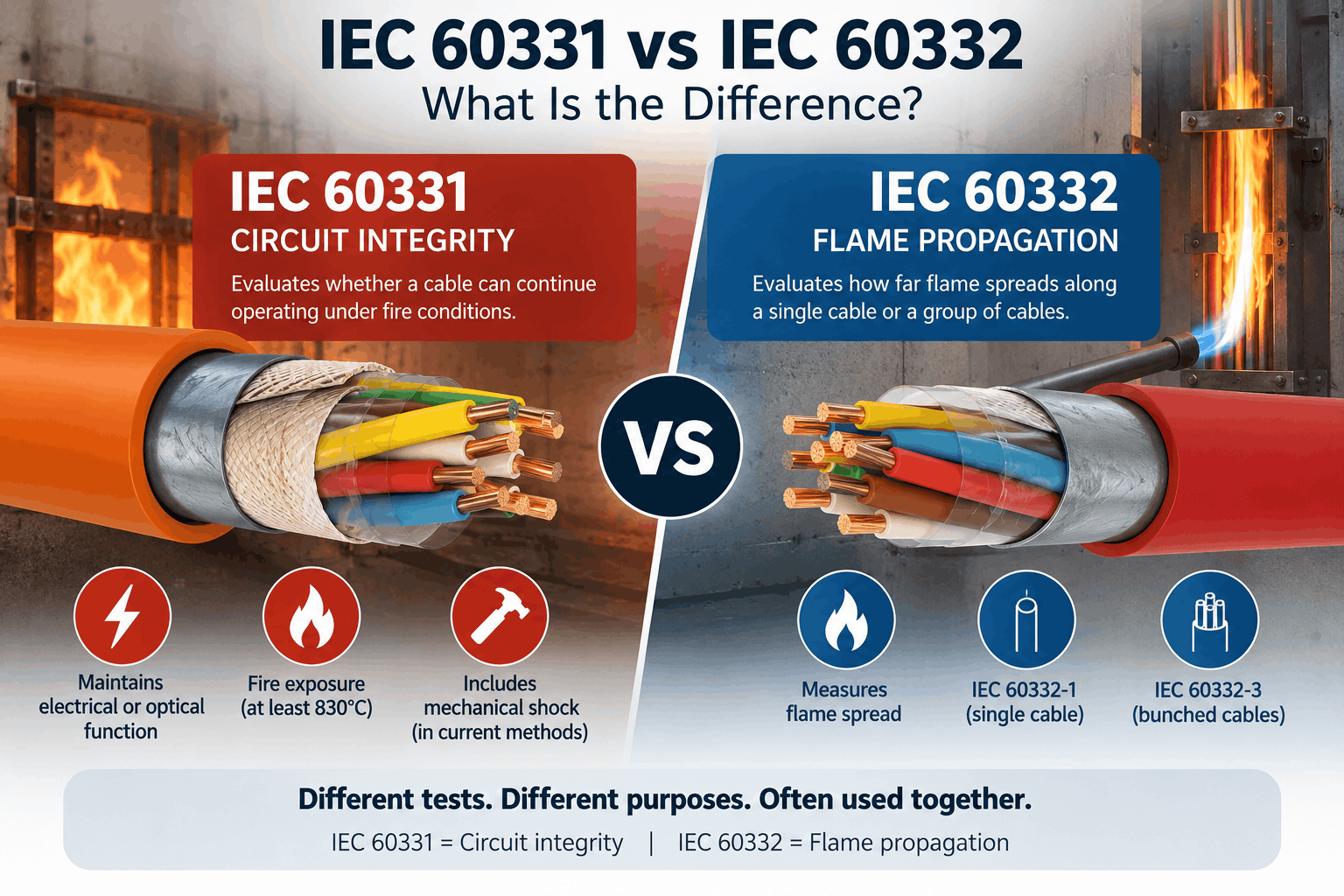
IEC 60331 vs IEC 60332 is one of the most important distinctions when specifying cable fire performance. Although both IEC standard families evaluate cables under fire conditions, they measure fundamentally different characteristics.
IEC 60331 evaluates circuit integrity. In other words, it asks whether a cable can continue performing its electrical or optical function while exposed to fire and, in the current test methods, mechanical shock under defined conditions.
IEC 60332, by contrast, evaluates flame propagation. It examines how far flame spreads along a single cable or a group of vertically installed cables under specified test conditions.
Therefore, passing IEC 60332 does not prove that a cable will continue operating during a fire. Likewise, passing an IEC 60331 circuit-integrity test does not automatically establish the cable’s complete flame-spread, smoke, halogen or CPR reaction-to-fire performance.
This difference matters in fire alarm systems, emergency lighting, tunnels, airports, metro systems, hospitals, industrial plants and other projects where cable behaviour during fire affects safety.
Quick answer: IEC 60331 is primarily a circuit-integrity test family for cables that must remain operational during fire. IEC 60332 is primarily a flame-propagation test family. IEC 60332-1-2 tests a single vertical cable, while the IEC 60332-3 series tests vertically installed cable bunches. Therefore, IEC 60331 and IEC 60332 should not be treated as alternative versions of the same fire test.
IEC 60331 vs IEC 60332 at a Glance
| Characteristic | IEC 60331 | IEC 60332 |
|---|---|---|
| Main purpose | Circuit integrity | Flame propagation |
| Main question | Does the circuit keep operating? | How far does flame spread? |
| Fire exposure | Yes | Yes |
| Mechanical shock | Included in current IEC 60331-1/-2/-3/-4 methods | Not the primary IEC 60332 test concept |
| Electrical continuity | Evaluated where applicable | Not the purpose |
| Optical continuity | Applicable to relevant optical cable tests | Not the purpose |
| Single-cable flame spread | No | IEC 60332-1 series |
| Bunched-cable flame spread | No | IEC 60332-3 series |
| Smoke classification | Separate requirement | Separate requirement |
| Halogen-free performance | Separate requirement | Separate requirement |
| CPR Euroclass | Separate classification | IEC 60332 results alone do not equal a CPR Euroclass |
Consequently, a technically complete fire-performance specification can require both IEC 60331 and IEC 60332 performance.
What Is IEC 60331?
The IEC 60331 family contains test methods for cables required to maintain circuit integrity during fire.
The current test framework applies to several cable types, including:
- Power cables
- Control cables
- Metallic communication cables
- Data cables within the applicable scope
- Optical fiber cables within the applicable scope
For the current low-voltage methods, the test combines fire exposure with mechanical shock.
Therefore, IEC 60331 is not merely checking whether the cable sheath burns slowly. Instead, the test evaluates whether the required circuit remains operational despite severe fire conditions.
What Does IEC 60331 Test?
IEC 60331 focuses on the ability of a cable to maintain its intended function.
Depending on cable type, this can involve verifying:
- Electrical continuity
- Absence of unacceptable short circuits
- Insulation integrity
- Power transmission
- Control signal continuity
- Optical transmission
Meanwhile, the cable experiences the defined flame and mechanical conditions.
As a result, IEC 60331 provides information that a conventional flame-propagation test cannot provide.
IEC 60331-1 Explained
IEC 60331-1:2018 applies to cables with rated voltage up to and including 0.6/1.0 kV and an overall diameter greater than 20 mm.
The method subjects the cable to fire and mechanical shock at a temperature of at least 830°C under the defined test conditions.
The scope includes relevant:
- Power cables
- Control cables
- Metallic data and telecom cables
- Optical fiber cables
Therefore, cable diameter is one of the factors that determines whether IEC 60331-1 or IEC 60331-2 applies.
IEC 60331-2 Explained
IEC 60331-2:2018 addresses cables with an overall diameter not exceeding 20 mm.
Like Part 1, it applies to cables rated up to and including 0.6/1.0 kV and uses fire with mechanical shock at a temperature of at least 830°C.
Consequently:
- Diameter over 20 mm → IEC 60331-1
- Diameter up to and including 20 mm → IEC 60331-2
This means that an RFQ stating only “IEC 60331” can be technically incomplete.
IEC 60331-3 Explained
IEC 60331-3:2018 covers relevant cables tested inside a metal enclosure while exposed to fire and mechanical shock.
It applies to cables up to and including 0.6/1.0 kV within its defined dimensional scope.
The enclosure creates a different test arrangement from the conventional IEC 60331-1 and IEC 60331-2 methods.
Therefore, test certificates should identify the exact IEC 60331 part rather than simply stating that a cable is “IEC 60331 tested.”
IEC 60331-4 for Higher-Voltage Cables
IEC 60331-4:2024 extended the current framework to higher-voltage power cables.
It covers power cables with rated voltages higher than 1 kV up to the standard’s defined range, including 18/30 kV cable systems.
The test again evaluates circuit integrity under fire and mechanical shock.
Moreover, the standard includes optional provisions relating to water spray or water jet protocols and an optional 1000°C flame condition for special applications.
Consequently, IEC 60331 should no longer be considered only a low-voltage fire-survival standard family.
IEC 60331 Fire Temperature
The current IEC 60331-1, IEC 60331-2 and IEC 60331-3 methods use a flame environment corresponding to a temperature of at least 830°C.
IEC 60331-4 also uses at least 830°C as its principal fire condition.
However, temperature alone does not describe the severity of the test.
Mechanical shock, sample arrangement, electrical loading, cable dimensions and test duration can also affect the result.
Therefore, two cable ratings should never be compared only by quoting flame temperature.
Why Mechanical Shock Matters in IEC 60331
Real fires can create mechanical stresses in addition to heat.
For example, cable installations can experience:
- Falling materials
- Structural movement
- Vibration
- Impact
- Deformation of supports
Accordingly, the current IEC 60331 methods introduce mechanical shock during fire exposure.
This provides a more demanding assessment of circuit survival than a fire-only continuity test.
What Is IEC 60332?
The IEC 60332 family evaluates flame propagation on electrical and optical fiber cables.
Its central question is different from IEC 60331.
IEC 60332 asks:
How far does flame propagate along the cable under defined conditions?
Therefore, IEC 60332 is fundamentally associated with flame-retardant behaviour rather than continued circuit operation.
What Does IEC 60332 Test?
The IEC 60332 family includes separate methods for different cable arrangements.
The two most important groups are:
- IEC 60332-1 → single insulated wire or cable
- IEC 60332-3 → vertically installed bunched cables
This distinction matters because several cables grouped together can behave differently from one isolated cable.
Consequently, passing a single-cable flame test should not automatically be interpreted as proof of bunched-cable flame performance.
IEC 60332-1-2 Explained
IEC 60332-1-2 is one of the most widely referenced cable flame-propagation tests.
The current edition is IEC 60332-1-2:2025.
It evaluates resistance to vertical flame propagation for a single vertically installed:
- Insulated conductor
- Electrical cable
- Optical fiber cable
The test uses a 1 kW premixed flame under controlled conditions.
Therefore, IEC 60332-1-2 provides a standardized method for determining whether flame damage remains within the applicable test limits on an individual cable.
Important 2025 Update to IEC 60332-1-2
Many cable datasheets still reference the previous IEC 60332-1-2:2004+A1:2015 edition.
However, that version was withdrawn in June 2025.
The current edition is:
IEC 60332-1-2:2025
Therefore, engineers preparing new specifications should check whether certificates refer to the current standard or to an older test report accepted by the project.
Existing historical certificates should not automatically be considered invalid, but the edition should be identified clearly.
IEC 60332-1 vs IEC 60332-3
| Characteristic | IEC 60332-1 | IEC 60332-3 |
|---|---|---|
| Cable arrangement | Single cable | Bunched cables |
| Orientation | Vertical | Vertical |
| Main purpose | Single-cable flame propagation | Bunched-cable flame spread |
| Typical use | Basic flame-retardant evaluation | Higher-density cable installations |
| Non-metallic volume categories | Not the same category system | A, B, C, D and related categories |
As a result, engineers should understand which test arrangement corresponds to the actual project requirement.
What Is the IEC 60332-3 Series?
The IEC 60332-3 series evaluates vertical flame spread on groups of vertically mounted wires or cables.
This is particularly important because real installations frequently contain cables installed together on:
- Cable trays
- Ladders
- Risers
- Vertical shafts
- Industrial routes
When cables are grouped, the combined amount of combustible polymer material can affect fire propagation.
Therefore, the IEC 60332-3 series uses defined cable-loading categories.
IEC 60332-3 Category A
IEC 60332-3-22 covers Category A.
For the common Category A arrangement, cables are installed to provide a nominal total volume of non-metallic material of approximately 7 litres per metre of test sample.
The flame application time is 40 minutes.
Consequently, Category A represents a demanding cable-bunch arrangement with a relatively high combustible-material loading.
IEC 60332-3 Category B
IEC 60332-3-23 covers Category B.
The cable bunch provides approximately:
3.5 litres of non-metallic material per metre.
The flame application time is 40 minutes.
Therefore, Category B uses a lower non-metallic-material loading than Category A while still assessing vertically installed cable bunches.
IEC 60332-3 Category C
IEC 60332-3-24 covers Category C.
The test arrangement uses approximately:
1.5 litres of non-metallic material per metre.
The flame application time is 20 minutes.
Category C is widely encountered in cable specifications and product datasheets.
However, describing a product simply as “IEC 60332-3” is less precise than identifying the applicable category.
IEC 60332-3 Category D
IEC 60332-3-25 covers Category D.
This category addresses small cables with very low volumes of non-metallic material.
The test uses approximately:
0.5 litres of non-metallic material per metre.
It applies to cables within the dimensional limits defined by the standard, including an overall diameter not exceeding 12 mm.
Therefore, Category D should not be interpreted simply as a lower-performance version of Category C. It serves a different cable-loading and dimensional situation.
IEC 60332 Categories Are Not Cable Quality Grades
This point is important.
Categories A, B, C and D primarily define different test-loading arrangements based on the quantity of non-metallic material and other conditions.
Therefore, engineers should not automatically interpret:
A > B > C > D
as though these were simple quality grades.
Instead, the applicable category should correspond to the cable construction, installation and specification requirement.
IEC 60331 vs IEC 60332: Circuit Integrity vs Flame Propagation
The fundamental technical difference can now be expressed clearly.
IEC 60331 evaluates whether the circuit survives.
IEC 60332 evaluates whether the cable limits flame propagation.
Consequently, the two standards address different fire hazards.
A safety circuit can require IEC 60331 because it must remain operational. At the same time, that cable can also require IEC 60332 because uncontrolled flame propagation along the cable route would create an additional fire hazard.
Does IEC 60332 Mean Fire Resistant?
No.
This is one of the most common cable specification mistakes.
A cable that passes IEC 60332 is generally demonstrating flame-propagation performance under the relevant test.
However, its insulation can still fail electrically when exposed to sustained fire.
Therefore:
IEC 60332 does not prove circuit integrity.
A separate fire-survival requirement is necessary where the circuit must remain operational.
Does IEC 60331 Mean Flame Retardant?
Not automatically.
IEC 60331 demonstrates circuit integrity under the applicable test conditions.
However, flame propagation is a separate performance characteristic.
Consequently, an IEC 60331-tested cable should not automatically be claimed to satisfy IEC 60332 unless the finished cable has also passed the applicable IEC 60332 test.
Fire-Resistant Cable and Circuit Integrity
Fire-resistant cables are designed for circuits that need to continue operating during fire.
Therefore, IEC 60331 belongs conceptually to the fire-resistant or circuit-integrity side of cable performance.
Suitable cable constructions can use:
- Mica tapes
- Fire-resistant insulation systems
- Ceramic-forming compounds
- Glass tapes
- Special fillers
Nevertheless, construction materials alone do not establish compliance. The finished cable must achieve the required test result.
Flame-Retardant Cable and Flame Propagation
Flame-retardant cables are designed to resist or limit the spread of flame.
Therefore, IEC 60332 belongs primarily to this performance category.
However, a flame-retardant cable can still stop operating during prolonged fire exposure.
As a result:
Flame retardant ≠ fire resistant.
This distinction should remain explicit in cable datasheets, specifications and project documentation.
How FE180 Relates to IEC 60331
FE180 is commonly used in the market to describe fire-integrity performance associated with prolonged fire exposure under the applicable test framework.
Therefore, FE180 belongs conceptually much closer to IEC 60331 than IEC 60332.
However, FE180 should not simply be translated into “IEC 60331” without checking the exact certificate.
The cable documentation should identify:
- Test standard
- Standard edition
- Test duration
- Cable construction
- Test laboratory
Consequently, procurement teams should verify the actual fire-test report rather than relying only on an FE180 product designation.
How PH120 Relates to Circuit Integrity
PH120 represents another type of circuit-integrity performance used in European fire-resistant cable specifications.
It is commonly associated with EN 50200-type testing and classification rather than IEC 60332.
Therefore, PH120 and IEC 60332 measure different characteristics.
A fire-resistant cable can potentially require:
- PH120 circuit integrity
- IEC 60332 flame propagation
- LSZH performance
- CPR classification
Each requirement provides different information.
Understanding E30, E60 and E90
E30, E60 and E90 add another layer to cable fire-performance terminology.
These ratings are associated with functional integrity of tested cable systems under DIN 4102-12 practice.
The tested system can include:
- Cable
- Supports
- Clamps
- Trays
- Fixings
- Installation arrangement
Therefore, E30/E60/E90 should not be interpreted as alternative names for IEC 60331 or IEC 60332.
Where LSZH Fits into Cable Fire Performance
LSZH stands for Low Smoke Zero Halogen.
It describes material-related characteristics associated with smoke and halogen-containing combustion products.
However:
LSZH does not mean IEC 60331.
Likewise:
LSZH does not mean IEC 60332 compliance.
A cable can be LSZH but require separate testing for flame propagation and circuit integrity.
Therefore, all three characteristics should be considered independently.
How CPR Differs from IEC Fire Tests
European CPR cable classification evaluates reaction to fire through Euroclasses such as:
- B2ca
- Cca
- Dca
- Eca
Higher classes can also include smoke, flaming-droplet and acidity classifications.
IEC 60332 flame tests can form part of the broader technical landscape of cable fire behaviour, but passing IEC 60332 alone does not mean that a cable is B2ca or Cca.
Similarly, CPR classification does not establish IEC 60331 circuit integrity.
Consequently, CPR, IEC 60331 and IEC 60332 should remain separate entries in a technical cable specification.
B2ca vs IEC 60332
B2ca represents a comprehensive European reaction-to-fire classification.
It evaluates characteristics beyond a simple single-cable flame test, including parameters related to:
- Heat release
- Fire growth
- Flame spread
- Smoke where classified
- Flaming droplets where classified
- Acidity where classified
IEC 60332, by contrast, focuses specifically on flame propagation under its defined test arrangements.
Therefore, the two should not be treated as equivalent ratings.
Fire Alarm Cable Requirements
Fire alarm systems provide a useful practical example.
A standard fire alarm cable can require flame-retardant performance to reduce propagation along cable routes.
In that case, IEC 60332 can be relevant.
However, if the fire alarm circuit must continue operating during fire, circuit-integrity performance can also be required.
Therefore, a fire alarm cable can legitimately require both IEC 60331-related fire-survival performance and IEC 60332 flame-propagation performance.
Emergency Lighting Cable Requirements
Emergency lighting circuits can need to remain operational after normal electrical systems fail.
Consequently, circuit integrity can become essential.
IEC 60331-type fire-survival performance addresses whether the cable keeps the circuit functioning.
Meanwhile, IEC 60332 can address whether the cable itself contributes to flame propagation along the installation.
Therefore, both characteristics can serve different safety objectives within the same emergency-lighting system.
IEC 60331 vs IEC 60332 for Tunnels
Tunnels can combine difficult evacuation with extensive cable installations.
As a result, specifications can require several independent fire characteristics:
- Limited flame propagation
- Low smoke
- Low halogen emissions
- High reaction-to-fire performance
- Circuit integrity for safety systems
IEC 60332 can address flame spread. Meanwhile, IEC 60331 can address continued operation of selected critical circuits.
Consequently, neither standard alone describes the complete tunnel fire-performance specification.
IEC 60331 vs IEC 60332 for Railway and Metro Systems
Railway and metro projects can use cables for both ordinary services and critical emergency systems.
Potential applications include:
- Fire alarms
- Emergency communications
- Smoke control
- Signalling-related systems
- Emergency lighting
- Critical telecom links
Therefore, some circuits can require continued operation while others primarily require controlled flame propagation and smoke behaviour.
The project specification should identify each requirement separately.
IEC 60331 vs IEC 60332 for Airports
Airports contain large numbers of electrical and communication cables across public and technical areas.
Flame propagation can therefore be an important consideration for general cable routes.
Meanwhile, selected emergency systems may need to remain functional during fire.
Consequently, IEC 60332 and IEC 60331 can both appear in airport cable specifications without being redundant.
IEC 60331 vs IEC 60332 for Hospitals
Hospitals can require continued operation of selected safety systems because evacuation can be complex.
Therefore, circuit-integrity cable can be relevant to critical emergency systems.
At the same time, large cable installations should not promote uncontrolled flame spread.
As a result, cable specifications can combine fire-survival, flame-retardant, LSZH and reaction-to-fire requirements.
IEC 60331 vs IEC 60332 for Industrial Plants
Industrial and petrochemical plants can contain substantial cable concentrations together with safety-critical control systems.
For example, selected:
- Emergency shutdown circuits
- Fire alarm circuits
- Critical control systems
- Emergency communication circuits
may need to remain operational during fire.
Meanwhile, IEC 60332 performance can help limit flame propagation across cable routes.
Therefore, engineers should define both objectives independently.
IEC 60331 for Fiber Optic Cable
Fiber optic cables can also require circuit-integrity performance where critical communications must remain available during fire.
The current IEC 60331-1 and IEC 60331-2 scopes explicitly include optical fiber cables within the applicable dimensions and test conditions.
During the test, optical performance must remain within the applicable requirements.
Consequently, circuit integrity is not limited to copper conductor continuity.
IEC 60332 for Fiber Optic Cable
IEC 60332 also applies to optical fiber cable constructions.
This is important because the glass optical fibers themselves represent only one part of the cable.
A fiber optic cable can also contain:
- PBT loose tubes
- Buffers
- Fillers
- Strength members
- Inner sheaths
- Outer sheaths
Therefore, the complete fiber optic cable can still propagate flame through its polymer materials.
Can One Cable Pass Both IEC 60331 and IEC 60332?
Yes.
In fact, this is common for purpose-designed fire-resistant cables.
A cable can provide:
- Circuit integrity
- Single-cable flame-retardant performance
- Bunched-cable flame-retardant performance
- LSZH characteristics
- Low smoke
- CPR reaction-to-fire performance
However, each claim should be supported by the appropriate test or certification.
Therefore, passing one fire test should never be used to imply compliance with every other fire requirement.
Older IEC 60331-21 and IEC 60331-25 References
Many existing cable catalogues and project specifications still reference older standards such as:
- IEC 60331-21
- IEC 60331-23
- IEC 60331-25
These standards historically addressed fire-alone circuit-integrity testing for different cable families.
However, IEC withdrew these publications at the end of 2024.
Therefore, new specifications should verify the current IEC 60331 structure rather than automatically copying historical standard references.
Nevertheless, existing products can legitimately have historical test certificates issued to older standards. The project engineer should therefore evaluate the certificate date, project requirement and acceptance criteria before rejecting or accepting a legacy report.
Older IEC 60332-1-2 References
A similar issue now exists with IEC 60332-1-2.
Many current cable datasheets were originally tested according to:
IEC 60332-1-2:2004 + A1:2015
However, this edition was withdrawn in June 2025 and replaced by IEC 60332-1-2:2025.
Therefore, new cable specifications should ideally identify the current edition while recognizing that older valid project documentation can contain historical test references.
Common IEC 60331 vs IEC 60332 Mistakes
1. Assuming IEC 60332 Means Fire Resistant
IEC 60332 addresses flame propagation, not continued circuit operation.
2. Assuming IEC 60331 Means Flame Retardant
Circuit-integrity performance does not automatically establish IEC 60332 compliance.
3. Specifying Only “IEC 60331”
The applicable part depends on cable dimensions, voltage and test arrangement.
4. Specifying Only “IEC 60332”
The standard family contains different single-cable and bunched-cable tests.
5. Confusing IEC 60332-1 with IEC 60332-3
A single cable and a cable bunch can behave differently during fire.
6. Treating Category A, B, C and D as Simple Quality Grades
The categories define different test loading conditions.
7. Assuming LSZH Means IEC 60331
Halogen-free material performance does not establish circuit integrity.
8. Assuming LSZH Means IEC 60332
A separate flame-propagation test is still required.
9. Assuming B2ca Means IEC 60331
CPR reaction to fire does not establish continued operation.
10. Assuming IEC 60332 Equals B2ca
CPR classification evaluates a broader reaction-to-fire framework.
11. Comparing Fire Ratings Only by Test Duration
Different standards use different flame, mechanical and sample conditions.
12. Ignoring Mechanical Shock
The current IEC 60331 methods include mechanical shock under fire conditions.
13. Using Withdrawn Standards in New Specifications Without Review
Older IEC 60331-21/-23/-25 references require verification against current project requirements.
14. Using the Old IEC 60332-1-2 Edition Automatically
The current edition is IEC 60332-1-2:2025.
15. Assuming Cable Construction Proves Compliance
Mica, LSZH or flame-retardant compounds do not replace finished-cable testing.
How to Specify IEC 60331 vs IEC 60332
1. Decide Whether the Circuit Must Remain Operational
If continued function during fire is required, define the applicable circuit-integrity test.
2. Identify the Correct IEC 60331 Part
Check cable voltage, diameter and installation/test arrangement.
3. Define the Required Survival Duration
Use the fire strategy and system function rather than selecting the longest available rating automatically.
4. Define Single-Cable Flame Performance
Specify IEC 60332-1-2 where the relevant single-cable requirement applies.
5. Define Bunched-Cable Flame Performance
Specify the appropriate IEC 60332-3 category where cables are assessed in grouped installations.
6. Identify the Standard Edition
Where possible, use the current edition or clearly state which edition the project accepts.
7. Define LSZH Requirements Separately
Smoke and halogen characteristics should not be inferred from IEC 60331 or IEC 60332 alone.
8. Define CPR Requirements Separately
Specify B2ca, Cca, Dca or another required Euroclass independently.
9. Verify Test Certificates
Ensure the certificate applies to the actual cable construction being supplied.
What Should Buyers Include in a Fire-Test Cable RFQ?
A professional specification should identify the exact required fire performance rather than requesting only a “fire-rated cable.”
Useful information includes:
- Cable type
- Application
- Rated voltage
- Overall cable diameter
- Conductor size
- Number of cores, pairs or fibers
- Required IEC 60331 part
- IEC 60331 standard edition
- Required circuit-integrity duration
- Required flame-test temperature where applicable
- Mechanical shock requirement
- Water spray or jet requirement where applicable
- IEC 60332-1-2 requirement
- IEC 60332-3 requirement
- IEC 60332-3 category
- LSZH requirement
- Smoke requirement
- Halogen requirement
- CPR Euroclass where applicable
- FE180 requirement where applicable
- PH120 requirement where applicable
- E30 / E60 / E90 requirement where applicable
- Required test certificates
- Applicable product standard
- Project or end-user specification
Consequently, manufacturers can evaluate every fire requirement independently and propose the correct cable construction.
ETK Kablo and IEC 60331 vs IEC 60332 Requirements
ETK Kablo manufactures power, control, signal, instrumentation and communication cable constructions for projects requiring different levels of fire performance.
Depending on the cable family and project requirement, fire-performance characteristics can include:
- Circuit integrity
- Single-cable flame propagation
- Bunched-cable flame propagation
- LSZH materials
- Low smoke
- CPR reaction-to-fire classification
Fire-resistant cable constructions can incorporate specialized fire barriers such as mica tapes and suitable high-temperature insulation systems where required.
Meanwhile, flame-retardant cable compounds and complete cable constructions can be engineered for the applicable IEC 60332 requirements.
Therefore, ETK treats circuit integrity and flame propagation as independent technical characteristics rather than using the general term “fire resistant” to describe every fire-performance cable.
Frequently Asked Questions About IEC 60331 vs IEC 60332
What is the main difference between IEC 60331 and IEC 60332?
IEC 60331 evaluates circuit integrity during fire, while IEC 60332 evaluates flame propagation.
Is IEC 60331 a fire-resistance test?
Yes. The IEC 60331 family evaluates whether relevant cables maintain circuit integrity under defined fire conditions.
Is IEC 60332 a fire-resistance test?
IEC 60332 is more accurately described as a flame-propagation test family. It does not demonstrate continued circuit operation.
What does IEC 60332-1-2 test?
It tests vertical flame propagation on a single insulated wire, electrical cable or optical fiber cable using a defined 1 kW premixed flame.
What is the current IEC 60332-1-2 edition?
The current edition is IEC 60332-1-2:2025.
What does IEC 60332-3 test?
The IEC 60332-3 series evaluates vertical flame spread on groups of vertically installed cables.
What is IEC 60332-3-24?
IEC 60332-3-24 covers Category C bunched-cable flame-spread testing.
What is IEC 60332-3-23?
IEC 60332-3-23 covers Category B.
What is IEC 60332-3-22?
IEC 60332-3-22 covers Category A.
What is IEC 60332-3-25?
IEC 60332-3-25 covers Category D for small cables and low non-metallic-material loading within the defined scope.
Does IEC 60332 mean flame retardant?
It provides standardized flame-propagation tests commonly used to demonstrate flame-retardant behaviour.
Does IEC 60332 mean fire resistant?
No. Continued circuit operation requires separate circuit-integrity testing.
Does IEC 60331 include mechanical shock?
The current IEC 60331-1, -2, -3 and -4 methods evaluate circuit integrity with fire and mechanical shock under specified conditions.
What temperature is IEC 60331 tested at?
The current principal IEC 60331 methods use a fire condition at a temperature of at least 830°C, with additional options in specific parts.
Is IEC 60331 applicable to fiber optic cable?
Yes. Current IEC 60331-1 and IEC 60331-2 explicitly include optical fiber cables within their applicable scope.
Is IEC 60332 applicable to fiber optic cable?
Yes. The current IEC 60332 standards apply to electrical and optical fiber cable constructions within their respective scopes.
Can one cable pass IEC 60331 and IEC 60332?
Yes. Fire-resistant cable can be designed and independently tested for both circuit integrity and flame-propagation performance.
Is IEC 60331 the same as FE180?
No. FE180 and IEC 60331 should not be treated as automatically interchangeable without checking the applicable test certificate and specification.
Is IEC 60332 the same as CPR?
No. CPR Euroclass evaluates a broader reaction-to-fire framework and uses separate classification procedures.
Which standard should I specify: IEC 60331 or IEC 60332?
Specify IEC 60331 when continued circuit operation during fire is required and IEC 60332 when flame propagation must be controlled. Many safety-critical cables require both types of performance.
Conclusion
The IEC 60331 vs IEC 60332 distinction is fundamental to correct cable fire-performance specification.
IEC 60331 addresses circuit integrity. Its purpose is to determine whether electrical, control, communication or optical circuits can continue operating while cables experience defined fire and mechanical conditions.
Meanwhile, IEC 60332 addresses flame propagation. IEC 60332-1-2 evaluates an individual vertical cable, while the IEC 60332-3 series evaluates cable bunches under defined loading conditions.
Therefore, passing IEC 60332 does not make a cable fire resistant in the circuit-integrity sense. Likewise, passing IEC 60331 does not automatically establish flame-propagation, smoke, LSZH or CPR performance.
Specify Each Fire Characteristic Independently
Modern cable specifications can combine several fire requirements.
For example, a critical cable can need IEC 60331 circuit integrity together with IEC 60332 flame-retardant performance. In addition, the same cable can require LSZH construction, controlled smoke and a specified CPR Euroclass.
The exact IEC part also matters. IEC 60331-1 and IEC 60331-2 differentiate relevant low-voltage cables partly according to cable diameter, while IEC 60331-4 covers higher-voltage power cables. Similarly, IEC 60332 distinguishes single-cable and bunched-cable test arrangements.
Finally, engineers should check the standard edition. IEC 60332-1-2:2025 has replaced the previous 2004+A1:2015 edition, while older IEC 60331-21, IEC 60331-23 and IEC 60331-25 references were withdrawn at the end of 2024.
Consequently, the most reliable specification is not simply “fire-resistant and flame-retardant cable.” It identifies the exact circuit-integrity test, flame-propagation test, test category, standard edition and any additional smoke, halogen or reaction-to-fire requirements required by the project.
Benzer yazılar
JZ vs OZ Control Cable: What Do the Core Identification Codes Mean?
JZ vs OZ control cable is a common comparison when specifying flexible multicore cables for industrial machinery, control panels, autom...
Ethernet Cable Testing: NEXT, Return Loss, Insertion Loss and ACR Explained
Ethernet cable testing verifies whether a twisted-pair copper cabling system can transmit data within the electrical performance limits...

Fiber Optic Cable Attenuation: 850, 1310, 1550 and 1625 nm Explained
Fiber optic cable attenuation describes the reduction in optical power as light travels through an optical fiber. It is normally expres...
A-02YSF(L)2Y vs A-2Y(L)2Y Outdoor Telephone Cable
A-02YSF(L)2Y vs A-2Y(L)2Y is an important comparison when selecting copper outdoor telephone cable for telecommunications networks, und...
RS-485 Cable vs Instrumentation Cable: Can Instrumentation Cable Be Used for Modbus RTU?
A Modbus RTU cable must do more than carry a low-voltage digital signal from one device to another. Modbus RTU commonly uses an RS-485 ...
Ethernet Cable for PoE: Conductor Size, Heat and Bundle Performance
A PoE Ethernet cable carries data and electrical power over the same balanced twisted-pair cabling system. This capability simplifies t...
NHXH vs N2XH vs N2XRH: Which Fire-Resistant Power Cable Should You Choose?
NHXH vs N2XH vs N2XRH is an important comparison when specifying 0.6/1 kV power cables for emergency and life-safety systems. Although ...

How to Specify Low Current Cables for Infrastructure Projects
A professional low current cable specification should define much more than a cable name, conductor count or sheath colour. Infrastruct...
Fire Resistant Cables for Hospitals and High-Rise Buildings
Fire resistant cable for hospitals and high-rise buildings supports electrical, communication and control systems that may need to rema...

Industrial Control Cable Selection for Automation and Machinery
Industrial control cable selection should begin with the function of the circuit and the mechanical conditions of the machine rather th...
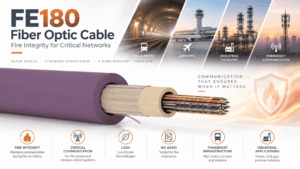
FE180 Fiber Optic Cable: Fire Integrity, Applications and Selection
An FE180 fiber optic cable is designed for optical communication routes where continued transmission during fire can form part of the p...
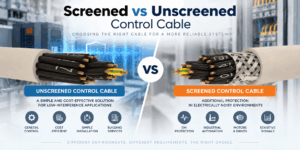
Screened vs Unscreened Control Cable: What Is the Difference?
Control cable shielding is one of the most important design decisions when selecting cable for industrial automation, machinery, buildi...


