





 President’s Message
Blog
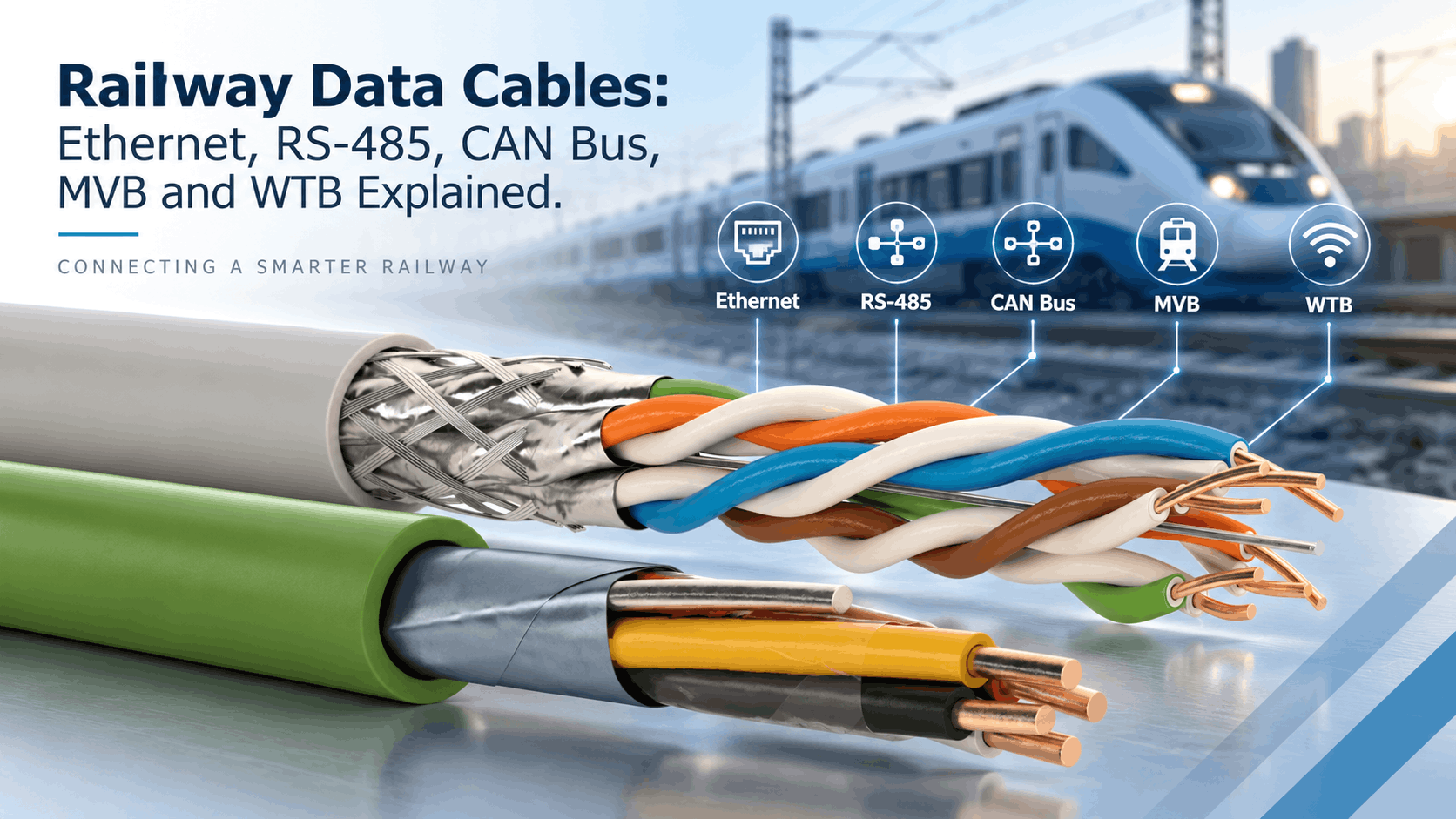
Railway Data Cables: Ethernet, RS-485, CAN Bus, MVB and WTB Explained
Reading Time: 18 minutes
Railway data cables form the communication infrastructure that connects electronic equipment across modern trains. Train control systems, passenger information, diagnostic equipment, braking subsystems, doors, HVAC controllers, cameras and other onboard devices all depend on reliable data exchange, yet they do not necessarily use the same communication technology.
Ethernet has become increasingly important in new rolling-stock networks because it supports high data rates, IP-based architectures and integration with modern digital systems. However, railway vehicles also continue to use RS-485, CAN-based networks, Multifunction Vehicle Bus (MVB) and Wire Train Bus (WTB) for applications where those technologies remain appropriate.
Each network imposes different electrical requirements on the cable. Pair geometry, characteristic impedance, capacitance, attenuation, shielding and conductor construction can all influence communication performance. At the same time, a cable installed on rolling stock must withstand a much harsher environment than ordinary office data cabling.
Therefore, railway cable selection cannot stop at the protocol name. Engineers must combine transmission requirements with fire behaviour, flexibility, mechanical durability, temperature performance, oil resistance, vibration exposure and the specific rolling-stock specification.
Quick answer: Ethernet provides high-bandwidth IP communication and forms the basis of standardized Ethernet Train Backbone and Ethernet Consist Network architectures. RS-485 remains useful for robust serial communication between devices and subsystems. CAN and CANopen support deterministic device-level control networks. MVB is a railway-specific vehicle bus within the Train Communication Network architecture, while WTB provides communication between consists in open trains. The correct railway data cable depends on the communication technology, network architecture and rolling-stock environmental requirements.
Railway Data Cables at a Glance
| Technology | Typical Railway Role | Important Cable Characteristics |
|---|---|---|
| Ethernet | High-bandwidth onboard networks, diagnostics, passenger systems, TCMS | Controlled impedance, balanced pairs, low attenuation, shielding |
| RS-485 | Serial communication between controllers and field devices | Balanced twisted pair, controlled impedance, low capacitance, screening |
| CAN / CANopen | Device-level control and subsystem communication | Balanced pair, suitable impedance, low capacitance, shielding where required |
| MVB | Communication inside vehicles or consists within TCN architectures | Railway-specific bus cable with controlled transmission parameters |
| WTB | Communication between consists in open trains | Railway train-bus cable with controlled electrical characteristics |
| Fiber Optic | High bandwidth, galvanic isolation and EMI immunity | Low attenuation, mechanical protection, appropriate fiber type |
Consequently, there is no single universal “railway data cable.” The cable must correspond to the physical layer and network architecture that it serves.
What Are Railway Data Cables?
Railway data cables are communication cables engineered for railway applications in which electronic devices exchange control, monitoring, diagnostic or passenger-service information.
They can use copper twisted pairs, shielded multicore constructions or optical fiber depending on the required protocol and bandwidth.
Typical onboard applications include:
- Train Control and Monitoring Systems
- Vehicle control units
- Door-control systems
- Brake monitoring
- Traction control
- HVAC systems
- Passenger information systems
- Diagnostic networks
- Passenger Wi-Fi infrastructure
- Video and multimedia systems
- Energy monitoring
- Remote I/O
However, a railway communication cable must satisfy more than its data-transmission function.
Moreover, rolling-stock installations expose cables to vibration, mechanical movement, temperature variation, oil, cleaning agents and stringent fire-safety requirements. Therefore, ordinary industrial or building data cable should not automatically replace a railway-qualified construction.
Why Modern Trains Need Several Data Networks
A modern train contains many electronic systems with very different communication needs.
A passenger-information display can require large amounts of data. Meanwhile, door-control units may prioritize predictable command timing. Diagnostic sensors can transmit relatively small data packets. At the same time, the train backbone must connect entire consists and sometimes support interoperability between vehicles from different systems.
Consequently, one communication technology does not necessarily provide the best solution for every device.
Railway architectures can therefore combine:
- Ethernet
- RS-485
- CAN
- CANopen
- MVB
- WTB
- Fiber optic links
- Project-specific serial networks
The result is a layered communication architecture in which different networks perform different functions.
Railway Data Cables and the Train Communication Network
The IEC 61375 series defines the Train Communication Network, commonly abbreviated TCN.
The TCN concept addresses communication between vehicles, within consists and between train systems. Importantly, the architecture has evolved significantly over time.
The current IEC 61375-1:2026 general architecture recognizes both traditional railway buses and newer network technologies. The latest revision also expands the architecture with additional backbone topologies, wireless technologies, virtual networks and cybersecurity considerations.
Therefore, modern TCN should not be interpreted only as the historical combination of WTB and MVB.
Ethernet-based networks now form an important standardized part of the architecture as well.
Ethernet Railway Data Cables
Ethernet has become one of the most important technologies in modern railway data cables because rolling stock increasingly requires higher bandwidth and IP-based communication.
Ethernet can support applications such as:
- TCMS communication
- Diagnostics
- Passenger information
- Video transmission
- Passenger Wi-Fi infrastructure
- Equipment monitoring
- Software updates
- Maintenance systems
However, ordinary structured-cabling Ethernet and railway Ethernet operate in very different physical environments.
Therefore, a railway Ethernet cable can require special materials, mechanical performance and fire behaviour in addition to its Cat 5e, Cat 6, Cat 6A or other transmission characteristics.
Ethernet Train Backbone
IEC 61375-2-5 defines the Ethernet Train Backbone, or ETB.
The ETB provides an Ethernet-based train backbone for communication between consists in applicable open-train architectures.
One key objective is interoperability between consist networks while allowing the individual consist to use an appropriate internal network architecture.
Consequently, Ethernet does not only serve local passenger-data applications. It can form part of the standardized communication backbone of the train itself.
Ethernet Consist Network
IEC 61375-3-4 defines the Ethernet Consist Network, commonly abbreviated ECN.
An ECN provides Ethernet-based data communication inside a consist.
Therefore, engineers can encounter two separate Ethernet concepts inside the TCN framework:
- ETB — Ethernet Train Backbone
- ECN — Ethernet Consist Network
The exact architecture depends on the rolling-stock design and interoperability requirements.
Railway Ethernet Cable vs Ordinary Ethernet Cable
A standard office Ethernet cable may satisfy Category 6 transmission requirements yet remain unsuitable for installation inside a railway vehicle.
Railway applications can additionally require:
- Low-smoke halogen-free materials
- Defined flame performance
- EN 45545-2 fire behaviour
- Oil resistance
- Temperature resistance
- Mechanical durability
- Flexibility
- Vibration resistance
- Reduced cable diameter
- Low weight
Therefore, “Cat 6” or “Cat 7” describes only part of the required railway cable specification.
Cat 5e, Cat 6 and Higher Categories in Rolling Stock
Railway Ethernet constructions can use familiar data-cable categories where the transmission system requires them.
Potential designs include:
- Cat 5e
- Cat 6
- Cat 6A
- Cat 7
In practice, the appropriate category depends on the required Ethernet application, connector system and network architecture.
Moreover, the screening structure can vary. Railway Ethernet cables can use foil, braid or combined shielding depending on the electromagnetic environment and performance target.
Consequently, engineers should specify both the Ethernet performance and the rolling-stock construction requirements.
Shielding in Ethernet Railway Data Cables
Railway vehicles contain numerous potential sources of electromagnetic disturbance.
Examples include:
- Traction equipment
- Power converters
- Motors
- High-current cables
- Contactors
- Auxiliary converters
- Switching power electronics
Therefore, screened data cables often play an important role in onboard communication.
Depending on the system, the construction can use:
- Overall foil screening
- Individual pair foil screening
- Copper braid
- Foil plus braid
However, shielding should follow the complete EMC concept rather than being selected from cable appearance alone.
Characteristic Impedance in Railway Ethernet Cable
Balanced Ethernet cable requires tightly controlled characteristic impedance.
For conventional balanced twisted-pair Ethernet, nominal impedance is approximately 100 Ω.
Manufacturers achieve this through control of:
- Conductor diameter
- Insulation diameter
- Dielectric material
- Pair spacing
- Twist rate
- Shield geometry
Consequently, cable deformation during installation can reduce transmission performance even if the outer sheath remains intact.
RS-485 Railway Data Cables
RS-485 remains widely relevant in railway equipment because it provides robust balanced serial communication.
Unlike Ethernet, RS-485 defines the electrical physical layer rather than one complete application protocol.
For example, railway equipment can use RS-485 for communication between:
- Controllers
- Display systems
- HVAC equipment
- Door systems
- Remote I/O
- Diagnostic devices
- Sensors
- Auxiliary equipment
However, RS-485 is not itself a standardized TCN backbone technology in the same sense as ETB, ECN, MVB or WTB.
Therefore, RS-485 cable requirements are commonly determined by the subsystem design and project specification.
Railway Data Cables for RS-485 Networks
A suitable RS-485 railway cable normally uses a balanced twisted pair with controlled transmission characteristics.
Important parameters can include:
- Characteristic impedance
- Capacitance
- Conductor resistance
- Pair balance
- Screening
- Operating temperature
- Fire performance
In many cases, RS-485 applications use cable around the 120 Ω impedance region, although engineers should follow the actual equipment and system specification.
Consequently, a generic screened control cable should not automatically replace a purpose-designed RS-485 pair.
Why Twisted Pair Matters for RS-485
RS-485 uses differential signalling.
The receiver responds primarily to the voltage difference between the two conductors rather than each conductor’s voltage relative to earth.
A balanced twisted pair helps expose both conductors to similar external electromagnetic fields.
As a result, the receiver can reject a significant portion of common-mode interference.
Therefore, pair geometry plays an important role in reliable railway serial communication.
RS-485 vs Ethernet in Rolling Stock
Ethernet and RS-485 serve different communication requirements.
Ethernet offers much greater bandwidth and integrates naturally into modern IP networks.
RS-485 provides a relatively simple and robust physical layer for serial device communication.
Therefore, Ethernet does not automatically eliminate RS-485 from rolling stock.
A train can use Ethernet for its high-level network while individual subsystems continue using RS-485 for local device communication.
CAN Bus Railway Data Cables
CAN Bus was originally developed for robust distributed control applications and has become widely used beyond automotive systems.
It uses differential signalling over a balanced pair and supports communication between multiple devices on the same bus.
For instance, railway applications can use CAN technology for device-level networks involving:
- Sensors
- Actuators
- I/O devices
- Controllers
- Doors
- Auxiliary systems
- Diagnostic modules
As with RS-485, engineers should select the cable according to the network’s impedance, capacitance, length and environmental requirements.
CANopen in Railway Networks
CAN defines the lower communication layers, while CANopen provides a standardized higher-level communication framework based on CAN.
Within the IEC 61375 railway architecture, CANopen receives a specific role.
IEC 61375-3-3 defines the CANopen Consist Network, or CCN.
This network applies to CANopen-based communication inside consists within the TCN architecture.
Consequently, CAN technology can form more than a project-specific local bus; CANopen also has a standardized railway consist-network implementation.
Railway Data Cables for CAN and CANopen
Railway data cables for CAN normally require a controlled balanced pair.
Many conventional high-speed CAN networks use nominal 120 Ω transmission-line architecture.
However, cable selection should still follow the equipment manufacturer and network specification.
Important characteristics include:
- Characteristic impedance
- Low capacitance
- Controlled pair geometry
- Screening where required
- Conductor resistance
- Railway fire performance
- Mechanical robustness
Therefore, ordinary multicore control cable should not automatically be assumed suitable for CAN communication.
CAN Bus vs RS-485 Railway Data Cable
The cables can look physically similar because both technologies often use screened balanced twisted pairs.
Nevertheless, the communication systems differ.
RS-485 defines an electrical interface and can carry several different application protocols.
CAN includes its own bus-access and frame architecture at lower communication layers, while CANopen adds standardized device and application profiles.
Consequently, engineers should specify the cable according to the actual bus rather than treating every 120 Ω-style twisted pair as universally interchangeable.
What Is MVB?
MVB stands for Multifunction Vehicle Bus.
It is a railway-specific communication technology within the IEC 61375 Train Communication Network architecture.
IEC 61375-3-1 defines MVB requirements where this bus is used.
MVB traditionally provides communication between electronic equipment within railway vehicles or consists.
Typical device categories can include:
- Vehicle control units
- Traction equipment
- Brake systems
- Door controllers
- Remote I/O
- Diagnostic equipment
Therefore, MVB differs fundamentally from simply installing an industrial fieldbus inside a train. It was developed specifically around railway communication requirements.
MVB Railway Data Cables
An MVB cable must meet the physical transmission requirements of the selected MVB medium.
Accordingly, engineers should not specify an MVB network only as “screened twisted pair.”
The cable design must control relevant parameters such as:
- Characteristic impedance
- Signal attenuation
- Capacitance
- Pair balance
- Shielding
- Conductor resistance
In addition, the rolling-stock environment adds fire, mechanical and environmental requirements.
Consequently, railway MVB cable is a specialized communication product rather than a generic instrumentation cable.
What Is WTB?
WTB means Wire Train Bus.
IEC 61375-2-1 defines WTB for communication in open trains.
Its role is especially associated with data communication between consists that can be coupled into or removed from a train configuration.
This creates a different networking problem from communication inside one fixed vehicle.
The train network must recognize and communicate across a changing vehicle arrangement while maintaining defined interoperability behaviour.
Therefore, WTB historically occupies an important role at train level within TCN architectures.
WTB Railway Data Cables
Railway data cables for WTB require controlled transmission performance and railway-qualified physical construction.
In addition, the bus can extend through multiple vehicles and inter-vehicle connections.
As a result, cable and connector consistency becomes critical.
The complete communication path can include:
- Vehicle wiring
- Train couplers
- Inter-vehicle connections
- Bus interfaces
- Termination components
Therefore, reliable WTB operation depends on the complete transmission system rather than cable alone.
MVB vs WTB: What Is the Difference?
MVB and WTB belong to the same broader TCN family but traditionally serve different network levels.
MVB primarily supports communication among devices within a vehicle or consist.
WTB addresses train-level communication between consists in open trains.
Consequently, the two buses should not be treated as alternate names for the same network.
| Characteristic | MVB | WTB |
|---|---|---|
| Full name | Multifunction Vehicle Bus | Wire Train Bus |
| Primary network level | Vehicle / consist | Train backbone between consists |
| IEC reference | IEC 61375-3-1 | IEC 61375-2-1 |
| Railway-specific technology | Yes | Yes |
| Modern alternative / complement | ECN or other consist networks | ETB |
WTB vs Ethernet Train Backbone
WTB represents the traditional wire-based railway train bus defined within TCN.
Ethernet Train Backbone introduces Ethernet technology at the train-backbone level.
Modern rolling-stock projects increasingly benefit from Ethernet because of its bandwidth, networking ecosystem and ability to integrate a broad range of digital applications.
However, existing fleets and project specifications can still require WTB.
Therefore, engineers should not assume that the existence of ETB makes every WTB network obsolete.
MVB vs Ethernet Consist Network
A similar evolution appears within the consist.
MVB provides a specialized railway bus architecture with a long history in TCMS applications.
ECN uses Ethernet technology for consist-level communication under IEC 61375-3-4.
Consequently, new vehicle architectures can move more functions toward Ethernet while legacy or project-specific systems continue using MVB.
The resulting railway cable demand therefore includes both traditional train buses and modern Ethernet networks.
Railway Data Cables: Ethernet vs MVB vs WTB
Ethernet, MVB and WTB should be understood according to their architectural roles rather than ranked from “best” to “worst.”
Ethernet offers high bandwidth and flexibility.
MVB provides railway-specific device communication within vehicle and consist architectures.
WTB supports communication between consists in open-train configurations.
Meanwhile, standardized Ethernet technologies now provide ECN and ETB alternatives within the same IEC 61375 family.
Therefore, the railway project architecture determines the correct technology.
Railway Data Cables and IEC 61375
The IEC 61375 series provides the central international framework for onboard Train Communication Networks.
Important parts include:
- IEC 61375-1 — General TCN architecture
- IEC 61375-2-1 — Wire Train Bus
- IEC 61375-2-5 — Ethernet Train Backbone
- IEC 61375-2-8 — TCN conformance testing
- IEC 61375-3-1 — Multifunction Vehicle Bus
- IEC 61375-3-3 — CANopen Consist Network
- IEC 61375-3-4 — Ethernet Consist Network
The current general architecture is IEC 61375-1:2026.
Consequently, railway communication specifications should identify the relevant part of the IEC 61375 family rather than cite only “IEC 61375” without context.
Why the 2026 TCN Revision Matters
The 2026 revision of IEC 61375-1 represents an important development in railway communication architecture.
The new edition expands train-backbone topology concepts and introduces provisions related to:
- Aggregated and segregated backbones
- Wireless train backbones
- Wireless consist networks
- Virtual networks
- Additional data classes
- Cybersecurity
Therefore, modern train communication increasingly extends beyond the traditional image of one copper bus running through the train.
Nevertheless, physical railway data cables remain essential because high-reliability wired communication still forms a critical part of onboard architecture.
Railway Data Cables and EN 50264
Communication performance alone does not make a cable suitable for rolling stock.
EN 50264 covers railway rolling-stock cables with special fire-performance characteristics and is widely referenced for onboard cable constructions.
Depending on the cable design, railway Ethernet or bus cables can use material systems and mechanical principles aligned with applicable rolling-stock cable requirements.
However, EN 50264 does not replace the data-protocol specification.
Therefore, a cable may need both railway environmental compliance and separate transmission characteristics.
Railway Data Cables and EN 50306
EN 50306 addresses thin-wall railway rolling-stock cable constructions.
Reduced dimensions can provide important benefits inside trains because cable pathways are densely populated and vehicle weight remains important.
Therefore, railway communication cable designers often need to balance:
- Small diameter
- Low weight
- Electrical performance
- Mechanical durability
- Fire safety
A smaller cable is useful only if it still preserves the required transmission characteristics.
Railway Data Cables and EN 45545-2
Fire behaviour is a central requirement for onboard rolling-stock cables.
EN 45545-2 defines fire-protection requirements for materials and components used on railway vehicles.
The applicable requirement depends on the product, location and hazard level of the rolling-stock project.
Railway data cables can therefore require performance related to:
- Flame spread
- Smoke production
- Toxic gas generation
- Halogen-free material systems
Consequently, a high-performance Ethernet or bus cable cannot be accepted for onboard use solely because its impedance and attenuation are correct.
Why LSZH Materials Matter in Rolling Stock
Train interiors and technical spaces can contain many kilometres of cable within enclosed areas.
During a fire, cable materials can contribute smoke and corrosive or toxic combustion products.
Therefore, railway specifications frequently use low-smoke halogen-free compounds.
However, “LSZH” alone does not prove compliance with a complete railway fire requirement.
The finished cable must satisfy the applicable tests and project criteria.
Mechanical Requirements for Railway Data Cables
Rolling stock exposes cables to mechanical conditions that ordinary building networks rarely experience.
Potential stresses include:
- Continuous vibration
- Shock
- Movement between equipment
- Tight routing
- Abrasion
- Repeated temperature cycling
- Installation in confined pathways
Therefore, cable construction must maintain transmission geometry under mechanical stress.
This requirement is particularly important for high-frequency twisted-pair systems because deformation can change impedance and crosstalk performance.
Flexible vs Fixed Railway Data Cable
Not every railway data cable needs the same degree of flexibility.
Fixed onboard routes can use constructions optimized for stable installation.
Other locations can experience repeated movement or significant vibration.
Therefore, the project should identify:
- Fixed installation
- Occasional movement
- Repeated flexing
- Inter-vehicle movement
A cable described as “flexible” should not automatically be assumed suitable for continuous dynamic motion unless the manufacturer specifically designs it for that application.
Railway Data Cables and Electromagnetic Compatibility
Electromagnetic compatibility is critical on rolling stock because low-voltage communication wiring can share limited routing space with high-power electrical systems.
Good EMC performance can depend on:
- Balanced pair design
- Shield coverage
- Shield termination
- Cable routing
- Separation from power circuits
- Connector construction
- Equipment grounding strategy
Therefore, screening cannot be considered independently from installation design.
Foil vs Braid Shielding for Railway Data Cables
Foil screens can provide excellent high-frequency coverage while maintaining relatively low weight.
Copper braid offers mechanical robustness and low-impedance screening performance.
Some high-performance data cables combine both systems.
For example, a cable can use individually foil-screened pairs together with an overall copper braid.
Consequently, the appropriate shielding construction depends on frequency range, EMC environment, flexibility and weight requirements.
Why Cable Capacitance Matters
Capacitance loads the communication transmitter and influences signal behaviour.
This consideration becomes particularly important in serial bus technologies such as RS-485 and CAN.
Longer cable lengths multiply the total capacitive load.
Therefore, a low-capacitance balanced pair can improve the available communication margin for long bus segments.
However, capacitance should always be considered together with characteristic impedance and conductor resistance.
Why Conductor Resistance Matters
Conductor resistance influences signal loss and electrical balance.
Larger conductors generally provide lower resistance but also increase cable diameter and weight.
Railway cable design therefore requires a compromise between:
- Electrical performance
- Mechanical flexibility
- Outside diameter
- Weight
Consequently, the largest conductor is not automatically the best railway data-cable solution.
Railway Copper Data Cable vs Fiber Optic Cable
Fiber optic communication provides several advantages on rolling stock.
These include:
- Immunity to electromagnetic interference
- Electrical isolation
- High bandwidth
- Low attenuation over distance
- Low cable weight at high data capacity
Copper remains valuable because many devices and established bus architectures use electrical interfaces directly.
Therefore, modern trains can use fiber and copper in complementary roles rather than choosing one medium for every subsystem.
When Fiber Can Be Preferred
Fiber can become particularly attractive when:
- Very high bandwidth is required
- EMI exposure is severe
- Galvanic isolation is important
- Long transmission distance is required
- Large quantities of data must cross the vehicle
However, optical systems also require suitable connectors, transceivers and maintenance practices.
Consequently, network architecture should determine the medium rather than bandwidth alone.
Railway Data Cables for Passenger Information Systems
Passenger-information systems can distribute:
- Destination information
- Route data
- Audio announcements
- Video content
- Real-time service information
Modern systems increasingly favour Ethernet because it supports high-bandwidth IP communication.
Nevertheless, local displays or controllers can still use serial buses depending on equipment architecture.
Therefore, the complete system can contain multiple data-cable technologies.
Railway Data Cables for Train Control and Monitoring Systems
TCMS acts as a major communication layer in modern rolling stock.
It can exchange information relating to:
- Traction
- Braking
- Doors
- Auxiliary power
- HVAC
- Diagnostics
- Vehicle status
The IEC 61375 architecture provides standardized communication concepts for these onboard systems.
Therefore, TCMS projects can require MVB, WTB, Ethernet or CANopen-related networks according to the platform architecture.
Railway Data Cables for Door Systems
Door systems require reliable communication because numerous local controllers, sensors and actuators must coordinate with the vehicle control architecture.
Depending on the manufacturer, door subsystems can use CAN, RS-485 or another defined communication bus.
Therefore, cable selection should follow the equipment interface rather than a generic request for “door-control cable.”
Mechanical flexibility and fire performance can also become especially important around door zones.
Railway Data Cables for HVAC Systems
Railway HVAC systems include controllers, sensors, actuators, fans and variable-speed equipment.
Communication can use Ethernet, CAN or RS-485 depending on the platform design.
At the same time, HVAC areas can contain electrical noise from motors and power electronics.
Consequently, balanced construction and effective screening can become important for reliable communication.
Railway Data Cables for Diagnostics
Modern maintenance strategies depend increasingly on onboard diagnostics and condition monitoring.
Vehicles generate data relating to:
- Fault codes
- Temperature
- Equipment status
- Operating hours
- Energy consumption
- Maintenance events
Ethernet becomes particularly valuable as the amount of diagnostic information increases.
Therefore, the transition toward data-intensive predictive maintenance supports continued growth in high-bandwidth railway networks.
Common Railway Data Cable Specification Mistakes
Using Ordinary Building Ethernet Cable on Rolling Stock
Category performance alone does not establish railway fire, mechanical or environmental suitability.
Assuming Every Screened Pair Can Carry RS-485
RS-485 also requires suitable impedance, capacitance and pair balance.
Using Instrumentation Cable for CAN Without Verification
A generic instrumentation pair does not automatically provide the controlled transmission characteristics required by the CAN network.
Confusing CAN With CANopen
CAN defines lower communication layers, while CANopen adds standardized higher-level communication functions.
Treating MVB and WTB as the Same Bus
MVB and WTB traditionally operate at different levels of the TCN architecture.
Assuming Ethernet Has Replaced Every Legacy Railway Bus
Existing fleets and many subsystem designs continue using MVB, WTB, CAN and serial communication.
Ignoring the IEC 61375 Part Number
Different parts cover ETB, WTB, MVB, CANopen and ECN, so a generic IEC 61375 reference can be insufficient.
Ignoring Characteristic Impedance
Bus communication requires controlled transmission-line behaviour rather than simple conductor continuity.
Ignoring Capacitance
Excessive capacitance can reduce communication margin, particularly on long serial-bus routes.
Specifying LSZH Without Railway Fire Tests
Halogen-free materials alone do not prove full rolling-stock fire compliance.
Ignoring Shield Termination
A well-screened cable can still deliver poor EMC performance if the overall grounding and termination design is incorrect.
Ignoring Cable Movement
A fixed cable and a dynamically flexing cable require different mechanical construction.
Choosing Cable Only by Data Rate
Protocol, impedance, topology, environmental conditions and fire requirements also control the selection.
How to Select Railway Data Cables
Identify the Communication Technology
Start by defining Ethernet, RS-485, CAN, CANopen, MVB, WTB or another required physical layer.
Define the Network Architecture
Determine whether the cable serves a train backbone, consist network, local device bus or subsystem link.
Confirm the Relevant Standard
For TCN applications, identify the exact IEC 61375 part that applies.
Define Characteristic Impedance
Match cable impedance to the communication interface instead of assuming all twisted pairs are equivalent.
Review Cable Capacitance
Low capacitance can be important for long serial-bus networks.
Specify Attenuation Where Required
High-frequency Ethernet systems require defined insertion-loss performance across frequency.
Select the Shielding Architecture
Choose foil, braid or combined screening according to EMC and mechanical requirements.
Define Conductor Size
Balance resistance requirements against cable diameter, flexibility and weight.
Check Railway Fire Performance
Specify the relevant rolling-stock fire requirements, including EN 45545-2 where applicable.
Review the Cable Material System
Confirm halogen-free, oil-resistant, temperature-resistant or other materials required by the project.
Evaluate Mechanical Movement
Identify fixed, flexible or repeated-motion installation conditions.
Check Cable Diameter and Weight
Rolling stock places a premium on compact and lightweight cable systems.
Confirm Connector Compatibility
The complete communication channel includes connectors, couplers and termination hardware.
Request Transmission Test Data
Verify that the manufacturer can demonstrate the required electrical parameters.
Review the Full Vehicle Specification
Finally, ensure that transmission, fire, mechanical and environmental requirements work together rather than appearing as independent catalogue selections.
Railway Data Cables RFQ Checklist
A professional railway data cables RFQ should include enough information for the manufacturer to engineer the correct transmission and railway construction.
Useful requirements include:
- Application: rolling stock or infrastructure
- Communication technology
- Ethernet category where applicable
- ETB or ECN requirement where applicable
- RS-485 requirement
- CAN / CANopen requirement
- MVB requirement
- WTB requirement
- Number of pairs
- Conductor size
- Characteristic impedance
- Maximum capacitance
- Maximum conductor resistance
- Attenuation requirements
- Crosstalk requirements for Ethernet
- Overall screen
- Individual pair screen where required
- Braid screen where required
- Operating temperature
- Oil resistance
- Mechanical flexibility
- Minimum bending radius
- Outer diameter limit
- Maximum cable weight
- Halogen-free requirement
- EN 45545-2 requirement
- EN 50264 or EN 50306 requirement where applicable
- Required IEC 61375 part
- Project-specific railway approvals
- Required test documentation
- Cable marking
Consequently, cable manufacturers can evaluate the actual railway communication system rather than interpret a vague request for “train data cable.”
ETK Kablo Solutions for Railway Data Cables
ETK Kablo manufactures a broad portfolio of copper and fiber optic communication cables and can engineer project-specific constructions for infrastructure and transportation applications.
Relevant ETK manufacturing capabilities include:
- Balanced twisted-pair data cables
- Cat 5e, Cat 6, Cat 6A, Cat 7 and higher-performance Ethernet constructions
- Foil-screened cables
- Braid-screened cables
- Individual and overall screened pair constructions
- RS-485-style balanced communication cables
- CAN-oriented data constructions
- Signal and control cables
- LSZH cable constructions
- Fire-performance cable systems
- Fiber optic cables
- Custom conductor, screening and sheath designs
However, ETK should not represent a standard industrial Ethernet, instrumentation or control cable as a certified MVB, WTB or railway Ethernet product unless the exact construction has been designed and tested against the applicable project and railway requirements.
Therefore, the strongest technical approach is to treat railway data cables as engineered products in which transmission performance, railway fire behaviour, mechanical design and customer-specific standards are verified together.
Frequently Asked Questions About Railway Data Cables
What are railway data cables?
They are communication cables designed to carry digital data in railway applications while meeting the transmission, mechanical, environmental and fire requirements of the project.
What communication systems are used on trains?
Modern trains can use Ethernet, RS-485, CAN, CANopen, MVB, WTB, fiber optics and other project-specific networks.
What is MVB?
MVB means Multifunction Vehicle Bus and is a railway-specific communication bus defined by IEC 61375-3-1.
What is WTB?
WTB means Wire Train Bus and is defined by IEC 61375-2-1 for communication in open trains.
What is the difference between MVB and WTB?
MVB traditionally serves communication within vehicles or consists, while WTB operates at train level between consists in open trains.
What is ETB?
ETB means Ethernet Train Backbone. IEC 61375-2-5 defines the standardized Ethernet-based train backbone.
What is ECN?
ECN means Ethernet Consist Network and provides Ethernet communication inside a consist under IEC 61375-3-4.
Has Ethernet replaced MVB and WTB?
Not completely. Ethernet plays a growing role, but existing fleets and specific architectures continue using MVB, WTB and other established buses.
Can ordinary Cat 6 cable be used on a train?
Category performance alone is insufficient. The cable must also satisfy the required railway fire, mechanical, environmental and project-specific criteria.
Can RS-485 be used on rolling stock?
Yes. RS-485 remains useful for subsystem and device-level communication when the equipment architecture specifies it.
Is RS-485 part of IEC 61375 TCN?
RS-485 itself is not one of the principal standardized TCN network technologies such as WTB, MVB, ETB, ECN or CANopen Consist Network. It can still be used within railway subsystems.
Can CAN Bus be used on trains?
Yes. CAN is widely suited to distributed control, and IEC 61375-3-3 specifically defines a CANopen Consist Network within the TCN architecture.
What impedance does CAN cable use?
Many high-speed CAN systems use approximately 120 Ω transmission-line architecture, but the actual network specification should control cable selection.
What impedance does RS-485 use?
Many RS-485 networks use cable around 120 Ω, although the equipment and project specification should define the required value.
What impedance does Ethernet use?
Balanced twisted-pair Ethernet uses approximately 100 Ω nominal characteristic impedance.
Why do railway data cables need shielding?
Rolling stock contains traction equipment, converters and other potential EMI sources. Screening helps protect sensitive balanced communication circuits when incorporated into a proper EMC design.
Do railway data cables need to be LSZH?
Many rolling-stock projects require halogen-free materials, but LSZH designation alone does not establish complete railway fire compliance.
What does EN 45545-2 mean for data cable?
It addresses fire behaviour of railway vehicle materials and components. The applicable cable requirements depend on the project, product and hazard level.
Can fiber optic cable be used inside trains?
Yes. Fiber provides high bandwidth, EMI immunity and galvanic isolation and can complement copper networks in suitable railway architectures.
How should railway data cables be specified?
First define the protocol and network architecture, then specify impedance, capacitance, attenuation, shielding, conductor construction, railway fire performance, environmental resistance and mechanical requirements.
Conclusion
Railway data cables support a diverse communication environment in which Ethernet, RS-485, CAN, MVB and WTB can each perform different roles.
Ethernet increasingly provides the bandwidth and IP connectivity required by modern TCMS, diagnostics and passenger systems. The IEC 61375 architecture formalizes this evolution through Ethernet Train Backbone and Ethernet Consist Network technologies.
Meanwhile, MVB and WTB remain important railway-specific communication technologies, particularly in established train architectures. CAN and CANopen offer robust device-level networking, while RS-485 continues to provide straightforward balanced serial communication for many railway subsystems.
However, protocol compatibility alone does not make a cable suitable for a railway vehicle.
The cable must also preserve signal integrity under vibration, electromagnetic disturbance, mechanical stress and demanding fire-safety conditions.
Specify the Network Before Specifying the Cable
Engineers should first identify the exact communication architecture and physical layer.
Next, impedance, capacitance, attenuation and screening requirements should define the electrical construction.
Afterward, rolling-stock fire behaviour, materials, flexibility, temperature performance, weight and mechanical requirements should complete the cable specification.
Finally, the relevant IEC 61375, EN 50264, EN 50306, EN 45545-2 and project-specific requirements should be verified against the actual cable design.
Ultimately, the best railway communication cable is not simply the highest-category Ethernet cable or the most heavily screened twisted pair. It is the cable whose transmission characteristics, railway construction and network architecture match the exact function it must perform onboard the train.
Benzer yazılar
Railway Data Cables: Ethernet, RS-485, CAN Bus, MVB and WTB Explained
Railway data cables form the communication infrastructure that connects electronic equipment across modern trains. Train control system...
JZ vs OZ Control Cable: What Do the Core Identification Codes Mean?
JZ vs OZ control cable is a common comparison when specifying flexible multicore cables for industrial machinery, control panels, autom...
Ethernet Cable Testing: NEXT, Return Loss, Insertion Loss and ACR Explained
Ethernet cable testing verifies whether a twisted-pair copper cabling system can transmit data within the electrical performance limits...

Fiber Optic Cable Attenuation: 850, 1310, 1550 and 1625 nm Explained
Fiber optic cable attenuation describes the reduction in optical power as light travels through an optical fiber. It is normally expres...
A-02YSF(L)2Y vs A-2Y(L)2Y Outdoor Telephone Cable
A-02YSF(L)2Y vs A-2Y(L)2Y is an important comparison when selecting copper outdoor telephone cable for telecommunications networks, und...
RS-485 Cable vs Instrumentation Cable: Can Instrumentation Cable Be Used for Modbus RTU?
A Modbus RTU cable must do more than carry a low-voltage digital signal from one device to another. Modbus RTU commonly uses an RS-485 ...
Ethernet Cable for PoE: Conductor Size, Heat and Bundle Performance
A PoE Ethernet cable carries data and electrical power over the same balanced twisted-pair cabling system. This capability simplifies t...
NHXH vs N2XH vs N2XRH: Which Fire-Resistant Power Cable Should You Choose?
NHXH vs N2XH vs N2XRH is an important comparison when specifying 0.6/1 kV power cables for emergency and life-safety systems. Although ...
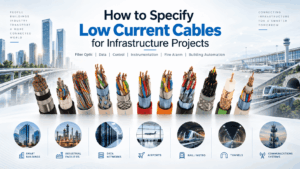
How to Specify Low Current Cables for Infrastructure Projects
A professional low current cable specification should define much more than a cable name, conductor count or sheath colour. Infrastruct...

Fire Resistant Cables for Hospitals and High-Rise Buildings
Fire resistant cable for hospitals and high-rise buildings supports electrical, communication and control systems that may need to rema...
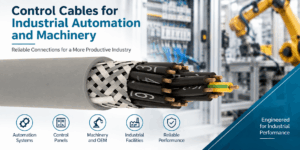
Industrial Control Cable Selection for Automation and Machinery
Industrial control cable selection should begin with the function of the circuit and the mechanical conditions of the machine rather th...
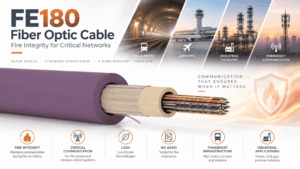
FE180 Fiber Optic Cable: Fire Integrity, Applications and Selection
An FE180 fiber optic cable is designed for optical communication routes where continued transmission during fire can form part of the p...


