





 President’s Message
Blog
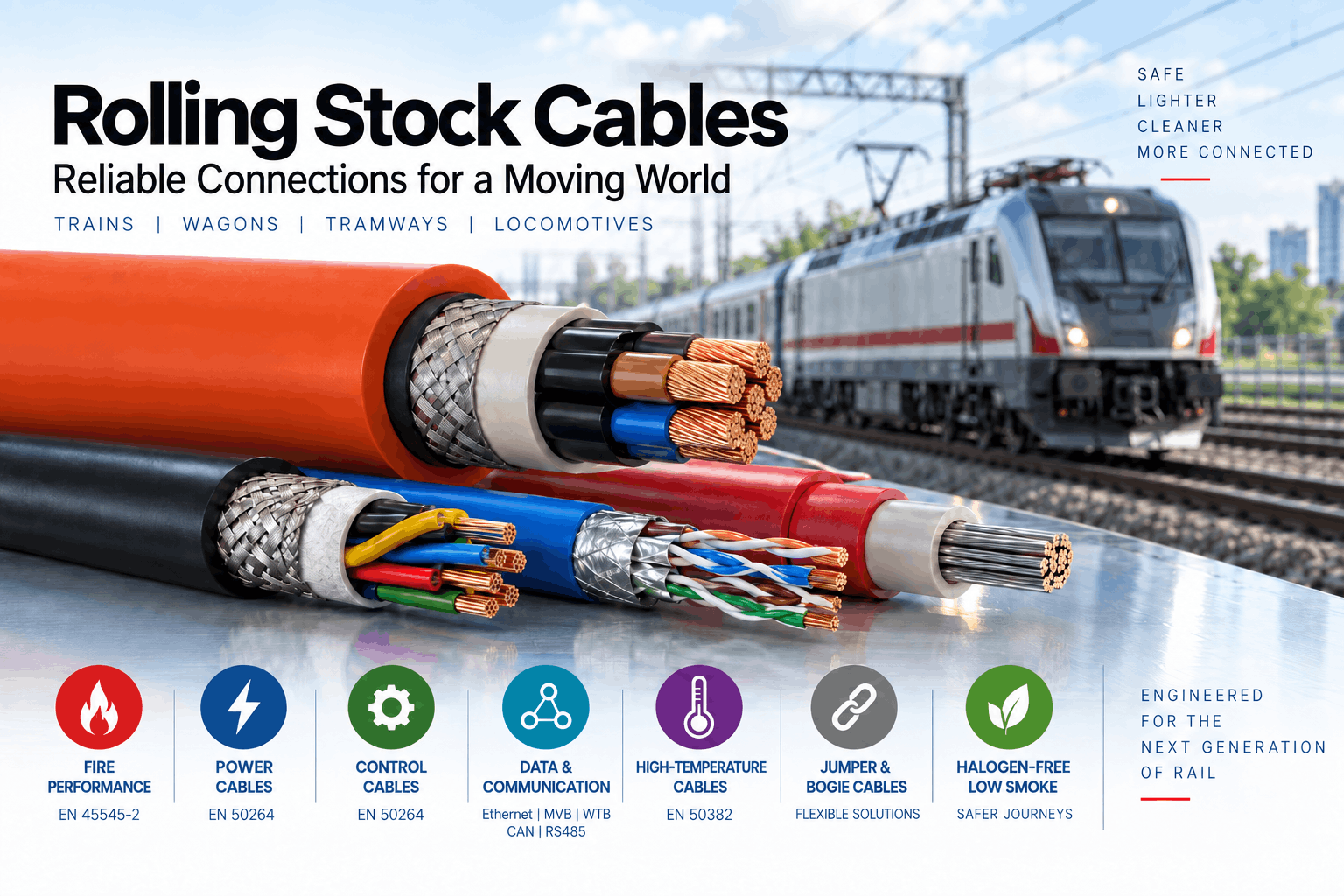
Rolling Stock Cables: Standards, Types and Applications
Reading Time: 18 minutes
Rolling stock cables are specialized electrical and communication cables designed for installation onboard railway vehicles such as trains, locomotives, metro cars, tramways and other rail transport systems. Unlike trackside railway cables, these products operate inside or directly on moving vehicles and must withstand demanding combinations of fire, smoke, vibration, temperature, oils, fuels, mechanical stress and limited installation space.
For this reason, rolling stock cable engineering goes far beyond choosing a halogen-free control cable. Cable diameter, weight, conductor flexibility, insulation thickness, fire behaviour, chemical resistance, operating temperature, electromagnetic compatibility and installation movement can all influence the final construction.
European rolling stock cable families are commonly associated with standards including EN 50264, EN 50306 and EN 50382. Meanwhile, EN 45545-2 defines important fire-behaviour requirements for materials and components used on railway vehicles, including hazard levels HL1, HL2 and HL3. Additional standards address testing, installation and fire-resistant circuit integrity.
Therefore, there is no single universal rolling stock cable. The correct construction depends on whether the cable serves power distribution, control, auxiliary circuits, data communications, high-temperature equipment, emergency circuits or flexible connections between moving parts of the vehicle.
Quick answer: EN 50264 is a major family for rolling stock power and control cables. EN 50306 covers thin-wall designs where reduced diameter and weight are important. EN 50382 addresses high-temperature power cables. EN 45545-2 defines railway-vehicle fire behaviour requirements, while EN 50200 can apply to cables that must maintain circuit operation during fire. Data applications can additionally require Ethernet, RS485, CAN bus, MVB, WTB or other defined transmission characteristics.
Rolling Stock Cables at a Glance
| Cable Requirement | Typical Standard or Cable Family | Main Purpose |
|---|---|---|
| Power and control | EN 50264 | Onboard power, auxiliary and control circuits |
| Reduced-dimension cable | EN 50264-3 | Lower diameter and weight |
| Thin-wall cable | EN 50306 | Compact high-density vehicle wiring |
| High-temperature power | EN 50382 | 120°C / 150°C high-temperature applications |
| Railway fire behaviour | EN 45545-2 | HL1, HL2 and HL3 fire-safety requirements |
| Special cable tests | EN 50305 | Mechanical, environmental and fire-related test methods |
| Cable use guidance | EN 50355 | Selection and use of rolling stock cable families |
| Cabling installation | EN 50343 | Rules for onboard copper-conductor cabling installation |
| Fire-resistant circuits | EN 50200 | Circuit integrity during fire where required |
| Data communication | Project-specific transmission standards | Ethernet, RS485, CAN, MVB, WTB and other data systems |
Consequently, the applicable standard should follow the electrical function and installation environment rather than simply the fact that the cable is installed on a train.
What Are Rolling Stock Cables?
Rolling stock cables are cables used to create electrical and communication connections within railway vehicles. Typical locations include passenger cars, locomotives, metro trains, tramways, driver cabins, equipment enclosures, bogies and inter-car connections.
These cables can carry power, control signals, data, auxiliary circuits and communications. Furthermore, different areas of the same train can expose cables to very different mechanical and environmental conditions.
For example, a control cable inside a protected electrical cabinet experiences a different duty from a jumper cable between two carriages. Likewise, an externally routed bogie cable faces a different environment from an Ethernet cable inside a passenger-information system.
Therefore, rolling stock cable specifications should always define both the electrical circuit and the mechanical installation duty.
Rolling Stock Cables vs Railway Infrastructure Cables
This distinction is fundamental.
Rolling stock cables are installed on the vehicle. Railway infrastructure cables, by contrast, remain part of the fixed railway system.
| Rolling Stock | Fixed Railway Infrastructure |
|---|---|
| Train | Trackside |
| Metro vehicle | Metro tunnel |
| Locomotive | Station infrastructure |
| Tram | Railway signaling route |
| Bogie | Trackside telecom network |
| Passenger carriage | Railway power distribution |
| Inter-car connection | Underground duct |
As a result, EN 45545 rolling-stock fire requirements should not automatically be applied to every fixed railway cable simply because the project involves rail transportation.
What Are Rolling Stock Cables Used For?
One railway vehicle can contain a large number of cable systems.
Typical applications include:
- Main power circuits
- Auxiliary power
- Control circuits
- Lighting
- Heating and ventilation
- Door-control systems
- Braking-related electrical systems
- Battery circuits
- Driver desks
- Control panels
- Passenger information systems
- CCTV
- Ethernet networks
- Train communication networks
- Sensors
- Radio and communication equipment
Therefore, “rolling stock cable” describes a market and application environment rather than one single electrical cable design.
Why Rolling Stock Cables Are Different from Standard Industrial Cables
A standard industrial control cable can perform perfectly well inside a factory but still fail to satisfy railway-vehicle requirements.
Rolling stock applications can require a combination of:
- Halogen-free materials
- Very low smoke emission
- Controlled toxicity
- Limited flame propagation
- Oil resistance
- Fuel resistance
- Ozone resistance
- Acid and alkali resistance
- Low-temperature flexibility
- Abrasion resistance
- Reduced cable diameter
- Reduced weight
- Mechanical durability
Moreover, all of these characteristics may need to be achieved simultaneously.
Consequently, rolling stock cable development normally involves specialized insulation and sheath compounds rather than simply adapting a conventional PVC cable.
Why Weight Matters in Rolling Stock Cable Design
Cable weight has much greater importance on a moving railway vehicle than in many fixed installations.
A train can contain kilometers of electrical wiring. Therefore, even a relatively small reduction in grams per meter can become meaningful when multiplied across the complete vehicle.
Lower cable mass can contribute to:
- Lower overall vehicle weight
- Improved energy efficiency
- Easier cable handling
- Reduced support loading
- Higher wiring density
For this reason, rolling stock cable standards include reduced-wall and thin-wall constructions designed to decrease diameter and mass while maintaining the required electrical and mechanical performance.
Why Cable Diameter Matters
Modern trains contain increasingly complex electrical and digital systems, but installation space remains limited.
Smaller cable diameters can improve:
- Harness density
- Cable-tray utilization
- Routing through restricted spaces
- Cabinet entry capacity
- Bending and installation handling
However, cable miniaturization cannot compromise insulation integrity, voltage withstand or mechanical durability.
Therefore, reduced-wall and thin-wall cable designs require controlled extrusion processes and carefully engineered compounds.
EN 50264 Rolling Stock Cables
EN 50264 is one of the most important European families for rolling stock cables. It covers power, control and associated circuits requiring special fire performance.
The family includes halogen-free insulated and sheathed or unsheathed constructions for railway vehicles.
Typical applications include:
- Power distribution
- Control wiring
- Auxiliary circuits
- Electrical cabinets
- Driver desks
- Cable harnesses
Depending on the specific part, EN 50264 includes single-core and multicore designs as well as standard and reduced-dimension constructions.
EN 50264 Standard Wall vs Reduced-Dimension Cable
The EN 50264 family includes different cable architectures to balance mechanical protection and compactness.
Standard constructions provide established insulation and sheath dimensions. Meanwhile, reduced-dimension designs use lower wall thicknesses to reduce cable diameter and weight.
As a result, engineers can select a construction according to:
- Installation space
- Mechanical exposure
- Required voltage
- Cable weight
- Routing conditions
The smaller construction should not automatically be considered superior. Instead, the project should use the wall architecture intended for its application.
EN 50264-2 Rolling Stock Power and Control Cables
EN 50264-2 covers crosslinked-insulation cable constructions including single-core and multicore power and control cables.
Depending on design, products can be:
- Unsheathed
- Sheathed
- Screened
- Unscreened
- Single core
- Multicore
Voltage classes can extend from lower-voltage control circuits toward several kilovolts for onboard power applications.
Therefore, simply writing “EN 50264 cable” in an RFQ does not define the complete construction.
EN 50264-3 Reduced-Dimension Rolling Stock Cables
EN 50264-3 addresses reduced-dimension constructions.
These designs are particularly valuable where railway vehicle engineers need to reduce:
- Cable diameter
- Weight
- Harness volume
- Installation space
Nevertheless, the cables still need to meet the electrical, mechanical, environmental and fire-performance requirements associated with the standard.
Consequently, reduced dimensions require more precise material and manufacturing control rather than simply using a thinner conventional jacket.
What Are EN 50306 Thin-Wall Rolling Stock Cables?
EN 50306 focuses on thin-wall cables having special fire performance.
This cable family is particularly relevant to modern rolling stock where a large number of circuits must fit inside restricted installation spaces.
Thin-wall constructions can include:
- Single-core cable
- Multicore cable
- Screened cable
- Unscreened cable
- Multipair cable
Moreover, EN 50306-4 includes multicore and multipair screened or unscreened sheathed cable designs.
Therefore, EN 50306 should not be interpreted as one simple single-core wire specification.
EN 50306 vs EN 50264
Both families address rolling stock cables with demanding fire behaviour, but they serve different design priorities.
| Characteristic | EN 50264 | EN 50306 |
|---|---|---|
| Main focus | Power and control cable family | Thin-wall rolling stock cables |
| Weight reduction | Important, especially reduced dimensions | Major design objective |
| Space saving | Good | Very strong |
| Single-core options | Yes | Yes |
| Multicore options | Yes | Yes |
| Multipair options | Construction-dependent | Important family |
| Power applications | Strong | More focused on compact lower-voltage wiring |
Therefore, the choice should follow the circuit and vehicle architecture rather than assuming that thin wall automatically replaces EN 50264.
EN 50382 High-Temperature Rolling Stock Cables
Some onboard circuits operate close to equipment producing significantly higher temperatures.
For these applications, EN 50382 covers high-temperature rolling stock power cables with special fire performance.
Typical characteristics can include:
- Flexible conductors
- Silicone-rubber insulation
- 120°C temperature classes
- 150°C temperature classes
- 1.8/3 kV voltage class
- 3.6/6 kV voltage class
Consequently, EN 50382 serves a substantially different application from an ordinary 300/500 V control cable.
When Is EN 50382 Used?
High-temperature power cables can be considered around equipment and circuits where conventional rolling-stock elastomer systems do not provide sufficient thermal margin.
Depending on vehicle design, applications can involve:
- Traction-related circuits
- High-power electrical equipment
- High-temperature equipment zones
- External power connections
- Special flexible connections
However, the actual cable should always follow the equipment manufacturer’s temperature and voltage requirements.
EN 45545-2 Fire Performance for Rolling Stock Cables
Fire behaviour is one of the defining requirements for rolling stock cables.
EN 45545-2 addresses fire behaviour requirements for materials and components used on railway vehicles.
The standard uses three hazard levels:
- HL1
- HL2
- HL3
The required hazard level depends on the relationship between vehicle design category and operating category.
Therefore, HL3 should not be treated as a universal requirement for every train simply because it provides the most demanding level.
What Do HL1, HL2 and HL3 Mean?
Hazard levels represent different fire-safety requirement levels for railway vehicle materials and components.
In general:
| Hazard Level | Relative Requirement |
|---|---|
| HL1 | Lower requirement within the EN 45545 hierarchy |
| HL2 | Intermediate requirement |
| HL3 | Most demanding requirement |
However, the correct level comes from the vehicle classification rather than from cable marketing.
For example, trains operating in environments where evacuation is more difficult can require more demanding fire behaviour than vehicles operating under less restrictive conditions.
R15 and R16 Cable Requirements
EN 45545-2 contains cable-related requirement sets commonly identified as R15 and R16.
Importantly, electrical cables that satisfy the relevant fire-safety requirements of EN 50306, EN 50264 or EN 50382 are considered to satisfy the corresponding R15/R16 requirements for the applicable hazard level.
Therefore, the relationship between the cable product standards and EN 45545-2 should be understood as coordinated rather than completely independent.
Fire Performance Is More Than Flame Retardancy
A strong rolling stock cable can need to control several fire-related characteristics simultaneously.
These can include:
- Single-cable flame propagation
- Bunched-cable flame spread
- Smoke density
- Halogen emissions
- Corrosive combustion gases
- Toxicity
As a result, describing a rolling-stock product only as “flame retardant” provides an incomplete technical specification.
Why Halogen-Free Materials Matter
Railway vehicles contain passengers, staff, electronics and confined spaces.
During fire, corrosive and toxic combustion products can create serious additional hazards.
For this reason, the principal European rolling-stock cable families use halogen-free insulation and sheath systems designed to provide controlled smoke and combustion-gas characteristics.
However, using an LSZH compound does not automatically prove EN 45545-2 compliance. The finished cable construction still needs the applicable tested performance.
Smoke and Toxicity in Railway Vehicles
Smoke production is particularly important onboard trains because evacuation can occur through constrained doors, corridors or tunnels.
Dense smoke can reduce visibility and make evacuation more difficult.
Furthermore, combustion gases can affect passengers, personnel and sensitive electrical systems.
Therefore, low-smoke and low-toxicity performance should be treated as fundamental railway cable characteristics rather than optional marketing features.
EN 50305 Rolling Stock Cable Tests
EN 50305 provides special test methods used with rolling stock cables having special fire performance.
Testing can address characteristics such as:
- Oil resistance
- Fuel resistance
- Ozone resistance
- Mechanical properties
- Environmental behaviour
- Fire-related performance
Consequently, railway cable qualification extends far beyond conductor resistance and high-voltage testing.
Oil and Fuel Resistance
Cables mounted beneath or outside railway vehicles can encounter lubricants, hydraulic fluids, mineral oils and fuel-related contamination.
Suitable rolling stock cable compounds are therefore designed and tested to resist these exposures without unacceptable deterioration.
Oil resistance is particularly important because swelling, cracking or softening of insulation and sheath materials can compromise mechanical and electrical performance.
As a result, generic industrial LSZH compounds should not automatically be assumed suitable for onboard railway use.
Ozone Resistance
Ozone can degrade certain elastomeric materials over long service periods.
Railway applications can expose cables to outdoor air, electrical equipment and environmental conditions where ozone resistance matters.
Therefore, EN railway cable systems commonly include ozone-performance requirements as part of the material qualification.
Acid and Alkali Resistance
Maintenance chemicals and environmental contamination can expose vehicle cabling to acidic or alkaline substances.
Consequently, resistance to acids and alkalis can form part of rolling-stock cable testing.
This requirement further separates specialist railway compounds from ordinary building-wire materials.
Low-Temperature Performance
Rolling stock can operate in extremely different climates.
A railway vehicle may experience sub-zero winter conditions outdoors and considerably higher temperatures near onboard electrical equipment.
Therefore, cable systems should maintain suitable:
- Flexibility
- Insulation integrity
- Mechanical resistance
- Electrical performance
across the required operating and installation temperature range.
Why Tinned Copper Is Common in Rolling Stock Cables
Flexible tinned-copper conductors appear repeatedly in European rolling stock cable designs.
Tinning can provide useful protection against copper surface oxidation while preserving conductivity and flexibility.
Moreover, fine-stranded conductors facilitate routing inside restricted vehicle spaces.
However, conductor class still needs to match the cable’s mechanical duty.
Class 5 Conductors
Many EN 50264 and EN 50306 constructions use IEC 60228 Class 5 flexible copper conductors.
Class 5 stranding improves flexibility compared with rigid conductor designs.
This can support routing through:
- Vehicle harnesses
- Control cabinets
- Driver desks
- Equipment compartments
- Restricted cable pathways
Nevertheless, Class 5 should not automatically be interpreted as continuous dynamic-flex capability.
Flexible Cable vs Dynamic Rolling Stock Cable
This distinction is extremely important.
A cable can use Class 5 flexible conductors while being designed primarily for fixed installation or only occasional movement.
By contrast, true dynamic applications can involve:
- Repeated bending
- Torsion
- Inter-car movement
- Bogie movement
- Door mechanisms
- Continuous vibration
Therefore, engineers should not select a dynamic jumper cable merely because a standard cable is described as “flexible.”
Jumper Cables Between Railway Vehicles
Connections between railway cars experience repeated mechanical movement as the train accelerates, brakes and travels through curves.
Jumper cables can therefore require:
- High flexibility
- Repeated bending resistance
- Torsion resistance
- Weather resistance
- Oil and fuel resistance
- UV resistance
- Strong strain relief
Consequently, inter-car jumper cable should be treated as a separate product family from ordinary fixed onboard wiring.
Bogie Cables
The bogie is another mechanically demanding location.
Cables can experience vibration, movement, temperature changes, contamination and outdoor exposure.
Therefore, bogie cable designs may require significantly greater flexibility and mechanical resistance than cables mounted inside a protected electrical cabinet.
Rolling Stock Power Cables
Power cables supply energy to onboard equipment and can cover a wide range of conductor sizes and voltage ratings.
Applications include:
- Power distribution
- Traction-related auxiliary systems
- Heating
- Air conditioning
- Battery systems
- Main electrical equipment
As conductor cross-section increases, weight, bending radius and termination design become increasingly important.
Therefore, large rolling-stock power cable should be coordinated with the entire electrical and mechanical installation.
Rolling Stock Control Cables
Control cables connect switches, relays, sensors, actuators, panels and auxiliary systems throughout the vehicle.
Depending on the electrical environment, these cables can be:
- Unscreened multicore
- Overall screened
- Multipair
- Thin wall
- Reduced wall
Consequently, cable selection should consider both circuit voltage and electromagnetic environment.
Screened Rolling Stock Cables
Metallic screening can help protect control and communication circuits from electromagnetic interference generated by traction and power electronics.
Screening can use constructions such as:
- Tinned-copper wire braid
- Overall metallic screen
- Individual pair screens
- Combined individual and overall screening
However, screen termination and grounding remain part of the complete vehicle EMC design.
Therefore, a screened cable alone cannot solve every electromagnetic-compatibility problem.
Data and Communication Rolling Stock Cables
Modern trains increasingly operate as mobile digital networks.
Onboard communication systems can use:
- Ethernet
- RS485
- CAN bus
- MVB
- WTB
- Profinet
- Coaxial cables
- Audio/video links
Unlike generic control cable, these products must maintain defined transmission characteristics.
Therefore, impedance, capacitance, attenuation, pair geometry and screening become as important as fire performance.
Ethernet Rolling Stock Cables
Ethernet is increasingly used for passenger information, CCTV, diagnostics, control networks and train backbone applications.
Railway Ethernet cables can be based on categories such as:
- Cat 5e
- Cat 6
- Cat 7
- Cat 7A
However, ordinary building Ethernet cable should not automatically be installed in rolling stock.
A railway Ethernet cable can additionally require EN 45545 fire behaviour, oil resistance, mechanical durability and specialized halogen-free compounds.
RS485 Cables for Railway Vehicles
RS485 remains relevant for robust serial communication in industrial and transportation systems.
Suitable railway constructions can require:
- Controlled characteristic impedance
- Twisted pair geometry
- Low capacitance
- Metallic screening
- Halogen-free materials
- Railway fire performance
Therefore, an RS485 rolling stock cable should be specified as a data cable rather than simply as a screened pair.
MVB and WTB Train Communication Cables
Multifunction Vehicle Bus and Wire Train Bus have historically formed important parts of train communication architectures.
These systems require controlled data-cable electrical parameters, commonly including defined impedance and attenuation.
Moreover, the cable still operates in the same demanding onboard fire and mechanical environment as other rolling-stock wiring.
Consequently, transmission performance and railway material performance must be engineered together.
CAN Bus Rolling Stock Cable
CAN-based communication can be used for distributed equipment, sensors and vehicle-control functions.
A railway CAN cable can combine:
- Twisted pair geometry
- Controlled impedance
- Screening
- Flexible conductor construction
- Halogen-free materials
- EN 45545-compatible fire performance
Therefore, substituting a generic industrial CAN cable should only occur after confirming all railway requirements.
Coaxial Cables in Rolling Stock
Coaxial cable can remain useful for applications involving radio, CCTV, antennas and specialized communication equipment.
Typical characteristic impedances include:
- 50 Ω
- 75 Ω
Nevertheless, the coaxial electrical design must be combined with the required rolling-stock fire, flexibility and environmental characteristics.
Fire-Resistant Rolling Stock Cables
Some safety-related circuits must continue operating during a fire.
For these applications, a fire-resistant cable can add a mica or other suitable fire barrier to the conductor insulation system.
Depending on project requirements, applications can include:
- Emergency lighting
- Safety circuits
- Emergency communication
- Critical auxiliary circuits
However, fire-resistant circuit integrity should not be confused with EN 45545 reaction-to-fire behaviour.
EN 45545 vs EN 50200
These standards answer different questions.
| Requirement | EN 45545-2 | EN 50200 |
|---|---|---|
| Main purpose | Fire behaviour of railway-vehicle materials/components | Circuit integrity during fire |
| Smoke/toxicity concerns | Important | Separate characteristic |
| Continued electrical operation | Not the primary classification purpose | Yes |
| Hazard levels | HL1 / HL2 / HL3 | No |
| PH time classification | No | Yes, where applicable |
Therefore, one cable can legitimately need both railway fire-behaviour qualification and separate circuit-integrity performance.
PH15, PH30, PH60, PH90 and PH120
EN 50200-type fire-resistance classifications can identify different periods of circuit survival under the defined fire and mechanical test conditions.
Depending on the project, requirements can include:
- PH15
- PH30
- PH60
- PH90
- PH120
However, a longer PH rating should only be specified where the safety system actually requires it.
Rolling Stock Cable Installation and EN 50343
EN 50343 addresses installation rules for cabling onboard railway vehicles.
The current 2024 edition covers copper-conductor cabling used to connect electrical equipment on railway vehicles and within electrical enclosures. Importantly, its scope excludes special-effect conductors such as fiber optic cable.
The standard addresses areas including:
- Cable sizing
- Installation
- Mechanical requirements
- Connections
- Protection
- EMC considerations
- Identification
Therefore, choosing a qualified cable is only one part of creating a reliable onboard electrical system. :contentReference[oaicite:0]{index=0}
EN 50355 Guide to Use
EN 50355 provides guidance for the use of rolling stock cables having special fire performance.
It complements the main cable product families by helping designers select suitable constructions according to service conditions.
As a result, cable standards and application guidance should be considered together during vehicle design.
Fixed vs Flexible Installation
Installation duty should be clearly defined in the technical specification.
A cable mounted permanently in a conduit or tray can tolerate a different mechanical design from a cable that repeatedly moves.
Therefore, RFQs should distinguish between:
- Fixed installation
- Limited flexing
- Repeated bending
- Continuous movement
- Torsion
- Jumper application
- Bogie application
This distinction can prevent premature cable failure.
Bending Radius
Compact vehicle installations can create tight cable-routing paths.
Nevertheless, every cable has a minimum permitted bending radius.
Exceeding that limit can damage:
- Conductors
- Insulation
- Screens
- Sheaths
- Internal cable geometry
Consequently, bending radius should be considered during vehicle pathway design rather than only during installation.
Rolling Stock Cables for Metro Vehicles
Metro trains combine high passenger density with frequent starts, stops and door operations.
Therefore, their cable systems can require strong combinations of:
- Fire performance
- Low smoke
- Low toxicity
- Compact dimensions
- Flexibility
- Data communications
Urban underground operation can also influence the EN 45545 hazard level through the vehicle’s operating category.
Rolling Stock Cables for High-Speed Trains
High-speed trains contain complex traction, control, monitoring and passenger systems.
Weight reduction becomes particularly valuable because the complete vehicle is optimized for efficiency.
Moreover, large amounts of data are exchanged between onboard systems.
Consequently, thin-wall control cables and high-performance data networks can both become important.
Rolling Stock Cables for Tramways
Tramways frequently combine urban passenger operation with compact vehicle construction.
Cabling can serve:
- Traction auxiliaries
- Doors
- Lighting
- HVAC
- Passenger information
- CCTV
- Control networks
Therefore, both compactness and strong fire performance can be important design objectives.
Rolling Stock Cables for Locomotives
Locomotives contain significant power and control equipment and can require large conductor cross-sections.
Depending on the system, cable families can include:
- Large single-core power cables
- High-temperature power cables
- Auxiliary wiring
- Control cable
- Communication cable
As a result, one locomotive can use products from several different rolling-stock standards.
London Underground Approved Rolling Stock Cables
Some railway operators maintain their own approved-product systems in addition to European standards.
London Underground rolling-stock cables provide a clear example.
LUL-specific products include multiple Part 6 cable types covering:
- Reduced-wall single-core cable
- Standard-wall single-core cable
- Enhanced-wall cable
- Multicore cable
- Pairs
- Multipairs
Therefore, compliance with EN 50264 does not automatically mean that a cable has London Underground approval. Operator approval is a separate qualification.
IRIS / ISO 22163 and Rolling Stock Cable Manufacturers
Railway customers often evaluate not only the cable but also the supplier’s quality-management system.
ISO 22163, commonly associated with the IRIS railway quality framework, is widely used across the rail supply chain.
Consequently, obtaining railway-specific manufacturing qualification can be commercially important for cable suppliers seeking direct relationships with rolling-stock manufacturers and Tier 1 system suppliers.
Common Mistakes When Selecting Rolling Stock Cables
1. Confusing Rolling Stock with Railway Infrastructure
Vehicle cable standards and fixed trackside infrastructure standards serve different environments.
2. Specifying Only EN 45545
EN 45545 fire performance does not fully define the power, control or data-cable construction.
3. Specifying Only EN 50264
The exact part, wall type, voltage, conductor size, screen and sheath still need to be defined.
4. Assuming HL3 Is Always Required
The correct hazard level follows vehicle design and operating categories.
5. Assuming LSZH Means EN 45545 Compliant
The finished cable must demonstrate the required railway fire behaviour.
6. Assuming Class 5 Means Dynamic Flex
Flexible conductors do not automatically provide continuous-motion capability.
7. Using Standard Ethernet Cable Onboard
Railway data cable can require both transmission performance and rolling-stock fire/environmental performance.
8. Ignoring Oil and Fuel Resistance
Externally installed cables can experience severe chemical exposure.
9. Ignoring Cable Weight
Vehicle wiring can represent significant cumulative mass.
10. Ignoring Cable Diameter
Compact vehicle pathways can severely limit installation space.
11. Confusing EN 45545 with Fire Resistance
Reaction-to-fire behaviour and circuit integrity are separate requirements.
12. Ignoring Screen Termination
EMC performance depends on the complete installed system.
13. Using a Fixed Cable as a Jumper Cable
Repeated motion can rapidly damage a cable not designed for dynamic service.
14. Ignoring Temperature Class
Some equipment zones can require EN 50382 high-temperature designs.
15. Assuming European Standards Equal Operator Approval
Customers such as London Underground can maintain additional approval requirements.
How to Select Rolling Stock Cables
A structured specification process can prevent both under-design and unnecessary complexity.
1. Define the Circuit
Determine whether the cable carries power, control, auxiliary or communication signals.
2. Define the Voltage
Select the applicable voltage class according to the vehicle electrical system.
3. Determine the Relevant Cable Standard
Evaluate EN 50264, EN 50306, EN 50382 or another applicable product specification.
4. Determine the EN 45545 Hazard Level
Use the vehicle operation and design classification to establish HL1, HL2 or HL3.
5. Define Fixed or Dynamic Duty
Identify whether the cable experiences occasional or repeated motion.
6. Select Conductor Size and Class
Calculate current, voltage drop, temperature and mechanical requirements.
7. Define Screening
Specify unscreened, overall screened or individually screened construction where required.
8. Review Environmental Exposure
Check oil, fuel, ozone, UV, temperature, acids, alkalis and moisture.
9. Define Fire Resistance Separately
Add EN 50200 circuit integrity where the circuit must continue operating during fire.
10. Confirm Customer Approvals
Identify operator, OEM and project-specific qualification requirements.
What Should Buyers Include in a Rolling Stock Cable RFQ?
An RFQ requesting only “rolling stock cable” leaves too many technical variables undefined.
A professional specification should include:
- Application
- Vehicle type
- Applicable cable standard
- EN 50264 / EN 50306 / EN 50382 requirement
- Applicable standard part
- EN 45545-2 hazard level
- R15 / R16 requirement where applicable
- Conductor material
- Tinned copper requirement
- Conductor class
- Number of cores or pairs
- Conductor cross-section
- Nominal voltage
- Screening requirement
- Individual or overall screening
- Insulation compound
- Sheath compound
- Standard, reduced or thin-wall construction
- Maximum outside diameter
- Maximum cable weight where relevant
- Operating temperature
- Installation temperature
- Minimum bending radius
- Fixed or flexible installation
- Dynamic-flex requirement
- Torsion requirement
- Oil resistance
- Fuel resistance
- Ozone resistance
- Acid and alkali resistance
- UV resistance where applicable
- Flame-propagation requirement
- Smoke requirement
- Halogen-free requirement
- Toxicity requirement
- Fire-resistance requirement
- EN 50200 / PH rating where applicable
- Data impedance where applicable
- Capacitance where applicable
- Attenuation where applicable
- Ethernet category where applicable
- RS485 / CAN / MVB / WTB specification where applicable
- OEM or operator approval
- ISO 22163 / IRIS supplier requirement where applicable
- Cable marking
- Test documentation
- Type-test certificates
As a result, cable manufacturers can propose the exact onboard construction rather than interpreting a broad railway description.
Rolling Stock Cable Development for New Railway Projects
Developing a rolling-stock cable portfolio requires more than adapting existing industrial cable constructions.
Manufacturers must coordinate:
- Crosslinked halogen-free compounds
- Thin and reduced-wall extrusion
- Tinned Class 5 or Class 6 conductors where required
- Screening technologies
- Data-cable geometry
- Fire testing
- Oil and fuel resistance
- Low-temperature performance
- Mechanical qualification
Furthermore, customers can require independent type testing and railway-specific supplier approval.
Therefore, successful entry into the rolling-stock market depends on both cable engineering and qualification capability.
Frequently Asked Questions
What are rolling stock cables?
Rolling stock cables are specialized power, control and communication cables installed onboard railway vehicles such as trains, locomotives, metro cars and tramways.
Are rolling stock cables the same as railway cables?
No. Rolling-stock cables are installed on moving railway vehicles, while the broader railway-cable category also includes fixed signaling, telecom, trackside and infrastructure cables.
What standard is used for rolling stock cables?
Important European standards include EN 50264 for power and control cables, EN 50306 for thin-wall cables, EN 50382 for high-temperature power cables and EN 45545-2 for railway-vehicle fire behaviour.
What is EN 50264?
EN 50264 is a family of railway rolling-stock power and control cables having special fire performance.
What is EN 50306?
EN 50306 covers thin-wall rolling-stock cables designed to provide compact dimensions and demanding railway fire performance.
What is EN 50382?
EN 50382 covers high-temperature rolling-stock power cables, including silicone-insulated constructions for higher operating temperatures.
What is EN 45545-2?
EN 45545-2 specifies fire-behaviour requirements for materials and components used on railway vehicles.
What are HL1, HL2 and HL3?
They are EN 45545 hazard levels determined from the railway vehicle’s design and operating categories, with HL3 representing the most demanding of the three levels.
Does HL3 mean fire resistant?
No. HL3 concerns railway fire behaviour. Circuit integrity during fire requires separate testing such as EN 50200 where applicable.
Are rolling stock cables halogen free?
Major European rolling-stock cable standards use halogen-free material systems because low smoke, low corrosivity and controlled toxicity are important onboard railway vehicles.
Why are rolling stock cables tinned copper?
Tinned copper provides flexible electrical conductors with improved resistance to surface oxidation and is widely used in railway cable constructions.
Are all rolling stock cables flexible?
Many use flexible Class 5 conductors, but this does not automatically make them suitable for repeated dynamic bending.
What is a railway jumper cable?
A jumper cable provides flexible electrical or communication connections across moving parts such as between carriages and therefore requires increased dynamic performance.
What cable is used between railway carriages?
Special flexible jumper or inter-car cables are used where repeated bending, torsion and vehicle movement occur.
Can Ethernet cable be used on trains?
Yes, but rolling-stock Ethernet cable should combine the required Category or Ethernet transmission characteristics with railway fire, environmental and mechanical performance.
Are Cat 6 and Cat 7 cables available for rolling stock?
Yes. Railway manufacturers offer specialized Cat 5e, Cat 6, Cat 7 and Cat 7A constructions for onboard data networks.
What is MVB cable?
MVB cable is used for Multifunction Vehicle Bus communications and requires defined transmission parameters together with suitable railway materials and fire performance.
What is WTB cable?
WTB refers to Wire Train Bus, a train-communication network that uses defined data-cable electrical characteristics.
Can RS485 cable be used in rolling stock?
Yes. Railway-specific RS485 cables combine controlled data characteristics with the required fire, mechanical and environmental properties.
Do rolling stock cables resist oil and fuel?
Suitable railway constructions are tested for resistance to mineral oil, fuel oil and other environmental exposures according to the applicable standard.
What is EN 50343?
EN 50343 provides rules for installing copper-conductor cabling onboard railway vehicles and within their electrical enclosures. The current 2024 scope does not cover fiber optic conductors.
What is EN 50305?
EN 50305 contains special test methods associated with rolling-stock cables having special fire performance.
Can rolling stock cables be fire resistant?
Yes. Special constructions can combine rolling-stock fire behaviour with separate EN 50200 circuit-integrity performance.
What should I specify when ordering rolling stock cables?
Define the application, cable standard, voltage, conductor size, screen, wall construction, EN 45545 hazard level, environmental requirements, movement duty and any OEM or operator approvals.
Conclusion
Rolling stock cables form a specialized cable category engineered specifically for railway vehicles rather than fixed railway infrastructure.
The cable environment combines several demanding requirements. Fire behaviour must protect passengers and staff, while low smoke and low toxicity become particularly important in enclosed vehicles and underground transportation systems.
At the same time, cable weight and diameter matter because modern trains contain increasingly dense electrical and communication networks.
EN 50264 provides one of the main foundations for power and control cable. Meanwhile, EN 50306 supports thin-wall constructions where space and weight reduction become especially important.
For high-temperature power circuits, EN 50382 provides another specialized cable family.
EN 45545-2 ties these products into the railway vehicle fire-safety framework through HL1, HL2 and HL3 requirements. However, fire behaviour should not be confused with continued circuit operation during fire, which can require separate EN 50200 testing.
Mechanical duty also matters. A Class 5 conductor can make a cable flexible enough for installation without making it suitable for millions of movement cycles. Inter-car jumper cables, bogie cables and other dynamic applications therefore need purpose-designed constructions.
Meanwhile, modern trains increasingly depend on specialized data cables. Ethernet, RS485, CAN, MVB, WTB and coaxial designs must combine controlled transmission characteristics with rolling-stock fire and environmental performance.
For manufacturers and purchasing teams, the best approach is therefore to define the electrical function first, the applicable rolling-stock standard second, the fire requirement third, and the installation movement and environmental conditions fourth.
The correct rolling stock cable is not simply the cable with the highest temperature rating or most demanding fire classification. It is the construction that delivers the required electrical or data performance while minimizing weight and space and maintaining reliable operation throughout the railway vehicle’s service life.


