





 President’s Message
Blog
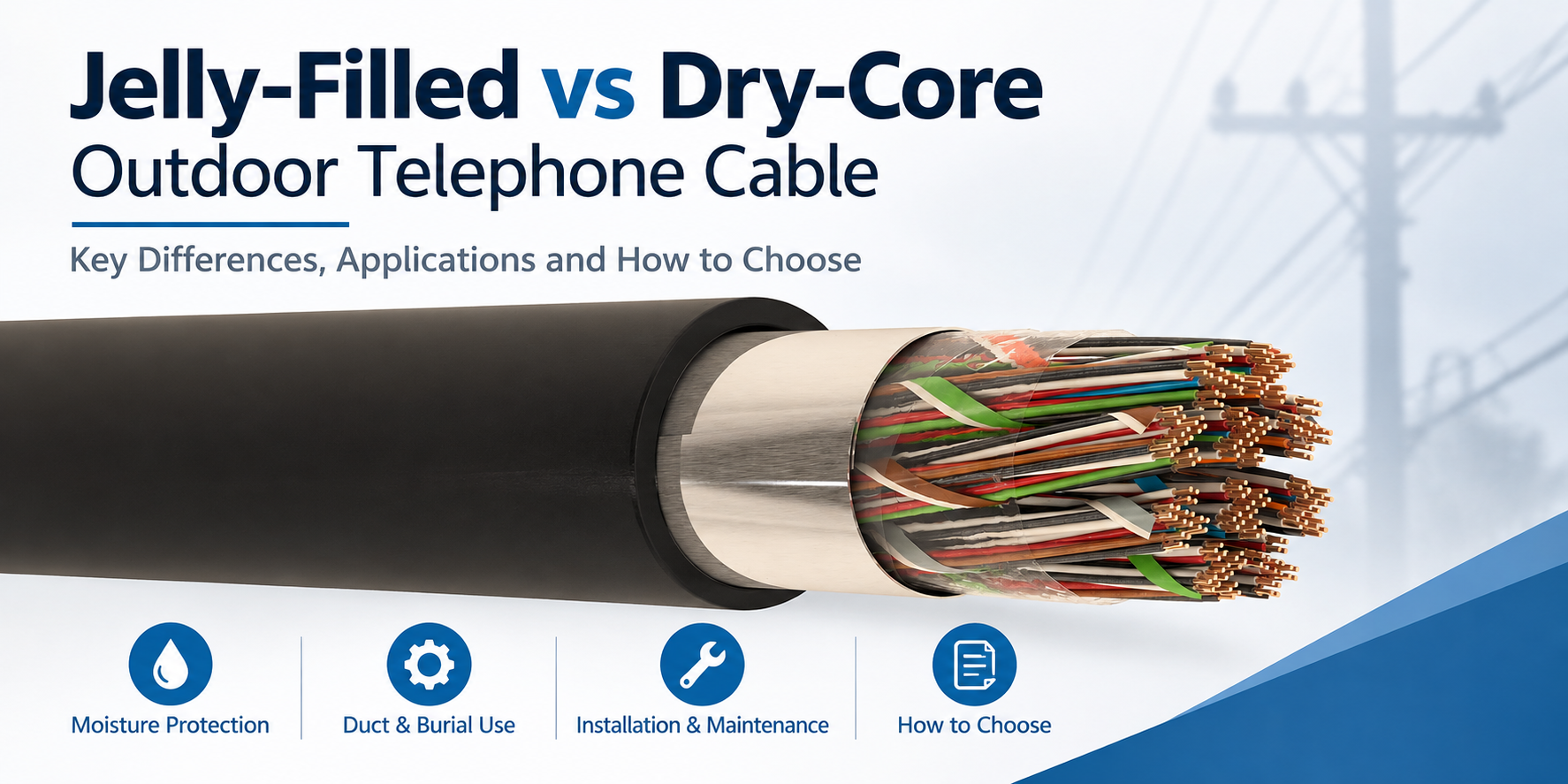
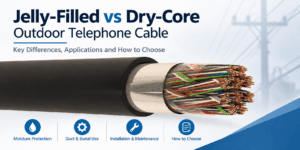
Jelly-Filled vs Dry-Core Outdoor Telephone Cable
Reading Time: 17 minutes
Jelly-filled vs dry-core is an important construction choice when specifying outdoor telephone cable for telecom distribution networks, underground ducts, infrastructure projects and protected outdoor routes. Both designs can use the same basic copper-pair architecture, polyethylene insulation, metallic screening and UV-resistant polyethylene outer sheath, yet they manage moisture inside the cable in very different ways.
A jelly-filled telephone cable uses a hydrophobic filling compound throughout the cable core. The compound occupies the air spaces between insulated pairs and helps prevent water from travelling longitudinally through the cable if the outer protection becomes damaged.
A dry-core cable contains no conventional petroleum jelly or similar flooding compound between the pairs. Depending on the exact design, it can simply be an unfilled core or it can include dry water-blocking elements such as swellable tapes, yarns or powders.
Therefore, “dry-core” should not automatically be interpreted as “water-blocked.” A genuinely dry water-blocked design and a conventional unfilled telephone cable are technically different constructions.
Quick answer: jelly-filled outdoor telephone cable is generally preferred where moisture ingress presents a significant risk, particularly in underground ducts, wet chambers and buried telecommunications networks. Dry-core cable offers cleaner preparation, easier termination and lower maintenance mess where the route is suitably protected. If a dry cable must withstand serious water exposure, the specification should explicitly require dry water-blocking elements rather than simply stating “dry core.”
Jelly-Filled vs Dry-Core at a Glance
| Characteristic | Jelly-Filled Cable | Dry-Core Cable |
|---|---|---|
| Conventional gel filling | Yes | No |
| Longitudinal water blocking | Strong when correctly filled | Depends on construction |
| Clean termination | Requires gel cleaning | Easier |
| Splicing convenience | More preparation required | Generally cleaner |
| Typical wet duct suitability | Strong choice | Only when adequately protected or dry-water-blocked |
| Direct burial | Commonly preferred where suitable | Requires appropriate overall design |
| Protected outdoor route | Suitable | Often suitable |
| Conventional petroleum jelly | Present | Absent |
| Dry swellable materials possible | Not normally required | Yes, depending on design |
| Screening determined by filling type? | No | No |
| PE outer sheath determined by filling type? | No | No |
Consequently, core filling should be selected according to water-exposure risk and maintenance requirements rather than treated as a simple quality ranking.
What Is a Jelly-Filled Outdoor Telephone Cable?
A jelly-filled outdoor telephone cable contains a water-resistant filling compound within the cable core.
The twisted copper pairs are assembled into units or larger cable groups. During manufacturing, the spaces between these insulated conductors are filled with a specially selected hydrophobic compound.
The objective is to prevent open longitudinal pathways through the cable.
If the outer sheath experiences localized damage, water can enter at that location. Without internal water blocking, it can migrate along the cable through the air spaces between conductors.
Jelly filling restricts this movement by occupying those spaces.
Therefore, the compound primarily protects against longitudinal moisture propagation rather than simply making the cable exterior resistant to rain.
How Jelly Filling Works
Outdoor multi-pair telephone cables contain numerous small spaces around twisted pairs, binders and cable units.
In an unfilled construction, these voids can create potential channels for moisture movement.
Manufacturers apply filling compound throughout the cable core to eliminate or substantially reduce those channels.
Depending on the cable design, additional compound can also be applied between the core wrapping and metallic screen.
As a result, water entering through a localized defect has much greater difficulty travelling along the cable length.
This protection can be particularly valuable in telecom networks where one damaged section might otherwise affect a much longer installed length.
What Is a Dry-Core Outdoor Telephone Cable?
A dry-core cable eliminates conventional jelly filling from the spaces between conductors.
The pairs remain physically dry during installation and termination.
This construction provides several practical advantages because technicians do not need to remove filling compound before making splices or terminations.
However, the term “dry core” can describe more than one design philosophy.
A cable may be:
- Completely unfilled without dedicated longitudinal water-blocking materials
- Dry but equipped with swellable water-blocking tape
- Dry but equipped with water-blocking yarns
- Dry with water-swellable powders or other engineered elements
Therefore, procurement teams should never assume that every dry-core cable provides the same moisture protection.
Jelly-Filled vs Dry-Core: The Main Difference
The fundamental difference in jelly-filled vs dry-core telephone cable is how the internal cable core manages water.
Jelly-filled construction physically fills the interstitial spaces with a hydrophobic compound.
Dry-core construction leaves out that conventional filling compound.
If the dry construction includes no additional water-blocking system, the core can contain open pathways through which moisture can migrate.
By contrast, an engineered dry water-blocked cable uses swellable components to restrict that movement without using conventional jelly.
Therefore, the correct comparison is not always simply:
Wet cable vs dry cable.
A more precise comparison is:
Gel-filled water blocking vs unfilled or dry water-blocking technology.
Why Outdoor Telephone Cables Need Moisture Protection
Outdoor telecom cables can encounter water throughout their service life.
Potential sources include rain, condensation, groundwater, flooded ducts, manholes and accidental sheath damage.
Moisture can create serious long-term problems in copper communication networks.
Potential consequences include:
- Reduced insulation resistance
- Corrosion
- Increasing leakage current
- Signal degradation
- Pair faults
- Intermittent communication problems
- Higher maintenance requirements
Consequently, water management forms a central part of outside-plant telephone cable design.
Jelly-Filled vs Dry-Core for Underground Ducts
Underground ducts are among the strongest applications for considering jelly-filled vs dry-core construction carefully.
Telecommunications ducts frequently contain water.
A duct does not need to be damaged for this to happen. Groundwater can enter through joints, chambers and access points, while temperature changes can also create condensation.
Therefore, engineers should normally treat underground telecom ducts as potentially wet environments rather than assume that the surrounding conduit keeps the cable dry.
Jelly-filled cable provides an established method of restricting longitudinal moisture movement in these conditions.
A dry-core design can also be suitable if the route remains reliably protected or if the cable incorporates an explicitly engineered dry water-blocking system.
Why Ducts Should Not Be Assumed Dry
One common specification mistake is to classify a cable as protected merely because it runs inside HDPE or PVC conduit.
In reality, underground duct systems can remain partially or completely flooded for long periods.
Water can enter through:
- Manholes
- Handholes
- Joint chambers
- Duct connections
- Cracks
- Groundwater pressure
- Condensation
Therefore, a duct route should be evaluated according to realistic field conditions.
If prolonged water exposure is possible, internal water-blocking performance becomes much more important.
Jelly-Filled vs Dry-Core for Direct Burial
Direct-burial telecom cable operates without a continuous protective duct around the cable.
The installation can face soil moisture, groundwater and localized mechanical damage.
Consequently, jelly-filled construction has traditionally been attractive for buried copper telephone networks because the filling compound helps prevent water from travelling through the cable core after localized damage.
However, filling compound does not replace mechanical protection.
A direct-burial design can also require:
- Appropriate PE outer sheath
- Metallic moisture barrier
- Armour where required
- Rodent protection
- Suitable crush resistance
- Project-specific mechanical protection
Therefore, jelly filling represents one part of a complete buried-cable design.
Can Dry-Core Cable Be Direct Buried?
Potentially, but “dry core” alone is not enough information to answer the question.
A purpose-designed dry water-blocked cable can be engineered for demanding outdoor conditions.
However, a simple unfilled cable with no longitudinal water-blocking system should not automatically be treated as equivalent to a jelly-filled buried cable.
Therefore, direct-burial specifications should identify the required water-blocking performance explicitly.
The cable manufacturer should then confirm whether the dry design meets that requirement.
Jelly-Filled vs Dry-Core for Protected Routes
Dry-core cable becomes especially attractive where water exposure is limited and the route provides strong environmental protection.
Examples can include:
- Protected conduits
- Equipment-to-building telecom links
- Sheltered outdoor pathways
- Controlled industrial sites
- Telecom cabinets with protected cable entries
In these installations, eliminating conventional filling compound can simplify termination and maintenance.
However, route assessment still matters.
A theoretically protected route can experience unexpected flooding during its service life.
Jelly-Filled vs Dry-Core for Aerial Telephone Cable
Aerial cables face a different environmental profile from buried cables.
They encounter sunlight, temperature cycling, rain, wind and mechanical movement rather than continuous underground moisture exposure.
As a result, dry-core construction can be attractive in some aerial designs because it reduces termination mess and unnecessary filling material.
Nevertheless, moisture can still enter aerial cable through damaged jackets, cable ends or poorly sealed accessories.
Therefore, aerial suitability depends on the complete design rather than core filling alone.
The cable can additionally require UV-resistant PE, a messenger element and suitable mechanical strength.
Does Jelly Filling Make a Cable Waterproof?
No cable should be described as universally waterproof merely because its core contains jelly.
The filling compound helps restrict longitudinal water movement.
It does not make external jacket damage irrelevant.
Likewise, prolonged immersion, mechanical damage or poorly sealed joints can create conditions outside the intended design.
Therefore, it is more technically accurate to describe jelly filling as a longitudinal water-blocking measure.
Jelly-Filled vs Dry-Core Water Blocking
Traditional jelly and modern dry water-blocking materials achieve the same broad objective through different mechanisms.
Jelly occupies cable voids continuously.
Dry swellable materials remain relatively compact under normal conditions but expand when exposed to water.
This expansion helps restrict further water migration through the cable.
Therefore, both technologies can provide water blocking when correctly engineered.
However, their manufacturing processes, maintenance characteristics and cable designs differ.
Dry-Core vs Dry Water-Blocked Cable
This distinction deserves particular attention.
A dry-core cable simply tells the buyer that conventional filling gel is absent.
A dry water-blocked cable tells the buyer that the manufacturer has intentionally incorporated dry materials to control water penetration.
Those terms should not be used interchangeably.
For example, a dry-core cable can contain no dedicated water-blocking tape at all.
Another dry cable can contain multiple swellable components designed specifically for longitudinal moisture protection.
Therefore, an RFQ should specify the required performance rather than rely only on the word “dry.”
Advantages of Jelly-Filled Telephone Cable
Jelly-filled construction has remained widely used in outdoor copper telecom networks because it provides several practical advantages.
These include:
- Strong longitudinal water blocking
- Protection after localized sheath damage
- Proven outside-plant construction
- Suitability for wet duct environments
- Useful protection for buried telecom routes
- Reduced moisture migration through cable voids
Consequently, filled cable remains a robust choice where environmental uncertainty is high.
Disadvantages of Jelly-Filled Telephone Cable
The main disadvantage becomes apparent during installation and maintenance.
Technicians must remove filling compound from conductors before preparing many types of termination or splice.
This can create:
- Additional cleaning time
- Messier work areas
- More consumable use
- Longer preparation during repairs
- More handling effort in high-pair-count cables
In addition, the filling compound contributes some additional cable material and weight.
Therefore, using jelly in a route with negligible moisture exposure may provide protection that the project does not actually need.
Advantages of Dry-Core Telephone Cable
The most obvious advantage is cleaner handling.
Installers can access the conductors without removing petroleum jelly from every pair.
This can simplify:
- Splicing
- Pair identification
- Joint preparation
- Termination
- Inspection
- Maintenance
Dry-core construction can also reduce unnecessary filling material where the environment does not justify full gel protection.
Consequently, it can provide an efficient solution for protected outdoor telecom routes.
Limitations of Dry-Core Telephone Cable
The main limitation depends on the exact dry construction.
If the cable contains no dry water-blocking components, open air spaces can allow moisture to travel longitudinally after water enters the cable.
This risk becomes especially important in flooded ducts or buried systems.
Therefore, buyers should ask one critical question:
Is the cable merely dry, or is it dry and water blocked?
The answer can fundamentally change whether the product is suitable for the intended installation.
Jelly-Filled vs Dry-Core Installation
Installation procedures are broadly similar because both cable types can use comparable PE outer jackets, copper pair constructions and metallic moisture barriers.
Nevertheless, cable-end preparation differs.
Jelly-filled cable requires access to the pair bundle through the filling compound.
Dry-core cable provides immediate physical access to the pairs after the sheath, wrapping and screen layers are removed.
Therefore, dry construction can make field work more convenient, especially where installers perform many joints.
Jelly-Filled vs Dry-Core Splicing
High-pair-count telecom networks can contain hundreds of pair connections inside one joint enclosure.
Any additional preparation step becomes significant at that scale.
With jelly-filled cable, technicians normally clean each required pair before completing the splice process.
Dry-core cable eliminates most of that cleaning.
As a result, dry construction can improve work efficiency during installation and fault repair.
However, splicing convenience should not override moisture-protection requirements.
Jelly-Filled vs Dry-Core Maintenance
Maintenance teams often prefer clean cable cores because troubleshooting becomes easier.
Pair identification, retermination and inspection can proceed without handling filling compound.
Nevertheless, outdoor network reliability remains the primary objective.
A cable that is easier to repair but more vulnerable to moisture can create additional faults over its lifetime.
Therefore, lifecycle maintenance should consider both serviceability and environmental reliability.
Does Jelly Affect Signal Performance?
A professionally designed jelly-filled cable is engineered so that its complete dielectric system meets the specified electrical performance.
Important parameters can include:
- Conductor resistance
- Insulation resistance
- Mutual capacitance
- Capacitance unbalance
- Dielectric strength
- Attenuation where specified
The filling compound becomes part of the overall cable design.
Therefore, engineers should compare finished-cable technical data rather than assume that dry cable always transmits signals better because it contains no gel.
Jelly-Filled vs Dry-Core Capacitance
Capacitance depends on conductor geometry, insulation material and the surrounding dielectric environment.
Consequently, manufacturers must account for core filling when engineering a jelly-filled cable.
A dry construction can have a different dielectric environment, but that does not automatically make its electrical characteristics superior.
Both constructions can achieve suitable telecom performance when properly designed.
Therefore, capacitance values should come from the exact product datasheet.
Jelly-Filled vs Dry-Core Insulation Resistance
High insulation resistance is essential for reliable copper telephone networks.
Moisture contamination can significantly reduce insulation performance.
For this reason, water blocking indirectly supports long-term electrical reliability by limiting moisture movement inside the cable.
Jelly-filled construction offers an established way to protect the internal environment.
A suitable dry water-blocked design can pursue the same goal through different materials.
Outdoor Telephone Cable Conductor Construction
Both jelly-filled and dry-core telephone cables commonly use solid annealed copper conductors.
Typical conductor diameters can include:
- 0.4 mm
- 0.5 mm
- 0.6 mm
- 0.63 mm
- 0.8 mm
- Other project-specific sizes
Conductor diameter influences DC resistance and transmission distance.
Therefore, core filling and conductor diameter should be specified independently.
A jelly-filled 0.4 mm cable and a dry-core 0.6 mm cable differ in much more than moisture protection.
Solid PE vs Foam-Skin Insulation
Outdoor telephone cable pairs can use solid polyethylene or foam-skin polyethylene insulation depending on the construction.
Foam-skin insulation combines a foamed dielectric layer with an outer solid skin.
The foamed structure can help reduce dielectric constant and capacitance while the solid outer skin provides mechanical integrity.
However, insulation type is independent from the jelly-filled vs dry-core decision.
Manufacturers can produce different combinations according to the required electrical and environmental performance.
Jelly-Filled vs Dry-Core and Metallic Screening
Core filling does not determine whether a telephone cable includes an electromagnetic screen.
Outdoor telephone cables frequently use aluminum-based metallic tapes around the pair bundle.
The screen can perform functions related to:
- Electromagnetic interference reduction
- Electrostatic protection
- Moisture-barrier construction
- Mechanical stability
Therefore, a cable can be jelly filled and screened, dry and screened, jelly filled without a particular screen design or dry with another shielding structure.
Why a Metallic Moisture Barrier Matters
A bonded or longitudinal aluminum layer can provide another line of environmental protection underneath the polyethylene sheath.
This feature is separate from core filling.
The outer PE sheath protects against external environmental exposure, while the metallic layer can improve moisture-barrier performance.
Jelly then controls water propagation within the cable core if moisture reaches the interior.
Consequently, robust outside-plant cables often use multiple complementary protection layers rather than depend on one feature.
Jelly-Filled vs Dry-Core and PE Outer Sheath
Polyethylene is widely used for outdoor telephone cable jackets because it provides strong resistance to moisture and weathering.
UV-stabilized black PE is particularly common in outside-plant telecom networks.
Both jelly-filled and dry-core cables can use the same outer-jacket concept.
Therefore:
Jelly or dry = internal water-management strategy.
PE = outer environmental protection.
The two specifications solve different problems.
Can a PE Sheath Replace Jelly Filling?
No.
A PE outer sheath can provide excellent moisture protection while it remains intact.
However, cable jackets can experience localized damage during installation or service.
If water reaches the internal core, the sheath itself can no longer prevent longitudinal migration inside the cable.
Therefore, PE sheathing and core water blocking should be evaluated as complementary construction features.
Can Jelly Replace Armour?
No.
Jelly provides water blocking rather than heavy mechanical protection.
Armour addresses risks such as:
- Crushing
- Impact
- Rodent damage
- Ground pressure
- Mechanical abuse
Therefore, buried telecom projects can require both jelly filling and armour.
Neither feature should be treated as a substitute for the other.
Jelly-Filled vs Dry-Core in High-Pair-Count Cables
Outdoor telephone cables can contain hundreds or even more than one thousand pairs.
As cable size increases, water migration through an unfilled core can affect a substantial amount of installed infrastructure.
At the same time, cleaning filling compound during high-pair-count splicing becomes more labour intensive.
Therefore, the trade-off between environmental protection and field handling becomes increasingly significant in large trunk cables.
The project environment should decide which priority carries more weight.
Jelly-Filled vs Dry-Core Cable Weight
Filling compound adds material to the cable.
Consequently, an otherwise comparable filled construction can weigh more than an unfilled version.
The actual difference depends heavily on:
- Pair count
- Cable diameter
- Filling quantity
- Screen design
- Outer-sheath thickness
- Armour where applicable
Therefore, weight should be compared from manufacturer product tables rather than estimated only from core type.
Jelly-Filled vs Dry-Core Cable Flexibility
Core filling can influence handling characteristics, but flexibility depends on many other construction parameters.
High-pair-count cables are naturally less flexible because of their overall size.
Conductor diameter, pair arrangement, sheath thickness and armour can have greater influence than the presence of jelly alone.
Consequently, bend radius should come from the exact cable specification.
Temperature Performance of Jelly-Filled Cable
Outdoor filling compounds must remain stable throughout the specified service-temperature range.
The compound should not flow excessively at elevated temperatures or become unsuitable at low temperatures.
For this reason, manufacturers select filling materials according to cable design and environmental specification.
Therefore, buyers should avoid judging a filled cable by generic household petroleum jelly or grease characteristics.
Telecommunication cable filling compounds are engineered materials.
Jelly-Filled vs Dry-Core in Hot Climates
High ambient temperatures increase the importance of compound stability and outer-sheath performance.
Outdoor cables exposed to solar radiation can become significantly warmer than surrounding air.
A properly selected jelly compound should remain stable throughout the specified temperature range.
Dry-core construction eliminates concerns related specifically to filling-compound migration.
However, the dry cable must still use insulation and sheath materials appropriate for the climate.
Jelly-Filled vs Dry-Core in Cold Climates
Low temperatures can affect polymer flexibility and cable handling.
Filled cables must use compounds that retain suitable characteristics at the specified minimum temperature.
Meanwhile, dry cables avoid filling-compound behaviour but still depend on PE and other polymer materials.
Therefore, both constructions should be selected from documented operating and installation temperature ranges.
Jelly-Filled vs Dry-Core for Telecom Operators
Telecom operators often prioritize network longevity because outside-plant cables can remain installed for decades.
Unexpected water ingress can create widespread maintenance problems across large copper networks.
For this reason, jelly-filled telephone cable has a long history in carrier outside-plant applications.
However, dry water-blocking technology can also provide strong performance while simplifying splicing.
Consequently, operator specifications increasingly need to define performance rather than simply prescribe a historical material choice.
Jelly-Filled vs Dry-Core for Infrastructure Projects
Infrastructure contractors can encounter outdoor copper telecom requirements in:
- Airports
- Railways
- Tunnels
- Industrial plants
- Oil and gas facilities
- Utility networks
- Large campuses
- Transport infrastructure
These projects can contain long duct routes and underground chambers.
Therefore, water-exposure assessment should form part of cable selection from the beginning.
Where field conditions are uncertain, stronger longitudinal water protection can provide valuable reliability margin.
Jelly-Filled vs Dry-Core and Pair Count
Pair count does not determine whether a cable should be filled or dry.
A small 10-pair outdoor cable can face severe flooding, while a 200-pair cable can run through a highly protected route.
Nevertheless, the financial impact of moisture damage tends to increase with cable size because more communication circuits can be affected.
Therefore, pair count should be considered together with route criticality and environmental exposure.
Common Jelly-Filled vs Dry-Core Specification Mistakes
Assuming Every Dry-Core Cable Is Water Blocked
Dry simply means conventional jelly is absent. Dedicated dry water-blocking materials must be confirmed separately.
Assuming Jelly Makes the Cable Completely Waterproof
Jelly primarily restricts longitudinal moisture migration inside the cable core.
Assuming a Duct Will Always Remain Dry
Underground telecommunications ducts commonly experience water ingress and condensation.
Choosing Dry Core Only for Easier Splicing
Installation convenience should not override long-term environmental requirements.
Specifying Jelly Without Reviewing the Route
Protected installations may not require the additional filling compound.
Confusing Water Blocking With Screening
Jelly and metallic screening perform different functions.
Confusing PE Sheath With Core Water Blocking
A weather-resistant outer jacket does not prevent water from travelling internally after localized damage.
Assuming Jelly Provides Mechanical Armour
Water-blocking compound does not protect against crushing, rodents or digging damage.
Ignoring Cable-End Sealing
Water can enter through improperly protected cable ends even when the sheath remains intact.
Ignoring Joint Enclosures
The installed system is only as reliable as its cable joints, closures and termination practices.
Using a Dry Cable for a Flooded Route Without Verification
The specification should confirm whether the dry construction actually contains an appropriate water-blocking system.
Assuming Dry Core Always Means Lower Electrical Performance
Electrical parameters depend on the complete cable design rather than the absence of jelly alone.
How to Choose Jelly-Filled vs Dry-Core
Assess Water Exposure
Start by determining whether the cable will operate in a dry, damp, intermittently wet or continuously flood-prone environment.
Identify the Installation Method
Differentiate between duct, direct burial, aerial and protected outdoor routes.
Check Longitudinal Water-Blocking Requirements
If moisture can enter the core, decide whether conventional jelly or an engineered dry system should control water migration.
Confirm Whether Dry Means Water Blocked
Do not accept “dry core” as proof of longitudinal water protection.
Review Pair Count
Consider the operational impact if moisture affects a high-capacity trunk cable.
Evaluate Splicing Requirements
Where frequent field joints are expected, dry construction can reduce preparation time.
Specify Conductor Diameter
Select 0.4, 0.5, 0.6 mm or another conductor size according to resistance and transmission requirements.
Select Insulation Type
Choose solid PE or foam-skin PE according to the required cable design.
Define the Screen Construction
Add the required metallic screen or moisture barrier independently from the core-filling method.
Specify the Outer Sheath
Outdoor routes commonly require UV-resistant polyethylene.
Evaluate Mechanical Protection
Add armour, messenger wire or other reinforcement where installation conditions require it.
Confirm Temperature Performance
Check operating, installation and storage temperature ranges.
Review the Manufacturer Datasheet
Finally, verify electrical, environmental and mechanical performance for the exact construction.
Jelly-Filled vs Dry-Core RFQ Checklist
A professional jelly-filled vs dry-core outdoor telephone cable specification should define environmental conditions as clearly as electrical performance.
Useful RFQ parameters include:
- Jelly-filled or dry-core requirement
- Dry water-blocking requirement where applicable
- Installation in duct, direct burial or aerial route
- Expected water exposure
- Pair count
- Conductor diameter
- Solid copper conductor
- Solid PE or foam-skin PE insulation
- Pair or quad construction
- Required capacitance
- Capacitance unbalance
- Maximum conductor resistance
- Insulation resistance
- Dielectric-strength requirement
- Metallic screen
- Moisture-barrier construction
- UV-resistant PE outer sheath
- Armour where required
- Messenger wire where required
- Operating temperature
- Maximum cable diameter where relevant
- Applicable telecom standard
- Required water-penetration performance
- Cable marking
- Required test documentation
Consequently, cable manufacturers can select the correct moisture-management system instead of interpreting a vague request for “outdoor telephone cable.”
IEC 60708 and Outdoor Telephone Cable
IEC 60708 provides an important international reference for low-frequency outdoor communication cables using polyolefin insulation and moisture-barrier polyolefin sheaths.
Importantly, the standard covers both filled and unfilled copper cable constructions.
This confirms a fundamental engineering point: jelly-filled and dry-core technologies can both form legitimate outdoor telephone cable designs when they meet the required construction and performance criteria.
Therefore, the correct decision should come from installation conditions and specified performance rather than the assumption that one construction is universally superior.
ETK Kablo Jelly-Filled and Dry-Core Telephone Cables
ETK Kablo manufactures outdoor telephone cables for underground, ducted, aerial and infrastructure communication networks.
One of ETK’s main filled constructions is A-02YSF(L)2Y, also identified as KPDF-AP.
This cable uses solid copper conductors, foam-skin polyethylene insulation, twisted pair or quad organization and a jelly-filled cable core.
ETK additionally applies secondary filling compound between the core wrapping and screen to strengthen moisture protection.
The cable uses a metallic aluminum-based screen and UV-resistant polyethylene outer jacket for demanding outdoor applications.
ETK also manufactures outdoor telephone cables with solid PE insulation and jelly filling, together with a broad range of related constructions for different mechanical and environmental requirements.
For projects where conventional gel is not required, ETK can provide dry-core configurations according to the project specification.
Therefore, ETK can approach jelly-filled vs dry-core selection according to water exposure, installation route, pair count, conductor size, screen construction and mechanical requirements rather than treating every outdoor telephone cable as one standard design.
Frequently Asked Questions About Jelly-Filled vs Dry-Core Cable
What is a jelly-filled telephone cable?
It is an outdoor copper telecom cable whose internal air spaces contain a hydrophobic filling compound designed to restrict longitudinal water movement.
What is dry-core telephone cable?
Dry-core cable contains no conventional jelly filling between the cable pairs.
Is dry-core cable water blocked?
Not necessarily. Some dry cables contain swellable tapes, yarns or powders, while others are simply unfilled.
Why is jelly used in outdoor telephone cables?
The filling compound occupies internal air spaces and helps prevent water from travelling along the cable after localized moisture ingress.
Which is better for underground ducts?
Jelly-filled cable is a strong conventional choice for wet or flood-prone ducts. A dry construction should provide suitable water blocking if significant moisture exposure is expected.
Can dry-core cable be used outdoors?
Yes. Outdoor suitability depends on the complete construction, including PE sheath, UV resistance and the expected level of moisture exposure.
Can dry-core cable be directly buried?
Only when the complete cable is designed for the burial environment and provides the necessary water and mechanical protection.
Does jelly make telephone cable waterproof?
No. Jelly mainly restricts longitudinal water migration inside the cable core.
Does jelly-filled cable need a PE sheath?
Outdoor cable still requires an appropriate environmental outer jacket. Jelly does not replace the outer sheath.
Does jelly replace cable armour?
No. Jelly addresses water migration, while armour provides mechanical protection.
Is jelly-filled cable harder to splice?
It requires additional cleaning and cable preparation compared with a dry-core construction.
Why would an installer prefer dry-core cable?
Dry cable provides cleaner pair access and can simplify termination, splicing and maintenance.
What is dry water blocking?
It uses swellable tapes, yarns, powders or related materials that react to water and restrict its movement without conventional filling gel.
Is dry water-blocked cable the same as ordinary dry-core cable?
No. Dry water-blocked cable contains a deliberate moisture-control system, while an ordinary dry core may contain none.
Which cable is better for flooded ducts?
A cable with proven longitudinal water-blocking performance should be selected. Jelly-filled designs provide an established solution for this environment.
Does jelly affect telephone signal quality?
The cable manufacturer designs the complete dielectric system to meet the required capacitance, insulation and transmission characteristics.
Can jelly-filled cable carry digital signals?
Yes, when its electrical characteristics meet the requirements of the communication system.
Is a dry cable lighter?
An otherwise comparable dry construction can be lighter because it contains no filling compound, although the actual difference depends on the complete cable design.
What standard covers filled outdoor telephone cable?
IEC 60708 covers low-frequency outdoor communication cables with polyolefin insulation and moisture-barrier polyolefin sheaths, including filled and unfilled constructions.
How should jelly-filled vs dry-core cable be selected?
Evaluate the route, water exposure, required longitudinal water protection, splicing requirements, pair count, screening, sheath and mechanical protection before choosing the core design.
Conclusion
The jelly-filled vs dry-core comparison is fundamentally about how an outdoor telephone cable manages moisture inside its core.
Jelly-filled cable uses a hydrophobic filling compound to occupy the spaces between twisted pairs and restrict longitudinal water migration. This makes it particularly attractive for underground ducts, wet chambers, buried routes and other outside-plant environments where water ingress presents a realistic long-term risk.
Dry-core cable eliminates conventional filling compound and provides cleaner, easier access during splicing, termination and maintenance. However, dry construction does not automatically provide longitudinal water protection.
A dry cable can be completely unfilled or can use engineered water-swellable tapes, yarns or powders.
Therefore, engineers should distinguish carefully between a simple dry core and a dry water-blocked construction.
Choose Water Protection Before Installation Convenience
First, identify the realistic moisture exposure of the route.
Next, determine whether the cable needs longitudinal water blocking and whether jelly or dry technology should provide it.
Afterward, specify conductor size, insulation, pair count, metallic screening, PE sheath and mechanical protection.
Finally, confirm the complete construction and water-protection performance from the manufacturer’s technical documentation.
Ultimately, neither jelly-filled nor dry-core telephone cable is universally superior. Jelly provides established and robust internal moisture protection, while dry construction can simplify field work and reduce unnecessary material in suitable routes. The best solution is the construction that matches the real environmental conditions of the telecommunications network.
Benzer yazılar
EN 45545-2 HL1 vs HL2 vs HL3: Railway Cable Fire Requirements
EN 45545-2 hazard levels define different fire-performance requirements for materials and components installed on railway vehicles. For...
0.4 mm vs 0.6 mm vs 0.8 mm Telephone Cable Conductors: How to Select
Telephone cable conductor diameter directly affects electrical resistance, transmission performance, copper content, cable size, weight...
RE-Y vs RE-2Y vs RE-2X Instrumentation Cable: PVC, PE and XLPE Insulation Compared
RE-Y vs RE-2Y vs RE-2X is fundamentally a comparison of the insulation materials surrounding the copper conductors inside an instrument...
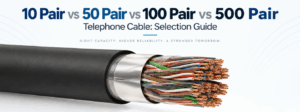
10 Pair vs 50 Pair vs 100 Pair vs 500 Pair Telephone Cable: Selection Guide
Telephone cable pair count is one of the first specifications engineers and procurement teams must define when selecting a multi-pair c...
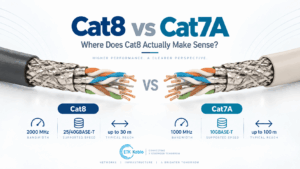
Cat8 vs Cat7A Cable: Where Does Cat8 Actually Make Sense?
Cat8 vs Cat7A is often presented as a simple comparison in which Cat8 is assumed to be the newer, faster and therefore better Ethernet ...
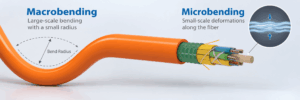
Fiber Optic Cable Bend Radius: Macrobending vs Microbending Explained
Fiber optic bend radius is one of the most important installation limits in an optical cable system. A fiber cable can meet its attenua...
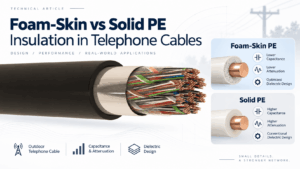
Foam-Skin vs Solid PE Insulation in Telephone Cables
Foam-skin vs solid PE is an important insulation choice in outdoor copper telephone cables because the material surrounding each conduc...

Cat6A Alien Crosstalk Explained: Why ANEXT Matters
Cat6A alien crosstalk is one of the most important performance considerations in high-speed copper structured cabling. As Ethernet freq...

Fiber Optic Cable Mechanical Tests: Tensile, Crush, Impact and Bend Performance
Fiber optic cable testing is essential because good optical performance alone does not prove that a cable can survive installation and ...
Jelly-Filled vs Dry-Core Outdoor Telephone Cable
Jelly-filled vs dry-core is an important construction choice when specifying outdoor telephone cable for telecom distribution networks,...
0.5 vs 0.75 vs 1.0 vs 1.5 mm² Control Cable: How to Select Conductor Size
Control cable conductor size affects resistance, voltage drop, current-carrying capability, cable diameter, flexibility and cost. Among...
300/500 V vs 450/750 V Control Cable: When Is the Higher Voltage Rating Required?
Control cable voltage rating is one of the most important electrical parameters to check when selecting cables for industrial machinery...


