





 President’s Message
Blog
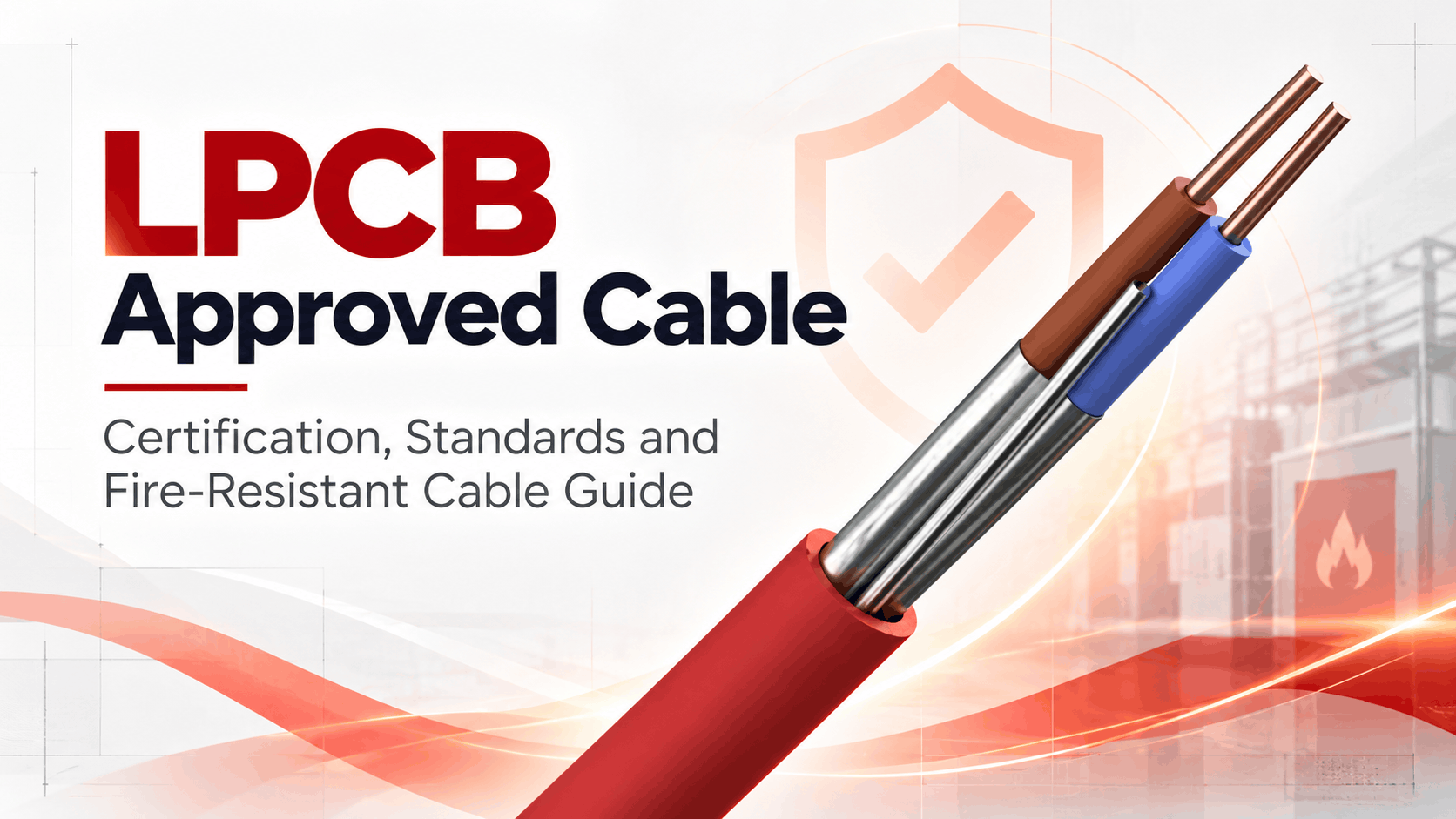
LPCB Approved Cable: LPCB Certification, Standards and Fire-Resistant Cable Guide
Reading Time: 19 minutes
LPCB approved cable is a cable whose specific product construction has received third-party certification under the Loss Prevention Certification Board framework and appears within the applicable LPCB RedBook listing. The term is particularly important in fire-safety projects where consultants, contractors and authorities need independent evidence that a cable meets defined performance requirements.
However, LPCB approval should not be confused with a laboratory test report. A manufacturer may test a cable to BS 6387, EN 50200 or another standard without holding LPCB certification for that product.
Likewise, a statement such as “complies with BS 7629-1” does not automatically mean that the cable is LPCB approved. The exact product, manufacturer, construction, conductor size and applicable standards must fall within a valid certification listing.
Therefore, professional procurement teams should verify LPCB approval through the official RedBook rather than relying only on a catalogue, cable marking, distributor statement or copied certificate.
ETK Kablo manufactures a broad range of fire-resistant cables, fire-resistant power cables and fire alarm cables for critical electrical and signal circuits. Where a project specifically requires LPCB approval, that requirement should be verified separately against the exact product offered.
Quick answer: an LPCB approved cable is not simply a fire-resistant cable that has passed one laboratory test. LPCB is a third-party certification framework. The official RedBook listing identifies the manufacturer, approved product, certification reference, cable sizes or configurations and standards included within the approval scope. Therefore, buyers should verify the live RedBook listing before accepting an LPCB claim.
LPCB Approved Cable at a Glance
| Question | Answer |
|---|---|
| What does LPCB mean? | Loss Prevention Certification Board |
| What is LPCB? | A third-party certification brand for fire and security products and services |
| Where are approved products listed? | RedBook Live |
| Is a fire test report enough? | No. Testing and third-party product certification are different |
| Does one approved cable make the complete manufacturer approved? | No. Approval applies according to the defined certification scope |
| Does BS 6387 CWZ automatically mean LPCB? | No |
| Does EN 50200 PH120 automatically mean LPCB? | No |
| Does BS 7629-1 automatically mean LPCB? | No. The product must hold the corresponding certification |
| Can power cables receive LPCB certification? | Yes, applicable products can be listed under relevant standards such as BS 7846 |
| Can fire-resistant signal cables receive LPCB certification? | Yes, applicable products can be listed under relevant standards such as BS 7629-1 |
| Does LPCB replace CPR? | No. They address different conformity and certification requirements |
| How should buyers verify approval? | Check the current RedBook listing for the exact manufacturer and product |
Consequently, the words “LPCB approved” carry a much more specific meaning than simply “fire tested.”
What Does LPCB Mean?
LPCB stands for Loss Prevention Certification Board.
LPCB operates as the certification brand used for fire and security products and services within the BRE certification framework.
The certification system provides independent third-party assessment rather than relying only on a manufacturer’s own declaration.
For cable buyers, that distinction is valuable because critical life-safety circuits can depend on the performance of the installed cable during a fire.
Therefore, a specification that requests LPCB certification is normally asking for independent product certification to the relevant defined standard or standards.
What Is LPCB Certification?
LPCB certification is a third-party conformity assessment process.
In practical terms, certification provides independent evidence that the approved product has satisfied the requirements included within its certification scope.
Moreover, product certification is designed to provide more than a one-time laboratory result. Certification schemes are intended to confirm continuing compliance with the applicable requirements.
This is an important distinction for procurement teams.
A single laboratory test answers:
Did this test specimen meet the test requirement under these conditions?
Third-party certification asks a broader question:
Does this defined product remain controlled within an approved certification system and meet the requirements stated in its certification scope?
What Is an LPCB Approved Cable?
An LPCB approved cable is a cable covered by a valid LPCB product certification listing.
The listing normally identifies information such as:
- Manufacturer
- Product or product family
- Certificate number
- LPCB reference number
- Applicable standard or standards
- Fire-performance classifications
- Nominal conductor sizes
- Core configurations
- Other approval limitations or notes
Therefore, approval should be understood at product level rather than as a vague manufacturer-wide statement.
A cable producer can manufacture many hundreds of cable types while holding LPCB certification for only selected constructions.
LPCB Approved vs LPCB Certified Cable
The expressions “LPCB approved cable” and “LPCB certified cable” are often used to describe the same practical procurement requirement.
RedBook documentation commonly uses the language of approved products, certification and listings.
Therefore, both expressions can appear in technical discussions.
However, the most important point is not the wording itself. Buyers should confirm that the exact offered cable appears within a valid LPCB listing.
For SEO and procurement terminology, “LPCB approved cable” remains particularly useful because project specifications and commercial searches frequently use the word “approved.”
LPCB Approved Cable vs Tested Cable
This is one of the most important distinctions in the entire subject.
A cable can be tested to a standard without being LPCB certified.
For example, a manufacturer may send a cable to a laboratory for testing according to:
- BS 6387
- EN 50200
- IEC 60331
- EN 61034
- EN 60754
- Another applicable cable test
If the cable passes, the laboratory can issue a test report.
Nevertheless, that report by itself does not create LPCB approval.
Therefore, the following statements should not automatically be treated as equivalent:
| Statement | Does It Automatically Mean LPCB Approval? |
|---|---|
| Tested to BS 6387 CWZ | No |
| Complies with EN 50200 PH120 | No |
| Tested by an independent laboratory | No |
| Manufactured according to BS 7629-1 | No |
| Fire-resistant cable | No |
| LSZH fire cable | No |
| Listed in RedBook under a valid LPCB certification reference | Yes, within the exact listed scope |
Accordingly, purchasing teams should request both technical performance documentation and certification evidence when the project requires LPCB approval.
Why Third-Party Certification Matters for Fire Cables
Fire-resistant cables can form part of life-safety systems that must continue operating during an emergency.
Examples include:
- Fire detection
- Voice evacuation
- Emergency lighting
- Smoke control
- Emergency communication
- Safety shutdown systems
- Firefighting equipment
- Critical building-control functions
A failure in one critical circuit can affect the wider emergency response.
For this reason, independent certification can provide additional confidence to:
- Consultants
- System designers
- Contractors
- Authorities
- Insurers
- Building owners
- Procurement teams
However, certification does not replace good engineering.
The cable must still match the electrical circuit, fire strategy, support system and installation environment.
What Is RedBook Live?
RedBook Live is the public reference used to verify LPCB-certified products and services.
For cable procurement, the RedBook listing allows a buyer to check whether a claimed product appears within the official certification database.
A fire-resistant cable listing can show:
- Manufacturer name
- Factory or company information
- Certificate number
- Exact product name
- Conductor cross-sections
- Number of cores
- Applicable standards
- Performance classifications
- LPCB reference
- Technical notes
Therefore, RedBook verification is considerably stronger than simply receiving an image of an LPCB logo from a supplier.
How to Verify an LPCB Approved Cable
1. Search the Official RedBook
Start with the current RedBook listing rather than a third-party catalogue.
2. Confirm the Manufacturer
Check that the manufacturer shown in the listing matches the actual manufacturer of the offered product.
3. Check the Product Name
The cable designation or commercial product family should correspond to the product being supplied.
4. Check the Certificate Number
Confirm that the certificate number matches the supporting documentation.
5. Check the LPCB Reference
RedBook listings normally include a specific LPCB reference for the product or product group.
6. Confirm the Conductor Size
Do not assume every conductor cross-section in the cable family is covered.
7. Confirm the Core Configuration
A certification for a two-core cable should not automatically be extended to unrelated multicore constructions.
8. Check the Applicable Standards
Verify which standards and classifications are actually included in the listing.
9. Read the Notes
Certification listings can include important limitations or technical conditions.
10. Verify Current Validity
Finally, use the current live listing rather than relying on an old downloaded certificate that may no longer represent the current status.
Why the Exact Cable Size Matters
An LPCB certificate does not necessarily cover every cable dimension manufactured under a commercial family name.
For example, a RedBook listing can identify specific conductor sizes such as:
- 1.0 mm²
- 1.5 mm²
- 2.5 mm²
- 4.0 mm²
Meanwhile, another cable family may cover much larger power-cable sizes.
Therefore, procurement teams should check the actual nominal cross-section rather than approving the cable from the brand name alone.
This becomes especially important for large fire-resistant power cable ranges.
Why the Number of Cores Matters
Fire performance depends on the complete cable construction.
Changing the number of conductors can alter:
- Cable diameter
- Thermal behaviour
- Amount of combustible material
- Fire-barrier geometry
- Mechanical response
- Overall cable construction
Consequently, a certification listing can define specific core configurations.
Buyers should therefore avoid assuming that approval for 2-, 3- and 4-core cable automatically includes every larger multicore option.
LPCB Approved Cable and BS 7629-1
BS 7629-1 is an important product standard associated with fire-resistant screened cables used in emergency and life-safety circuits.
Current LPCB fire-resistant cable listings can include products certified to BS 7629-1:2015.
Such listings can identify performance categories including Standard 60 or Enhanced 120 according to the applicable certification scope.
However, the important distinction remains:
BS 7629-1 is the product standard; LPCB is the third-party certification framework.
Therefore, a cable should not be called LPCB approved merely because its datasheet states BS 7629-1.
LPCB Approved Fire Alarm Cable
Fire alarm systems represent one of the most common applications associated with LPCB-approved fire-resistant cable.
Depending on the project, the cable may need to support:
- Detection loops
- Alarm circuits
- Voice alarm systems
- Evacuation systems
- Control interfaces
- Emergency communication
Nevertheless, “fire alarm cable” and “LPCB approved cable” are not synonyms.
ETK Kablo’s fire alarm vs fire-resistant cable guide explains why the application and the fire-survival performance must be evaluated separately.
If LPCB approval is required, the exact cable must additionally fall within a valid LPCB certification listing.
LPCB Approved Cable and BS 5839-1
BS 5839-1 is a code of practice associated with fire detection and fire alarm systems in non-domestic buildings.
Within fire-resistant cable selection, project specifications can distinguish between standard and enhanced fire-resistant cable requirements.
RedBook listings can therefore reference the applicable BS 5839-1 classification together with the product’s supporting cable standards and fire tests.
However, BS 5839-1 is not itself a cable construction.
The selected product must satisfy the cable and system requirements appropriate to the circuit.
Standard vs Enhanced Fire-Resistant Cable
Some LPCB-listed fire-resistant cables are classified for standard applications, while others meet enhanced requirements.
The distinction reflects different fire-survival expectations within the applicable fire-alarm framework.
For example, RedBook listings can combine:
- BS 7629-1 Standard 60
- BS 5839-1 standard fire-resistant classification
or, for higher requirements:
- BS 7629-1 Enhanced 120
- BS 8434-2 performance
- BS 5839-1 enhanced fire-resistant classification
Therefore, buyers should avoid treating every LPCB fire-resistant cable as one universal performance level.
LPCB Approved Cable and BS 6387 CWZ
BS 6387 CWZ is commonly found within LPCB fire-resistant cable listings.
The C, W and Z protocols address different circuit-integrity conditions involving:
- Fire alone
- Fire with water
- Fire with mechanical shock
However, BS 6387 CWZ and LPCB approval are not the same thing.
A cable can pass BS 6387 CWZ without being LPCB certified.
Conversely, an LPCB listing can reference BS 6387 CWZ as one of several standards included in the product’s certification scope.
Therefore, buyers should ask two separate questions:
Has the cable passed BS 6387 CWZ?
Is this exact cable LPCB approved for that performance?
LPCB Approved Cable and EN 50200 PH120
EN 50200 is another important fire-resistance test method associated with small unprotected cables used in emergency circuits.
Many LPCB fire-resistant cable listings include PH classifications such as PH120.
Nevertheless, PH120 alone does not create LPCB approval.
A manufacturer can have a laboratory report demonstrating EN 50200 performance without holding a RedBook-listed LPCB certificate.
Therefore, project teams should distinguish the test classification from the certification route.
LPCB Approved Cable and BS 8434-2
Enhanced fire-resistant cable specifications can also reference BS 8434-2.
This test framework introduces demanding combined fire, mechanical and water exposure conditions for applicable cable constructions.
Current RedBook listings for enhanced fire-resistant cables can include BS 8434-2 alongside BS 7629-1, BS 6387 and EN 50200.
Accordingly, a consultant can specify enhanced fire survival while LPCB certification provides independent evidence for the listed cable.
LPCB Approved Fire-Resistant Power Cable
LPCB certification is not limited to small fire-alarm or signal cables.
Fire-resistant power cables can also appear within RedBook listings.
These cables supply electrical energy to critical equipment such as:
- Emergency lighting
- Smoke extraction
- Firefighting systems
- Safety-related ventilation
- Emergency distribution equipment
- Other life-safety loads
However, power cable creates different electrical requirements from fire alarm or signal cable.
The engineer must still calculate:
- System voltage
- Load current
- Conductor size
- Voltage drop
- Short-circuit performance
- Installation conditions
Therefore, LPCB certification does not replace electrical cable sizing.
LPCB Approved Cable and BS 7846
BS 7846 is an important product standard associated with 600/1000 V armored fire-resistant cables with thermosetting insulation and low-smoke, low-corrosive-gas characteristics.
RedBook listings can include BS 7846 categories such as F2 and F120 for approved power-cable constructions.
Such products can contain:
- Copper conductors
- Fire-survival barriers
- Thermosetting insulation
- Low-smoke halogen-free materials
- Steel wire armor
- Protective outer sheath
Nevertheless, armor and fire resistance remain separate functions within the complete construction.
ETK Kablo’s fire-resistant power cable range illustrates how critical power cables differ electrically from smaller fire-resistant signal products.
BS 7846 F2 vs F120
RedBook listings can show different BS 7846 categories depending on the approved cable construction.
Therefore, buyers should never assume that every conductor size in an approved power family carries the same category.
Some sizes may be listed for one performance category while selected constructions receive additional fire-survival classification.
This again demonstrates why the complete RedBook table matters more than the family name printed on the brochure.
LPCB Approved Cable and BS 8519
BS 8519 addresses the selection and installation of fire-resistant power and control cable systems for life-safety and firefighting applications.
This introduces another important distinction.
A cable certificate addresses the product, while the final emergency circuit also depends on the complete installation.
For example, the system can include:
- Cable
- Supports
- Clamps
- Trays
- Fixings
- Junction systems
- Route design
Therefore, an LPCB-approved cable alone cannot guarantee that an incorrectly installed circuit will satisfy every project requirement.
LPCB Approved Cable vs Fire-Resistant Cable
Not every fire-resistant cable is LPCB approved.
Fire resistance describes a technical performance characteristic.
LPCB approval describes an independent third-party certification status for a defined product.
| Characteristic | Fire-Resistant Cable | LPCB Approved Cable |
|---|---|---|
| Main Meaning | Cable has defined fire-survival performance | Specific product holds applicable LPCB certification |
| Requires Fire Testing | Yes, according to applicable requirement | Certification incorporates applicable assessment requirements |
| Automatically Third-Party Certified? | No | Yes, within the certification scope |
| RedBook Listing Required? | No | Yes for LPCB approval verification |
| Can Use BS 6387 / EN 50200? | Yes | Applicable LPCB listings may include these tests |
For a broader technical explanation, see our fire-resistant cable types and ratings guide.
LPCB Approved Cable vs Flame-Retardant Cable
Flame retardancy and fire resistance solve different safety problems.
A flame-retardant cable aims to limit flame propagation.
A fire-resistant cable aims to maintain the electrical circuit under defined fire conditions.
LPCB certification can then provide third-party assurance for products certified under the applicable standard framework.
Consequently, the phrases should not be used interchangeably.
Our fire-resistant vs flame-retardant cable guide explains the underlying performance distinction.
Does LPCB Approval Mean LSZH?
Not automatically.
LSZH describes low-smoke, halogen-free material behaviour.
LPCB describes certification.
However, many fire-resistant cable product standards associated with LPCB listings also contain smoke and corrosive-gas requirements.
Therefore, an approved cable may combine several characteristics, such as:
- Circuit integrity
- Low smoke
- Low halogen or corrosive gas
- Flame performance
- Mechanical protection
Nevertheless, each requirement should be confirmed from the exact listing and datasheet.
Does LPCB Approval Mean CPR Compliance?
No.
LPCB certification and CPR address different compliance frameworks.
For applicable construction cables placed on the European market, CPR classification under EN 50575 can define reaction-to-fire performance and related conformity documentation.
LPCB approval, by contrast, provides third-party certification according to the standards stated in the relevant RedBook listing.
Therefore, a project can require both.
Neither requirement should be assumed from the other.
LPCB Approved Cable vs CPR B2ca Cable
B2ca is a reaction-to-fire class.
It indicates how the cable performs within the applicable CPR fire-classification system.
However, B2ca does not demonstrate circuit integrity.
Likewise, LPCB certification to a fire-resistance cable standard does not automatically establish B2ca.
Therefore, specifications should state CPR and fire-survival requirements independently.
LPCB Approved Cable vs IEC 60331
IEC 60331 is a family of international test methods related to circuit integrity during fire.
A cable can be tested under an applicable IEC 60331 method without being LPCB approved.
Likewise, some RedBook fire-resistant power cable listings include IEC 60331 performance alongside British product standards.
Accordingly, the standard reference and certification status must remain separate pieces of information.
Does LPCB Approve the Manufacturer or the Cable?
This question requires careful wording.
A manufacturer can hold LPCB-certified products, but the approval should not be interpreted as a blanket certification of every cable it manufactures.
The RedBook identifies approved products and the scope associated with the certification.
Therefore, a supplier should not claim:
“Our factory is LPCB approved, so all our fire cables are LPCB approved.”
Instead, the question should be:
“Is this exact product, construction and size covered by the current LPCB listing?”
Can a Distributor Sell an LPCB Approved Cable?
Yes. A distributor can sell an approved cable manufactured under a valid LPCB certification.
However, distribution does not create a new certification.
The buyer should still verify the original approved product and manufacturer within RedBook.
Moreover, product markings and traceability should make it possible to connect the delivered cable with the approved product.
What Is LPCB Cross-Listing?
In certain certification arrangements, an approved product can also be listed under another company’s brand through an authorized cross-listing process.
This is different from a distributor simply applying a new label to an approved cable.
An official cross-listing must form part of the certification framework.
Therefore, OEM and private-label buyers should confirm the RedBook listing for the branded product rather than assuming that the original manufacturer’s certificate automatically transfers to every commercial brand.
Can an OEM Cable Be LPCB Approved?
Yes, when the certification and listing arrangement legitimately covers that OEM or branded product.
However, an OEM relationship alone does not establish LPCB approval.
The construction, manufacturer, branding and certification relationship must follow the applicable certification process.
Consequently, private-label buyers should include certification requirements early in supplier discussions rather than attempting to resolve them only after production.
Why Cable Marking Matters
Physical cable marking supports product identification and traceability.
Depending on the approved construction and applicable marking rules, the jacket can include information such as:
- Manufacturer
- Product designation
- Relevant approval identification
- Voltage rating
- Applicable cable standard
- Production identification
- Length marking
However, printed text alone should not be treated as proof of certification.
Counterfeit or incorrectly marked products can exist.
Therefore, the current official listing remains the primary verification point.
Why Counterfeit LPCB Cable Is a Serious Risk
Life-safety products create strong commercial incentives for fraudulent certification claims.
A counterfeit cable can visually resemble a genuine approved product while using different:
- Conductors
- Fire barriers
- Insulation
- Screens
- Sheath compounds
- Manufacturing controls
Consequently, visual inspection alone cannot confirm approval.
For critical projects, procurement teams should verify both documentation and product traceability.
Warning Signs of a Questionable LPCB Claim
Buyers should investigate further when they encounter:
- An LPCB logo but no certificate number
- A certificate image that cannot be matched in RedBook
- A manufacturer’s name that differs from the listing
- A cable size not shown in the certification scope
- A product family name that does not match the listing
- Claims such as “LPCB equivalent”
- Claims such as “tested as LPCB cable”
- Statements such as “meets LPCB requirements” without a listing
- An expired or superseded document
- A distributor certificate with no traceable approved manufacturer
Most importantly, certification should be verified before the cable reaches the installation stage.
Can a Cable Be “LPCB Equivalent”?
From an engineering perspective, two cables may provide similar technical performance.
However, “equivalent performance” and “equivalent certification” are not the same thing.
If the project specification explicitly requires LPCB approval, a cable with similar test reports but no LPCB listing may still fail the procurement requirement.
Therefore, contractors should not substitute a non-listed cable without formal project approval.
Is LPCB Approval Mandatory?
LPCB approval is not a universal legal requirement for every cable installation worldwide.
The requirement can instead come from:
- Project specification
- Consultant specification
- Authority requirement
- Insurance requirement
- Client standard
- Fire strategy
- Local procurement rules
Consequently, the project documentation should determine whether LPCB certification is mandatory, preferred or not required.
If it is mandatory, a technically similar non-LPCB cable should not automatically be treated as an acceptable substitute.
When Should You Specify LPCB Approved Cable?
Consider specifying LPCB-certified products when the project requires independent third-party certification for critical fire and life-safety circuits.
This can become particularly relevant when:
- The consultant explicitly requires LPCB
- The authority requests RedBook-listed products
- The project uses UK-oriented fire-safety specifications
- Independent product certification is a contractual requirement
- The client requires additional verification beyond a manufacturer test report
- Fire-survival circuits have high safety or operational importance
Nevertheless, certification should remain proportional to the actual project requirement.
LPCB Approved Cable for Fire Alarm Systems
Fire alarm systems can contain multiple circuit types.
Some cables provide ordinary alarm signal transmission, while other circuits must maintain operation during fire.
Therefore, the designer should first determine whether the circuit requires fire survival.
If the project additionally requires LPCB certification, the correct approved cable should then be selected from the relevant listing.
Our fire alarm cable types guide explains the wider differences between alarm, LSZH and fire-resistant cable constructions.
LPCB Approved Cable for Voice Alarm and Evacuation
Voice alarm systems rely on communication during an emergency.
Therefore, cable continuity can become an important part of the evacuation strategy.
The cable selection can involve:
- Conductor resistance
- Voltage drop
- Fire-survival duration
- Standard or enhanced performance
- LSZH construction
- Third-party certification
Consequently, LPCB approval should be considered together with the electrical requirements of the actual voice-alarm circuit.
LPCB Approved Cable for Emergency Lighting
Emergency lighting differs from signal circuits because the cable supplies electrical energy to the lighting equipment.
Therefore, conductor sizing and voltage drop become major design parameters.
Where the project requires certified fire-resistant power distribution, the applicable approved power cable must also match:
- Voltage rating
- Load current
- Conductor cross-section
- Core count
- Mechanical protection
- Fire-survival classification
Certification should never replace the electrical design.
LPCB Approved Cable for Smoke Control
Smoke-control systems frequently require both power and control circuits.
A smoke-extraction fan can require a large fire-resistant power cable, while smaller fire-resistant control cables carry commands and status signals.
As a result, one system can require multiple cable types and different certification scopes.
Therefore, the project should not use a single generic phrase such as “LPCB cable” for every connection.
LPCB Approved Cable for Tunnels, Airports and Stations
Transport infrastructure combines complex evacuation routes, critical communications and extensive electrical systems.
Consequently, projects can require independent fire-cable certification for selected life-safety circuits.
However, the application environment alone does not determine the correct cable.
The project must still define:
- Power or signal function
- Voltage rating
- Fire duration
- Mechanical requirements
- Smoke and halogen requirements
- Reaction-to-fire classification
- Approved installation method
Our fire-resistant cable guide for tunnels, airports and railway stations explains these wider project conditions.
Does an LPCB Approved Cable Guarantee the Complete System?
No.
Product certification addresses the cable within the defined certification scope.
The installed system can still fail if designers or installers use unsuitable:
- Cable supports
- Fixings
- Junction boxes
- Terminations
- Glands
- Distribution equipment
- Power supplies
- Installation routes
Therefore, system-level design remains essential.
A certified cable is an important component, but it is not a substitute for a compliant life-safety circuit.
Does LPCB Approval Mean E30, E60 or E90?
No.
E30, E60 and E90 refer to functional integrity concepts associated with complete tested cable installation systems.
LPCB is a certification framework.
An LPCB listing may reference standards connected with system performance, but the terms should not be merged into one generic rating.
Therefore, a project asking for E90 should identify the applicable approved installation system in addition to any product-certification requirement.
Does LPCB Approval Mean BS 6387 CWZ?
No.
Many LPCB fire-resistant cable listings include BS 6387 CWZ, but LPCB approval and CWZ remain separate concepts.
BS 6387 defines fire-test protocols.
LPCB provides third-party certification for the defined product and certification scope.
Accordingly, always check the actual standards shown in the RedBook entry.
Does LPCB Approval Mean PH120?
No.
PH120 is a fire-performance classification associated with the applicable EN 50200 test method.
Many LPCB-approved fire cables hold PH120 performance, but another LPCB-certified cable can have a different certification scope.
Therefore, the exact classification must be read from the product listing.
LPCB Approved Cable and Product Traceability
Certification becomes more useful when the delivered cable can be traced back to the approved manufacturing system.
Useful traceability information can include:
- Manufacturer
- Product code
- Batch or production information
- Drum number
- Production date
- Cable marking
- Certificate reference
- Delivery documentation
Consequently, EPC contractors and distributors should maintain certification records together with the project cable documentation.
What Documents Should You Request?
When a project specifies LPCB-approved cable, procurement teams can request:
- Current LPCB certificate
- RedBook listing reference
- Product datasheet
- Applicable fire-test information
- Conductor-size and core-range confirmation
- CPR Declaration of Performance where applicable
- Batch or manufacturing traceability documentation
- Project-specific compliance statement
However, documents should be cross-checked rather than accepted independently.
The certificate, RedBook listing and supplied product should all describe the same construction.
How to Specify LPCB Approved Cable in an RFQ
A professional RFQ should avoid writing only “LPCB cable.”
Instead, specify:
| RFQ Item | Information to Provide |
|---|---|
| Certification | Valid LPCB certification / RedBook listing required |
| Application | Fire alarm, PA/VA, emergency lighting, smoke control or other circuit |
| Product Standard | BS 7629-1, BS 7846 or applicable project standard |
| Fire Performance | Required CWZ, PH or other applicable performance |
| Standard / Enhanced | Required classification where applicable |
| Voltage Rating | Required system voltage |
| Conductor Size | Required mm² cross-section |
| Core Count | Required number of conductors |
| Screening | Screened or other required construction |
| Armor | Armored or unarmored according to route |
| Material | Required LSZH / halogen-free performance |
| CPR | Required Euroclass where applicable |
| Documentation | Current certificate and RedBook evidence |
| Traceability | Production and delivery identification requirements |
This format reduces ambiguity and helps suppliers quote the correct certified construction.
Example LPCB Approved Cable Specification
A project requirement could follow this structure:
“Fire-resistant cable shall be LPCB certified and currently listed in RedBook Live for the exact offered construction. The supplier shall provide the applicable LPCB certificate, listing reference, cable datasheet and evidence that the offered conductor size and core configuration fall within the approval scope. Fire-performance, LSZH, CPR and electrical requirements shall comply with the project cable schedule.”
This wording is stronger than simply writing:
“LPCB cable required.”
Common LPCB Approved Cable Specification Mistakes
- Assuming a laboratory test report equals LPCB certification
- Accepting an LPCB logo without checking RedBook
- Assuming one approved product means every cable from the manufacturer is approved
- Ignoring conductor-size limitations in the listing
- Ignoring core-count limitations
- Accepting an old certificate without checking current status
- Using “tested to BS 6387” as proof of LPCB approval
- Using PH120 as proof of LPCB approval
- Assuming BS 7629-1 automatically means LPCB certified
- Assuming BS 7846 automatically means LPCB certified
- Confusing LPCB certification with CPR classification
- Assuming LPCB approval automatically means B2ca
- Assuming LPCB certification automatically creates E90 system integrity
- Ignoring traceability between delivered cable and certification
- Accepting OEM branding without verifying the certification relationship
- Assuming a distributor’s company name must appear as the approved manufacturer
- Using the same approved signal cable for an unrelated power circuit
- Ignoring electrical sizing because the cable is certified
- Ignoring the cable support and installation system
- Approving a product from marketing claims rather than the current listing
LPCB Approved Cable Selection Checklist
- Does the project explicitly require LPCB?
- What circuit will the cable serve?
- Is the cable power, signal, control or fire alarm?
- What product standard applies?
- What fire-performance classification is required?
- Is standard or enhanced fire resistance required?
- What voltage rating is required?
- What conductor size is required?
- What core count is required?
- Is screening required?
- Is armor required?
- Is LSZH required?
- Is a CPR Euroclass required?
- Does the exact manufacturer appear in RedBook?
- Does the exact product appear in RedBook?
- Does the conductor size appear in the listing?
- Does the core configuration appear in the listing?
- Do the required standards appear in the listing?
- Does the certificate remain valid?
- Can the delivered cable be traced to the approved product?
ETK Kablo and LPCB Project Requirements
ETK Kablo manufactures fire-resistant signal, control, instrumentation and power cable families for critical electrical systems.
The portfolio includes constructions with different fire-survival technologies, conductor arrangements, screening systems, armor and halogen-free materials.
However, project certification requirements should always be treated separately from general cable manufacturing capability.
If a tender or specification explicitly requires LPCB approved cable, the procurement process should verify the exact offered product against the current RedBook listing.
Likewise, another fire-test certificate, CPR documentation or ETK technical datasheet should not be presented as a substitute for LPCB certification where LPCB is a mandatory contractual requirement.
This approach protects the consultant, contractor, distributor, manufacturer and end user from ambiguity during technical approval.
Frequently Asked Questions About LPCB Approved Cable
What is LPCB?
LPCB stands for Loss Prevention Certification Board. It is a certification brand used for fire and security products and services.
What does LPCB approved mean?
LPCB approved means that the defined product falls within a valid LPCB certification scope. For cables, buyers should verify the exact product through RedBook Live.
What is an LPCB approved cable?
An LPCB approved cable is a cable covered by an LPCB product certification listing for the applicable product construction and standards.
What is LPCB certification?
LPCB certification is an independent third-party conformity assessment framework used to verify that defined products or services meet the applicable requirements within their certification scope.
Where can I check LPCB certification?
The official RedBook Live database provides current LPCB product and service listings.
Is LPCB the same as BRE?
LPCB is the certification brand used for fire and security products and services within the BRE certification framework.
Is LPCB certification mandatory?
Not universally. LPCB can become mandatory when it is required by a project specification, consultant, authority, insurer, client or other governing requirement.
Is LPCB approved the same as BS 6387 CWZ?
No. BS 6387 CWZ describes defined fire-test performance. LPCB approval is third-party certification of a defined product. An LPCB listing can include CWZ performance.
Is LPCB approved the same as PH120?
No. PH120 is a fire-performance classification. LPCB is a certification framework. The exact RedBook listing shows whether PH120 forms part of the approved product scope.
Is a BS 7629-1 cable automatically LPCB approved?
No. A cable can be designed or tested to BS 7629-1 without holding LPCB certification. The product must appear within the appropriate LPCB listing.
Is a BS 7846 cable automatically LPCB approved?
No. Compliance with the product standard and third-party LPCB certification are separate requirements.
Does LPCB certification mean the cable is fire resistant?
For LPCB-listed fire-resistant cable products, the listing identifies the applicable fire-resistance standards and classifications. However, always read the exact certification scope rather than relying only on the LPCB name.
Does LPCB approval mean LSZH?
Not automatically. Many applicable fire-resistant cable standards include smoke and corrosive-gas requirements, but the exact product listing and datasheet should confirm the material performance.
Does LPCB approval mean CPR certified?
No. LPCB certification and CPR conformity are separate frameworks. A project can require both.
Does LPCB approval mean B2ca?
No. B2ca is a CPR reaction-to-fire class. It should be verified separately from LPCB fire-resistance certification.
Can LPCB cable be armored?
Yes. LPCB-listed fire-resistant power cables can include steel-wire-armored constructions where the applicable product standard and certification cover them.
Can LPCB cable be used for fire alarm systems?
Yes, when the listed cable matches the fire-alarm circuit requirements and applicable project specification.
Can LPCB cable be used for emergency lighting?
Yes, when the project uses an approved fire-resistant power construction with the correct electrical sizing and certification scope.
Can a manufacturer claim LPCB approval after passing one fire test?
No. Passing an individual laboratory test should not be presented as LPCB product certification unless the product holds the applicable valid certification and listing.
Can an OEM cable be LPCB approved?
Yes, when the OEM or cross-listed product forms part of an authorized LPCB certification and RedBook listing. A normal private-label arrangement alone does not create LPCB approval.
How can I identify fake LPCB certification?
Verify the manufacturer, product name, certificate number, LPCB reference, applicable standards and current listing directly in RedBook Live. Do not rely only on an LPCB logo or certificate image.
What information should be on an LPCB cable certificate?
The supporting certification should allow the buyer to identify the approved manufacturer, product, certificate and relevant certification scope. The official RedBook listing should be used for final verification.
What should I write in an LPCB cable RFQ?
State that valid LPCB certification and RedBook listing are required for the exact offered cable, then define the applicable product standard, fire rating, conductor size, core count, voltage, material and other project requirements.
Conclusion: Verify the Product, Not Just the LPCB Logo
LPCB approved cable is a specific certification concept rather than a generic description for any high-quality fire-resistant cable.
Third-party certification gives consultants and procurement teams independent evidence that a defined product falls within an approved certification framework.
However, certification only has value when the offered cable actually matches the approved listing.
Therefore, buyers should confirm the manufacturer, product name, certificate number, LPCB reference, conductor size, core configuration and applicable standards through the current RedBook information.
Furthermore, LPCB approval should remain separate from individual technical requirements such as BS 6387 CWZ, EN 50200 PH120, BS 7629-1, BS 7846, LSZH performance, CPR classification and complete system integrity.
A cable can provide excellent fire performance without being LPCB approved. Conversely, a project that explicitly requires LPCB certification still needs the correct electrical and installation design.
Most importantly, do not approve a cable from a logo, marketing statement or isolated test report.
The strongest procurement approach is to specify the required electrical and fire performance first, require LPCB certification where the project demands it, and then verify the exact cable against the official current listing before purchase and installation.
Benzer yazılar
Cat6 B2ca Cable: CPR Fire Performance, Standards and Selection Guide
Cat6 B2ca cable combines Category 6 Ethernet transmission performance with a high reaction-to-fire classification for permanently insta...

Servo Motor Cable: Power, Encoder, Feedback, Shielding and Selection Guide
Servo motor cable connects a servo drive with the motor, feedback system or related control components in precision automation equipmen...
Hybrid Fiber Optic Cable for Power and Data: Design, Applications and Selection Guide
Hybrid fiber optic cable combines optical fibers for high-speed communication with copper conductors that can deliver electrical power ...
Composite Fiber Optic Cable: Fiber + Copper Hybrid Cable Design, Applications and Selection Guide
Composite fiber optic cable combines optical fibers with one or more additional transmission or electrical elements inside a coordinate...
LPCB Approved Cable: LPCB Certification, Standards and Fire-Resistant Cable Guide
LPCB approved cable is a cable whose specific product construction has received third-party certification under the Loss Prevention Cer...
PROFIBUS Cable: DP vs PA, Impedance, Shielding and Selection Guide
PROFIBUS cable is a purpose-designed industrial communication cable used to connect automation equipment over a defined fieldbus networ...
Fire-Resistant Power Cable vs Fire-Resistant Signal Cable: What Is the Difference?
Power vs signal cable is an important distinction when specifying fire-resistant circuits. Two cables can both maintain circuit integri...
Shielded vs Unshielded Outdoor Telephone Cable: When Is Screening Required?
Shielded outdoor telephone cable includes a metallic screen around the communication core to reduce the effect of external electromagne...
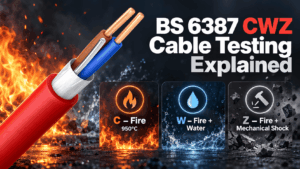
BS 6387 CWZ Cable Testing Explained
BS 6387 CWZ is a fire-resistance test designation used for cables that must maintain circuit integrity under defined fire conditions. I...
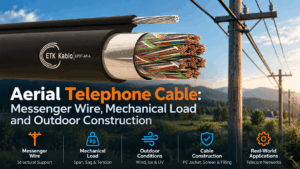
Aerial Telephone Cable: Messenger Wire, Mechanical Load and Outdoor Construction
Aerial telephone cable is designed for copper communication routes installed above ground between poles or other approved support point...
Copper vs Fiber for Data Center Networks: When Should You Use Each?
Copper vs fiber for data centers is not a question with one universal winner. Modern data centers commonly use both media because serve...
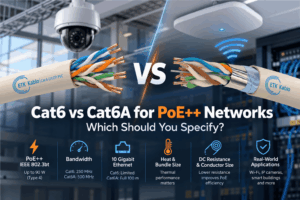
Cat6 vs Cat6A for PoE++ Networks: Which Should You Specify?
Cat6 vs Cat6A for PoE++ is no longer only a bandwidth decision. When an Ethernet cable carries both high-speed data and high levels of ...


