





 President’s Message
Cat 6 SF/UTP Data Cable
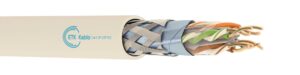
Cat 6 SF/UTP PVC Ethernet Cable
SKU:
Cat 6 SF/UTP PVC
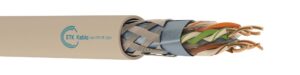
Cat 6 SF/UTP LSOH Ethernet Cable
SKU:
Cat 6 SF/UTP LSOH
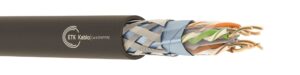
Cat 6 SF/UTP PE Ethernet Cable
SKU:
Cat 6 SF/UTP PE
Cat 6 SF/UTP Cable for Double-Shielded Gigabit Ethernet Networks
Cat 6 SF/UTP Cable provides double-screened copper connectivity for Gigabit Ethernet, structured cabling, industrial networks, IP surveillance, VoIP and other LAN applications where increased protection against electromagnetic interference is required. ETK Kablo manufactures Cat 6 SF/UTP cables with solid copper conductors and PVC, LSOH or PE outer jackets.
The current ETK Kablo Cat 6 SF/UTP range uses four unshielded twisted pairs, 0.57 mm solid copper conductors, a star-shaped separator, an overall Al/PET foil screen and an overall tinned copper braid. A tinned copper earthing wire supports screen continuity and termination. The cables provide Category 6 transmission performance through 250 MHz.
SF/UTP combines two overall metallic screening layers while leaving the individual twisted pairs unshielded. This architecture provides more extensive overall screening than U/UTP, F/UTP or S/UTP while preserving a conventional four-pair Cat 6 internal structure.
What Is Cat 6 SF/UTP Cable?
Cat 6 SF/UTP is a four-pair balanced Ethernet cable with an overall braid and an overall foil surrounding four individually unshielded twisted pairs.
The designation means:
- S – overall metallic braid screen
- F – additional overall foil screen
- UTP – individually unshielded twisted pairs
This notation clearly distinguishes SF/UTP from other screened Ethernet constructions. The individual pairs do not receive their own foil screens.
ETK Kablo Cat 6 SF/UTP Cable Range
| Product | Outer Jacket | Main Selection Direction |
|---|---|---|
| Cat 6 SF/UTP PVC | PVC | General fixed structured cabling where PVC is permitted |
| Cat 6 SF/UTP LSOH | Halogen-free / low-smoke material | Projects requiring specified smoke and halogen characteristics |
| Cat 6 SF/UTP PE | Polyethylene | Outdoor-oriented screened Ethernet routes |
All three products share the same basic Cat 6 SF/UTP electrical and screening architecture. The main variation is the outer-jacket material.
Cat 6 SF/UTP Cable Construction
| Component | Current ETK Kablo Construction |
|---|---|
| Conductor | Electrolytic solid copper |
| Conductor Diameter | 0.57 mm |
| Insulation | Solid polyethylene |
| Pair Construction | Four twisted pairs |
| Separator | Star-shaped separator |
| Overall Foil | Al/PET tape |
| Overall Braid | Tinned copper braid |
| Earthing Wire | Tinned copper |
| Individual Pair Screens | None |
| Outer Jacket | PVC, LSOH or PE according to product |
How Cat 6 SF/UTP Double Shielding Works
Cat 6 SF/UTP combines two different overall screening layers.
The Al/PET foil provides broad metallic coverage around the complete four-pair cable core. The tinned copper braid then adds a second conductive screen around that assembly.
Together, these layers help reduce coupling between the Ethernet cable and external electromagnetic fields.
The individual twisted pairs remain unshielded. Pair twisting, the star separator and balanced transmission still play an important role in controlling internal crosstalk.
Foil and Braid Shielding in Cat 6 Cable
Foil and braid screens have different physical characteristics.
Foil provides high surface coverage with relatively little material thickness. A copper braid uses many conductive strands woven around the cable core and provides a mechanically robust conductive screen.
SF/UTP combines both systems around the complete cable core.
This does not mean that SF/UTP is automatically required for every network. The screening architecture should follow the electromagnetic environment and project specification.
Cat 6 SF/UTP Earthing Wire
ETK Kablo's current Cat 6 SF/UTP constructions include a tinned copper earthing wire together with the Al/PET foil and tinned copper braid.
The earthing wire supports continuity and termination of the screening system.
A screened Ethernet cable should form part of a correctly designed screened channel. Connectors, patch panels, bonding and field termination influence the performance of the complete screening system.
Installing a heavily screened cable without suitable screened hardware and termination does not automatically provide its intended EMC benefit.
23 AWG Solid Copper Cat 6 SF/UTP Cable
The current ETK Kablo Cat 6 SF/UTP products use 0.57 mm solid copper conductors, corresponding closely to the commonly specified 23 AWG conductor size.
Solid copper provides predictable DC resistance and stable transmission characteristics for fixed structured-cabling installations.
The current products publish a maximum conductor resistance of 94 Ω/km at 20°C.
Professional buyers should distinguish solid copper from copper-clad conductor alternatives when network performance, Power over Ethernet and project compliance are important.
Why Cat 6 SF/UTP Uses a Star Separator
A star-shaped separator divides the four twisted pairs within the current ETK Kablo Cat 6 SF/UTP construction.
The separator helps maintain controlled spacing between pairs and contributes to Category 6 crosstalk performance.
Pair twist rates, conductor geometry, physical separation and the overall screening system work together as part of the cable's electrical design.
250 MHz Cat 6 SF/UTP Performance
ETK Kablo publishes transmission characteristics for its current Cat 6 SF/UTP products through 250 MHz.
Relevant parameters include:
- Insertion loss
- Near-end crosstalk (NEXT)
- Power-sum NEXT
- Equal-level far-end crosstalk
- Power-sum equal-level far-end crosstalk
- Return loss
- Characteristic impedance
- Propagation velocity
The current products publish a characteristic impedance of 100 Ω ±5% across the specified Category 6 frequency range.
Cat 6 SF/UTP for Gigabit Ethernet
Cat 6 SF/UTP supports 1000BASE-T Gigabit Ethernet when the complete structured-cabling channel meets the applicable requirements.
Potential applications include:
- Enterprise LAN networks
- Industrial Ethernet
- Commercial structured cabling
- IP surveillance
- VoIP systems
- Wi-Fi access points
- Building automation
- Technical and equipment rooms
The complete installed channel includes cable, connectors, patch panels, patch cords and terminations. All components contribute to final transmission performance.
When Should You Choose Cat 6 SF/UTP?
Cat 6 SF/UTP can be relevant where a project requires Category 6 performance together with a substantial overall electromagnetic screen.
Typical selection factors include:
- Electrically noisy network routes
- Industrial environments
- High-density electrical infrastructure
- Projects specifying combined foil and braid screening
- Ethernet routes near equipment that can generate electromagnetic interference
- Networks requiring a screened copper cabling system
Normal separation from power circuits and applicable installation practices should still be followed. Double shielding does not remove the need for correct cable routing.
Cat 6 U/UTP vs F/UTP vs S/UTP vs SF/UTP
| Construction | Overall Foil | Overall Braid | Individual Pair Screens |
|---|---|---|---|
| U/UTP | No | No | No |
| F/UTP | Yes | No | No |
| S/UTP | No | Yes | No |
| SF/UTP | Yes | Yes | No |
These four constructions can all provide Category 6 transmission performance, but their electromagnetic-screening architectures differ.
U/UTP provides no metallic screen. F/UTP adds an overall foil. S/UTP uses an overall braid. SF/UTP combines both an overall foil and braid.
Cat 6 F/UTP vs SF/UTP
F/UTP and SF/UTP both contain an overall foil around unshielded twisted pairs.
SF/UTP adds an additional tinned copper braid around the cable core.
| Feature | F/UTP | SF/UTP |
|---|---|---|
| Overall Foil | Yes | Yes |
| Overall Braid | No | Yes |
| Individual Pair Screens | No | No |
| Screen Architecture | Single overall foil | Combined overall foil + braid |
SF/UTP therefore provides a more extensive overall screen architecture. F/UTP can remain the more appropriate construction where one overall foil satisfies the project requirements.
Cat 6 S/UTP vs SF/UTP
S/UTP uses one overall metallic braid around unshielded twisted pairs.
SF/UTP combines that braid architecture with an additional overall foil.
| Feature | S/UTP | SF/UTP |
|---|---|---|
| Overall Braid | Yes | Yes |
| Overall Foil | No | Yes |
| Individual Pair Screens | No | No |
The correct construction should follow the required EMC architecture rather than the assumption that more metallic layers are always necessary.
SF/UTP Is Not the Same as S/FTP
SF/UTP and S/FTP are different screening architectures.
SF/UTP uses an overall braid plus an overall foil around four individually unshielded twisted pairs.
S/FTP uses an overall braid while each individual twisted pair receives its own foil screen.
This distinction becomes especially important when comparing Cat 6 SF/UTP with higher-category S/FTP products such as Cat 6A, Cat 7 and Cat 7A cables.
Procurement documents should use the exact screening notation to avoid supplying a technically different cable.
Cat 6 SF/UTP PVC Cable
Cat 6 SF/UTP PVC Cable combines double overall shielding with a UV-resistant PVC outer jacket.
The current ETK Kablo product uses 0.57 mm solid copper conductors, solid polyethylene insulation, a star separator, tinned copper earthing wire, Al/PET tape and tinned copper braiding.
The published approximate cable diameter is 6.9 mm.
PVC provides a conventional material option for structured-cabling projects where PVC is permitted by the installation specification.
Cat 6 SF/UTP LSOH Cable
Cat 6 SF/UTP LSOH Cable retains the same foil-and-braid screening architecture while using a UV-resistant halogen-free outer jacket.
The current ETK Kablo product documentation publishes applicable testing for:
- Smoke density
- Single-cable flame retardancy
- Corrosive-gas characteristics
- Halogen content
LSOH or LSZH describes cable-material behavior during combustion. It does not mean that the cable maintains Ethernet transmission during prolonged fire exposure.
Cat 6 SF/UTP PE Outdoor Cable
Cat 6 SF/UTP PE Cable combines the double-screened Cat 6 architecture with a UV-resistant polyethylene outer jacket.
The current product retains the 0.57 mm solid copper conductors, star separator, Al/PET foil, tinned copper braid and earthing wire found across the SF/UTP family.
Potential applications include:
- Building-to-building Ethernet links
- Outdoor IP camera networks
- External Wi-Fi infrastructure
- Campus networks
- Outdoor industrial Ethernet
- External automation networks
A PE outer jacket provides an outdoor-oriented material system. It should not automatically be interpreted as steel armor, water blocking or universal direct-burial qualification.
PVC vs LSOH vs PE Cat 6 SF/UTP
| Jacket | Main Selection Consideration |
|---|---|
| PVC | General fixed installations where PVC materials are permitted |
| LSOH / LSZH | Projects requiring defined low-smoke and halogen-related material characteristics |
| PE | Outdoor-oriented installations requiring a polyethylene jacket |
The outer-jacket material changes environmental and fire-related material characteristics but does not change the underlying 250 MHz SF/UTP transmission architecture.
Cat 6 SF/UTP for Industrial Ethernet
Industrial plants can contain motors, drives, switching equipment and power-distribution systems that generate electromagnetic interference.
The combined foil and braid screen makes Cat 6 SF/UTP relevant where the project requires greater overall electromagnetic protection than an unshielded or single-screen Cat 6 construction.
Shielding should still form part of a complete installation strategy that includes suitable separation, screened connectors and correct bonding.
Cat 6 SF/UTP for IP CCTV
Cat 6 SF/UTP can support IP surveillance cameras that communicate over Ethernet.
The double overall screen can provide additional electromagnetic protection where camera routes pass through electrically active areas.
PVC or LSOH constructions can serve applicable indoor routes, while the PE version provides an outdoor-oriented option.
Where the camera uses Power over Ethernet, cable resistance, route length, bundle size and PoE loading should also form part of the system design.
Cat 6 SF/UTP for Wi-Fi and Building Networks
Wireless access points and smart-building equipment still rely on wired Ethernet infrastructure.
Cat 6 SF/UTP can provide Gigabit connectivity for compatible access points, controllers and IP devices where the project specifies a double-screened copper cabling architecture.
The actual network bandwidth and PoE requirements should determine the complete channel design.
Cat 6 SF/UTP for Power over Ethernet
Cat 6 SF/UTP can form part of compatible Power over Ethernet systems.
The foil and braid primarily address electromagnetic behavior. PoE loading also depends on conductor resistance and thermal conditions.
Important factors include:
- Solid copper conductor construction
- Conductor diameter
- DC resistance
- Resistance unbalance
- Cable bundle size
- Ambient temperature
- Installation pathway
- Required PoE level
Double shielding should not be treated as a substitute for proper PoE electrical and thermal design.
Cat 6 SF/UTP Cable Length
Balanced copper Ethernet installations commonly use a maximum 100-meter structured-cabling channel, typically including up to 90 meters of permanent-link cable together with patch and equipment cords.
Double shielding does not extend the standardized Ethernet channel distance beyond the applicable structured-cabling design.
Longer network routes can require active equipment or fiber optic cabling.
Cat 6 SF/UTP Electrical Characteristics
| Parameter | Current Published Value |
|---|---|
| Conductor Resistance at 20°C | Max. 94 Ω/km |
| Insulation Resistance at 20°C | 5000 MΩ/km |
| Mutual Capacitance | Max. 56 nF/km |
| Resistance Unbalance | 2% |
| Propagation Velocity | 67–69% |
| Characteristic Impedance | 100 Ω ±5% |
| Operating Voltage | 250 V DC |
| Test Voltage | 1200 V DC for 1 minute |
Cat 6 SF/UTP Mechanical Characteristics
The current Cat 6 SF/UTP PVC, LSOH and PE products use 0.57 mm solid copper conductors and publish an approximate overall cable diameter of 6.9 mm.
Current documentation publishes:
- Minimum bending radius: 8xD
- Operating temperature: -20°C to +60°C
- Packing lengths: 100 m, 500 m and 1000 m
The exact packing requirement should be confirmed during quotation.
Cat 6 SF/UTP Standards
The current ETK Kablo Cat 6 SF/UTP product documentation references:
- ANSI/TIA-568-C.2
- IEC 61156-5
- IEC 11801
The project specification can require a different edition or additional certification. Procurement teams should verify the exact documentation required for the supplied product.
Flame, Smoke and Halogen Requirements
Fire-related material characteristics depend on the selected outer-jacket construction.
The current PVC product publishes IEC 60332-1-2 flame-retardancy testing.
The current LSOH product additionally publishes IEC 61034-2 smoke-density, IEC 60754-1 halogen-content and IEC 60754-2 corrosive-gas testing.
These tests describe reaction-to-fire and material characteristics. They should not be confused with fire-resistant circuit integrity.
How to Specify Cat 6 SF/UTP Cable
A complete RFQ should define both network and installation requirements.
| Specification Item | Information to Provide |
|---|---|
| Category | Cat 6 |
| Screening | SF/UTP – overall foil + braid, unshielded pairs |
| Conductor | Solid copper / required conductor diameter |
| Jacket | PVC, LSOH or PE |
| Network Application | LAN, IP CCTV, VoIP, Wi-Fi, industrial Ethernet or other application |
| EMI Environment | Required electromagnetic-screening conditions |
| PoE Requirement | Required PoE application where applicable |
| Installation Environment | Indoor or outdoor-oriented route |
| Fire Requirement | Required flame, smoke, halogen and CPR classification where applicable |
| Packing Length | 100 m, 500 m, 1000 m or project-specific requirement where available |
| Documentation | Datasheet, DoP where applicable and project documentation |
Why Choose ETK Kablo for Cat 6 SF/UTP Cable?
ETK Kablo manufactures Cat 6 SF/UTP cable in PVC, LSOH and PE constructions while maintaining the same double-screened Ethernet architecture.
The current range uses 0.57 mm solid copper conductors, a star-shaped separator, Al/PET foil, tinned copper braid and a tinned copper earthing wire.
This provides network contractors, distributors, CCTV integrators and industrial projects with a Category 6 option where combined foil-and-braid screening forms part of the installation specification.
ETK Kablo can evaluate jacket material, electromagnetic environment, PoE requirements, packing length, CPR requirements and project documentation during the quotation process.
Frequently Asked Questions About Cat 6 SF/UTP Cable
What is Cat 6 SF/UTP cable?
Cat 6 SF/UTP is a four-pair Ethernet cable with an overall foil and an overall metallic braid around four individually unshielded twisted pairs.
What does SF/UTP mean?
SF/UTP means the complete cable core has both an overall braid and an overall foil, while the individual twisted pairs remain unshielded.
Is Cat 6 SF/UTP double shielded?
Yes. The current ETK Kablo construction uses an overall Al/PET foil together with an overall tinned copper braid.
Is SF/UTP the same as S/FTP?
No. SF/UTP uses overall foil and braid around unshielded pairs. S/FTP uses an overall braid together with individual foil screens around each twisted pair.
What speed does Cat 6 SF/UTP support?
Cat 6 SF/UTP supports 1000BASE-T Gigabit Ethernet over standard structured-cabling distances when the complete installed channel meets the applicable requirements.
What frequency is Cat 6 SF/UTP?
Category 6 transmission requirements extend through 250 MHz.
Is ETK Kablo Cat 6 SF/UTP 23 AWG?
The current products use 0.57 mm solid copper conductors, corresponding closely to the commonly specified 23 AWG size.
What is the difference between F/UTP and SF/UTP?
F/UTP uses one overall foil. SF/UTP adds an overall metallic braid in addition to the foil.
What is the difference between S/UTP and SF/UTP?
S/UTP uses one overall braid. SF/UTP combines that braid with an additional overall foil.
Does SF/UTP have individually shielded pairs?
No. The four twisted pairs remain individually unshielded.
Can Cat 6 SF/UTP be used outdoors?
Yes, when the exact construction is intended for external use. ETK Kablo manufactures Cat 6 SF/UTP PE cable with a UV-resistant polyethylene outer jacket.
Is Cat 6 SF/UTP PE armored?
No. PE outer jacket, electromagnetic shielding and mechanical steel armor perform different functions. Where the route requires mechanical armor, an armored Cat 6 construction should be evaluated.
Does ETK Kablo manufacture LSZH Cat 6 SF/UTP?
Yes. The current range includes a Cat 6 SF/UTP LSOH construction with a halogen-free outer jacket.
Can Cat 6 SF/UTP support PoE?
Cat 6 SF/UTP can form part of compatible PoE networks. Conductor resistance, cable length, bundle size, ambient temperature and the required PoE level should form part of the network design.
What packing lengths are available?
The current ETK Kablo Cat 6 SF/UTP PVC, LSOH and PE products publish 100 m, 500 m and 1000 m packing options.
What information should I provide when requesting a quotation?
Provide the Cat 6 SF/UTP requirement, PVC/LSOH/PE jacket, required packing length, application, electromagnetic environment, PoE requirement where applicable, quantity and required project documentation.


