





 President’s Message
Blog
12/24/48/96/144/288 Core Fiber Optic Cable: Selection Guide
Reading Time: 22 minutes
A fiber optic cable core count determines how many individual optical fibers are available inside one cable for active connections, redundancy, future expansion and network segmentation. Common configurations include 12, 24, 48, 96, 144 and 288 fiber cables, but selecting the highest fiber count is not automatically the best engineering or commercial decision.
A 12 core fiber optic cable may provide more than enough capacity for a small industrial link or local distribution route. By contrast, a 144 or 288 core fiber optic cable can become more efficient when many network branches, subscribers, buildings, cabinets or future services must share the same backbone route.
Therefore, cable sizing should begin with the network architecture rather than the cable catalogue. Engineers should consider the number of active fibers, duplex or single-fiber transmission, spare capacity, future expansion, network topology, splice-closure capacity, duct space and cable construction before selecting the final fiber count.
Another terminology point is important. In the cable industry, expressions such as “24 core fiber optic cable” usually mean a cable containing 24 separate optical fibers. Technically, each individual optical fiber has its own glass core. For that reason, fiber count is the more precise engineering term, although “core fiber optic cable” remains widely used commercially.
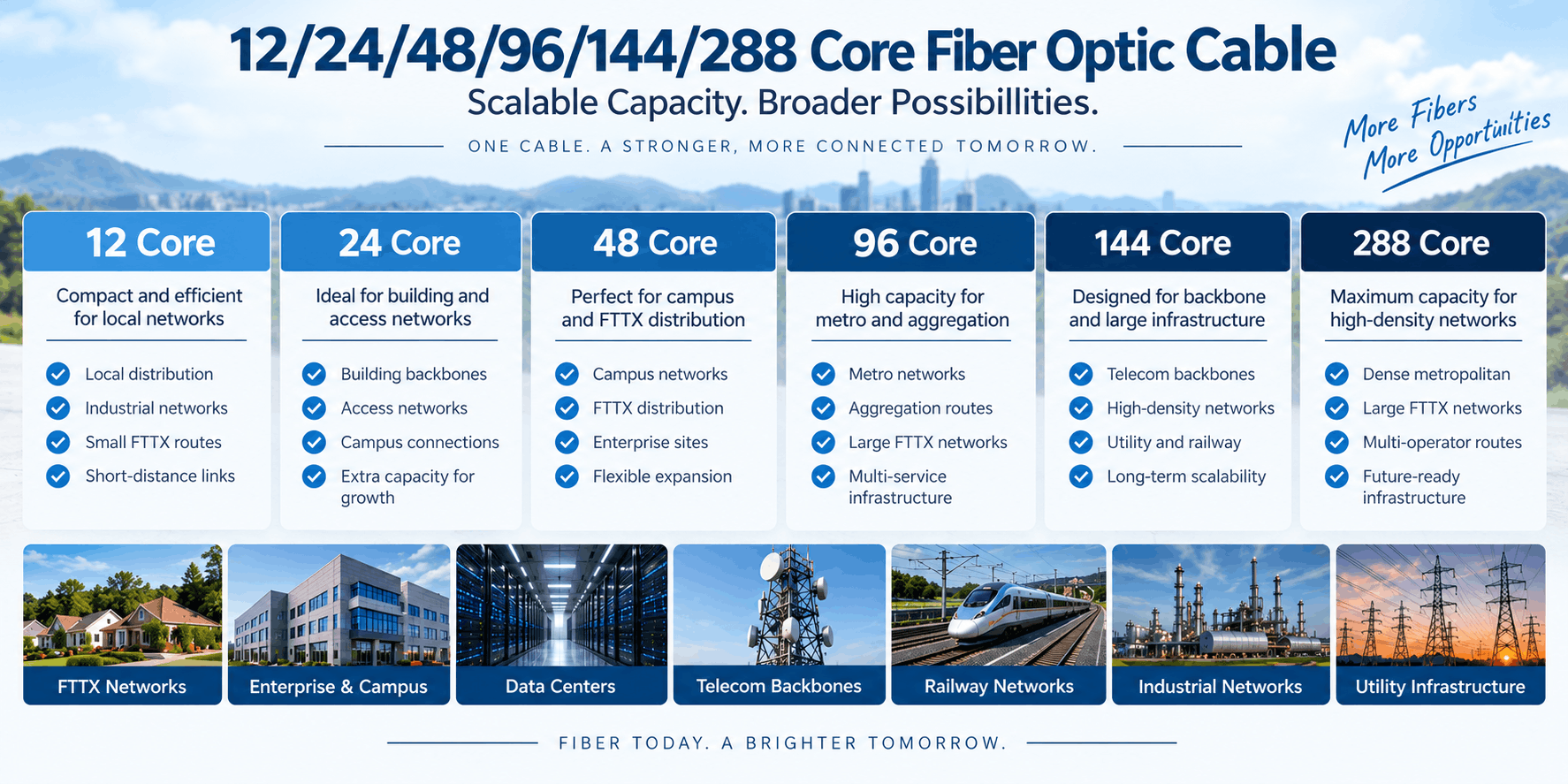
Quick answer: 12 and 24 fibers commonly suit smaller distribution and industrial connections; 48 fibers provide useful medium-capacity flexibility; 96 fibers can serve larger access and aggregation networks; 144 fibers are widely suited to high-capacity distribution and backbone routes; and 288 fibers address dense metropolitan, FTTX and telecommunications infrastructure. However, the correct number depends on how many fibers the network will actually consume and how much spare capacity the project wants to preserve.
12/24/48/96/144/288 Core Fiber Optic Cable at a Glance
| Fiber Count | General Capacity Position | Typical Network Role |
|---|---|---|
| 12 Core | Low | Small backbone, local distribution, industrial links |
| 24 Core | Low to medium | Building backbone, access networks, industrial distribution |
| 48 Core | Medium | Campus, infrastructure, FTTX distribution, telecom access |
| 96 Core | Medium to high | Aggregation, metro access, larger FTTX and utility networks |
| 144 Core | High | Telecom backbone, high-density distribution, metro networks |
| 288 Core | Very high | Dense FTTX, metropolitan backbone and major telecom infrastructure |
These descriptions are general rather than absolute. For example, a 24-fiber cable can form part of a large telecommunications system, while a 144-fiber cable can be appropriate for a relatively short route if that route aggregates many downstream connections.
Consequently, fiber count should follow network demand rather than project size alone.
What Does Fiber Optic Cable Core Count Mean?
Fiber optic cable core count identifies the number of individual optical fibers contained inside the cable.
For example:
- 12 core cable = 12 optical fibers
- 24 core cable = 24 optical fibers
- 48 core cable = 48 optical fibers
- 96 core cable = 96 optical fibers
- 144 core cable = 144 optical fibers
- 288 core cable = 288 optical fibers
Each fiber can potentially carry an optical signal independently.
However, the number of fibers should not be confused with network bandwidth.
Fiber Count Is Not the Same as Bandwidth
A 288-fiber cable does not automatically provide 24 times the bandwidth of a 12-fiber cable.
Transmission capacity also depends on:
- Optical transceivers
- Ethernet speed
- Wavelength
- Wavelength-division multiplexing
- Network architecture
- PON technology
- Equipment interfaces
For example, one fiber pair can potentially carry extremely high data capacity when advanced optical equipment and wavelength multiplexing are used.
Therefore, fiber count primarily determines the number of available physical optical paths rather than the total number of gigabits the cable can transport.
How Many Duplex Links Can Each Fiber Count Support?
Traditional duplex optical Ethernet commonly uses one fiber to transmit and another fiber to receive.
If every connection receives its own dedicated two-fiber pair, the theoretical simple allocation becomes:
| Fiber Count | Dedicated Duplex Fiber Pairs |
|---|---|
| 12 fibers | 6 pairs |
| 24 fibers | 12 pairs |
| 48 fibers | 24 pairs |
| 96 fibers | 48 pairs |
| 144 fibers | 72 pairs |
| 288 fibers | 144 pairs |
However, this table represents only a simple dedicated-duplex architecture.
BiDi optics can transmit and receive over one fiber using different wavelengths. In addition, CWDM and DWDM systems can place multiple optical channels onto one fiber or fiber pair.
Consequently, the number of services supported by a cable can be far greater than its basic fiber-pair count suggests.
How Many Fibers Should You Specify?
A practical fiber optic cable core count calculation should begin with the expected active requirement.
Then engineers should consider:
- Redundancy
- Unused spare fibers
- Future network expansion
- Additional buildings or cabinets
- Network topology
- Maintenance strategy
- Dark-fiber requirements
- Potential equipment upgrades
Therefore, ordering exactly the number of fibers required on the first day can create unnecessary limitations later.
At the same time, excessive spare capacity increases cable size, termination count, splice-closure requirements and material cost.
The objective is not to maximize fiber count. Instead, it is to create sufficient capacity for the expected life of the network.
Active Fibers vs Spare Fibers
An installed cable does not need to use every fiber immediately.
Unused fibers can serve several purposes:
- Future expansion
- Emergency replacement
- New services
- Additional network operators
- Redundant paths
- Technology upgrades
These unused fibers are often described as spare or dark fibers.
Therefore, spare capacity can reduce the probability that a project needs to install an entirely new backbone cable later.
How Much Spare Fiber Capacity Is Enough?
There is no universal percentage that suits every project.
A private industrial network with a highly predictable layout may require relatively modest reserve capacity.
By contrast, a municipal, FTTX, metropolitan or telecom backbone can experience much greater long-term growth.
Accordingly, spare-fiber planning should consider:
- Expected network life
- Cost of installing another cable later
- Available duct capacity
- Future subscriber growth
- Planned network branches
- Strategic dark-fiber requirements
If civil works are expensive, purchasing additional fiber capacity during the first installation can often be more efficient than reopening the route several years later.
What Is a 12 Core Fiber Optic Cable?
A 12 core fiber optic cable contains 12 individual optical fibers.
This configuration provides useful capacity without creating the size and termination complexity of a larger backbone cable.
Typical applications can include:
- Industrial Ethernet links
- Small building backbones
- Telecom access links
- Security infrastructure
- Campus distribution
- Local railway systems
- Small FTTX distribution sections
In a simple dedicated duplex architecture, 12 fibers provide six fiber pairs.
However, single-fiber BiDi or wavelength-multiplexed systems can use those fibers differently.
When Should You Choose 12 Core Fiber Cable?
A 12-fiber cable can be appropriate when the route serves a relatively limited number of endpoints and future expansion remains manageable.
For example, it can connect one industrial building to another while leaving additional fibers available for:
- Redundant network links
- CCTV backbone
- Access control
- Process networks
- Future equipment
As a result, 12 fibers can provide significantly more flexibility than installing only one or two active fiber pairs.
When Is 12 Core Too Small?
A 12-core construction may become restrictive when one route aggregates many downstream branches.
Potential warning signs include:
- Many buildings on one backbone
- Rapid subscriber growth
- Several network operators sharing the route
- High redundancy requirements
- Large quantities of dark fiber required
- Long-term network expansion expected
In those situations, selecting 24 or 48 fibers can create useful capacity without dramatically changing the installation.
What Is a 24 Core Fiber Optic Cable?
A 24 core fiber optic cable contains 24 individual optical fibers.
It offers twice the physical fiber capacity of a 12-fiber cable while remaining relatively modest compared with high-count backbone designs.
Typical applications include:
- Commercial-building backbones
- Industrial facilities
- Campus networks
- FTTX access networks
- Transportation infrastructure
- Utility communication systems
- Small telecom aggregation routes
Therefore, 24 fibers often provide a useful balance between present demand and future capacity.
12 Core vs 24 Core Fiber Optic Cable
The main difference is available fiber capacity.
A 12-fiber cable provides six simple duplex pairs, while a 24-fiber cable provides twelve if all fibers are allocated in pairs.
However, doubling the fiber count does not always double the cable diameter.
Actual dimensions depend on:
- Loose-tube size
- Number of tubes
- Strength members
- Armor
- Water blocking
- Outer sheath
Therefore, moving from 12 to 24 fibers can sometimes provide substantial additional capacity for a relatively modest increase in cable size.
What Is a 48 Core Fiber Optic Cable?
A 48 core fiber optic cable contains 48 separate optical fibers.
This count represents an important transition between smaller access cables and higher-capacity network backbones.
Common applications can include:
- Telecommunication distribution
- Medium-sized FTTX networks
- Campus backbones
- Railway communication systems
- Airport infrastructure
- Utility networks
- Industrial campuses
- Data-center interbuilding links
In a conventional duplex-pair allocation, 48 fibers provide 24 physical fiber pairs.
Consequently, the cable can support a significant number of independent links while retaining spare capacity.
Why 48 Core Fiber Cable Is a Useful Capacity Point
At 48 fibers, manufacturers can still use relatively compact constructions while providing meaningful network scalability.
For example, certain single-loose-tube designs can accommodate fiber counts through 48 fibers.
Meanwhile, multi-loose-tube constructions can also provide 48 fibers where the project prefers several separate tube groups.
Therefore, 48 fibers can offer considerable construction flexibility.
24 Core vs 48 Core Fiber Optic Cable
The correct decision usually depends on aggregation.
A 24-fiber cable can efficiently serve a local route, while 48 fibers provide greater room for multiple downstream systems or future expansion.
For example, suppose a route initially requires 16 fibers.
A 24-core cable leaves eight spare fibers.
By contrast, a 48-core cable leaves 32 spare fibers.
Whether that additional reserve is economically justified depends on how difficult and expensive it would be to install another cable later.
What Is a 96 Core Fiber Optic Cable?
A 96 core fiber optic cable contains 96 independent optical fibers.
At this level, multi-loose-tube construction becomes particularly relevant because the fibers can be organized into manageable groups around a central strength member.
Typical 96-fiber applications include:
- Metro access networks
- FTTX feeder networks
- Telecommunications aggregation
- Large industrial campuses
- Utility communications
- Railway backbone systems
- Airport and transportation networks
For dedicated duplex circuits, 96 fibers provide 48 possible pairs before spare-fiber planning or alternative optical architectures are considered.
48 Core vs 96 Core Fiber Optic Cable
A 96-fiber cable doubles the physical optical paths available in a 48-fiber cable.
However, the more important difference is usually the role within the network.
A 48-fiber cable often works well within distribution sections.
Meanwhile, 96 fibers can become more attractive where multiple distribution branches converge onto one common feeder or backbone.
Consequently, 96 fibers often appear closer to the aggregation side of a network architecture.
What Is a 144 Core Fiber Optic Cable?
A 144 core fiber optic cable contains 144 individual optical fibers.
This count is well suited to high-capacity backbone and distribution infrastructure where large numbers of optical paths must travel along the same physical route.
Potential applications include:
- Metropolitan telecommunications
- FTTX backbone networks
- Regional broadband
- High-density campus networks
- Railway telecommunications
- Utility backbone systems
- Large industrial infrastructure
With 72 simple duplex pairs available before reserve planning, a 144-fiber cable can aggregate substantial network demand.
Why 144 Fibers Is Common in Multi Loose Tube Designs
Multi-loose-tube cable architecture groups fibers into separate PBT tubes stranded around a central strength member.
A common organizational concept uses 12 fibers per active tube.
Under that illustrative arrangement:
- 48 fibers = 4 × 12-fiber groups
- 96 fibers = 8 × 12-fiber groups
- 144 fibers = 12 × 12-fiber groups
However, this is not a mandatory construction rule.
Manufacturers can use different fibers-per-tube values and different numbers of active and filler tubes according to cable diameter, tube geometry and product design.
Therefore, procurement teams should review the actual construction table rather than assume that every 144-core cable contains twelve identical tubes.
96 Core vs 144 Core Fiber Optic Cable
The move from 96 to 144 fibers adds 48 additional optical paths.
That increase can be valuable when a backbone must accommodate several large distribution branches.
However, higher count also affects:
- Splice quantity
- Closure capacity
- Fiber management
- Jointing time
- Cable diameter
- Drum length and weight
Therefore, a 144-fiber cable should be selected because the route needs the capacity, not simply because higher fiber count appears safer.
What Is a 288 Core Fiber Optic Cable?
A 288 core fiber optic cable contains 288 individual optical fibers.
This is a high-density construction intended for networks where a single physical route must carry a very large number of optical paths.
Typical applications include:
- Large metropolitan fiber networks
- Dense FTTX feeder systems
- Telecom backbone routes
- Broadband infrastructure
- High-capacity utility networks
- Large-scale campus systems
- Regional network aggregation
In simple duplex allocation, 288 fibers represent 144 fiber pairs.
However, high-count routes often use more sophisticated architectures, so the number of logical services can be far higher.
144 Core vs 288 Core Fiber Optic Cable
The fiber count doubles from 144 to 288.
Nevertheless, the engineering decision involves more than raw capacity.
A 288-fiber cable can reduce the number of separate cables required within a heavily loaded duct.
That consolidation can provide advantages involving:
- Duct utilization
- Route management
- Future expansion
- Backbone consolidation
- Civil-work efficiency
On the other hand, one very high-count cable concentrates more network capacity into one physical asset.
Therefore, redundancy and route-diversity strategy become increasingly important as fiber count rises.
High Fiber Count Does Not Replace Route Redundancy
Installing 288 fibers in one cable provides enormous physical fiber capacity.
However, if every service follows the same trench, duct or cable, one severe physical incident can affect all of them.
For critical networks, redundancy can therefore require:
- Separate cables
- Separate ducts
- Separate geographical routes
- Ring topology
- Alternative network nodes
Consequently, one 288-fiber cable is not necessarily more resilient than two geographically diverse lower-count cables.
What About 432 Core Fiber Optic Cable?
Networks requiring even greater density can move beyond 288 fibers.
A 432 core fiber optic cable contains 432 individual optical fibers and can serve extremely high-capacity telecommunications, metropolitan and broadband infrastructure.
At this level, network engineers must pay particular attention to:
- Cable diameter
- Fiber density
- Tube architecture
- Splice-closure capacity
- Jointing productivity
- Duct occupancy
- Route redundancy
Therefore, 288 fibers should not be interpreted as the upper technical limit of modern loose-tube fiber cable.
Central Loose Tube vs Multi Loose Tube by Fiber Count
Fiber optic cable core count strongly influences cable-core architecture.
A central loose-tube cable places the optical fibers inside one primary tube.
This design can provide:
- Compact construction
- Simple cable architecture
- Low or medium fiber counts
- Efficient outdoor protection
By contrast, multi-loose-tube cable divides the fibers among several tubes stranded around a central strength member.
This architecture becomes increasingly useful as fiber count rises.
| Fiber Count | Construction Commonly Considered |
|---|---|
| 12 | Central loose tube or multi loose tube |
| 24 | Central loose tube or multi loose tube |
| 48 | Central loose tube or multi loose tube |
| 96 | Multi loose tube generally becomes more relevant |
| 144 | Multi loose tube |
| 288 | High-density multi loose tube |
These are general engineering tendencies rather than universal restrictions.
The actual manufacturer design should govern.
Why Multi Loose Tube Works Well for High Fiber Counts
Separating fibers among several tubes provides practical organization.
For example, each tube can represent:
- A network branch
- A geographical area
- A building
- A service group
- A future expansion group
In addition, loose tubes provide mechanical isolation and allow fibers to move as the cable expands and contracts with temperature.
Consequently, multi-tube construction offers both scalability and environmental protection for high-count outdoor networks.
How Are 288 Fibers Organized Inside a Cable?
There is no single mandatory arrangement.
For illustration, a 288-fiber cable could theoretically use:
- 24 tubes × 12 fibers
- 12 tubes × 24 fibers
- Another high-density manufacturer-specific grouping
The manufacturer chooses the architecture according to tube capacity, cable diameter, mechanical performance, fiber accessibility and production design.
Therefore, “288 core” describes total optical fiber capacity rather than one specific internal arrangement.
Why Tube Count Matters
Two cables with the same 144- or 288-fiber capacity can use different tube structures.
That difference can affect:
- Overall diameter
- Tube identification
- Mid-span access
- Splice organization
- Mechanical balance
- Production design
As a result, buyers comparing high-count cables should ask for both fiber count and tube configuration.
Fiber Identification in High-Count Cables
As fiber count increases, identification becomes increasingly important.
Color coding allows technicians to distinguish individual fibers and loose tubes.
High-count constructions can also use:
- Colored fibers
- Colored tubes
- Ring marking
- Bundling
- Numbered identification systems
Therefore, the project should use a clear identification scheme that remains practical during splicing, troubleshooting and future network expansion.
12-Fiber Color Coding and Higher Fiber Counts
Twelve-fiber color sequences are widely used as a practical organizational building block.
Higher-count cables can repeat the color sequence while differentiating tubes or bundles.
For example, a 144-fiber cable using twelve groups of twelve fibers can identify:
- The tube or bundle
- The individual fiber within that group
Consequently, technicians can locate a specific fiber systematically even in a very high-count cable.
Single-Mode Fiber for 12 to 288 Core Cable
Fiber optic cable core count does not determine the optical-fiber type.
Any of these cable counts can use suitable single-mode fibers such as:
- G.652.D
- G.657.A1
- G.657.A2
G.652.D remains widely used for telecom, backbone and infrastructure applications.
Meanwhile, bend-insensitive G.657 variants can provide advantages where tighter routing or access-network conditions make bend performance important.
Therefore, fiber specification and fiber count should remain separate decisions.
Can 96, 144 and 288 Core Cable Use Multimode Fiber?
Technically, high-count cables can also use multimode optical fibers when the application requires them.
Options can include:
- OM1
- OM2
- OM3
- OM4
- OM5
However, large metropolitan and long-distance telecom backbones more commonly favour single-mode technology because of transmission-distance requirements.
By contrast, multimode remains relevant in shorter-distance enterprise, industrial and data-center environments.
Core Count for FTTX Networks
FTTX architecture can consume fiber capacity very differently from dedicated point-to-point networks.
Passive Optical Networks use optical splitters to allow one feeder fiber to serve multiple downstream optical-network terminals.
Therefore, one subscriber does not necessarily require one dedicated fiber along the complete route back to the central office.
However, FTTX networks still require fiber capacity for:
- Feeder sections
- Distribution branches
- Multiple PON ports
- Network redundancy
- Future subscribers
- Business connections
- Dark-fiber reserve
Consequently, fiber count generally becomes higher as traffic from multiple distribution areas converges toward the network backbone.
12/24/48 Core Fiber Cable for FTTX Distribution
Lower and medium fiber counts can work well in distribution sections closer to subscribers.
For example, depending on network topology:
- 12 fibers can serve a small local branch
- 24 fibers can provide additional split or reserve capacity
- 48 fibers can aggregate several distribution sections
However, actual PON design, splitter ratios and feeder architecture should determine the count.
96/144/288 Core Fiber Cable for FTTX Backbone
Higher-count cables become particularly attractive closer to aggregation and feeder routes.
Several downstream areas can converge onto one common corridor.
Therefore, 96, 144 or 288 fibers can provide useful capacity for:
- Multiple PON feeder groups
- Future network expansion
- Enterprise circuits
- Transport links
- Redundancy
- Dark fiber
Nevertheless, the optimum count remains network-specific.
Fiber Optic Cable Core Count for Telecom Backbone Networks
Telecommunications backbones can favour higher fiber counts because installing additional cable later can be expensive.
A backbone may simultaneously carry:
- Access-network traffic
- Mobile backhaul
- Enterprise circuits
- Government networks
- Transport infrastructure
- Wholesale dark fiber
As a result, 96-, 144- and 288-fiber cables can provide valuable long-term scalability.
Fiber Count for Metro Networks
Metro networks often contain many branch points and network nodes within relatively short geographical distances.
Therefore, high fiber density can be more important than transmission distance.
A 144- or 288-fiber backbone can allow individual fibers or groups to be dropped at different locations while the remaining fibers continue through the route.
This makes mid-span accessibility and loose-tube organization important design considerations.
Fiber Count for Data Centers
Data-center networks can require extremely high fiber density, but cable architecture differs between campus backbone and internal equipment connectivity.
For example, an outdoor 96- or 144-fiber loose-tube cable can connect separate data-center buildings.
Meanwhile, high-density indoor environments can use dedicated data-center cable architectures optimized for:
- Patch-panel density
- MPO/MTP connectivity
- Ribbon systems
- Fast deployment
- Mass fusion splicing
Therefore, a high fiber count alone does not make an outdoor loose-tube cable the correct data-center cable for every location.
Fiber Count for Industrial Networks
Industrial plants often require fewer fibers than public telecom networks, but multiple operational systems can share the same backbone.
These can include:
- Industrial Ethernet
- SCADA
- CCTV
- Access control
- Process automation
- Building management
- Fire and safety systems
Consequently, a 12- or 24-fiber cable can be sufficient for a smaller plant route, while 48 or 96 fibers can provide better scalability across a large industrial campus.
Fiber Count for Railway Networks
Railway routes often extend over long distances and serve multiple stations, signaling points and telecommunications systems.
Fiber demand can include:
- Signaling
- Telecommunications
- CCTV
- Passenger information
- SCADA
- Ticketing
- Station networks
Therefore, fiber-count requirements can increase quickly along a common railway backbone.
In addition, spare fibers can provide valuable capacity for later route upgrades.
Fiber Optic Cable Core Count for Airports
Airports combine many distributed buildings and operational systems.
Fiber networks can connect:
- Terminals
- Control facilities
- Security systems
- Baggage systems
- Parking infrastructure
- Data centers
- Airfield systems
As a result, 48-, 96- or higher-count backbone cables can become appropriate depending on the scale and topology of the airport.
Fiber Optic Cable Core Count for Utility Networks
Utilities use fiber for communication, protection, SCADA and operational monitoring.
A smaller local substation connection may require only 12 or 24 fibers.
Meanwhile, a regional utility backbone can justify 48, 96, 144 or more fibers.
Therefore, network hierarchy strongly influences the correct count.
Does Higher Fiber Count Increase Cable Diameter?
Generally, fiber count can increase outside diameter because the manufacturer must accommodate more fibers or additional loose tubes.
However, the relationship is not linear.
Cable diameter also depends on:
- Fibers per tube
- Tube diameter
- Filler elements
- Strength member diameter
- Water blocking
- Armor
- Number of jackets
Consequently, doubling fiber count does not necessarily double cable diameter.
Why Diameter Matters for High-Count Fiber Cable
Duct capacity is limited.
Therefore, outside diameter affects:
- Duct fill
- Cable blowing
- Pulling
- Bending radius
- Joint-chamber space
- Drum capacity
In high-density networks, selecting a compact 288-fiber design can sometimes be more valuable than installing several lower-count cables in the same duct.
Does Higher Fiber Count Increase Cable Weight?
Usually, but fiber itself contributes relatively little mass.
The larger impact often comes from additional:
- Loose tubes
- Jacket material
- Armor
- Strength members
- Water-blocking materials
Therefore, two 144-fiber cables with different armor systems can have very different weights even though they contain the same number of optical fibers.
Fiber Count and Cable Blowing
Higher-count cables can still be installed by blowing when the complete product is designed for that method.
Important variables include:
- Cable diameter
- Weight
- Stiffness
- Outer-sheath friction
- Duct diameter
- Route geometry
- Blowing equipment
Consequently, fiber count alone does not determine achievable blowing distance.
Fiber Count and Splicing Workload
Higher fiber count can significantly increase jointing work.
For example, fully splicing:
- 12 fibers requires up to 12 individual fusion splices
- 48 fibers requires up to 48
- 144 fibers requires up to 144
- 288 fibers requires up to 288
Therefore, high-count networks require careful planning for technician productivity and closure organization.
288 Core Cable and Mass Fusion Splicing
Very high-count networks can benefit from ribbon or ribbonized fiber architectures that allow several fibers to be fusion-spliced simultaneously.
However, conventional loose individual fibers remain valuable because they provide flexible single-fiber routing and repair.
Consequently, the decision between loose fiber and ribbon architecture involves installation strategy as well as fiber count.
Splice Closure Capacity
The splice closure must accommodate the selected fiber count and expected future splicing.
Therefore, a 288-fiber cable can require substantially greater tray and organizer capacity than a 24- or 48-fiber construction.
Project engineers should verify:
- Maximum splice count
- Number of trays
- Tube-management capacity
- Mid-span capability
- Future expansion space
Otherwise, selecting sufficient cable capacity while undersizing the closure can create a bottleneck during installation.
Fiber Count and Mid-Span Access
High-count backbone networks often require only selected fibers at each branch point.
Mid-span access allows technicians to open a cable and extract the required tube or fibers while leaving other fibers uncut.
This capability becomes increasingly valuable with 96-, 144- and 288-fiber cables.
Therefore, cable-core organization should support the project’s branching strategy.
Dry Core vs Gel-Filled High-Count Fiber Cable
High-count cables can use either gel-filled or dry water-blocking systems.
Dry-core designs can simplify preparation because technicians do not need to remove flooding gel from the entire cable core.
Meanwhile, gel-filled loose tubes remain a proven method of protecting fibers against moisture.
For high-count splicing, cleaner access can create meaningful labour advantages.
Therefore, water-blocking construction becomes increasingly relevant as fiber count and splice workload increase.
Armored 12/24/48/96/144/288 Core Fiber Cable
Any required fiber count can be combined with mechanical protection according to product architecture.
Armor options can include:
- Corrugated steel tape
- Steel Wire Armour
- Steel Wire Braid
- Non-metallic glass-yarn reinforcement
- Multiple armor systems for severe environments
Therefore, fiber optic cable core count and armor type remain separate selection decisions.
Corrugated Steel Tape for High-Count Fiber Cable
Corrugated steel tape can provide strong radial, impact and rodent protection while maintaining a relatively compact metallic-armored construction.
This can be useful for:
- Underground telecom networks
- Duct installations
- Railways
- Industrial infrastructure
Consequently, 48-, 96-, 144- and higher-count CST cables can provide a useful combination of capacity and mechanical protection.
SWA for High-Count Fiber Cable
Steel Wire Armour creates a heavier mechanical structure around the cable.
It can become useful where high-capacity cable routes also face demanding tensile or mechanical conditions.
However, SWA increases:
- Weight
- Diameter
- Bending requirements
- Installation effort
Therefore, high fiber count should not automatically lead to the heaviest armor construction.
Non-Metallic Armored High-Count Fiber Cable
High-count fiber cables can also use dielectric reinforcement.
Glass yarn, aramid yarn and FRP can provide mechanical strength without introducing conductive steel.
This can be particularly valuable near:
- High-voltage infrastructure
- Power transmission systems
- Electrical substations
- Locations requiring electrical isolation
Consequently, a 144- or 288-fiber cable does not need metallic armour merely because of its high capacity.
Duct Fiber Cable by Core Count
Duct networks can use the entire range from small fiber counts through high-density backbone cables.
Selection depends on the role of the route.
| Network Position | Fiber Counts Often Considered |
|---|---|
| Local connection | 12 / 24 |
| Distribution | 24 / 48 / 96 |
| Aggregation | 48 / 96 / 144 |
| High-capacity backbone | 96 / 144 / 288 |
These ranges are illustrative rather than fixed network rules.
Direct Burial Fiber Cable by Core Count
Direct burial can also use low or high fiber counts.
However, burial suitability depends on the complete mechanical and environmental construction rather than the number of fibers.
The cable can require:
- Water blocking
- Rodent protection
- Crush resistance
- Impact protection
- Appropriate outer sheath
- Metallic or non-metallic armour
Therefore, a 288-core cable is not automatically more suitable for underground installation than a 24-core cable.
ADSS Fiber Cable and Core Count
ADSS construction can also support substantial fiber counts.
The cable uses dielectric strength members and does not require a metallic messenger wire.
As fiber count increases, engineers should still evaluate:
- Cable weight
- Span length
- Maximum operating tension
- Wind loading
- Ice loading
- Sag
Therefore, the fiber count must work within the complete aerial mechanical design.
Fiber Count and IEC 60794 Testing
Optical cables are commonly evaluated through IEC 60794 mechanical and environmental test frameworks.
Depending on cable construction, testing can include:
- Tensile strength
- Crush resistance
- Impact
- Torsion
- Repeated bending
- Temperature cycling
- Water penetration
Higher fiber count does not reduce the need for mechanical qualification.
Instead, the complete finished cable should meet the project requirements without creating unacceptable fiber strain or attenuation changes.
Common Mistakes When Selecting Fiber Optic Cable Core Count
1. Choosing Only the Fibers Needed Today
A cable with no reserve capacity can become obsolete as soon as the network expands.
2. Automatically Choosing the Highest Fiber Count
Unused capacity adds cost, termination complexity and splice-management requirements.
3. Assuming One Fiber Equals One Network Connection
Duplex, BiDi, PON and wavelength-multiplexed architectures consume fibers differently.
4. Confusing Fiber Count with Bandwidth
Transmission equipment and wavelengths strongly influence actual network capacity.
5. Ignoring Dark Fiber
Unused fibers can provide valuable future or emergency capacity.
6. Ignoring Route Redundancy
Hundreds of fibers inside one cable still share one physical failure point.
7. Ignoring Duct Capacity
Higher-count and armored cables can increase outside diameter.
8. Ignoring Splice Closure Capacity
The closure must accommodate both the cable and the required number of fiber splices.
9. Assuming Every 144-Core Cable Has the Same Tube Arrangement
Fibers per tube and tube count can vary between designs.
10. Assuming 288 Core Requires Ribbon Fiber
High-count cables can also use conventional loose fibers.
11. Selecting Fiber Count Before Designing the Network
The topology should determine the required physical paths.
12. Ignoring Future Branches
New buildings, cabinets or subscriber areas can consume reserve capacity rapidly.
13. Assuming Higher Count Requires Metallic Armour
Fiber count and mechanical protection are independent decisions.
14. Ignoring Cable Weight
High-count armored constructions can materially affect drum handling and installation.
15. Ignoring Mid-Span Access
High-count backbone cables often require efficient branching without cutting every fiber.
16. Specifying Only “144 Core Fiber Cable”
Fiber count alone does not define fiber type, armor, sheath, water blocking or mechanical performance.
How to Choose Fiber Optic Cable Core Count
| Question | Selection Effect |
|---|---|
| How many fibers are initially active? | Establishes minimum capacity |
| Does each link use duplex or BiDi optics? | Changes fiber consumption |
| Is the network PON-based? | Changes feeder and distribution requirements |
| How much future growth is expected? | Determines spare-fiber requirement |
| Are dark fibers required? | Increases required count |
| How many branches leave the backbone? | Can justify higher aggregation count |
| Is another cable difficult to install later? | Supports greater initial reserve |
| Is duct space limited? | Favours efficient high-density design |
| Does the project require route diversity? | May favour multiple cables/routes instead of one very high-count cable |
| What splice closures are available? | Must match the selected fiber count |
Simple Fiber Count Selection Example
Consider a campus backbone that initially requires ten dedicated duplex links.
Ten conventional duplex links require 20 active fibers.
A 24-fiber cable would therefore leave only four spare fibers.
A 48-fiber cable would leave 28 spare fibers.
If the route passes through an existing duct and adding another cable later would be easy, 24 fibers may be economically sufficient.
However, if the route involves expensive civil works and the campus expects several additional buildings, 48 fibers may provide better lifecycle value.
Therefore, the same initial requirement can legitimately produce different cable-count decisions depending on future expansion and installation economics.
High-Capacity Backbone Selection Example
Now consider a metropolitan backbone connecting several distribution zones.
Each zone may require:
- FTTX feeder capacity
- Enterprise circuits
- Mobile backhaul
- Public-service networks
- Dark-fiber reserve
As the requirements from several zones converge, a 96- or 144-fiber route may quickly become insufficient.
In that situation, a 288-fiber backbone can reduce the need for multiple parallel cables while preserving capacity for future services.
Nevertheless, critical redundancy may still justify a second geographically diverse cable.
What Should Buyers Include in a Fiber Optic Cable RFQ?
An RFQ stating only “96 core fiber optic cable” remains incomplete.
A useful specification should include:
- Required fiber count
- 12 / 24 / 48 / 96 / 144 / 288 or other count
- Single-mode or multimode
- G.652.D, G.657.A1 or G.657.A2 where required
- OM1, OM2, OM3, OM4 or OM5 where required
- Central loose tube or multi loose tube
- Fibers per tube where specified
- Tube identification requirement
- Gel-filled, dry-core or fully dry construction
- Duct, aerial or direct-burial installation
- Metallic or non-metallic armour requirement
- Corrugated steel tape where required
- SWA where required
- ADSS requirement where applicable
- Outer sheath material
- PE, HDPE or LSZH requirement
- UV resistance
- Water-penetration requirement
- Maximum installation tension
- Maximum operating tension
- Crush resistance
- Impact resistance
- Minimum bending radius
- Operating temperature
- Installation temperature
- Maximum outside diameter where applicable
- Maximum cable weight where relevant
- IEC 60794 requirements
- Fiber and tube color coding
- Cable marking
- Drum length
- Optical test reports
- Mechanical test documentation
As a result, the manufacturer can propose a construction that provides the required fiber capacity without leaving major technical decisions unresolved.
ETK Kablo 12/24/48/96/144/288 Core Fiber Optic Cables
ETK Kablo manufactures fiber optic cables across a wide range of core counts for telecommunications, FTTX, data-center, railway, utility, industrial and infrastructure networks.
Low and medium fiber counts such as 12, 24 and 48 fibers can be manufactured in compact constructions for access, distribution and local backbone applications.
Meanwhile, multi-loose-tube constructions allow ETK to scale toward 96, 144, 288 and other high-count configurations for metro, FTTX and telecommunications backbone networks.
The fiber-count decision can be combined independently with several cable architectures, including:
- Central loose tube
- Multi loose tube
- Mini and microduct cable
- Duct cable
- Direct-burial cable
- Corrugated steel tape armor
- Steel Wire Armour
- Non-metallic armor
- ADSS
- Messenger-wire cable
- Dry-core and gel-filled construction
- Flame-retardant cable
- Fire-resistant fiber optic cable
Single-mode options can include G.652.D, G.657.A1 and G.657.A2, while suitable multimode designs can use OM1 through OM5 according to project requirements.
ETK’s fiber-optic manufacturing capability also extends beyond the 288-fiber level to designs containing up to 432 optical fibers.
Therefore, purchasing teams can determine the fiber count from the network requirement first and then specify the mechanical, environmental and optical construction required by the installation.
Frequently Asked Questions
What does 12 core fiber optic cable mean?
It normally means that the cable contains 12 individual optical fibers. In technical terminology, “12-fiber cable” is more precise because each optical fiber itself contains a glass core.
What does 24 core fiber optic cable mean?
A 24 core fiber optic cable contains 24 individual optical fibers available for active connections, spare capacity or future services.
How many fiber pairs are in a 24-core cable?
If the fibers are allocated exclusively as dedicated duplex pairs, 24 fibers provide 12 pairs.
How many pairs are in a 48-core fiber cable?
A simple duplex allocation provides 24 fiber pairs. BiDi or wavelength-multiplexed systems can use the fibers differently.
What is a 96 core fiber optic cable used for?
96-fiber cables are commonly suited to aggregation, metro access, FTTX feeder, railway, utility and larger campus networks.
What is a 144 core fiber optic cable used for?
144 fibers can provide high-capacity distribution or backbone connectivity for telecom, FTTX, metro, transportation and infrastructure networks.
What is a 288 core fiber optic cable used for?
288-fiber cables are particularly useful where dense telecommunications, metropolitan or FTTX networks need a large number of optical paths in one physical cable.
Is 288 core the maximum fiber optic cable size?
No. Higher-count cables are possible. ETK Kablo’s manufacturing capability extends up to 432 optical fibers.
Should I choose 12 or 24 core fiber cable?
Choose according to current active-fiber demand and future expansion. If 12 fibers leave insufficient reserve, moving to 24 fibers can be more economical than installing another cable later.
Should I choose 24 or 48 core fiber cable?
48 fibers can provide substantially more spare and aggregation capacity. However, 24 fibers may be sufficient where network growth remains limited and future cable installation is easy.
Should I choose 96 or 144 core fiber cable?
The decision should follow expected backbone aggregation, spare-fiber requirements and long-term growth rather than a fixed rule.
Should I choose 144 or 288 core fiber cable?
288 fibers become attractive where several high-capacity network branches share one corridor or where future civil work would be expensive. However, route redundancy should also be considered.
Does more fiber mean faster internet?
Not automatically. Fiber count provides more physical optical paths, while speed depends on transceivers, wavelengths, Ethernet or PON technology and network equipment.
Can one fiber carry multiple channels?
Yes. Wavelength-division multiplexing can carry multiple optical wavelengths over one fiber, while BiDi systems can transmit in both directions using different wavelengths on a single fiber.
Does a duplex connection need two fibers?
Traditional duplex optics commonly use two fibers, one for each direction. However, BiDi optics can use a single fiber.
Does every FTTH subscriber require one fiber all the way to the central office?
Not necessarily. PON architectures use optical splitters, allowing one feeder fiber to serve multiple downstream subscribers before the network branches.
Can 48 core cable use a central loose tube?
Yes. Suitable central loose-tube constructions can accommodate 48 fibers, although multi-loose-tube designs are also available.
Does 144 core cable require multi loose tube construction?
Multi-loose-tube architecture is commonly used for this fiber count because it organizes the fibers into manageable groups, although actual construction remains manufacturer-specific.
How many fibers are inside each loose tube?
The number varies by cable design. Twelve fibers per tube is common in many constructions, but higher or lower tube capacities are possible.
Can 288 core cable be dry core?
Yes. High-count cables can use dry water-blocking yarns and tapes, gel-filled elements or combinations of both.
Can 288 core fiber cable be armored?
Yes. High-count cable can use suitable metallic or non-metallic mechanical protection according to project requirements.
Can high-count cable use G.657.A2 fiber?
Yes. Fiber count and optical-fiber type are independent design choices when the requested construction supports the required fiber specification.
Which fiber count should I choose?
Calculate the initial active fibers, transmission architecture, redundancy, spare-fiber requirement and anticipated growth. Then choose the next practical cable capacity that provides sufficient lifecycle capacity without unnecessary complexity.
Conclusion
Selecting a fiber optic cable core count is fundamentally a network-capacity planning decision.
A 12 core fiber optic cable can provide an efficient solution for small distribution or industrial routes. Meanwhile, 24 fibers add useful reserve capacity without moving into a high-density backbone construction.
At 48 fibers, networks gain considerably greater flexibility for campus, FTTX, industrial and infrastructure distribution.
As aggregation increases, 96 and 144 core fiber optic cables can support larger metro, telecom, railway, utility and broadband networks.
Finally, 288 core fiber optic cable provides very high physical fiber density for major telecommunications and FTTX backbone routes. Even higher counts, including 432 fibers, can be manufactured where network density requires them.
However, more fibers do not automatically mean more bandwidth. Duplex versus BiDi transmission, PON architecture and wavelength multiplexing can significantly change how many physical fibers the network consumes.
Future capacity also matters. Installing sufficient spare fibers during initial construction can prevent expensive civil works later, particularly in underground and metropolitan networks.
At the same time, simply maximizing fiber count can increase cable diameter, splice workload, closure capacity and network-management complexity.
Therefore, engineers should determine active fiber requirements first, future expansion second, route redundancy third and physical installation constraints fourth.
Once the correct count is established, the cable can then be specified with the appropriate central or multi loose-tube architecture, fiber type, water blocking, armor, sheath, mechanical performance and environmental characteristics.
The best fiber optic cable is not the one with the highest core count. It is the construction that provides enough optical paths for the network’s complete expected service life while remaining efficient to install, splice, protect and maintain.
Benzer yazılar
Microduct Fiber Optic Cable: Cable Design for High-Density Networks
A microduct fiber optic cable is designed to place substantial optical capacity inside a small cable diameter while supporting efficien...
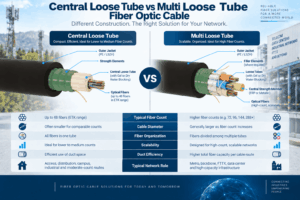
Central Loose Tube vs Multi Loose Tube Fiber Optic Cable: Which Should You Choose?
Choosing between central loose tube vs multi loose tube fiber optic cable starts with the internal cable architecture. Both constructio...
Micro-Module Fiber Cable: High-Density Design & Selection Guide
A micro module fiber cable groups optical fibers inside thin, flexible modules rather than conventional rigid buffer tubes. This archit...
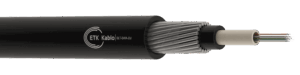
SWA Fiber Optic Cable: Construction, Applications & Selection Guide
SWA fiber optic cable combines optical fibers with a Steel Wire Armour layer that provides additional mechanical reinforcement around t...

What Is a Fiber Optic Cable? Types, Structure & Selection Guide
A fiber optic cable carries information as light through one or more optical fibers. Instead of transmitting electrical signals through...

Fiber Optic Cable Types: Complete Selection Guide
Fiber optic cable types differ according to optical fiber, cable construction, installation environment, mechanical protection, water b...


