





 President’s Message
Blog
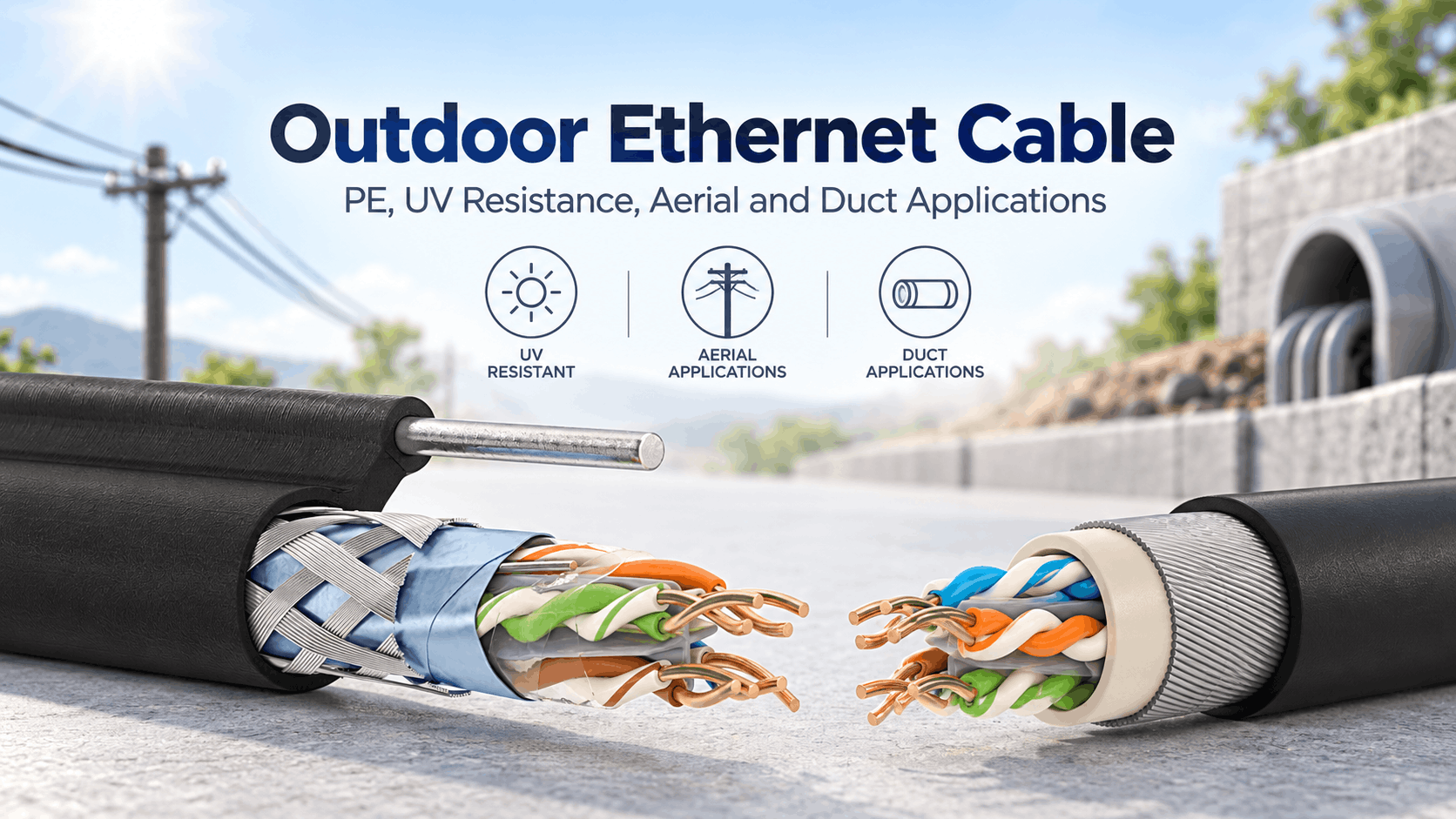
Outdoor Ethernet Cable: PE, UV Resistance, Aerial and Duct Applications
Reading Time: 17 minutes
Outdoor Ethernet cable applications require more than standard Cat 6 or Cat 6A transmission performance. A cable installed outside a building can face sunlight, moisture, temperature variation, abrasion and mechanical stress that an ordinary indoor network cable was never designed to withstand.
For this reason, outdoor Ethernet cables commonly use a polyethylene, or PE, outer sheath. PE provides strong resistance to moisture and environmental exposure, while properly formulated outdoor-grade compounds can also provide the UV resistance required for prolonged sunlight exposure.
However, the words “outdoor Ethernet cable” do not describe one universal construction. A cable installed inside an underground duct has different mechanical requirements from a cable suspended between structures. Likewise, a PE-sheathed cable intended for a protected pathway should not automatically be treated as a self-supporting aerial cable or a mechanically protected direct-burial cable.
Therefore, engineers should combine Ethernet category performance with the actual route. The specification should consider PE sheath material, UV resistance, shielding, cable support, moisture exposure, mechanical protection, conductor size and the electromagnetic environment.
Quick answer: PE-sheathed Ethernet cable is commonly used for outdoor routes because polyethylene provides strong moisture and weather resistance. UV-resistant PE is important when cable is exposed to sunlight. Duct installations can use suitable PE-jacketed cables, although flooded ducts or severe moisture exposure may justify additional water-blocking measures. Aerial Ethernet requires a construction specifically designed for suspension, such as a cable with a galvanized steel messenger wire. PE alone does not automatically make an Ethernet cable suitable for every outdoor installation.
Outdoor Ethernet Cable Applications at a Glance
| Application | Important Cable Features | Typical Construction |
|---|---|---|
| Outdoor wall / exposed route | UV resistance, moisture resistance, weather-resistant jacket | PE-sheathed Ethernet cable |
| Underground duct | PE sheath, moisture resistance, pulling durability | PE outdoor Ethernet cable |
| Wet or flood-prone duct | Enhanced water protection, suitable jacket and core design | Project-specific outdoor cable |
| Aerial installation | UV resistance plus mechanical support | Messenger-wire aerial Ethernet cable |
| Industrial outdoor network | UV resistance, EMI protection, durable sheath | F/UTP, SF/UTP or S/FTP PE |
| Campus connection | Weather resistance, network distance, electrical environment | Outdoor copper Ethernet or fiber optic cable |
| Mechanically exposed route | Impact and crushing protection | Armoured Ethernet construction where required |
Consequently, the correct cable should be selected from the installation environment rather than from the Ethernet category alone.
What Is an Outdoor Ethernet Cable?
An outdoor Ethernet cable combines balanced copper data transmission with materials designed for external environmental exposure.
Electrically, the cable can still belong to familiar categories such as:
It still relies on twisted-pair geometry, controlled characteristic impedance, conductor resistance, insertion loss and crosstalk performance.
The main difference lies in the physical construction surrounding those pairs.
For example, ETK’s Cat 6 U/UTP PE construction uses solid copper conductors, polyethylene insulation, four twisted pairs, a star-shaped separator and a UV-resistant polyethylene outer jacket. Its published characteristic impedance is 100 ±5% Ω across 1–250 MHz.
Therefore, an outdoor cable must preserve Ethernet transmission characteristics while adding environmental protection.
Why PE Is Used for Outdoor Ethernet Cable Applications
Polyethylene is widely used as an outer-jacket material for outdoor Ethernet cable applications.
Its advantages can include:
- Low moisture absorption
- Good water resistance
- Strong environmental durability
- Good abrasion resistance
- Suitable low-temperature behaviour
- Ability to incorporate UV-stabilizing additives
These properties make PE particularly useful for outdoor data and telecommunications cables.
However, the word “PE” alone does not guarantee every environmental characteristic. The actual compound must be formulated for the required UV, temperature and ageing performance.
Therefore, project specifications should ask for a UV-resistant PE outer sheath rather than merely stating “PE jacket.”
PE vs PVC for Outdoor Ethernet Cable
PVC is extremely common in general-purpose cable construction because it can provide good flexibility, durability and flame performance at a competitive cost.
Nevertheless, a standard indoor PVC Ethernet cable is not automatically suitable for continuous outdoor exposure.
Sunlight, moisture and temperature cycling can accelerate deterioration if the jacket has not been formulated for those conditions.
PE, meanwhile, is widely preferred for outdoor telecommunications because of its strong moisture and weather resistance.
Therefore, ETK offers PE versions alongside PVC and LSZH variants across several Ethernet cable families.
PE vs LSZH for Ethernet Cable
PE and LSZH solve different problems.
A PE outer sheath primarily addresses environmental exposure such as sunlight and moisture.
LSZH materials primarily address fire behaviour by reducing halogen-containing gases and dense smoke compared with conventional halogen-containing materials.
Therefore:
PE = primarily an outdoor/environmental material choice.
LSZH = primarily a fire/smoke material choice.
One should not automatically replace the other.
For example, a building route may use outdoor PE cable externally and then transition to a cable construction that satisfies the applicable indoor fire requirements after entering the building.
Why UV Resistance Matters
Sunlight contains ultraviolet radiation that can degrade many polymer materials over time.
Without adequate stabilization, prolonged UV exposure can contribute to:
- Surface cracking
- Embrittlement
- Loss of flexibility
- Discolouration
- Reduced mechanical strength
Once an outer sheath deteriorates, environmental protection of the internal Ethernet pairs can also decline.
Consequently, UV resistance is one of the most important characteristics for cable installed on exposed walls, poles, rooftops and other open-air routes.
Outdoor Ethernet Cable Applications and UV-Stabilized PE
For outdoor Ethernet cable applications with direct sunlight exposure, the manufacturer should use an appropriate outdoor-grade PE compound.
UV stabilization can be achieved through formulation additives, pigments and other polymer-engineering methods.
Black PE is particularly common in outdoor telecommunications cabling because suitable black compounds can provide strong protection against ultraviolet exposure.
However, jacket colour alone should never replace documented material performance.
Therefore, procurement teams should verify that the product datasheet specifically identifies the outer sheath as UV resistant.
Does Every Black Ethernet Cable Work Outdoors?
No.
Colour does not define environmental suitability.
An indoor cable can have a black PVC or LSZH jacket without being designed for long-term sunlight exposure.
Likewise, an outdoor PE cable can have specific compound properties that are not visible from appearance alone.
Therefore, “black cable” and “outdoor cable” should never be treated as equivalent specifications.
Moisture Resistance in Outdoor Ethernet Cable
Outdoor network routes can encounter moisture from:
- Rain
- Condensation
- Humidity
- Groundwater
- Flooded ducts
- Snow and ice
- Temperature cycling
A PE jacket provides a strong external moisture barrier when it remains intact.
However, moisture protection involves more than the outer jacket.
If water reaches the cable interior through accidental sheath damage or an improperly sealed cable end, it can travel through internal spaces.
Therefore, severe wet environments can require additional water-management features beyond an ordinary PE sheath.
Does PE Make Ethernet Cable Waterproof?
It is better to describe PE Ethernet cable as moisture resistant or weather resistant rather than universally “waterproof.”
A cable can withstand outdoor moisture while intact without being intended for continuous submersion.
Moreover, water can enter through:
- Damaged jackets
- Open cable ends
- Poor joints
- Damaged connectors
Consequently, the required construction should reflect the actual exposure level.
Long-term submerged or flood-prone installations may justify water-blocking elements specifically designed for that environment.
Outdoor Ethernet Cable Applications in Underground Ducts
Underground duct systems represent one of the most common outdoor Ethernet cable applications.
Ducts protect cables from direct sunlight and many forms of accidental physical damage. However, they do not necessarily provide a dry environment.
Water can enter ducts through:
- Manholes
- Joint chambers
- Cracked pathways
- Groundwater
- Condensation
- Poor drainage
Therefore, cables installed in underground ducts should use an outer sheath designed for the expected moisture exposure.
PE provides a strong starting point because it offers good moisture and abrasion resistance.
Why Indoor Ethernet Cable Should Not Be Pulled Through Outdoor Ducts
An underground duct may look mechanically protected, but the cable inside still faces an outside-plant environment.
Standard indoor Ethernet cable can lack the jacket characteristics required for prolonged moisture and temperature exposure.
Furthermore, underground ducts frequently contain standing water.
Therefore, the fact that the cable is “inside a pipe” does not convert the route into an indoor installation.
Do Duct Ethernet Cables Need Armour?
Not always.
A properly designed underground duct already provides significant mechanical protection.
Consequently, an unarmoured PE Ethernet cable can be suitable for many protected duct routes.
However, armour can become relevant when the route involves:
- High pulling stress
- Rodent risk
- Crushing hazards
- Poorly protected chambers
- Industrial mechanical exposure
- Project-specific requirements
Therefore, armour should be selected according to mechanical risk rather than added automatically to every duct cable.
Outdoor Ethernet Cable Applications in Aerial Networks
Aerial routes are another important group of outdoor Ethernet cable applications.
Unlike a duct cable, an aerial cable has to deal with both environmental exposure and structural loading.
The cable can face:
- Sunlight
- Wind
- Temperature variation
- Rain
- Snow or ice depending on location
- Mechanical tension
- Movement
Therefore, a normal PE-jacketed Ethernet cable should not automatically be suspended between poles or structures.
The cable needs a defined support system.
What Is an Aerial Ethernet Cable?
An aerial Ethernet cable combines the required data construction with a mechanical element designed to support the suspended route.
For example, ETK’s Cat 6 F/UTP Aerial PE cable includes:
- Solid copper conductors
- Solid PE insulation
- Twisted pairs
- A star-shaped separator
- Al/PET overall screening
- A tinned-copper drain wire
- A galvanized steel messenger wire
- A UV-resistant PE outer jacket
ETK publishes 100 ±5% Ω characteristic impedance across 1–250 MHz for this construction.
Therefore, the messenger wire provides the mechanical distinction that an ordinary outdoor PE Ethernet cable does not have.
Why a Messenger Wire Is Used
The messenger takes the mechanical loading associated with the aerial span.
This helps prevent the data conductors and twisted-pair structure from carrying the full tensile load.
Maintaining pair geometry is particularly important because deformation can affect:
- Characteristic impedance
- Return loss
- NEXT
- Insertion loss
Consequently, aerial design is not only a mechanical issue. Protecting the physical cable geometry also helps preserve Ethernet transmission performance.
Aerial Ethernet Cable vs Standard PE Ethernet Cable
Both products can have UV-resistant polyethylene jackets.
However, only the aerial construction is specifically designed around suspended mechanical loading.
| Feature | Standard Outdoor PE | Aerial PE Ethernet |
|---|---|---|
| UV-resistant outer jacket | Yes, where specified | Yes |
| Moisture-resistant PE jacket | Yes | Yes |
| Twisted-pair Ethernet construction | Yes | Yes |
| Dedicated suspension element | Usually no | Yes |
| Galvanized steel messenger | No | Common design option |
| Designed for aerial span | Not automatically | Yes |
Therefore, specifying “PE Ethernet cable” alone is insufficient for an aerial route.
Cat 6 Outdoor Ethernet Cable Applications
Cat 6 remains widely used for outdoor LAN and industrial networking because it supports Gigabit Ethernet over standards-compliant channel configurations and operates through 250 MHz.
Common applications can include:
- Outdoor industrial equipment
- Campus LAN extensions
- External wireless access points
- Smart-building infrastructure
- Utility facilities
- Transport facilities
- Outdoor automation equipment
ETK manufactures Cat 6 outdoor constructions including U/UTP PE, SF/UTP PE and F/UTP aerial PE versions.
Consequently, engineers can match shielding and mechanical construction to the specific route.
Cat 6A Outdoor Ethernet Cable Applications
Cat 6A extends balanced copper transmission to 500 MHz and supports 10GBASE-T over the complete standards-compliant channel length.
It can therefore be attractive when an outdoor route requires greater bandwidth or additional future capacity.
ETK’s Cat 6A product portfolio includes PE-sheathed outdoor variants in multiple shielding constructions.
For example, the Cat 6A S/FTP PE cable uses individually foil-screened pairs, an overall tinned-copper braid and a UV-resistant PE outer jacket.
Therefore, Cat 6A can combine higher transmission performance with robust EMI protection for demanding outdoor networks.
Cat 7 PE Cable for Outdoor Networks
Cat 7 constructions can provide still higher transmission bandwidth together with extensive pair and overall shielding.
ETK’s Cat 7 S/FTP PE cable is designed with a PE outer sheath for outdoor applications and publishes transmission performance through 600 MHz in its product table, while the accompanying product description references operation up to 1000 MHz.
Because category terminology, connector systems and project standards need to align, Cat 7 should be selected from the complete network architecture rather than solely from the highest available frequency figure.
U/UTP vs Shielded Outdoor Ethernet Cable
Outdoor environmental protection and electromagnetic shielding are separate requirements.
A U/UTP PE cable can provide excellent outdoor durability while having no metallic screen.
Meanwhile, F/UTP, SF/UTP, U/FTP and S/FTP constructions add different levels of electromagnetic protection.
Therefore, an engineer should answer two separate questions:
- Does the route require environmental protection?
- Does the electrical environment require shielding?
The PE jacket answers the first question. The pair and overall screen architecture answers the second.
When U/UTP PE Can Be Appropriate
Unshielded outdoor Ethernet can be appropriate in relatively low-EMI environments.
Potential advantages include:
- Simpler construction
- Lower cable diameter
- Lower weight
- Easier termination
- No shield-bonding requirement
However, the electromagnetic environment should be assessed before selecting the cable.
Consequently, outdoor location alone does not mean that shielding is necessary.
When Shielded Outdoor Ethernet Cable Is Preferred
Industrial external routes can pass close to significant electrical-noise sources.
Examples include:
- Motors
- Variable-frequency drives
- Power cables
- Transformers
- Switchgear
- Industrial machinery
In these environments, a screened design can improve immunity to electromagnetic interference when the complete bonding and grounding system is correctly engineered.
Therefore, ETK offers outdoor screened constructions such as Cat 6 SF/UTP PE and Cat 6A S/FTP PE.
Outdoor Ethernet Cable Applications and Characteristic Impedance
Environmental durability cannot compensate for poor electrical transmission performance.
Balanced Ethernet cables require controlled characteristic impedance, normally around 100 Ω.
Pair spacing, conductor size, insulation geometry and twist rate all contribute to this value.
For example, ETK publishes 100 ±5% Ω for both its Cat 6 U/UTP PE and Cat 6 F/UTP Aerial PE constructions.
Therefore, outdoor cable design must preserve exactly the same fundamental signal-integrity principles as indoor Ethernet.
Does Outdoor Ethernet Have a Longer Distance Limit?
No.
A PE outer jacket does not extend the transmission distance of the Ethernet physical layer.
For conventional four-pair balanced structured cabling, the familiar channel architecture remains based on a maximum channel length of approximately 100 metres, with a conventional permanent-link length of up to 90 metres under relevant structured-cabling standards.
Consequently, replacing an indoor jacket with PE does not turn a 100-metre copper Ethernet link into a 200-metre link.
If a route exceeds the supported copper distance, fiber optic cable or active network equipment may be required.
Outdoor Ethernet Cable Applications Between Buildings
Inter-building LAN connections are a common reason to consider outdoor Ethernet cable applications.
However, the decision involves more than weather resistance.
Separate buildings can create additional electrical considerations involving:
- Ground-potential differences
- Lightning exposure
- Surge conditions
- Different electrical systems
- Long transmission distances
Therefore, copper Ethernet is not automatically the preferred medium between every pair of buildings.
Fiber optic cable can provide an important advantage because the optical transmission medium provides galvanic isolation and immunity to electromagnetic interference.
Copper vs Fiber for Outdoor Building Connections
Copper Ethernet can be appropriate where the route is short, the electrical environment is controlled and the network design requires copper connectivity.
Fiber, however, becomes particularly attractive where:
- The route exceeds copper distance limits
- Electrical isolation is important
- Lightning exposure is significant
- EMI levels are high
- Higher bandwidth or future expansion is expected
Therefore, the presence of an outdoor Cat 6A cable does not mean copper should always be chosen instead of fiber.
The correct medium depends on the complete network architecture.
Outdoor Ethernet Cable Applications and PoE
Power over Ethernet can supply outdoor network devices through the same copper pairs that carry data.
As a result, conductor size and resistance become particularly important.
Higher outdoor temperatures can also increase copper resistance.
Therefore, PoE-oriented outdoor cable selection should consider:
- Solid copper conductors
- Conductor gauge
- DC resistance
- Resistance unbalance
- Ambient temperature
- Bundle conditions
- Network power level
Consequently, the PE jacket solves environmental exposure but does not replace proper PoE electrical design.
Temperature and Outdoor Ethernet Performance
Outdoor cable can experience a wider temperature range than indoor structured cabling.
Sun-exposed surfaces can become significantly warmer than surrounding ambient air.
Meanwhile, winter installations can experience very low temperatures.
Temperature influences both material properties and conductor resistance.
Therefore, project specifications should verify the manufacturer’s stated operating-temperature range.
For example, ETK currently publishes an operating range of -20°C to +60°C for its Cat 6 F/UTP Aerial PE construction.
Why Cable Bending Radius Still Matters Outdoors
A rugged PE sheath does not make a twisted-pair cable immune to deformation.
Excessive bending can alter the geometry of the cable core.
As a result, impedance and return-loss performance can deteriorate.
Therefore, installers and project designers should follow the manufacturer’s stated minimum bending radius.
ETK currently publishes an 8×D bending-radius figure for its Cat 6 F/UTP Aerial PE model.
Mechanical Protection in Outdoor Ethernet Cable Applications
Some outdoor Ethernet cable applications involve more physical risk than ordinary external-wall or duct routes.
Potential threats include:
- Crushing
- Impact
- Rodents
- Construction activity
- Sharp objects
- Heavy industrial equipment
A PE outer sheath offers useful durability but should not be confused with heavy mechanical armour.
Therefore, mechanically exposed routes can require a purpose-designed armoured Ethernet cable.
PE Jacket vs Armour
PE and armour perform fundamentally different jobs.
PE outer jacket: environmental and surface mechanical protection.
Armour: enhanced resistance against mechanical damage.
Armoured Ethernet constructions can use metallic protection around the communication core while maintaining the required twisted-pair transmission characteristics.
Consequently, one feature should not be substituted for the other in a project specification.
Is PE Ethernet Cable Suitable for Direct Burial?
A PE sheath by itself should not be treated as universal proof of direct-burial suitability.
A buried route can expose cable to:
- Soil pressure
- Stones
- Digging damage
- Water
- Rodents
- Ground movement
Therefore, direct-burial selection should evaluate mechanical protection, water-blocking design and the complete route conditions in addition to the outer-jacket material.
Where those risks are significant, an armoured or specially water-protected Ethernet construction can provide a stronger engineering solution.
Outdoor Ethernet Cable Applications on External Walls
External wall routes are comparatively straightforward outdoor Ethernet cable applications, but the cable still requires appropriate environmental resistance.
The key requirements typically include:
- UV-resistant jacket
- Moisture resistance
- Suitable operating temperature
- Mechanical durability
- Appropriate cable support
Meanwhile, electrically noisy industrial areas can justify screened constructions.
Therefore, the cable should match both the weather exposure and the surrounding electrical environment.
Outdoor Ethernet Cable at Building Entry Points
A cable can be excellent outdoors yet unsuitable for an extended indoor route because outdoor PE and indoor fire-performance requirements address different hazards.
Once outdoor cabling enters a building, local electrical and telecommunications regulations can impose requirements concerning:
- Flame spread
- Smoke behaviour
- Cable routing
- Allowed indoor distance
- Transition points
Therefore, project designers should verify whether the external PE cable can continue inside or whether a transition to an appropriate indoor-rated cable is required.
Outdoor Ethernet Cable Applications in Industrial Sites
Industrial campuses are demanding outdoor Ethernet cable applications because weather and electromagnetic interference can occur simultaneously.
Network routes can connect:
- Production buildings
- Control rooms
- Utility equipment
- Warehouses
- Outdoor automation systems
- Remote machinery
In such environments, a screened PE cable can provide both environmental protection and improved EMI immunity.
Nevertheless, route length, grounding and surge risk should still be reviewed before selecting copper instead of fiber.
Outdoor Ethernet Cable for Smart Infrastructure
Modern infrastructure projects increasingly place network-connected equipment outside conventional buildings.
Examples include:
- Transport infrastructure
- Outdoor access control
- Environmental monitoring
- Parking infrastructure
- Smart utility systems
- Remote building equipment
Consequently, outdoor Ethernet has become an important extension of structured and industrial network design.
However, environmental resilience should be specified from the beginning rather than achieved by placing ordinary indoor cable into an external pathway.
Outdoor Ethernet Cable Applications and Cable Shielding
Shielding decisions should follow electromagnetic conditions rather than weather conditions.
For example, an exposed cable running across a quiet campus can require PE protection without requiring extensive metallic screening.
By contrast, a short outdoor cable near a variable-frequency drive can require strong EMI protection despite its limited length.
Therefore, outdoor and screened are not synonyms.
The environmental and EMC requirements should be evaluated separately.
Common Outdoor Ethernet Cable Specification Mistakes
Using Indoor PVC Cable Outdoors
Standard indoor PVC cable may lack the UV and environmental resistance required for prolonged outdoor exposure.
Assuming Any PE Cable Is UV Resistant
The compound should be specifically designed and documented for ultraviolet exposure.
Assuming Black Cable Automatically Means Outdoor Cable
Jacket colour alone does not establish UV or weather performance.
Suspending Standard PE Cable as an Aerial Cable
Aerial spans require an appropriate mechanical support system or purpose-designed aerial construction.
Ignoring Messenger-Wire Requirements
Aerial designs must manage tensile loading rather than allowing the communication core to carry inappropriate mechanical stress.
Assuming a Duct Is Always Dry
Underground telecommunications ducts frequently contain water or condensation.
Calling Every PE Cable Waterproof
Weather resistance and continuous-submersion performance are not the same specification.
Assuming PE Means Direct Burial
Direct burial can require additional mechanical and water protection beyond the outer jacket.
Ignoring Ethernet Distance Limits
An outdoor jacket does not extend the supported copper Ethernet channel distance.
Ignoring Electrical Differences Between Buildings
Ground-potential and surge conditions can make fiber a more suitable inter-building medium.
Specifying Shielded Cable Without an EMC Strategy
Screen performance depends on the complete connector, bonding and grounding design.
Using U/UTP in Severe EMI Without Evaluation
Outdoor industrial environments can require a screened Ethernet construction.
Ignoring PoE Conductor Resistance
Remote powering increases the importance of conductor size, resistance and temperature.
Using Outdoor PE Cable Indoors Without Checking Fire Requirements
Environmental durability and building fire compliance are separate cable characteristics.
Choosing Cat 7 When Cat 6A Meets the Network Requirement
Higher category does not automatically produce a better project when connectors, applications and system architecture do not require it.
How to Select Outdoor Ethernet Cable Applications
Identify the Route
Start by determining whether the cable will run on an external wall, through a duct, between structures, overhead or in another exposed environment.
Define Sunlight Exposure
Where direct or prolonged sunlight is expected, specify a documented UV-resistant outer jacket.
Select the PE Construction
Choose an outdoor-grade polyethylene compound appropriate for the environmental conditions.
Assess Moisture Exposure
Distinguish occasional weather exposure from flooded ducts, prolonged water contact or submerged conditions.
Determine Whether Aerial Support Is Required
For suspended spans, specify an aerial construction with an appropriate messenger or support system.
Evaluate Mechanical Risk
Add armour or another protective construction where crushing, impact or rodent damage presents a realistic risk.
Select the Ethernet Category
Choose Cat 6, Cat 6A or another required category according to bandwidth and application requirements.
Review Shielding
Use U/UTP, F/UTP, SF/UTP, U/FTP or S/FTP according to the electromagnetic environment.
Check Characteristic Impedance
Verify the required 100 Ω balanced transmission performance and applicable category limits.
Review Conductor Size
Solid copper conductor size influences resistance, insertion loss and PoE performance.
Verify Temperature Range
Ensure the selected construction suits the minimum and maximum environmental temperature.
Check Network Distance
Do not exceed the permitted copper-channel architecture merely because the cable is designed for outdoor use.
Review Inter-Building Electrical Risk
Consider whether galvanic isolation, lightning exposure or distance makes fiber optic cable preferable.
Check Building Entry Requirements
Determine whether the PE cable can continue indoors under applicable local rules or requires a transition to another jacket type.
Confirm the Complete Manufacturer Datasheet
Finally, verify electrical performance, mechanical data, materials and environmental characteristics for the exact product.
Outdoor Ethernet Cable Applications RFQ Checklist
A professional outdoor Ethernet cable applications specification should define both network performance and environmental exposure.
Useful RFQ information includes:
- Ethernet category
- Required data rate
- Frequency range
- U/UTP, F/UTP, SF/UTP, U/FTP or S/FTP
- Solid copper conductor requirement
- Conductor diameter or AWG
- Characteristic impedance
- Insertion-loss requirements
- NEXT requirements
- Return-loss requirements
- PE outer jacket
- UV resistance
- Outer-jacket colour
- Operating temperature
- Duct application
- Aerial application
- Messenger-wire requirement
- Direct-sunlight exposure
- Expected moisture level
- Water-blocking requirement where applicable
- Mechanical armour where required
- Rodent protection where required
- PoE requirement
- Maximum route length
- Minimum bending radius
- Indoor transition requirement
- Applicable IEC / ISO / TIA performance standard
- Required test documentation
- Project-specific cable marking
Consequently, cable manufacturers can evaluate the actual environment instead of responding to a vague request for “outdoor Cat 6 cable.”
Outdoor Ethernet Cable Standards
Outdoor environmental construction and Ethernet transmission standards should be considered separately.
For balanced twisted-pair performance, relevant standards include the ISO/IEC 11801 family and cable specifications such as IEC 61156-5 for applicable balanced data cables.
In the United States, ANSI/TIA-568.2-E is the current balanced twisted-pair telecommunications cabling and components standard. TIA published the E revision in November 2024 to replace ANSI/TIA-568.2-D.
Meanwhile, customer-owned outside-plant infrastructure has its own pathway and installation considerations. TIA continues development work on TIA-758-C for customer-owned outside-plant telecommunications infrastructure.
Therefore, engineers should distinguish between a cable’s category transmission standard and the broader outside-plant infrastructure design.
ETK Kablo Outdoor Ethernet Cable Applications
ETK Kablo manufactures PE-sheathed Ethernet cable constructions for a range of outdoor Ethernet cable applications.
Relevant products include:
- Cat 6 U/UTP PE
- Cat 6 SF/UTP PE
- Cat 6 F/UTP Aerial PE
- Cat 6A U/UTP PE
- Cat 6A S/FTP PE
- Cat 7 S/FTP PE
- Armoured Ethernet constructions for applications requiring additional mechanical protection
ETK’s Cat 6 U/UTP PE construction provides an unshielded outdoor option with solid copper conductors and a UV-resistant polyethylene jacket. The Cat 6 SF/UTP PE design adds aluminium foil and tinned-copper braid protection for EMI-intensive environments.
For overhead routes, ETK’s Cat 6 F/UTP Aerial PE construction adds a galvanized steel messenger wire to the shielded Cat 6 cable design.
Meanwhile, higher-bandwidth applications can use PE-sheathed Cat 6A and Cat 7 constructions, including highly screened S/FTP designs.
Therefore, ETK can match the Ethernet category, shielding system and mechanical construction to the specific outdoor route rather than treating every PE Ethernet cable as the same product.
Frequently Asked Questions About Outdoor Ethernet Cable Applications
What makes an Ethernet cable suitable for outdoor use?
Outdoor constructions use materials designed for environmental exposure, commonly including a UV-resistant polyethylene outer jacket.
Is PE better than PVC for outdoor Ethernet cable?
PE is generally preferred for prolonged outdoor moisture and weather exposure, although the complete material specification should determine suitability.
Does outdoor Ethernet cable need to be UV resistant?
Yes, when the cable will be exposed to sunlight. The datasheet should specifically confirm UV-resistant construction.
Can Cat 6 cable be installed outdoors?
Yes, when a Cat 6 construction is specifically designed for outdoor use, such as a UV-resistant PE-sheathed version.
Can Cat 6A cable be used outdoors?
Yes. Outdoor Cat 6A constructions can combine 500 MHz transmission performance with PE jackets and appropriate shielding.
What is the best jacket for outdoor Ethernet?
UV-resistant polyethylene is widely used because of its strong moisture and environmental resistance.
Can ordinary indoor Ethernet cable be installed inside an outdoor duct?
It should not be assumed suitable. Underground ducts can contain moisture and should be treated as an outside-plant environment.
Can PE Ethernet cable be installed in a duct?
Yes, suitable PE-jacketed Ethernet cable is commonly used in outdoor duct routes.
Are underground ducts waterproof?
No. Telecom ducts can contain groundwater, condensation or standing water, so cable selection should consider realistic moisture exposure.
Is outdoor Ethernet cable waterproof?
A better description is weather or moisture resistant unless the exact cable is designed and approved for continuous water exposure.
Can PE Ethernet cable be buried directly?
PE alone does not establish direct-burial suitability. Mechanical hazards and water ingress can require armour or additional water protection.
What is aerial Ethernet cable?
Aerial Ethernet combines the required twisted-pair transmission construction with a support element, such as a galvanized steel messenger wire, for suspended routes.
Can normal outdoor Ethernet cable be suspended between buildings?
Not automatically. Aerial spans require a cable or support method engineered for the mechanical tension of the route.
What is a messenger wire?
It is a mechanical support element that carries the tensile loading of an aerial cable span.
Does PE improve Ethernet speed?
No. The jacket provides environmental protection. Data performance comes from the cable category, conductor and pair geometry.
Does outdoor Ethernet have a longer distance limit?
No. Outdoor construction does not extend the normal transmission-distance limits of the Ethernet physical layer.
Should outdoor Ethernet be shielded?
Shielding depends on the electromagnetic environment. Outdoor location alone does not require F/UTP or S/FTP construction.
Which outdoor Ethernet cable is best near industrial equipment?
A screened PE construction can be appropriate where motors, drives or power equipment create significant EMI.
Is copper Ethernet suitable between buildings?
It can be, but distance, grounding, surge exposure and lightning risk should be assessed. Fiber can provide galvanic isolation and EMI immunity.
Can outdoor Ethernet support PoE?
Yes, when the cable and complete network meet the required Ethernet and remote-power specifications. Conductor size, resistance and temperature become particularly important.
Can PE Ethernet cable be used indoors?
The applicable building and fire rules should be checked. Outdoor environmental performance does not automatically establish indoor fire suitability.
What is the difference between PE Ethernet and aerial Ethernet?
PE describes the outer-jacket material, while aerial Ethernet includes a mechanical design intended for suspended installation.
What is the difference between PE Ethernet and armoured Ethernet?
PE primarily provides environmental protection, whereas armour provides enhanced mechanical protection.
How should outdoor Ethernet cable applications be specified?
Define the route first, then select category, shielding, PE and UV performance, moisture protection, aerial support, mechanical protection, temperature range and electrical requirements.
Conclusion
Outdoor Ethernet cable applications require a combination of network performance and environmental engineering.
A UV-resistant polyethylene jacket provides an effective foundation for many external LAN routes because PE offers strong moisture and weather resistance. However, the jacket alone does not define the complete cable application.
For underground ducts, engineers should consider realistic water exposure rather than assume that a conduit remains dry. Aerial routes, by contrast, need an appropriate mechanical support system such as a messenger wire. Meanwhile, industrial environments can require additional foil or braid shielding to control electromagnetic interference.
Likewise, a PE outer jacket should not automatically be interpreted as direct-burial approval, heavy mechanical protection or indoor fire compliance.
Match the Outdoor Construction to the Route
First, determine whether the route is exposed, ducted, aerial or mechanically vulnerable.
Next, choose the required Ethernet category and shielding architecture.
Afterward, specify UV-resistant PE, temperature performance and any necessary water or mechanical protection.
For building-to-building routes, the electrical environment and copper distance limit should also be reviewed against a possible fiber optic solution.
Ultimately, the right outdoor Ethernet cable is not simply an indoor Cat 6 cable with a different-coloured jacket. It is a transmission cable whose electrical performance, PE compound, UV resistance, shielding and mechanical design have been matched to the exact external environment.
Benzer yazılar
0.5 vs 0.75 vs 1.0 vs 1.5 mm² Control Cable: How to Select Conductor Size
Control cable conductor size affects resistance, voltage drop, current-carrying capability, cable diameter, flexibility and cost. Among...

300/500 V vs 450/750 V Control Cable: When Is the Higher Voltage Rating Required?
Control cable voltage rating is one of the most important electrical parameters to check when selecting cables for industrial machinery...
Outdoor Ethernet Cable: PE, UV Resistance, Aerial and Duct Applications
Outdoor Ethernet cable applications require more than standard Cat 6 or Cat 6A transmission performance. A cable installed outside a bu...

Railway Data Cables: Ethernet, RS-485, CAN Bus, MVB and WTB Explained
Railway data cables form the communication infrastructure that connects electronic equipment across modern trains. Train control system...
JZ vs OZ Control Cable: What Do the Core Identification Codes Mean?
JZ vs OZ control cable is a common comparison when specifying flexible multicore cables for industrial machinery, control panels, autom...

Ethernet Cable Testing: NEXT, Return Loss, Insertion Loss and ACR Explained
Ethernet cable testing verifies whether a twisted-pair copper cabling system can transmit data within the electrical performance limits...

Fiber Optic Cable Attenuation: 850, 1310, 1550 and 1625 nm Explained
Fiber optic cable attenuation describes the reduction in optical power as light travels through an optical fiber. It is normally expres...
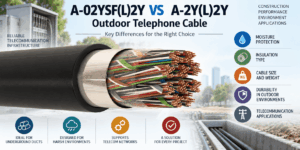
A-02YSF(L)2Y vs A-2Y(L)2Y Outdoor Telephone Cable
A-02YSF(L)2Y vs A-2Y(L)2Y is an important comparison when selecting copper outdoor telephone cable for telecommunications networks, und...

RS-485 Cable vs Instrumentation Cable: Can Instrumentation Cable Be Used for Modbus RTU?
A Modbus RTU cable must do more than carry a low-voltage digital signal from one device to another. Modbus RTU commonly uses an RS-485 ...

Ethernet Cable for PoE: Conductor Size, Heat and Bundle Performance
A PoE Ethernet cable carries data and electrical power over the same balanced twisted-pair cabling system. This capability simplifies t...
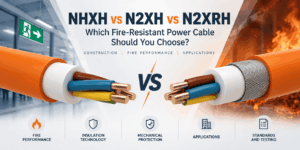
NHXH vs N2XH vs N2XRH: Which Fire-Resistant Power Cable Should You Choose?
NHXH vs N2XH vs N2XRH is an important comparison when specifying 0.6/1 kV power cables for emergency and life-safety systems. Although ...

How to Specify Low Current Cables for Infrastructure Projects
A professional low current cable specification should define much more than a cable name, conductor count or sheath colour. Infrastruct...


