





 President’s Message
Blog
Fiber Optic Cable Types
Reading Time: 4 minutes
In today’s digitally interconnected world, fiber optic cables have become the cornerstone of high-speed, high-capacity data networks, enabling rapid and reliable transmission of information across vast distances. Whether the application involves long-haul telecom backbones, metropolitan area networks, data centers, industrial automation, or Fiber to the Home (FTTH) installations, choosing the appropriate fiber optic cable type is crucial for optimizing network performance, reliability, and total ownership costs.
ETK Kablo, a prominent global manufacturer of fiber optic solutions, delivers a comprehensive portfolio of cables tailored to diverse infrastructure requirements. This guide explores essential fiber optic cable types, including their construction, applications, and inherent advantages.
Single Loose Tube Fiber Optic Cable
Single loose tube fiber optic cables consist of a central loose tube that houses multiple optical fibers, typically protected by a water-blocking gel or dry-blocking materials. This design minimizes mechanical and thermal stress on the fibers, significantly enhancing their lifespan and reliability.
Ideal for installations involving fewer fiber counts, these cables are often employed in telecom backbones, rural broadband expansions, and outdoor duct installations where robust protection against environmental factors like moisture and temperature fluctuations is critical.
ETK Kablo offers single loose tube cables optimized with singlemode fibers (such as G.652.D or G.657.A1), ensuring minimal signal attenuation and supporting long-distance high-bandwidth transmissions.
Multi Loose Tube Fiber Optic Cable
For higher-capacity applications, multi loose tube fiber optic cables are employed, featuring several loose tubes stranded around a central strength member, typically fabricated from FRP (Fiber Reinforced Plastic) or metallic components like steel.
This construction facilitates scalability and flexibility, making these cables suitable for dense urban telecom networks, extensive data center backbones, and cross-country fiber routes. Often armored with corrugated steel tape or steel wire armor (SWA), these cables provide exceptional mechanical durability against rodent damage, crushing, and environmental stress.
The external sheath, usually polyethylene (PE) or LSZH (Low Smoke Zero Halogen), enhances protection against harsh conditions, making ETK Kablo’s multi loose tube cables a top choice for metropolitan and enterprise infrastructure projects.
Tight Buffered Fiber Optic Cables
Tight buffered fiber optic cables are uniquely designed for indoor environments such as data centers, server rooms, riser installations, and structured cabling applications. Each fiber in these cables is individually buffered with a protective coating, providing easy handling and termination capabilities compared to loose tube designs. These cables offer excellent flexibility and facilitate quick installation and termination in confined spaces.
ETK Kablo’s tight buffered cables adhere to strict international standards, including CPR class B2ca, ensuring safety and performance for public buildings and large commercial structures. Their LSZH jackets provide additional safety by reducing smoke emission and toxic fumes during fires, a critical consideration in densely occupied spaces.
Aerial Fiber Optic Cable
Aerial fiber optic cables are engineered specifically for overhead installation, commonly deployed between poles or towers in rural broadband networks, municipal Wi-Fi projects, or inter-campus connections. These cables frequently incorporate integrated messenger wires or non-metallic strength members such as aramid yarn to support mechanical loads over considerable spans.
ETK Kablo’s aerial fiber optic cables, including the widely used ADSS (All-Dielectric Self Supporting) design, feature UV-resistant polyethylene jackets, protecting fibers from sunlight degradation, moisture, and wind-induced vibrations. Their non-conductive construction ensures safe operation near power lines, simplifying installations in mixed utility environments.
Steel Wire Armored (SWA) Fiber Optic Cable
Steel wire armored fiber optic cables offer maximum mechanical protection for harsh industrial and environmental conditions. These cables incorporate galvanized steel wire armoring beneath their outer sheath, providing substantial crush and rodent resistance. SWA cables are particularly favored in direct-buried installations, mining operations, tunnels, railways, and oil & gas sectors, where the risk of mechanical damage is heightened.
ETK Kablo’s SWA cables are available in both singlemode (e.g., G.652.D, G.657.A2) and multimode variants (OM1, OM2, OM3, OM4, OM5), delivering versatile and robust solutions suitable for various transmission distances and bandwidth demands.
FTTH Drop Fiber Optic Cable
FTTH (Fiber to the Home) drop cables constitute the final connectivity link between service distribution points and subscriber locations, whether residential or commercial. Characteristically lightweight and flexible, these cables facilitate easy installation through tight bends, ducts, and wall conduits without compromising fiber integrity.
ETK Kablo manufactures indoor/outdoor-rated FTTH drop cables featuring bend-insensitive fibers like G.657.A2, enabling superior performance in constrained installation scenarios common in urban residential areas. Self-supporting designs, including integrated aramid yarn strength members, provide exceptional durability, ensuring stable, high-speed broadband connectivity critical for streaming, video conferencing, and smart-home applications.
Key Considerations in Selecting Fiber Optic Cable Types
Selecting the right fiber optic cable type involves evaluating multiple factors, including installation environment, transmission distance, bandwidth requirements, regulatory compliance (such as CPR classification), and mechanical protection demands. While multi loose tube cables are ideal for high-density metropolitan networks, tight buffered cables excel in indoor data center environments. Similarly, armored fiber optic cables address mechanical protection needs, whereas aerial cables suit overhead installations.
Additionally, fiber type selection between singlemode (G.652.D, G.657.A1/A2) for extensive distances and multimode (OM3, OM4, OM5) for shorter, high-bandwidth links significantly impacts overall network efficiency, cost, and performance. Compatibility with active network components such as routers, optical transceivers, and switches is equally critical.
ETK Kablo rigorously complies with international telecommunications standards, including ITU-T, CPR, RoHS, and ISO 11801, ensuring certified product quality, performance reliability, and environmental sustainability. Through continuous innovation, ETK Kablo maintains its position at the forefront of fiber optic technology development, providing tailor-made cable solutions optimized for customer-specific network challenges worldwide.
Understanding fiber optic cable types empowers telecommunications professionals, system integrators, network planners, and end-users to achieve optimal results in their network designs. ETK Kablo’s comprehensive portfolio, encompassing single loose tube, multi loose tube, tight buffered, aerial, SWA armored, and FTTH drop cables, supports a diverse range of applications, from extensive telecom backbones to intricate indoor network installations. By selecting ETK Kablo’s fiber optic cable solutions, clients ensure future-proof, reliable connectivity that aligns with global standards and best practices, positioning their networks for sustained growth, performance, and operational efficiency.
For robust, scalable, and innovative fiber optic cable solutions, choose ETK Kablo—your trusted partner in global connectivity.
Benzer yazılar
LSZH vs PVC Cable: Which Should You Specify?
Choosing between LSZH vs PVC cable is primarily a material and fire-safety decision rather than a simple question of which cable is “be...
Cat6A Cable for Data Centers: U/FTP, F/FTP or S/FTP?
Choosing the right Cat6A cable for data centers involves more than specifying 10 Gigabit Ethernet and 500 MHz performance. U/FTP, F/FTP...
Instrumentation Cable Shielding: Individual Screen vs Overall Screen
Instrumentation cable shielding plays a critical role in protecting low-level analogue and digital signals from electromagnetic interfe...
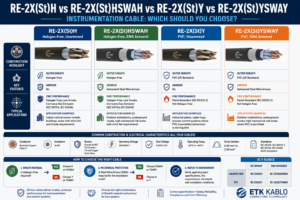
RE-2X(St)H vs RE-2X(St)HSWAH vs RE-2X(St)Y vs RE-2X(St)YSWAY: Which Should You Choose?
Choosing the right RE-2X(St) instrumentation cable is not simply a matter of comparing four similar product codes. RE-2X(St)H, RE-2X(St...
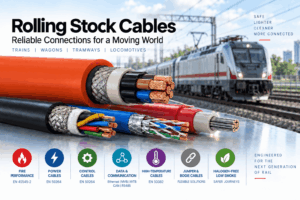
Rolling Stock Cables: Standards, Types and Applications
Rolling stock cables are specialized electrical and communication cables designed for installation onboard railway vehicles such as tra...
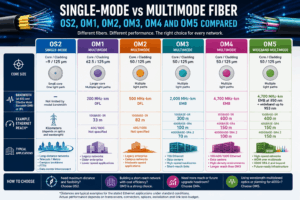
Single-Mode vs Multimode Fiber: OS2, OM1, OM2, OM3, OM4 and OM5 Compared
Choosing single-mode vs multimode fiber is one of the most important decisions when designing a fiber optic network. OS2, OM1, OM2, OM3...
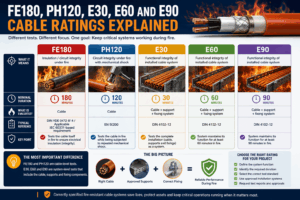
FE180, PH120, E30, E60 and E90 Cable Ratings Explained
Understanding FE180, PH120, E30, E60 and E90 cable ratings is essential when specifying fire-resistant cables for emergency, life-safet...
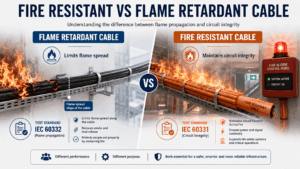
Fire Resistant vs Flame Retardant Cable: What Is the Difference?
The difference between a fire resistant vs flame retardant cable is one of the most important distinctions in cable fire performance. A...
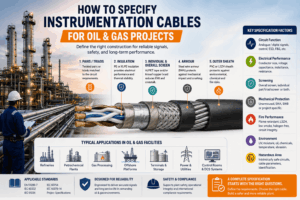
How to Specify Instrumentation Cables for Oil & Gas Projects
Selecting oil and gas instrumentation cables requires much more than choosing a conductor size and adding a screen. Refineries, petroch...
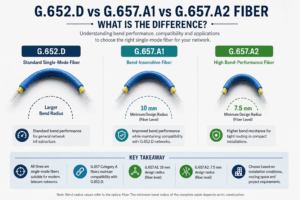
G.652.D vs G.657.A1 vs G.657.A2 Fiber: What Is the Difference?
Choosing between G.652.D, G.657.A1 and G.657.A2 fiber is primarily a question of how the optical fiber will behave when the network is ...
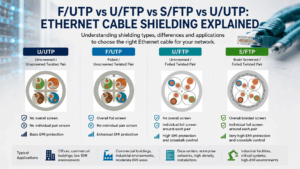
F/UTP vs U/FTP vs S/FTP vs U/UTP: Ethernet Cable Shielding Explained
Ethernet cable shielding can have a major influence on how reliably a network performs in environments affected by electromagnetic inte...
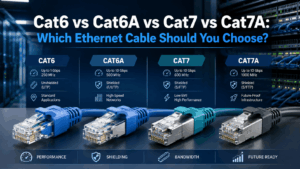
Cat6 vs Cat6A vs Cat7 vs Cat7A: Which Ethernet Cable Should You Choose?
Choosing between Cat6 vs Cat6A vs Cat7 vs Cat7A is not simply a matter of selecting the highest cable category available. Each Ethernet...


