





 President’s Message
Blog
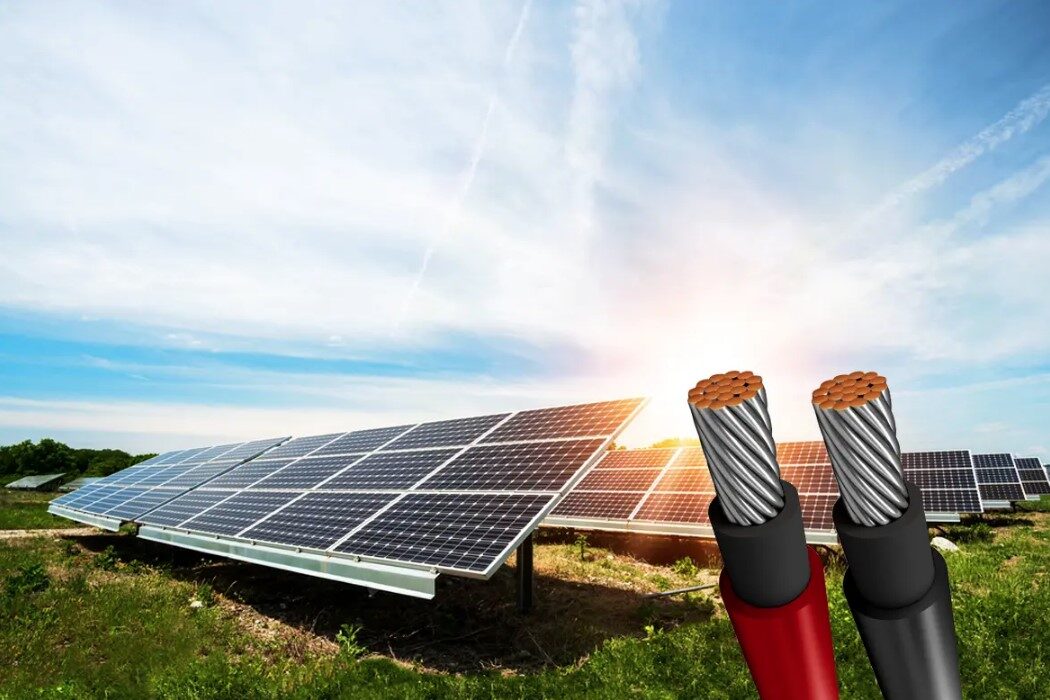
What is a Solar Cable?
Reading Time: 4 minutes
Solar energy systems (SES) are among the fastest-growing renewable energy technologies globally and play a crucial role in building a sustainable future. For these systems to function efficiently, safely, and with longevity, every infrastructure component must be chosen correctly. At the core of this infrastructure lies the solar cable.
A solar cable is a specially designed wire that carries direct current (DC) between solar panels, inverters, and other energy conversion components. These cables are engineered to withstand extreme environmental conditions such as high temperatures, UV radiation, and ozone exposure, making them ideal for long-term outdoor applications.
Unlike standard electrical cables, which degrade rapidly in harsh environments, solar cables offer long-lasting performance due to their advanced insulation and sheathing. Most high-quality solar cables conform to the H1Z2Z2-K standard, which supports a service life of up to 25 years.
Where Are Solar Cables Used?
Solar cables serve critical functions not only in the connection of solar panels but throughout the entire photovoltaic (PV) system. Reliable and continuous current flow is essential at every stage of power generation in a solar energy facility, and solar cables ensure this continuity.
1. Solar Panel Connections
Solar cables collect the DC power generated by photovoltaic modules and transmit it to the inverter. These cables must withstand prolonged UV exposure and temperature fluctuations in this exposed area.
2. String Inverter Connections
Solar cables are used to connect string configurations of multiple panels to the inverter. In this segment, voltage levels are higher, requiring excellent insulation integrity.
3. Distribution Panels and Grounding
Solar cables are also used in grounding systems and DC-side distribution panels. Flexibility and mechanical strength are especially beneficial in these zones.
4. Floating PV Systems and Mobile Applications
In environments such as floating solar systems or mobile solar units, cables must be resistant to moisture, ozone, and water ingress for prolonged durability.
Why is Cable Selection Important in Solar Energy Systems?
The performance of a solar energy system is not only determined by the panel efficiency or inverter quality. The design and quality of the cabling infrastructure significantly affect system performance. Incorrect cable selection can result in poor efficiency, frequent faults, or even fire hazards.
Impacts Energy Efficiency
Factors such as conductor size, material, and insulation quality directly influence DC power transmission. Undersized or poor-quality cables cause voltage drops and overheating.
Presents Safety Risks
Cables not suited for outdoor conditions may deteriorate due to UV, moisture, or heat, increasing the risk of short circuits, electrical leakage, or fires.
Reduces System Lifespan
Solar installations are expected to last 20–25 years. Using standard electrical cables that are not designed for long-term outdoor use significantly shortens the system’s operational life.
Increases Maintenance Costs
Inferior or mismatched cables lead to frequent faults and increased maintenance, which reduces uptime and raises operating expenses.
How Are Solar Cables Different From Standard Cables?
Solar cables are structurally and functionally different from conventional power cables. These distinctions make them highly suitable for the demanding conditions in solar installations.
1. Wide Operating Temperature Range
Solar cables typically operate within -40°C to +120°C, ensuring reliability in both extremely cold and hot climates.
2. UV and Ozone Resistance
Continuous exposure to sunlight and ozone can degrade standard cable materials. Solar cables feature specialized sheaths that withstand these elements over many years.
3. High Flexibility
In rooftop, ground-mounted, or mobile installations, flexible cables allow for easier routing and more secure connections.
4. Flame Retardant Properties
Solar cables are designed with flame-retardant materials that prevent fire propagation, enhancing system safety.
5. Compliance with H1Z2Z2-K Standard
Manufactured according to EN 50618, solar cables with the H1Z2Z2-K designation meet stringent criteria for insulation, sheath composition, mechanical strength, and electrical performance.
The Importance of UV- and Ozone-Resistant Cables
Virtually all solar installations are outdoors, where cables must endure not just electrical loads but constant environmental stress. Therefore, resistance to UV radiation and ozone is essential.
UV Resistance
Ultraviolet light can cause plastics to crack, harden, or lose flexibility over time. Solar cables use UV-stabilized materials to avoid such degradation and maintain insulation integrity.
Ozone Resistance
Ozone exposure can oxidize insulation surfaces, leading to microcracks and loss of dielectric strength. Ozone-resistant cables perform reliably in coastal areas, high altitudes, and industrial zones with elevated ozone levels.
Moisture and Humidity Protection
In addition to UV and ozone, solar cables are designed with waterproof sheaths to resist damage from rain, dew, or condensation—making them suitable for even the harshest climates.
How to Select the Right Cable for Your Solar Project
Every solar energy system has its unique technical parameters. Therefore, choosing the right solar cable involves careful consideration of several key factors.
1. Conductor Size and Voltage Rating
The conductor cross-section should be selected based on the expected current load and cable length. Common sizes include 4 mm², 6 mm², and 10 mm². H1Z2Z2-K solar cables typically support up to 1500 V DC.
2. Installation Environment
Is the installation on a rooftop, ground mount, or floating platform? Is it sheltered or exposed? These conditions help determine the type of sheath and installation method required.
3. Project Scale
In large-scale solar plants, aspects such as reel length, color coding, and connector compatibility become crucial. In such cases, project-specific cable manufacturing may be needed.
4. Manufacturer Reliability
Working with a reputable manufacturer with engineering expertise and testing capabilities ensures the long-term success of your solar project.
Solar energy systems play a vital role in the global transition to clean energy. Their success depends not only on panels and inverters but also on the quality of the infrastructure behind them. Solar cables are among the most critical components that ensure efficient, safe, and long-lasting operation of solar power systems.
Using high-standard products like H1Z2Z2-K solar cables increases the overall performance and safety of photovoltaic installations. ETK Kablo, with its engineering know-how and custom manufacturing capabilities, offers tailored solar cable solutions for projects of every scale.
Benzer yazılar
LSZH vs PVC Cable: Which Should You Specify?
Choosing between LSZH vs PVC cable is primarily a material and fire-safety decision rather than a simple question of which cable is “be...
Cat6A Cable for Data Centers: U/FTP, F/FTP or S/FTP?
Choosing the right Cat6A cable for data centers involves more than specifying 10 Gigabit Ethernet and 500 MHz performance. U/FTP, F/FTP...
Instrumentation Cable Shielding: Individual Screen vs Overall Screen
Instrumentation cable shielding plays a critical role in protecting low-level analogue and digital signals from electromagnetic interfe...
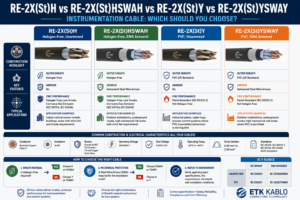
RE-2X(St)H vs RE-2X(St)HSWAH vs RE-2X(St)Y vs RE-2X(St)YSWAY: Which Should You Choose?
Choosing the right RE-2X(St) instrumentation cable is not simply a matter of comparing four similar product codes. RE-2X(St)H, RE-2X(St...
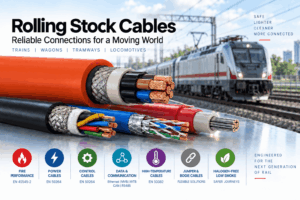
Rolling Stock Cables: Standards, Types and Applications
Rolling stock cables are specialized electrical and communication cables designed for installation onboard railway vehicles such as tra...
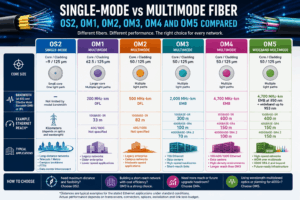
Single-Mode vs Multimode Fiber: OS2, OM1, OM2, OM3, OM4 and OM5 Compared
Choosing single-mode vs multimode fiber is one of the most important decisions when designing a fiber optic network. OS2, OM1, OM2, OM3...
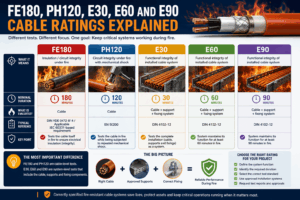
FE180, PH120, E30, E60 and E90 Cable Ratings Explained
Understanding FE180, PH120, E30, E60 and E90 cable ratings is essential when specifying fire-resistant cables for emergency, life-safet...
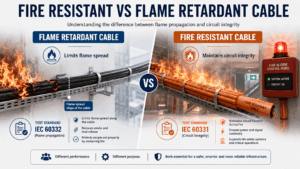
Fire Resistant vs Flame Retardant Cable: What Is the Difference?
The difference between a fire resistant vs flame retardant cable is one of the most important distinctions in cable fire performance. A...
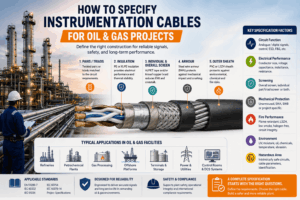
How to Specify Instrumentation Cables for Oil & Gas Projects
Selecting oil and gas instrumentation cables requires much more than choosing a conductor size and adding a screen. Refineries, petroch...
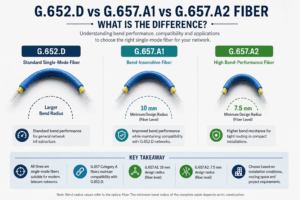
G.652.D vs G.657.A1 vs G.657.A2 Fiber: What Is the Difference?
Choosing between G.652.D, G.657.A1 and G.657.A2 fiber is primarily a question of how the optical fiber will behave when the network is ...
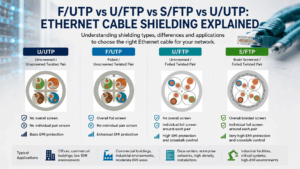
F/UTP vs U/FTP vs S/FTP vs U/UTP: Ethernet Cable Shielding Explained
Ethernet cable shielding can have a major influence on how reliably a network performs in environments affected by electromagnetic inte...
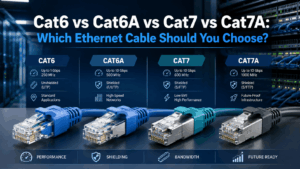
Cat6 vs Cat6A vs Cat7 vs Cat7A: Which Ethernet Cable Should You Choose?
Choosing between Cat6 vs Cat6A vs Cat7 vs Cat7A is not simply a matter of selecting the highest cable category available. Each Ethernet...


