





 President’s Message
Blog

What Is a CCTV Cable? Types, Coax, PoE & Selection Guide
Reading Time: 12 minutes
What is a CCTV cable? A CCTV cable connects surveillance cameras with recording, network or monitoring equipment. However, CCTV systems do not use one universal cable type. The correct construction depends on whether the system uses analogue video, HD-over-coax, IP networking or an optical backbone.
For example, traditional and compatible HD-over-coax cameras often use 75-ohm coaxial cable. Some surveillance systems combine coaxial video with additional low-voltage signal conductors in one composite construction. By contrast, IP cameras normally use Ethernet cabling such as Cat 5e or Cat 6. Many IP cameras can also receive power through Power over Ethernet (PoE).
Fiber optic cable serves a different role. It becomes valuable when surveillance networks cover long distances, multiple buildings or electrically noisy environments. However, standard optical fiber does not power the camera. Therefore, the project must provide another power method where required.
As a result, CCTV cabling should be selected from the complete system architecture. Engineers need to consider signal type, route length, bandwidth, power, attenuation, electromagnetic interference, outdoor exposure and mechanical risk.
ETK Kablo manufactures a dedicated surveillance product portfolio together with coaxial, Data/LAN and fiber optic solutions for different security-system architectures.
Quick answer: Use a compatible 75-ohm coaxial cable for analogue or HD-over-coax systems. Choose a composite surveillance construction when one cable needs video plus additional low-voltage signal conductors. Use Cat 5e or Cat 6 for many IP camera links. For long-distance or multi-building backbones, fiber optic cable can connect remote network switches and surveillance zones.
What Is a CCTV Cable?
A CCTV cable provides the physical connection between components of a closed-circuit television system.
Depending on the system architecture, the cabling can carry:
- Analogue video
- Compatible HD-over-coax video
- Ethernet data
- PoE power
- Low-voltage auxiliary signals
- Control or communication circuits
- Backbone traffic between network switches
However, one cable does not necessarily carry all these functions.
A standalone coaxial cable mainly carries the compatible video signal. Meanwhile, a composite construction can add low-voltage signal conductors around the coaxial element. An Ethernet cable carries digital network traffic and can also deliver PoE when the complete system supports it.
Therefore, the term describes an application family rather than one fixed electrical design.
CCTV Cable Types Used in Surveillance Systems
| Cable Type | Typical System | Main Function |
|---|---|---|
| RG59 coaxial | Analogue / compatible HD-over-coax | Video signal |
| RG6 coaxial | Compatible video systems | Video signal where its electrical data match the route |
| Composite surveillance cable | Analogue / hybrid systems | Coaxial video plus additional low-voltage circuits |
| Cat 5e | IP CCTV | Ethernet data and compatible PoE |
| Cat 6 | IP CCTV | Ethernet data and compatible PoE |
| Cat 6A | Higher-capacity network infrastructure | 10 Gigabit structured-cabling capability where required |
| Fiber optic cable | Long-distance / campus surveillance | Optical network backbone |
So, what is a CCTV cable in practical terms? It is the cable construction that matches the camera technology, transmission method and installation environment.
Each technology solves a different problem. Therefore, the camera and network architecture should come before the cable name.
Analogue, HD-over-Coax and IP Camera Systems
Analogue CCTV
Traditional analogue cameras transmit video as an electrical signal. Compatible 75-ohm coaxial cable commonly connects the camera to a DVR or other video equipment.
For this reason, RG59 remains strongly associated with conventional surveillance video.
HD-over-Coax
Several modern surveillance technologies can transmit higher-resolution video while retaining coaxial infrastructure.
However, supported distance depends on the exact camera technology and equipment specification. Cable attenuation, connectors and installation quality also affect the link.
Therefore, designers should not select RG59 or RG6 from a generic distance claim alone.
IP CCTV
An IP camera operates as a network device. It sends digital video through Ethernet rather than through a conventional analogue-video circuit.
As a result, IP cameras commonly use Category-rated balanced copper cabling. PoE can also carry electrical power through the same network connection when the camera, switch and cabling support the required PoE level.
For IP systems, understanding what is a CCTV cable also means understanding that standard Ethernet cabling becomes part of the surveillance infrastructure.
Coaxial CCTV Cable: How It Works
Coaxial cable uses a concentric electrical construction. A typical design contains a center conductor, dielectric insulation, metallic screen and outer jacket.
The geometry creates a controlled characteristic impedance. Many surveillance and video systems use a nominal 75-ohm architecture.
ETK Kablo manufactures a broad RG coaxial cable portfolio with different conductors, dielectric systems and screen constructions.
However, buyers should verify the exact product rather than assuming that every cable in one RG family has identical performance.
Why 75-Ohm Impedance Matters
Video transmission performs best when the cable and connected equipment use compatible characteristic impedance.
If the impedance does not match the system, reflections can reduce signal quality. Therefore, installers should not substitute a 50-ohm RF cable simply because its outside diameter looks similar.
In addition, the RG designation alone does not provide every electrical detail. Engineers should verify impedance, attenuation and capacitance from the applicable datasheet.
RG59 for Surveillance Video
RG59 is one of the best-known coaxial families for camera systems.
It can provide a compact solution for compatible analogue and HD-over-coax links. In addition, installers benefit from a mature connector ecosystem.
However, there is no universal “RG59 maximum distance.” Actual performance depends on several factors:
- Video technology
- Operating frequency
- Cable attenuation
- Conductor design
- Dielectric material
- Screen construction
- Connector losses
- Camera and recorder specifications
Therefore, the system manufacturer’s route limit and the cable’s actual attenuation data should guide the design.
RG6 vs RG59
RG6 and RG59 can both appear in compatible 75-ohm video systems. However, their physical and electrical constructions normally differ.
| Characteristic | RG59 | RG6 |
|---|---|---|
| General cable size | Usually more compact | Usually larger |
| Common application direction | CCTV and video | Video, CATV, satellite and broadband |
| Attenuation | Check the exact product and frequency | Check the exact product and frequency |
| Characteristic impedance | Verify the exact product | Verify the exact product |
| Selection method | Use equipment and cable data | Use equipment and cable data |
RG6 is not automatically better than RG59. Likewise, RG59 does not have one fixed maximum route length. Instead, compare the actual electrical performance against the surveillance equipment requirement.
Composite CCTV Cable
A composite construction places more than one circuit type inside a common outer cable.
ETK Kablo’s composite surveillance product combines one 75-ohm coaxial video element with additional 0.22 mm² stranded copper signal conductors. The coaxial element uses a 7 × 0.20 mm stranded copper center conductor, solid polyethylene dielectric and electrolytic copper braid.
This architecture can reduce the number of separate cables along the route. In addition, it can simplify installations that require coaxial video and auxiliary low-voltage circuits.
However, the additional conductors should not automatically be treated as camera-power conductors. Their cross-section and the camera’s electrical demand must match before the project uses them for power.
Therefore, when buyers ask what is a CCTV cable for a hybrid analogue system, the answer can include both the coaxial video element and the required auxiliary conductors.
Standalone Coaxial vs Composite Construction
| Feature | Standalone Coaxial | Composite Construction |
|---|---|---|
| Main role | Compatible video or RF transmission | Video plus additional low-voltage circuits |
| Additional conductors | Not part of the standard coaxial element | Included according to product design |
| Installation | Separate circuits may need separate cables | Can reduce the number of cable runs |
| Selection basis | Impedance, attenuation, frequency | Video plus auxiliary-circuit requirements |
Consequently, the system design should determine whether a standalone coaxial cable or a composite construction offers the better installation strategy.
CCTV Cable for IP Cameras
IP surveillance changes the cable-selection logic because each camera becomes part of the data network.
Typical copper options include Cat 5e, Cat 6 and, in some infrastructure layers, Cat 6A.
In addition, the complete network can use fiber between buildings, remote switches or major aggregation points.
For a broader explanation of balanced copper network cabling, see our LAN cable selection guide.
Cat 5e for IP Cameras
Cat 5e supports Gigabit Ethernet in compliant structured-cabling systems. Therefore, it provides sufficient network capacity for many individual IP cameras.
ETK Kablo’s Category 5e range includes different shielding and jacket constructions for indoor, outdoor and mechanically demanding routes.
However, the category alone does not complete the specification. Engineers must also consider PoE, jacket material, electromagnetic environment and installation method.
Cat 6 for IP Cameras
Cat 6 offers more transmission margin than Cat 5e and operates through a higher standardized frequency range.
As a result, many new surveillance projects choose Cat 6 for their access network.
ETK Kablo’s Category 6 range includes unshielded, screened, outdoor, aerial and mechanically protected options.
Nevertheless, Cat 6 does not automatically improve camera image quality. If the network already carries the required video stream without congestion or errors, the camera and encoding system determine the image quality.
When Does Cat 6A Make Sense?
Most individual IP cameras do not need a 10 Gigabit Ethernet connection.
However, Cat 6A can make sense in larger structured-cabling systems. For example, the project may use it in control rooms, multi-service networks or other links where 10GBASE-T capability supports the broader infrastructure strategy.
Therefore, designers should choose Cat 6A because of the network architecture rather than camera resolution alone.
Power over Ethernet and Camera Cabling
PoE allows compatible network equipment to deliver data and electrical power through the same balanced copper connection.
This approach simplifies many IP camera installations. For example, one horizontal cable can connect the camera to a PoE-capable network switch.
However, PoE adds electrical and thermal considerations. Engineers should check:
- Camera power demand
- PoE switch capability
- Conductor resistance
- Resistance unbalance
- Cable conductor size
- Bundle size
- Ambient temperature
- Pathway conditions
As PoE power increases, these factors become more important. Therefore, buyers should not assume that every Category cable behaves identically under power loading.
How Far Can an IP Camera Run on Copper Ethernet?
Conventional balanced-copper Ethernet structured cabling normally uses a 100-meter channel architecture.
A common design allows up to 90 meters of permanent-link installation cable, while patch and equipment cords complete the channel.
Therefore, installers should not simply extend standard Cat 5e or Cat 6 for several hundred meters.
For longer routes, designers can use an intermediate active device, a suitable extender or an optical backbone.
Fiber Optic Backbones for Surveillance
Fiber optic cable carries network traffic as light and becomes especially useful in large surveillance systems.
Key advantages include:
- Long transmission distance
- High backbone capacity
- Immunity to electromagnetic interference
- Electrical isolation with fully dielectric designs
- Efficient aggregation of many camera zones
Typical projects include airports, industrial plants, railways, ports, stadiums, campuses and urban surveillance networks.
For additional background, see our optical backbone guide.
However, standard optical fiber does not deliver electrical power to the camera. Therefore, remote camera locations still need an appropriate power source.
When Should a Surveillance Network Use Fiber?
Fiber becomes attractive when conventional copper Ethernet creates distance or environmental limitations.
Consider an optical backbone when:
- Camera zones sit beyond a normal copper Ethernet segment
- The system spans several buildings
- High electromagnetic interference exists
- Many cameras aggregate at remote network switches
- Electrical isolation matters
- Future backbone capacity is important
For example, an industrial site can use short Cat 6 PoE links between local switches and cameras. Meanwhile, fiber can connect those switches to the central control room.
This hybrid architecture combines convenient PoE access with long-distance optical backbone transmission.
Does Higher Camera Resolution Require a Different Cable?
Not automatically.
Resolution influences video bitrate, but codec, frame rate and image settings also affect bandwidth.
For IP systems, designers should calculate the expected bitrate of each camera and the aggregate traffic on uplinks.
For coaxial systems, the selected transmission technology defines the compatible electrical link.
Therefore, labels such as “4K camera cable” rarely provide enough information for engineering selection.
Shielding and Electromagnetic Interference
Electromagnetic interference can affect electrical camera links.
Common sources include:
- Variable-frequency drives
- Industrial motors
- Transformers
- Switchgear
- High-current power cables
- Power-conversion equipment
Coaxial cable already uses a concentric metallic screen as part of its transmission architecture.
Ethernet cabling can use either unshielded or screened designs. For example, U/UTP may suit a controlled office environment. By contrast, F/UTP or other screened constructions can add protection on electrically noisy routes.
However, screened structured cabling also depends on correct termination and bonding. Therefore, the highest shielding level is not automatically the best solution.
Indoor Surveillance Cabling
Indoor projects should consider both transmission performance and building requirements.
Typical factors include:
- Fire-performance requirements
- LSZH or other material requirements
- Pathway capacity
- Cable flexibility
- PoE bundle heating
- Termination method
For example, a public building can require a different jacket from a protected equipment room. Therefore, electrical performance alone should not determine the cable.
Outdoor Camera Routes
Outdoor installations add environmental stress.
The route may face:
- UV radiation
- Rain and moisture
- Temperature variation
- Mechanical impact
- Rodents
- Long exposed sections
As a result, outdoor systems can require PE jackets, UV-resistant materials or additional mechanical protection.
However, an outdoor jacket does not automatically make a cable suitable for direct burial or aerial use. Those installation methods create additional mechanical requirements.
Aerial Camera Networks
Pole-mounted cameras can require aerial cable routes.
In these cases, the designer must consider wind, span length, mechanical support and cable tension.
A standard indoor Ethernet cable should not carry its own aerial span simply because its electrical performance suits the camera.
Instead, projects should use a purpose-designed aerial data construction or another supported pathway.
Mechanical Protection and Armour
Some camera routes face significant physical risk.
Factories, tunnels, transport systems and outdoor infrastructure can expose cables to impact, crushing or maintenance activity.
In these cases, mechanical reinforcement can improve cable protection. Depending on the product family, the project can evaluate Steel Wire Armour, Steel Wire Braid or another suitable reinforcement system.
However, armour increases diameter, weight and stiffness. Therefore, specify it only where the route creates a real mechanical requirement.
Coaxial Cable vs Dedicated Surveillance Construction
| Characteristic | Standalone Coaxial | Dedicated Composite Construction |
|---|---|---|
| Main architecture | One controlled-impedance coaxial element | Coaxial element plus additional conductors |
| Main selection criteria | Impedance, attenuation, frequency and shielding | Video requirement plus auxiliary circuits |
| Power / control conductors | Not inherently included | Can be included according to product design |
| Typical procurement logic | Select the exact RG construction | Define the complete surveillance-system requirement |
This distinction prevents a common purchasing error. A standalone RG product does not become a composite surveillance cable simply because the project uses it for a camera.
Ethernet Cable vs Dedicated Surveillance Construction
Ethernet cable becomes part of a surveillance system by application. The cable itself still follows its Category transmission requirements.
For example, a Cat 6 cable can connect a workstation in one project and an IP camera in another.
However, camera projects can add requirements for PoE, outdoor exposure, shielding, LSZH materials, aerial installation or mechanical protection.
ETK Kablo’s broader network cabling portfolio covers these structured-cabling choices.
Device Interoperability and ONVIF
Cabling and device interoperability solve different parts of an IP surveillance system.
ONVIF develops standardized interfaces for IP-based physical security products. Its specifications cover areas such as device communication, media and video streaming.
You can review the official ONVIF profiles and specifications for the device-interoperability framework.
However, ONVIF conformity does not replace structured-cabling requirements. The physical network still needs suitable Ethernet or fiber infrastructure.
How to Choose the Right CCTV Cable
To determine what is a CCTV cable for a specific project, start with the camera technology and work outward to distance, power and installation conditions.
1. Identify the Camera Technology
First, determine whether the system uses analogue, HD-over-coax or IP cameras.
2. Define the Signal Interface
For coaxial systems, confirm the required impedance and video technology. For IP systems, define the Ethernet category and network architecture.
3. Calculate the Route Length
Next, measure the actual cable route. Do not rely on generic RG59 or RG6 distance claims. Likewise, respect the normal Ethernet channel architecture.
4. Define the Power Method
Determine whether the camera uses local power, a separate electrical circuit, suitable auxiliary conductors or PoE.
5. Review Bandwidth
For IP systems, calculate camera bitrate and aggregate traffic. Then verify the access and backbone capacity.
6. Evaluate EMI
Check motors, drives, switchgear and nearby power cables. Then select shielding only where the environment requires it.
7. Define the Environment
Specify indoor, outdoor, aerial, underground or mechanically exposed installation.
8. Select the Jacket and Mechanical Protection
Choose PVC, LSZH, PE or another appropriate jacket according to the route. Add reinforcement only when the project needs it.
9. Verify Connectors and Equipment
Confirm BNC, RJ45, optical transceiver or other interface requirements.
10. Review the Complete Link
Finally, verify the cable, connectors, cameras, recorders, switches and power equipment as one system.
Common CCTV Cabling Mistakes
Assuming Every Camera Cable Carries Power
Standalone coaxial and optical cables do not automatically power the camera.
Using Fixed RG59 and RG6 Distance Rules
Actual distance depends on attenuation, signal technology, connectors and equipment.
Running Standard Ethernet Beyond Normal Channel Limits
Long routes can require active equipment, extenders or fiber.
Choosing Cat 6 Only Because the Camera Is 4K
Resolution alone does not determine the Ethernet category.
Ignoring PoE Heating
Large bundles and higher-power devices can increase conductor temperature.
Using the Wrong Coaxial Impedance
The cable impedance should match the connected video equipment.
Assuming Outdoor Means Direct Burial
Direct burial adds mechanical and environmental requirements beyond a simple outdoor jacket.
Using Heavy Armour Everywhere
Unnecessary armour increases cable size, weight and installation difficulty.
Assuming Fiber Powers the Camera
Standard optical fiber carries network data as light. The camera still needs electrical power.
What Should a Surveillance Cable RFQ Include?
A professional inquiry should describe the system rather than request only a generic “camera cable.”
- Analogue, HD-over-coax or IP architecture
- Required coaxial type or Ethernet category
- Characteristic impedance where relevant
- Maximum route length
- Required attenuation or frequency data
- Camera power requirement
- PoE requirement where applicable
- Number and cross-section of auxiliary conductors
- Indoor or outdoor environment
- PVC, LSZH or PE jacket
- Shielding requirement
- Aerial, duct or underground installation
- Mechanical protection where required
- Operating temperature
- Fire-performance requirement
- Connector system
- Packing length
- Test reports and project documentation
As a result, suppliers can quote comparable constructions. In addition, the project avoids comparing products that only share a similar application name.
ETK Kablo Solutions for Surveillance Networks
ETK Kablo manufactures copper and optical solutions for analogue, video and IP surveillance infrastructure.
The portfolio covers dedicated composite surveillance constructions, RG coaxial products, Category-rated network cables and fiber optic products for long-distance backbones.
For larger optical networks, ETK Kablo’s fiber optic product range supports campus, industrial and infrastructure connectivity.
This product breadth allows project engineers to select the transmission medium according to the actual architecture rather than forcing every camera system into one cable family.
Frequently Asked Questions
What is a CCTV cable?
What is a CCTV cable? It is cabling used to connect surveillance cameras with recording, network or monitoring equipment. The exact construction depends on whether the system uses coaxial video, Ethernet or an optical backbone.
Which cable is best for CCTV?
There is no universal best option. Compatible 75-ohm coaxial cable can suit analogue and HD-over-coax systems. Cat 5e or Cat 6 can serve many IP cameras, while fiber works well for longer backbones.
Is RG59 used for CCTV?
Yes. RG59 remains widely associated with compatible surveillance video systems.
Is RG6 better than RG59?
Not automatically. The required frequency, attenuation, route length and equipment interface should determine the choice.
How far can RG59 run?
There is no universal maximum distance. The supported route depends on cable attenuation, signal technology, connectors and the equipment specification.
Can Cat 5e be used for IP cameras?
Yes. Cat 5e supports Gigabit Ethernet and can serve many IP camera systems when the complete link meets the network and PoE requirements.
Is Cat 6 better for surveillance?
Cat 6 provides more transmission margin than Cat 5e. However, camera resolution alone does not make Cat 6 mandatory.
Can the same cable carry video and power?
Some architectures can. PoE carries Ethernet data and compatible power on balanced copper cabling. A composite coaxial construction may also contain additional conductors, but engineers must verify their electrical suitability before using them for power.
What is PoE CCTV?
PoE surveillance uses Ethernet cabling to carry both network data and electrical power to a compatible IP camera.
How far can an IP camera run on Cat 6?
Conventional balanced-copper Ethernet structured cabling normally uses a maximum 100-meter channel architecture. Longer routes require another network design.
Can fiber optic cable be used for CCTV?
Yes. Fiber works particularly well for long-distance surveillance backbones, large campuses and high-EMI environments.
Does optical fiber power the camera?
Standard optical fiber does not carry electrical camera power. The system needs another suitable power method.
What cable should I use outdoors?
Choose a construction that addresses UV, moisture, temperature and mechanical conditions. The exact solution can use coaxial, Ethernet or fiber depending on the system architecture.
Do surveillance links need shielding?
Coaxial cable inherently includes a metallic screen. Ethernet shielding depends on the electromagnetic environment and complete cabling-system design.
What is a composite surveillance cable?
It combines a coaxial video element with additional low-voltage conductors within one overall construction.
Conclusion: Which CCTV Cabling Architecture Should You Choose?
What is a CCTV cable? In practice, it is the physical cabling that supports a surveillance-system connection. However, the correct construction depends on the camera technology and network architecture.
For analogue or compatible HD-over-coax systems, begin with the required 75-ohm transmission path. Then compare RG59, RG6 or a dedicated composite product by actual attenuation and equipment requirements.
For IP cameras, use compliant Ethernet cabling. Cat 5e and Cat 6 can serve many access links, while higher-category cabling can support broader network requirements where justified.
If the same route needs auxiliary low-voltage conductors, evaluate a suitable composite construction. Meanwhile, large sites can use fiber to connect remote camera networks and switches over longer distances.
Finally, consider the installation environment. Outdoor exposure, EMI, PoE, mechanical risk and fire requirements can change the correct cable even when the camera technology remains the same.
Therefore, the best solution is not simply the thickest RG cable or the highest Ethernet category. It is the construction that matches the complete video, data, power and installation requirements of the surveillance system.
Benzer yazılar
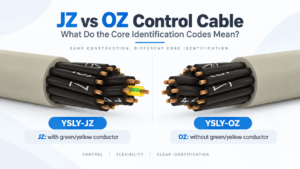
JZ vs OZ Control Cable: What Do the Core Identification Codes Mean?
JZ vs OZ control cable is a common comparison when specifying flexible multicore cables for industrial machinery, control panels, autom...

Ethernet Cable Testing: NEXT, Return Loss, Insertion Loss and ACR Explained
Ethernet cable testing verifies whether a twisted-pair copper cabling system can transmit data within the electrical performance limits...

Fiber Optic Cable Attenuation: 850, 1310, 1550 and 1625 nm Explained
Fiber optic cable attenuation describes the reduction in optical power as light travels through an optical fiber. It is normally expres...

A-02YSF(L)2Y vs A-2Y(L)2Y Outdoor Telephone Cable
A-02YSF(L)2Y vs A-2Y(L)2Y is an important comparison when selecting copper outdoor telephone cable for telecommunications networks, und...
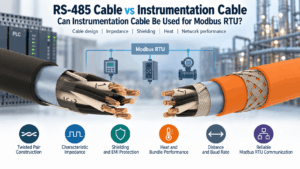
RS-485 Cable vs Instrumentation Cable: Can Instrumentation Cable Be Used for Modbus RTU?
A Modbus RTU cable must do more than carry a low-voltage digital signal from one device to another. Modbus RTU commonly uses an RS-485 ...

Ethernet Cable for PoE: Conductor Size, Heat and Bundle Performance
A PoE Ethernet cable carries data and electrical power over the same balanced twisted-pair cabling system. This capability simplifies t...
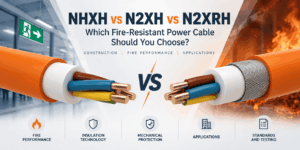
NHXH vs N2XH vs N2XRH: Which Fire-Resistant Power Cable Should You Choose?
NHXH vs N2XH vs N2XRH is an important comparison when specifying 0.6/1 kV power cables for emergency and life-safety systems. Although ...

How to Specify Low Current Cables for Infrastructure Projects
A professional low current cable specification should define much more than a cable name, conductor count or sheath colour. Infrastruct...

Fire Resistant Cables for Hospitals and High-Rise Buildings
Fire resistant cable for hospitals and high-rise buildings supports electrical, communication and control systems that may need to rema...

Industrial Control Cable Selection for Automation and Machinery
Industrial control cable selection should begin with the function of the circuit and the mechanical conditions of the machine rather th...

FE180 Fiber Optic Cable: Fire Integrity, Applications and Selection
An FE180 fiber optic cable is designed for optical communication routes where continued transmission during fire can form part of the p...

Screened vs Unscreened Control Cable: What Is the Difference?
Control cable shielding is one of the most important design decisions when selecting cable for industrial automation, machinery, buildi...


