





 President’s Message
Blog

What Are Control Cables?
Reading Time: 3 minutes
In industrial plants, automation systems, and building infrastructure, one of the most critical components for transmitting data, signals, and energy is the control cable. These are specially designed cables that enable low-voltage transmission of commands, control signals, or energy between various devices and machines.
Control cables must be mechanically durable, flexible, and resistant to bending and abrasion. Common types such as YSLY, YSLY-JZ, YSLYCY, YSLYCY-JZ, and HSLH-JZ are widely used in automated machinery and process control systems for stable and reliable operation.
These cables often carry analog or digital signals. In certain models, copper braiding is used for electromagnetic shielding, helping maintain signal integrity even in noisy industrial environments.
Where Are Control Cables Used?
Control cables are used across a wide range of applications. As industrial automation and digital infrastructure expand, the demand for flexible, durable, and interference-resistant cabling grows significantly.
1. Industrial Automation Systems
Control cables ensure secure data transmission between automation panels, PLCs, sensors, and motor drives. YSLY-JZ and YSLYCY-JZ are among the most preferred types in industrial control systems.
2. Machinery and Equipment Connections
They are used to transmit power and control signals between control units and actuators, motors, or valves. Cables with high flexibility and bending resistance are especially important in this area.
3. Power Plants and Process Facilities
In energy production, petrochemical, and chemical plants, control cables are essential for operating process control and automation systems. For environments requiring fire safety, halogen-free models like HSLH-JZ control cables are recommended.
4. Building Automation Systems
Used in systems such as elevators, HVAC, and fire alarm infrastructure, control cables play a vital role in building-wide connectivity, offering ease of routing and reliable performance.
5. Electrical Panels and Distribution Systems
Control cables are employed inside control panels, MCCs, and field distribution boxes to ensure accurate signal and command transmission.
Key Considerations When Selecting a Control Cable
Each control application has its own specific requirements. Selecting the correct control cable is critical to ensuring system reliability, safety, and long-term performance.
1. Installation Environment
The intended location—indoor, outdoor, in industrial machinery, or moving applications—must be considered. For indoor environments requiring fire safety, halogen-free (HFFR) outer sheath cables are preferred. For outdoor or harsh environments, outer sheaths with UV and mechanical resistance are critical.
2. Shielded or Unshielded
In systems exposed to electromagnetic interference (EMI), shielded cables like YSLYCY or YSLYCY-JZ are ideal to protect signal integrity. In low-EMI environments, unshielded options like YSLY-JZ are sufficient.
3. Halogen-Free Structure
To minimize toxic gas emissions during fire, halogen-free control cables such as HSLH-JZ are recommended in public buildings, hospitals, and enclosed spaces. These cables feature a Low Smoke Zero Halogen (LSZH / LS0H) outer sheath, reducing both smoke density and toxic emissions during combustion.
4. Flexibility and Mechanical Durability
Cables used in moving machinery must be highly flexible. Multi-stranded copper conductors offer better movement tolerance. JZ-type cables are particularly suitable for dynamic applications and compact installations.
5. Core Count and Color Coding
Control cables can be manufactured with various conductor counts and color codes depending on application needs. This simplifies panel wiring and system integration in complex installations.
6. Standards and Compliance
Control cables should comply with recognized certifications such as VDE, HAR, IEC, CE, and RoHS to ensure product safety and regulatory compliance.
ETK Kablo’s Control Cable Solutions
ETK Kablo manufactures a wide range of high-performance control cables tailored to industrial automation and control systems. These cables are engineered to meet the diverse needs of global industries.
1. YSLY-JZ Control Cable
One of ETK Kablo’s most popular products, YSLY-JZ features a PVC outer sheath, flexible multi-stranded conductors, and color- or number-coded cores. It is ideal for indoor industrial automation and fixed installations.
2. HSLH-JZ Control Cable
For projects requiring flame-retardant and halogen-free cabling, HSLH-JZ provides a LSZH outer sheath that prevents the release of harmful gases during fire. It is especially recommended for use in hospitals, metros, and high-occupancy buildings.
3. YSLYCY-JZ Control Cable
Equipped with copper wire braiding, this cable offers superior EMI protection, making it perfect for sensitive connections in automation panels, motor drives, and process equipment.
4. Custom Configurations
ETK Kablo can tailor its control cables based on customer needs—conductor cross-sections, cable lengths, outer sheath color, marking, and packaging can all be customized to fit your project.
5. Tested for Compliance
All ETK Kablo control cables are tested in the company’s in-house laboratories for compliance with international performance standards. Product certifications are issued by authorized third-party testing and certification bodies.
Control cables are fundamental to maintaining reliable and safe operation across industries—from factory automation to building infrastructure. Selecting the right control cable is vital not only for system durability but also for operational efficiency and safety.
With decades of manufacturing expertise, a commitment to quality, and flexible production capabilities, ETK Kablo offers a full range of control cables such as YSLY-JZ, HSLH-JZ, and YSLYCY-JZ, suited to projects of all scales. For robust, high-performance automation cable solutions, ETK Kablo is your trusted partner.
Benzer yazılar
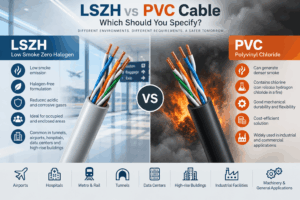
LSZH vs PVC Cable: Which Should You Specify?
Choosing between LSZH vs PVC cable is primarily a material and fire-safety decision rather than a simple question of which cable is “be...
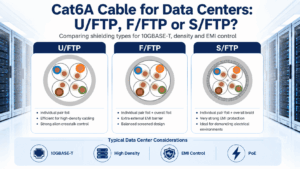
Cat6A Cable for Data Centers: U/FTP, F/FTP or S/FTP?
Choosing the right Cat6A cable for data centers involves more than specifying 10 Gigabit Ethernet and 500 MHz performance. U/FTP, F/FTP...
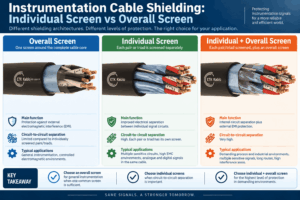
Instrumentation Cable Shielding: Individual Screen vs Overall Screen
Instrumentation cable shielding plays a critical role in protecting low-level analogue and digital signals from electromagnetic interfe...
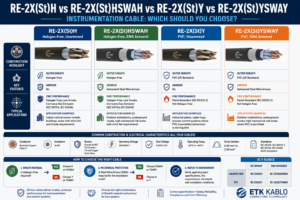
RE-2X(St)H vs RE-2X(St)HSWAH vs RE-2X(St)Y vs RE-2X(St)YSWAY: Which Should You Choose?
Choosing the right RE-2X(St) instrumentation cable is not simply a matter of comparing four similar product codes. RE-2X(St)H, RE-2X(St...
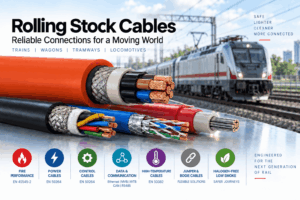
Rolling Stock Cables: Standards, Types and Applications
Rolling stock cables are specialized electrical and communication cables designed for installation onboard railway vehicles such as tra...
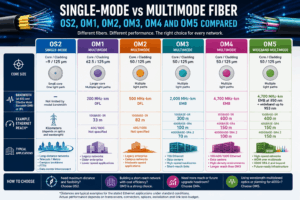
Single-Mode vs Multimode Fiber: OS2, OM1, OM2, OM3, OM4 and OM5 Compared
Choosing single-mode vs multimode fiber is one of the most important decisions when designing a fiber optic network. OS2, OM1, OM2, OM3...
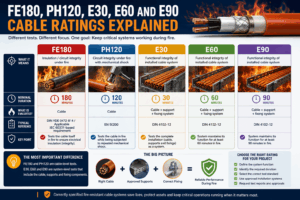
FE180, PH120, E30, E60 and E90 Cable Ratings Explained
Understanding FE180, PH120, E30, E60 and E90 cable ratings is essential when specifying fire-resistant cables for emergency, life-safet...
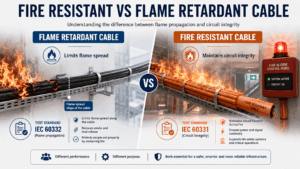
Fire Resistant vs Flame Retardant Cable: What Is the Difference?
The difference between a fire resistant vs flame retardant cable is one of the most important distinctions in cable fire performance. A...
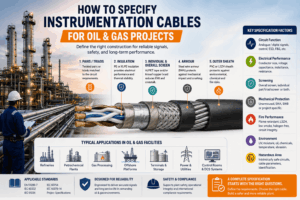
How to Specify Instrumentation Cables for Oil & Gas Projects
Selecting oil and gas instrumentation cables requires much more than choosing a conductor size and adding a screen. Refineries, petroch...
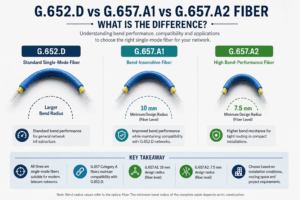
G.652.D vs G.657.A1 vs G.657.A2 Fiber: What Is the Difference?
Choosing between G.652.D, G.657.A1 and G.657.A2 fiber is primarily a question of how the optical fiber will behave when the network is ...
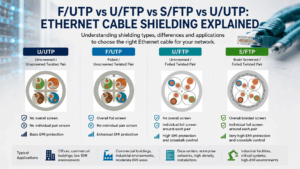
F/UTP vs U/FTP vs S/FTP vs U/UTP: Ethernet Cable Shielding Explained
Ethernet cable shielding can have a major influence on how reliably a network performs in environments affected by electromagnetic inte...
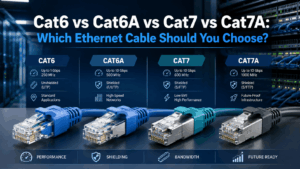
Cat6 vs Cat6A vs Cat7 vs Cat7A: Which Ethernet Cable Should You Choose?
Choosing between Cat6 vs Cat6A vs Cat7 vs Cat7A is not simply a matter of selecting the highest cable category available. Each Ethernet...


