





 President’s Message
Blog
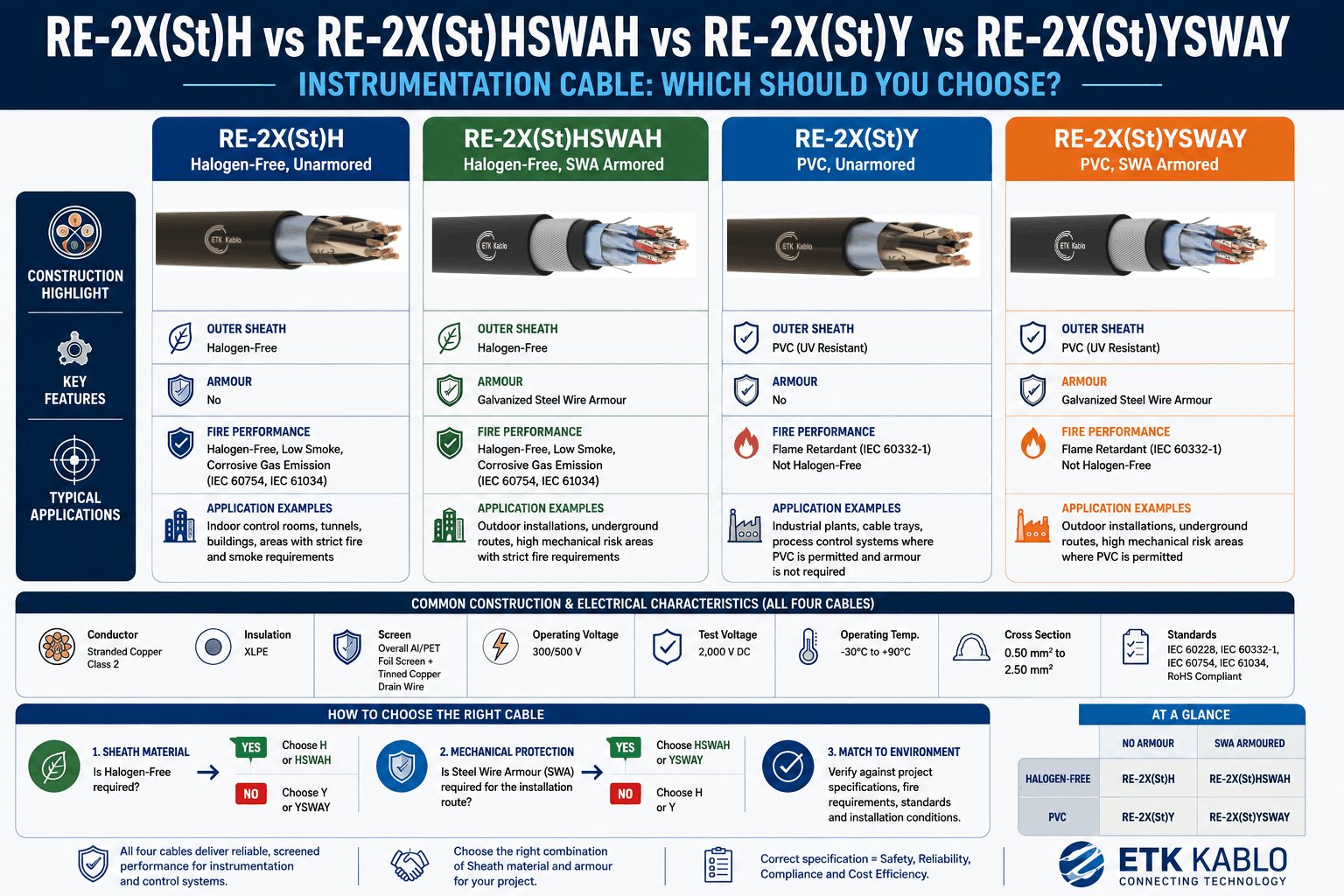
RE-2X(St)H vs RE-2X(St)HSWAH vs RE-2X(St)Y vs RE-2X(St)YSWAY: Which Should You Choose?
Reading Time: 12 minutes
Choosing the right RE-2X(St) instrumentation cable is not simply a matter of comparing four similar product codes. RE-2X(St)H, RE-2X(St)HSWAH, RE-2X(St)Y and RE-2X(St)YSWAY share the same basic instrumentation-cable purpose, but they differ in two areas that can completely change their suitability for a project: outer sheath material and mechanical protection.
RE-2X(St)Y combines XLPE-insulated conductors and overall screening with a PVC outer sheath. RE-2X(St)YSWAY adds galvanized steel wire armour to that PVC-based construction. RE-2X(St)H uses a halogen-free outer sheath without armour, while RE-2X(St)HSWAH combines halogen-free inner and outer sheaths with steel wire armour.
This makes the comparison particularly relevant for refineries, petrochemical plants, power stations, industrial automation systems, process facilities and infrastructure projects where engineers must decide not only how a cable transmits instrumentation signals, but also how it should respond to fire conditions and mechanical exposure.
Quick answer: Choose RE-2X(St)Y when a screened, XLPE-insulated instrumentation cable with a PVC sheath is sufficient and armour is not required. Choose RE-2X(St)YSWAY when the same type of signal cable also needs steel wire armour. Choose RE-2X(St)H where a halogen-free cable construction is required without armour, and choose RE-2X(St)HSWAH when both halogen-free performance and steel wire armour are required.
RE-2X(St) Instrumentation Cable Comparison at a Glance
| Cable Type | Insulation | Screen | Armour | Outer Sheath | Main Selection Logic |
|---|---|---|---|---|---|
| RE-2X(St)Y | XLPE | Overall Al/PET foil | No | PVC | PVC construction where mechanical armour is unnecessary |
| RE-2X(St)YSWAY | XLPE | Overall Al/PET foil | Galvanized steel wire armour | PVC | PVC construction requiring additional mechanical protection |
| RE-2X(St)H | XLPE | Overall Al/PET foil | No | Halogen-free | Halogen-free construction where armour is unnecessary |
| RE-2X(St)HSWAH | XLPE | Overall Al/PET foil | Galvanized steel wire armour | Halogen-free | Halogen-free construction requiring mechanical protection |
The table reveals an important point: these cables do not form a simple hierarchy from “basic” to “best.”
Instead, they create a four-way specification matrix:
- PVC + unarmored
- PVC + armored
- Halogen-free + unarmored
- Halogen-free + armored
The correct choice depends on the environment and project specification rather than on selecting the longest or most complex cable designation.
What Do the Four RE-2X(St) Cables Have in Common?
Before examining the differences, it is useful to understand how similar these four constructions actually are from an electrical and signal-transmission perspective.
In ETK Kablo’s standard designs, the four cable families use:
- Stranded electrolytic copper Class 2 conductors
- XLPE conductor insulation
- Layered conductor stranding
- Polyester wrapping
- Overall aluminum/polyester foil screening
- Tinned copper earthing wire
- 300/500 V operating voltage
- 2,000 V DC test voltage
- Conductor cross-sections from 0.50 mm² to 2.50 mm²
They are therefore all designed around the same fundamental requirement: reliable transmission of low-voltage analogue and digital instrumentation signals while the overall screen helps protect the circuits against electromagnetic interference.
The Electrical Performance Is Not the Main Difference
For equivalent conductor sizes, these four ETK constructions share the same stated conductor resistance, insulation resistance and mutual capacitance limits.
This means engineers should not normally choose RE-2X(St)HSWAH instead of RE-2X(St)Y because they expect the armored halogen-free version to transmit a process signal more accurately.
The deciding factors are primarily:
- Fire and smoke requirements
- Halogen-free requirements
- Mechanical exposure
- Installation route
- Environmental conditions
- Project or consultant specifications
This distinction can prevent unnecessary over-specification.
What Is RE-2X(St)Y Instrumentation Cable?
RE-2X(St)Y is the PVC-sheathed, unarmored member of the four-cable comparison.
The cable combines Class 2 copper conductors with XLPE insulation and an overall Al/PET foil screen. A UV-resistant PVC outer sheath provides the external protective layer.
Because it does not contain steel wire armour, RE-2X(St)Y is generally most appropriate where the installation route already provides adequate mechanical protection.
Typical Situations for RE-2X(St)Y
RE-2X(St)Y can be considered for:
- Protected industrial cable trays
- Process control installations
- DCS and PLC signal circuits
- Measurement and monitoring systems
- Industrial environments where PVC is permitted
- Routes without significant crushing or impact risk
- Applications where halogen-free construction is not specified
Its main advantage is straightforward: it provides the screened XLPE instrumentation construction without adding mechanical armour or a halogen-free sheath that the project may not require.
When Should You Not Automatically Choose RE-2X(St)Y?
RE-2X(St)Y becomes less suitable when the project specifically requires:
- Steel wire armour
- Enhanced mechanical protection
- Halogen-free materials
- Low-smoke cable construction
- Specific IEC 60754 or IEC 61034 performance
In those cases, one of the other three constructions may provide a closer match.
What Is RE-2X(St)YSWAY Instrumentation Cable?
RE-2X(St)YSWAY keeps the basic XLPE insulation and overall screening architecture of RE-2X(St)Y but adds mechanical protection.
The construction includes a PVC inner sheath, galvanized steel wire armour and a UV-resistant PVC outer sheath.
Therefore, the main reason to move from RE-2X(St)Y to RE-2X(St)YSWAY is not improved signal transmission. It is the need for a physically more robust cable.
What Does SWA Add?
Steel wire armour provides protection against mechanical stresses that an unarmored cable is less equipped to tolerate.
Depending on the project and installation design, these stresses can include:
- Impact
- Crushing forces
- Mechanical damage during installation
- Exposed industrial routing
- Underground installation conditions
- External physical stress
The armour also increases the cable’s diameter, weight and stiffness. Therefore, it should be specified because the installation environment requires it, not simply because an armored cable appears more durable.
Typical Applications for RE-2X(St)YSWAY
RE-2X(St)YSWAY can be particularly relevant for:
- Refineries
- Petrochemical facilities
- Power plants
- Outdoor industrial routes
- Mechanically exposed cable trays
- Underground routes where the project specifies SWA
- Process facilities requiring screened instrumentation circuits with mechanical protection
If the project allows PVC and requires steel wire armour, RE-2X(St)YSWAY becomes a logical construction to evaluate.
What Is RE-2X(St)H Instrumentation Cable?
RE-2X(St)H represents the halogen-free, unarmored alternative within this group.
Like RE-2X(St)Y, it uses Class 2 copper conductors, XLPE insulation and overall Al/PET screening. The major difference is the outer sheath.
RE-2X(St)H uses a UV-resistant halogen-free outer jacket rather than PVC.
ETK’s standard RE-2X(St)H construction is associated with additional tests covering smoke density, corrosive gases, halogen content and flame behaviour.
Why Choose a Halogen-Free Instrumentation Cable?
During a fire, cable materials can generate smoke and combustion gases. In occupied, enclosed or safety-sensitive environments, the project specification may therefore require cable compounds that reduce smoke and avoid halogen-based emissions.
Halogen-free constructions are commonly considered for environments such as:
- Tunnels
- Transportation infrastructure
- Control buildings
- Industrial facilities with strict fire specifications
- Offshore projects
- Power generation facilities
- Enclosed technical areas
- Public or occupied infrastructure
However, halogen-free does not automatically mean that a cable is fire resistant or maintains circuit integrity during a fire. Those are separate performance requirements.
When Does RE-2X(St)H Make Sense?
RE-2X(St)H is a strong candidate when the project requires:
- Overall screened instrumentation cable
- XLPE insulation
- Halogen-free outer sheath
- Low-smoke performance according to the specified test requirements
- No steel wire armour
For a protected cable tray inside a control building, for example, mechanical armour may offer little benefit while the project’s fire philosophy may still require halogen-free cable materials.
What Is RE-2X(St)HSWAH Instrumentation Cable?
RE-2X(St)HSWAH combines the two additional features discussed separately above: halogen-free materials and galvanized steel wire armour.
The construction includes:
- Class 2 copper conductors
- XLPE insulation
- Overall Al/PET foil screen
- Tinned copper earthing wire
- Halogen-free inner sheath
- Galvanized steel wire armour
- Halogen-free outer sheath
As a result, RE-2X(St)HSWAH is designed for projects that need both mechanical protection and the fire-related material characteristics associated with a halogen-free cable system.
Typical Applications for RE-2X(St)HSWAH
This construction can be considered for demanding environments such as:
- Oil and gas infrastructure
- Petrochemical plants
- Power generation facilities
- Offshore and marine-related industrial projects
- Tunnels and transportation infrastructure
- Mechanically exposed industrial areas
- Projects combining SWA and halogen-free requirements
However, it is important to avoid assuming that RE-2X(St)HSWAH is automatically the correct cable for every severe industrial environment.
If the cable runs inside a well-protected indoor tray, steel wire armour may add unnecessary diameter, weight and cost. Likewise, if the project permits PVC, the halogen-free construction may not be required.
RE-2X(St)H vs RE-2X(St)Y: What Is the Difference?
This comparison isolates the sheath-material decision because neither construction includes steel wire armour.
| Characteristic | RE-2X(St)H | RE-2X(St)Y |
|---|---|---|
| Conductor | Class 2 copper | Class 2 copper |
| Insulation | XLPE | XLPE |
| Overall screen | Al/PET + tinned copper earth wire | Al/PET + tinned copper earth wire |
| Armour | No | No |
| Outer sheath | Halogen-free | PVC |
| Smoke / halogen test requirements | Applicable in ETK standard H construction | Not equivalent to H construction |
| Main decision | Choose when halogen-free construction is required | Choose when PVC is permitted |
In simple terms:
H vs Y is primarily a sheath and fire-material decision.
If the project specification requires halogen-free cable materials and the route does not require armour, RE-2X(St)H is the closer match.
If PVC is accepted and there is no requirement for armour, RE-2X(St)Y can provide a simpler solution.
RE-2X(St)Y vs RE-2X(St)YSWAY: When Do You Need Armour?
This comparison keeps the PVC material family constant and focuses on mechanical protection.
Both cables use XLPE insulation, overall foil screening and PVC outer sheath materials. RE-2X(St)YSWAY additionally incorporates an inner sheath and galvanized steel wire armour.
| Requirement | RE-2X(St)Y | RE-2X(St)YSWAY |
|---|---|---|
| PVC outer sheath | Yes | Yes |
| Overall screening | Yes | Yes |
| Steel wire armour | No | Yes |
| Protected installation | Strong candidate | Can be unnecessary unless project requires armour |
| High mechanical exposure | Less protection | Better suited |
The decision should therefore come from the cable route.
If the cable runs through a protected tray system where crushing and impact are well controlled, the unarmored design may be adequate.
If the route introduces significant mechanical risk, RE-2X(St)YSWAY provides an additional protective layer.
RE-2X(St)H vs RE-2X(St)HSWAH: When Do You Need Halogen-Free SWA?
The same logic applies to the H family.
Both cables use halogen-free outer jacket materials, but RE-2X(St)HSWAH adds a halogen-free inner sheath and galvanized steel wire armour.
Therefore:
RE-2X(St)H = halogen-free + unarmored
RE-2X(St)HSWAH = halogen-free + SWA armored
If the project requires halogen-free materials but the cable route already protects the cable mechanically, RE-2X(St)H can avoid unnecessary armour.
If the same fire-material requirements apply in a mechanically exposed route, RE-2X(St)HSWAH can provide the required combination.
RE-2X(St)HSWAH vs RE-2X(St)YSWAY: Which Armored Cable Should You Choose?
This is often the most relevant comparison for heavy industrial projects because both cables include galvanized steel wire armour.
The deciding factor becomes the sheath material.
| Characteristic | RE-2X(St)HSWAH | RE-2X(St)YSWAY |
|---|---|---|
| XLPE insulation | Yes | Yes |
| Overall foil screen | Yes | Yes |
| Steel wire armour | Yes | Yes |
| Inner sheath | Halogen-free | PVC |
| Outer sheath | Halogen-free | PVC |
| Main selection factor | Halogen-free armored construction | PVC armored construction |
Therefore, the question is not which cable has stronger armour. Both use the SWA concept in ETK’s standard constructions.
The key question is whether the project requires the smoke, halogen and corrosive-gas characteristics associated with the H construction or permits a PVC-sheathed design.
PVC vs Halogen-Free Instrumentation Cable
PVC and halogen-free materials address different project priorities.
PVC remains widely used because it provides a practical outer sheath for many industrial installations. However, PVC contains chlorine and can generate halogen-containing combustion products when exposed to fire.
Halogen-free compounds are designed to avoid halogen emissions and can be combined with low-smoke performance according to the required testing.
The correct choice should depend on:
- Local regulations
- Project fire strategy
- Occupancy
- Escape routes
- Ventilation
- Equipment sensitivity
- Client specifications
- Applicable cable test requirements
Therefore, it is too simplistic to say that an H cable is always better than a Y cable.
The H construction provides specific material and fire-performance characteristics. If the project does not require those characteristics, a PVC cable may remain entirely appropriate.
Unarmored vs SWA Instrumentation Cable
The armour decision should also be based on risk rather than habit.
Steel wire armour can improve resistance to mechanical damage, but it also changes the cable physically.
Compared with an equivalent unarmored design, an SWA cable generally becomes:
- Larger
- Heavier
- Less flexible
- More demanding to handle
- More complex to terminate
- More expensive to manufacture and install
For this reason, an armored cable should be specified when its mechanical protection provides a genuine engineering benefit.
A useful question is:
What mechanical hazard are we protecting this cable from?
If the project cannot identify a meaningful risk, the unarmored construction may deserve consideration.
Which RE-2X(St) Instrumentation Cable Should You Choose?
| Project Condition | Recommended Construction to Consider | Reason |
|---|---|---|
| PVC permitted, protected route | RE-2X(St)Y | Screened XLPE instrumentation cable without unnecessary armour |
| PVC permitted, mechanical protection required | RE-2X(St)YSWAY | Combines PVC construction with steel wire armour |
| Halogen-free required, protected route | RE-2X(St)H | Halogen-free construction without additional armour |
| Halogen-free required, mechanical protection required | RE-2X(St)HSWAH | Combines halogen-free construction with SWA |
| Indoor control room | RE-2X(St)H or RE-2X(St)Y | Armour may be unnecessary; sheath requirement becomes decisive |
| Outdoor industrial process route | YSWAY or HSWAH depending project requirements | Mechanical exposure may justify SWA |
| Tunnel or enclosed area with strict smoke/halogen requirements | RE-2X(St)H or RE-2X(St)HSWAH | Halogen-free material performance may be required |
| Oil and gas project | Any of the four depending route and fire philosophy | Industry name alone does not determine sheath or armour requirement |
This last point is especially important.
There is no universal rule that every oil and gas instrumentation cable must be armored or halogen-free. A refinery can contain protected indoor control rooms, outdoor pipe racks, underground routes and occupied buildings within the same project.
Each route can justify a different cable construction.
Are All Four Cables Suitable for Analogue and Digital Instrumentation Signals?
Yes, when the selected construction meets the electrical and project requirements of the circuit.
The shared overall foil screen helps protect instrumentation signals against electromagnetic interference, making these cable families relevant to process-control systems such as:
- DCS
- PLC
- SCADA
- Pressure measurement
- Flow measurement
- Temperature monitoring
- Level measurement
- Process automation
- Data acquisition
However, engineers should also determine whether an overall screen is sufficient.
Highly sensitive multi-pair installations may instead require individually screened PiMF or TiMF constructions. That is a separate screening decision and should not be confused with the H, Y or SWA differences discussed in this comparison.
Do RE-2X(St)HSWAH and RE-2X(St)YSWAY Provide Better EMI Protection?
Not simply because they contain armour.
All four constructions in this comparison use the overall Al/PET instrumentation screen as the primary signal-screening element.
Steel wire armour primarily addresses mechanical protection rather than serving as a substitute for the instrumentation screen.
Therefore, choosing an SWA version should not be based on the assumption that it automatically gives significantly better signal quality.
If electromagnetic interference is the primary concern, engineers should review:
- Overall screening
- Individual pair screening
- Screen continuity
- Earthing arrangement
- Pair twisting
- Cable routing
- Separation from power cables
- Project EMC requirements
Do the H Versions Mean Fire Resistant?
No.
The H designation in these ETK constructions indicates the use of halogen-free sheath materials. ETK’s H and HSWAH variants also have specified smoke, corrosive-gas, halogen and flame-performance tests.
However, halogen-free and fire-resistant are different concepts.
A cable designed to maintain electrical circuit integrity during a fire requires specific fire-survival construction and testing.
Therefore:
Halogen-free does not automatically mean FE180, PH120 or another circuit-integrity classification.
Likewise, a PVC cable can still meet defined flame-retardancy requirements even though it is not halogen-free.
What About Outdoor and UV Exposure?
ETK’s standard constructions for these four cable families use UV-resistant outer sheath materials.
However, outdoor suitability involves more than UV resistance alone.
The project should also evaluate:
- Ambient temperature
- Water exposure
- Cable tray design
- Mechanical loading
- Chemical exposure
- Hydrocarbon exposure
- Rodent risk
- Direct burial requirements
- Local installation rules
A UV-resistant outer sheath should therefore not be interpreted as a universal approval for every outdoor installation method.
How Should Buyers Specify These Four Cable Types?
A request such as “RE-2X(St) cable” leaves an important part of the specification unresolved.
A technically useful RFQ should identify:
- Exact cable designation
- Number of conductors, pairs or triads
- Conductor cross-section
- Operating voltage
- Overall screen requirement
- Individual screening if required
- PVC or halogen-free sheath
- SWA armour requirement
- Indoor or outdoor installation
- Required fire-performance tests
- Smoke-density requirements
- Halogen and corrosive-gas requirements
- CPR Euroclass where applicable
- UV resistance
- Oil or chemical resistance where required
- Applicable manufacturing standard
- Cable marking
- Drum lengths
- Required certificates and test reports
Defining these requirements before quotation allows different manufacturers or suppliers to be compared on a technically equivalent basis.
Common Mistakes When Choosing Between the Four Constructions
1. Assuming the Longest Cable Code Is the Best Cable
RE-2X(St)HSWAH contains additional construction elements, but those elements only add value when the project needs them.
An unnecessary armored construction increases complexity without improving the electrical function of a protected signal circuit.
2. Choosing SWA for Every Oil and Gas Project
Oil and gas facilities contain many different installation environments. Some require substantial mechanical protection; others do not.
The cable route should determine the armour requirement.
3. Assuming H Means Fire Resistant
H indicates halogen-free material construction in this product family. Fire-resistant circuit integrity requires separate testing and classification.
4. Assuming Y Means the Cable Has Poor Fire Performance
PVC and halogen-free are different material systems. PVC cables can still meet specified flame-retardancy requirements.
5. Using Armour as an EMI Solution
The overall Al/PET screen performs the primary instrumentation-screening function. SWA primarily provides mechanical protection.
6. Ignoring the Inner Sheath
The armored constructions require an inner sheath beneath the steel wire armour. In RE-2X(St)YSWAY this layer is PVC, while RE-2X(St)HSWAH uses a halogen-free inner sheath.
7. Specifying Halogen-Free Without Stating the Required Tests
Project specifications should define the applicable smoke, halogen, corrosive-gas and flame-performance requirements rather than relying only on descriptive terminology.
8. Assuming Every Route in One Facility Needs the Same Construction
A large industrial project may legitimately use RE-2X(St)Y in one area, RE-2X(St)H in another and armored versions outdoors or underground.
Standardizing unnecessarily on one cable can increase cost or create mismatches with local installation requirements.
ETK Kablo RE-2X(St) Instrumentation Cable Solutions
ETK Kablo manufactures a broad range of RE-2X(St) instrumentation cable constructions for industrial automation, process control, measurement and infrastructure projects.
Within the overall-screened product range, RE-2X(St)Y, RE-2X(St)YSWAY, RE-2X(St)H and RE-2X(St)HSWAH allow project designers to select between PVC and halogen-free materials as well as unarmored and steel wire armored constructions.
All four standard ETK versions use XLPE-insulated Class 2 copper conductors and an overall aluminum/polyester foil screen with a tinned copper earthing wire.
RE-2X(St)Y provides the PVC, unarmored option. RE-2X(St)YSWAY adds steel wire armour while retaining the PVC material system. RE-2X(St)H provides a halogen-free unarmored alternative, while RE-2X(St)HSWAH combines halogen-free materials with galvanized steel wire armour.
This range allows engineers and buyers to match the cable construction to the actual installation route rather than changing the fundamental instrumentation signal architecture.
Frequently Asked Questions
What is an RE-2X(St) instrumentation cable?
An RE-2X(St) instrumentation cable is an XLPE-insulated, overall-screened cable used for low-voltage analogue and digital instrumentation, measurement and process-control signals. Different suffixes identify variations such as PVC or halogen-free sheaths and steel wire armour.
What is the difference between RE-2X(St)H and RE-2X(St)Y?
The main difference is the outer sheath. RE-2X(St)H uses a halogen-free outer jacket, while RE-2X(St)Y uses a UV-resistant PVC outer jacket. Both standard ETK constructions are unarmored.
What is the difference between RE-2X(St)Y and RE-2X(St)YSWAY?
RE-2X(St)YSWAY adds a PVC inner sheath and galvanized steel wire armour to the PVC-sheathed instrumentation construction. RE-2X(St)Y is unarmored.
What is the difference between RE-2X(St)H and RE-2X(St)HSWAH?
Both use halogen-free sheath materials. RE-2X(St)HSWAH additionally includes a halogen-free inner sheath and galvanized steel wire armour for increased mechanical protection.
What is the difference between RE-2X(St)HSWAH and RE-2X(St)YSWAY?
Both are steel wire armored, overall-screened XLPE instrumentation cables. The main distinction is the sheath material: RE-2X(St)HSWAH uses halogen-free inner and outer sheath materials, while RE-2X(St)YSWAY uses PVC.
Which RE-2X(St) cable is halogen-free?
RE-2X(St)H and RE-2X(St)HSWAH use halogen-free outer sheath materials in ETK Kablo’s standard constructions. RE-2X(St)HSWAH also uses a halogen-free inner sheath beneath the steel wire armour.
Which RE-2X(St) cable has steel wire armour?
RE-2X(St)YSWAY and RE-2X(St)HSWAH use galvanized steel wire armour. RE-2X(St)Y and RE-2X(St)H are unarmored.
Which cable should be used in an indoor control room?
If the route provides adequate mechanical protection, an unarmored RE-2X(St)H or RE-2X(St)Y may be suitable. The choice between them depends mainly on whether the project requires halogen-free materials or permits PVC.
Which cable should be used for an outdoor industrial route?
The answer depends on the mechanical and fire requirements of the route. Where steel wire armour is required, RE-2X(St)YSWAY or RE-2X(St)HSWAH can be considered. The sheath choice then depends on whether PVC or halogen-free materials are specified.
Is RE-2X(St)HSWAH better than RE-2X(St)Y?
Not universally. RE-2X(St)HSWAH provides additional armour and halogen-free materials, but those features may be unnecessary in a protected route where PVC is permitted. The correct cable is the one that matches the project requirements without unnecessary over-specification.
Does SWA improve signal shielding?
Steel wire armour primarily provides mechanical protection. The overall Al/PET foil screen performs the main instrumentation-signal screening function in these cable constructions.
Are these cables suitable for oil and gas projects?
All four constructions can be relevant to oil and gas, petrochemical and industrial process projects depending on the route and specification. The industry alone does not determine whether the cable must use PVC, halogen-free materials or steel wire armour.
Conclusion
Choosing between the four common RE-2X(St) instrumentation cable constructions becomes much easier when the decision is divided into two questions.
First: Does the project require PVC or halogen-free sheath materials?
Second: Does the cable route require steel wire armour?
If PVC is permitted and armour is unnecessary, RE-2X(St)Y provides the straightforward option. If mechanical protection is also required, RE-2X(St)YSWAY adds galvanized steel wire armour.
Where halogen-free materials are specified, RE-2X(St)H provides the unarmored construction, while RE-2X(St)HSWAH combines the same fire-material philosophy with steel wire armour.
The four cables therefore share the same basic instrumentation purpose but solve different installation problems.
By selecting the sheath material and mechanical protection according to the real project environment, engineers and purchasing teams can avoid both under-specification and unnecessary over-specification while maintaining the required signal-transmission performance.
Benzer yazılar
Instrumentation Cable Shielding: Individual Screen vs Overall Screen
Instrumentation cable shielding plays a critical role in protecting low-level analogue and digital signals from electromagnetic interfe...
How to Specify Instrumentation Cables for Oil & Gas Projects
Selecting oil and gas instrumentation cables requires much more than choosing a conductor size and adding a screen. Refineries, petroch...


