





 President’s Message
Blog
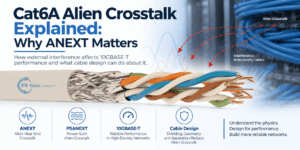
Cat6A Alien Crosstalk Explained: Why ANEXT Matters
Reading Time: 19 minutes
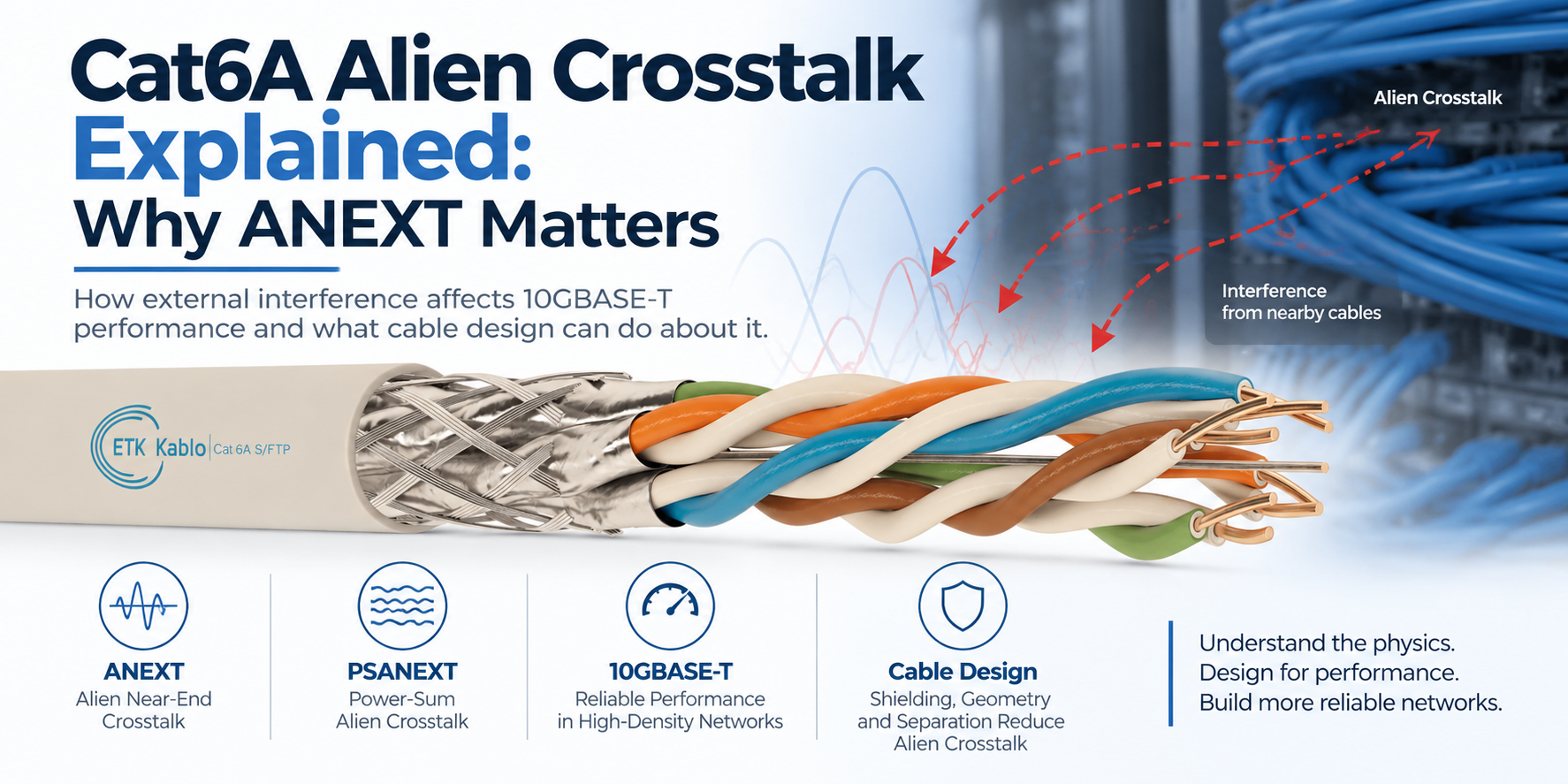
Cat6A alien crosstalk is one of the most important performance considerations in high-speed copper structured cabling. As Ethernet frequencies and data rates increase, interference no longer comes only from the four twisted pairs inside one cable. Signals from completely separate cables installed nearby can also couple into the victim cable.
This external interference is called alien crosstalk.
It becomes particularly important in Category 6A systems because Cat6A is designed to support 10GBASE-T over a full structured-cabling channel while operating at frequencies up to 500 MHz. At these frequencies, closely bundled cables can interact electromagnetically even when each individual cable performs well for conventional internal NEXT.
For this reason, engineers evaluating Cat6A should understand terms such as ANEXT, PSANEXT and alien far-end crosstalk rather than looking only at NEXT, return loss and insertion loss.
Quick answer: ANEXT means Alien Near-End Crosstalk. It measures unwanted signal energy coupled into a pair from a neighbouring cable and observed at the near end of the victim link. Cat6A cable construction is specifically engineered to control this type of external interference. Shielding, pair geometry, cable diameter, separator design and pair twist rates can all influence alien-crosstalk performance. PSANEXT goes further by evaluating the combined alien NEXT contribution from multiple external disturbing pairs or cables.
Cat6A Alien Crosstalk at a Glance
| Parameter | Meaning | Source of Interference | Why It Matters |
|---|---|---|---|
| NEXT | Near-End Crosstalk | Pairs inside the same cable | Controls internal pair-to-pair interference |
| PSNEXT | Power-Sum Near-End Crosstalk | Multiple pairs inside the same cable | Evaluates combined internal interference |
| ANEXT | Alien Near-End Crosstalk | Pairs in neighbouring cables | Important for Cat6A and 10GBASE-T |
| PSANEXT | Power-Sum Alien Near-End Crosstalk | Multiple external disturbing pairs | Represents aggregate external interference |
| Alien far-end crosstalk | External interference observed at the far end | Neighbouring cables | Important to overall 10GBASE-T signal margin |
| PSAACRF | Power-Sum Alien ACR at Far End | Combined external far-end interference | Evaluates far-end alien-crosstalk margin |
Therefore, alien crosstalk should be distinguished from the familiar crosstalk parameters measured between pairs within the same Ethernet cable.
What Is Cat6A Alien Crosstalk?
Cat6A alien crosstalk is electromagnetic interference coupled from one balanced twisted-pair cable into another physically separate cable.
Consider a bundle containing many Ethernet cables.
Each Cat6A cable contains four twisted pairs. Signals travelling through one cable generate electromagnetic fields around its conductors.
The twisting of each pair helps contain these fields and maintain electrical balance, but some electromagnetic energy can still extend beyond the cable.
If another cable runs close beside it, a portion of this energy can couple into the second cable.
The neighbouring cable therefore becomes a source of unwanted noise.
This is why the word alien is used: the interference originates outside the victim cable rather than from one of its own twisted pairs.
Why Alien Crosstalk Became Important with Cat6A
Alien crosstalk existed before Category 6A, but its importance increased dramatically as copper Ethernet moved toward 10 Gigabit Ethernet.
Higher transmission frequency creates more demanding signal-integrity conditions.
Category 6 operates to 250 MHz, while Category 6A extends balanced copper cabling performance to 500 MHz.
At these higher frequencies, electromagnetic coupling between adjacent cables becomes more significant.
In addition, 10GBASE-T uses all four pairs simultaneously for high-speed bidirectional transmission.
Therefore, the total noise environment becomes much more demanding than in earlier Ethernet generations.
Why Cat6A Was Designed for 10GBASE-T
Category 6A was developed specifically to provide the transmission margins required for 10GBASE-T over the complete 100-metre structured cabling channel architecture.
That required improvement in several areas, including:
- Insertion loss
- Return loss
- NEXT
- Power-sum crosstalk
- Balance
- Alien crosstalk
Consequently, Cat6A should not be understood simply as “Cat6 with twice the frequency.”
Its design also addresses the external coupling problems associated with dense 10 Gigabit copper networks.
NEXT vs Cat6A Alien Crosstalk
NEXT and alien NEXT describe similar electromagnetic coupling mechanisms but from different physical sources.
NEXT occurs between twisted pairs inside the same cable.
ANEXT occurs when interference comes from a different cable.
For example, one Cat6A cable contains pairs A, B, C and D.
Interference from pair A into pair B within that same cable contributes to conventional NEXT.
However, interference from a pair in an adjacent Cat6A cable into pair B belongs to alien crosstalk.
Therefore, a cable can demonstrate excellent internal NEXT performance while still requiring additional design features to control interference from neighbouring cables.
What Does ANEXT Mean?
ANEXT stands for Alien Near-End Crosstalk.
The measurement evaluates unwanted signal coupling from a disturbing pair located in another cable into the victim pair, with the resulting interference observed at the near end.
As with ordinary NEXT, higher loss values expressed in decibels generally represent better isolation.
A higher ANEXT value means that less interfering energy reaches the victim circuit.
Therefore, Cat6A designs aim to maintain sufficient ANEXT margin across the required frequency range.
Why ANEXT Matters for 10GBASE-T
10GBASE-T transmits complex high-speed signals over all four balanced twisted pairs.
The receiver can use sophisticated digital signal processing to manage several predictable impairments within the channel.
Alien crosstalk presents a more difficult problem because the disturbing signal comes from an independent neighbouring cable.
The victim transceiver does not control that external data stream.
Consequently, preventing or reducing the interference through cabling design becomes particularly valuable.
This is one of the fundamental reasons Cat6A places much more emphasis on external crosstalk control than earlier structured-cabling categories.
What Is PSANEXT?
One neighbouring pair is not the only possible noise source.
A victim cable inside a bundle can be surrounded by several other cables, each carrying four active pairs.
PSANEXT means Power-Sum Alien Near-End Crosstalk.
Instead of considering only one disturbing pair, the parameter evaluates the combined interference contribution from multiple external sources.
This produces a more realistic representation of a dense network environment.
Therefore, PSANEXT can be more useful than one pair-to-pair ANEXT result when engineers want to evaluate overall Cat6A system performance.
ANEXT vs PSANEXT
| Parameter | ANEXT | PSANEXT |
|---|---|---|
| Full name | Alien Near-End Crosstalk | Power-Sum Alien Near-End Crosstalk |
| Interference source | Individual external disturbing pair | Combined external disturbing pairs |
| Application | Pair-level assessment | Aggregate system assessment |
| Higher value better? | Yes | Yes |
| Relevant to Cat6A | Yes | Yes |
Consequently, specifying only ANEXT can provide an incomplete picture when the installed cable will operate inside a large bundle.
What Is Alien Far-End Crosstalk?
External interference can also be evaluated at the far end of the victim link.
In this case, the interfering signal couples from a neighbouring cable and is measured at the opposite end of the victim pair.
Far-end crosstalk behaves differently from near-end coupling because the interfering and victim signals experience propagation loss while travelling along the cable.
Therefore, far-end parameters normally account for insertion loss as part of the useful signal-to-interference relationship.
What Is PSAACRF?
PSAACRF stands for Power-Sum Alien Attenuation-to-Crosstalk Ratio at the Far End.
It evaluates aggregate far-end alien crosstalk while accounting for the attenuation of the transmitted signal.
This makes it a useful measure of the remaining signal margin at the receiving end.
Older technical literature can use different terminology for related far-end crosstalk parameters.
Therefore, when comparing old and new cable specifications, engineers should verify the exact parameter definition rather than rely only on an abbreviation.
Cat6A Alien Crosstalk vs Internal Crosstalk
Internal and alien crosstalk require different design strategies.
Inside the cable, manufacturers can directly control:
- Pair twist length
- Relative pair position
- Separator geometry
- Insulation thickness
- Pair spacing
However, the manufacturer cannot completely control how neighbouring cables will be arranged after installation.
This makes alien crosstalk particularly challenging.
Therefore, Cat6A cables are designed to reduce electromagnetic coupling even when many cables operate close together.
How Cat6A Cable Design Reduces Alien Crosstalk
Several cable-engineering techniques can improve Cat6A alien crosstalk performance.
These can include:
- Optimized pair twist rates
- Greater separation between pairs
- Larger cable diameter
- Star-shaped separators
- Improved conductor insulation
- Overall foil shielding
- Individual pair shielding
- Overall braid shielding
- Optimized cable geometry
Manufacturers can combine these techniques differently depending on whether the Cat6A cable is U/UTP, F/UTP, U/FTP, F/FTP or S/FTP.
Why Cable Diameter Can Affect Alien Crosstalk
Physical separation reduces electromagnetic coupling.
For this reason, many unshielded Cat6A cables are larger than comparable lower-category cables.
A larger outside diameter increases the distance between the twisted pairs in one cable and the conductors inside adjacent cables.
Even a relatively small increase in separation can reduce electromagnetic coupling.
Therefore, the larger diameter of some Cat6A U/UTP designs is not merely additional plastic. It can form part of the alien-crosstalk control strategy.
Why the Star Separator Matters
Many Cat6A U/UTP cables contain a star-shaped separator between the four twisted pairs.
The separator helps maintain pair geometry and physical separation.
This supports several transmission characteristics, including:
- NEXT
- Return loss
- Pair balance
- Alien crosstalk
It also helps prevent pairs from moving excessively during manufacturing and installation.
Consequently, separator geometry becomes an important part of high-frequency unshielded Cat6A design.
Pair Twist Rate and Cat6A Alien Crosstalk
Ethernet pairs are twisted to improve electromagnetic balance and reduce unwanted coupling.
Manufacturers use different twist rates for different pairs inside the same cable.
If every pair had identical twist geometry, electromagnetic coupling between them could become more consistent and potentially stronger.
Different lay lengths help decorrelate the electromagnetic relationship between pairs.
Similarly, carefully engineered pair geometry can help reduce coupling between neighbouring cables.
Therefore, pair twist design influences both internal and external crosstalk performance.
Does Shielding Reduce Cat6A Alien Crosstalk?
Yes. Metallic shielding can provide a significant advantage in controlling alien crosstalk.
A conductive screen creates an electromagnetic barrier between signal pairs and the surrounding environment.
Depending on the construction, a Cat6A cable can use:
- One overall foil
- Individual foil around every pair
- Individual pair foils plus overall foil
- Individual pair foils plus overall braid
These screens can substantially reduce coupling between neighbouring cables.
However, shielding architecture still needs to be integrated correctly into the complete structured cabling system.
Cat6A U/UTP and Alien Crosstalk
U/UTP means that the cable has no overall metallic screen and no individual pair screens.
At first glance, this might appear unsuitable for Cat6A.
However, a properly engineered U/UTP cable can meet Category 6A performance requirements through physical geometry rather than metallic shielding.
Design strategies can include:
- AWG23 conductors
- Larger outside diameter
- Optimized pair spacing
- Star separator
- Carefully controlled twist rates
- Advanced insulation geometry
Therefore, U/UTP should not be interpreted as inherently incapable of controlling alien crosstalk.
Why Cat6A U/UTP Is Often Larger
Because U/UTP has no metallic barrier, the mechanical geometry must perform more of the electromagnetic isolation work.
Increasing distance between neighbouring cable pairs can reduce coupling.
Consequently, U/UTP Cat6A cables can have larger outside diameters than some individually screened alternatives.
This creates trade-offs involving:
- Tray fill
- Conduit capacity
- Bundle diameter
- Rack cable management
- Airflow
Therefore, alien-crosstalk performance can influence physical infrastructure requirements.
Cat6A F/UTP and Alien Crosstalk
F/UTP uses one overall foil screen around four otherwise unscreened twisted pairs.
The foil provides a barrier between the internal pairs and electromagnetic fields outside the cable.
This can improve resistance to:
- External EMI
- Alien crosstalk
- Coupling from adjacent cables
However, internal pair-to-pair crosstalk still depends primarily on twisting, separation and core geometry because the individual pairs do not have their own screens.
Cat6A U/FTP and Alien Crosstalk
U/FTP individually wraps each twisted pair in metallic foil but does not add an overall screen around the complete cable.
This arrangement provides direct electromagnetic isolation around each pair.
As a result, U/FTP can provide excellent crosstalk and alien-crosstalk performance without requiring an additional overall foil or braid.
The individually screened architecture can also help manufacturers maintain relatively efficient cable dimensions.
Therefore, U/FTP is widely attractive for high-density structured cabling and data-center applications.
Cat6A F/FTP and Alien Crosstalk
F/FTP combines individual foil screens around each pair with another overall foil around the entire cable core.
This creates two levels of metallic screening.
The individual pair screens help control:
- Pair-to-pair coupling
- External coupling into individual pairs
The overall foil provides an additional barrier between the cable and its environment.
Consequently, F/FTP can provide strong alien-crosstalk performance in demanding installations.
Cat6A S/FTP and Alien Crosstalk
S/FTP uses foil around each twisted pair together with an overall metallic braid.
This provides comprehensive screening.
The braid can deliver robust electromagnetic performance while the individual pair foils provide strong pair isolation.
Therefore, S/FTP is commonly considered for environments with demanding EMI and crosstalk requirements.
However, the additional braid can affect:
- Weight
- Diameter
- Flexibility
- Termination
- Cost
It should therefore be selected because the shielding architecture benefits the application, not simply because it contains more metal.
Cat6A Alien Crosstalk by Shielding Type
| Construction | Individual Pair Screens | Overall Screen | Alien Crosstalk Strategy |
|---|---|---|---|
| U/UTP | No | No | Geometry, spacing and pair design |
| F/UTP | No | Foil | Overall electromagnetic barrier plus pair geometry |
| U/FTP | Foil | No | Direct pair-level screening |
| F/FTP | Foil | Foil | Pair screens plus overall foil |
| S/FTP | Foil | Braid | Pair screens plus overall braid |
All of these constructions can be engineered for Category 6A performance. Shielding type alone does not determine compliance.
Does More Shielding Always Mean Better Cat6A?
No.
More metallic shielding can provide stronger electromagnetic isolation, but the complete cable must satisfy many other parameters.
A poorly designed heavily screened cable is not automatically better than a properly engineered U/FTP or U/UTP product.
Important factors include:
- Insertion loss
- NEXT
- Return loss
- Characteristic impedance
- Resistance unbalance
- Alien crosstalk
- Cable diameter
- Termination quality
Therefore, engineers should compare verified Category 6A performance rather than rank products only by shielding layers.
Cat6A Alien Crosstalk in Cable Bundles
Alien crosstalk becomes most relevant when many cables run close together.
Typical examples include:
- Large cable trays
- Data-center pathways
- Vertical risers
- Conduits
- Rack cable managers
- High-density office cabling
A cable in the middle of a bundle can receive interference from several neighbouring cables simultaneously.
Therefore, bundle geometry plays an important role in practical alien-crosstalk exposure.
The Six-Around-One Alien Crosstalk Concept
A commonly used worst-case evaluation arrangement places one victim cable in the centre with six disturbing cables positioned around it.
This geometry creates strong electromagnetic coupling because the central cable has multiple close neighbours.
Measurements can then evaluate alien crosstalk from the surrounding disturbers into the victim link.
This arrangement helps engineers understand performance in tightly bundled installations.
However, exact laboratory or field procedures should always follow the applicable cabling standard and test methodology.
Why Bundle Size Matters
As bundle density increases, the number of potential disturbers around a cable also increases.
This can raise the aggregate alien-crosstalk environment.
However, the relationship is not simply “twice as many cables equals twice as much interference.”
Physical position, cable geometry, twist relationships and shielding all influence coupling.
Consequently, power-sum measurements are useful because they combine multiple interference sources mathematically.
Does Separating Cat6A Cables Reduce Alien Crosstalk?
Yes.
Electromagnetic coupling decreases as physical separation increases.
Therefore, spreading cables apart can improve alien-crosstalk conditions.
This principle can be particularly useful when working with unshielded cabling.
Nevertheless, structured cabling projects should follow the manufacturer’s installation requirements rather than depend on arbitrary spacing rules.
Why Cable Randomization Can Help
Perfectly parallel cable geometry can maintain consistent electromagnetic coupling over long distances.
Real cable bundles naturally contain some variation in cable positions.
This changing geometry can reduce the consistency of the coupling relationship between two specific cables.
Consequently, some installation guidance can discourage excessive organization that forces cables into perfectly fixed parallel relationships.
However, cable-management practices should always remain consistent with bend-radius, pathway and manufacturer requirements.
Can Tight Cable Ties Affect Cat6A Performance?
Excessively tight cable ties can deform Ethernet cable geometry.
This can affect:
- Pair spacing
- Characteristic impedance
- Return loss
- Internal crosstalk
- External coupling
Therefore, cables should be supported without unnecessary compression.
Hook-and-loop management is often preferred in high-performance structured cabling because it can hold cable bundles without applying excessive localized pressure.
Cat6A Alien Crosstalk and Termination Quality
Alien-crosstalk performance does not depend only on the horizontal cable.
The complete channel can include:
- RJ45 connectors
- Keystone jacks
- Patch panels
- Patch cords
- Consolidation points
Excessive pair untwist or poor connector geometry can reduce transmission performance near the termination.
For shielded systems, inadequate screen continuity can also reduce electromagnetic isolation.
Therefore, Cat6A should be treated as a system rather than merely a cable specification.
Why Pair Untwist Should Be Minimized
The twisted geometry of an Ethernet pair provides electrical balance and crosstalk control.
When installers untwist conductors excessively near a connector, the pair no longer maintains the geometry used throughout the cable.
This can degrade:
- NEXT
- Return loss
- Balance
- High-frequency performance
Consequently, proper Cat6A termination requires maintaining the pair twist as close as practical to the termination point according to the connectivity manufacturer’s instructions.
Cat6A Alien Crosstalk and Shield Continuity
Shielded Cat6A cable works as part of a complete screened channel.
The channel can include:
- Shielded connectors
- Shielded patch panels
- Shielded patch cords
- Bonded racks
- Telecommunications bonding infrastructure
If screen continuity is interrupted, the installed system may not deliver the electromagnetic performance intended by the cable design.
Therefore, selecting S/FTP or U/FTP without considering connectivity and bonding is incomplete engineering.
Does Cat6A Alien Crosstalk Affect Data Speed?
Alien crosstalk does not directly change the nominal Ethernet speed specification.
A Cat6A channel is still intended for 10GBASE-T.
However, excessive alien interference reduces signal-to-noise margin.
If the interference becomes severe enough, the network can experience:
- Higher error rates
- Retransmissions
- Reduced link stability
- Failed qualification tests
- Intermittent performance problems
Therefore, controlling alien crosstalk helps the channel maintain the electrical conditions required for reliable 10 Gigabit transmission.
Cat6A Alien Crosstalk and Signal-to-Noise Ratio
A receiver must distinguish the desired Ethernet signal from unwanted electrical noise.
Alien crosstalk increases the noise portion of that equation.
As external interference rises, the available signal-to-noise margin falls.
Therefore, high ANEXT and PSANEXT isolation values provide more margin for reliable high-speed operation.
Cat6A Alien Crosstalk and Frequency
Crosstalk becomes increasingly difficult to control as frequency rises.
Cat6A extends transmission performance to 500 MHz.
This makes accurate cable geometry and electromagnetic isolation particularly important toward the upper end of the frequency range.
Therefore, a cable that performs well at 100 MHz cannot automatically be assumed to provide acceptable Category 6A performance at 500 MHz.
Why Cat6A Requires 500 MHz Performance
Category 6A is specified to a referenced frequency of 500 MHz.
The wider bandwidth supports the signal requirements associated with 10GBASE-T structured cabling.
Transmission parameters therefore need to remain controlled across a much broader frequency range than Cat5e or Cat6.
These parameters include both conventional pair performance and external crosstalk behaviour.
Cat6A vs Cat6 Alien Crosstalk
Cat6 was originally designed around lower-frequency structured cabling requirements.
While Cat6 can support many high-performance Ethernet applications, Category 6A was specifically developed to provide full 10GBASE-T channel performance with more comprehensive alien-crosstalk requirements.
| Characteristic | Cat6 | Cat6A |
|---|---|---|
| Referenced frequency | 250 MHz | 500 MHz |
| Primary common Ethernet application | 1GBASE-T | 10GBASE-T |
| 100 m 10GBASE-T architecture | Not its primary design target | Yes |
| Alien-crosstalk emphasis | Lower | High |
| Typical conductor size | Often AWG23 or AWG24 | Often AWG23 |
Consequently, engineers planning new 10 Gigabit horizontal copper infrastructure generally look toward Cat6A rather than relying on Cat6.
Cat6A Alien Crosstalk in Data Centers
Data centers represent one of the most demanding environments for Cat6A alien crosstalk.
Cables can be installed:
- In large bundles
- In densely loaded trays
- Inside rack managers
- Close to power-distribution equipment
- Across high-density pathways
Furthermore, many cables can transmit data simultaneously.
Consequently, Cat6A shielding architecture and cable geometry become especially important in high-density copper installations.
Cat6A Alien Crosstalk in Office Networks
Office structured cabling can also contain substantial cable bundles, particularly near telecommunications rooms.
A large number of horizontal links can converge into:
- Cable trays
- Conduits
- Vertical pathways
- Patch panels
Therefore, alien-crosstalk performance remains relevant even when the individual work-area links appear widely separated at their final destinations.
Cat6A Alien Crosstalk in Industrial Networks
Industrial networks add external electromagnetic interference to the normal cable-to-cable crosstalk environment.
Potential noise sources include:
- Variable-frequency drives
- Motors
- Transformers
- Switchgear
- Power cables
- Welding equipment
In these environments, screened Cat6A constructions can provide two benefits:
First, they help control coupling between neighbouring Ethernet cables.
Second, they help protect the data pairs from external industrial EMI.
Therefore, U/FTP, F/FTP or S/FTP can become particularly attractive in electrically demanding installations.
Cat6A Alien Crosstalk and PoE
Alien crosstalk and Power over Ethernet are different engineering issues.
Alien crosstalk concerns electromagnetic signal coupling between cables.
PoE bundle design concerns electrical current, conductor resistance and temperature rise.
However, both issues can become important in the same high-density bundle.
Therefore, Cat6A bundle design should consider:
- Alien-crosstalk performance
- Conductor gauge
- DC resistance
- Resistance unbalance
- Bundle size
- Ambient temperature
- PoE power level
A cable can perform excellently for alien crosstalk while still requiring proper thermal assessment for high-power PoE.
Does AWG23 Help Cat6A Performance?
AWG23 solid copper conductors are common in Cat6A horizontal cable.
Larger copper conductors provide lower DC resistance than smaller gauges.
This is useful for insertion-loss performance and remote powering.
However, conductor gauge alone does not determine alien crosstalk.
Pair geometry, insulation, spacing and shielding remain essential.
Therefore, “AWG23” should be treated as one construction parameter rather than proof of Cat6A compliance.
How Cat6A Alien Crosstalk Is Tested
Alien-crosstalk testing evaluates interference from one or more disturbing cables into a victim link.
The test configuration must define:
- Victim cable
- Disturbing cables
- Pair combinations
- Frequency range
- Near-end measurements
- Far-end measurements
Power-sum calculations can then combine the contributions from multiple disturbing pairs.
Therefore, alien-crosstalk testing is more complex than measuring NEXT between the four pairs inside one cable.
Why Alien Crosstalk Testing Takes More Measurements
A single four-pair Ethernet cable contains a limited number of internal pair combinations.
Alien-crosstalk testing introduces additional neighbouring cables, each with four more potential disturbing pairs.
As a result, the number of possible coupling relationships grows substantially.
This is one reason alien-crosstalk qualification historically required more test time than ordinary channel certification.
Do All Installed Cat6A Links Need Full Alien Crosstalk Testing?
Testing requirements depend on the project, cabling architecture, product qualification and applicable standard.
A project using a proven Cat6A cabling system can follow the system manufacturer’s and consultant’s testing requirements rather than assume every installed link requires an exhaustive worst-case alien-crosstalk measurement.
However, alien-crosstalk testing can become particularly relevant when:
- The specification explicitly requires it
- Unshielded Cat6A is used in large bundles
- Products from different manufacturers are mixed
- Installation conditions differ from the qualified system
- The consultant requires additional verification
Therefore, the commissioning plan should define alien-crosstalk testing before installation is complete.
Cat6A Alien Crosstalk and Mixed Cable Bundles
Different cable designs can have different outside diameters, pair geometries and electromagnetic characteristics.
Therefore, mixing multiple Cat6A constructions within one tightly packed bundle can alter the coupling environment.
This does not mean mixed bundles automatically fail.
However, engineers should avoid assuming that alien-crosstalk performance remains identical to a homogeneous laboratory bundle.
Manufacturer guidance becomes particularly important in such installations.
Cat6A Alien Crosstalk and Cable Certification
Certification should distinguish between cable-component performance and installed-link performance.
A Cat6A cable manufacturer evaluates the cable against relevant transmission requirements.
The installed permanent link or channel additionally includes:
- Connectors
- Patch panels
- Work-area outlets
- Patch cords
- Installation workmanship
Therefore, excellent cable performance cannot compensate for poor connectivity or termination.
ANSI/TIA-568.2-E and Cat6A
ANSI/TIA-568.2-E is the current TIA standard for balanced twisted-pair telecommunications cabling and components.
It replaced the previous ANSI/TIA-568.2-D revision.
The standard provides transmission-performance requirements for balanced copper cabling and components used in structured cabling systems.
Consequently, current North American Cat6A project specifications should reference the applicable current revision rather than rely indefinitely on older C.2 or D-era references.
IEC 61156-5 and Cat6A Cable
IEC 61156-5 specifies symmetrical pair and quad cables intended primarily for horizontal floor wiring.
The current specification covers individually screened, overall screened and unscreened cable constructions.
Category 6A performance is referenced through 500 MHz.
Therefore, the standard provides an important cable-level reference for international Cat6A products.
ISO/IEC 11801 and Cat6A Structured Cabling
ISO/IEC 11801 provides the international generic-cabling framework for customer premises.
It addresses the complete structured-cabling system rather than only the horizontal cable.
Consequently, engineers should distinguish between:
- Cable component requirements
- Permanent-link performance
- Channel performance
A compliant Cat6A cable is one component of a complete Class EA structured cabling system.
Category 6A vs Class EA
The terms Category 6A and Class EA are related but describe different levels of the cabling system.
Category 6A commonly refers to cable and connecting-hardware component performance.
Class EA describes the complete installed cabling performance within the ISO/IEC framework.
Therefore, specifying Cat6A cable alone does not automatically define the final channel as Class EA.
Common Cat6A Alien Crosstalk Mistakes
Confusing NEXT with ANEXT
NEXT measures interference between pairs inside one cable, while ANEXT originates from neighbouring cables.
Assuming Excellent NEXT Guarantees Excellent Alien Crosstalk
Internal and external coupling depend on different physical relationships.
Assuming Only Shielded Cat6A Can Meet the Standard
Properly engineered U/UTP constructions can achieve Category 6A performance through cable geometry and separation.
Assuming U/FTP Has an Overall Shield
U/FTP individually screens each pair but has no overall metallic screen.
Confusing F/UTP with F/FTP
F/UTP uses an overall foil around unscreened pairs. F/FTP additionally foil-screens each individual pair.
Assuming S/FTP Is Automatically the Best Choice
The additional braid can provide excellent EMI performance but also affects diameter, weight, flexibility and cost.
Ignoring Bundle Density
Alien crosstalk becomes more important as cables operate close together.
Compressing Bundles with Tight Cable Ties
Excessive pressure can deform high-frequency cable geometry.
Ignoring Connector Performance
The complete Cat6A channel includes cable, jacks, panels and patch cords.
Breaking Shield Continuity
A shielded cable requires compatible screened connectivity and proper bonding practices.
Assuming Alien Crosstalk and EMI Are the Same
Alien crosstalk specifically comes from neighbouring balanced cables. EMI can originate from many external electrical sources.
Assuming PoE Heat Is Alien Crosstalk
PoE bundle heating and electromagnetic crosstalk are separate engineering phenomena.
Ignoring Frequency
A cable must control alien crosstalk throughout the required Category 6A frequency range, not only at low frequencies.
Mixing Products Without Reviewing System Qualification
Different cable and connector geometries can influence installed channel performance.
How to Select Cat6A for Alien Crosstalk Performance
Define the Network Application
Start by confirming that the project requires 10GBASE-T or another application supported by Cat6A.
Review Cable Density
Determine whether cables will operate individually, in small groups or inside large bundles.
Evaluate the EMI Environment
Industrial or electrically demanding locations can justify screened constructions independently from alien-crosstalk requirements.
Select the Shielding Architecture
Choose U/UTP, F/UTP, U/FTP, F/FTP or S/FTP according to electromagnetic performance, pathway space and project requirements.
Check Cable Diameter
Outside diameter affects tray capacity, conduit fill and physical separation between adjacent cables.
Review Conductor Gauge
AWG23 is common for Cat6A horizontal cabling and can provide useful insertion-loss and PoE advantages.
Check 500 MHz Performance
Verify Category 6A transmission data across the complete required frequency range.
Review Alien Crosstalk Parameters
Confirm that the product and system meet the applicable ANEXT and power-sum alien-crosstalk requirements.
Select Compatible Connectivity
Jacks, patch panels and patch cords should form part of the same Cat6A performance strategy.
Plan Shield Bonding Where Applicable
Screened systems require appropriate continuity and bonding throughout the channel.
Define Installation Practices
Specify bend radius, bundle management, pathway capacity and cable-support requirements.
Define Field Testing
Determine permanent-link, channel and alien-crosstalk test requirements before commissioning.
Verify the Manufacturer Datasheet
Finally, compare the actual cable construction and transmission data rather than relying only on the Cat6A label.
Cat6A Alien Crosstalk RFQ Checklist
A professional Cat6A alien crosstalk specification can include:
- Category 6A performance
- 10GBASE-T requirement
- 500 MHz operating range
- U/UTP, F/UTP, U/FTP, F/FTP or S/FTP construction
- Solid copper conductor
- Conductor gauge
- Characteristic impedance
- Insertion loss
- Return loss
- NEXT
- PSNEXT
- ANEXT
- PSANEXT
- Far-end alien-crosstalk performance
- PSAACRF where applicable
- Maximum outside diameter
- Bending radius
- LSZH, PVC or PE outer sheath
- CPR Euroclass where applicable
- PoE requirements
- Operating temperature
- Compatible Cat6A connectivity
- Permanent-link or channel requirements
- Applicable ISO/IEC, IEC or TIA standard
- Alien-crosstalk test documentation where required
- Cable marking
- Packaging length
Consequently, manufacturers can evaluate the complete Cat6A transmission requirement rather than respond only to a request for “10 Gigabit Ethernet cable.”
ETK Kablo Cat6A Alien Crosstalk Solutions
ETK Kablo manufactures Category 6A Ethernet cables with multiple shielding architectures for structured cabling, data centers, industrial networks and infrastructure applications.
The portfolio includes:
- Cat6A U/UTP
- Cat6A U/FTP
- Cat6A F/FTP
- Cat6A S/FTP
- Mechanically protected Cat6A constructions
- LSZH, PVC and PE variants according to product design
ETK Cat6A cable designs operate across the Category 6A frequency range up to 500 MHz and use solid copper conductors for high-performance horizontal cabling.
For U/UTP designs, cable geometry, pair twisting and a star-shaped separator help control pair relationships and external electromagnetic coupling.
Screened constructions provide additional options where projects require stronger alien-crosstalk control or electromagnetic immunity.
U/FTP individually screens each twisted pair, F/FTP combines individual pair foils with an overall foil, while S/FTP combines individual pair screening with an overall braid.
Therefore, ETK can match Cat6A alien crosstalk requirements with the cable density, EMI environment, pathway constraints and structured-cabling architecture of the project rather than treating every Cat6A installation as identical.
ETK Cat6A U/UTP Example
ETK’s Cat6A U/UTP construction demonstrates how an unshielded cable can be engineered for high-frequency structured cabling.
The cable uses:
- Solid copper conductors
- Solid polyethylene insulation
- Four twisted pairs
- A star-shaped separator
- Category 6A electrical performance through 500 MHz
The lack of a metallic screen makes geometric control especially important.
Therefore, conductor positioning, pair lay and separator design become central to high-frequency transmission and alien-crosstalk performance.
ETK Cat6A Screened Cable Options
Where stronger electromagnetic isolation is required, ETK provides several screened Cat6A architectures.
U/FTP provides individual pair foils without an overall screen.
F/FTP adds both individual pair foils and an overall foil.
S/FTP combines individually screened pairs with an overall tinned-copper braid.
These alternatives allow consultants and network designers to balance:
- Alien-crosstalk performance
- EMI immunity
- Cable diameter
- Flexibility
- Grounding architecture
- Project cost
Consequently, shielding should be selected as part of the complete Cat6A system design.
Frequently Asked Questions About Cat6A Alien Crosstalk
What is alien crosstalk?
Alien crosstalk is unwanted electromagnetic coupling into a twisted pair from pairs located in neighbouring cables rather than from pairs within the same cable.
What does ANEXT mean?
ANEXT means Alien Near-End Crosstalk. It measures external cable-to-cable crosstalk observed at the near end of the victim pair.
What is PSANEXT?
PSANEXT is Power-Sum Alien Near-End Crosstalk and represents the combined alien near-end interference from multiple external disturbing pairs.
Is ANEXT the same as NEXT?
No. NEXT originates from pairs within the same cable, while ANEXT comes from another cable.
Why does alien crosstalk matter for Cat6A?
Cat6A operates to 500 MHz and supports 10GBASE-T, making external cable-to-cable interference an important part of signal-integrity performance.
Does Cat6A eliminate alien crosstalk?
No cable eliminates electromagnetic coupling completely. Cat6A systems are designed to maintain alien crosstalk within specified performance limits.
Does shielding reduce alien crosstalk?
Yes. Metallic foil or braid screens can substantially reduce electromagnetic coupling between neighbouring cables.
Can U/UTP Cat6A control alien crosstalk?
Yes. Properly engineered U/UTP Cat6A uses geometry, pair spacing, separator design and controlled twisting to achieve the required performance without metallic shielding.
Why is Cat6A U/UTP often thicker than Cat6?
Greater physical separation between conductors in neighbouring cables can help reduce alien crosstalk, so some unshielded Cat6A designs use larger diameters.
Is U/FTP good for alien crosstalk?
Yes. Individual foil around each pair provides strong electromagnetic isolation and can deliver excellent alien-crosstalk control.
Is S/FTP better than U/FTP?
S/FTP adds an overall braid and can provide stronger overall electromagnetic screening, but U/FTP can already provide excellent Cat6A performance. The correct choice depends on the environment.
What is F/FTP?
F/FTP individually foil-screens each pair and adds another overall foil screen around the complete cable core.
What is the difference between F/UTP and F/FTP?
F/UTP has one overall foil around unscreened pairs. F/FTP additionally gives every pair its own foil screen.
What does PSAACRF mean?
It refers to power-sum alien attenuation-to-crosstalk ratio at the far end and evaluates aggregate alien far-end crosstalk relative to signal attenuation.
Does cable bundling increase alien crosstalk?
Dense cable placement increases the potential for electromagnetic coupling, although actual performance depends on cable construction and bundle geometry.
What is a six-around-one test?
It is a commonly used evaluation arrangement in which six disturbing cables surround one central victim cable to create a demanding alien-crosstalk environment.
Do tight cable ties affect Cat6A?
They can. Excessive compression can deform cable geometry and negatively affect high-frequency transmission performance.
Does Cat6A support 10GBASE-T?
Yes. Category 6A structured cabling is designed to support 10GBASE-T over a complete 100-metre channel.
What frequency does Cat6A support?
Category 6A transmission requirements extend to 500 MHz.
Is alien crosstalk the same as EMI?
No. Alien crosstalk is specifically coupling from neighbouring balanced cables. EMI is a broader term covering electromagnetic interference from many sources.
Does PoE increase alien crosstalk?
PoE primarily creates thermal and DC resistance considerations. Alien crosstalk is a high-frequency electromagnetic coupling issue, although both can matter in dense cable bundles.
Should every Cat6A project use shielded cable?
No. Both screened and unscreened Cat6A systems can meet the applicable performance requirements when properly engineered and installed.
Which Cat6A construction is best for data centers?
U/FTP, F/FTP and S/FTP can all provide strong performance. The best choice depends on cable density, EMI, pathway capacity, grounding and overall network architecture.
How should Cat6A alien crosstalk performance be specified?
Define the Category 6A system, shielding architecture, frequency range, relevant alien-crosstalk parameters, connectivity and field-testing requirements under the applicable structured cabling standard.
Conclusion
Cat6A alien crosstalk describes interference that enters a twisted pair from neighbouring Ethernet cables rather than from another pair inside the same cable.
This distinction becomes critical at Category 6A frequencies because 10GBASE-T uses high-speed signalling across all four pairs and requires reliable operation throughout a 500 MHz cabling environment.
ANEXT measures individual alien near-end crosstalk, while PSANEXT evaluates the combined contribution from multiple external noise sources. Far-end parameters provide additional information about external interference at the receiving end.
Cat6A manufacturers can control alien crosstalk through pair geometry, separators, cable diameter, twist design and metallic shielding.
However, shielding alone does not determine Cat6A performance.
U/UTP, F/UTP, U/FTP, F/FTP and S/FTP can all provide valid Cat6A architectures when correctly designed.
Evaluate the Complete Cat6A Channel
First, determine the required network speed, bundle density and electromagnetic environment.
Next, choose an appropriate shielding architecture and verify Category 6A performance through 500 MHz.
Afterward, review pathway capacity, cable diameter, connectors, shield continuity and installation practices.
Finally, define permanent-link, channel and alien-crosstalk testing requirements before commissioning.
Ultimately, ANEXT matters because a 10 Gigabit copper link does not operate in isolation. In real structured cabling systems, dozens or hundreds of neighbouring cables can transmit simultaneously. Cat6A must therefore control not only interference generated inside each cable but also electromagnetic energy arriving from the cables around it.
Benzer yazılar
EN 45545-2 HL1 vs HL2 vs HL3: Railway Cable Fire Requirements
EN 45545-2 hazard levels define different fire-performance requirements for materials and components installed on railway vehicles. For...

0.4 mm vs 0.6 mm vs 0.8 mm Telephone Cable Conductors: How to Select
Telephone cable conductor diameter directly affects electrical resistance, transmission performance, copper content, cable size, weight...
RE-Y vs RE-2Y vs RE-2X Instrumentation Cable: PVC, PE and XLPE Insulation Compared
RE-Y vs RE-2Y vs RE-2X is fundamentally a comparison of the insulation materials surrounding the copper conductors inside an instrument...

10 Pair vs 50 Pair vs 100 Pair vs 500 Pair Telephone Cable: Selection Guide
Telephone cable pair count is one of the first specifications engineers and procurement teams must define when selecting a multi-pair c...
Cat8 vs Cat7A Cable: Where Does Cat8 Actually Make Sense?
Cat8 vs Cat7A is often presented as a simple comparison in which Cat8 is assumed to be the newer, faster and therefore better Ethernet ...
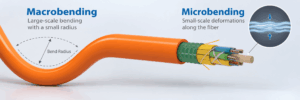
Fiber Optic Cable Bend Radius: Macrobending vs Microbending Explained
Fiber optic bend radius is one of the most important installation limits in an optical cable system. A fiber cable can meet its attenua...

Foam-Skin vs Solid PE Insulation in Telephone Cables
Foam-skin vs solid PE is an important insulation choice in outdoor copper telephone cables because the material surrounding each conduc...
Cat6A Alien Crosstalk Explained: Why ANEXT Matters
Cat6A alien crosstalk is one of the most important performance considerations in high-speed copper structured cabling. As Ethernet freq...

Fiber Optic Cable Mechanical Tests: Tensile, Crush, Impact and Bend Performance
Fiber optic cable testing is essential because good optical performance alone does not prove that a cable can survive installation and ...
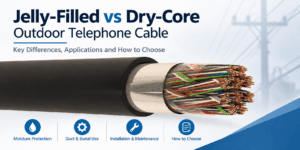
Jelly-Filled vs Dry-Core Outdoor Telephone Cable
Jelly-filled vs dry-core is an important construction choice when specifying outdoor telephone cable for telecom distribution networks,...
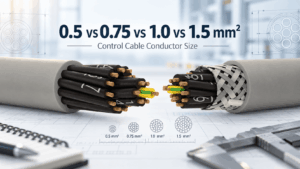
0.5 vs 0.75 vs 1.0 vs 1.5 mm² Control Cable: How to Select Conductor Size
Control cable conductor size affects resistance, voltage drop, current-carrying capability, cable diameter, flexibility and cost. Among...

300/500 V vs 450/750 V Control Cable: When Is the Higher Voltage Rating Required?
Control cable voltage rating is one of the most important electrical parameters to check when selecting cables for industrial machinery...


