





 President’s Message
Blog
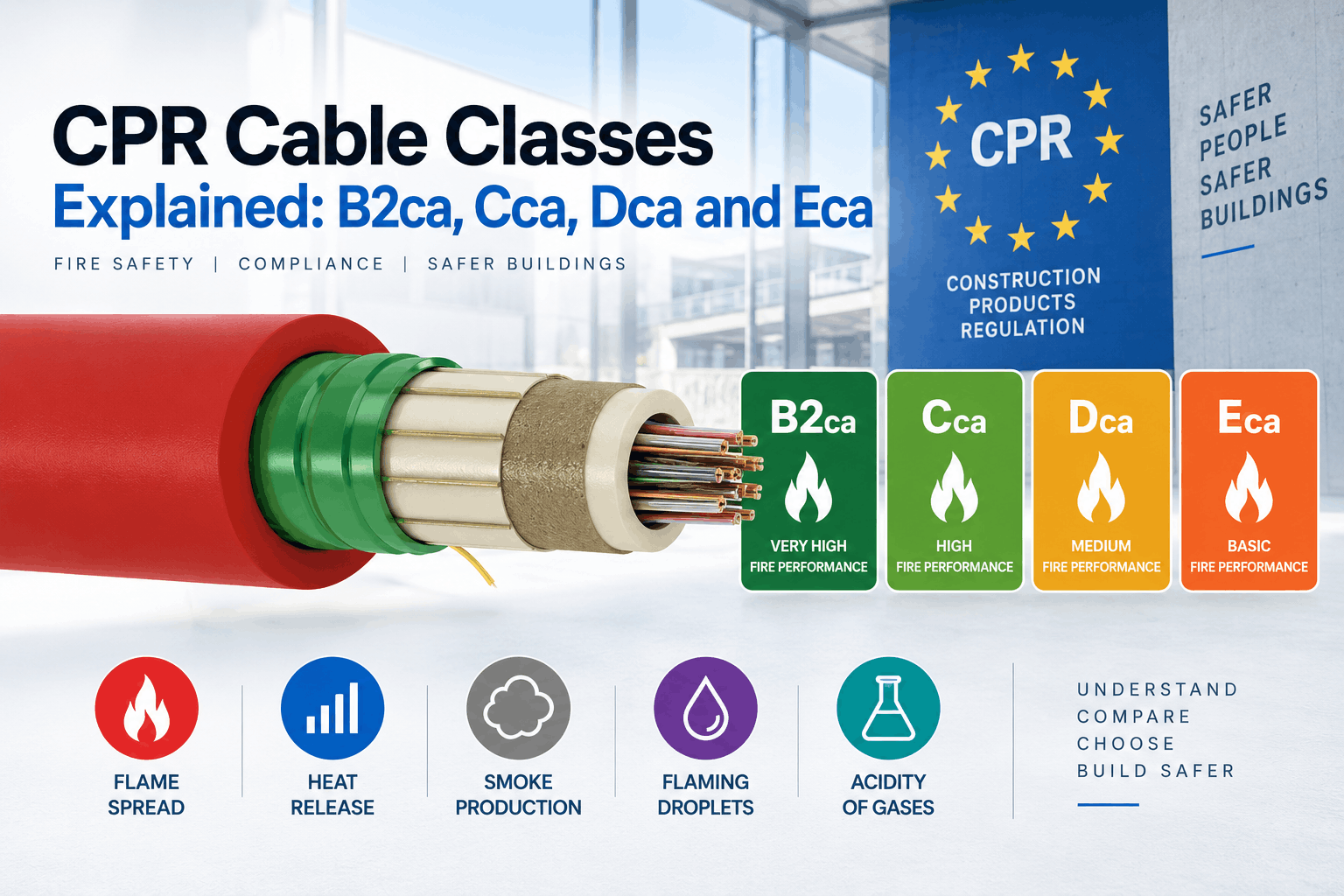
CPR Cable Classes Explained: B2ca, Cca, Dca and Eca
Reading Time: 19 minutes
CPR cable classes provide a standardized European system for describing how cables react when exposed to fire. Common classifications such as B2ca, Cca, Dca and Eca help engineers, contractors and purchasing teams compare characteristics including flame spread and heat release, while higher-performance classes can also include supplementary ratings for smoke, flaming droplets and acidity.
However, CPR classification is frequently misunderstood. A B2ca cable is not automatically a fire-resistant cable, while an Eca cable is not simply a cable with no fire performance. Each Euroclass represents a defined level of reaction-to-fire performance under standardized European test and classification methods.
Furthermore, the class required for a building is not determined by the cable manufacturer. National regulations, building codes, project specifications and the intended installation environment determine which CPR performance level must be used.
Therefore, selecting the correct cable requires understanding both the main Euroclass and, where applicable, supplementary classifications such as s1, d1 and a1.
Quick answer: B2ca provides significantly higher reaction-to-fire performance than Cca, while Cca provides higher performance than Dca. Eca represents a more basic flame-propagation level. For B2ca, Cca and Dca cables, additional classifications can define smoke production, flaming droplets and acidity. None of these classifications alone proves that the cable will maintain electrical or optical functionality during a fire.
CPR Cable Classes at a Glance
| CPR Class | Relative Reaction-to-Fire Performance | Typical Interpretation | Supplementary s/d/a Classes |
|---|---|---|---|
| Aca | Highest | Essentially no contribution to fire | Not normally applicable |
| B1ca | Very high | Extremely limited contribution to fire | Yes |
| B2ca | Very high | Very limited fire growth and heat release | Yes |
| Cca | High | Limited contribution to fire | Yes |
| Dca | Medium | Moderate reaction-to-fire performance | Yes |
| Eca | Basic | Basic single-cable flame-spread performance | No |
| Fca | Lowest / not determined | Does not demonstrate Eca performance or performance is not determined | No |
Consequently, B2ca, Cca, Dca and Eca should be understood as different levels within one broader Euroclass system rather than four unrelated cable standards.
What Are CPR Cable Classes?
The term CPR cable classes refers to reaction-to-fire performance categories used for cables intended for permanent installation in buildings and civil engineering works where the applicable harmonized construction-product requirements apply.
The complete hierarchy is:
- Aca
- B1ca
- B2ca
- Cca
- Dca
- Eca
- Fca
Performance generally decreases as the classification moves down the list.
In practical cable markets, B2ca, Cca, Dca and Eca are among the classifications most frequently encountered for power, control, communication and fiber optic cable products.
Therefore, these four classes form the main focus of this guide.
What Does “ca” Mean in B2ca, Cca, Dca and Eca?
The suffix ca identifies the Euroclass as a classification specifically for cables.
For example:
- B2ca = B2 class for cable
- Cca = C class for cable
- Dca = D class for cable
- Eca = E class for cable
This distinction is useful because construction products such as wall panels, flooring and insulation use other Euroclass systems and test arrangements.
Accordingly, buyers should use the complete cable designation rather than simply requesting “Class C” or “Class B2.”
What Do CPR Cable Classes Measure in a Cable Fire?
CPR reaction-to-fire classification evaluates how the cable contributes to the development of a fire.
Depending on the class, assessment can involve characteristics such as:
- Flame spread
- Heat release
- Fire growth
- Smoke production
- Flaming droplets or particles
- Acidity and conductivity of combustion gases
However, not every criterion applies to every Euroclass.
For example, B2ca, Cca and Dca can include supplementary smoke, droplet and acidity classifications. Meanwhile, Eca is primarily based on a more basic flame-propagation requirement.
CPR Cable Classes: B2ca vs Cca vs Dca vs Eca
The practical difference between the four classes is the extent to which the cable limits its contribution to fire.
| Characteristic | B2ca | Cca | Dca | Eca |
|---|---|---|---|---|
| Relative performance | Very high | High | Medium | Basic |
| Heat-release assessment | Strict | Strict | Less restrictive | Not classified through the same bundle-fire performance route |
| Bundle-fire testing | Yes | Yes | Yes | No equivalent EN 50399 class requirement |
| Single-cable flame test | Yes as applicable | Yes as applicable | Yes as applicable | Core requirement |
| Smoke subclass | Available | Available | Available | No |
| Droplet subclass | Available | Available | Available | No |
| Acidity subclass | Available | Available | Available | No |
Therefore, moving from Eca toward B2ca represents increasingly demanding control of the cable’s contribution to fire.
What Is B2ca Cable?
B2ca represents a very high level of reaction-to-fire performance for cables.
B2ca cables are evaluated using demanding criteria involving fire growth, flame spread and heat release.
In addition, the classification can include supplementary ratings for:
- Smoke production
- Flaming droplets
- Acidity
A complete B2ca designation can therefore look like:
B2ca-s1a,d1,a1
Each part communicates different fire-behavior information.
Consequently, specifying only “B2ca” can be incomplete when a project also requires a particular smoke, droplet or acidity performance.
Is B2ca the Highest CPR Cable Class?
No.
Aca and B1ca sit above B2ca in the full Euroclass hierarchy.
However, B2ca is one of the highest performance levels commonly supplied for many practical cable constructions.
Therefore, descriptions such as “B2ca is the highest CPR class” should be avoided unless referring only to a specific manufacturer portfolio or project range.
Where Are B2ca Cables Used?
B2ca can be specified for buildings or infrastructure where fire risk, evacuation difficulty or concentration of people and critical assets justify demanding reaction-to-fire performance.
Depending on national regulations and project requirements, applications can include:
- Airports
- Hospitals
- Data centers
- Railway and metro infrastructure
- Tunnels
- High-rise buildings
- Public buildings
- Critical infrastructure
- Large commercial facilities
However, B2ca is not automatically mandatory in all such locations.
Instead, the required class must come from the applicable national rule or project fire specification.
What Is Cca Cable?
Cca provides a high reaction-to-fire performance level below B2ca.
Like B2ca, Cca cables are evaluated through a more demanding fire-test framework than Eca cables and can include supplementary s, d and a classifications.
A typical designation can be:
Cca-s1b,d1,a1
or:
Cca-s2,d2,a2
depending on the actual tested cable performance.
As a result, two Cca cables do not necessarily behave identically with respect to smoke, flaming droplets or acidity.
B2ca vs Cca: What Is the Difference?
B2ca imposes more demanding limits on fire growth and heat release than Cca.
Therefore, B2ca provides a higher reaction-to-fire classification.
However, the primary class alone does not describe every relevant fire characteristic.
For example:
B2ca-s2,d2,a2
and:
Cca-s1,d0,a1
have different combinations of primary and supplementary performance.
The B2ca cable has the higher main Euroclass, while the Cca example has stronger smoke/droplet/acidity subclasses.
Consequently, project engineers should evaluate the complete designation rather than comparing only the first four characters.
What Is Dca Cable?
Dca represents a medium reaction-to-fire classification.
Dca is still assessed using the EN 50399 family of bundle-fire performance methods, but its limits are less demanding than those for Cca and B2ca.
In addition, Dca can include supplementary smoke, droplet and acidity ratings.
Examples can include:
- Dca-s1,d1,a1
- Dca-s2,d2,a1
- Dca-s2,d2,a2
Therefore, Dca provides substantially more fire-performance information than a simple Eca classification.
Cca vs Dca: What Is the Difference?
The primary difference lies in the permitted contribution to fire.
Cca requires stronger limitation of fire growth and heat release than Dca.
Meanwhile, both classifications can be combined with smoke, droplet and acidity subclasses.
Consequently, Cca generally represents a more demanding main reaction-to-fire requirement.
Nevertheless, national building codes determine whether a particular application requires Cca, Dca or another class.
What Is Eca Cable?
Eca represents a basic defined reaction-to-fire level for cable.
Its principal requirement involves limited flame propagation on an individual cable under the relevant standardized test.
Unlike B2ca, Cca and Dca, Eca does not carry the supplementary:
- s smoke classification
- d flaming-droplet classification
- a acidity classification
Therefore, an Eca designation provides significantly less information about smoke, droplets and combustion-gas behavior.
Does Eca Mean the Cable Is Unsafe?
No.
Eca is a recognized CPR performance class and can be appropriate where regulations or project requirements permit it.
However, it represents a lower reaction-to-fire performance level than Dca, Cca or B2ca.
As a result, Eca may not be appropriate for installations requiring controlled fire growth, low smoke or low corrosive-gas performance.
The installation environment should determine whether its performance is sufficient.
Eca vs Dca: Why Is the Difference Important?
Dca provides a more comprehensive assessment of cable behavior during developing fire conditions.
Furthermore, Dca can include supplementary smoke, droplet and acidity ratings.
Eca, by contrast, primarily demonstrates a basic individual-cable flame-propagation performance.
Therefore, changing a specification from Eca to Dca is not simply a cosmetic class upgrade. It introduces a significantly more demanding fire-performance framework.
What Is Fca Cable?
Fca sits below Eca in the Euroclass system.
Broadly, Fca indicates that the cable does not demonstrate the minimum performance necessary for Eca or that the relevant reaction-to-fire performance has not been determined within the classification system.
Consequently, Fca should not be confused with Eca.
Eca demonstrates a defined basic flame-performance level, while Fca represents the lowest classification position.
CPR Cable Classes and Smoke Ratings: s1, s2 and s3
For B1ca, B2ca, Cca and Dca cables, the letter s provides information about smoke production.
The general hierarchy is:
| Smoke Class | Relative Performance |
|---|---|
| s1 | Lowest smoke production / best main smoke class |
| s2 | Intermediate smoke production |
| s3 | Does not meet s1 or s2 limits |
Therefore, a B2ca-s1 cable produces less smoke under the relevant classification criteria than a B2ca-s3 cable.
What Do s1a and s1b Mean?
The s1 smoke category can be divided further into s1a and s1b.
These subclasses provide an additional distinction based on smoke transmittance under the applicable test.
In simple terms:
- s1a = more demanding smoke-transmittance performance
- s1b = lower but still demanding smoke-transmittance performance within the s1 framework
Consequently, B2ca-s1a provides more specific low-smoke information than B2ca-s1 alone.
Why Smoke Performance Matters
Smoke can create one of the greatest hazards during building evacuation.
Dense smoke can:
- Reduce visibility
- Obscure escape signs
- Slow evacuation
- Complicate firefighting
Moreover, cables can run continuously through multiple rooms, corridors and technical spaces.
Therefore, smoke classification can become particularly important in hospitals, airports, metros, public buildings and other difficult-to-evacuate environments.
CPR Cable Classes and Flaming Droplets: d0, d1 and d2
The letter d describes flaming droplets and particles released during the fire test.
| Droplet Class | Relative Performance |
|---|---|
| d0 | Best performance; no flaming droplets/particles within the defined criterion |
| d1 | Controlled flaming droplets/particles within the defined criterion |
| d2 | Does not meet d0 or d1 |
Flaming droplets matter because burning particles can transfer fire to material located beneath or beside the cable route.
Consequently, d0 can provide a particularly demanding performance where this hazard is important.
CPR Cable Classes and Acidity Ratings: a1, a2 and a3
The letter a describes the acidity and conductivity characteristics of combustion gases.
| Acidity Class | Relative Performance |
|---|---|
| a1 | Best performance / very low acidity and conductivity |
| a2 | Intermediate performance |
| a3 | Does not meet a1 or a2 |
Low acidity can be particularly valuable where smoke could damage:
- Electronic equipment
- Servers
- Control systems
- Switchgear
- Building infrastructure
- Metal components
Therefore, an a1 requirement can be particularly relevant for data centers and other electronics-intensive facilities.
How to Read B2ca-s1a,d1,a1
A complete cable designation becomes easy to understand when it is divided into individual elements.
| Part | Meaning |
|---|---|
| B2ca | Main reaction-to-fire Euroclass |
| s1a | Very low smoke performance with the more demanding s1 transmittance subclass |
| d1 | Controlled flaming droplets/particles |
| a1 | Lowest acidity / conductivity class |
Therefore:
B2ca-s1a,d1,a1
does not describe one single property. Instead, it combines four separate pieces of fire-performance information.
Is B2ca-s1a,d1,a1 Better Than B2ca-s1,d0,a1?
Not in every individual parameter.
Both have the same primary B2ca Euroclass.
However, one has an s1a smoke subclass while the other has a d0 droplet rating.
Therefore, the word “better” can become misleading unless the project identifies which supplementary characteristics matter most.
The correct cable is the construction that meets the complete required designation.
CPR Cable Classes and EN 50575
EN 50575 provides the harmonized product framework historically used under the Construction Products Regulation for power, control and communication cables intended for permanent installation in construction works and subject to reaction-to-fire requirements.
The framework covers cables such as:
Consequently, CPR classification is not restricted to electrical power cables.
EN 13501-6 and Cable Classification
EN 13501-6 provides the European classification framework for the reaction-to-fire performance of electric cables.
It brings the relevant test results together into the Euroclass system:
- Aca
- B1ca
- B2ca
- Cca
- Dca
- Eca
- Fca
Therefore, EN 50575 and EN 13501-6 perform different but complementary roles within CPR cable classification.
What Is EN 50399?
EN 50399 is a major fire-test method used for higher CPR reaction-to-fire classifications.
The test evaluates cable behavior under fire conditions involving bundles of vertically installed cables.
Measurements can include characteristics related to:
- Heat release
- Fire growth
- Flame spread
- Smoke production
- Flaming droplets
As a result, EN 50399 provides substantially more information about developing fire behavior than a basic single-cable flame test.
What Is EN 60332-1-2?
EN/IEC 60332-1-2 evaluates vertical flame propagation on a single insulated wire or cable.
This test forms an important part of basic cable flame-performance assessment.
Eca, in particular, relies on the relevant single-cable flame performance rather than the more extensive bundled-cable fire-growth classification used for B2ca, Cca and Dca.
Therefore, passing IEC 60332-1-2 does not mean that a cable automatically meets Cca or B2ca.
CPR Cable Classes vs Flame-Retardant Cable
The term flame retardant is broader than a CPR Euroclass.
A manufacturer can test a cable against an IEC flame-propagation standard and describe its flame-retardant performance.
However, a complete CPR classification requires evaluation under the applicable European classification system.
Consequently:
IEC 60332 compliance alone ≠ B2ca, Cca or Dca classification.
CPR Cable Classes vs LSZH
LSZH and CPR describe different characteristics.
LSZH refers broadly to Low Smoke Zero Halogen material performance.
Meanwhile, CPR cable classes describe standardized reaction-to-fire performance.
As a result, an LSZH cable can potentially be classified as:
- B2ca
- Cca
- Dca
- Eca
depending on the complete cable design and tested performance.
Likewise, simply using a halogen-free outer jacket does not guarantee B2ca or Cca performance.
Does B2ca Mean LSZH?
Not automatically.
B2ca defines the primary reaction-to-fire class.
Low smoke and low acidity are separately communicated through classifications such as:
- s1a
- s1b
- a1
- a2
Therefore, buyers seeking both high CPR performance and halogen-free/low-smoke behavior should specify the complete required construction and supplementary classifications.
CPR Cable Classes vs Fire-Resistant Cable
This is the most important distinction in the article.
CPR reaction to fire asks:
How much does the cable contribute to the development of the fire?
Fire resistance or circuit integrity asks:
Can the cable continue to perform its electrical or optical function while exposed to fire?
These are fundamentally different engineering questions.
Therefore:
B2ca does not automatically mean FE180.
Cca does not automatically mean PH120.
B2ca does not automatically mean E30 or E90.
Can One Cable Be Both B2ca and Fire Resistant?
Yes.
A cable can be engineered and tested for both:
- High reaction-to-fire performance
- Continued circuit integrity during fire
For example, a fire-resistant fiber optic cable can achieve a B2ca reaction-to-fire classification while also passing an IEC 60331 circuit-integrity test.
Similarly, a power or communication cable can combine CPR performance with separate functional-integrity requirements.
Consequently, the two types of performance can complement each other.
CPR B2ca vs FE180
| Characteristic | B2ca | FE180 |
|---|---|---|
| Performance type | Reaction to fire | Circuit integrity |
| Main question | How much does the cable contribute to fire? | Can the circuit continue operating during fire? |
| Heat release | Important criterion | Not the classification purpose |
| Smoke subclasses | Can be included | Separate requirement |
| Flaming droplets | Can be included | Separate requirement |
| Functional operation | Not guaranteed | Central requirement |
Therefore, neither classification should be substituted for the other.
CPR B2ca vs PH120
PH120 is another circuit-integrity concept involving fire exposure and mechanical shock under the applicable test arrangement.
By contrast, B2ca limits the cable’s contribution to developing fire.
Consequently, a tunnel or emergency communication project can legitimately require both:
B2ca + PH120
rather than treating them as competing specifications.
CPR B2ca vs E30 / E90
E30 and E90 relate to maintaining function within defined cable-system installation arrangements for specified periods.
They therefore address a fundamentally different requirement from CPR reaction to fire.
A cable marked B2ca does not automatically meet E30 or E90.
Likewise, an E90 cable installation does not automatically establish a B2ca Euroclass.
Therefore, emergency-power projects should specify both characteristics where both are required.
Who Decides Whether B2ca, Cca, Dca or Eca Is Required?
The CPR creates a common European language for declaring cable performance.
However, it does not prescribe one universal cable class for every building across Europe.
Instead, requirements can come from:
- National building regulations
- National fire codes
- Local regulations
- Project specifications
- Fire-engineering design
- Client standards
As a result, the same building application can face different minimum CPR requirements in different European countries.
Why CPR Requirements Differ Between Countries
European harmonization standardizes how cable performance is measured and declared.
It does not completely harmonize national building fire regulations.
Therefore, individual countries can determine which Euroclass is appropriate for:
- Homes
- Hotels
- Hospitals
- Schools
- High-rise buildings
- Escape routes
- Industrial facilities
- Public buildings
Consequently, manufacturers and distributors should not assume that a cable accepted for one application in one country automatically satisfies another country’s installation rules.
Should You Always Choose B2ca Instead of Cca?
No.
Higher fire performance can provide meaningful safety benefits, but engineering specifications should still match the actual requirement.
B2ca cables can require:
- More advanced compounds
- More complex cable construction
- More demanding production control
- More demanding third-party assessment
As a result, B2ca can be more expensive than an equivalent Cca or Dca design.
Therefore, the objective should be to meet or exceed the project requirement intelligently rather than maximizing the Euroclass without considering the complete design.
Can a Cable Be Upgraded from Eca to Cca by Changing Only the Sheath?
Not necessarily.
Reaction-to-fire performance comes from the complete cable.
Factors can include:
- Conductor quantity
- Copper content
- Insulation material
- Fillers
- Wrapping tapes
- Screens
- Armour
- Inner sheath
- Outer sheath
- Cable diameter
Consequently, changing only the outer jacket does not guarantee a higher CPR classification.
The complete finished construction must achieve the required tested performance.
Why Cable Diameter Can Affect CPR Performance
Fire behavior depends partly on the amount and arrangement of combustible material in the cable.
Therefore, two cables using similar polymer compounds can achieve different CPR results because they contain different:
- Core counts
- Conductor sections
- Insulation volumes
- Jacket thicknesses
- Screening materials
As a result, a CPR certificate should be checked against the actual product family and construction rather than assumed to apply to every superficially similar cable.
CPR Cable Classes for Fiber Optic Cable
Fiber optic cables intended for permanent installation in construction works can also receive CPR cable classes.
The absence of copper conductors does not remove the fire contribution of polymer materials such as:
- PBT loose tubes
- Buffers
- Fillers
- Yarns
- Inner jackets
- Outer jackets
Therefore, fiber optic cable can be classified as B2ca, Cca, Dca, Eca or another applicable Euroclass according to its tested construction.
B2ca Fiber Optic Cable
B2ca fiber optic cable can be particularly useful in high-safety infrastructure such as:
- Railway tunnels
- Metro systems
- Data centers
- Airports
- Hospitals
- Public buildings
However, B2ca alone does not demonstrate continued optical transmission during a fire.
Therefore, critical optical links can require B2ca together with a separate fire-resistance classification.
CPR Cable Classes for Data / LAN Cable
Category cables installed permanently in buildings can also require CPR classification.
Examples include:
Depending on project requirements, LAN cables can be manufactured in classifications such as:
- B2ca
- Cca
- Dca
- Eca
Consequently, Ethernet performance such as Category 6A and CPR fire performance should be specified independently.
Does Cat 6A Automatically Mean Cca?
No.
Cat 6A describes electrical transmission performance.
Cca describes reaction-to-fire performance.
Therefore, a Cat 6A cable can potentially be manufactured in different CPR classes depending on the jacket, construction and tested product.
The same principle applies to Cat 6, Cat 7 and Cat 7A.
CPR Cable Classes for Control Cable
Control cable families can also be supplied at different reaction-to-fire performance levels.
For example, halogen-free HSLH, HSLCH or HSLHCH designs can be engineered for higher CPR performance than conventional PVC alternatives.
However, halogen-free material alone does not determine the Euroclass.
Consequently, purchasing teams should specify both:
- The required control-cable construction
- The required CPR classification
CPR Cable Classes for Instrumentation Cable
Instrumentation cables used in fixed construction works can also fall under applicable CPR requirements.
Their reaction-to-fire performance is independent from characteristics such as:
- Pair or triad design
- PiMF / TiMF screening
- Overall screen
- SWA
- Electrical capacitance
Therefore, a petrochemical or industrial project can specify an instrumentation construction together with a separate CPR Euroclass where the installation falls within the relevant scope.
CPR Cable Classes for Fire Alarm Cable
Fire alarm cables illustrate why reaction to fire and circuit integrity must remain separate.
A fire alarm cable can require:
- Cca or B2ca reaction-to-fire performance
- Low smoke
- Low acidity
- Fire-resistant circuit integrity
These requirements solve different fire-safety problems.
Therefore, specifying only “fire alarm cable” or only “B2ca” can leave important performance requirements unresolved.
CPR Cable Classes for EIB / KNX Cable
Building-automation cables such as EIB / KNX bus cables can also require CPR classification when permanently installed within buildings.
For example, one project may require Dca while another requires Cca with demanding smoke and acidity subclasses.
Consequently, KNX compatibility and CPR classification should remain separate procurement parameters.
CPR Cable Classes and the Declaration of Performance
A Declaration of Performance, commonly abbreviated DoP, provides the formal declared performance information for a construction product covered by the applicable harmonized framework.
For a cable, the documentation can identify:
- Product identification
- Intended use
- Manufacturer
- Applicable harmonized standard
- Declared reaction-to-fire class
- Assessment system
- Relevant notified body where applicable
Therefore, buyers should request the DoP for project approval rather than rely only on a CPR class printed in a commercial quotation.
CE Marking and CPR Cable Classes
CE marking accompanies construction products where required under the applicable harmonized European framework.
For CPR cables, CE marking is connected to the declared performance rather than being a general indication that one cable is technically superior to another.
Consequently, CE marking should be interpreted together with:
- The DoP
- The harmonized standard
- The CPR Euroclass
- The intended use
What Is AVCP?
AVCP means Assessment and Verification of Constancy of Performance.
It defines the level of assessment and third-party involvement used to establish and maintain confidence in the declared performance.
Under the current EN 50575 transitional framework, the system becomes more demanding for higher fire classes.
| Euroclass | AVCP System |
|---|---|
| Aca / B1ca / B2ca / Cca | System 1+ |
| Dca / Eca | System 3 |
| Fca | System 4 |
Therefore, achieving B2ca involves substantially greater third-party conformity-assessment involvement than a lower class such as Eca.
Does a B2ca Certificate Cover Every Cable Made by the Manufacturer?
No.
CPR performance applies to defined product constructions or product families covered by the relevant assessment and documentation.
A manufacturer having one B2ca-certified product does not mean every cable leaving that factory is B2ca.
Consequently, purchasing teams should verify:
- Exact product code
- Construction
- CPR class
- DoP reference
- Certificate where applicable
Can the Same Cable Type Be Available in Several CPR Classes?
Yes.
Manufacturers can develop different versions of one general cable family.
For example, a communication cable could potentially be offered as:
- Eca PVC version
- Dca halogen-free version
- Cca high-performance LSZH version
- B2ca premium fire-performance version
However, each construction must have the appropriate declared and verified performance.
Therefore, product names alone are not enough to determine CPR class.
CPR 2024: Has the Classification System Changed?
The European Union adopted Regulation (EU) 2024/3110 as the revised Construction Products Regulation.
However, the transition does not move every construction-product family to the new framework on the same date.
Product families migrate as new harmonized technical specifications become applicable.
Furthermore, the European Commission has maintained the established reaction-to-fire class structure, including the cable Euroclasses, to preserve continuity.
Therefore, familiar classes such as B2ca, Cca, Dca and Eca remain relevant during the transition to the revised CPR framework.
Does CPR 2024 Immediately Replace EN 50575 for Every Cable?
No.
The European Commission has established a transition in which the older and newer CPR frameworks coexist for product families.
Where a product continues to be covered by an existing harmonized standard cited under the previous CPR framework, those provisions generally continue until the product family migrates to a new performance harmonized standard under CPR 2024.
Consequently, buyers should check the current harmonized specification applicable when the product is placed on the market rather than assume that every cable document changed automatically in January 2026.
Common Mistakes When Selecting CPR Cable Classes
1. Assuming B2ca Means Fire Resistant
B2ca describes reaction to fire, not circuit integrity.
2. Assuming B2ca Is the Highest Possible Class
Aca and B1ca exist above B2ca.
3. Assuming Eca Means No Fire Performance
Eca demonstrates a defined basic flame-propagation performance.
4. Comparing Only B2ca and Cca Without the Subclasses
Smoke, droplets and acidity can materially change the complete specification.
5. Assuming LSZH Automatically Means Cca or B2ca
LSZH materials and CPR reaction-to-fire classification are separate concepts.
6. Assuming PVC Can Only Be Eca
CPR performance is determined by the complete tested cable construction, not material terminology alone.
7. Assuming One CPR Class Is Required Across Europe
National building regulations determine minimum performance for specific applications.
8. Ignoring the DoP
The Declaration of Performance provides the formal declared classification for the product.
9. Assuming CE Marking Means B2ca
CE marking can accompany products with different declared CPR performance classes.
10. Assuming Cat 6A Determines CPR Class
Data transmission category and reaction-to-fire performance are independent.
11. Assuming Fiber Optic Cable Does Not Need CPR
Its polymer construction can still contribute to fire and can fall within CPR scope when permanently installed in construction works.
12. Ignoring s, d and a Ratings
These additional classifications provide important smoke, droplet and acidity information.
13. Assuming s1a and s1 Are Identical
s1a provides a more specific smoke-transmittance performance within the s1 category.
14. Specifying Only “Low Smoke Cable”
A defined CPR subclass provides more precise procurement information.
15. Assuming the Same Product Name Always Has the Same Euroclass
Different sheath and construction variants can have different declared classifications.
16. Assuming a Manufacturer’s CPR Certificate Covers Its Entire Portfolio
Certification and DoP documents must correspond to the relevant product construction.
17. Replacing National Fire Rules With CPR Classification
CPR provides the common performance language; national rules decide the required performance level.
18. Selecting the Highest Class Without Considering the Project
The correct specification balances required safety performance, construction and project economics.
How to Select the Correct CPR Cable Classes for a Project
A practical selection process can follow several steps.
1. Identify Whether the Cable Is Permanently Installed
Confirm whether the cable falls within the applicable construction-products framework for its intended installation.
2. Check National Regulations
Determine the minimum Euroclass required for the building type and installation area.
3. Review the Project Fire Strategy
Escape routes, high-occupancy spaces and critical infrastructure can require more demanding performance.
4. Select the Main Euroclass
Define B2ca, Cca, Dca, Eca or another required class.
5. Define Smoke Performance
Specify s1a, s1b, s1, s2 or other permitted performance where relevant.
6. Define Flaming-Droplet Performance
Specify d0, d1 or d2 where required.
7. Define Acidity Performance
Specify a1, a2 or a3 according to the project requirement.
8. Define Fire Resistance Separately
Add FE180, PH120, E30/E90 or other circuit-integrity requirements where the system must continue operating during fire.
9. Confirm the Exact Product DoP
Verify that the proposed construction has the required declared performance.
10. Verify CE Marking and Documentation
Ensure the product documentation corresponds to the exact cable supplied.
What Should Buyers Include in a CPR Cable RFQ?
An RFQ stating only “CPR compliant cable” is insufficient because Eca and B2ca can both be CPR-classified products while providing very different performance.
A professional specification should include:
- Cable type
- Applicable construction standard
- Required CPR Euroclass
- B2ca / Cca / Dca / Eca or other class
- Required smoke subclass
- s1a / s1b / s1 / s2 where applicable
- Required flaming-droplet subclass
- d0 / d1 / d2 where applicable
- Required acidity subclass
- a1 / a2 / a3 where applicable
- LSZH requirement where applicable
- Flame-retardancy requirement
- Fire-resistance requirement where applicable
- FE180 requirement where applicable
- PH requirement where applicable
- E30 / E60 / E90 where applicable
- Applicable national fire regulation
- CE marking requirement
- Declaration of Performance
- CPR certificate where applicable
- Notified-body information where applicable
- Exact product identification
- Cable marking requirement
- Project documentation package
As a result, the manufacturer can supply exactly the required reaction-to-fire construction rather than interpreting the vague phrase “fire-rated cable.”
ETK Kablo CPR Cable Classes
ETK Kablo manufactures power, communication, data, control, signal, instrumentation and fiber optic cables across several CPR cable classes according to product family and project requirement.
ETK’s published CPR certification portfolio currently includes products in:
- B2ca
- Cca
- Dca
- Eca
For high-performance B2ca applications, ETK manufactures constructions including selected Cat 6 / Cat 6A network cables, HSLHCH control cable and fire-resistant fiber optic cable families.
Meanwhile, Cca certifications include selected HSLH, HSLCH, HSLHCH, LIHH, LIHCH, EIB / KNX and structured-network cable constructions.
Dca and Eca are also available across multiple communication, control, signal and fiber product families where those classes match the installation requirement.
One ETK fire-resistant fiber optic construction is classified B2ca-s1a,d1,a1 while separately providing FE180 fire-resistant circuit integrity. This illustrates the important distinction between reaction-to-fire classification and continued operation during fire.
Therefore, ETK can match the cable’s electrical or optical design with the required CPR performance rather than treating fire class as a separate generic label.
Frequently Asked Questions
What are CPR cable classes?
CPR cable classes are European reaction-to-fire classifications used to describe how cables contribute to fire. The full hierarchy includes Aca, B1ca, B2ca, Cca, Dca, Eca and Fca.
Which is better, B2ca or Cca?
B2ca represents a higher main reaction-to-fire performance class than Cca. However, the complete s, d and a subclasses should also be compared.
Which is better, Cca or Dca?
Cca provides a higher main reaction-to-fire performance level than Dca.
Which is better, Dca or Eca?
Dca provides a more demanding and more comprehensive reaction-to-fire classification than Eca.
Is B2ca the highest cable class?
No. Aca and B1ca are above B2ca in the complete Euroclass hierarchy.
What does B2ca-s1a,d1,a1 mean?
B2ca is the main reaction-to-fire class, s1a describes demanding low-smoke performance, d1 describes controlled flaming droplets, and a1 represents the best acidity category.
What does s1 mean in CPR cable?
s1 represents the highest main smoke-performance category within the supplementary smoke classification, with s1a and s1b providing additional subdivisions.
What does d0 mean?
d0 represents the best supplementary performance regarding flaming droplets or particles under the applicable classification criteria.
What does a1 mean?
a1 represents the most demanding supplementary acidity and conductivity category for combustion gases.
Does Eca have s1, d1 or a1 subclasses?
No. The smoke, droplet and acidity supplementary classifications apply to the higher B1ca through Dca groups rather than Eca.
Is Eca flame retardant?
Eca demonstrates a defined basic individual-cable flame-propagation performance. However, it should not be treated as equivalent to higher Cca or B2ca fire-growth performance.
Does LSZH mean B2ca?
No. LSZH describes material-related smoke and halogen behavior, while B2ca is a reaction-to-fire Euroclass obtained for the finished cable construction.
Is B2ca fire resistant?
Not automatically. B2ca describes reaction to fire. Continued electrical or optical operation requires a separate fire-resistance or circuit-integrity classification.
Is B2ca the same as FE180?
No. B2ca measures reaction to fire, while FE180 evaluates circuit integrity under defined fire exposure.
Is B2ca the same as PH120?
No. PH120 concerns circuit integrity under fire and mechanical shock, while B2ca concerns the cable’s contribution to fire.
Can a cable be both B2ca and FE180?
Yes. A cable can satisfy both reaction-to-fire and circuit-integrity requirements when it has been designed and tested for both.
Does Cat 6A determine CPR class?
No. Category 6A defines data-transmission performance, while CPR Euroclass describes reaction to fire.
Can fiber optic cable be B2ca?
Yes. Fiber optic cables can achieve B2ca, Cca, Dca or other applicable Euroclasses depending on the complete construction and tested performance.
Can PVC cable achieve Cca?
The CPR class depends on the complete tested construction rather than the polymer name alone. The actual DoP should always be checked.
Who decides which CPR cable class is required?
National regulations, local building rules, project specifications and fire-engineering requirements determine the class required for a particular installation.
Does every EU country require the same CPR class?
No. CPR provides a harmonized performance-classification system, while Member States can specify different minimum classes for particular applications.
What document proves a cable’s CPR class?
The Declaration of Performance identifies the declared reaction-to-fire classification for the relevant construction, supported by the applicable conformity-assessment documentation.
Does CE marking show that a cable is B2ca?
No. CE marking alone does not identify the specific Euroclass. The declared performance and product documentation should be checked.
What CPR cable class should I choose?
Start with the national building requirement and project fire strategy. Then specify the main Euroclass together with smoke, flaming-droplet and acidity subclasses where applicable.
Conclusion
Understanding CPR cable classes requires separating the main Euroclass from the supplementary fire characteristics and from completely different concepts such as circuit integrity.
B2ca provides very high reaction-to-fire performance and is one of the most demanding classifications commonly encountered in practical cable projects.
Cca provides a high level of fire-growth control and is widely used in projects requiring strong reaction-to-fire performance without necessarily moving to B2ca.
Dca provides an intermediate level and still allows supplementary smoke, flaming-droplet and acidity classifications.
Eca provides a more basic defined flame-propagation performance and does not include the s, d and a subclasses used with higher classes.
However, the primary class is only part of the specification. B2ca-s1a,d1,a1 communicates substantially more information than simply writing B2ca.
Smoke performance can influence evacuation visibility. Flaming droplets can contribute to secondary fire spread. Meanwhile, acidity becomes particularly important where combustion gases can threaten people, electronics and infrastructure.
Most importantly, CPR reaction-to-fire classification must not be confused with fire resistance. A B2ca cable does not automatically continue operating during a fire, and an FE180 cable does not automatically achieve B2ca.
For critical systems, both characteristics can legitimately be required at the same time.
The correct Euroclass also depends on the installation. CPR provides the common European language for declaring performance, while national regulations and project requirements determine what level must actually be installed.
Therefore, purchasing teams should avoid vague requirements such as “CPR cable,” “LSZH cable” or “fire-rated cable.” Instead, the specification should identify the exact Euroclass, smoke subclass, flaming-droplet subclass, acidity subclass and any separate circuit-integrity requirements.
The best cable is not automatically the one with the highest CPR class. It is the cable whose verified reaction-to-fire performance, electrical or optical characteristics and fire-resistance requirements precisely match the safety strategy of the building or infrastructure project.


