





 President’s Message
Blog
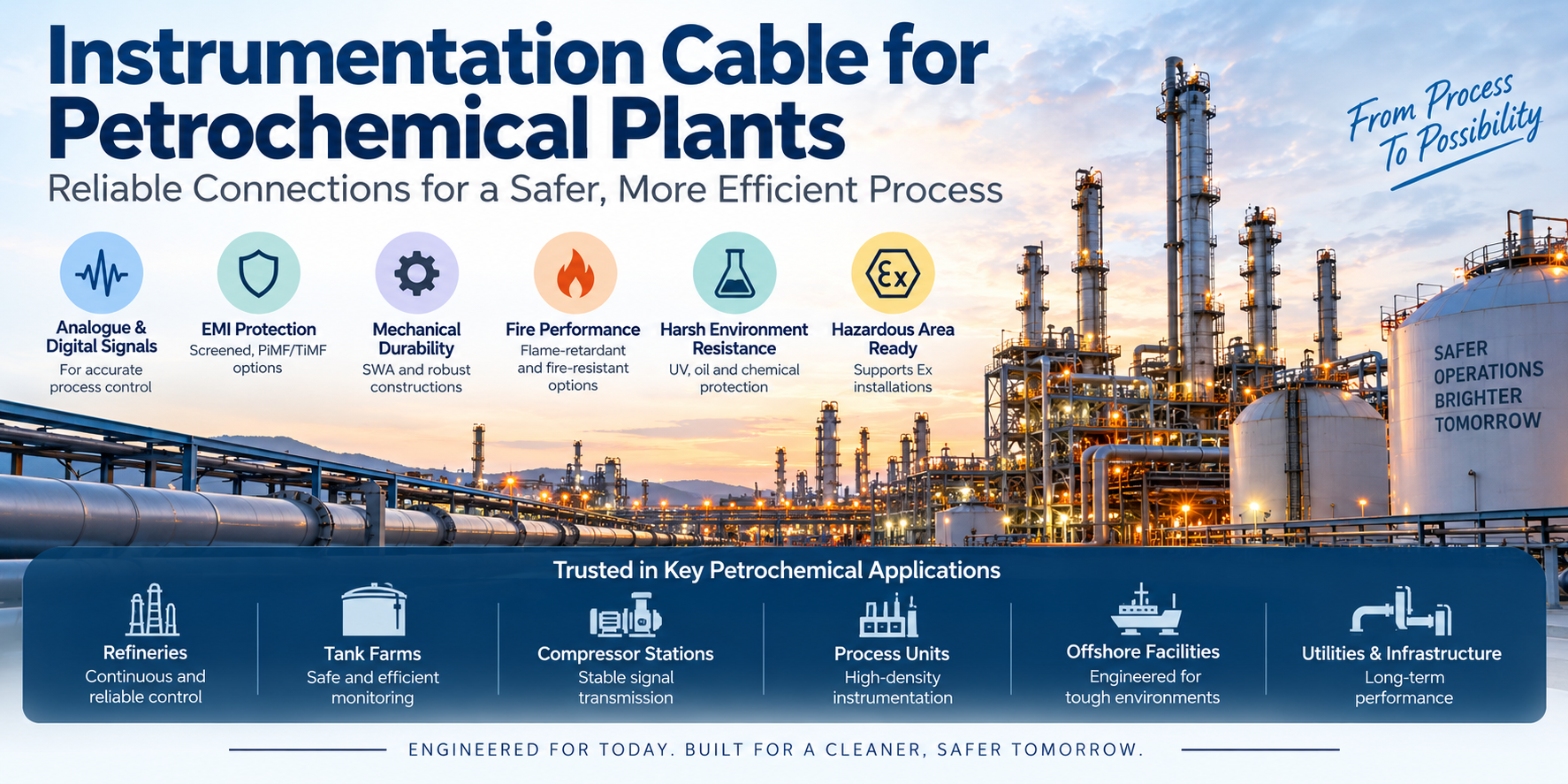
Instrumentation Cable for Petrochemical Plants: Selection Guide
Reading Time: 18 minutes
Selecting an instrumentation cable for petrochemical plants requires more than choosing a screened multicore cable. Refineries, petrochemical complexes, tank farms, process units and chemical facilities combine sensitive analogue and digital signals with electromagnetic interference, outdoor exposure, mechanical risk, hazardous areas and demanding fire requirements.
As a result, several cable characteristics must be selected independently. Engineers need to determine whether the circuit uses pairs or triads, whether individual PiMF or TiMF screening is required, whether an overall screen is sufficient, whether Steel Wire Armour is necessary, and whether PVC or halogen-free materials better suit the project.
Electrical characteristics are equally important. Conductor resistance, mutual capacitance, operating voltage and intrinsic-safety parameters can directly affect instrumentation-loop performance. Meanwhile, environmental requirements can add UV resistance, chemical resistance, water protection, flame retardancy or fire-resistant circuit integrity.
Therefore, there is no single universal petrochemical instrumentation cable. The most suitable construction is the one that matches the signal, electromagnetic environment, mechanical route, fire strategy and hazardous-area design of the specific project.
Quick answer: For general petrochemical instrumentation, an overall-screened pair or triad cable can provide an efficient solution. Where neighboring circuits require greater electrical isolation, individually screened PiMF or TiMF constructions may be preferred. SWA should be added where genuine mechanical protection is required, while halogen-free materials can be selected where smoke and corrosive combustion products are a concern. Hazardous-area and intrinsically safe circuits must still be evaluated as complete systems rather than by cable designation alone.
Instrumentation Cable for Petrochemical Plants at a Glance
| Project Requirement | Cable Feature to Consider |
|---|---|
| Two-wire analogue circuit | Twisted pair |
| Three-wire measurement circuit | Twisted triad |
| Moderate external EMI | Overall metallic screen |
| High circuit density or crosstalk concern | PiMF / TiMF individual screening |
| High external EMI + circuit-to-circuit isolation | Individual screens + overall screen |
| Mechanical exposure | SWA or suitable mechanical reinforcement |
| Outdoor installation | UV-resistant and environmentally suitable outer sheath |
| Low-smoke / halogen-free requirement | Halogen-free insulation or sheath system as specified |
| Flame propagation requirement | Applicable flame-retardancy tests |
| Circuit survival during fire | Dedicated fire-resistant instrumentation cable |
| Intrinsically safe circuit | Suitable capacitance, inductance and loop parameters |
| Hazardous area | Complete Ex installation requirements must be considered |
| Underground route | Mechanical and moisture protection matched to burial conditions |
| Chemical exposure | Project-specific sheath compound and resistance requirements |
This table illustrates why a project description such as “screened petrochemical cable” remains incomplete.
Instead, the final specification should define each performance requirement separately.
Why Petrochemical Plants Need Specialized Instrumentation Cables
Petrochemical plants contain extensive networks of sensors, transmitters, control valves, analyzers and automation systems.
These field devices can transmit relatively low-level electrical signals over long distances between process equipment and systems such as:
- Distributed Control Systems
- Programmable Logic Controllers
- Safety Instrumented Systems
- Emergency shutdown systems
- Remote I/O cabinets
- Marshalling cabinets
- Process monitoring systems
At the same time, the same facility may contain large motors, pumps, compressors, variable-frequency drives, transformers and power-distribution equipment.
Consequently, instrumentation circuits can operate in an electrically noisy environment while also facing outdoor, mechanical and process-related hazards.
What Signals Do Petrochemical Instrumentation Cables Carry?
Instrumentation cables can carry several types of low-energy analogue and digital signals.
Typical examples include:
- 4–20 mA process signals
- Temperature measurements
- Pressure measurements
- Flow measurements
- Level measurements
- Valve position signals
- Digital status signals
- Alarm circuits
- Control commands
- Selected communication signals
However, not every digital industrial protocol can use an ordinary instrumentation cable.
Some communication systems require defined characteristic impedance, capacitance, attenuation or other transmission parameters.
Therefore, protocol-specific cable requirements should always take priority over a generic instrumentation-cable designation.
Instrumentation Cable for Petrochemical Plants: Pair vs Triad
The first fundamental decision is often whether the cable elements should be arranged as pairs or triads.
A pair groups two associated conductors together.
By contrast, a triad groups three conductors into one electrical element.
| Characteristic | Pair | Triad |
|---|---|---|
| Conductors per element | 2 | 3 |
| Typical application | Two-wire instrumentation circuits | Three-wire measurement circuits |
| Example | 4–20 mA transmitter | Three-wire RTD |
| Individual-screen designation | PiMF | TiMF |
Consequently, pair versus triad should follow the wiring architecture of the field instrument rather than a general plant preference.
Why Twisting Matters in Instrumentation Cable
Twisting associated conductors helps maintain balanced electrical geometry along the cable route.
As a result, the conductors experience similar external electromagnetic conditions.
This can help reduce unwanted noise in suitable balanced circuits.
However, twisting alone does not provide the same protection as a metallic screen.
Therefore, petrochemical installations often combine twisted pairs or triads with additional screening.
Instrumentation Cable for Petrochemical Plants: Overall Screening
An overall-screened instrumentation cable places one metallic screen around the complete assembled cable core.
A common construction can use:
- Aluminium/polyester foil
- Tinned-copper drain wire
- Protective wrapping
The screen helps reduce electromagnetic interference entering the complete group of instrumentation circuits from the surrounding environment.
Therefore, overall screening can provide an efficient solution where external EMI is the main concern and additional pair-to-pair isolation is unnecessary.
When Is an Overall Screen Enough?
An overall screen can be suitable where:
- Signal circuits have similar characteristics
- Internal crosstalk risk is controlled
- The main EMI sources are external to the cable
- Project specifications do not require individual pair screens
- Termination simplicity is valuable
In addition, overall-screened constructions generally contain fewer screening components than PiMF or TiMF cable.
Consequently, they can offer lower diameter, weight and termination complexity for suitable applications.
What Is PiMF Instrumentation Cable?
PiMF stands for Pair in Metal Foil.
In this construction, each twisted pair receives its own metallic screen.
A typical individually screened pair can include:
- Two insulated conductors
- Pair twisting
- Polyester separator
- Aluminium/polyester foil screen
- Tinned-copper drain wire
The individually screened pairs are then assembled into the complete cable.
Furthermore, the complete group can receive another overall screen where required.
What Is TiMF Instrumentation Cable?
TiMF stands for Triad in Metal Foil.
The concept is similar to PiMF, but each screened element contains three conductors rather than two.
Therefore:
PiMF = individually screened pair.
TiMF = individually screened triad.
The decision between them should follow the circuit architecture rather than the expected EMI level.
Instrumentation Cable for Petrochemical Plants: PiMF vs TiMF
Individual screening can be particularly valuable in petrochemical installations with high cable density and sensitive measurement circuits.
Each pair or triad receives its own metallic barrier.
As a result, the construction can help reduce unwanted coupling between adjacent instrumentation circuits.
This becomes useful where one multicircuit cable contains many signals passing through electrically demanding plant areas.
However, PiMF and TiMF add material, outside diameter and termination work.
Therefore, individual screening should be selected where the project genuinely benefits from greater circuit isolation.
Individual Screen Plus Overall Screen
More demanding petrochemical constructions can combine both screening levels.
First, each pair or triad receives an individual screen.
Then the complete assembled cable receives an additional overall screen.
This architecture addresses two different EMI paths:
- Circuit-to-circuit coupling inside the cable
- External interference entering the complete cable
Consequently, individual plus overall screening can provide a robust EMC architecture for high-noise instrumentation networks.
Screening Does Not Replace Good EMC Design
Even a highly screened cable remains only one part of the electromagnetic-compatibility strategy.
System performance can also depend on:
- Cable routing
- Separation from power cables
- Grounding philosophy
- Screen continuity
- Termination method
- Equipment interfaces
- Plant bonding system
Therefore, specifying PiMF or TiMF does not automatically solve every EMI problem in a petrochemical plant.
Instrumentation Cable Near VFDs and Large Motors
Variable-frequency drives and large motor systems can create significant electromagnetic noise.
Consequently, nearby low-level signal routes require careful cable selection.
Screened instrumentation cable can provide additional protection for sensitive circuits.
However, cable routing remains equally important.
For example, running instrumentation cable unnecessarily close and parallel to high-current power or motor cables can increase electromagnetic exposure.
Therefore, the cable specification and plant cable-routing philosophy should work together.
Instrumentation Cable for Petrochemical Plants: When Is SWA Required?
Screening and mechanical armour serve different purposes.
Instrumentation screens primarily address electromagnetic interference.
Meanwhile, Steel Wire Armour provides mechanical reinforcement.
SWA can be considered where the route faces:
- Impact
- Crushing
- Industrial handling damage
- Rodent exposure
- Underground mechanical stress
- Exposed outdoor installation
As a result, many petrochemical cable constructions combine both an instrumentation screen and galvanized steel-wire armour.
Does Every Petrochemical Instrumentation Cable Need SWA?
No.
A cable installed inside a protected control building or enclosed cable-management system may not require heavy steel armour.
By contrast, outdoor pipe racks, exposed process areas or underground routes can justify additional mechanical protection.
Therefore, SWA should be selected according to route conditions rather than simply because the cable is used in a refinery or petrochemical plant.
SWA vs SWB for Petrochemical Instrumentation Cable
Steel Wire Braid can provide another mechanical-reinforcement option.
Compared with conventional SWA, SWB can provide a different balance of:
- Flexibility
- Cable diameter
- Weight
- Mechanical protection
However, the exact performance depends on the finished cable construction.
Consequently, SWA versus SWB should be decided from actual mechanical requirements rather than terminology alone.
Overall Screen vs Armour
| Feature | Instrumentation Screen | Mechanical Armour |
|---|---|---|
| Main purpose | Electromagnetic protection | Mechanical protection |
| Typical material | Al/PET foil, copper braid | Galvanized steel wire or braid |
| Reduces external EMI | Yes | Not its primary function |
| Reduces circuit-to-circuit coupling | Individual screening can | No |
| Protects against crushing | Limited | Yes when appropriately designed |
| Protects against impact | Limited | Yes when appropriately designed |
Accordingly, the words “screened” and “armored” should never be used interchangeably in an instrumentation-cable specification.
PVC vs XLPE Insulation in Petrochemical Instrumentation Cable
Instrumentation cable can use different conductor-insulation materials.
PVC remains available in established industrial constructions.
Meanwhile, XLPE is widely used in modern RE-2X instrumentation cable families.
Material selection can influence:
- Electrical characteristics
- Temperature performance
- Mechanical properties
- Overall construction
Therefore, insulation material should be specified from the required electrical and environmental performance rather than from cable-name familiarity.
PVC vs Halogen-Free Outer Sheath
Outer-sheath material is another independent project choice.
PVC can provide a practical industrial jacket for many plant environments.
However, projects concerned about smoke and corrosive combustion products can specify halogen-free alternatives.
Potential locations where such requirements may become important include:
- Control buildings
- Enclosed process buildings
- Tunnels
- Equipment rooms
- Escape routes
- High-value control areas
Consequently, petrochemical projects can use different sheath strategies in different parts of the same facility.
Does Halogen-Free Mean Fire Resistant?
No.
This distinction is essential.
Halogen-free describes material behaviour, particularly the absence or limitation of halogen-containing combustion products according to the applicable tests.
By contrast, fire resistance concerns maintaining electrical circuit integrity under defined fire conditions.
Therefore, a halogen-free instrumentation cable should not automatically be described as fire resistant.
Flame Retardant vs Fire Resistant Instrumentation Cable
Flame retardancy and fire resistance also describe different performance characteristics.
A flame-retardant cable is designed and tested to limit flame propagation under specified conditions.
A fire-resistant cable must maintain required circuit operation during a defined fire test.
Consequently, standard process instrumentation and emergency or safety circuits may require different cable constructions.
When Might Fire-Resistant Instrumentation Cable Be Required?
Some critical plant circuits can require continued operation during fire according to the project design.
Depending on the engineering philosophy, this can include selected:
- Emergency shutdown circuits
- Safety-related monitoring
- Emergency control functions
- Critical alarm systems
However, the exact requirement should come from the project’s fire and functional-safety specification.
Therefore, fire-resistant construction should not be applied indiscriminately to every instrumentation circuit.
Mica Tape in Fire-Resistant Instrumentation Cable
Dedicated fire-resistant cable designs can add a mica-based fire barrier around the conductors before insulation.
This layer helps protect the electrical path during the specified fire exposure.
In addition, a fire-resistant instrumentation cable can still incorporate:
- Twisted pairs or triads
- Individual PiMF/TiMF screens
- Overall screening
- SWA
- Halogen-free jackets
Therefore, circuit integrity can be combined with other petrochemical cable requirements when the project demands them.
Instrumentation Cable for Petrochemical Plants and EN 50288-7
EN 50288-7 provides an important specification framework for multi-element instrumentation and control cables carrying analogue or digital signals.
Within that framework, cables can use different:
- Conductor arrangements
- Pair or triad structures
- Screens
- Armour systems
- Moisture barriers
- Environmental protection layers
Therefore, stating only “EN 50288-7 cable” does not define a complete petrochemical instrumentation construction.
Why EN 50288-7 Does Not Define One Cable
Two cables manufactured with EN 50288-7 as a reference can look substantially different.
For example, one product may use:
- XLPE insulation
- Overall Al/PET screen
- PVC outer sheath
Another can use:
- XLPE insulation
- Individually screened pairs
- Overall screen
- Halogen-free inner sheath
- SWA
- Halogen-free outer sheath
Consequently, the standard should be combined with a complete cable construction specification.
EN 50288-7 vs BS 5308 in Petrochemical Projects
BS 5308 terminology remains familiar in many international oil, gas and petrochemical specifications.
Meanwhile, EN 50288-7 provides a European framework for instrumentation and control cables.
The references should not automatically be treated as identical.
Therefore, when a project schedule refers to a legacy cable designation, purchasing teams should confirm the actual construction rather than substitute another standard solely because the products appear similar.
Instrumentation Cable Conductor Class
Industrial petrochemical instrumentation commonly uses stranded copper conductors.
For example, Class 2 stranded copper is widely used in fixed industrial instrumentation constructions.
This architecture provides a practical balance between:
- Electrical performance
- Mechanical durability
- Termination
- Fixed-installation handling
However, conductor class should follow the actual cable and project specification.
Choosing Conductor Cross-Section
Common instrumentation cable sizes include:
- 0.50 mm²
- 0.75 mm²
- 1.00 mm²
- 1.50 mm²
- 2.50 mm²
Nevertheless, larger conductor size is not automatically better.
The correct cross-section depends on:
- Loop resistance
- Route length
- Voltage drop
- Signal type
- Terminal dimensions
- Intrinsic-safety calculations
- Project standards
Accordingly, conductor size should be calculated from circuit requirements rather than standardized plant-wide without review.
Why Conductor Resistance Matters
Long instrumentation routes can accumulate significant loop resistance.
This becomes particularly relevant to:
- 4–20 mA loops
- Long-distance transmitters
- RTD circuits
- Intrinsically safe loops
- Low-voltage field devices
Therefore, the maximum conductor resistance at the specified temperature should form part of the cable evaluation.
Why Mutual Capacitance Matters
Mutual capacitance is another important electrical property of instrumentation cable.
Depending on the circuit, excessive cable capacitance can affect:
- Analogue signal response
- Long cable runs
- Digital signalling
- Intrinsic-safety calculations
Consequently, buyers should compare actual capacitance values where the control-system or hazardous-area design imposes limits.
Instrumentation Cable for Petrochemical Plants: Intrinsic Safety
An instrumentation cable can form part of an intrinsically safe circuit.
However, the cable alone does not make the circuit intrinsically safe.
The complete loop can require evaluation of:
- Cable capacitance
- Cable inductance
- Conductor resistance
- Total cable length
- Barrier parameters
- Galvanic isolator parameters
- Field-device parameters
Therefore, an intrinsically safe system must be evaluated as a complete electrical loop.
Does Blue Sheath Mean Intrinsically Safe Cable?
Not by itself.
Blue is commonly used in industrial projects as an identification colour for intrinsically safe circuits.
However, jacket colour is only an identification method.
It does not demonstrate that the cable or complete loop satisfies intrinsic-safety requirements.
Consequently, electrical parameters and the approved hazardous-area design remain essential.
Instrumentation Cable for Petrochemical Plants: Hazardous Areas
Petrochemical plants can contain areas where flammable gases or vapours may create explosive atmospheres.
Electrical systems in these locations require appropriate hazardous-area design.
However, the instrumentation cable should not be selected by simply searching for an “ATEX cable.”
The complete installation includes considerations such as:
- Area classification
- Equipment protection method
- Cable-entry system
- Cable glands
- Equipment certification
- Earthing and bonding
- Circuit type
- Installation rules
Therefore, hazardous-area compliance belongs to the complete installation rather than to a marketing description printed on the cable alone.
Instrumentation Cable and IEC 60079-14
IEC 60079-14 addresses the design, selection and installation of electrical equipment and installations associated with explosive atmospheres.
Consequently, petrochemical projects using instrumentation cable in classified areas should coordinate cable selection with the project’s applicable hazardous-area requirements.
The cable construction, glands and connected equipment must work together within the approved protection concept.
Is SWA Required in Hazardous Areas?
Hazardous-area classification does not automatically mean every cable needs Steel Wire Armour.
Mechanical protection and explosion-protection requirements are separate engineering considerations.
For example, a protected cable route can face little mechanical exposure even though it passes through a classified process area.
Meanwhile, an unclassified outdoor route can still require SWA because of severe mechanical hazards.
Therefore, armour should follow the complete project specification.
Cable Glands and Armored Instrumentation Cable
SWA influences the cable-entry system because the armour must be accommodated by the selected gland and installation design.
Likewise, screened cables require an intentional screen-termination strategy.
As a result, cable outside diameter, armour dimensions and screen construction can affect gland selection.
For purchasing teams, this means the cable and gland packages should be technically compatible rather than specified independently without dimensional review.
Outdoor Instrumentation Cable for Petrochemical Plants
Large portions of petrochemical cabling are installed outdoors.
As a result, the outer sheath may need to resist:
- UV exposure
- Rain
- Humidity
- Temperature variation
- Industrial contamination
- Mechanical handling
Therefore, outdoor suitability should be confirmed from the actual material specification and product datasheet.
Chemical Resistance in Petrochemical Cable
The term “petrochemical resistant” can be too vague for a procurement specification.
Different process areas can expose cables to different:
- Oils
- Hydrocarbons
- Chemicals
- Cleaning agents
- Acids or alkalis
- Industrial contaminants
Consequently, a project should identify the actual expected exposure and specify the required sheath material or chemical-resistance test.
Engineers should not assume that a generic PVC, PE or halogen-free sheath resists every chemical present in a petrochemical facility.
Oil Resistance Should Be Specified Separately
Oil resistance is another characteristic that should come from the actual cable compound and test requirement.
A cable being marketed for industrial use does not automatically prove resistance to prolonged oil exposure.
Therefore, where oil contamination is expected, the RFQ should define the relevant performance requirement explicitly.
Underground Instrumentation Cable
Instrumentation routes can also pass underground between process units and control facilities.
Depending on the installation, the cable can require additional:
- Mechanical protection
- Water protection
- Rodent resistance
- Durable outer sheath
- Armour
However, underground installation does not automatically mean that one particular SWA construction is suitable for every route.
Consequently, burial conditions and project standards should determine the complete design.
Instrumentation Cable in Cable Trays
Petrochemical facilities frequently route large quantities of instrumentation cables through tray systems.
In these high-density installations, cable diameter and weight become important.
A more complex construction containing:
- Individual pair screens
- Overall screen
- Inner sheath
- SWA
- Heavy outer sheath
can be considerably larger than a basic overall-screened cable.
Therefore, engineers should avoid specifying unnecessary construction layers merely because they appear more robust.
Cable Diameter and Tray Capacity
Small changes in outside diameter can become important when hundreds of cables share a tray route.
Diameter influences:
- Tray fill
- Gland size
- Junction-box entries
- Minimum bending space
- Drum capacity
- Installation handling
Consequently, the most heavily constructed instrumentation cable is not automatically the most efficient plant-wide solution.
Cable Weight and Support Loading
SWA, additional screens and extra jacket layers also increase cable weight.
Higher mass can affect:
- Tray support loading
- Drum handling
- Transport
- Pulling effort
- Installation labour
Therefore, mechanical protection should be selected according to actual route risk rather than applied universally.
Bending Radius in Petrochemical Instrumentation Cable
Armored and high-element-count instrumentation cables can require substantial bending space.
This matters at:
- Junction boxes
- Control cabinets
- Tray transitions
- Equipment entries
- Plant-room penetrations
Accordingly, engineers should confirm the manufacturer’s minimum bending-radius requirement before finalizing pathway geometry and termination layouts.
Operating Temperature
Petrochemical facilities can experience wide ambient-temperature ranges depending on geography and process location.
Furthermore, cables near hot equipment can face different conditions from cables buried underground or installed in air-conditioned control rooms.
Therefore, the specified cable should meet:
- Operating temperature
- Installation temperature
- Storage temperature where relevant
The product code alone should not be used to infer thermal suitability.
Instrumentation Cable for Petrochemical Plants and Refineries
Refineries contain dense instrumentation systems around process units such as:
- Distillation systems
- Compressors
- Pumps
- Tank farms
- Utilities
- Loading facilities
Consequently, one refinery can legitimately use several different instrumentation-cable constructions.
Overall-screened unarmored cable may serve protected routes, while PiMF/TiMF SWA constructions can suit electrically and mechanically demanding areas.
Instrumentation Cable for Tank Farms
Tank farms can require instrumentation for:
- Level measurement
- Temperature monitoring
- Valve control
- Leak detection
- Fire and safety systems
Because many routes are outdoors, UV and environmental performance become important.
Meanwhile, underground or exposed routes can add mechanical and moisture requirements.
Therefore, tank-farm cable selection should reflect both the field signal and the physical route.
Instrumentation Cable for Compressor Stations
Compressor areas can combine sensitive instrumentation with large motors and electrically noisy equipment.
As a result, screening can become particularly important.
High-density sensitive circuits may justify individual PiMF or TiMF screening.
Additionally, exposed plant routes can require armour.
Consequently, compressor-station instrumentation often requires a careful balance between EMI protection and mechanical construction.
Instrumentation Cable for Process Units
Process units can contain large numbers of transmitters and control devices within a relatively small area.
High cable density can increase:
- EMI exposure
- Tray congestion
- Termination complexity
- Cross-circuit interaction
Therefore, the cable-selection strategy should consider both electrical isolation and physical cable-management requirements.
Instrumentation Cable for Offshore Petrochemical Facilities
Offshore installations can add demanding environmental conditions to ordinary petrochemical requirements.
Depending on the project, additional consideration can include:
- Salt atmosphere
- Humidity
- Corrosion
- Restricted cable space
- Fire performance
- Mechanical exposure
Consequently, an ordinary land-based refinery cable specification should not automatically be transferred to an offshore project without environmental review.
Overall-Screened vs PiMF/TiMF Petrochemical Cable
| Characteristic | Overall Screen | PiMF / TiMF |
|---|---|---|
| External EMI protection | Yes | Yes, especially when combined with overall screen |
| Circuit-to-circuit isolation | Limited compared with individual screens | Higher |
| Construction complexity | Lower | Higher |
| Termination workload | Lower | Higher |
| Cable diameter | Generally lower | Generally higher |
| Typical use | General instrumentation | Sensitive / high-density circuits |
Therefore, individual screening should solve an actual signal-integrity requirement rather than become a default specification.
Armored vs Unarmored Petrochemical Instrumentation Cable
| Route Condition | Construction to Consider |
|---|---|
| Protected indoor cable route | Unarmored may be sufficient |
| Protected instrument tray | Project-dependent |
| Outdoor exposed route | Evaluate armour |
| Underground installation | Armored or otherwise mechanically protected construction may be required |
| High impact / crush risk | SWA or suitable reinforcement |
| High rodent risk | Suitable armored construction |
Again, route conditions should determine the mechanical architecture.
PVC vs Halogen-Free Petrochemical Instrumentation Cable
| Requirement | PVC Construction | Halogen-Free Construction |
|---|---|---|
| General industrial use | Common option | Also possible |
| Low-smoke requirement | Project-dependent | Preferred when specified and tested |
| Reduced corrosive combustion gases | Not the primary material strategy | Designed for this requirement when appropriately tested |
| Outdoor suitability | Depends on exact compound | Depends on exact compound |
| Chemical resistance | Must be verified | Must be verified |
Most importantly, neither material family should be assumed to satisfy every petrochemical exposure without reviewing the product data.
How to Select the Right Instrumentation Cable for Petrochemical Plants
A practical selection process can follow several engineering questions.
1. What Type of Circuit Is Being Connected?
Determine whether the field device requires individual cores, a pair or a triad.
2. How Sensitive Is the Signal?
Low-level analogue and measurement circuits may require greater attention to EMI and capacitance.
3. What Is the Electromagnetic Environment?
Evaluate proximity to drives, motors, power cables, transformers and switching equipment.
4. Is Individual Screening Required?
Specify PiMF or TiMF where circuit-to-circuit isolation justifies it.
5. Does the Route Require Mechanical Armour?
Consider impact, crushing, burial, rodents and exposed industrial conditions.
6. What Fire-Material Performance Is Required?
Define PVC, halogen-free, flame-retardant and fire-resistant requirements separately.
7. Is the Circuit in a Hazardous Area?
Coordinate the cable with the complete Ex installation and applicable project requirements.
8. Is the Circuit Intrinsically Safe?
Confirm capacitance, inductance, resistance and total route length within the loop calculation.
9. What Environmental Exposure Exists?
Review UV, water, temperature, oil and chemical exposure.
10. What Electrical Parameters Are Required?
Specify conductor resistance, capacitance, voltage and test requirements.
Common Mistakes When Specifying Petrochemical Instrumentation Cable
1. Specifying Only “Instrumentation Cable”
The phrase does not define pairs, triads, screening, armour or materials.
2. Assuming Every Petrochemical Cable Needs SWA
Protected routes may not require heavy mechanical armour.
3. Assuming SWA Provides EMI Screening
The instrumentation screen and mechanical armour perform different functions.
4. Assuming Overall Screening and PiMF Are Equivalent
PiMF provides individual pair isolation that one overall screen does not.
5. Choosing PiMF for Every Circuit
Additional screening increases diameter, weight and termination complexity.
6. Using Pair Cable for a Three-Wire Circuit
The cable-element architecture should match the field device.
7. Assuming Blue Sheath Proves Intrinsic Safety
Colour identification does not replace the complete loop calculation.
8. Asking for “ATEX Cable” Without Defining the Ex Installation
Hazardous-area compliance involves the complete electrical installation and protection concept.
9. Ignoring Cable Capacitance
Long or intrinsically safe circuits can be sensitive to capacitance.
10. Ignoring Conductor Resistance
Long loops can accumulate meaningful resistance and voltage drop.
11. Assuming Halogen-Free Means Fire Resistant
These are separate cable-performance characteristics.
12. Assuming Flame Retardant Means Circuit Integrity
Flame propagation and fire-resistant operation are different requirements.
13. Assuming Generic PVC Resists Every Petrochemical Chemical
Chemical exposure should be defined and the sheath verified accordingly.
14. Ignoring Cable Diameter
High-density petrochemical cable trays can become congested quickly.
15. Ignoring Bending Radius
Large SWA PiMF/TiMF cables require adequate termination and routing space.
16. Ignoring Gland Compatibility
Cable dimensions and armour construction must match the selected entry system.
17. Using Power Cable Standards as a Substitute for Signal Requirements
Instrumentation cables serve low-energy analogue and digital control circuits and must meet the relevant signal requirements.
18. Selecting by Product Code Alone
The complete datasheet should govern electrical, mechanical and environmental performance.
What Should Buyers Include in a Petrochemical Instrumentation Cable RFQ?
An RFQ stating only “instrumentation cable for refinery” leaves too many variables unresolved.
A professional cable specification should define:
- Required instrumentation cable standard
- Number of pairs or triads
- Pair or triad architecture
- Conductor material
- Conductor class
- Conductor cross-section
- Insulation material
- Core identification
- Operating voltage
- Conductor resistance
- Mutual capacitance limit
- Inductance where relevant
- Overall screen requirement
- Individual PiMF or TiMF requirement
- Drain-wire construction
- Inner sheath requirement
- SWA or SWB requirement
- Armour material
- Outer sheath material
- PVC or halogen-free construction
- Outer sheath colour
- Blue identification where project-required
- UV resistance
- Oil resistance where required
- Chemical resistance where required
- Water or moisture protection
- Outdoor installation requirement
- Underground installation requirement
- Operating temperature
- Installation temperature
- Minimum bending radius
- Maximum outside diameter where relevant
- Maximum cable weight where relevant
- Flame-retardancy requirement
- Flame-propagation requirement
- Halogen-content requirement
- Smoke-density requirement
- Corrosive-gas requirement
- Fire-resistance requirement where applicable
- Intrinsic-safety electrical parameters where applicable
- Hazardous-area installation requirements where applicable
- Cable marking
- Drum length
- Inspection and test plan
- Electrical test reports
- Mechanical test documentation
- Project-specific certificates
As a result, manufacturers can quote the actual petrochemical cable construction rather than make assumptions from a broad product description.
ETK Kablo Instrumentation Cables for Petrochemical Plants
ETK Kablo manufactures instrumentation cables for petrochemical plants, refineries, oil and gas facilities, power plants and demanding industrial process applications.
The portfolio includes overall-screened as well as individually screened pair and triad constructions for analogue and digital instrumentation circuits.
For general screened applications, RE-series constructions can combine stranded copper conductors with suitable insulation, Al/PET overall screening and project-specific outer sheaths.
Meanwhile, RE-2X(St)YSWAY-type designs add an inner sheath and galvanized Steel Wire Armour where additional mechanical protection is required.
For circuits requiring greater electrical isolation, PiMF and TiMF constructions can individually screen each pair or triad before the cable receives its overall screen.
ETK also manufactures halogen-free armored instrumentation designs such as RE-2X(St)HSWAH and corresponding PiMF/TiMF variants for projects where both mechanical protection and halogen-free material performance are required.
In addition, fire-resistant instrumentation constructions can combine mica fire barriers, XLPE insulation, individual screening, overall screening, SWA and halogen-free jackets where the project requires circuit integrity during fire.
Depending on the selected product family, conductor cross-sections can include common industrial sizes from 0.50 mm² through 2.50 mm².
Therefore, ETK’s petrochemical instrumentation portfolio can be configured according to signal architecture, EMI exposure, mechanical conditions, fire requirements, environmental exposure and project-specific electrical parameters.
Frequently Asked Questions
What instrumentation cable is used in petrochemical plants?
Petrochemical plants commonly use screened pair or triad instrumentation cables. The exact construction can include overall screening, individual PiMF/TiMF screens, SWA and PVC or halogen-free materials depending on the project.
What is the best instrumentation cable for a refinery?
There is no universal best construction. The cable should match the circuit type, EMI exposure, mechanical route, hazardous-area design, fire requirements and environmental conditions.
Should instrumentation cable be paired or triad?
Pairs generally suit two-wire circuits, while triads suit three-wire measurement circuits such as certain RTD arrangements.
What is PiMF instrumentation cable?
PiMF individually screens each twisted pair with metallic foil to provide greater pair-to-pair electrical isolation.
What is TiMF instrumentation cable?
TiMF applies an individual metallic screen around each three-conductor triad.
Is PiMF better than overall screening?
PiMF provides additional circuit isolation, but it also increases construction complexity. Overall screening can be sufficient where individual pair isolation is unnecessary.
Does petrochemical instrumentation cable need SWA?
Only where the route requires significant mechanical protection. The petrochemical application alone does not make SWA mandatory.
Does SWA protect against EMI?
Its primary purpose is mechanical protection. Dedicated instrumentation screens provide the intended EMI control.
Can instrumentation cable be installed outdoors?
Yes, when the selected sheath and complete construction meet the required UV, temperature, moisture and environmental conditions.
Can instrumentation cable be installed underground?
Yes, with a construction specifically suited to the route’s mechanical and moisture requirements.
What is EN 50288-7?
EN 50288-7 provides a sectional specification framework for multi-element instrumentation and control cables carrying analogue and digital signals.
Does EN 50288-7 require screening?
No. The framework can include screened or unscreened constructions and can also incorporate armour and environmental protection.
Is instrumentation cable a power cable?
No. Instrumentation cables are intended primarily for analogue, digital and control-signal circuits rather than general mains power distribution.
What conductor size is used for instrumentation cable?
Common industrial sizes include 0.50, 0.75, 1.00, 1.50 and 2.50 mm², although the correct size should follow loop calculations and project requirements.
Why is capacitance important in instrumentation cable?
Cable capacitance can affect long signal routes, communication performance and intrinsically safe loop calculations.
What does blue instrumentation cable mean?
Blue is commonly used to identify intrinsically safe circuits in industrial projects, but colour alone does not establish intrinsic-safety compliance.
Is instrumentation cable ATEX certified?
Hazardous-area compliance should be considered at the complete electrical-installation level. Cable selection must coordinate with the Ex equipment, glands, protection concept and applicable installation requirements.
Can an instrumentation cable be intrinsically safe?
It can form part of an intrinsically safe loop, but the complete circuit must account for cable capacitance, inductance, resistance and connected equipment parameters.
Is halogen-free instrumentation cable fire resistant?
Not automatically. Halogen-free behaviour and fire-resistant circuit integrity are separate cable characteristics.
Is flame-retardant instrumentation cable fire resistant?
No. Flame retardancy limits flame propagation under the applicable test, whereas fire resistance concerns maintaining circuit operation during specified fire conditions.
Why use XLPE insulation in instrumentation cable?
XLPE provides useful electrical, thermal and mechanical properties and is widely used in industrial RE-2X instrumentation cable families.
Which sheath is best for petrochemical plants?
The best material depends on UV exposure, fire strategy, temperature and the actual chemicals or oils present. Chemical resistance should be verified rather than assumed from a generic material name.
Can instrumentation cable be used near VFDs?
Yes, but sensitive circuits can require strong screening and careful routing because VFD systems can create significant electromagnetic noise.
What should I specify when ordering petrochemical instrumentation cable?
Specify the pair or triad count, conductor size, insulation, screening, armour, sheath, electrical parameters, fire requirements, environmental conditions, hazardous-area requirements and applicable standards.
Conclusion
Selecting an instrumentation cable for petrochemical plants requires coordinating several independent technical decisions.
The process begins with the field circuit. Two-wire transmitters typically favour pair constructions, while three-wire measurement circuits can require triads.
Next comes electromagnetic protection. An overall screen can provide efficient protection against external noise in general instrumentation circuits. Meanwhile, PiMF and TiMF constructions add individual screens where greater circuit-to-circuit isolation is required.
Mechanical protection should then be considered separately. SWA can provide valuable reinforcement for exposed, underground or mechanically demanding routes, but it should not be specified automatically for every petrochemical cable.
Material and fire requirements form another independent layer. PVC and halogen-free constructions solve different project requirements, while flame retardancy and fire-resistant circuit integrity must remain clearly distinguished.
Hazardous areas require particular care. A petrochemical instrumentation cable does not become suitable for an explosive atmosphere merely because it is described as an “ATEX cable.” Instead, the cable, glands, equipment, protection method and installation must work together within the approved Ex design.
Likewise, intrinsic safety depends on the complete loop. Cable capacitance, inductance and conductor resistance can influence the permitted route length and must be evaluated together with barriers, isolators and field devices.
Environmental exposure also matters. UV, water, temperature, oil and chemical resistance should be specified from actual site conditions rather than assumed from a generic outer-sheath material.
For engineering and procurement teams, the most effective approach is therefore to define the signal architecture first, screening second, mechanical protection third, fire and environmental requirements fourth, and electrical parameters fifth.
The result should not simply be the most heavily constructed cable available. It should be the most efficient instrumentation cable that reliably meets the electrical, mechanical, environmental and safety requirements of the specific petrochemical circuit.
Benzer yazılar

EN 50288-7 Instrumentation Cables Explained
EN 50288-7 cable specifications are widely used for instrumentation and control systems that transmit analogue or digital signals betwe...

SWA Instrumentation Cable for Oil, Gas and Petrochemical Projects
An SWA instrumentation cable combines low-level signal transmission with Steel Wire Armour to provide additional mechanical protection ...
PiMF vs TiMF Instrumentation Cable Explained
Understanding PiMF vs TiMF cable construction is important when an instrumentation system carries multiple low-level analogue or digita...
Instrumentation Cable Pair vs Triad: Which Should You Use?
Choosing between an instrumentation cable pair vs triad should begin with the electrical circuit rather than the cable construction. A ...
SWA vs SWB Cable: Steel Wire Armour and Steel Wire Braid Explained
Choosing between SWA vs SWB cable requires understanding how two different steel protection systems affect mechanical strength, flexibi...
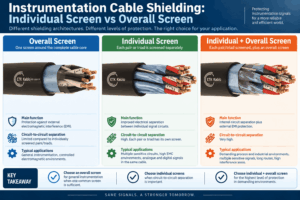
Instrumentation Cable Shielding: Individual Screen vs Overall Screen
Instrumentation cable shielding plays a critical role in protecting low-level analogue and digital signals from electromagnetic interfe...
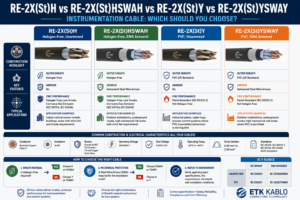
RE-2X(St)H vs RE-2X(St)HSWAH vs RE-2X(St)Y vs RE-2X(St)YSWAY: Which Should You Choose?
Choosing the right RE-2X(St) instrumentation cable is not simply a matter of comparing four similar product codes. RE-2X(St)H, RE-2X(St...
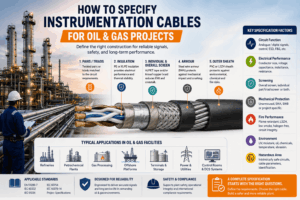
How to Specify Instrumentation Cables for Oil & Gas Projects
Selecting oil and gas instrumentation cables requires much more than choosing a conductor size and adding a screen. Refineries, petroch...
What Are Instrumentation Cables? Types, Uses & Selection Guide
Instrumentation cable types carry low-level analogue and digital signals between field instruments, control systems and monitoring equi...


