





 President’s Message
CCTV Cables
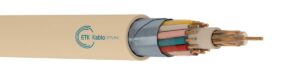
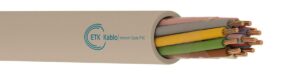
CCTV Cable for Video Surveillance and Security Systems
CCTV Cable provides signal connectivity for closed-circuit television, surveillance and building-security systems. ETK Kablo manufactures a composite CCTV cable with one 75-ohm coaxial video element and additional signal conductors, together with a dedicated multi-core intercom cable for doorphone and communication systems.
The ETK Kablo CCTV range includes the CCTV (1 Coax) construction and Intercom Cable (DT). The CCTV cable combines coaxial video transmission with additional low-voltage signal conductors inside one overall cable, while the intercom product provides multi-core copper connectivity for door-entry, audio and communication circuits.
Selecting the correct surveillance cable depends on the camera technology and system architecture. Traditional analogue and compatible HD-over-coax systems can use 75-ohm coaxial transmission, while IP cameras normally use Category-rated Ethernet cable such as Cat 5e or Cat 6. Power, control and communication requirements should therefore be specified separately rather than treating every security-camera system as electrically identical.
What Is a CCTV Cable?
A CCTV cable connects surveillance equipment within a closed-circuit television system.
Depending on the system architecture, the cable can carry:
- Analogue video signals
- Compatible HD-over-coax video signals
- Low-voltage auxiliary signals
- Control or communication circuits where the cable construction provides them
The exact conductor and screen architecture should match the camera, recorder, control equipment and installation environment.
ETK Kablo CCTV Cable Range
| Product | Main Construction | Primary Application Direction |
|---|---|---|
| CCTV (1 Coax) | One 75-ohm coaxial element plus additional signal conductors | Video-surveillance installations requiring coaxial video and auxiliary signal conductors |
| Intercom Cable (DT) | Multi-core flexible copper cable | Intercom, doorphone and building communication systems |
The product range focuses on practical surveillance and building-communication connectivity.
CCTV (1 Coax) Composite Cable
CCTV (1 Coax) combines one coaxial video-transmission element with additional low-voltage signal conductors within the same overall cable construction.
The ETK Kablo coaxial element uses:
- 7 x 0.20 mm stranded copper center conductor
- Solid polyethylene dielectric
- Electrolytic copper braid
The coaxial electrical data includes a characteristic impedance of 75 ± 3 ohms, mutual capacitance of 54 ± 2 pF/m and propagation velocity of approximately 0.82.
The additional signal conductors use 0.22 mm² stranded copper in the available configurations.
Why 75 Ohm Coaxial Cable Is Used for CCTV
Many analogue and compatible video-surveillance systems use a nominal 75-ohm transmission path.
Matching the characteristic impedance of the cable and connected equipment helps control signal reflections and maintain video quality.
The ETK Kablo CCTV (1 Coax) product has a characteristic impedance of 75 ± 3 ohms for its coaxial element.
A 50-ohm RF cable should not automatically replace a specified 75-ohm CCTV cable simply because both products use coaxial construction.
Composite CCTV Cable
A composite CCTV cable places more than one circuit type inside one overall cable.
In ETK Kablo's CCTV (1 Coax) construction, the coaxial element carries the video signal while additional copper conductors provide separate low-voltage signal paths.
This architecture can reduce the number of individual cables required along a surveillance route and simplify installation where the connected equipment requires both video and auxiliary conductors.
The additional conductors should not automatically be treated as camera-power conductors without checking their cross-section and the electrical requirements of the camera system.
CCTV Coaxial Cable Construction
| Component | ETK CCTV (1 Coax) Construction |
|---|---|
| Center Conductor | 7 x 0.20 mm stranded copper |
| Coaxial Dielectric | Solid polyethylene |
| Coaxial Screen | Electrolytic copper braid |
| Characteristic Impedance | 75 ± 3 Ω |
| Additional Signal Conductors | 0.22 mm² stranded copper |
| Additional Signal Screen | Al/PET tape in applicable construction |
| Outer Jacket | PVC, halogen-free or polyethylene options according to construction |
Screening in CCTV Cable
Video-surveillance cables can operate near power circuits, lighting equipment, motors and other sources of electromagnetic interference.
The coaxial structure itself provides a concentric screened transmission path. ETK Kablo's CCTV (1 Coax) product uses an electrolytic copper braid around its coaxial element.
The additional signal section can also use an Al/PET screen in applicable variants.
Correct termination remains important. The performance of a screened cable depends on connectors, continuity of the screen and the complete installation design.
Copper Conductor CCTV Cable
ETK Kablo's CCTV (1 Coax) product uses copper conductors for both the coaxial and additional signal elements.
The coaxial center conductor uses a 7 x 0.20 mm stranded copper construction, while the auxiliary signal conductors use 0.22 mm² stranded copper.
Conductor construction affects resistance, flexibility and signal performance. Buyers should therefore compare exact conductor material and dimensions when evaluating CCTV cable quotations.
CCTV Cable with PVC, LSZH and PE Options
ETK Kablo CCTV (1 Coax) constructions include multiple material options according to the applicable variant.
Outer-jacket options include:
- UV-resistant PVC
- UV-resistant halogen-free material
- UV-resistant polyethylene
The additional signal conductors can also use different insulation material systems according to the exact construction.
Material selection should follow the installation environment and project fire requirements rather than assuming that one jacket type suits every CCTV project.
PVC CCTV Cable
PVC CCTV Cable can provide a practical construction for suitable indoor and protected installations where the project permits PVC materials.
PVC should not automatically be associated with one universal fire classification or environmental resistance level. The exact cable construction and project documentation should determine compliance.
LSZH CCTV Cable
LSZH CCTV Cable uses halogen-free materials where the project requires specific smoke and halogen characteristics.
Applicable ETK Kablo CCTV constructions include smoke-density, halogen-content, corrosive-gas and flame-retardancy test requirements.
LSZH does not mean fire resistant. A low-smoke halogen-free surveillance cable does not automatically maintain electrical continuity during prolonged fire exposure.
PE CCTV Cable for Outdoor Installations
Selected ETK Kablo CCTV constructions use a UV-resistant polyethylene outer jacket.
PE can provide an appropriate material direction for external surveillance routes where environmental exposure forms part of the cable specification.
However, outdoor suitability should always be confirmed from the exact product construction, route and installation method.
A PE jacket should also not be confused with mechanical armor.
Analogue CCTV Cable
Traditional analogue CCTV systems transmit video over a dedicated coaxial path between the camera and recording equipment.
A 75-ohm coaxial architecture remains relevant to these installations and to compatible surveillance technologies that continue to use coaxial video transmission.
System designers should verify camera technology, transmission format and maximum route length before selecting the cable.
HD-over-Coax CCTV Systems
Several modern surveillance technologies can transmit higher-resolution video while retaining a coaxial cabling architecture.
Where the equipment manufacturer specifies a compatible 75-ohm coaxial transmission path, cable attenuation and route length become important design parameters.
The exact camera and recorder specification should determine whether a particular CCTV cable is suitable for the required resolution and distance.
CCTV Cable vs RG Coaxial Cable
CCTV cable and general RG coaxial cable can overlap in video applications, but the product categories serve different procurement requirements.
| Characteristic | ETK CCTV Cable | ETK RG Coaxial Cable |
|---|---|---|
| Main Product Concept | Surveillance-specific composite construction | Standalone coaxial transmission cable |
| Video Element | One 75-ohm coaxial element | Depends on exact RG type |
| Additional Signal Conductors | Available in CCTV (1 Coax) | Not part of a standard standalone RG cable |
| Typical Procurement Logic | Camera / surveillance system requirements | RG designation, impedance and RF/video performance |
Where a project requires only a standalone coaxial video cable, ETK Kablo's Coaxial Cable portfolio provides multiple RG constructions. Where the route also requires additional signal conductors, the composite CCTV construction can provide a more integrated solution.
CCTV Cable vs Ethernet Cable for IP Cameras
Analogue CCTV and IP CCTV use different transmission architectures.
| System Type | Typical Cable Direction |
|---|---|
| Analogue / compatible coaxial CCTV | 75-ohm coaxial or composite CCTV cable |
| IP Camera Network | Cat 5e, Cat 6 or another suitable Ethernet category |
| Long-Distance IP Network | Ethernet infrastructure or fiber optic network according to design |
IP cameras should therefore not be connected with a conventional coaxial CCTV cable unless the system includes equipment specifically designed to convert between the technologies.
CCTV Cable vs Cat 6 Cable
Cat 6 cable is a four-pair balanced Ethernet cable designed for data networking, while a CCTV coaxial cable uses an unbalanced 75-ohm coaxial transmission path.
Cat 6 is relevant to IP surveillance networks, especially where cameras communicate through Ethernet switches and network video recorders.
Composite CCTV cable remains relevant where the surveillance equipment uses coaxial video and separate auxiliary circuits.
CCTV Cable and Power over Ethernet
Power over Ethernet belongs to IP-based surveillance networks rather than conventional coaxial CCTV architecture.
PoE allows compatible Ethernet cabling to carry both network data and electrical power to an IP camera.
A CCTV composite cable should not be treated as a PoE cable simply because it contains several copper conductors.
For PoE camera networks, ETK Kablo's Cat 5e, Cat 6 or higher-category Data/LAN cables should be evaluated according to the required Ethernet and PoE performance.
CCTV Cable for Commercial Buildings
Commercial properties can use surveillance systems throughout entrances, corridors, parking areas, technical rooms and external perimeters.
The correct cable depends on whether the project uses analogue cameras, HD-over-coax equipment or IP surveillance.
Indoor and outdoor sections can also require different jacket materials and installation methods.
CCTV Cable for Industrial Facilities
Factories and industrial sites can create challenging electromagnetic and mechanical environments for surveillance networks.
Camera routes can pass near motors, power cables, drives and other electrical equipment. Screen construction and cable routing therefore deserve particular attention.
Where the surveillance system uses Ethernet cameras, a suitable screened or industrial Data/LAN cable may be more appropriate than coaxial CCTV cable.
CCTV Cable for Transportation Infrastructure
Airports, railway stations, metro facilities and other transport environments often use extensive surveillance infrastructure.
The project can require different cable characteristics according to indoor or outdoor routes, smoke and halogen requirements and the selected camera technology.
LSZH material requirements should be evaluated separately from video-transmission technology and circuit-integrity requirements.
CCTV Cable for Outdoor Security Cameras
Outdoor surveillance routes expose cable to sunlight, temperature changes and environmental conditions that differ from indoor installation.
ETK Kablo offers UV-resistant PE, PVC and halogen-free jacket options within the CCTV (1 Coax) product family.
The exact cable should be selected according to the actual outdoor route rather than assuming that every CCTV cable is weather resistant.
CCTV Cable Electrical Characteristics
The ETK Kablo CCTV (1 Coax) product has the following key electrical data for its coaxial element:
| Parameter | Value |
|---|---|
| Characteristic Impedance | 75 ± 3 Ω |
| Mutual Capacitance | 54 ± 2 pF/m |
| Propagation Velocity | Approximately 0.82 |
| Operating Voltage | 300/500 V |
| Test Voltage | 1200 V |
Electrical requirements should still be verified against the exact product configuration and surveillance equipment.
CCTV Cable Temperature and Bending Radius
The ETK Kablo CCTV (1 Coax) product has an operating-temperature range of -30°C to +70°C.
The minimum bending radius is 15xD, where D represents the overall cable diameter.
Respecting the bending radius helps prevent excessive mechanical deformation of the coaxial geometry during installation.
Intercom Cable (DT)
Intercom Cable (DT) provides multi-core copper connectivity for intercom, doorphone and building communication applications.
The cable uses stranded copper conductors, polyester wrapping and PVC or halogen-free material options for building communication applications.
Available configurations include 4, 6, 8, 12, 16 and 20 conductors.
Conductor cross-sections include 0.14 mm² and 0.22 mm² options.
Intercom and Doorphone Cable
Intercom systems connect entrance panels, handsets, indoor stations and related building-communication equipment.
The exact number of conductors depends on the communication system and equipment architecture.
ETK Kablo's Intercom Cable range provides multi-core configurations up to 20 conductors.
System installers should determine conductor count and cross-section from the doorphone or intercom equipment specification.
PVC vs LSZH Intercom Cable
The ETK Kablo Intercom Cable is available with PVC and halogen-free insulation and outer-jacket options.
PVC can provide a conventional material solution where permitted by the project.
Halogen-free variants can suit buildings where low-smoke and halogen-related requirements form part of the specification.
The material system should not be confused with communication protocol or conductor count.
Intercom Cable Electrical Data
The Intercom Cable has a 300/500 V operating-voltage rating and a 1200 V test voltage.
The operating-temperature range is -30°C to +70°C, with a minimum bending radius of 10xD.
The exact conductor count, cross-section and material configuration should be specified during procurement.
CCTV Cable Fire and Smoke Requirements
Fire-related requirements belong to the exact cable construction rather than the generic term CCTV cable.
Applicable ETK Kablo CCTV and Intercom variants include test families such as:
- IEC 61034-2 for smoke density
- IEC 60754-1 for halogen content
- IEC 60754-2 for corrosive-gas characteristics
- IEC 60332-1-2 for flame retardancy
These tests should be applied according to the exact material variant and technical documentation.
LSZH CCTV Cable Is Not Fire Resistant Cable
Low-smoke halogen-free construction addresses smoke and halogen characteristics during combustion.
It does not automatically mean that video, control or communication circuits remain operational during a fire.
Where the project requires defined fire-resistant circuit integrity, a separately tested fire-resistant cable construction should be specified.
How to Specify a CCTV Cable
A complete CCTV cable RFQ should identify the surveillance technology and cable requirements clearly.
| Specification Item | Information to Provide |
|---|---|
| System Type | Analogue, HD-over-coax, IP CCTV or intercom |
| Cable Type | CCTV (1 Coax), Intercom Cable or required equivalent |
| Video Transmission | 75-ohm coaxial where applicable |
| Additional Conductors | Required conductor count and cross-section |
| Jacket Material | PVC, halogen-free or PE according to construction |
| Installation Environment | Indoor, outdoor, commercial, industrial or infrastructure route |
| Fire Requirement | Required smoke, halogen, flame and CPR characteristics where applicable |
| Route Length | Required camera or communication cable length |
| Packing | Required coil or drum length |
| Documentation | Datasheet, test documentation and required project certificates |
Why Choose ETK Kablo for CCTV Cable?
ETK Kablo manufactures surveillance-oriented cable constructions for coaxial video and building communication applications.
The CCTV (1 Coax) product combines a 75-ohm copper coaxial element with additional signal conductors, allowing multiple low-voltage functions to share one overall cable construction.
The Intercom Cable range adds multi-core connectivity for doorphone and communication systems with several conductor counts and material options.
ETK Kablo can evaluate video technology, conductor configuration, jacket material, installation environment and project documentation together during the quotation process.
Frequently Asked Questions About CCTV Cable
What is CCTV cable?
CCTV cable is used to connect equipment within video-surveillance systems. The exact construction depends on whether the system uses coaxial video, IP Ethernet or another transmission architecture.
What impedance is CCTV coaxial cable?
Many analogue and compatible CCTV systems use 75-ohm coaxial transmission. The ETK Kablo CCTV (1 Coax) product has a characteristic impedance of 75 ± 3 ohms.
What is CCTV (1 Coax) cable?
ETK Kablo CCTV (1 Coax) combines one coaxial video element with additional 0.22 mm² signal conductors within one overall cable construction.
Can CCTV cable carry power?
Some surveillance cable designs combine video and power conductors, but the additional 0.22 mm² conductors in the ETK Kablo CCTV (1 Coax) product should not automatically be specified as camera-power conductors without checking the required current and voltage drop.
Is CCTV cable the same as RG59?
No. RG59 is a specific coaxial cable family. CCTV cable is a broader application term and can include standalone RG coax, composite cable or Ethernet cable depending on the surveillance system.
What cable should be used for IP cameras?
IP cameras normally use suitable Ethernet cable such as Cat 5e or Cat 6 according to the network and PoE requirements.
Can Cat 6 replace CCTV coaxial cable?
Not directly in a conventional coaxial surveillance system. Cat 6 uses balanced Ethernet transmission, while analogue CCTV coax uses a 75-ohm coaxial architecture. The camera and recording equipment determine the required cable.
What is intercom cable?
Intercom cable is a multi-core low-voltage cable used to connect doorphones, entrance panels, indoor stations and related building-communication equipment.
How many conductors are available in ETK Kablo Intercom Cable?
The ETK Kablo Intercom Cable range includes 4, 6, 8, 12, 16 and 20-conductor constructions.
Is LSZH CCTV cable fire resistant?
No. LSZH describes smoke and halogen characteristics of cable materials. Defined circuit integrity requires a separate fire-resistant cable construction.
Can CCTV cable be installed outdoors?
Yes, when the exact cable construction is suitable for the external environment. ETK Kablo offers UV-resistant material options within the CCTV product family.
What information should I provide when requesting a quotation?
Provide the surveillance technology, required cable type, coaxial impedance where applicable, signal-conductor count and cross-section, jacket material, indoor or outdoor route, quantity, packing length and required project documentation.


